
Tulisan ini belum tersedia dalam Bahasa Indonesia. Anda sedang membaca versi aslinya dalam bahasa Inggris.
Dead Man's Switch Claim in #KawalIbam: A Logic Audit of Ibrahim Arief's "State Secrets" Threat
One sentence from the #KawalIbam episode, "I will spread anything, even if it is a state secret", read as an argument and not as a personality. Why the threat fails on its own terms, what it would take to answer a critic properly, and the limits of this reading. An analysis of rhetoric, not a verdict.
RAHMAT WIBOWO | 23 OCTOBER 2026
The claim in one sentence
Between September and November 2023, Ibrahim Arief ("Ibam"), then a technology executive at a state-owned edtech subsidiary and later a defendant in the Chromebook procurement corruption case, ran a public self-defence campaign under the hashtag #KawalIbam. In my longer audit of that campaign I label one piece of it Exhibit G. The claim is short:
"I will spread anything, even if it is a state secret." (translated from the Indonesian original)
Online, this kind of statement is often called a "dead man's switch": a threat that if something happens to me, or if the criticism keeps coming, a trove of damaging material gets released automatically. This post does not ask whether such material exists. It asks a narrower question: does the threat work as an argument?
I am not a neutral party. I am the private individual who was the subject of several of the statements in the campaign, and I say so up front. Everything below is a reading of rhetoric, and the presumption of innocence applies to everyone named.
Fallacy 1: an appeal to fear in place of an argument
The first problem is the type of move. A critic raises a concern. The reply does not answer the concern. It announces a consequence: if the criticism continues, something will be leaked.
In logic this is an appeal to fear, or argumentum ad baculum: replacing a rebuttal with a threat of harm. A threat changes how risky it is to speak. It does not change whether what was said is true. Whether the original criticism was fair stays exactly as open as it was before the threat was made.
The same pattern appears in Exhibit D of the campaign, where a critic is warned that invoking the law "can backfire". In my recap of the fallacy types, Exhibits D and G are both filed under the same heading: replacing a rebuttal with a threat.
Fallacy 2: a claim that defeats itself
The second problem is more interesting, because it is internal to the sentence.
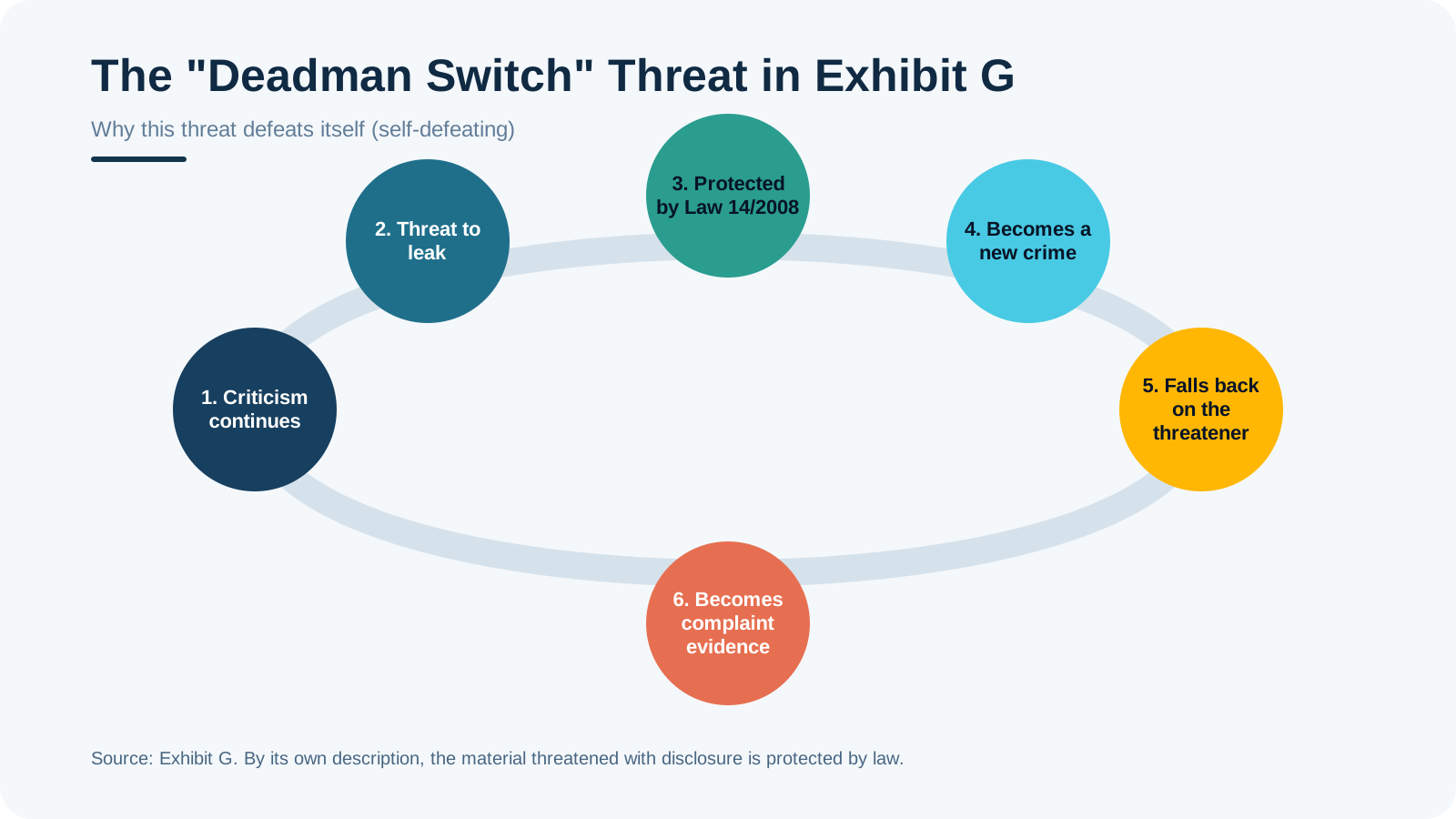
By Ibam's own description, the material that would be leaked is a state secret. In the source report, that is information protected by law (Law No. 14 of 2008, the public information disclosure law, which carves out exceptions for information that could endanger state interests). Follow the chain the threat itself sets up:
- The criticism continues.
- A threat is made to leak.
- The material is, by its own description, protected by law.
- Leaking it would itself be a new offence.
- The consequence falls back on the person making the threat.
- The threat becomes evidence in a complaint.
The figure below shows the loop. The point is not a prediction about any court. It is that the threat rests on an asset (secret material) whose release would harm the threatener's own position. A deterrent that costs the person using it more than it costs the target is not a strong deterrent. It is a self-defeating claim.
What the threat harms: a third party
There is a third issue, and the source report puts it plainly. The threat proposes to raise the cost to a third party, the state, if personal criticism does not stop. The source's reading is that this is coercion and not a defence of the conduct being questioned.
A defence says: "here is why what I did was proper." Coercion says: "stop, or someone else pays." Only the first speaks to the criticism.
The counter-campaign material that the report reviews made essentially the same point in one line: "If the goal is justice, show the facts, not drama." I quote it as the counter-poster's words, not as a finding of my own. The report also cautions that dramatised posters on both sides are commentary and not evidence, and that any formal filing should rest on the underlying exhibits instead.
What a valid response looks like
The source report's section on valid defences gives a constructive alternative. If the aim is to answer critics, the logically sound move is to open the facts that are already permitted to be opened: public court documents, the relevant chronology, and public evidence. The report notes that the counter-material itself lists these items in a short checklist. In its words, that is better than a "deadman switch" gesture toward material that, by its own description, is protected by law.
Put simply:
- Answer the claim, not the messenger. A threat addresses the risk of speaking, not the truth of what was said.
- Use what is open. Court documents and public evidence need no leak and carry no new legal exposure.
- Apply the rule symmetrically. Material cannot be too dangerous to release and also the basis of a threat that depends on releasing it.
None of this requires knowing what any hypothetical leak contains.
Why it is part of a pattern, not a one-off
In the full audit, Exhibits D and G are read together with a recognised rhetorical pattern known as DARVO (Deny, Attack, Reverse Victim and Offender): deny wrongdoing, attack the critic with legal threats, and reframe the person facing legal process as the one wronged. The report is explicit that DARVO is a documented rhetorical and psychological pattern, not a classical syllogistic fallacy, and that describing the pattern is not an accusation about anyone's inner intent.
There is also an irony the report records, as a factual note and not as a claim that someone deserved it: a threat meant to silence documentation ended up being documentation. The report treats the Chromebook case as separate and unrelated to the dispute between Ibam and me, and says that case is not caused by any of the fallacies discussed.
Read the full analysis
This post is one exhibit out of many. For the whole pattern, see the complete audit, Kawal Ibam: Anatomy of a Self-Defense Campaign, a Fallacy Audit of Ibrahim Arief. For the companion exhibit about a private "never-hire" list, see Never-Hire List: Logical Flaws in Ibrahim Arief's Claim.
Limits and right of reply
- This is an independent analysis of rhetoric and a personal opinion. It is not a court ruling, an official document, or legal advice.
- The presumption of innocence applies in full. Allegations connected to my personal dispute with Ibrahim Arief are allegations that have been raised, not decisions that have been made. The Chromebook case is a separate matter, was widely reported, and may still change if further legal remedies are pursued.
- The view is one-sided by construction: it is written by a party to the dispute. Quotes from the other side are reproduced as they appeared, but the assessment of fallacies is mine.
- Right of reply applies to anyone named. Readers with a direct stake should rely on official court and agency documents, not on this post.