
Tulisan ini belum tersedia dalam Bahasa Indonesia. Anda sedang membaca versi aslinya dalam bahasa Inggris.
Logic Flaws Behind a Promise of Secrecy: Ibrahim Arief's Vindica.ai (Vindica AI) and Perkara AI (Perkara.ai)
A review of Vindica.ai (also written Vindica AI) and Perkara AI (perkara.ai), the legal AI product described by e27 as founded by Ibrahim Arief. Eighteen attack factors, the evidence status of each, and the path to fixing them. A draft for right of reply, based on public evidence only, with no active testing and with disclosure of the author's own position.
RAHMAT WIBOWO, CEO INFRALOKA | 21 OCTOBER 2026 | VERSION 1.0 (DRAFT FOR RIGHT OF REPLY)
Executive Summary
Short answer
Vindica.ai (Vindica AI), the legal AI product of founder Ibrahim Arief as reported by e27, which now redirects to perkara.ai under the name Perkara AI, answers a real problem: defence counsel drown in files and deadlines. But its central promise, that case secrets stay secret, does not yet match the attack surface visible from outside. The panel found eighteen attack factors, ten of them high risk, and gave a composite score of 4.2 out of 10: a conditional pass with major corrections. Nearly all of it can be closed by decisions, not new technology: who may enter, where the data lives, and what evidence is opened to the public.
This paper does not judge anyone's character, intent, or private life. It checks claims and design against material that can be opened, presents what is strong first, and then shows the flaws together with the way to fix them.
- 18: attack factors: 8 from the author's observations, 10 from follow-up checks
- 10: high risk; 8 medium risk
- 4.2: panel score out of 10: conditional pass, major corrections
Decisions requested
| Decision | Owner | Horizon |
|---|---|---|
| Close open access: invitation plus verification of lawyer status | Founder | 30 days |
| Publish the storage region, sub-processors, and who holds the keys | Founder and engineering | 30 days |
| Move the Perkara AI trademark to the contracting legal entity, or license it in writing | Founder and legal counsel | 30 days |
| Add a versioned norm corpus; set a Chinese wall for public prosecutors | Product and legal counsel | 90 days |
| Separate the Indonesian norm corpus from the US case-law corpus, and label the legal system on every analysis | Product | 90 days |
| Clarify the Indonesian legal entity, PSE registration, and tax obligations | Legal counsel | 90 days |
| Client-held encryption keys and a physical-server option for classified cases | Engineering | 180 days |
Disclosure and Limits
The author leads a technology company that could be seen as similar, so the viewpoint is not neutral. Readers should weigh this paper critically.
Only public material was read: the e27 article, the perkara.ai pages, app screenshots, and technology-scanner screenshots. There was no active testing and no access to any system for this paper. What is called a flaw is a design and governance flaw, not proof that anyone has attacked.
This is not legal advice, not a verdict, and the presumption of innocence applies to everyone mentioned. This paper is a draft for right of reply: the founder and the team are invited to rebut with evidence. App screenshots are cropped so workspace names do not appear, and rights in the product's appearance remain with its owners.
Material and How to Read It
| Status | Meaning |
|---|---|
| Observed | Visible on public material or in a screenshot received |
| Reported | Comes from an article or another party's statement; its truth depends on that source |
| Inference | The author's logical conclusion from what was observed; it may be wrong |
| Not stated | Not found in public material; not the same as absent |
Three methodological notes. First, the e27 article is paywalled, so only the open portion was read. Second, the technology scanner detects from the client side, so its results are clues and not an audit. Third, some articles were read only through summaries; the source register records the status of every reference, and official texts should be checked before quoting in an official forum.
What Was Built and What Is Strong
Vindica.ai redirects (HTTP 302) to perkara.ai, so the two are one product. The product's founder, according to the e27 article cited in the references, is Ibrahim Arief; this paper reviews the product's design and public claims, not the person. According to e27, the product sells AI-powered fact-finding to defence teams during trials: a swarm of AI models that check each other, an auditor agent that matches answers to source pages, and a legal knowledge graph that maps facts, parties, and money flows. Marketing material shows AI recognising speakers from voice prints and guessing document types; users only check and correct.
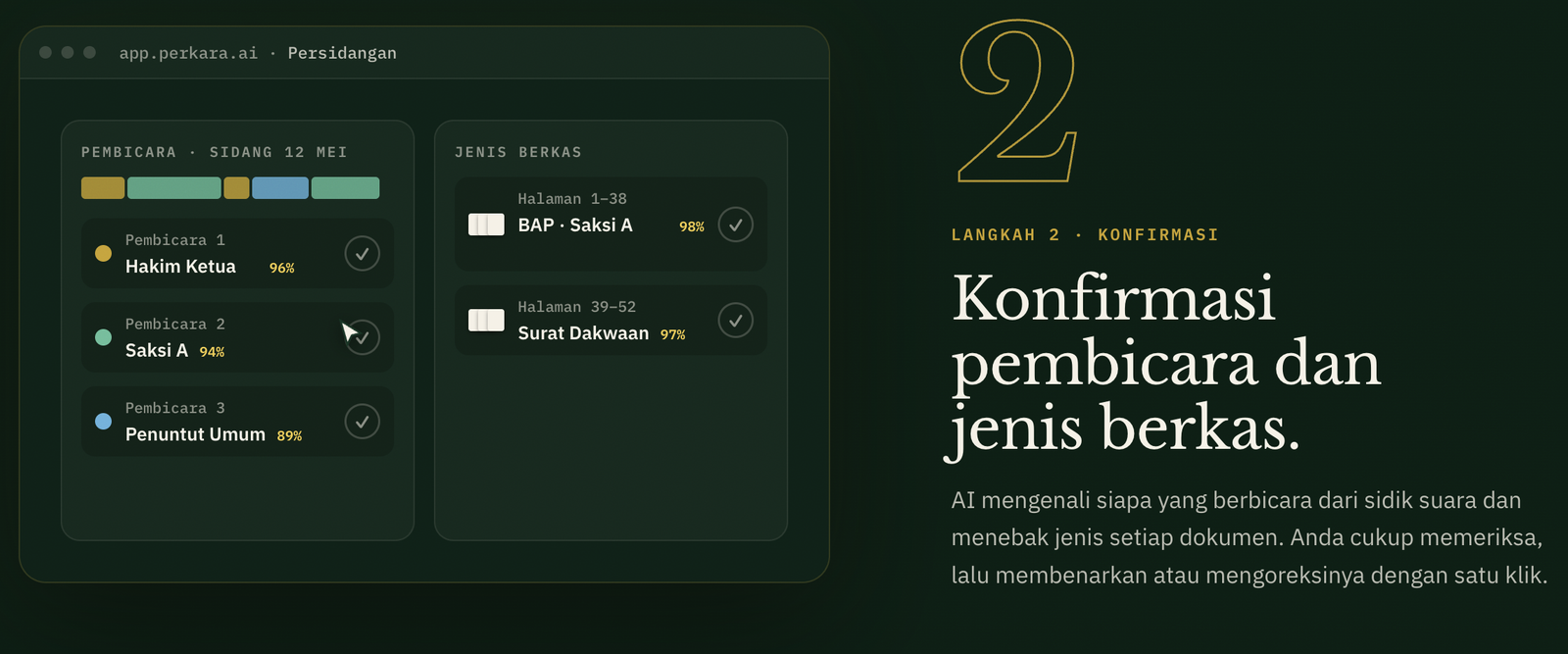
Figure 1. Company marketing material, "Step 2: Confirm speakers and file types". The address bar shows app.perkara.ai. Source: screenshot received by the author.
The security promise is stated plainly on the Security page: one case one space, clear roles (administrator uploads, member reads and asks), AES-256-GCM encryption with a unique key per document, data not sent to third-party AI services that train on it, an audit trail, and storage in Indonesia.
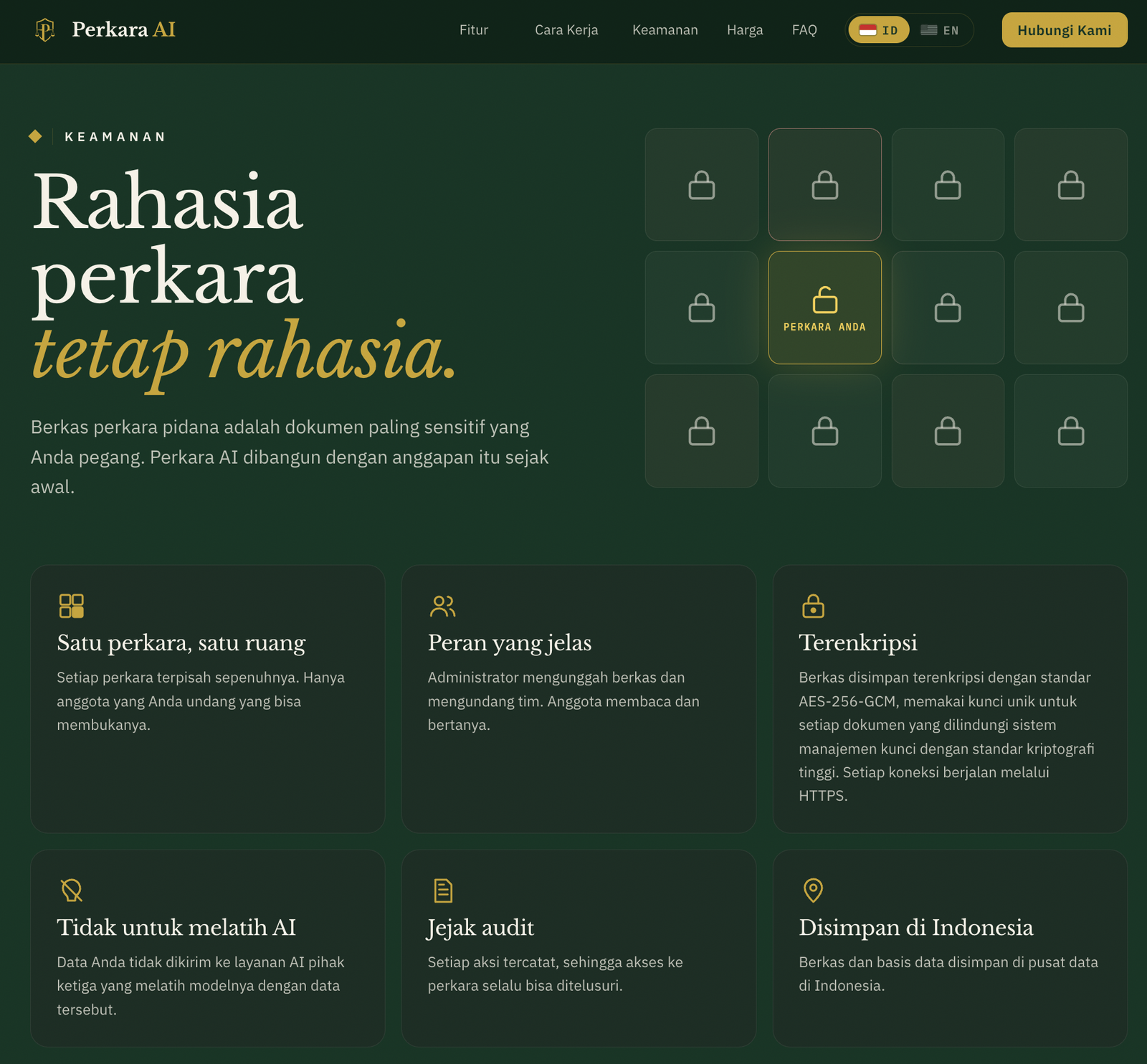
Figure 2. The perkara.ai Security page: six promises. Source: screenshot received by the author.
What is strong and worth emulating. The problem is real. The basic design is sound. The founder is open with the media about the structure, and that openness is what makes examination possible. Most findings below are not about intent but about public evidence for promises already made.
Map of Eighteen Attack Factors
An attack factor is a design or governance flaw that can be exploited, or that undermines the product's promise. AF-01 to AF-05 come from the author's first observations; AF-06 to AF-15 from follow-up checks; AF-16 to AF-18 were added later on the author's observations.
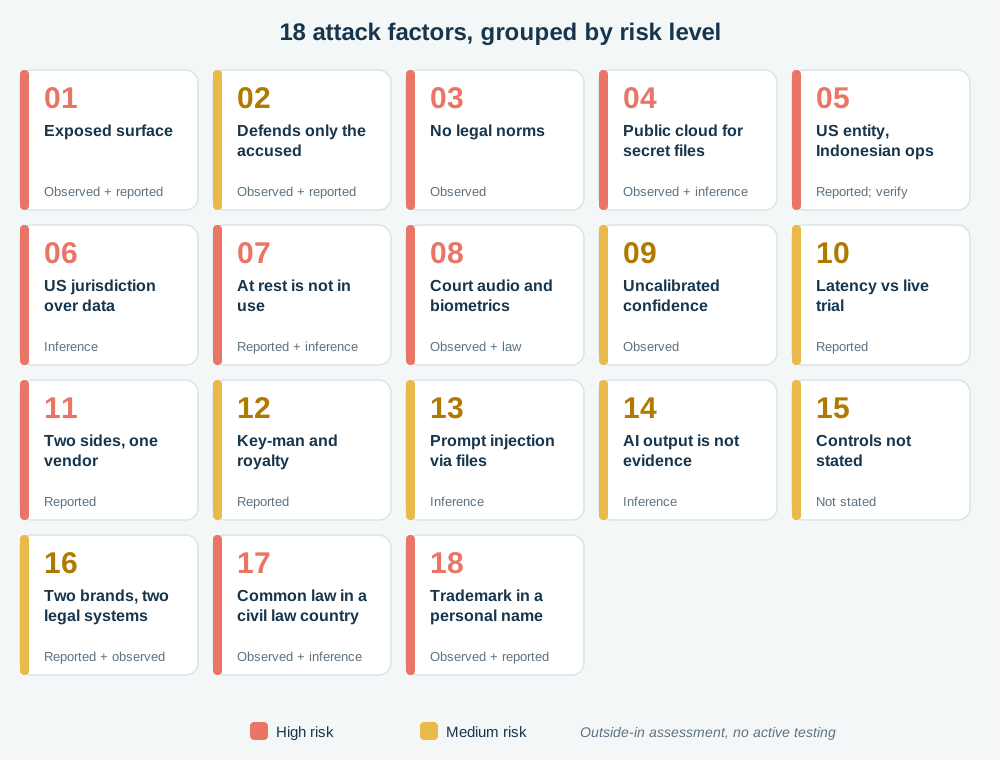
Figure 3. Eighteen attack factors by risk level and evidence status. Outside-in assessment without active testing.
Five Factors from the Initial Observations
AF-01. Exposed surface: the app address is visible and the access gate is immature
Finding. Observed: app.perkara.ai is written on the screenshot of the company's marketing material (Figure 1). Observed: the technology scanner detects React, Firebase, and Cloudflare on the app subdomain, and Google Cloud behind Cloudflare on api.perkara.ai. Reported by the author: functions are limited, but people with no business there can try them while there is no payment system.
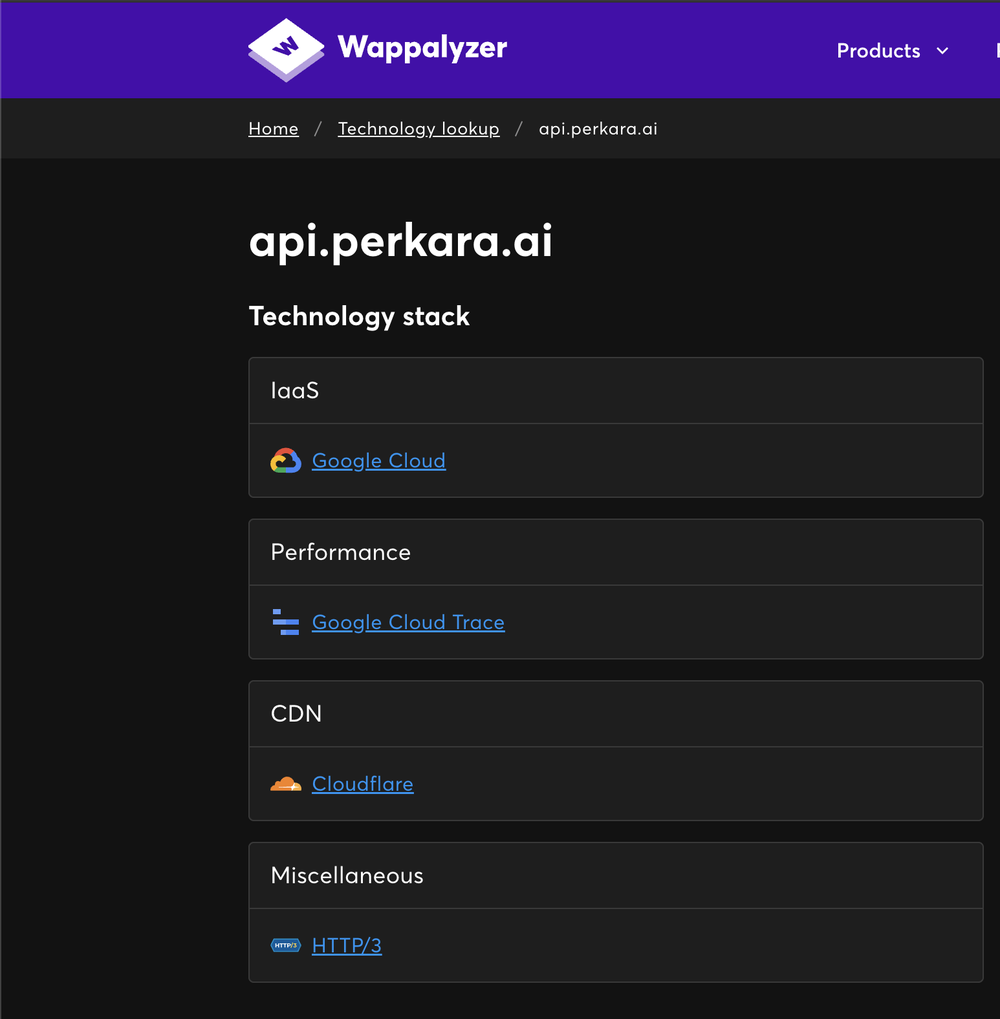
Figure 4. Technology scan for api.perkara.ai: Google Cloud, Google Cloud Trace, Cloudflare, HTTP/3.
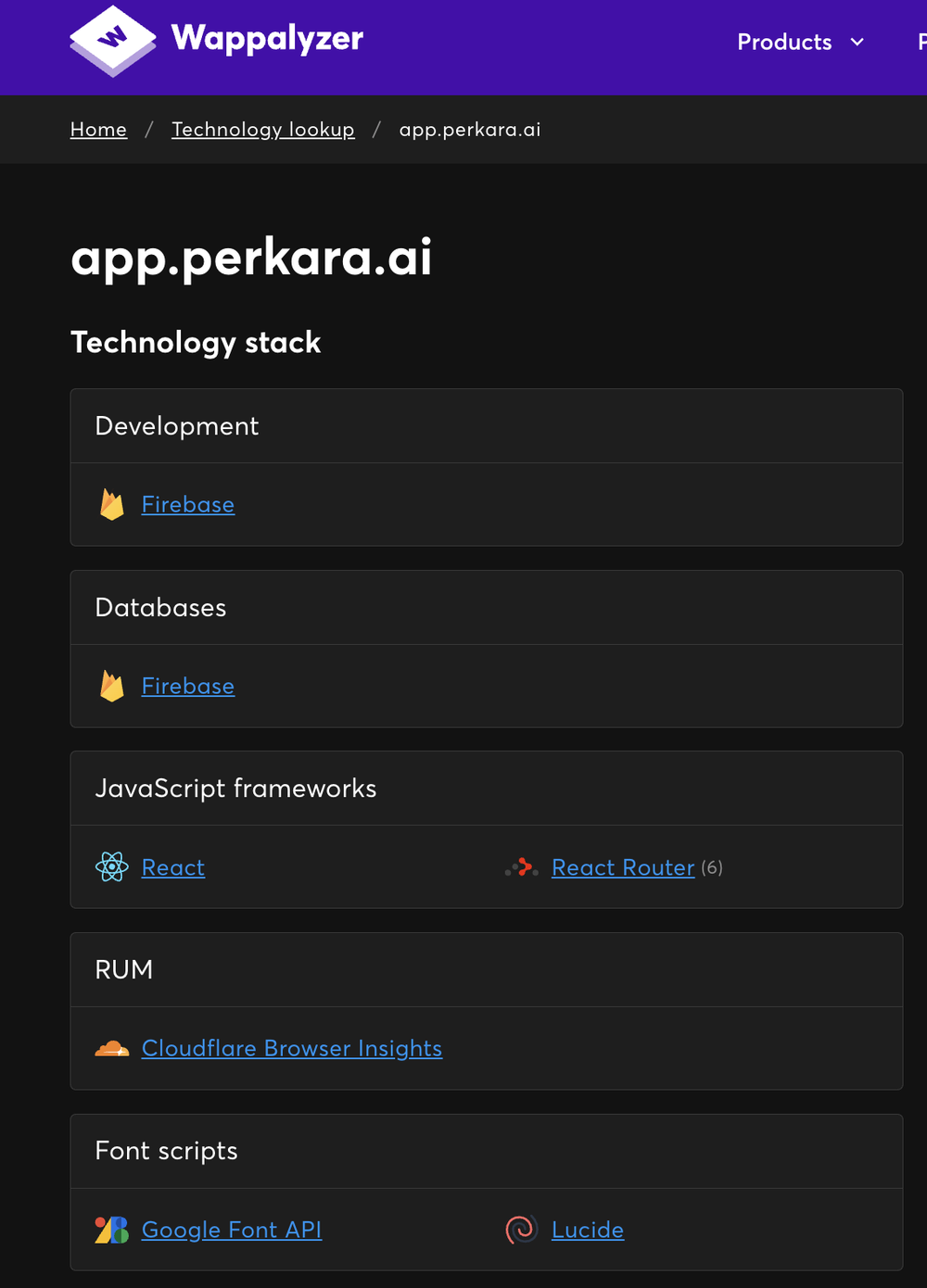
Figure 5. Technology scan for app.perkara.ai: Firebase, React, React Router, Cloudflare Browser Insights.
Why it matters. Every visible door is attack surface, the total of all points an attacker can touch. Payment is not only about revenue; it is also the first filter of identity, card, and binding contract. Without that filter, open signup invites throwaway accounts, probing, and the cost of model calls.
Fix. Invitation-based access, verification that the user is a lawyer, per-account rate limits, and a limited-beta label on public material. No access testing was done for this paper.
AF-02. Taking the defence's side is legitimate; what is lopsided is who is absent
Finding. Reported: the main market is defence teams; the public prosecutor is to receive the same tool free. Observed: the file types and menu serve the trial stage (indictment to verdict), that is the terdakwa (defendant), while the page title reads "for the best legal defence". Victims are not mentioned in the article or the menu.
Why it matters. The right to a defence is a foundation of fair justice; a tool for defence is not a flaw. Two things need fixing. First, precision of terms: a tersangka is a suspect at the investigation stage and a terdakwa is a defendant at trial, and marketing claims should use the right word. Second, asymmetry: equality of arms, parity of means between prosecution and defence, does not automatically represent victims, who need their own channel so the product does not look lopsided.
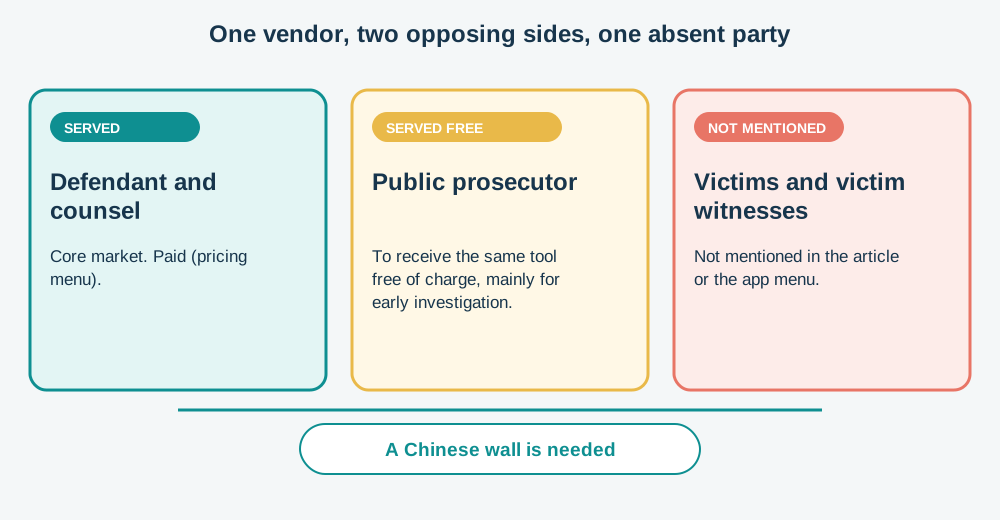
Figure 6. Who the product serves: defence paying, prosecutor free, victims not mentioned.
Fix. Clarify the position as a tool for the defence of the terdakwa, use the right stage terms, and consider partnering with victim-support organisations so the ethical narrative is complete.
AF-03. Legal norms: the files hold facts, and the norms that test them have no place
Finding. Observed: the Type filter offers twelve choices: not yet tagged, witness BAP, expert BAP, suspect BAP, witness list, evidence list, indictment, prosecution demand, defence plea, reply, rejoinder, and verdict. (BAP is berita acara pemeriksaan, the official examination record.) No type for statutes, regulations, or case law is visible.
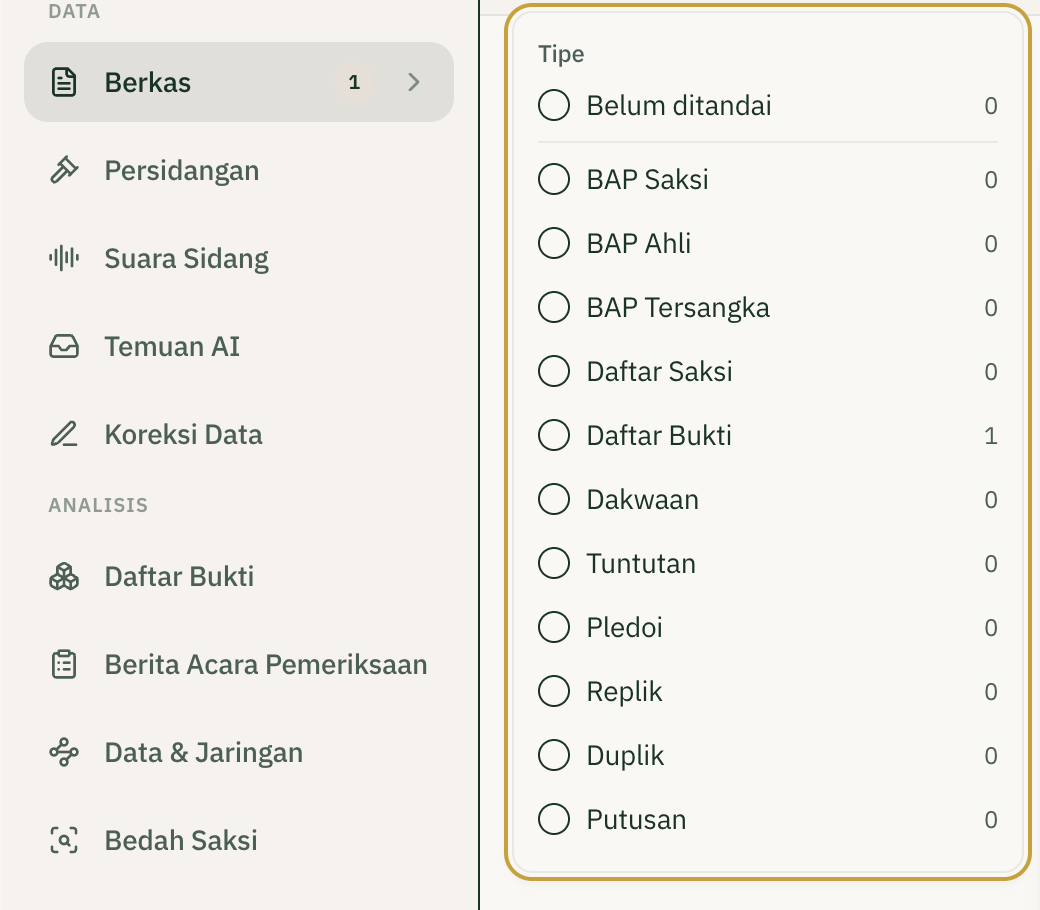
Figure 7. Side menu and file Type filter in the app (workspace name cropped).
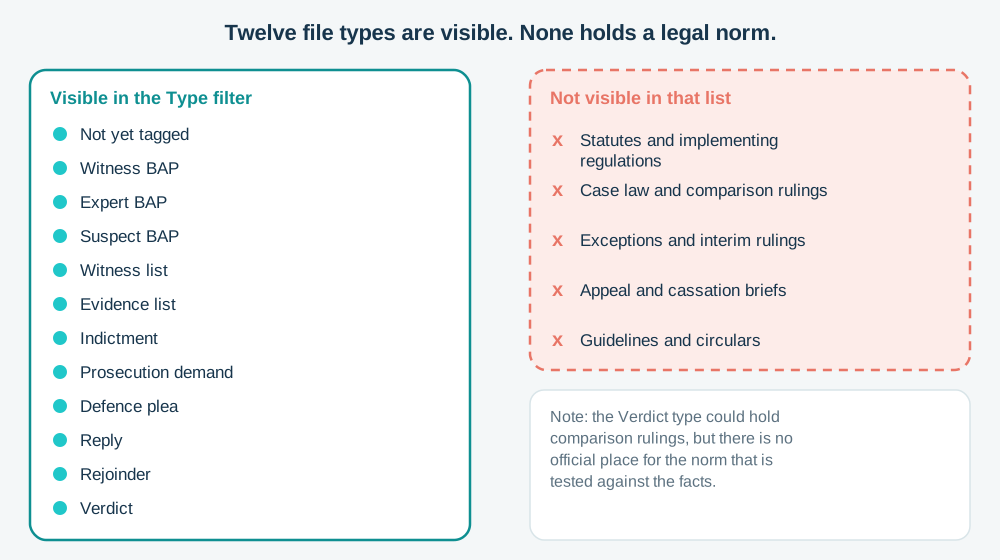
Figure 8. The twelve visible types, and the kinds of file not visible in that list.
Why it matters. The core of defence is testing facts against the elements of an article. Without norms inside the system, AI only summarises facts and cannot tell counsel that an element is not proven. The reason is stronger since 2 January 2026, when the new KUHP and KUHAP took effect (Law 20/2025 for KUHAP) and courts began using the new procedure; older cases follow transitional rules, including the principle that a provision more favourable to the defendant may apply. A tool that quietly uses the wrong norm version moves malpractice risk into software.
What defence counsel look for is not only an article's wording but provisions and principles that weaken the demand or mitigate for the defendant. Common ones: lex favor reo (Article 3 of Law 1/2023: if the rule changes after the act, the older rule applies when it favours the offender), in dubio pro reo (doubt favours the defendant), excuse and justification grounds, and judicial pardon, rechterlijk pardon (Article 54(2): the defendant is still found guilty, but the judge may impose no penalty because of the lightness of the act and the offender's circumstances). Without a versioned norm corpus inside the system, all of that searching happens outside the product. These articles were read through summaries; check the official text.
Fix. A versioned norm corpus (effective date, repeal date), links to primary sources, and a warning when the act and the trial fall under different legal regimes. A fair note: the Verdict type could hold comparison rulings, and counsel could upload a statute as another file, but that is not a deliberate design.
AF-04. Public cloud for files promised secret
Finding. Observed: the API runs on Google Cloud with Cloudflare in front; the app is detected using Firebase as development and database. Observed: the Security page promises AES-256-GCM encryption and storage in an Indonesian data centre. Not stated: the storage region chosen and who holds the keys. Methodological note: Firebase detection comes from the client side; it is a sign to check, not proof that Firebase is the only database.
Why it matters. The author's view is that case files promised secret should, for certain classes, sit on a physical server the company owns. That view needs calibrating with two facts. First, criminal files are usually not state secrets in the legal sense, but they hold specific personal data and information protected by lawyer confidentiality. Second, under Government Regulation 71/2019 private-scope electronic system operators may store data inside or outside Indonesia, while public-scope operators must manage and store data in Indonesia. So "must be on a physical server" is a risk-based proposal, not a legal duty for private businesses. The position changes if government bodies, including public prosecutors, become users. Google Cloud encrypts data at rest by default with Google-managed keys and offers customer-managed keys (CMEK); if the provider holds the keys, the provider can technically open the data.
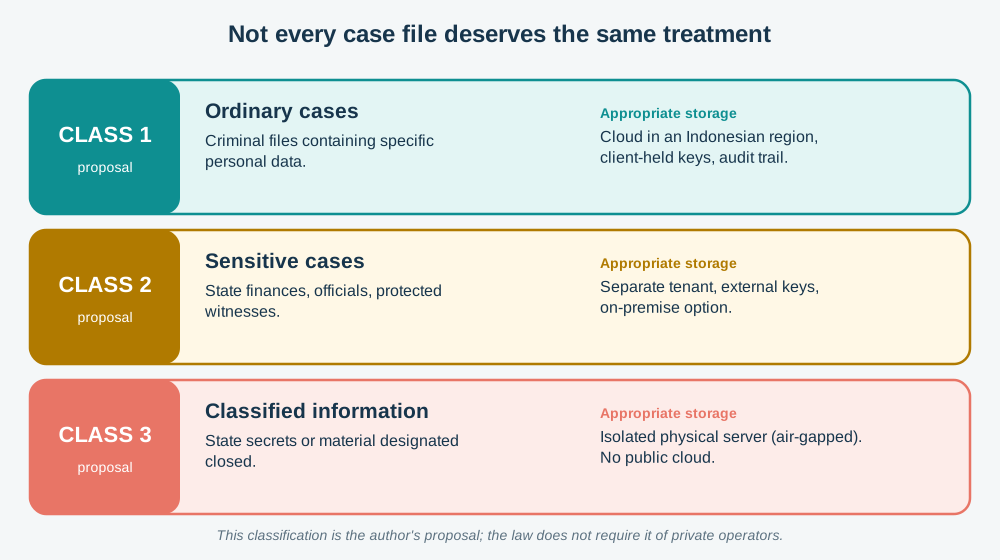
Figure 9. Proposed classification: ordinary, sensitive, and classified cases, with appropriate storage for each.
Fix. Publish regions and sub-processors, offer client-held keys (CMEK or external keys), provide a separate tenant for sensitive cases, and an isolated physical-server option for classified cases. The e27 article says an on-premise option already exists; that is the right step and worth highlighting.
AF-05. US legal entity, Indonesian operations, and the foreign-capital question
Finding. Reported: a US legal entity funded by a US-based angel investor; the founder holds no equity but grants an exclusive licence over his intellectual property and receives royalties on gross revenue. Not found in public sources: an Indonesian legal entity, a business identification number (NIB), or registration as an electronic system operator.
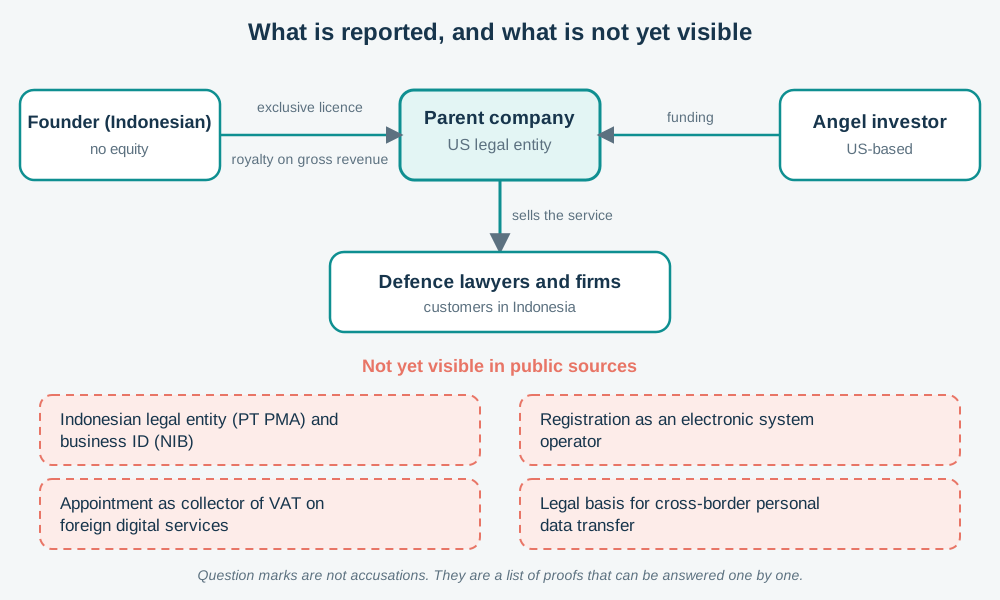
Figure 10. The reported structure, and four compliance elements not yet visible in public sources.
Why it matters. From public sources the author cannot conclude that foreign-capital rules were violated. What can be concluded: compliance cannot yet be proved. The questions regulators, auditors, and careful investors usually ask:
| Question | Basis | Reference status |
|---|---|---|
| Is there a business presence in Indonesia, through a PT PMA and an NIB? | Investment Law, business licensing through OSS | Partial |
| Are foreign private PSE registered? | Government Regulation 71/2019, Communications Ministry Regulation 5/2020 as amended by 10/2021 | Partial |
| Is VAT on digital services from abroad collected by an appointed collector? | Finance Ministry Regulation 48/2020 | Partial |
| What is the basis for transferring personal data abroad? | Law 27/2022 Article 56 | Partial |
| What is the tax treatment of cross-border royalties to the founder? | Income-tax rules and double-taxation treaties | Needs opinion |
Fix. Publish a summary of structure and compliance verified by legal counsel: the Indonesian entity (or why none is needed), the PSE registration number, the basis for data transfers, and the tax treatment. If these do not exist yet, they are a 90-day work list, not a cause for embarrassment.
Ten Factors from Follow-up Checks
AF-06. US jurisdiction over data stored in Indonesia
Finding (inference). The 2018 CLOUD Act requires US service providers to produce data in their possession wherever it is stored, with mechanisms for the provider to object. A parent company that is a US legal entity, Google Cloud, and Cloudflare are all within that reach. The commentary read is dated 2018; later developments need checking.
Why it matters. Lawyers must keep confidential everything known or obtained from their clients (Law 18/2003, Article 19). The physical location of a server does not alone decide which law applies to the data.
Fix. Client-held encryption keys, transparency reports on data requests, and contract clauses that name the objection mechanism.
AF-07. "Stored in Indonesia" answers data at rest, not data being read
Finding. Reported: data at rest is stored in Indonesia; model providers are zero-training. Not stated: where models process data, and downstream sub-processors. If traffic passes through a Cloudflare proxy (an inference from the CDN detection), transport encryption ends at its edge.
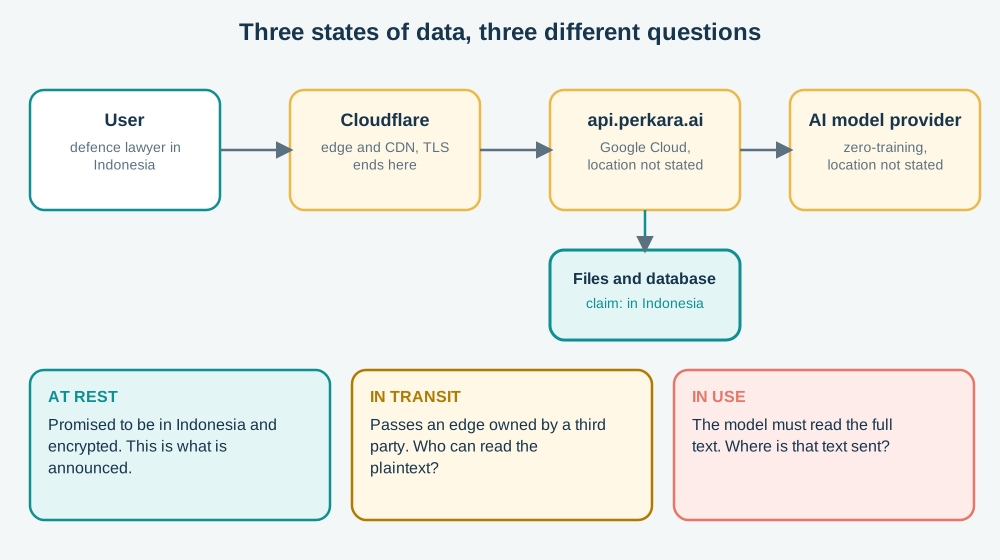
Figure 11. Three states of data: at rest, in transit, and in use, with the points not stated.
Why it matters. To analyse, a model must read the full text. Zero-training is about training, not about location or who can read.
Fix. A sub-processor list, inference regions, and a local or on-premise model option for high data classes.
AF-08. Court Audio: judicial permission and biometric data
Finding. Observed: a Court Audio menu; AI recognises speakers from voice prints. Under Supreme Court Regulation 5/2020 Article 4(6), photos, audio recordings, and audio-visual recordings in court need permission from the judge or presiding judge before the hearing begins, and documentation is prohibited in closed hearings. A voice print is biometric data, a category of specific personal data under the PDP Law (check the article text).
Why it matters. Judges, witnesses, and public prosecutors whose voices are processed have not consented to the vendor. The most attractive feature turns out to attach most heavily to the law.
Fix. Record the recording permission inside the product, block the feature for closed hearings, delete recordings and voice profiles on a clear schedule, and do not keep permanent voice profiles.
AF-09. Uncalibrated confidence scores
Finding. Observed: 96%, 94%, and 89% on speakers, 98% and 97% on file types (Figure 1). The lowest score falls on the public prosecutor.
Why it matters. A model's confidence is not necessarily its accuracy. Without calibration against ground truth, the correct answers set by humans, the numbers encourage automation bias: users simply click "correct". In a criminal case, attributing a statement to the wrong person is not a small error.
Fix. Test with labelled data, show measured error rates, and require manual review for scores below a threshold.
AF-10. "While the trial is running" collides with latency
Finding. Reported: deep queries take four to five minutes and a 30-page witness analysis about an hour.
Why it matters. A trial moves minute by minute; an hour is the gap between hearings. A between-hearings tool is very useful, but marketing must distinguish a courtroom assistant from a between-hearings analyst.
Fix. Clarify the product's position; measure and publish latency.
AF-11. Two opposing parties on one vendor
Finding. Reported: the defence pays, while the public prosecutor is to be given the tool free, mainly for early investigation.
Why it matters. Lawyers are bound by confidentiality. If one vendor serves both sides, the defence has a right to ask about the separating wall (a Chinese wall, strict separation of information between sides), its audit, and the conflict-of-interest policy. Free for the state should also be arranged openly: who decides, and what is the return.
Fix. Technical and organisational separation, independent audit of that separation, and a published written conflict-of-interest policy.
AF-12. Dependence on one person and the royalty structure
Finding. Reported: the founder holds no equity, a long-term exclusive licence, and a royalty on gross revenue. Per e27 the founder is in criminal proceedings. The presumption of innocence applies, and that status is not a basis to judge the product.
Why it matters. What is assessed is governance: key-man risk, operating capacity, and the fate of the licence, the code, and the customers if circumstances change. Investors will ask regardless of the founder's situation.
Fix. A succession plan, source-code escrow, an independent board, and clarity on intellectual-property rights.
AF-13. Prompt injection through files
Finding (inference). The system is reported to use multiple AI agents that read scanned files and documents from various parties.
Why it matters. Prompt injection hides instructions inside a document so an agent strays from its task. In a criminal case documents are drafted by interested parties, so the threat is realistic. This is a widely known risk framework, not a finding that this product is vulnerable.
Fix. Separate the agent that reads from the agent that acts, least privilege, mark untrusted text, and periodic testing with a simulated attacker team (red team).
AF-14. AI output is not evidence
Finding (inference). The AI Findings menu produces findings that are easily treated as fact.
Why it matters. In a courtroom, a machine finding is a working lead for counsel, not a witness, a document, or expert testimony; what is tested remains the original file. A wrong quote or swapped page that enters the defence plea damages counsel's credibility, and the chain of custody, the unbroken chain of possession of evidence, breaks when machine text replaces the original file.
Fix. Each finding links its source page, is labelled "working aid", and records the human who verified it.
AF-15. Security controls not stated
Finding. Not stated on the Security page: multi-factor authentication (MFA), single sign-on, certifications such as ISO 27001, independent penetration testing, and an incident notification procedure (the PDP Law governs notification of data-protection failures). The roles described are simple: administrator uploads, member reads.
Why it matters. One hijacked administrator account opens every case. Not stated does not mean absent, but customers entrusting files cannot tell the difference.
Fix. Mandatory MFA, a public summary of penetration-test results, a vulnerability-reporting channel, and a published incident procedure.
Three Factors Added from the Author's Observations
AF-16. Two brands for two legal systems, one door
Finding. Reported by the author: Vindica.ai is the US side (a US legal entity), perkara.ai is the Indonesian side. Observed: vindica.ai redirects (HTTP 302) to perkara.ai/?from=vindica, and e27 uses the name Vindica for a service at Indonesian trials. Two names imply two markets and two legal systems, yet it looks like one engine and one company.
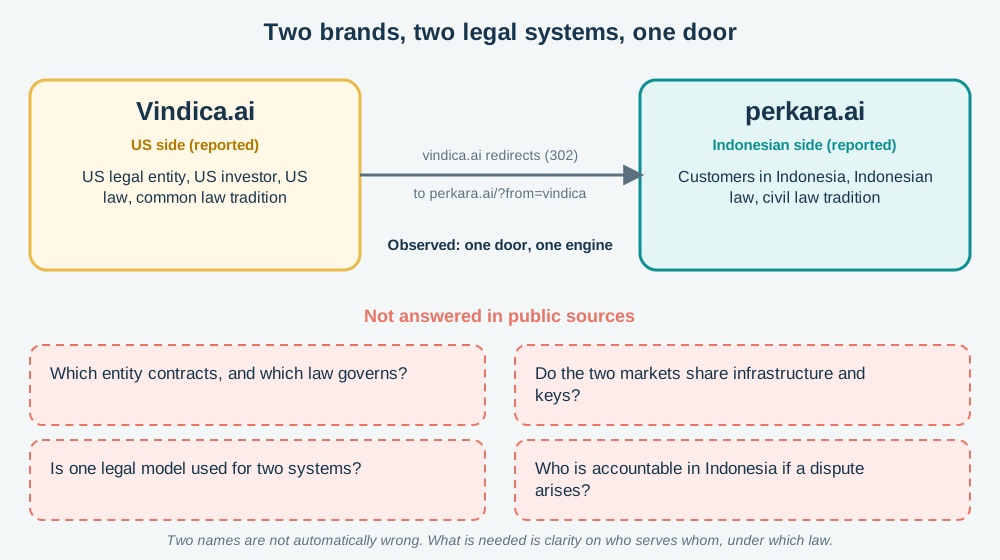
Figure 12. The two reported brands, the one observed door, and the questions not answered in public sources.
Why it matters. A brand per country is common practice and not automatically wrong. But here two markets mean two very different legal systems, so customers have a right to know the contracting party, the governing law, whether the data of both markets shares infrastructure and keys, and who is accountable in Indonesia if a dispute arises.
Fix. Explain publicly which entity serves each market, the law governing the contract, and the data separation between markets.
AF-17. A common law model in a civil law country
Finding. Observed: the app's file-type list holds only case documents; there is no norm corpus and no comparison-ruling corpus (Figures 7 and 8). Inference: a product built first for the common law tradition tends to centre on facts and rulings, while counsel in Indonesia work from norms. The American side of the product was not seen.
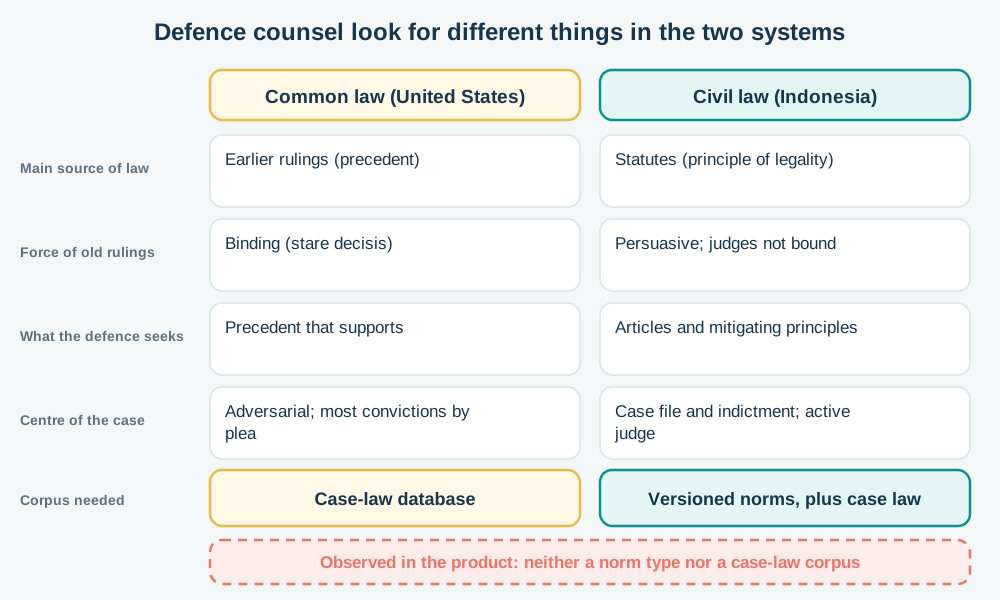
Figure 13. Counsel seek different things in the two systems: precedent in America, norms and mitigating principles in Indonesia.
Why it matters. In common law, rulings of higher courts bind (stare decisis), so precedent research is the core of defence work; about 90 to 98 percent of US federal convictions come from guilty pleas, and precedent research drives the bargaining. Indonesia follows civil law: statutes are the main source, case law is persuasive, and judges are not bound by earlier rulings (although the Supreme Court uses a chamber system and case law remains useful as argument). The two systems are not always black and white, but the basic direction differs. So the missing statutes in the file list are not a technical detail: they are the absence of the foundation of defence in the system where the product is marketed.
Fix. Two corpora by jurisdiction (versioned Indonesian norms, American rulings), and a legal-system label on every analysis so users know the rules the machine applies.
AF-18. A trademark in a personal name, not a company asset
Finding. Observed in the intellectual property database: the mark "Perkara AI" (number BRM26202A, application DID2026102684) was filed on 29 September 2026 and has the status Under Announcement; registration number and date are empty. The recorded owner is a natural person with the same name as the founder, not a PT. Reported: the founder holds no shares and receives royalties under an exclusive licence. The screenshot is cropped so the named panel does not appear.
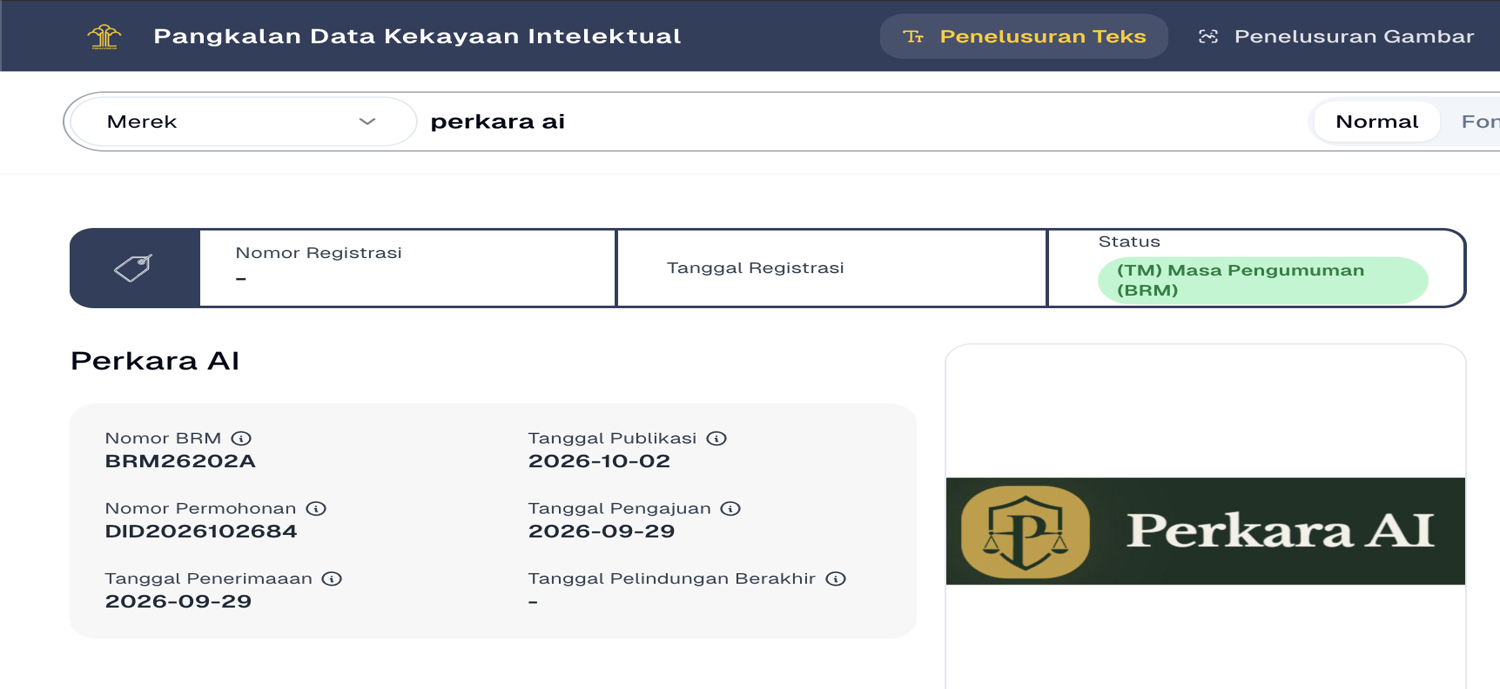
Figure 14. Intellectual Property Database: the Perkara AI mark, status Under Announcement. Source: screenshot received by the author, cropped.
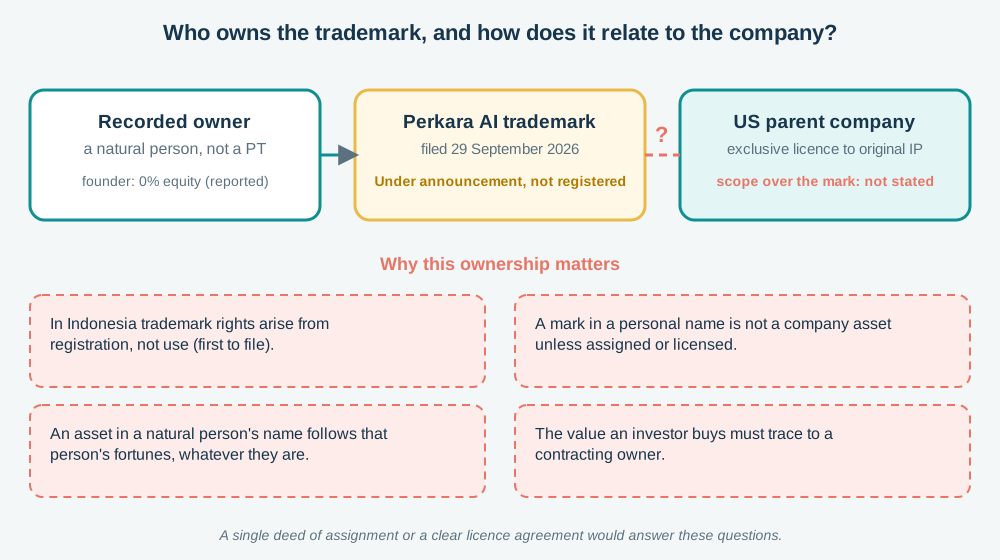
Figure 15. Recorded owner, mark, and parent company: the unstated relationship is marked with a question mark.
Why it matters. In Indonesia trademark rights arise from registration (first to file), not from use, and during the announcement period the right has not yet arisen. A mark in a personal name is not a company asset unless a deed of assignment or a licence agreement covers it; e27 mentions an exclusive licence over the founder's original intellectual property, but its scope over the mark is not stated. An asset in a natural person's name follows that person's fortunes, whatever their legal situation; this is the law of ownership, not an accusation. The value an investor buys must trace to a contracting owner. The Vindica mark in Indonesia and the US was not checked for this paper.
Fix. Assign the mark to the contracting legal entity, or license it in writing with a clear scope; run intellectual-property due diligence; and align the Vindica and Perkara registrations in America and Indonesia.
Review Panel
A four-role panel assessed the product from outside on public material. Weights: CTO 25%, CEO 30%, CRO 30%, hacker 15%. Scores below 5.0 come with a path to remediation.
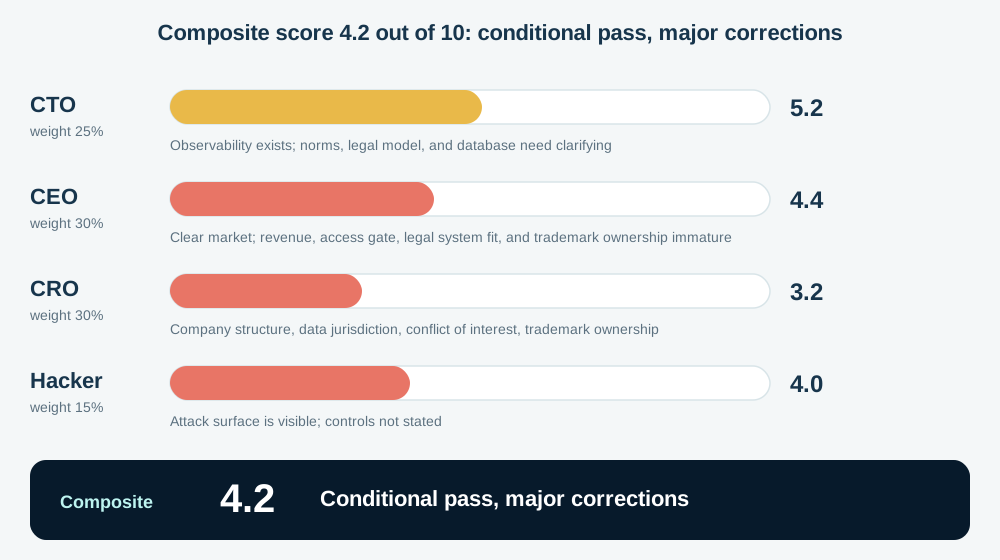
Figure 16. Panel scores and the composite of 4.2 out of 10: conditional pass, major corrections.
| Role | Score | Main reasons | Path to remediation |
|---|---|---|---|
| CTO | 5.2 | Observability exists (Cloud Trace); encryption is promised; norms, legal model, and the database role need clarifying | Separate norm and ruling corpora; data-architecture documentation |
| CEO | 4.4 | Clear market (defence teams); revenue model, access gate, legal-system fit, and trademark ownership immature; the free path for the state is not organised | Public pricing, invitation access, prosecutor policy, mark to the legal entity |
| CRO | 3.2 | Company structure, data jurisdiction, two-sided conflict, and trademark ownership unanswered publicly | Legal opinion on structure, Chinese wall, client-held keys, mark assignment |
| Hacker | 4.0 | Attack surface visible in marketing material; controls not stated | MFA, penetration test, rate limits, invitation access |
Composite: 0.25 x 5.2 + 0.30 x 4.4 + 0.30 x 3.2 + 0.15 x 4.0 = 4.18, rounded to 4.2. The score rises if the controls not stated turn out to exist and are opened. This is an outside-in assessment, not an audit and not a penetration-test result.
The Strongest Counter-Argument
This paper must test itself. First, the problem solved is real: defence counsel, especially small ones, face a state with far greater resources. Second, many design decisions are sound: one case one space, an audit trail, no-training model providers, and an on-premise option. Third, storage in Indonesia may well be true, because cloud providers offer region choice, and no rule requires private operators to use their own physical servers. Fourth, most of the flaws here may already be closed behind the scenes; what is missing is public evidence. That is why the score has room to rise, and the right of reply is open.
Remediation Plan
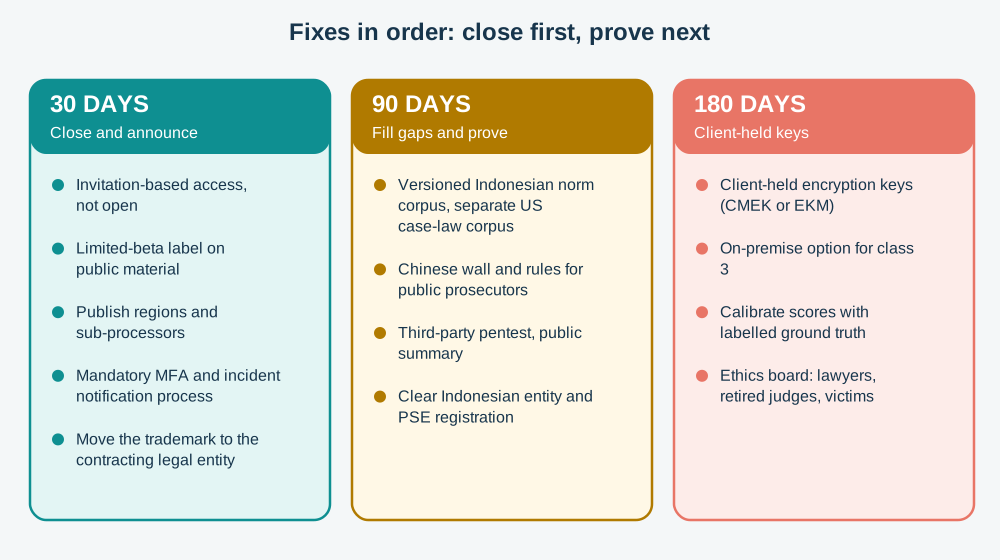
Figure 17. A sequenced plan: close and announce, fill gaps and prove, then client-held keys.
The action owners are the founder and the company's legal counsel. The measure of success is public evidence, not new promises.
Right of Reply and Corrections
The founder and the team are invited to respond. Rebutting evidence, for example the storage region, the legal entity's status, PSE registration, or certifications, will be published as a dated correction. Contact for right of reply: admin@infraloka.co.id.
Limits acknowledged: the e27 article is paywalled and only partly read; scanner detection is client-side; some articles were read through summaries; and the screenshots received were not cross-verified for authenticity.
Glossary
| Term | Meaning |
|---|---|
| Attack factor | A design or governance flaw that can be exploited |
| Attack surface | Every point an attacker can touch |
| At rest, in transit, in use | Data stored, moving across a network, being processed |
| Equality of arms | Parity of means between prosecution and defence |
| Chinese wall | Strict separation of information between sides inside one organisation |
| Key-man risk | Business value depends on one person |
| Prompt injection | Hidden instructions inside a document used to steer an AI agent |
| Automation bias | The tendency to over-trust machine output |
| Chain of custody | The unbroken chain of possession of evidence |
| Ground truth | Correct answers set by humans to test a model |
| MFA | Sign-in verification with more than one factor |
| CMEK | Encryption keys owned and controlled by the customer |
| Zero-training | A model provider's promise not to train on customer data |
| Red team | A team that attacks a system under control to test its defences |
| Terdakwa, tersangka | Defendant at trial; suspect at the investigation stage |
| BAP | Berita acara pemeriksaan, the official examination record |
| PSE | Penyelenggara sistem elektronik, an electronic system operator |
| PT PMA, NIB | A foreign-investment company; a business identification number |
References
The 21 references below are the ones cited in this post. The full source register that accompanies the paper records an audit status for 24 references: 6 observed, 17 partially verified and 1 verified.
- e27, "Ibrahim Arief is building a legal AI startup from city detention" (19 October 2026). https://e27.co/ibrahim-arief-is-building-a-legal-ai-startup-from-city-detention-20261019/
- perkara.ai, Security page and "Step 2" material (screenshots, 21 October 2026). https://perkara.ai/
- Perkara AI app, menu and file Type filter (screenshot). https://app.perkara.ai/
- Wappalyzer, technology lookup for api.perkara.ai and app.perkara.ai (screenshots).
- vindica.ai, HTTP 302 redirect to perkara.ai (observed 21 October 2026). https://vindica.ai
- Jawa Pos, "The new KUHP and KUHAP take effect 2 January 2026". https://www.jawapos.com/kasuistika/2601020137/kuhp-dan-kuhap-yang-baru-mulai-berlaku-2-januari-2026
- Hukumonline, "Protocol and security guidelines for trials" (Supreme Court Regulation 5/2020). https://www.hukumonline.com/berita/a/melihat-pedoman-protokol-dan-pengamanan-persidangan-lt5fdc57afbee7d/
- Hukumonline, "Main points of the new PSTE regulation" (Government Regulation 71/2019). https://www.hukumonline.com/berita/a/mengenal-pokok-pokok-aturan-baru-pp-pste-lt5de653d86d627/
- Hukumonline, "Not every PSE must register" (private-scope PSE registration). https://www.hukumonline.com/berita/a/tak-semua-pse-wajib-daftar--simak-kategorinya-lt63088cd2de81c/
- Law 27/2022 on Personal Data Protection, Article 56 (Wikisource). https://id.wikisource.org/wiki/Halaman:UU_Nomor_27_Tahun_2022_Tentang_Perlindungan_Data_Pribadi.pdf/24
- Hukumonline, "Lawyer-client confidentiality" (Law 18/2003 Article 19). https://www.hukumonline.com/berita/a/hubungan-kerahasiaan-advokat-dan-klien-lt63b7e90220e9b
- Jones Day, "Congress passes CLOUD Act to facilitate law enforcement access to data" (2018). https://www.jonesday.com/en/insights/2018/03/congress-passes-cloud-act-to-facilitate-law-enforc
- DDTCNews, VAT collectors on foreign digital services (Finance Ministry Regulation 48/2020). https://news.ddtc.co.id/berita/nasional/37496/tambah-jumlah-pemungut-ppn-pmse-djp-dekati-58-perusahaan-asing
- Google Cloud, Firestore CMEK and server-side encryption. https://docs.cloud.google.com/firestore/docs/cmek
- OWASP, Top 10 for LLM Applications, LLM01 Prompt Injection. https://genai.owasp.org/llmrisk/llm01-prompt-injection/
- Hukumonline, "Judicial pardon in the new KUHP" (Law 1/2023 Article 54(2)). https://www.hukumonline.com/berita/a/melihat-ketentuan-pemaafan-hakim-dalam-kuhp-baru-lt6667b5d2c1b5b/
- Hukumonline, "The new KUHP takes effect: legal principles to know" (Law 1/2023 Article 3). https://www.hukumonline.com/berita/a/kuhp-baru-berlaku--ini-asas-hukum-yang-perlu-diketahui-lt695f81a6329b5/
- Hukumonline, "The binding force of precedent versus case law". https://www.hukumonline.com/klinik/a/perbedaan-sifat-mengikat-antara-preseden-dengan-yurisprudensi-cl1679/
- Criminal Legal News, US federal convictions that come from guilty pleas (2019). https://www.criminallegalnews.org/news/2019/sep/16/whether-state-or-federal-most-convictions-are-overwhelmingly-based-guilty-pleas
- Indonesian Intellectual Property Database (DJKI), trademark search for "perkara ai" (screenshot, 21 October 2026). Official DJKI trademark database.
- Hukumonline, "First to file or first to use: which does Indonesia follow" (Law 20/2016 Article 3). https://www.hukumonline.com/klinik/a/ifirst-to-file-i-atau-ifirst-to-use-i--indonesia-anut-yang-mana-lt62e7a7ed3521a