
Tulisan ini belum tersedia dalam Bahasa Indonesia. Anda sedang membaca versi aslinya dalam bahasa Inggris.
Seven Logical Fallacy Families Behind Never-Hire Lists, from Equivocation to Double Standard
Between October 2023 and January 2025, a tech executive repeatedly defended a personal "never-hire list" on social media. I tested 13 of those public statements with the same five questions. The same seven families of logical fallacy kept coming back, and this is a short guide to them. It is an analysis of rhetoric, not a verdict on anyone.
RAHMAT WIBOWO | 23 OCTOBER 2026
Why look at the logic of a never-hire list?
Choosing whom to hire is every employer's right. That right is not what I tested. I tested how a permanent never-hire list is built, defended and announced: vague criteria, evidence nobody can inspect, a judge who is also the party being criticised, and no way back.
The material is 26 screenshots of public posts and the reactions to them. From them I pulled 13 claims and gave each the same five questions. The result: 1 claim holds, 7 hold in part, and 5 fail. Across those 13 claims, the same seven families of fallacy repeat. Some claims carry more than one, so the counts below overlap.
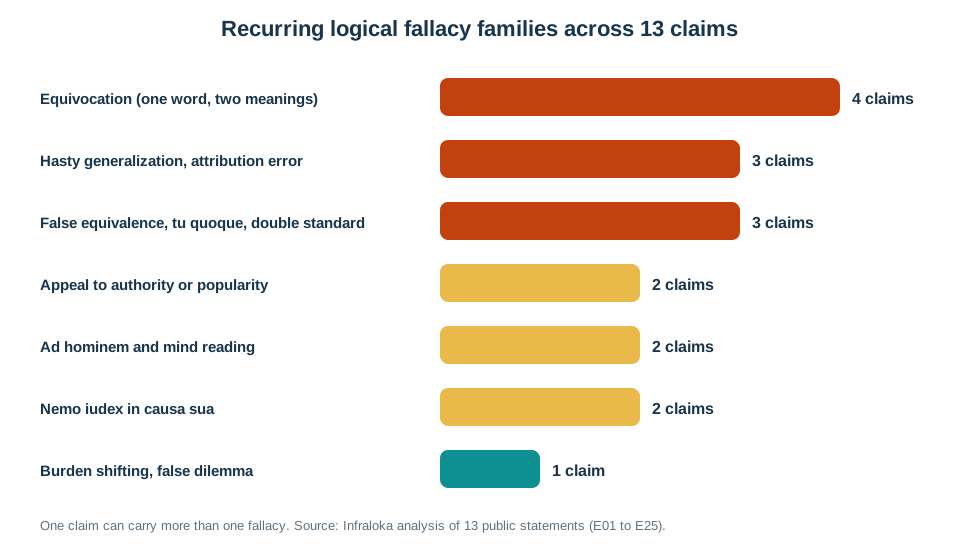
Family 1: Equivocation (4 claims)
Equivocation means using one word in two senses and letting the reader slide between them. It was the most common family in the material.
- "Personal." The post that announced the list called it "a personal never-hire list" and added "including that guy who got fired from AWS a week ago." It drew 387 thousand views (E01). As a private note, "personal" is easy to defend. As a public statement that points at someone, it is not. Another reader linked the reference to a specific individual (E08), which shows that a person does not need to be named to be recognised. This is also a motte-and-bailey pattern: the defensible ground protects the indefensible one.
- "Privacy." The list is not shared, but the context of each rejection goes to the hiring manager (E02). From the point of view of the person listed, the information still changes hands.
- "Consequences." "Freedom of speech does not mean freedom from consequences" (E09, E10) covers two different things: social consequences such as being rebutted or not chosen as a colleague, and consequences set by the very party who was criticised, with no process, that affect a livelihood.
Family 2: Hasty generalization and attribution error (3 claims)
The clearest case is the step from a pattern of comments to "toxic coworker" (E09, E10). The claim was that those who only talk passive-aggressively behind one's back, seeking validation from their groupthink, will generally be toxic coworkers. It fails on three counts. It generalises from one pattern of comments to work behaviour. It infers a fixed trait from one situation. And it writes a motive ("seeking validation") as fact. The word "toxic" cannot be proved wrong, so it is unfalsifiable. One commenter in the evidence made the same point: social media conversation was being carried over into the workplace, though the relationship and context are different (E20).
The same family covers the inference that a company that nearly went under must have managers who cannot support one employee (E12). That is a judgement about an absent party, based on an account nobody can check.
Family 3: False equivalence, tu quoque and double standard (3 claims)
- "Why shouldn't I evaluate others' character?" (E09). Being judged in public and being shut out of a job market by someone with more bargaining power are not symmetric. Everyone may judge. A person whose judgement has a larger impact owes more care.
- The no-apply list ("of course, that's only fair", E11). A no-apply list is an exit from one company. A never-hire list can close access to a small labour market. The acceptance of symmetry is a sign of consistent principle and deserves credit, but the two are not equal.
- The January 2025 principle. The author wrote that he was applying the presumption of innocence to everyone associated with the fiasco, and rejected guilt by association (E24). The principle is right and I use it as the yardstick in my own analysis. But it is not visible in the criteria of the list, which rest on one pattern of comments. I flag this carefully: the two situations are not identical, since one judges a group by association and the other an individual observed directly. What is the same is the principle.
Family 4: Appeal to authority or popularity (2 claims)
"Per the legal advice I received, there will be liabilities if I share the list publicly... I encourage leaders to maintain their version of the 'never-hire list' as a fiduciary duty to the company" (E01). The advice and its source cannot be seen, and from "there is a fiduciary duty" it does not follow that a rejection list is required. A director's fiduciary duty is to act in good faith for the company. It does not name a never-hire list as the only way, and the same duty asks for hiring decisions that are fair and accountable.
The second case is the claim that "most hiring managers in our industry are mature enough" (E24), a popularity argument.
Family 5: Ad hominem and mind reading (2 claims)
Mind reading shows up in the presumption-of-innocence post: the idea that people who discard that presumption do so because they think everyone treats them the same way (E24) writes a psychological motive as an explanation. A mild ad hominem appears in "I'm well aware of her antics" (E25), which passes over the critic's argument and characterises the critic. The "always bitter" comment aimed at the same person is also ad hominem. The author's explanation that the post was written for a different audience is a reasonable statement of intent.
Family 6: Nemo iudex in causa sua (2 claims)
Nemo iudex in causa sua means no one should be a judge in their own cause. By the author's own account, the basis for the character judgement was comments aimed at the list's creator, so the judge and the criticised party were the same (E09, E10). The same structure sits inside the "consequences" claim: the consequences were set by the person who felt judged.
Family 7: Burden shifting and false dilemma (1 claim)
"That's the only consequence from me... Now, tell me how that is not fair and reasonable?" (E10). The burden of showing that an action is reasonable rests on the party who acts and holds the bargaining power. The question also offers only two options: accept that it is fair, or explain why not. A defensible version would read: "These are my criteria, this is the limit, and this is how people can object."
What held up
I think the strongest arguments of the list's creator deserve to be shown first, and they hold. No one has a right to be hired by a particular company. Character is part of qualification, and reference checks are normal practice, so the reference-check claim (E06) held without formal flaw, provided anonymous input only triggers a check and never decides alone. Refusing to share the list because others have a right to earn a living elsewhere (E23) is a good ethical position. Accepting that others may have a no-apply list is consistent. And "how we judge others is how we judge ourselves" is a fair yardstick.
The problem is mostly in application, not in principle. That is also why a defensible list is possible: written criteria of three to five observable behaviours, a record of facts only, and a way to object.
Read the full analysis
This article is a short guide to one figure. The full 13-claim test, the legal and ethical maps and the protocol for a defensible list are in Never Hire List: Logical Flaws in Ibrahim Arief's Statements (Kawal Ibam). For the same kind of audit applied to a later campaign, see Kawal Ibam: Anatomy of a Self-Defense Campaign, a Fallacy Audit.
Limits and right of reply
This is an analysis of arguments, not of people. All quotes come from public posts captured in the evidence files. I do not assess anyone's intent and I do not say that anyone lied, acted maliciously or is guilty. There is no evidence that the list was used to reject applicants, so no violation can be concluded. This is not legal advice.
Disclosure. I am connected to two of the pieces of evidence (E01 and E08), through the reference "that guy who got fired from AWS," so I have an interest. To keep the analysis fair, each claim is quoted exactly, the strongest argument of the criticised side comes first, and claims that held are said to have held. The dismissal that the reference points to is not in question here.
Right of reply. The list's creator and anyone quoted can send corrections to admin@infraloka.co.id. A proven correction will be added to the next version.