
Tulisan ini belum tersedia dalam Bahasa Indonesia. Anda sedang membaca versi aslinya dalam bahasa Inggris.
Special Pleading in the Kawal Ibam Defense: Ibrahim Arief's Secret List
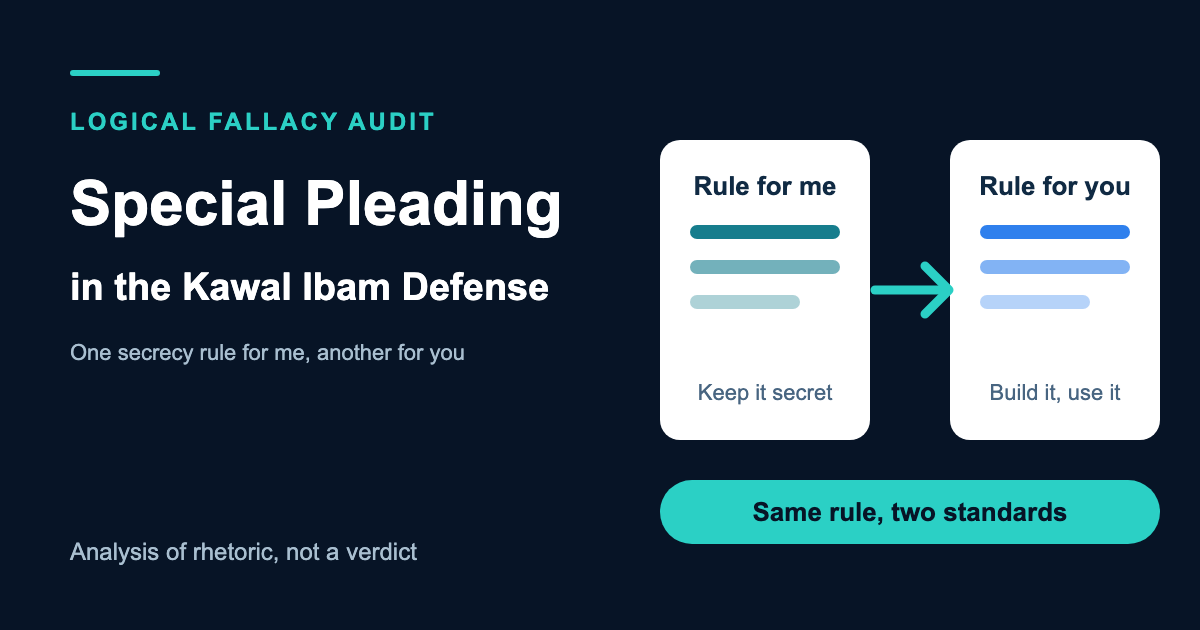
One post from the #KawalIbam campaign shows a textbook case of special pleading. Ibrahim Arief said his own "never-hire list" had to stay private because of legal liability, and in the same post urged other leaders to keep and act on lists of their own. This is an analysis of rhetoric, not a verdict, and it is open to a right of reply.
RAHMAT WIBOWO | 23 OCTOBER 2026
What special pleading is, and why it matters here
Special pleading is a fallacy of exemption. A rule is stated as if it were a general principle, and then the person stating it quietly excludes themselves, or their own case, from it. If the rule is real, it applies to everyone it logically covers. If it applies only when convenient, it was never a principle. It was a rationalisation.
This post looks at one exhibit from my audit of the #KawalIbam campaign, the public self-defence run by Ibrahim Arief ("Ibam") between September and November 2023. In the full audit I checked every substantive claim in that defence with the same five questions. What is claimed? What evidence supports it? Which fallacy pattern is used? Why does that pattern fail logically? And what would a valid version of the argument look like?
Special pleading appears once in the audit's taxonomy of fallacies, and it appears in Exhibit C.
Exhibit C: the "liabilities if I share the list" post
The claim, quoted from the source:
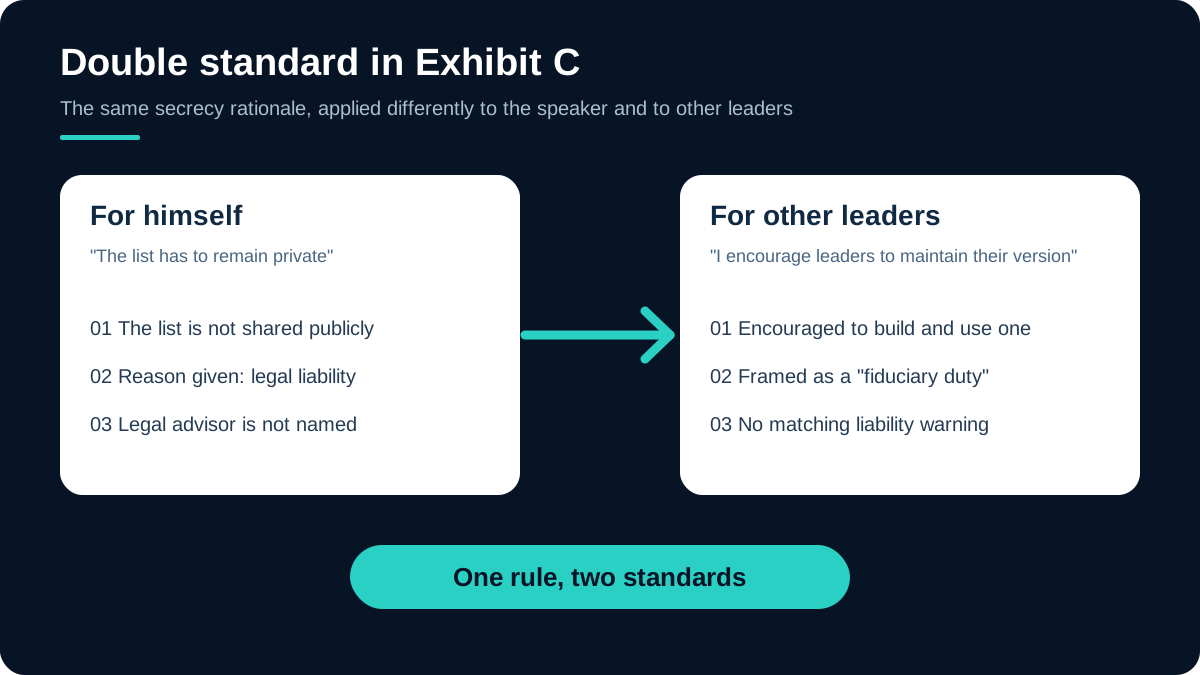
"Per the legal advice I received, there will be liabilities if I share the list publicly... The list has to remain private, but I encourage leaders to maintain their version... as a fiduciary duty."
Read it as two instructions inside one post:
- For himself: the list stays private, because sharing it would create legal liability.
- For other leaders: build and maintain your own version of such a list, and treat doing so as a duty.
The standard Ibam applies to himself is to withhold information in order to avoid consequences. The standard he asks others to apply is to build the same mechanism and use it. The post gives no reason why the secrecy rule, and the liability concern behind it, would not also bear on the leaders he is encouraging. Nothing in the post separates his case from theirs.
Why the argument fails
A rule used to justify your own behaviour has to hold generally. Applying it selectively is the sign that the "rule" is a rationalisation rather than a principle. That is the core of the audit's finding on Exhibit C.
There is a practical side as well. If liability really attaches to sharing such a list, the logical consequence is that the exposure is not unique to the person who happens to be speaking. A speaker who believes that should either warn others, or explain why the risk does not apply to them. The post does neither. It encourages the practice and protects only the speaker.
A second fallacy sits in the same sentence
Exhibit C is made worse by a second fallacy, which is an appeal to unverifiable authority: "per the legal advice I received."
An appeal to authority is only worth something when the authority is named, can be checked, and is actually quoted on the specific point in dispute. Here no lawyer is named and no opinion is quoted. The audience cannot test the claim, so it works as a signal of confidence rather than as evidence. The audit finds the same pattern in Exhibit A, where Ibam referred to having spoken to "legal counsel beneran" (real legal counsel) without naming anyone or citing what they said.
The two fallacies reinforce each other. The special pleading needs a reason for the exemption, and the reason offered, legal advice, is the one thing the audience cannot examine.
What a valid version would look like
The audit's fifth question asks what the argument would look like if it were logically sound. For Exhibit C there are two straightforward routes:
- Apply the rule evenly. If sharing such a list creates legal liability, say so for everyone, and do not encourage others to build and act on the same kind of list as a "fiduciary duty."
- Justify the exemption. If the speaker's situation really is different, explain what makes it different, and name the legal advice or quote the specific point it makes so that it can be checked.
Either route would turn a rationalisation into an argument that can be tested.
Where this sits in the larger pattern
In the audit's frequency table, special pleading is the single entry tied to Exhibit C. Its function in the defence is to apply the secrecy rule to himself while not applying it to other people who are encouraged to do something similar. It sits beside other patterns catalogued in the same table, including appeal to unverifiable authority (Exhibits A and C), appeal to force (Exhibits D and G) and DARVO-style reframing (Exhibits D, G and I). Those are covered in the full audit.
Read the full analysis
This post is one slice of a longer study. For the complete walk through every exhibit, the fallacy taxonomy and the documented consequences, read the full Kawal Ibam fallacy audit. For the separate analysis of the list itself, see the Never Hire List logical flaws analysis.
Limits and right of reply
This is an independent analysis of rhetoric and the author's personal opinion. It is not a court ruling, not an official document of any law enforcement body, and not professional legal advice. The presumption of innocence applies in full: the matters touched on in the underlying report that concern the personal dispute between me and Ibrahim Arief are allegations, not findings.
I should also be open about my position. I am the subject of some of the statements analysed in the report, so it naturally reflects my point of view. Quotes from others are reproduced as closely as possible, but the judgement that a statement is a fallacy remains one-sided analysis. Ibrahim Arief, and anyone else named, is welcome to reply, and I will consider any correction in good faith. Readers with a direct interest in the underlying matters should rely on official court or agency documents rather than on this post.