
A Field Guide to Logical Fallacies: Lessons from an Unexpected Teacher Study Case of Awas
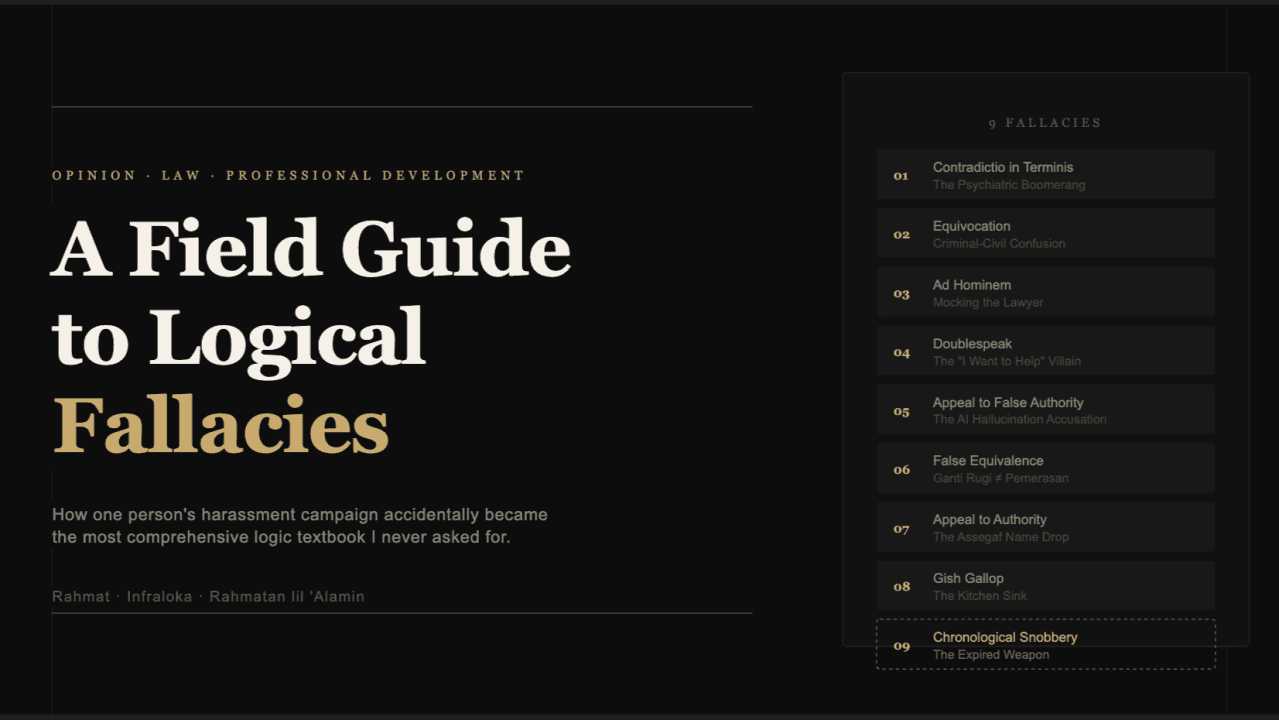
How one person's harassment campaign accidentally became the most comprehensive logic textbook I never asked for.
For a newer trilingual application of the same method, read the Rahmat Wibowo–Gatot Gunarso logical-fallacy audit, which reviews 30 exhibits in Hanzi, Hanyu Pinyin, and English.
The Book of Suryadiputra Liawatimena reasoning audit applies the framework to 27 exhibits about books, credentials, legacy, faith, failure, and legal persistence.
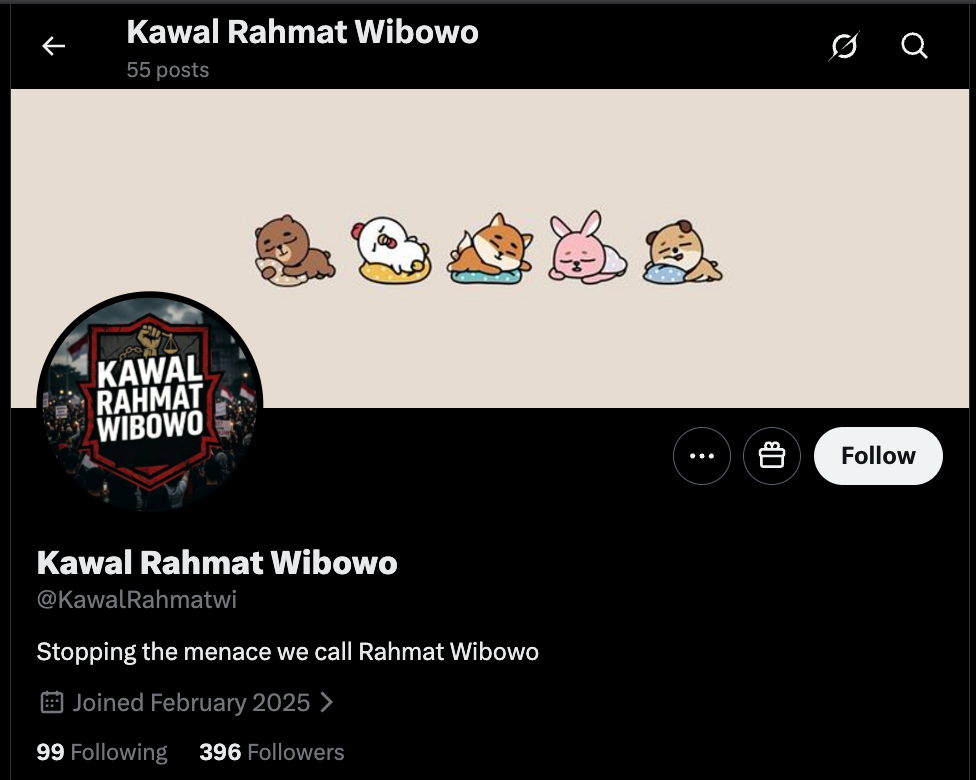
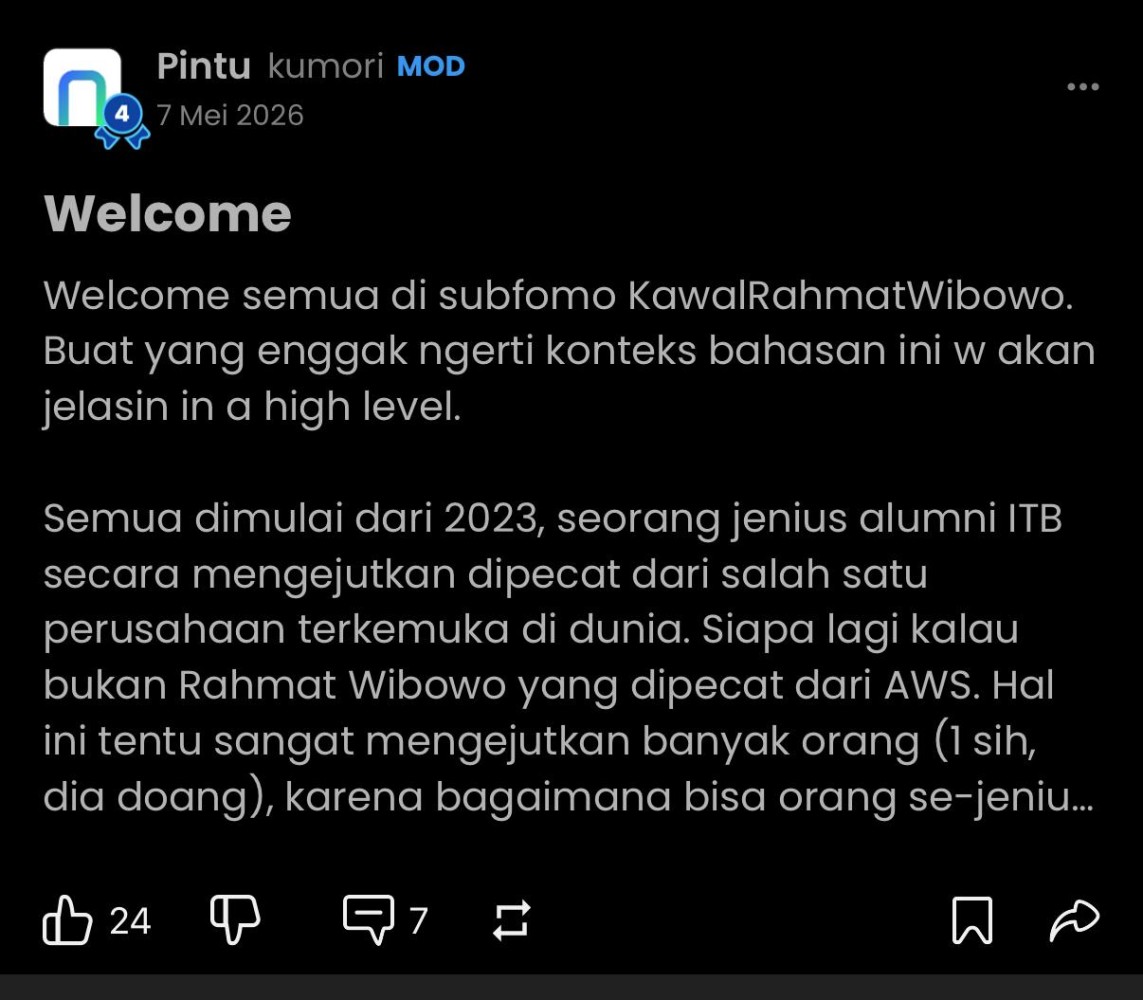
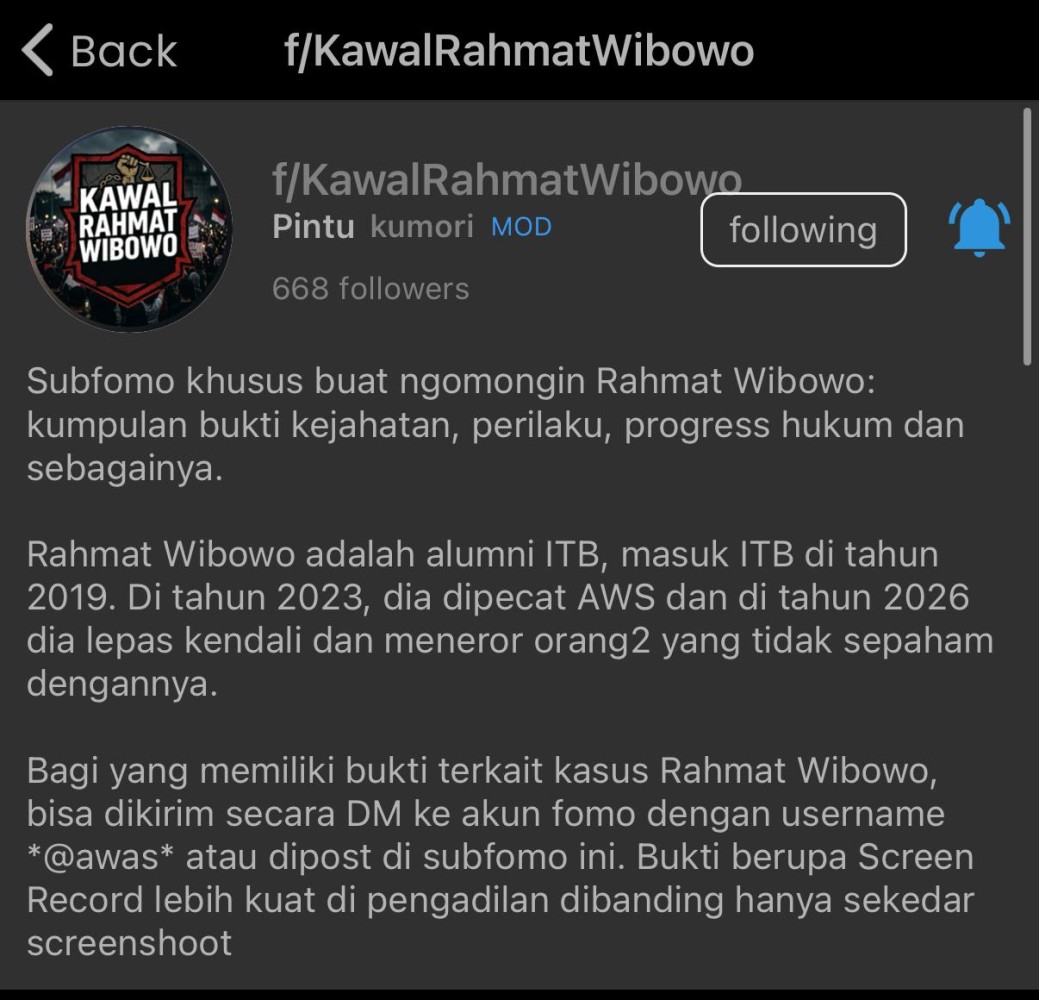
In law school, professors spend semesters teaching students to identify logical fallacies — the flawed reasoning patterns that collapse under scrutiny. I didn't go to law school. But apparently, life decided to send the curriculum to me anyway, delivered free of charge via DMs and story posts over 2.5 years.Consider this article my tuition receipt — and my thank-you note.
Logical Fallacy #1
The Self-Defeating Threat (or: The Psychiatric Boomerang)
"kami juga udah ngelaporin kamu ke bareskrim dan RSJ Dr. Soeharto Heerdjan. Bedanya ga di story aja. Muka kamu juga ga kami sebarkan seperti orang tidak waras"
Translation: "We have also reported you to Bareskrim [National Detective Agency] and Dr. Soeharto Heerdjan Psychiatric Hospital. The difference is we didn't do it on our story. We also didn't spread your face like a crazy person."
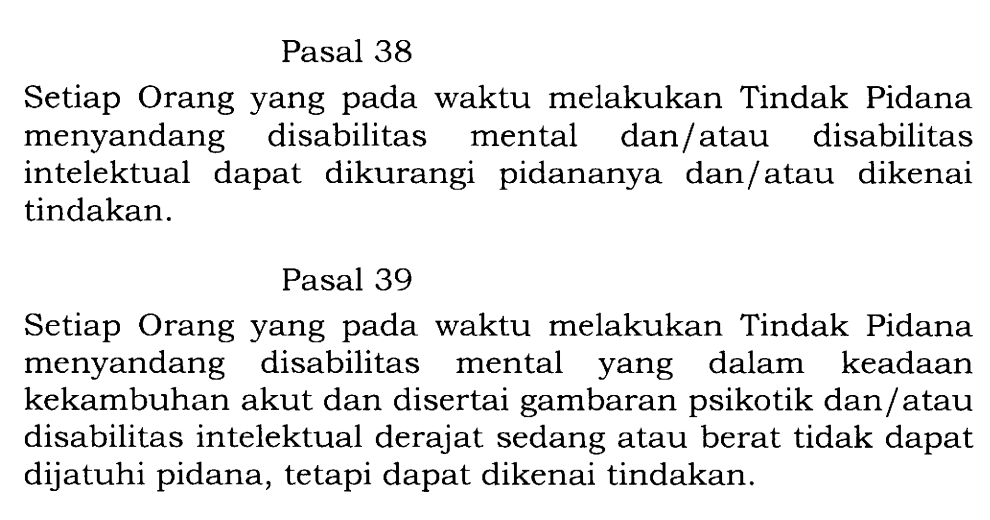
This is a masterclass in unintentional self-defeat. The individual simultaneously reported me to the police (criminal proceedings) AND a psychiatric hospital (implying mental incapacity) — apparently without consulting Article 38 and 39 of UU No. 1 Tahun 2023 (the new Indonesian Criminal Code), which state precisely this: if a perpetrator has a mental disability, punishment is lessened (Art. 38); if the mental condition was severe and acute, they are exempt from criminal punishment entirely (Art. 39).
So by reporting me to a psychiatric hospital, my accuser was effectively building my legal defense for me. The logic is: if I'm mentally ill enough for RSJ, I'm too mentally ill to be criminally prosecuted. You can't have it both ways. You've either reported a criminal or reported a patient — the law will not let you report both on the same facts.
I'm genuinely grateful. I couldn't have written a better defense motion myself.
Fallacy: Contradictio in Terminis — The argument refutes itself.
Logical Fallacy #2
Criminal-Civil Confusion (or: Choosing Both Lanes on a One-Way Street)
"Tindakan kamu udah bukan cuma perdata lagi. Udah PIDANA. Kami lapor dua duanya"
Translation: "Your actions are no longer just civil. It's now CRIMINAL. We've reported both."
Let's pause here. In one statement, the individual: ① Declared my alleged actions were criminal (pidana), not civil (perdata), ② Then — in the same breath — said they reported both.
The problem? In other statements, this same person described UU ITE proceedings as civil law — when UU ITE is, by nature, primarily criminal legislation. You cannot in one conversation call something criminal, then later call it civil, then circle back to "both."
This is not a minor terminology slip. Criminal law is prosecuted by the state. Civil law is pursued by the individual. They have different courts, different burdens of proof, and entirely different remedies. Conflating them doesn't make you sound like you have two cases — it makes you sound like you have zero understanding of either.
Fallacy: Equivocation — Using the same term to mean different things.
Logical Fallacy #3
The Credential Attack (or: Mocking the Lawyer, Accidentally Triggering PERADI)
"anak ini asal ngomong mens rea gatau penerapannya, dan sewa pengacara bodong / pakai AI"
Translation: "This kid just talks nonsense about mens rea without knowing how to apply it, and hired a fraudulent lawyer / uses AI."
Calling a licensed legal professional a "pengacara bodong" (fraudulent lawyer) is not just rude — it is potentially a violation of professional ethics regulations and defamatory under Indonesian law. Advocates in Indonesia are regulated by PERADI (Perhimpunan Advokat Indonesia). Making public accusations of fraud against a registered advocate without evidence is exactly the kind of statement PERADI takes seriously.
The irony? This accusation was made precisely as a way to discredit my legal standing — but it ended up creating an independent reportable incident. If you're trying to win a legal dispute, publicly slandering the opposing counsel is a curious strategy.
As for the "mens rea" critique — mens rea is the Latin legal term for criminal intent. The individual mocked my use of it. Then in the very next set of messages, used the term themselves. I'll let that sit.
Fallacy: Ad Hominem + Genetic Fallacy — Attacking the person instead of the argument.
Logical Fallacy #4
The "I Want to Help" Villain Speech
"Ini saya bantu korbannya mamat karena ada kenalan pengacara. Mau dia ada masalah mental atau ngga, bawa ke kepolisian dulu biar dikurung, nanti baru dikurung di lapas atau di RSJ terserah pihak berwenang. Kalau pakai kata kata dia, mat mat mat mat, yang bentar lagi nyikat di lapas"
Translation: "I'm helping the victim here because I have a lawyer contact. Whether or not he has mental issues, bring him to the police first to be locked up, then later lock him in prison or a psychiatric hospital, up to the authorities. Using his words: mat mat mat mat, who's about to scrub [serve time] in prison."
This paragraph opens with "saya bantu" — "I am helping." It then proceeds to describe dragging someone to jail, debating between prison and a psychiatric facility, and ends with a mocking chant about someone serving prison time.
I want to formally recognize this as one of the most creative redefinitions of "helping" I have ever encountered. In most languages and cultures, helping involves, at minimum, a net positive outcome for the person being helped. What's being described here is something the criminal law community would call "intimidation" and what the rest of us would call "not helping."
The chant — "mat mat mat mat" — is a personal touch. It's the kind of thing you might expect from a 12-year-old. The individual was 25 years old at the time of writing.
Fallacy: Doublespeak — Labeling harm as assistance.
Logical Fallacy #5
The AI Hallucination Accusation (From Someone Who Doesn't Know What Hallucination Means)
"oiya, kuasa hukum jg sudah confirm kalau somasi rahmat itu AI-GENERATED. Ga ada dasarnya, banyak halusinasi. Cocok lah sama orangnya... Kuasa hukum saya bilang itu ai generated karena banyak halusinasinya mamat dongoo mamat dongo. Ga sesuai dengan undang undang yang ada... Ga perlu jadi anak IT untuk bisa tau apa yang kamu sebar itu FRAUD dan KEBOHONGAN. Kuasa hukum saya juga sudah confirm kalau laporan yang valid itu dari kami, yang anda mah valid dari Claude AI aja"
Translation: "Our lawyer has confirmed that Rahmat's legal notice is AI-GENERATED. It has no basis, full of hallucinations. Fitting for who he is... My lawyer said it's AI generated because there are many hallucinations, you stupid Rahmat. Not aligned with existing laws... You don't need to be an IT person to know what you spread is FRAUD and LIES. My lawyer has confirmed the valid report is ours — yours is only valid from Claude AI."
Let's address the epistemological problem here. The claim is that a legal somasi (notice) is invalid because it was "AI-generated" and contains "hallucinations" — a technical term meaning an AI fabricated information.
This determination was made by a law graduate, not a computer scientist or AI researcher. The field of AI output verification — distinguishing AI-generated text, detecting hallucinations, understanding model behavior — is a computer science discipline. A lawyer's opinion on whether text is AI-generated carries roughly the same professional authority as a software engineer's opinion on whether a contract is legally binding.
Furthermore, even if a document was AI-assisted, validity in Indonesian law is determined by content accuracy and legal standing — not by which word processor was used. Microsoft Word also didn't write the statutes. We don't typically call legislation invalid because it was typed on a computer.
Fallacy: Appeal to False Authority — Citing a credential outside its domain of expertise.
Logical Fallacy #6
Ganti Rugi ≠ Pemerasan (Civil Damages Are Not Extortion)
"Kami juga ada bukti chat si Rahmat ngirim somasi itu tujuannya buat malak duit dan dibisnisin. Sudah terlihat MENS REA nya. Confirmed by REAL lawyer ya all."
Translation: "We also have evidence that Rahmat sent the legal notice with the intent to extort money and turn it into a business. The MENS REA is already visible. Confirmed by a REAL lawyer, everyone."
Under Indonesian civil law, any aggrieved party has the right to request ganti rugi — compensation for damages — through the courts. This is not extortion (pemerasan). Pemerasan under the Indonesian Criminal Code requires coercion and threats. A formal legal somasi requesting civil compensation is, definitionally, the lawful mechanism designed for exactly this purpose.
If requesting ganti rugi via a somasi constitutes pemerasan, then the entire Indonesian civil litigation system is technically a criminal enterprise. I suspect the Mahkamah Agung would have thoughts about this interpretation.
Also — and I say this gently — if your primary evidence of criminal mens rea is a WhatsApp chat, you may want to speak with your REAL lawyer about burden of proof.
Fallacy: False Equivalence — Treating two legally distinct concepts as identical.
Logical Fallacy #7
The Assegaf Name Drop (Spider-Man Pointing Intensifies)
"On a serious note, nope. Lawyer keluarga dari assegaf. Kami udah dapat kontak mamamu juga, jadi komunikasinya mulai sekarang dengan beliau ya kedepannya. Good luck, and i hope you get help"
Translation: "On a serious note, nope. Our family lawyer is from Assegaf. We've also gotten your mom's contact, so from now on communication will be with her. Good luck, and I hope you get help."
For context: Assegaf Hamzah & Partners is one of Indonesia's most prestigious law firms. It is also worth noting that the chairman of PERADI — the national bar association — is associated with this firm's network.

[Two Spider-Men pointing at each other, captioned: "Assegaf partner" vs "PERADI chairman's firm" — realizing they're in the same network as the lawyer who was just called a 'pengacara bodong']
The meme writes itself. In one thread, my advocate was called a fraud. In the next, the opposing party claims counsel from one of the most credentialed firms in the country — a firm whose network overlooks the very bar association that regulates all Indonesian lawyers. I'll leave the irony here for you to collect.
As for contacting my mother: I had already provided my lawyer's contact details. Reaching out to a family member instead of legal counsel is not a negotiation tactic — it is the definition of social intimidation. This detail has been documented accordingly.
Fallacy: Appeal to Authority + Intimidation as Argumentation.
Logical Fallacy #8
The Kitchen Sink (Everything Including the Nabi Accusation)
"Loh kamu kan gila? Ya jelas ke ibu kamu... 'Pengacara' kamu (claude) nanti tinggal datang aja ke pengadilan. Kami ngobrol dulu sama ibu kamu... MAMAT HASAD sang hasidin yang pengacaranya claude AI, antum mengaku2 nabi tapi tidak paham agama, mengaku ngaku paham hukum tapi law firm terkenal aja gatau. Mat mat mat mat mat, astagayagesya, yang akan nyikat nyikat di penjara, kalau gak ada orang dalam (ibu kamu), kamu bisa apa sih? Ipk mu dukomsel ya dulu? Kok dipecat pecat terus? Rahmat si HASAD, asal nuduh karena udah takut yagesya"
Translation: "You're crazy, right? Of course we go to your mother... Your 'lawyer' (Claude AI) can just show up to court. We'll talk with your mother first... RAHMAT HASAD the hasidin [one who envies] whose lawyer is Claude AI, you claim to be a prophet but don't understand religion, you claim to understand law but don't even know a famous law firm. Mat mat mat mat mat, oh my, who will be scrubbing floors in prison — without your insider connection (your mom), what can you even do? Your GPA was at Dukomsel level [poor]? Why do you keep getting fired? Rahmat the HASAD, making accusations out of fear."
This is what logicians call a "Gish Gallop" — overwhelming the opponent with a rapid volley of accusations, so many that it becomes difficult to respond to each one. Let's try anyway:
① "Mengaku-ngaku nabi" (claiming to be a prophet) — I have never made this claim. This is fabricated.
② GPA and firing history — irrelevant to any legal matter and constitutes defamation if false. ③ "Orang dalam" (insider connections via mother) — my mother is not a party to any of these proceedings and contacting her was not a legal move.
④ "HASAD" — an Islamic term for destructive envy. The theological accusation is ironic coming in the same message that includes a chant about someone going to prison.
⑤ The phrase "yagesya" — this is Indonesian teen slang for "ya gitu deh" (something like "yeah, whatever"). It appears twice. In what was presumably meant to be an intimidating legal threat.
Fallacy: Gish Gallop + Multiple Ad Hominem — Volume substituting for substance.
I want to be clear about something. None of this is written from anger. It's written from a place of deep, almost archaeological fascination — because what you've just read is a rare specimen: a comprehensive logical fallacy collection, assembled organically, over 2.5 years, by a single individual.
In Indonesian law, in Islamic ethics, and in basic human discourse, the standard is not perfection — it's sincerity and coherence. You can be wrong. You can be emotional. But when your arguments simultaneously prove and disprove themselves, when your threats become legal gifts, when your mockery of AI expertise is confirmed by the absence of relevant credentials — at some point, the argument is no longer with me.
Logical Fallacy #9
The Expired Weapon (or: Digging Up a 2.5-Year-Old Video and Finding Only a Legal Dead End)
Let me be transparent about something before I apply the legal analysis — because intellectual honesty requires it.
Personal statement
Approximately 2.5 years ago, during a manic episode — a period I did not fully control and have since sought help for — I behaved in a way that was wrong toward a woman who was not involved in any of the disputes described in this article. I am not proud of it. I take responsibility for it. The episode was part of a mental health condition, but that does not erase the harm caused. I have made my peace with that chapter, sought accountability privately, and moved forward.
The harasser recently surfaced a video of this incident and circulated it — not as an act of justice toward the person actually involved, but as a weapon in an unrelated dispute, wielded by someone who had no personal stake in that original incident, against me.
Here is where the law becomes relevant — not as a shield from accountability, but as a framework that exists for precisely this kind of situation.
Legal timeline — daluwarsa aduan
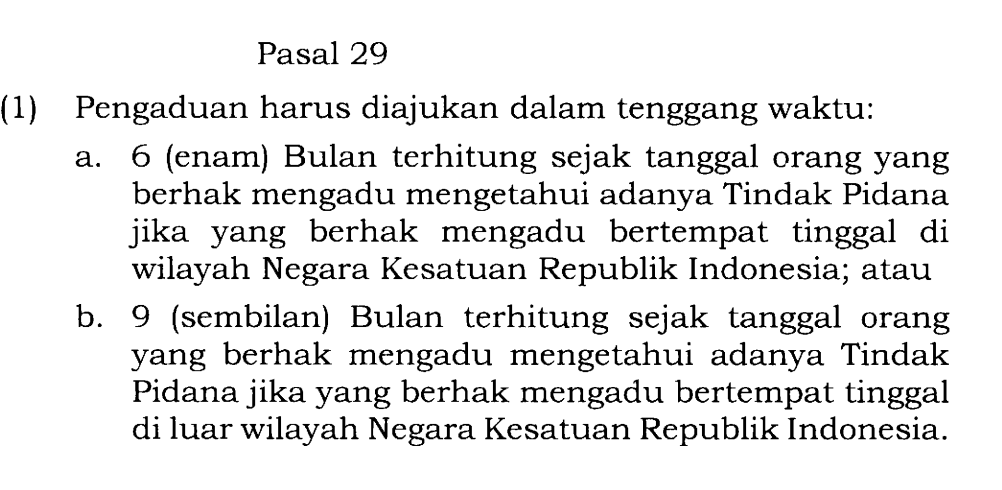
Under Pasal 29 of the new KUHP, a criminal complaint must be filed within 6 months of the victim becoming aware of the incident. After that, the case cannot be processed by law — the right to prosecute is extinguished by operation of law, not by anyone's decision. It simply expires. This is called daluwarsa aduan.
The incident in question occurred approximately 30 months ago. The complaint window closed roughly 24 months ago. No prosecution can be initiated at this point — not by the actual victim, and certainly not by a third party who was not involved.
This brings us to the second problem: legal standing. In Indonesian criminal complaint law, a delik aduan (complaint offense) can only be reported by the aggrieved party — the person directly harmed. A third party who was not the subject of the incident, who has no direct legal interest in it, and who is using it instrumentally in an unrelated dispute, has no legal standing to file or amplify such a complaint. Circulating the video does not create standing. Outrage does not create standing. Being someone's friend does not create standing.
What this means, practically: the harasser surfaced a 2.5-year-old video of a private incident involving a completely different person, in a dispute that person has no part in, past the point at which any legal process could be initiated, wielded by someone with no legal standing to wield it.
The correct response to genuine concern for that incident's subject would have been to support her in filing a report within the legal timeframe. That window is long closed. What this is instead is character assassination — using someone else's pain as ammunition in a separate conflict. That's not advocacy. That's exploitation.
I say this not to minimize what I did 2.5 years ago. I say it to be precise about what this tactic actually is. Accountability and weaponization are not the same thing.
The argument is with your own logic.
I wish you well. I genuinely do. Rahmatan lil 'alamin is not a selective principle — it applies even here.
— Rahmat Co-founder, Infraloka | Rahmatan lil 'Alamin
#LogicalFallacies #IndonesianLaw #UUITE #KHUPNasional #Harassment #LegalLiteracy #Infraloka #LinkedInIndonesia #RahmatalilAlamin #PersonalBranding #MentalHealth #Accountability #SocialEntrepreneurship #Indonesia #TechIndonesia