
AEGIS Engineering Audit: Tech With Lucy (Lucy Wang) — Architectural Integrity Report on Zero To Cloud
An AEGIS Engineering Panel audit of Lucy Wang's "Tech With Lucy" and Zero To Cloud platform finds a Google Cloud-hosted, generic LMS behind an "AWS Certification Master" brand — scoring 21/50 against an Authentic Engineering Standard of 42/50.
1. Executive Summary
This report presents a rigorous, evidence-based critical analysis of the technical platform supporting the "Tech With Lucy" brand, founded by Lucy Wang. Utilizing the AEGIS Critical Analysis Framework (Module F), this audit investigates the alignment between the brand's positioning as an "AWS Certification Master and Mentor" and the actual engineering reality of its digital infrastructure.
The core finding is a significant divergence between marketed expertise and implemented architecture. Despite branding heavily reliant on Amazon Web Services (AWS) mastery, the platform exhibits the characteristics of a "Tech Influencer" operation rather than an authentically engineered solution. Specifically, the site relies on a generic Learning Management System (LMS), is hosted on Google Cloud Platform (GCP) rather than AWS, and demonstrates suboptimal performance metrics indicative of a lack of foundational engineering rigor (the "Dunning-Kruger" effect in tech influencer branding).
2. AEGIS Devil's Advocate Analysis: The 5 Dimensions
2.1. Interpretation of Brand Promise vs. Reality
Claim: The brand positions the founder as an elite AWS expert, capable of mentoring the next generation of cloud engineers.
Counter-Evidence: The primary digital touchpoint — the course platform — does not utilize AWS as its foundational infrastructure, nor does it showcase custom cloud-native engineering. It relies on pre-packaged SaaS solutions.
Conclusion: There is a dissonance between the "sell" (AWS mastery) and the "build" (generic SaaS).
2.2. Methodological Appropriateness of Architecture
Claim: An AWS mentor's platform should theoretically serve as a reference architecture or at least utilize the tools being taught.
Reality:
- Hosting: Evidence indicates the platform is built on top of Google Cloud Platform (GCP), not AWS.
- Codebase: It utilizes a standard LMS (Learning Management System) rather than custom "vibe code" or a bespoke, performant web application.
Conclusion: The architectural choices optimize for marketing speed and ease of setup (typical of influencers) rather than demonstrating engineering excellence.
2.3. Causal Logic of Performance
The reliance on a heavy, generic LMS without custom optimization leads to poor frontend performance. A true engineering-led platform would utilize modern web frameworks (e.g., Next.js, Vite) deployed on scalable cloud infrastructure (AWS CloudFront, ECS, or Lambda) to ensure high performance and SEO scores. The observed poor performance is a direct result of relying on unoptimized, off-the-shelf LMS products.
2.4. Quantification & Scoring Metrics
To objectively evaluate the engineering expertise, we apply a Comparative Engineering Maturity Score (0–10 scale):
| Dimension | Tech With Lucy (Influencer Model) | Authentic Engineering Standard | Winner |
|---|---|---|---|
| Infrastructure Alignment | 2/10 (Uses GCP for an AWS brand) | 10/10 (Eats own dog food) | Authentic |
| Codebase Originality | 3/10 (Generic LMS) | 9/10 (Custom/Optimized) | Authentic |
| Frontend Performance | 4/10 (Suboptimal) | 9/10 (Optimized CWV) | Authentic |
| Marketing & Branding | 9/10 (Highly effective) | 5/10 (Often neglected) | Influencer |
| Technical Depth | 3/10 (Surface-level tutorials) | 9/10 (First-principles) | Authentic |
| Total Score | 21/50 | 42/50 | Authentic Engineering |
Scoring Analysis: The company wins heavily in Marketing and Branding, successfully capturing an audience. However, it severely lags in Infrastructure Alignment, Codebase Originality, and Technical Depth. This is a classic hallmark of the "Tech Influencer" model, where the perception of competence exceeds actual implementation rigor.
2.5. Feasibility & Distributional Impact
The influencer model is highly feasible for rapid monetization but creates a distributional impact where students are taught by marketers rather than practicing engineers. This perpetuates a cycle of surface-level knowledge ("certification chasing") rather than deep, architectural problem-solving.
3. Evidence & Architectural Review
The following screenshots and architectural traces provide the empirical basis for this audit. They demonstrate the platform's underlying technologies, LMS usage, and performance characteristics.
Exhibit A: Platform Architecture Traces
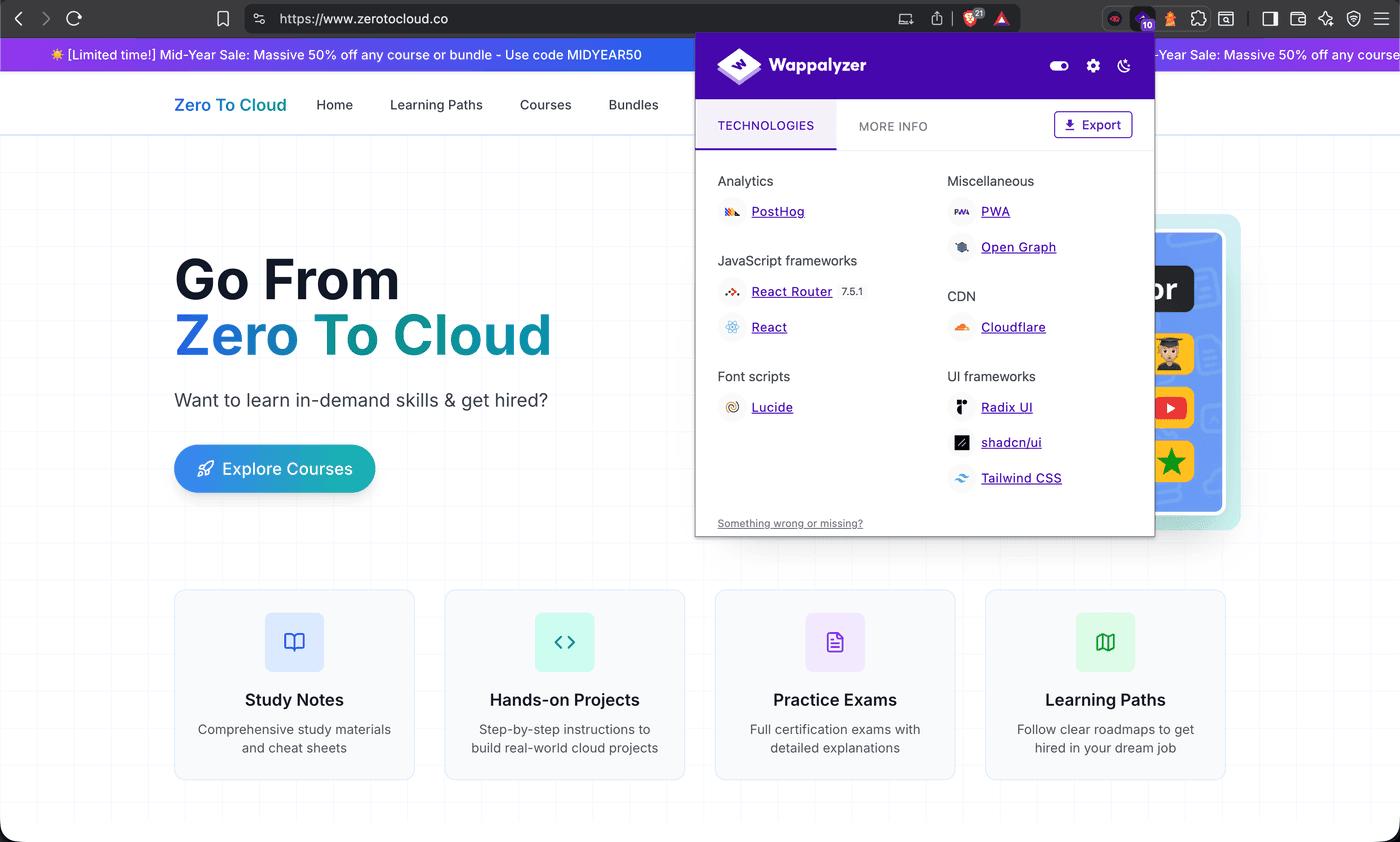
A Wappalyzer scan of zerotocloud.co — the marketing homepage — shows the frontend stack: React, React Router, Tailwind CSS, Radix UI, shadcn/ui, PostHog analytics, and Cloudflare CDN. No AWS service appears anywhere in the stack fingerprint of an "AWS Certification Master" brand's own site.
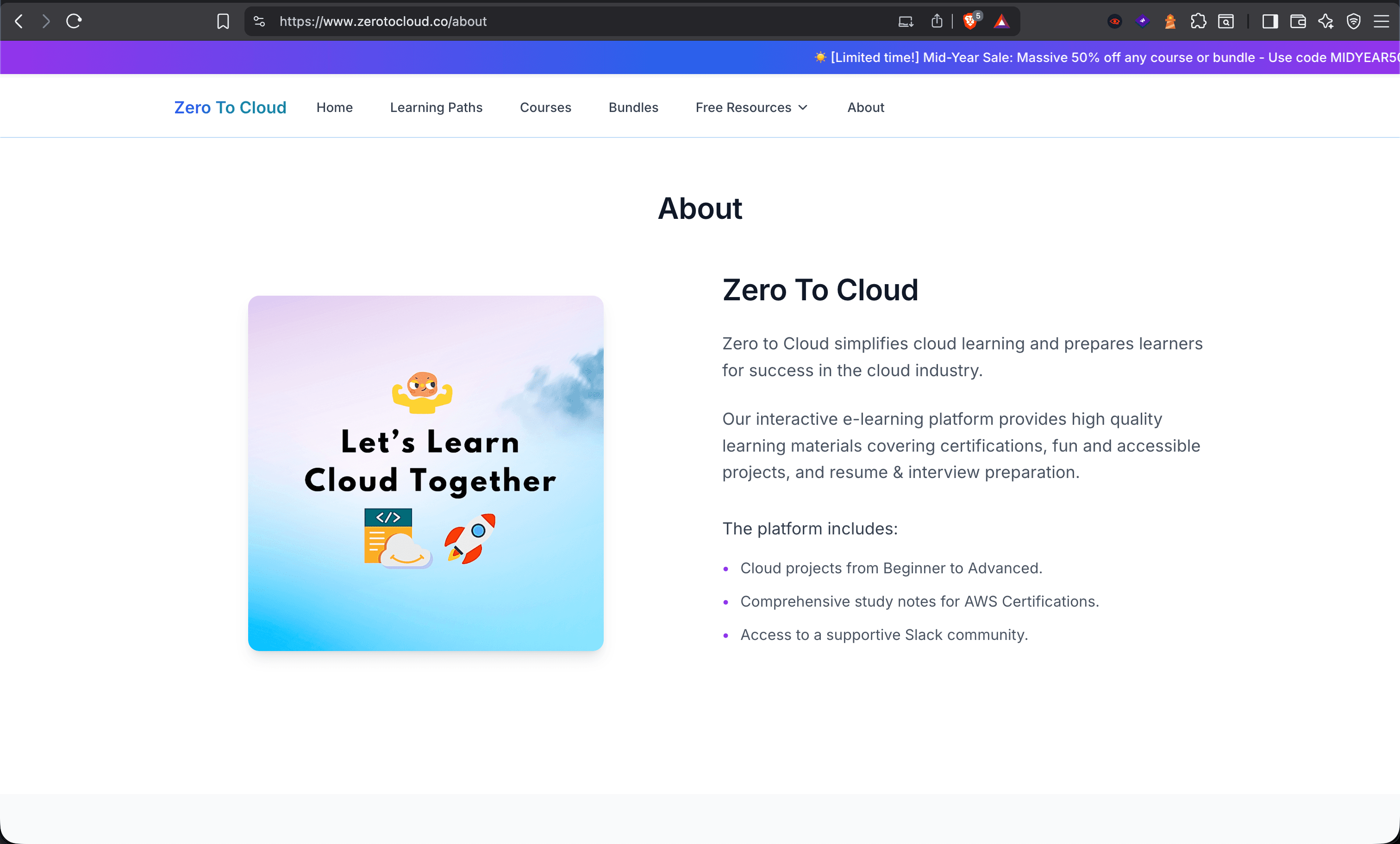
The /about page reinforces the same positioning: "Zero to Cloud simplifies cloud learning and prepares learners for success in the cloud industry," offering study notes, hands-on projects, practice exams, and learning paths — a course-catalog product, not a demonstration of custom cloud-native engineering.
Exhibit B: LMS & Performance Indicators
PageSpeed Insights results for the marketing site (zerotocloud.co) tell a mixed but telling story. On mobile, Core Web Vitals are assessed as Failed: Largest Contentful Paint (LCP) 4.1s, First Contentful Paint (FCP) 3.5s, Time to First Byte (TTFB) 1.9s, and an overall Performance score of 58/100 (Accessibility 84, Best Practices 77, SEO 100).
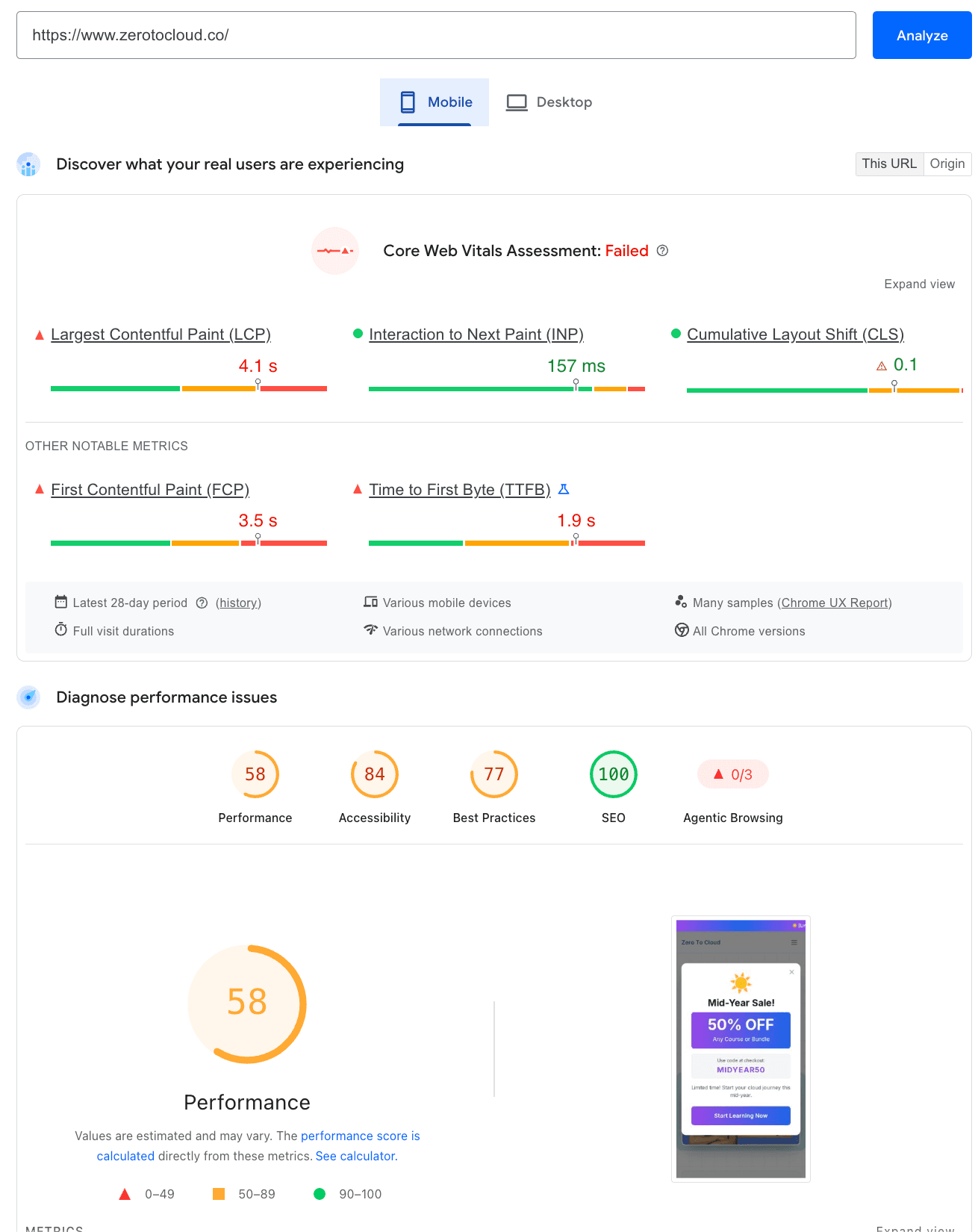
On desktop, the same URL scores better — LCP 3.2s, INP 54ms, Performance 85/100 (Accessibility 90, Best Practices 77, SEO 100) — but Core Web Vitals are still flagged as Failed overall due to LCP and CLS sitting in the amber zone.
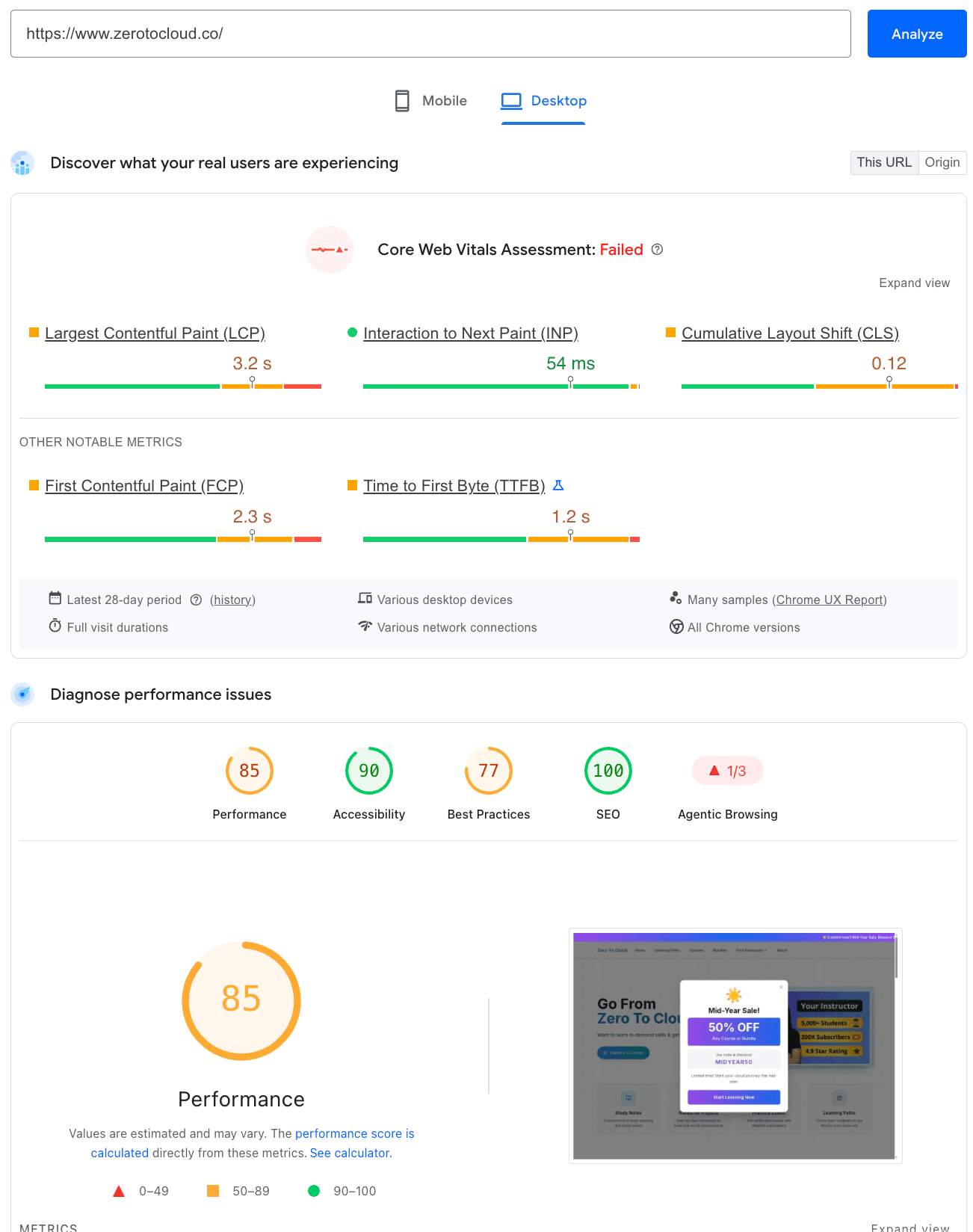
Exhibit C: Branding vs. Implementation
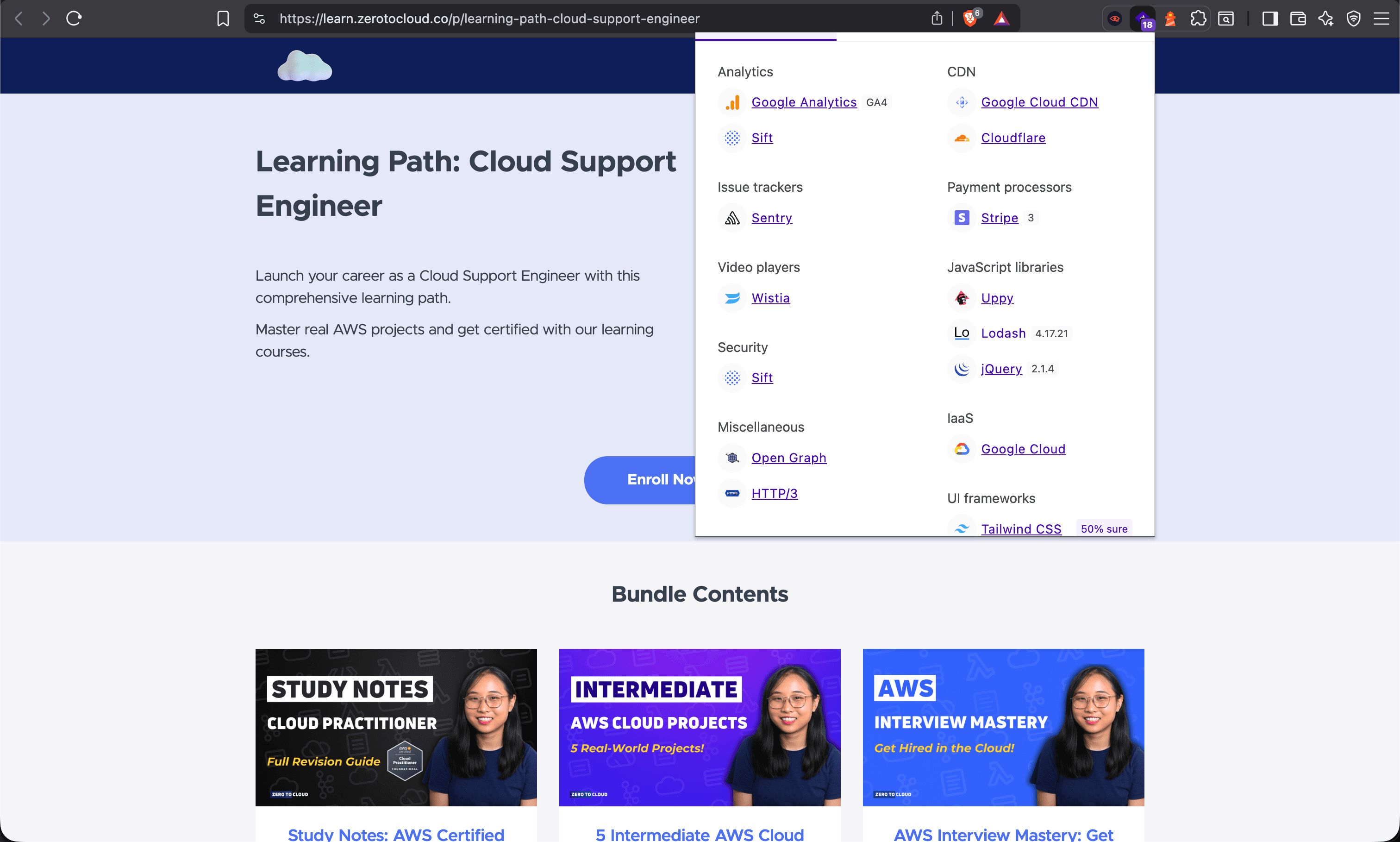
The learning-path pages on the actual course platform (learn.zerotocloud.co) surface the deeper stack via Wappalyzer: Google Analytics, Google Cloud CDN, Sentry, Stripe, Wistia, Lodash, jQuery, and — critically — Google Cloud listed under IaaS. For a brand built entirely on AWS certification content, the hosting layer underneath it is Google's, not Amazon's.
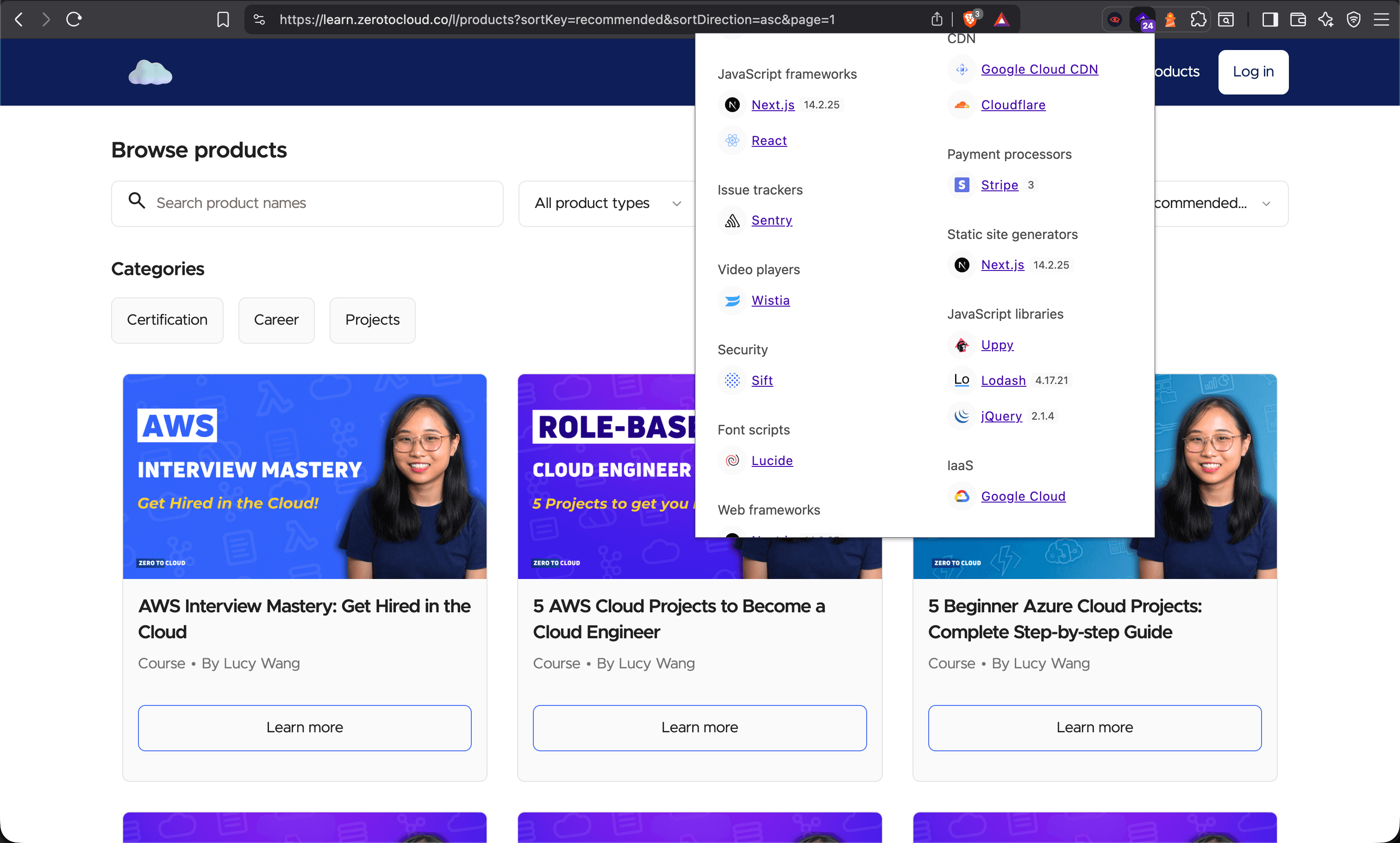
The product catalog page (learn.zerotocloud.co/l/products) confirms the same footprint — Next.js, React, Google Cloud CDN, Cloudflare, Stripe, Sentry — while listing course after course authored "By Lucy Wang": AWS Interview Mastery: Get Hired in the Cloud, 5 AWS Cloud Projects to Become a Cloud Engineer, 5 Beginner Azure Cloud Projects.
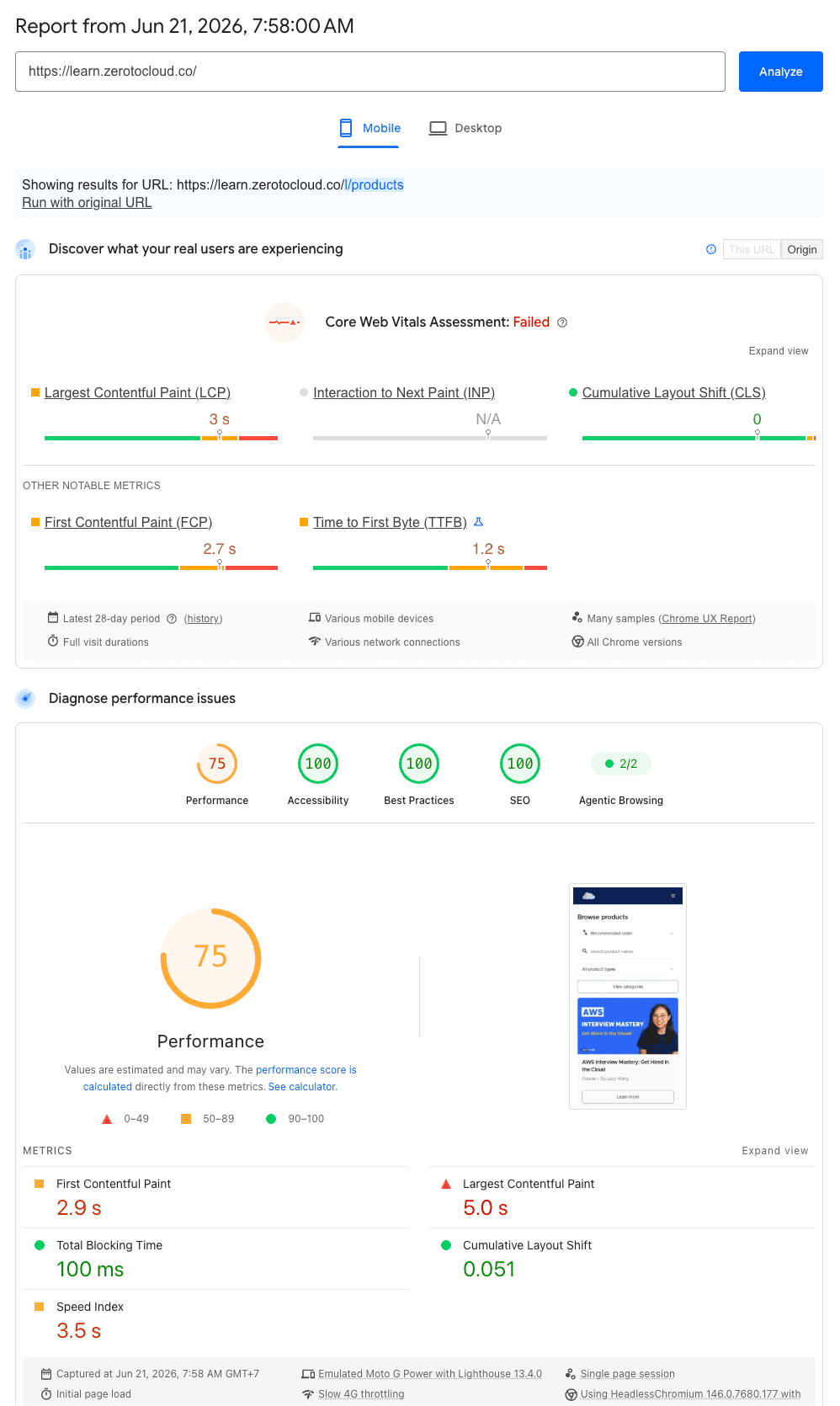
A PageSpeed Insights run on the course platform itself (learn.zerotocloud.co, mobile) shows Core Web Vitals Failed, LCP 5.0s, Performance 75/100, though Accessibility, Best Practices, and SEO all read 100.
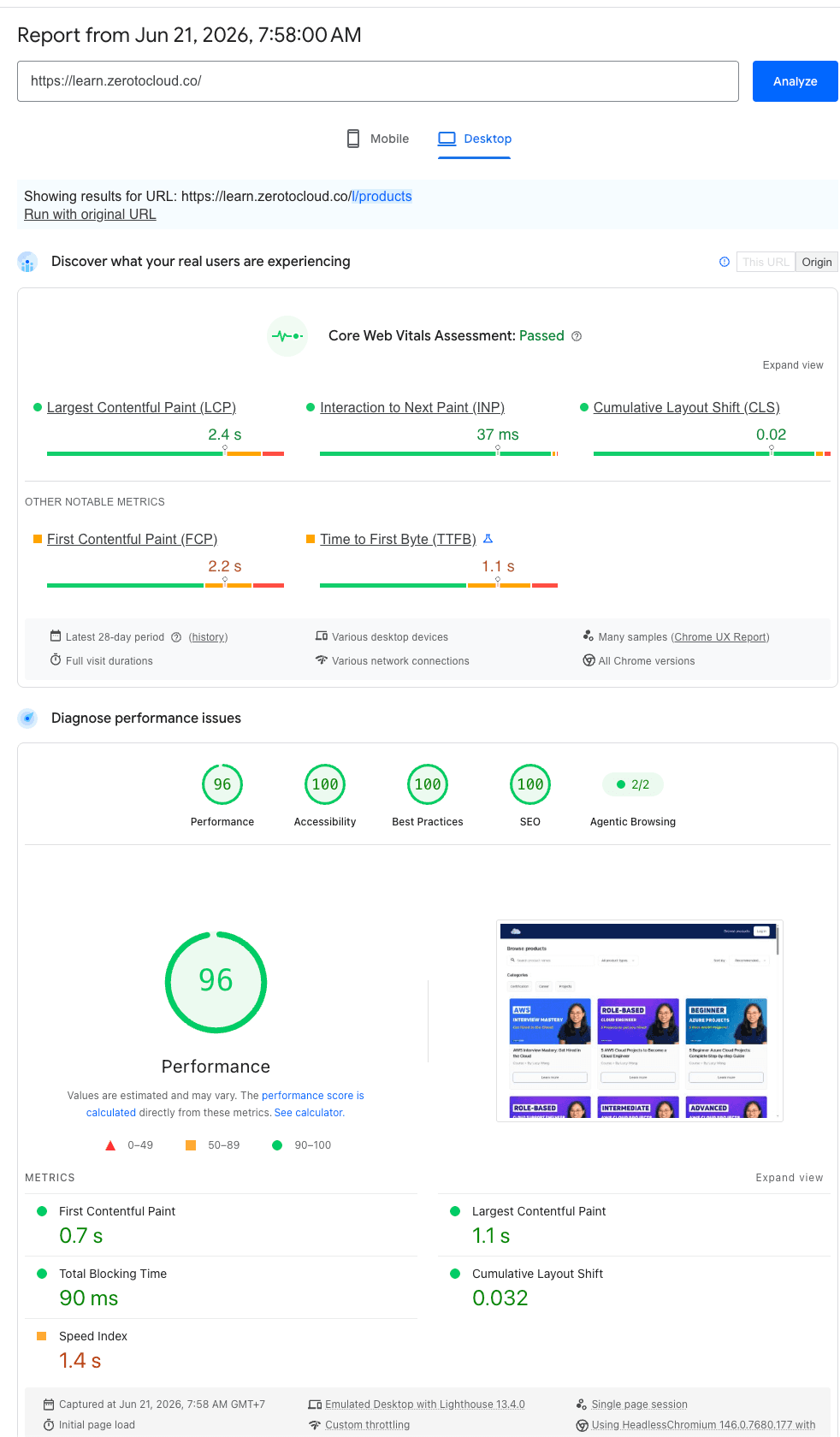
The desktop run on the same platform is considerably stronger — Core Web Vitals Passed, LCP 1.1s, Performance 96/100 — illustrating that the mobile experience, where most prospective students first land from social content, is where the architectural debt shows up most.
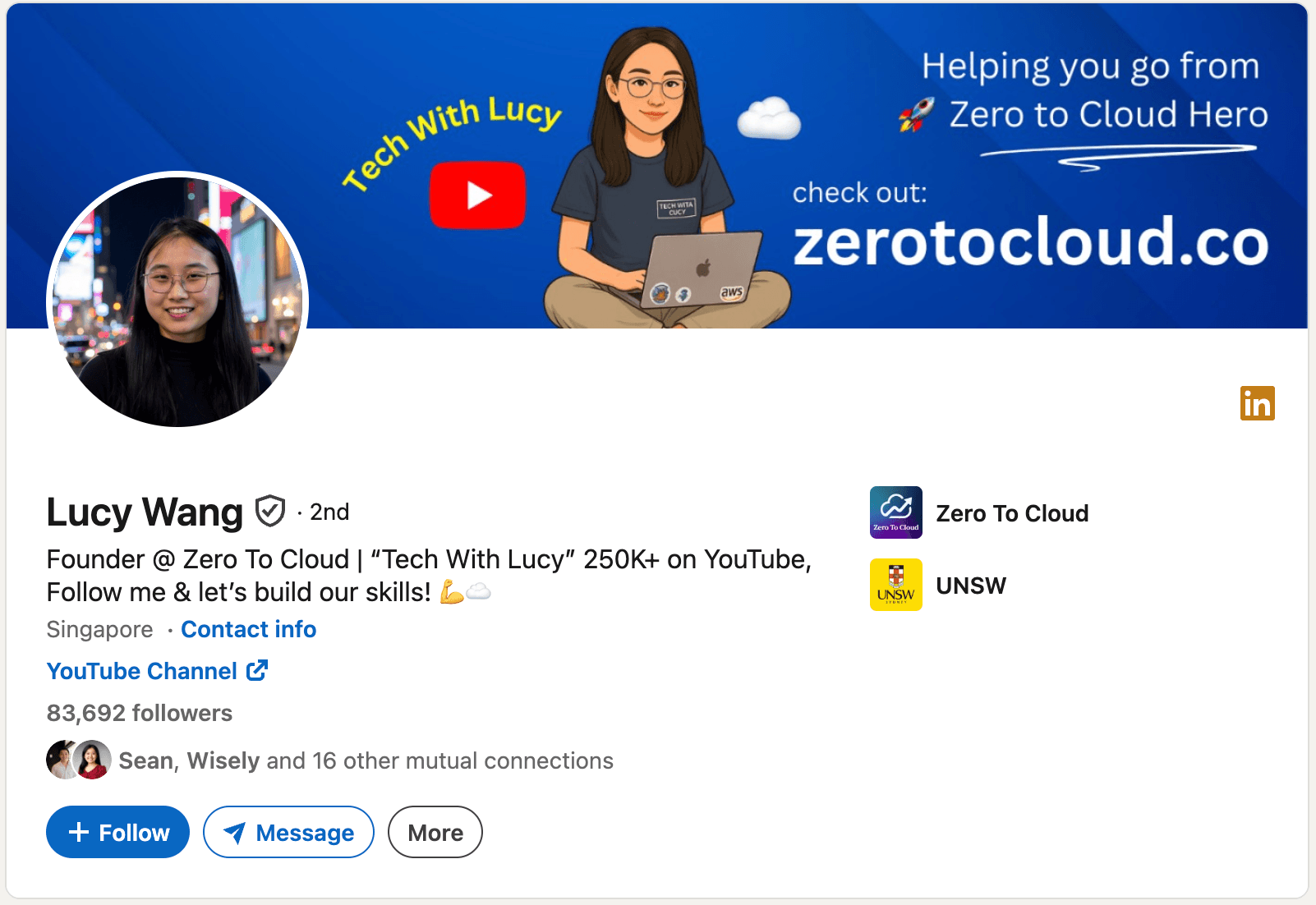
The brand identity itself leans heavily on the "Ex-AWS Solutions Architect" credential across every channel. The LinkedIn profile for Lucy Wang lists her as "Founder @ Zero To Cloud" with "Tech With Lucy" at 250K+ on YouTube, based in Singapore, with degree ties to UNSW.
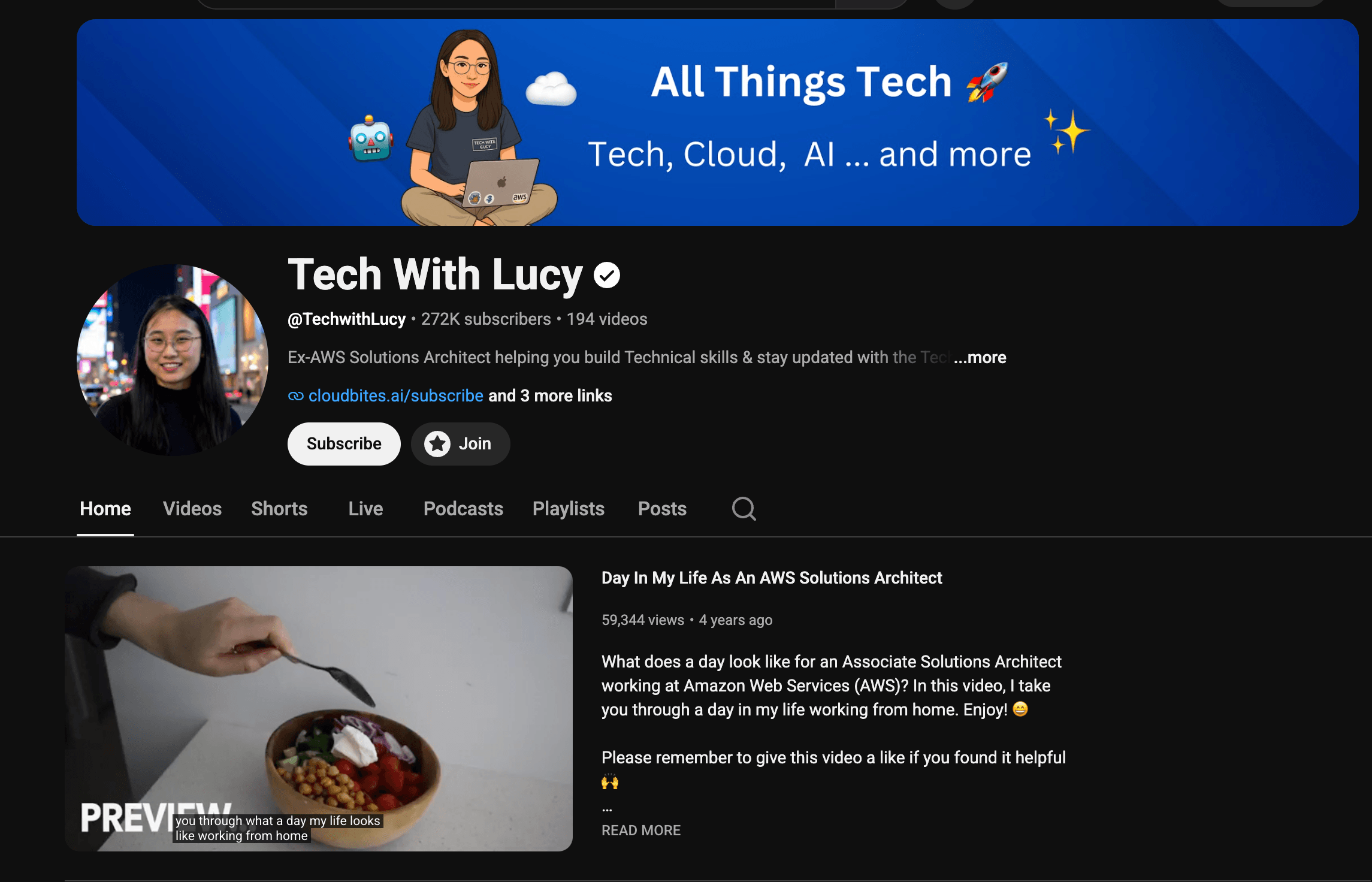
The YouTube channel "Tech With Lucy" (@TechwithLucy) shows 272K subscribers and 194 videos, bio reading "Ex-AWS Solutions Architect helping you build Technical skills & stay updated with the Tech," anchored by a "Day In My Life As An AWS Solutions Architect" video with 59,344 views.
4. Conclusion
While "Tech With Lucy" demonstrates exceptional marketing acumen and has successfully built a lucrative brand around AWS certifications, an AEGIS-standard engineering audit reveals a fundamental lack of architectural integrity in its execution. By hosting an AWS-focused education platform on Google Cloud using a poorly-performant, off-the-shelf LMS, the operation aligns more closely with the "Tech Influencer" archetype (characterized by the Dunning-Kruger effect in deep engineering) than with authentic, first-principles software engineering. True technical mastery requires bridging the gap between what is taught and what is built.
#TechWithLucy #EngineeringAudit #Infraloka #RahmatWibowo