
AEGIS Legal Assessment: Study Case of Kawal Ibam, Ibrahim Arief
A comprehensive AEGIS legal research investigation and case audit regarding Kawal Ibam.
RAHMAT WIBOWO | INFRALOKA LEGAL RESEARCH | PT INFRASTRUKTUR DIGITAL NUSANTARA
Beyond Salary: The “Kawal Ibam” Narrative
There’s a lot of noise around the “Kawal Ibam” case—and I think it’s important we step back and look at it more critically, beyond emotion and selective narratives.
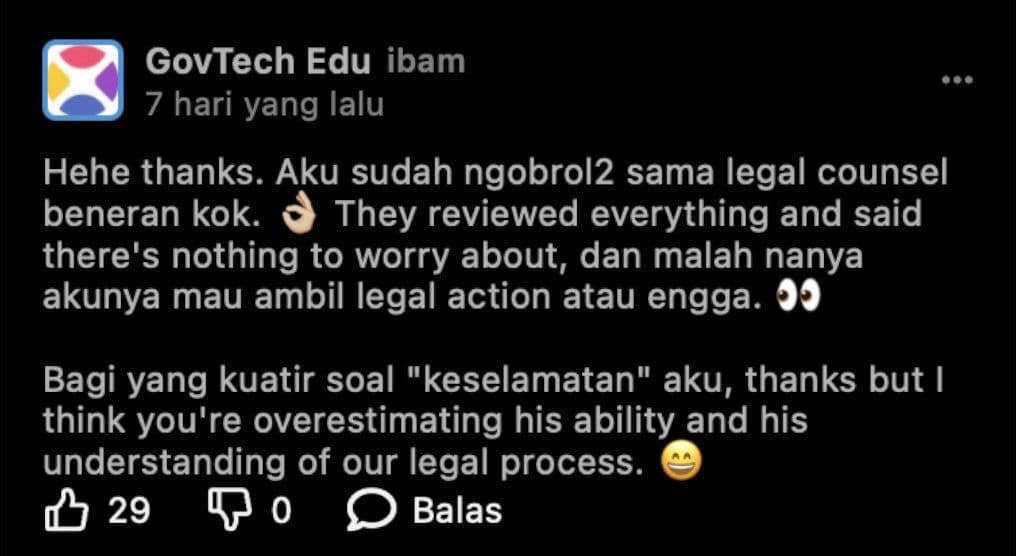
From what’s publicly circulating, much of the defense seems to rely heavily on testimonies and personal claims, rather than verifiable, objective evidence. In cases involving corruption or abuse of power, this becomes a crucial point: corruption is not always about direct financial gain. It can also involve influence, decision-making authority, access, and how power is exercised.
A question worth asking is: If the allegations are unfounded, why not clearly demonstrate evidence of proper conduct and absence of misuse of authority? Transparency is the strongest counter to suspicion—not just statements of character.
Another argument being discussed is the idea that rejecting an opportunity like Meta London, combined with a reported salary drop, somehow proves integrity.
But this framing deserves a deeper look.
Living and working in places like London is not just a career move—it’s a complete lifestyle reset:
Extremely high cost of living and rent Relocation challenges (new environment, no existing assets) No immediate access to conveniences many take for granted Building everything again from zero Reaching the top 1% lifestyle in the UK is significantly harder than in Indonesia, even with a strong salary.
Meanwhile, certain roles in Indonesia—especially those connected to government or advisory positions—can come with:
Social capital and influence Established networks Institutional privileges Access to facilities or support systems These are non-monetary advantages that are often overlooked in public discourse.
So the comparison shouldn’t be reduced to “salary vs. salary.” It’s about total lifestyle, power, and position.
Logical Fallacies in Public Discussion What we’re seeing in this case reflects several common logical fallacies:
Appeal to sacrifice: “He gave up X, therefore he must be honest.” Appeal to authority/status: “He holds position Y, therefore he is trustworthy.” Testimonial bias: Relying on statements rather than verifiable evidence These arguments can be persuasive—but they are not proof.
On Professional Conduct There are also broader concerns worth reflecting on in any professional setting—especially when discussions include allegations of misuse of influence:
Use of work time and responsibility boundaries Blurring lines between personal platforms and official authority Influence over others’ opportunities, hiring, or career progression The risk of informal “blacklisting” practices that may limit fair and equal access to opportunities Power asymmetry between public figures and early-career professionals The ability to shape narratives or reputations without formal accountability mechanisms In many industries, even the perception of these behaviors can be damaging. Blacklisting—formal or informal—is particularly serious, as it can silently impact careers without due process or transparency.
This is why strong governance, documentation, and accountability systems are critical—not only to prevent abuse, but also to protect all parties involved.
These are not definitive claims about any single individual, but rather systemic risks that should always be examined whenever power and influence are concentrated.
On Professional Conduct & Allegations of Misuse of Power There are also serious concerns raised in formal documentation, including a Somasi (legal notice), which outlines a pattern of behavior that—if accurate—goes beyond opinion and enters the realm of systematic misuse of influence.
Key patterns highlighted include:
Public humiliation of professional competence in open forums Legal intimidation to discourage individuals from pursuing justice (“lawyer on standby”, “backfire”) Active narrative shaping by resurfacing past content to construct negative character judgments Labeling individuals as “toxic talent” without due process or objective validation Public declaration of blacklist practices, which may influence hiring decisions across an industry One particularly concerning aspect is the normalization of informal blacklisting. When someone with visibility and influence publicly states that an individual has been blacklisted, the impact is not isolated—it can:
Spread across hiring networks Bias recruiters subconsciously Create systemic career barriers without transparency or appeal process This is where the issue becomes bigger than interpersonal conflict—it touches on fairness in the labor market.
Additionally, the combination of:
Public influence Community authority Direct statements affecting employability creates a power asymmetry that must be carefully examined.
Corruption Is Not Only About Money One important clarification: Corruption is often narrowly interpreted as financial gain—but in reality, it also includes:
Abuse of authority Manipulation of access or opportunities Use of influence to harm or exclude others Intimidation to suppress legal rights If these dimensions are ignored, we risk misunderstanding the full scope of accountability.
A Broader Reflection This case is not just about one individual. It’s about how we, as a society, evaluate:
Power Accountability Evidence vs. narrative Fairness in professional ecosystems We should be careful not to reduce complex issues into simplified stories that fit our biases.
Because in the end, integrity is not proven by lifestyle choices or personal testimonies— but by consistent, transparent, and accountable actions.
#kawalibam #Infraloka #RahmatWibowo #AEGIS