
Bandung High Tech Valley: Three Decades Chasing Indonesia's Silicon Valley Dream By Rahmat Wibowo From InfraLoka
From a 1986 ministry blueprint to Bukit Algoritma's stalled groundbreaking and the emergence of ITB Jatinangor as the ecosystem's most credible next chapter, here is the full arc of Indonesia's most persistent technology ambition.
Every decade or so, Indonesia rediscovers the idea that Bandung should become its Silicon Valley. The pitch is always compelling. A century-old technical university, a mild highland climate, a creative culture, a dense concentration of state-owned technology firms, and a steady outflow of engineers who have quietly shaped the country's industrial backbone. The idea has a name, a history, and an almost mythological resilience. It is called Bandung High Tech Valley.
What makes it interesting in 2026 is not that the dream still exists, but that it has finally split into three distinct stories happening simultaneously: the original BHTV initiative anchored in Bandung's existing tech cluster, the high-drama chapter of Bukit Algoritma in Sukabumi, and the quieter but structurally more robust development of ITB Jatinangor as a purpose-built research campus 25 kilometers east. Each tells us something different about how Indonesia builds, or fails to build, the knowledge economy it has promised itself for three decades.
Part I: The Original Blueprint, 1986 to Today
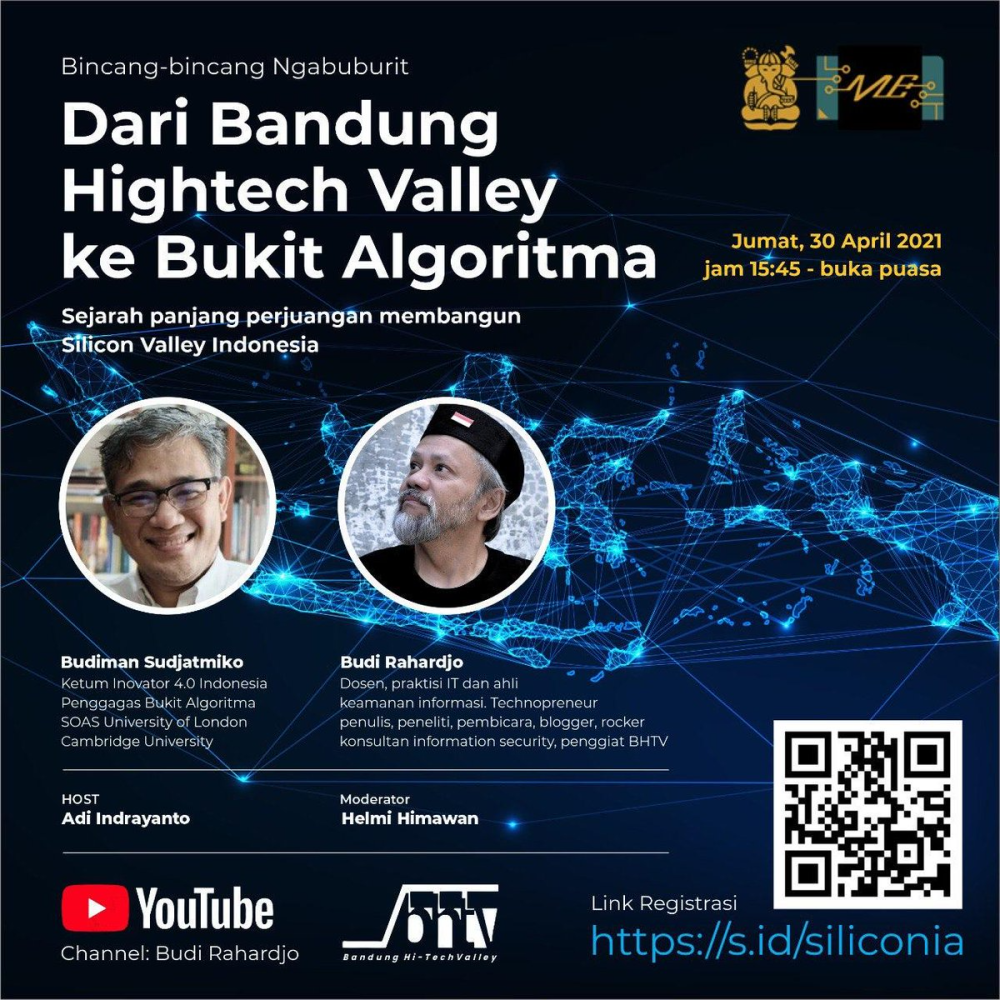
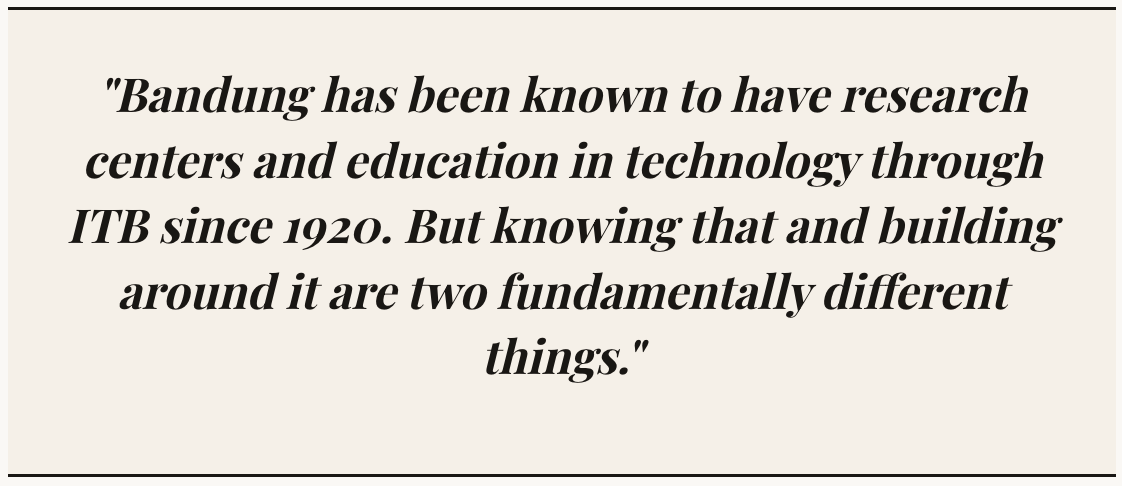
The Bandung High Tech Valley concept was not born in a startup pitch deck. It was a government initiative originating inside the Ministry of Industry and Trade of Indonesia as a mechanism to increase electronics export competitiveness. That was 1986. Bandung was chosen deliberately: it already had Institut Teknologi Bandung, founded during the Dutch East Indies period in 1920, and a constellation of state-linked technology institutions that had grown around it for decades.
Those institutions remain the structural backbone of the BHTV idea. PT Telkom, headquartered and operating its research center in Bandung. PT INTI, the electronics and telecommunications manufacturer. LEN, the National Electronics Institute. Omedata, handling IC bonding and packaging. PT Dirgantara Indonesia, the sole domestic aircraft manufacturer, formerly known as IPTN. PT Kereta Api Indonesia, managing railroad operations and rolling stock. These were not incidental presences. They represented a deliberate policy of clustering strategic industry around university talent.
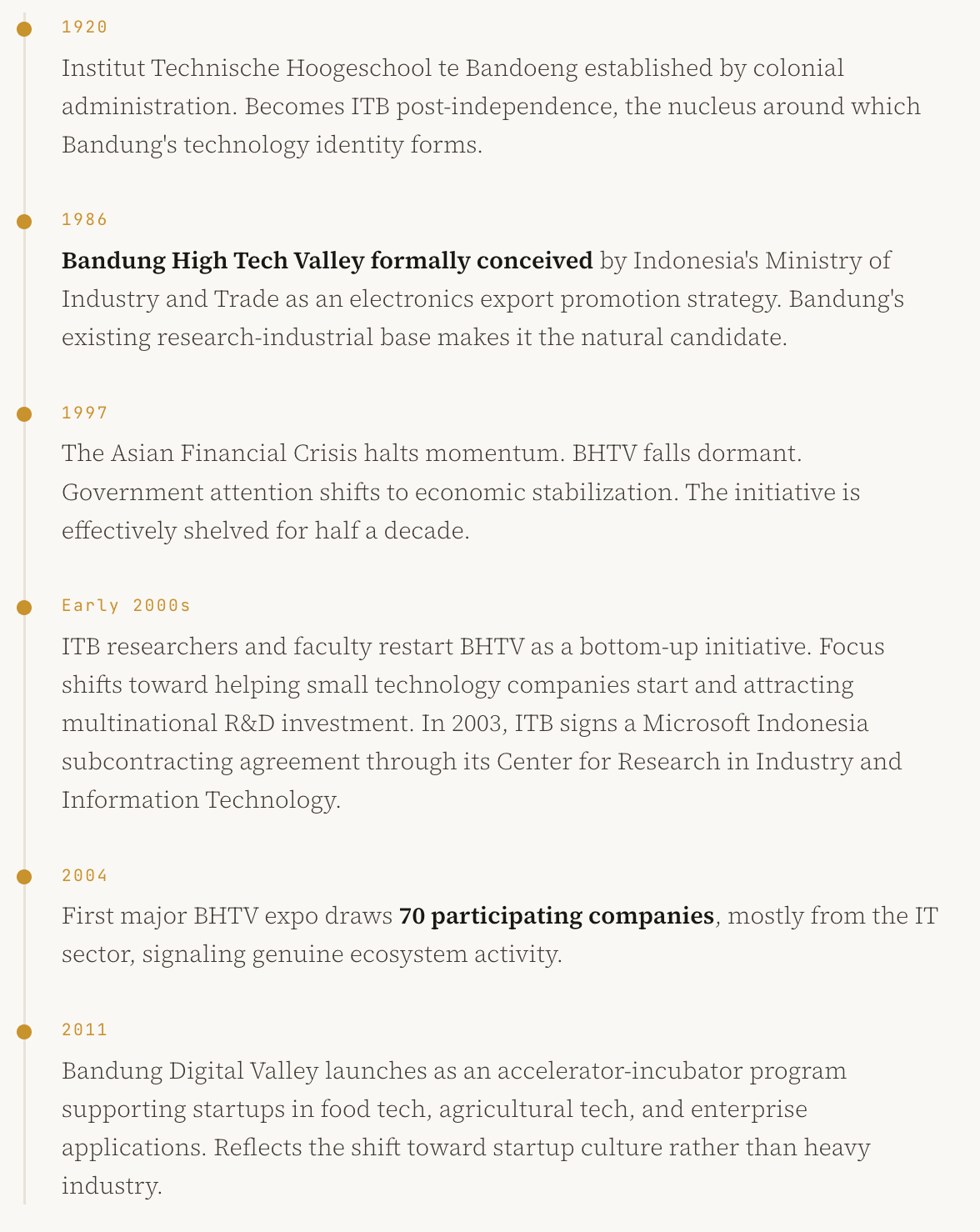
The 1997 crisis did to BHTV what crises tend to do to long-horizon development projects: it did not kill the idea, it just suspended it long enough that when it resumed, the world had changed. The restart in the early 2000s was different in character. The Ministry framework was replaced by a more organic university-led effort, and the focus pivoted from export manufacturing toward software, IT services, and offshore subcontracting. This was Bandung trying to become Bangalore, not Shenzhen.
The BBC noted this ambition in plain terms: the mayor of Bandung had a grand vision to turn the city into a tech capital, with investments in creative industries, a Star Trek-inspired city command center, and free public wi-fi across the city. Bandung was estimated to be Twitter's sixth largest user base globally at the time. The creative culture was real. The startup energy was real. The structural question was whether cultural momentum could translate into durable economic infrastructure.
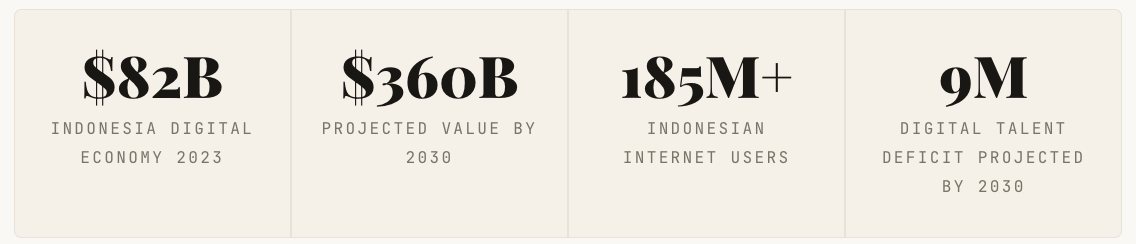
Research from the IMD World Competitiveness Center confirms what practitioners have observed: Bandung's information and communication sector serves as the primary driver of economic growth in the city. West Java's economic epicenter has been rapidly adopting digital solutions to optimize business operations, enhance public services, and foster a technology-driven ecosystem. The city demonstrates strong MSME diversification, particularly across food, beverage, and fashion industries, providing resilience that a pure tech monoculture would not have.
Market analysis from early 2026 reflects this dual reality. Java, especially Jakarta and Bandung, retains the majority of qualified cloud architects, AI engineers, and cybersecurity specialists. Salary inflation for senior DevOps engineers has hit double digits as demand outpaces supply. Bandung and Surabaya are gaining traction as secondary software development hubs, spurred by regional development initiatives and lower operational costs compared to Jakarta. The gravitational pull of the capital remains strong, but Bandung's ecosystem identity is holding.
Part II: Bukit Algoritma, the High-Stakes Detour Significantly Delayed
In June 2021, Indonesia got its most ambitious version yet of the Silicon Valley story. Bukit Algoritma, or Algorithm Hill, was groundbreaked on 888 hectares of land in Kecamatan Cikidang and Cibadak, Kabupaten Sukabumi, West Java, under the leadership of Budiman Sudjatmiko, the politician and activist who had framed the project as Indonesia's answer to the global tech power race. The target: a fully operational Industry 4.0 and human resource development center. The model: Silicon Valley, with Indonesian characteristics.
The investment picture presented at launch was extraordinary. Rp 18 trillion from Canada for Phase One infrastructure, to be executed by state-owned contractor PT Amarta Karya. Rp 1.7 trillion from Asian investors for sensor research serving Indonesian fishermen. Rp 1.4 trillion in renewable energy investment from Germany. No APBN money, Budiman emphasized repeatedly. This was private capital building Indonesia's technological future.
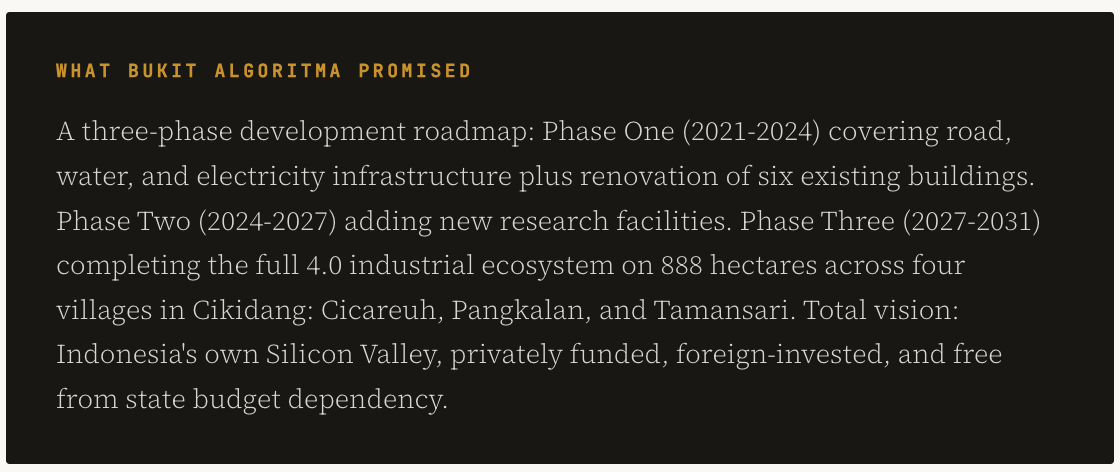
Three years later, the picture is materially different. By June 2024, on-site reporting found no construction activity at the location, only maintenance of pre-existing buildings. Budiman himself acknowledged that physical progress in Phase One had reached only 10 to 15 percent, still in renovation mode, with no new buildings erected. He stated that Phase One completion, originally targeted for 2024, could slide to 2025. "We are still waiting for new investors," he said. "The existing investors are not sufficient to build new buildings, so the focus is more on renovation."
PT Amarta Karya, the main Phase One contractor, became entangled in a separate legal case at the KPK, Indonesia's Corruption Eradication Commission. Budiman denied any connection between that legal situation and the project's slow progress. Infrastructure access remained a constraint: the project was waiting on continued operations of Tol Bogor-Ciawi-Sukabumi, the BOCIMI toll road, to resolve accessibility challenges.
The local village head, speaking to reporters in 2023, said there had been no clear information about the project's trajectory from the community's perspective. The gap between the ambition announced at groundbreaking and the visible reality on the ground was not small.
Why Bukit Algoritma's Struggles Matter Structurally
Bukit Algoritma is not simply a project that ran behind schedule. It represents a particular theory of how to build a technology ecosystem: choose a greenfield site, announce massive investment commitments, generate political and media momentum, and let execution follow. This theory has a long track record globally, and that track record is mixed. Greenfield tech campuses require simultaneous success across infrastructure, investor attraction, talent relocation, and institutional trust. Any one of those failing can cascade.
The contrast with how Silicon Valley actually formed is instructive. Stanford's proximity to early semiconductor companies, defense department procurement creating early market demand, a venture capital culture that developed organically over decades, and a tolerance for failure that was embedded in California's labor law and culture. These conditions were not planned by a ministry or announced at a groundbreaking. They accumulated over fifty years of accidents and adaptations.
Indonesia's ADB brief on startup ecosystems made a comparable observation: talent development requires four simultaneous channels, through the education system, through incubators and accelerators, through the startups themselves, and through experience gained in other established firms. A single large site does not automatically activate all four.
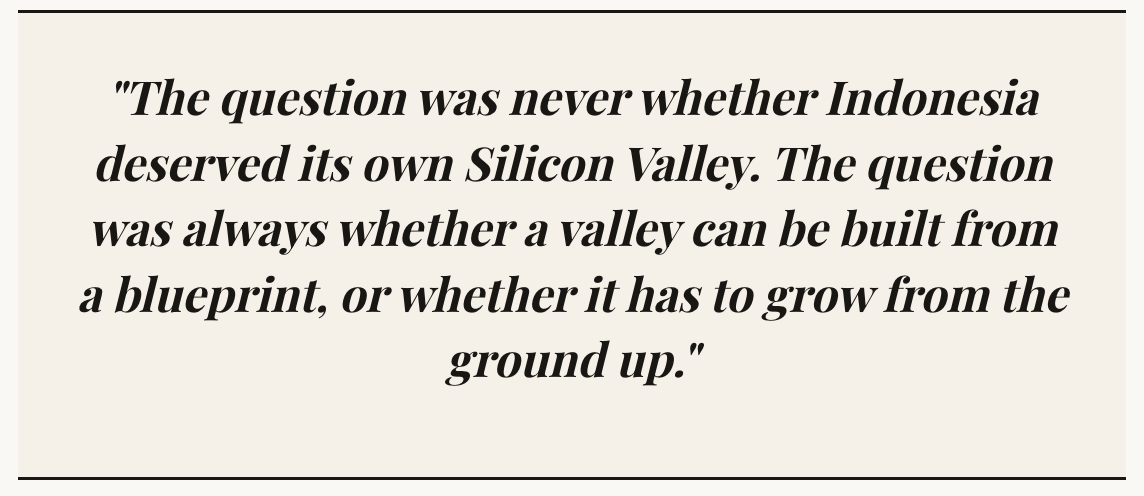
Part III: ITB Jatinangor, the Credible Next Iteration
Actively Developing
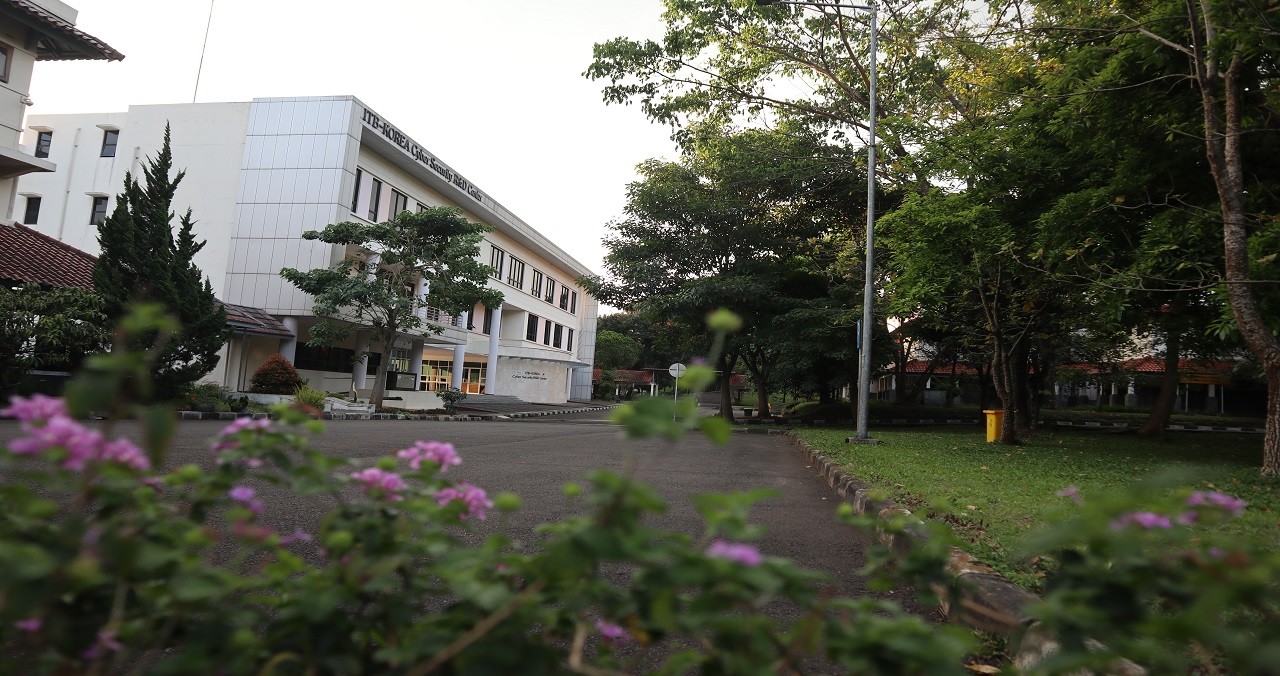
While Bukit Algoritma commanded the headlines, something more methodical and arguably more consequential was developing 25 kilometers east of Bandung's Ganesha campus. ITB Jatinangor, established on a 47-hectare site that once housed Universitas Winaya Mukti, has been systematically developed as ITB's second campus since the 2010s. Since August 2023, all ITB freshmen have completed their Joint Preparatory Stage, the Tahap Persiapan Bersama, at Jatinangor. The campus now runs 12 programs. The institutional commitment is real and growing.
The master plan for ITB Jatinangor carries a specific concept: "High Tech and Eco Campus." The plan aims for the campus to function as a showcase and model for technology, science, and art for both local and global audiences. It emphasizes flexibility, adaptability, sustainability, and independence. The spatial design prioritizes green networks linking facilities, water resource conservation through advanced treatment technologies, and flexible space that can expand, convert, and adapt to varied academic and non-academic needs.
Research Infrastructure Taking Shape
The most significant development at Jatinangor in 2024 was the inauguration of the China-Indonesia Joint Research Laboratory for New Energy Materials and Metallurgical Engineering Technology. Inaugurated on August 28, 2024, by Coordinating Minister Luhut Binsar Pandjaitan and ITB Rector Prof. Reini Wirahadikusumah, the laboratory was established in partnership with Central South University in China and GEM, a major battery materials firm.
The facility is not a symbolic ribbon-cutting. It is equipped with over 300 sets of world-class instruments and builds an innovation system spanning exploratory research through small-scale scientific study to semi-industrial experimental research. Since Semester 1 of the 2024-2025 academic year, ITB has launched a Multidisciplinary Master's and Doctoral Program in Battery Materials using the laboratory's facilities. Ten master's students and two doctoral candidates hold ITB-GEM scholarships. CSU master's students conduct thesis research at the joint lab, co-supervised by faculty from both institutions.
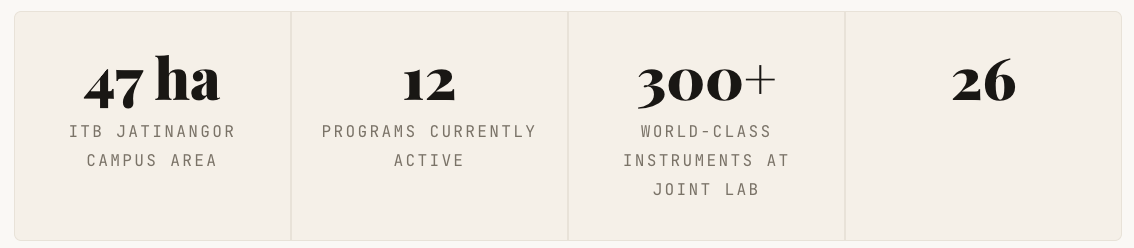
Over the five years ending in late 2024, ITB constructed, revitalized, and renovated a total of 26 facilities across its multi-campus network, including Jatinangor. The Science Techno Park building was inaugurated in November 2024. The Jatinangor campus received a new GKU 3 building from a former library renovation, campus infrastructure including pedestrian paths and the main road network, and student facilities including a basketball court and co-working space. These are the physical preconditions for a genuine research community, not just a classroom extension.
The Academic Programs Signal the Direction
The study programs planned for Jatinangor tell a coherent story about what kind of campus this is meant to become. They span forestry and agricultural engineering, bio-engineering, food technology, post-harvest technology, water resources engineering, hydrographic engineering, informatics engineering, system and information technology, environmental infrastructure engineering, and economic innovation. These are not randomly selected departments. They represent the disciplines where Indonesia's most urgent sovereign capability gaps intersect with global research frontiers: food security, energy materials, bioengineering, and water systems.
The research philosophy articulated for Jatinangor is equally deliberate. The campus prioritizes research that produces prototypes following the full process chain from beginning to end, research that utilizes Indonesian natural resources, research with close relationships to educational programs and community service, and research that does not structurally depend on foreign institutional partnerships to function. That last criterion is a quiet but important statement about self-sufficiency.
The Structural Argument for Bandung
Stepping back from the individual narratives, what is the actual case for Bandung as Indonesia's technology center? It rests on several compounding advantages that have been present for a century and are deepening rather than diminishing.
University Density and Research Output
ITB alone operates 24 research centers, 111 research groups, and 198 laboratories. It holds QS World Rankings placement at 235 globally and 63 in Asia as of recent rankings, with engineering and technology ranked at 179 worldwide. These are competitive positions for a Southeast Asian institution. The university produces 1,247 Scopus-indexed journal publications, 421 international journal articles, and 674 international conference proceedings. This is active research infrastructure, not legacy credential.
Surrounding ITB are Telkom University, Universitas Padjadjaran, Universitas Pendidikan Indonesia, and a cluster of polytechnics and vocational institutions. The combined talent pipeline from this university ecosystem is one of the densest outside Jakarta in the entire archipelago.
Industrial Anchors Providing Market and Mentorship
The state-owned and state-linked enterprises clustered around Bandung provide something that greenfield tech parks perpetually struggle to replicate: early customer demand and senior engineering mentorship. PT Telkom's research operations, LAPAN, LEN, and PT Dirgantara Indonesia collectively represent decades of systems engineering experience. Graduates from ITB who join these organizations, or who spin out of them to start companies, have access to domain expertise that pure startup ecosystems rarely accumulate quickly.
Market data confirms this advantage. Indonesia's digital transformation market analysis notes that Bandung leverages university-linked innovation hubs and established manufacturing clusters to trial Industry 4.0 upgrades. This is precisely what Silicon Valley's defense industry adjacency provided in the 1960s and 1970s: a sophisticated customer base that understood technical complexity and had budget to pay for it.
Lower Cost Structure Attracting Distributed Capital
Compared to Jakarta, Bandung offers substantially lower operational costs for technology firms. This matters most for companies in the product-building phase that need to extend their runway without compromising engineering quality. As remote and hybrid work structures become permanent features of the technology industry, the historical penalty for not being in the capital has diminished significantly. A senior engineer in Bandung producing the same output as one in Jakarta at a fraction of the housing and commute cost represents a genuine competitive advantage for companies willing to locate there.
What the Convergence Looks Like in 2026
The three stories, original BHTV, Bukit Algoritma, and ITB Jatinangor, are converging toward a different kind of technology geography than the Silicon Valley metaphor suggests. Silicon Valley is a single dense cluster. What Bandung is building, slowly and often chaotically, is something more distributed: a corridor of interconnected nodes stretching from Bandung's Ganesha core eastward through Jatinangor into Sumedang, with Sukabumi as a potential southern extension if Bukit Algoritma ever resolves its infrastructure and investor challenges.
The corridor model may actually be more appropriate for Indonesia's geography and governance structure than a single-point cluster. Bandwidth for digital collaboration has made physical co-location less mandatory than it was when Silicon Valley formed. What matters is shared talent pipelines, institutional trust, regulatory predictability, and access to capital. The first two exist in the Bandung corridor. The third and fourth are still works in progress.
The Indonesian government's broader AI push reinforces the opportunity. Microsoft committed USD 1.7 billion to Indonesia, the company's largest investment in the country's 29-year history, including infrastructure across Java and a commitment to upskill 840,000 Indonesians. Alibaba targets 800,000 trained in cloud computing and AI by 2033. Tencent pledged USD 500 million for infrastructure by 2030. These hyperscaler commitments are largely Jakarta-centric today, but they generate downstream demand for engineering talent that Bandung is structurally positioned to supply.
The Lessons and the Honest Assessment
Indonesia has announced its Silicon Valley ambition many times. The announcement itself has never been the constraint. What the history of BHTV, the status of Bukit Algoritma, and the trajectory of ITB Jatinangor collectively reveal is a more specific set of conditions that determine whether the ambition materializes.
First: institutional anchors matter more than blueprints. ITB's century of engineering education created the talent base. Bukit Algoritma's 888-hectare blueprint created a press release. Institutions compound; announcements depreciate.
Second: infrastructure must precede investment, not follow it. Bukit Algoritma's dependence on the unfinished BOCIMI toll road to resolve its accessibility problem illustrates what happens when a development thesis assumes that if you announce a vision, roads will appear. Roads must appear first. Jatinangor's integration into Sumedang's existing road network, and its proximity to Bandung, gives it a structural advantage that Sukabumi's hilly terrain cannot easily replicate.
Third: the talent-to-institution loop must close locally. The most valuable output of any technology cluster is not the companies that form; it is the experienced engineers who move between companies, carrying tacit knowledge that no curriculum can formalize. That loop closes when engineers trained locally stay locally and when the institutions around them give them reasons to. ITB Jatinangor's co-working spaces, joint research labs, and student startups are small but real beginnings of that loop closing.
Fourth: foreign partnerships accelerate but do not substitute for local institutional depth. The China-Indonesia joint research lab at Jatinangor is valuable because it brings instrumentation and research methodology that would take a decade to build independently. But the program is designed to produce ITB graduates who carry that methodology forward on their own. That is the right architecture.
The Bandung High Tech Valley dream is not dead. It is maturing, slowly and unevenly, into something that looks less like Silicon Valley and more like Bangalore: a city that became a technology hub not because of a single grand plan but because of decades of unglamorous institutional investment in education, infrastructure, and the gradual accumulation of engineering culture.
Indonesia has the ingredients. West Java has the geography. ITB has the institutional weight. What remains is the patience to build at the pace that ecosystems actually grow, which is longer than any politician's term and shorter than any generation's working life.
Further Reading and References
Research drawn from: Wikipedia BHTV historical record • ITB official campus documentation • Mordor Intelligence Indonesia digital transformation market report (January 2026) • ADB Brief No. 228 on startup ecosystems in Indonesia • ResearchGate / Green Technology Innovation Journal: "Beyond Silicon Valley: Bandung's Ecosystem Approach to Digital Economic Development" (November 2025) • Sukabumiupdate.com Bukit Algoritma field reporting (2021-2024) • Republika Bukit Algoritma investor timeline • Detik Finance Bukit Algoritma progress update • ITB.ac.id official news: China-Indonesia Joint Research Lab (August 2024), ITB Talks Multicampus (January 2024), Development Programs Launch (November 2024) • Malay Mail / MediaOutreach: Cyberport-Telkom University MoU (November 2025) • BBC Business: "Why Bandung could be Indonesia's Silicon Valley" • Digital Transformation Summit Indonesia data.
#BandungHighTechValley #IndonesiaTech #SiliconValley #BukitAlgoritma #ITBJatinangor #WestJava #DigitalEconomy #StartupIndonesia. #TechEcosystem #Innovation #Indonesia #Bandung #Infraloka #CloudNative #AIIndonesia #Industry40 #ResearchAndDevelopment #UniversityInnovation #TechPolicy #FutureOfWork