
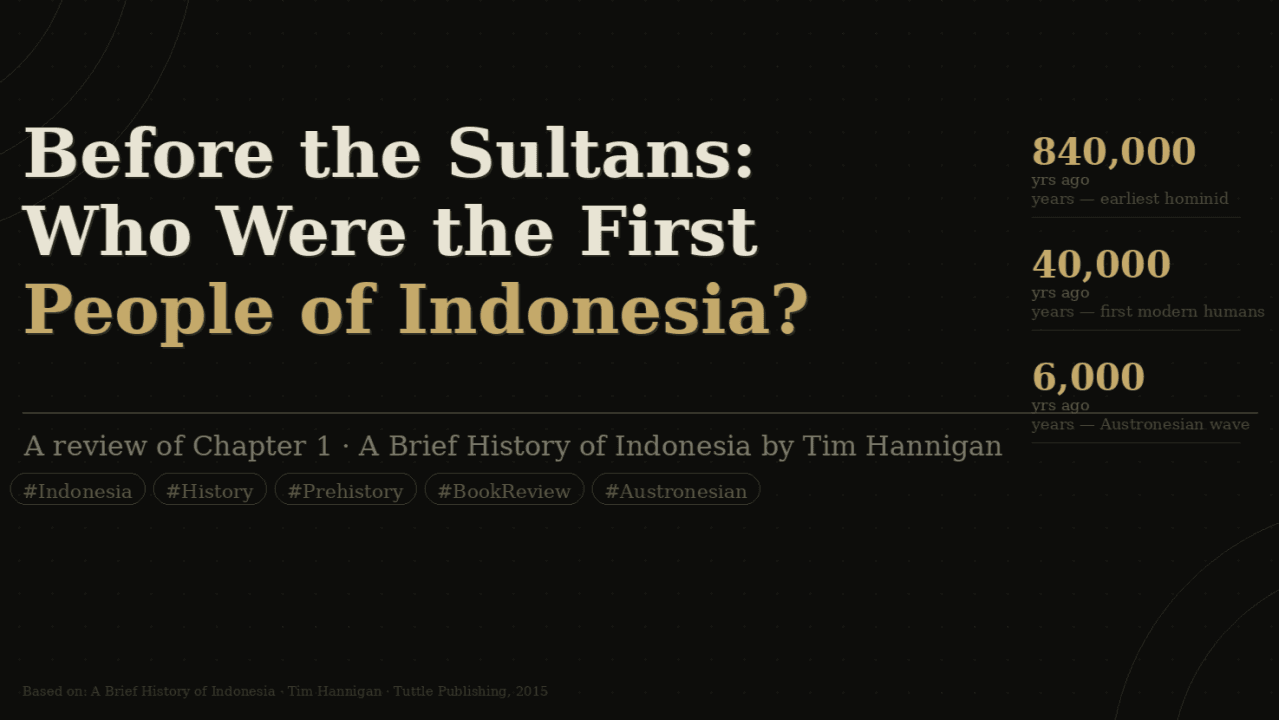
Before the Sultans: Who were the first people of Indonesia? A review of Chapter 1 of A Brief History of Indonesia by Tim Hannigan — tracing humanity's
Most people know Indonesia as a nation of sultans, spices, and colonial legacy. But long before any of that — long before the first Hindu kings adopted Sanskrit titles, before Islam arrived by sail — the islands that make up the world's largest archipelago were home to some of the most remarkable chapters in the human story.
Tim Hannigan's A Brief History of Indonesia opens with an extraordinary journey through deep prehistory. Chapter 1, titled "From Hobbits to Hinduism," introduces the first inhabitants of the Archipelago — and the account is nothing short of astonishing.
The pre-human inhabitants
Java Man and the Flores Hobbit
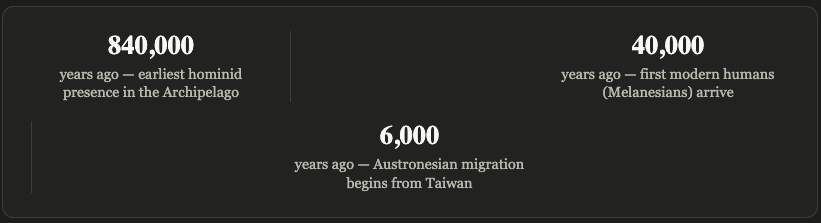
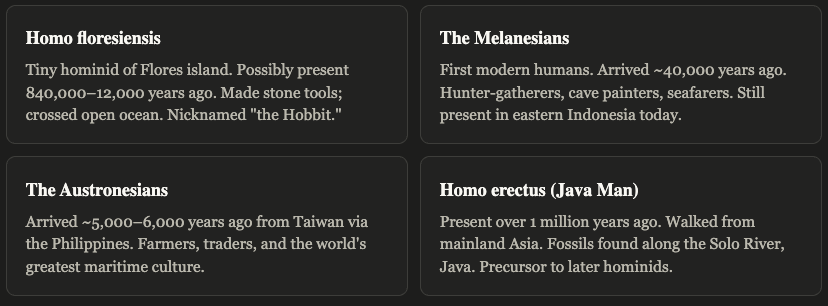
Before any modern human set foot in what is now Indonesia, the islands were already occupied. Along the banks of the Solo River in Java, fossils of Homo erectus — popularly known as "Java Man" — have been found dating back over a million years. Thickset, heavy-jawed, and beetle-browed, these early hominids are believed to have walked overland from mainland Asia when sea levels were far lower than today.
But the truly jaw-dropping discovery came in 2003, when a joint Indonesian-Australian team unearthing the floor of Liang Bua cave on the island of Flores found an 18,000-year-old skeleton barely three feet tall. The media quickly dubbed it "the Hobbit." Scientists named the putative new species Homo floresiensis.
"Something almost human had made the first serious maritime journey in Indonesian history — across the Lombok Strait — at least 95,000 years ago, and possibly as far back as 840,000 years."
What makes this creature so remarkable is not its size, but what its existence implies: it had crossed open ocean to reach Flores long before modern humans were anywhere near the region. The Lombok Strait, a deep channel that has never dried even during Ice Age sea-level drops, would have required a deliberate water crossing — making this possibly the earliest known maritime journey in history. The Hobbit's descendants apparently survived in the forests of Flores until around 12,000 years ago, perhaps even coexisting with the earliest modern human arrivals.
Local legend & science
The people of Flores had long told stories of small forest beings called the Ebu Gogo — hairy, wide-mouthed creatures that raided villages. Hannigan suggests these oral traditions may carry a cultural memory of actual contact between modern humans and Homo floresiensis. Science and myth, it turns out, are not so far apart.
The First Modern humans, The Melanesians: pioneers of the Archipelago
The first Homo sapiens to reach the Archipelago were the Melanesians, arriving approximately 40,000 years ago. Dark-skinned and curly-haired, they were hunter-gatherers who moved through open forests and along coastlines, hunting animals, gathering plants, and fishing the warm seas. They carried stone axes, buried their dead, and — in one of the most evocative details Hannigan offers — sometimes pressed their hands against cave walls and blew ochre pigment around them, leaving ghostly silhouettes as proof of their presence.
Their migration was aided by the Ice Age geography of the region: with sea levels far lower than today, much of what is now shallow water between Sumatra, Java, and Borneo was dry land, allowing extensive overland travel. But the Melanesians also proved willing to cross open water when necessary, eventually reaching New Guinea and launching what would become the settlement of the entire Pacific.
Today, their descendants remain the dominant population in the eastern reaches of Indonesia — East Nusa Tenggara, southern Maluku, and New Guinea — though the great episodes of Indonesian history mostly unfolded further west, in Java and Sumatra.
The Second Wave, The Austronesians: the world's greatest maritime people
Around 6,000 years ago, a far more dramatic migration began. From the interior of southern China, a group of people migrated to Taiwan. From there, propelled by overpopulation, they took to small outrigger canoes and began one of the most extraordinary dispersals in human history.
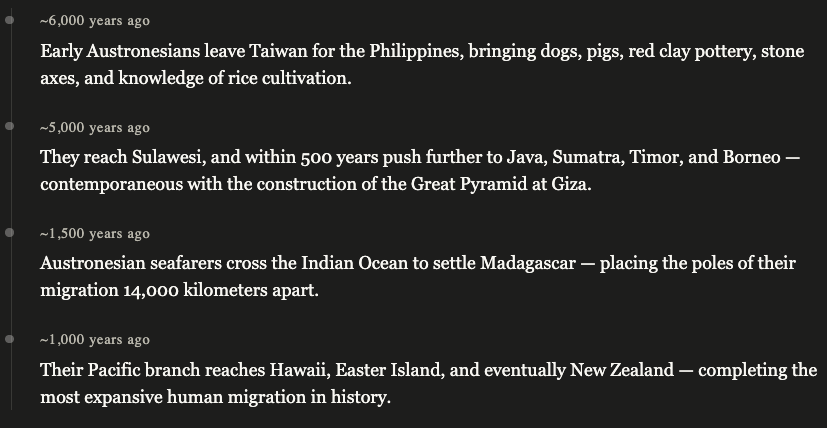
In the Archipelago, the Austronesians settled into villages, raised pigs and chickens, cleared forests for rice cultivation, and gradually differentiated into the peoples we now call the Javanese, Balinese, Malays, and dozens of other distinct groups. Theirs was a society of clans and scattered settlements, without kings or unified political structures — but with a remarkable cultural continuity that still surfaces today in architecture, ritual, and the treatment of the dead.
Who were they? Four founding peoples at a glance
Why this chapter matters
Hannigan writes popular history with the pace of a thriller and the eye of a novelist. What strikes me most about Chapter 1 is how it reframes Indonesia's story entirely. We often begin the history of this region with Hindu kingdoms or Islamic sultanates. Hannigan insists — rightly — that the deeper story is far older, stranger, and more human.
The idea that a tiny, tool-using hominid was already navigating the open seas of the Archipelago hundreds of thousands of years before Homo sapiens arrived is genuinely humbling. And the Austronesian expansion — invisible to most world history textbooks — stands as one of humanity's greatest achievements, a slow-motion epic that placed people from the same origin culture in Madagascar, Hawaii, and Easter Island simultaneously.
If you're Indonesian, or simply curious about Southeast Asia, this opening chapter alone is worth the read. It reminds us that the ground beneath Indonesia's mosques and rice terraces holds layers of human presence that stretch back almost beyond imagination.
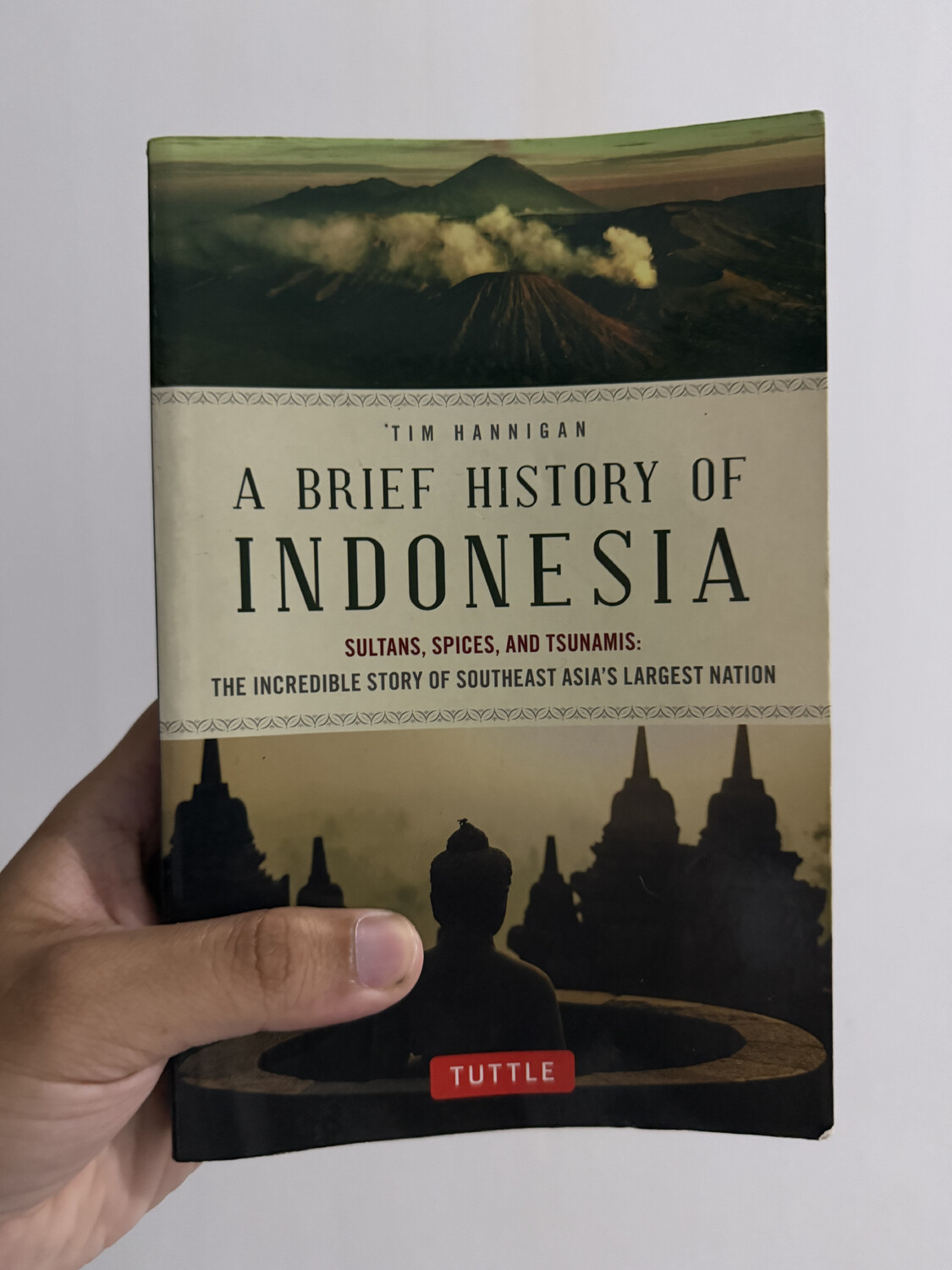
📚 A Brief History of Indonesia: Sultans, Spices, and Tsunamis by Tim Hannigan (Tuttle Publishing, 2015) is available in major bookstores and online platforms. Recommended for anyone curious about Southeast Asian history.
#Indonesia #History #Prehistory #BookReview #Austronesian #SoutheastAsia