
BOWOBHARATA: The War That Never Fought — Yet Won Everything By Rahmat Wibowo From InfraLoka
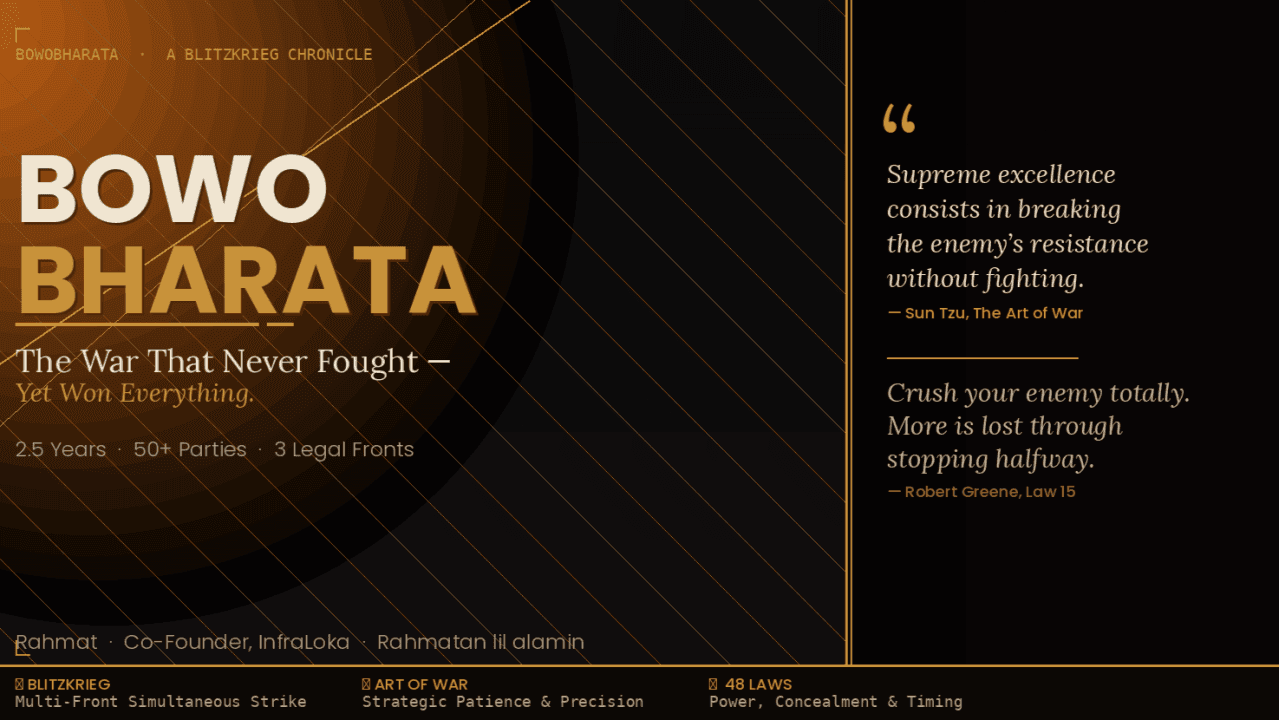
Two and a half years. 50+ parties. One Pandava against an army of Kurawas. This is not a story of rage — it is a study in strategic patience.
"In the midst of chaos, there is also opportunity."
Sun Tzu — The Art of War
I. The Declaration
In the Mahabharata, the Pandavas did not begin the war. They were pushed into it — stripped of their kingdom, humiliated, exiled for thirteen years. Yet when the moment came, they did not hesitate. They had prepared in silence. They struck with precision.
I call my own journey Bowobharata — a personal Mahabharata. For over two and a half years, I faced a coordinated campaign of harassment, defamation, and digital sabotage by individuals and groups connected to a dispute at ITB and across multiple platforms. More than 50 organisations and individuals. Documented. Named. Tracked.
I did not panic. I did not retaliate blindly. I collected every piece. I built my case brick by brick. And now — the Blitzkrieg begins.
"If you know the enemy and know yourself, you need not fear the result of a hundred battles."
— Sun Tzu — The Art of War, Chapter 3
For two years, I studied. I mapped every actor, every pattern, every legal lever. The Kurawa mistook my silence for weakness. In Sun Tzu's language: I appeared weak when I was strong.
II. The Blitzkrieg Method
The Blitzkrieg — German for "lightning war" — was not about brute force. It was about speed, shock, and multi-front simultaneous pressure that overwhelmed the enemy before they could coordinate a defence.
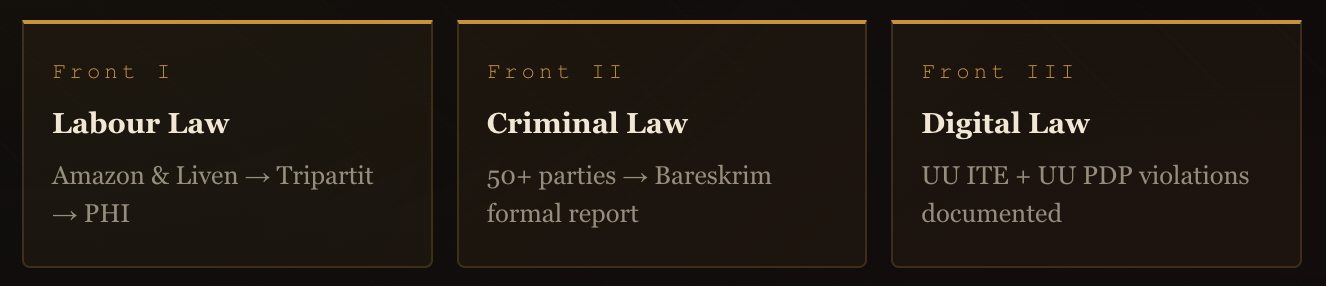
My Blitzkrieg is legal, structured, and relentless. It moves on three simultaneous fronts:
"Attack him where he is unprepared, appear where you are not expected."
— Sun Tzu — The Art of War, Chapter 1
The power of the Blitzkrieg is not just the attack — it is the simultaneity. While the Kurawa are busy defending one flank, three others open. They cannot focus. They cannot strategise. They are overwhelmed not by force, but by structured inevitability.
"Crush your enemy totally. More is lost through stopping halfway than through total annihilation."
— Robert Greene — 48 Laws of Power, Law 15
III. The Art of War: Applied
Sun Tzu wrote for generals. But his principles are timeless — they apply to every arena where conflict, strategy, and power converge. I applied them not on a battlefield, but in the halls of institutions, in the corridors of Indonesian labour and digital law.
Principle: The Supreme Art
"The supreme art of war is to subdue the enemy without fighting."
↳ My first choice was always dialogue. I extended an open invitation at Wisuda ITB April 2026. No one came. That refusal is now part of the evidence.
Principle: Strategic Patience
"Move swift as the Wind and closely formed as the Wood. Attack like the Fire and be still as the Mountain."
↳ For 2.5 years I was still as the Mountain. I collected. I documented. I endured. The fire comes now.
Principle: Knowing the Field
"Victorious warriors win first and then go to war, while defeated warriors go to war first and then seek to win."
↳ I spent two years studying Indonesian law — UU ITE, UU PDP, KUHP, labour mechanisms — before filing a single report. The Kurawa acted first and planned never.
IV. The 48 Laws of Power: My Playbook
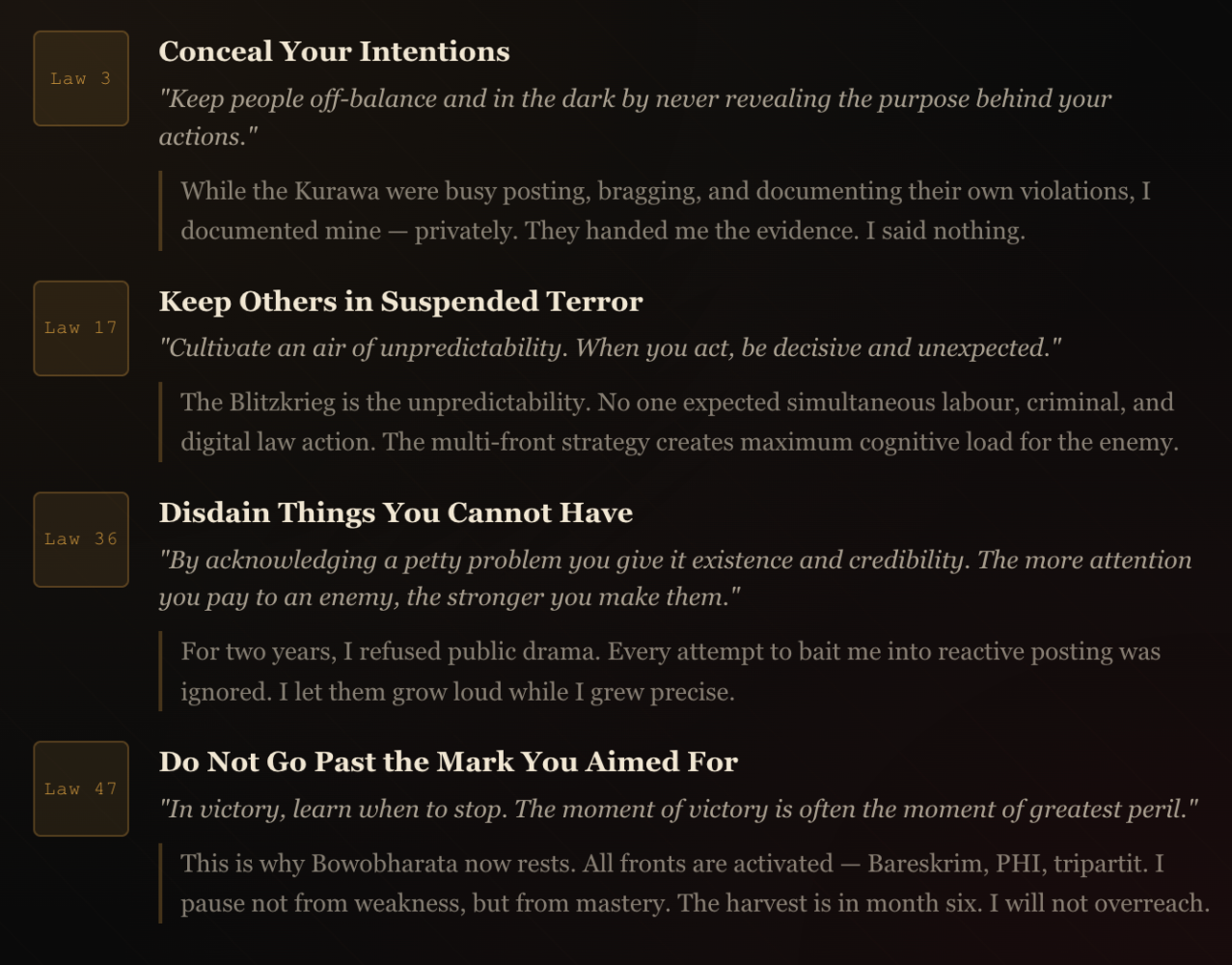
Robert Greene's 48 Laws of Power is not a manual for villainy — it is a mirror held up to power itself. To understand it is to decode the game being played against you — and to play it better.
V. Wanaparwa: The Pause Before the Harvest
In the Mahabharata, the Pandavas spent thirteen years in exile — Wanaparwa — before they reclaimed what was theirs. It was not wasted time. It was incubation.
"He will win who knows when to fight and when not to fight."
— Sun Tzu — The Art of War, Chapter 3
Bowobharata now enters its Wanaparwa. All legal mechanisms are activated. The 4-month pause is not retreat — it is the Pandava disappearing into the forest to emerge, transformed.
During this time, I build InfraLoka. I build community. I build the evidence of a life lived forward, not consumed by those who sought to destroy it. Ternak hasidin — cultivate, grow, and prepare for the panen raya.
"Never put too much trust in friends, learn how to use enemies."
— Robert Greene — 48 Laws of Power, Law 2
Every enemy I have faced has, ultimately, strengthened me. Every document they created became evidence. Every platform they weaponised became a witness. The Kurawa built my case for me — and for that, I am almost grateful.
To the Kurawas
"In the midst of chaos, there is also opportunity." — Sun Tzu
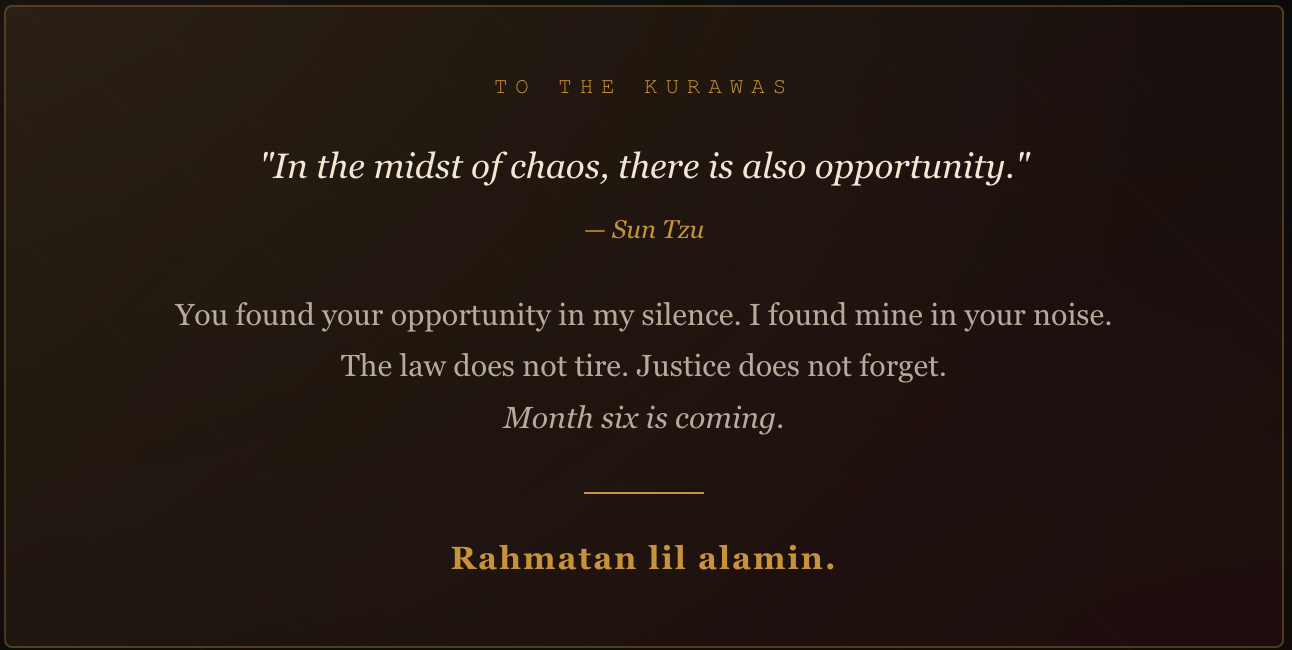
You found your opportunity in my silence. I found mine in your noise. The law does not tire. Justice does not forget. Month six is coming.
#Bowobharata#Blitzkrieg#ArtOfWar#48LawsOfPower#Keadilan#HukumIndonesia#InfraLoka#Pandawa#RahmatanLilAlamin#Bareskrim#UU_ITE#LinkedInArticle