
Ibrahim Arief Chromebook Case: Public Record vs the Personal Dispute Behind Kawal Ibam
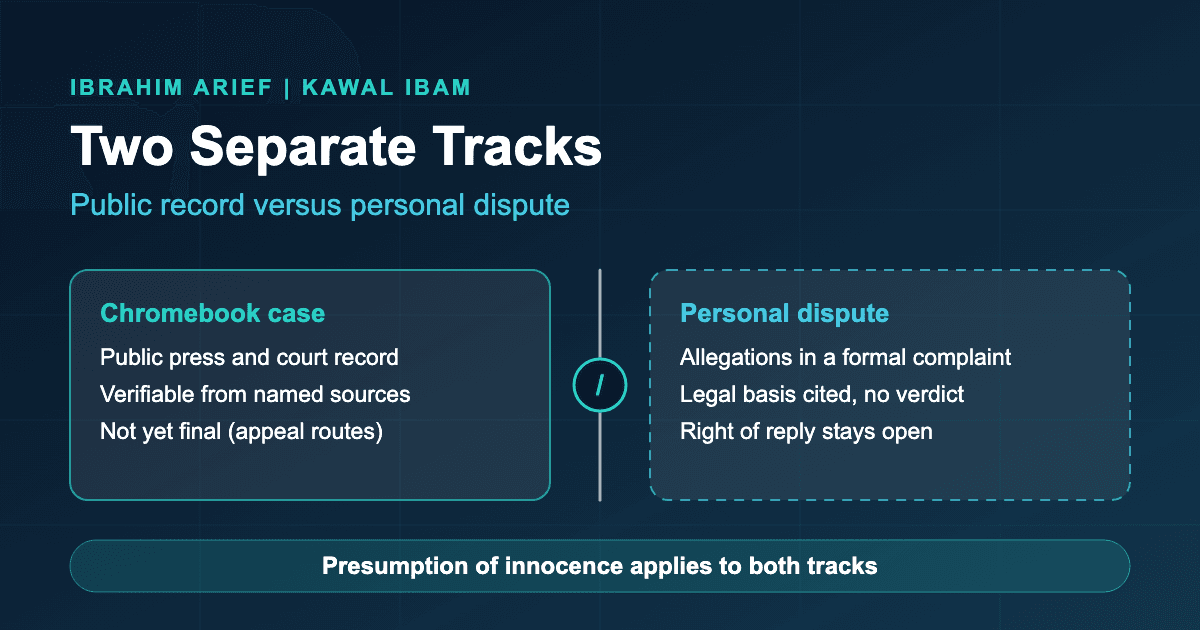
The Chromebook corruption case and the personal dispute around the #KawalIbam campaign are two different things with two different evidence bases. This piece keeps them apart: what the press and the courts have recorded, what is only an allegation in a formal complaint, and the legal-literacy points that stop anyone from reading one as proof of the other.
RAHMAT WIBOWO | 23 OCTOBER 2026
Why this separation matters
In my fallacy audit of the #KawalIbam campaign, I try to keep two things apart that public conversation often mixes together. The first is a criminal case that has already become part of the official court record. The second is a personal dispute between me and Ibrahim Arief ("Ibam") that runs on a separate track.
Some context on the dispute. I am a private individual. I have never had an employment relationship, a reporting line or a performance-review relationship with Ibrahim Arief. From around September 2023, I became the subject of public comment by Ibam and his circle. The comment included a "toxic talent" label, a personal "never-hire list" that named me, and a threat to invoke Article 45B of the ITE Law (Law 19/2016) against anyone who repeated criticism of him. Ibam later became a defendant in the Chromebook laptop procurement corruption case, which is unrelated to the dispute between us. The #KawalIbam campaign, largely built on testimony from outsiders rather than the facts of the case, ran alongside that legal process.
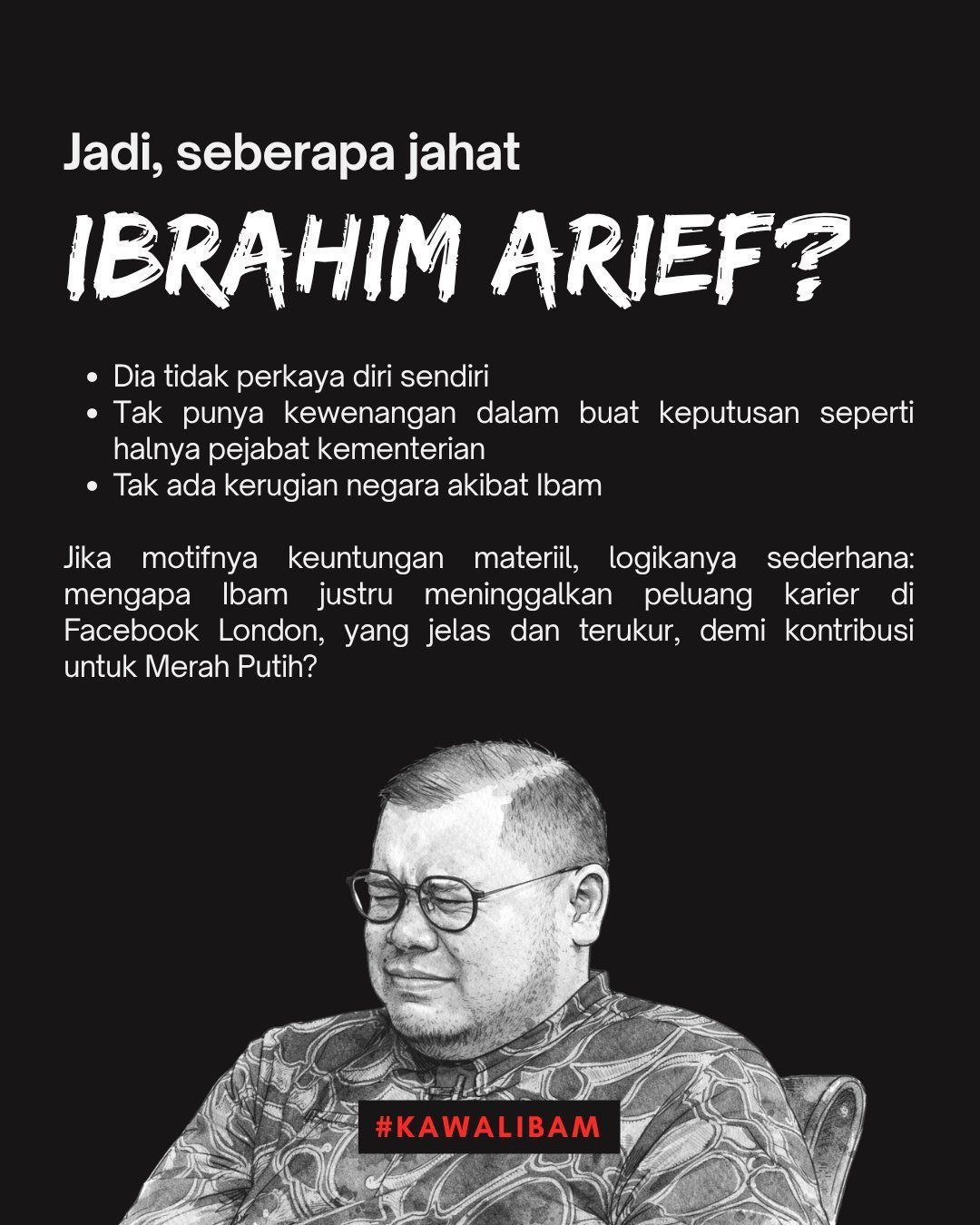
Everything below is an analysis of rhetoric and a summary of public reporting. It is not a verdict.
Track one: the Chromebook case, a public press and court record
Ibrahim Arief held the status of defendant, and then convicted person, in the case concerning alleged corruption in the procurement of Chromebook laptops and Chrome Device Management at the Ministry of Education, Culture, Research and Technology (Kemendikbudristek) for 2019-2022. The alleged state loss is around Rp1.9 trillion. These points have been widely reported and can be checked independently:
- The Attorney General's Office named him a suspect on 15 July 2025, together with three other suspects from the ministry.
- Prosecutors demanded 15 years in prison, a Rp1 billion fine and Rp16.9 billion in restitution.
- The Corruption Court found him guilty, with a split bench: the judges still declared him guilty, but some of them held that there was no malicious intent (mens rea) in his conduct.
- On appeal, the High Court increased the sentence to 5 years in prison and a Rp500 million fine.
- Prosecutor Roy Riady stated at trial that Ibrahim Arief was paid Rp163 million per month as a consultant. According to the judge's remarks when questioning a witness, that is two to three times the pay of a ministerial special staff member in the same period.
The sources are named so you can check them yourself: Tempo, Hukumonline, Kompas, Tirto, IDN Times and detikNews (listed at the end of this piece).
Two cautions apply even to this track. First, the source of every point above is press and court reporting, not my own evidence. Second, a case that has not reached final and binding force (inkracht) can still change if further legal remedies, such as cassation or judicial review (PK), are pursued and not yet final. The presumption of innocence continues to apply to any case that is not final.
The Chromebook case also stands alone legally. I list it as publicly recorded context, not as additional proof of anything in the personal dispute.
Track two: the personal dispute and its complaint basis
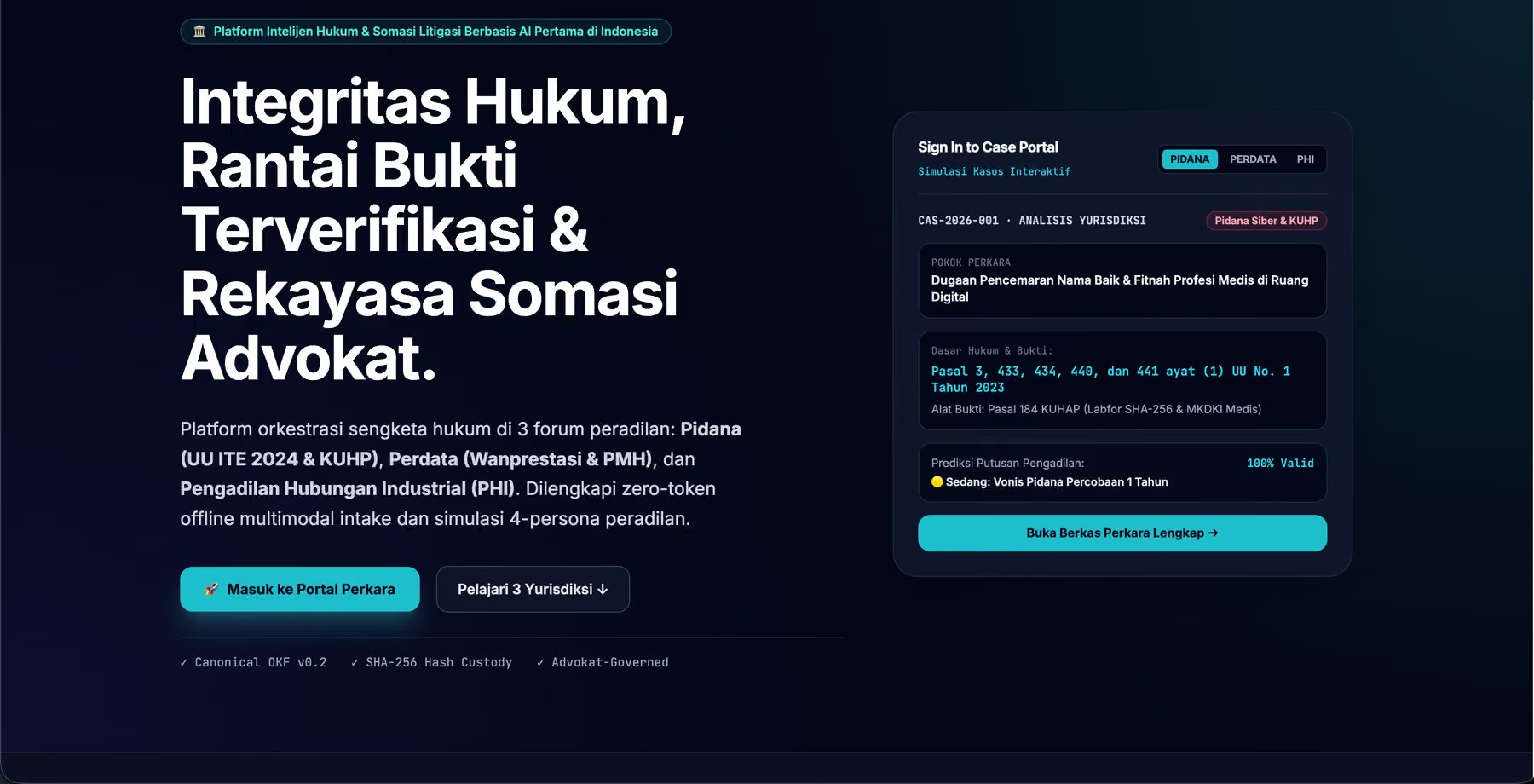
Separately, I have prepared a formal complaint about the pattern of statements documented in the audit. It is a self-prepared complaint based on Article 108 of the Criminal Procedure Code (KUHAP). The legal basis it cites is a summary, not a verdict:
| Alleged violation | Legal basis | Maximum penalty |
|---|---|---|
| Defamation through electronic means | Articles 433 in conjunction with 441, Law 1/2023 (new KUHP) | 9 months plus one-third aggravation, category II fine |
| Slander | Article 434, Law 1/2023 | 3 years, category IV fine |
| Intimidation through an electronic system | Article 45B, Law 1/2024 (ITE Law) | 4 years, Rp750 million fine |
| Obstructing access to justice for persons with disabilities | Articles 145 in conjunction with 143(r), Law 8/2016 | 2 years, Rp200 million fine |
Resolution outside the criminal route was allegedly tried first. Three warning letters (somasi) were recorded between April and August 2026. The third, dated 31 August 2026, allegedly received no response before the deadline it set.
This table lists the articles that were filed in the complaint, not articles that a court has decided. A person named in a complaint (terlapor) is not the same as a suspect, defendant or convicted person. The legal status of this dispute is still running through its own stages, and it must be read with the presumption of innocence fully in force.
Legal literacy: what corruption law requires before anyone says "proven"
Public accountability talk about executives and officials goes wrong when allegations are read as findings. A few general legal points explain why. They are educational only. I do not conclude that any element is met in any case, company or person discussed in the audit.
Corruption is a special law. The corruption provisions of the new KUHP (Law 1/2023) continue the earlier Anti-Corruption Law (Law 31/1999 as amended by Law 20/2001, the "Tipikor Law"). Under the principle of lex specialis derogat legi generali, the Tipikor Law applies as the special law over the general KUHP provisions unless expressly revoked, so investigators can test an act against both regimes in parallel. Article 603 of the new KUHP covers unlawfully enriching oneself, another person or a corporation in a way that harms state finances or the economy, with life imprisonment or 2 to 20 years. Article 604 covers abuse of authority or position that harms state finances. Their counterparts in the old Tipikor Law are Article 2 and Article 3.
State loss needs an official audit. The official elucidation of Article 603 states that the element of "harming state finances" must be proven through an official audit by the Supreme Audit Agency (BPK), not on the assumptions or estimates of any party, including a complainant.
Corporate liability has conditions. The new KUHP (Articles 46-49) holds a corporation criminally liable when at least one of five conditions is met: the act falls within the corporation's business scope, it unlawfully benefits the corporation, it was accepted as corporate policy, the corporation failed to take necessary preventive steps, and/or it allowed the offence to happen. Liability can fall on the corporation itself and on functional managers, those who gave orders or those who hold control (Article 49). The fine for a corporation is at least category IV, or about Rp200 million (Article 121(1)).
Why this is slow. The BPK audit requirement and the five corporate-liability conditions explain why corruption cases generally take long to investigate. A "proven corruption" conclusion cannot be drawn from early indications alone. It waits for audit and formal proof by the competent institutions.
What a logically valid defence looks like
The audit closes with five tests of a sound defence. Two matter most for this topic. First, disclose the facts that are already allowed to be disclosed: court documents, chronologies and public evidence, the one kind of evidence that could settle matters cheaply, instead of a "deadman's switch" gesture toward material described as protected by law. Second, answer the claim, not the messenger: threatening action under Article 45B of the ITE Law addresses the risk of speaking, not the truth of what was said.
Read the full analysis
The facts above are only one part of the picture. For the exhibit-by-exhibit fallacy review of the campaign itself, read the full Kawal Ibam fallacy audit. For the analysis of the "never-hire list", read the Never Hire List logical-flaws analysis.
Limits and right of reply
This is an independent analysis of rhetoric and the personal opinion of the author. It is not a court ruling, not an official document of any law-enforcement body and not professional legal advice. It is written from one side: I am the subject of some of the statements analysed, so it reflects my point of view, even though quotations from others are reproduced as faithfully as possible. The presumption of innocence applies fully. The allegations in the personal dispute remain allegations that have been filed, not decisions that have been handed down. Anyone with a direct interest should rely on official court or agency documents rather than on this piece. Ibrahim Arief and anyone named here have a right of reply.
Press and court sources (Chromebook case): Tempo, "Ibrahim Arief Mengaku Diintimidasi Sebelum Jadi Tersangka"; Tempo, "Kejagung Pasang Detektor untuk Ibrahim Arief Tersangka Kasus Korupsi Laptop"; Tempo, "Hukuman Ibrahim Arief di Kasus Chromebook Diperberat"; Hukumonline, "Pengadilan Tinggi Perberat Hukuman Ibam di Kasus Chromebook"; Kompas, "Saat Hakim Terpecah dalam Vonis Ibrahim Arief: Diputus Bersalah, tetapi Dinilai Tak Punya Niat Jahat"; Kompas, "Menangis Meminta Dibebaskan, Ibrahim Arief: Saya Dipaksakan Jadi Tersangka"; Tirto, "Kronologi Kasus Ibrahim Arief & Tuntutan 15 Tahun Bui"; IDN Times, "Profil Ibrahim Arief Mantan Bos Bukalapak Tersangka Kasus Korupsi Kemendikbud"; detikNews, "Eks Stafsus Baru Tahu Gaji Konsultan Era Nadiem Rp163 Juta".