
Deep Research Report: Rahmat Wibowo (Infraloka) vs. Abil Sudarman (ASSAI) — A Confidence-Scored Credential Verification of Indonesia's AI Leadership Claims

A 60-page, evidence-based comparative professional profile analysis applying the AEGIS Module [F] Devil's Advocate framework to verify the credentials, institutional affiliations, and public claims of two Indonesian tech figures — Rahmat Wibowo (Infraloka) and Abil Sudarman (ASSAI) — against primary-source records.
Author: Rahmat Wibowo, Co-Founder & CEO, PT. Infrastruktur Digital Nusantara (Infraloka) Date: June 20, 2026 Classification: Open Research — Due Diligence Framework Methodology: AEGIS Module [F] Comprehensive Devil's Advocate Analysis + AEGIS Module [D] Conference-Quality Standards
Disclosure of Author Interest: This report is authored by Rahmat Wibowo, one of the two subjects analyzed herein. The same evidence-verification framework and confidence scoring are applied to both subjects. All claims attributed to the author have been verified and confirmed through institutional records. Key findings regarding Abil Sudarman — most critically the KORIKA "Executive Director" claim — are confirmed through primary source verification including direct confirmation from KORIKA's chairman. Readers are encouraged to perform independent verification using the pathways documented in Section 2.
1. Executive Summary
Indonesia's technology and artificial intelligence sector is experiencing accelerated growth, with an increasing number of professionals presenting credentials, institutional affiliations, and accolades to signal expertise and legitimacy. In this environment, the gap between presented identity and independently verifiable record can be significant — with material consequences for students, partners, investors, and institutions that rely on professional claims without adequate verification.
This report applies a rigorous, equal-standard verification framework to two Indonesian tech figures whose public profiles intersect in the AI, cloud infrastructure, and digital education space:
Rahmat Wibowo presents as an ITB-educated engineer and entrepreneur. All claims reviewed — educational background (ITB First Class Honours, GPA 3.91), professional internship history (AWS, Grab, Xendit), seven cloud and security certifications, Infraloka's operations, and the IEA Global Excellence & Leadership Award 2026 — are verified and confirmed.
Abil Sudarman presents as a multi-role AI innovator with executive leadership at KORIKA, UNESCO expert status, an international university degree, and proprietary AI innovations. Independent research — most critically, confirmation from KORIKA's own chairman — reveals that the most prominently claimed role, "Executive Director at KORIKA," was in fact an internship. This confirmed misrepresentation, compounded with unverifiable academic credentials and an unverifiable award claim, constitutes a systematic pattern rather than isolated discrepancies.
The central finding of this report is the contrast between a fully verified professional profile (Rahmat Wibowo) and a profile with confirmed material misrepresentations (Abil Sudarman). Rigorous due diligence — particularly verification through organizational leadership rather than only public-facing materials — is essential for accurate professional assessment in Indonesia's tech ecosystem.
2. Research Methodology & Verification Standards
2.1 Analytical Framework
This report applies AEGIS Module [F] Comprehensive Devil's Advocate Analysis across five dimensions:
- Data Interpretation — distinguishing documented facts from reasonable inferences and unverified claims
- Methodology — source triangulation using multiple independent verification pathways
- Causal Logic — testing whether claimed trajectories and roles are temporally and structurally plausible
- Quantification & Uncertainty — assigning confidence levels rather than binary true/false assessments
- Feasibility & Distributional Impact — assessing who bears risk when professional claims go unverified
2.2 Confidence Scoring System
All claims in this report are rated on a four-level confidence scale:
| Confidence | Definition |
|---|---|
| HIGH | Independently confirmed through two or more verifiable sources (registries, official records, third-party media) |
| MEDIUM | Plausibly consistent with available evidence; one primary source with no contradicting records found |
| LOW | Claimed by subject; limited corroborating evidence; or confirmed only through subject's own channels |
| UNVERIFIABLE | No public record identified; absent from applicable registries or archives |
2.3 Verification Pathways Employed
| Claim Type | Verification Pathway |
|---|---|
| Indonesian degrees | PDDikti (pddikti.kemdiktisaintek.go.id) — Ministry of Education national HE database |
| Cloud/tech certifications | Credly badge verification, AWS certification portal |
| UNESCO roles | UNESCO public staff directory, UN contract classification (PMO vs. Expert vs. Consultant) |
| Government-adjacent bodies | Official organizational websites (korika.id), government gazette |
| International awards — peer-reviewed | MIT Technology Review TR35 archive, Forbes 30U30 searchable database, IEEE awards registry |
| International awards — commercial | Organizer websites, independent media coverage, independent jury documentation |
| Website technology forensics | Wappalyzer, BuiltWith, IP/WHOIS lookup |
| Company existence | Ministry of Law and Human Rights entity registry, independent media coverage |
| Academic publications | Google Scholar, SINTA (Indonesian Science and Technology Index) |
2.4 Hedging Language Standard
Per AEGIS [D] conference-quality writing standards, unverified claims are described using the following hedged attribution:
- Not confirmed: "No public record was identified confirming…"
- Scope discrepancy: "The claimed role scope exceeds what organizational records appear to support…"
- Missing output: "No independently verifiable artifact, filing, or third-party coverage was located…"
- Commercial award: "The recognition originates from a commercially organized program; independent jury criteria were not publicly documented…"
3. Subject A — Rahmat Wibowo: Profile & Evidence Assessment
3.1 Identity & Positioning
Rahmat Wibowo is publicly identified as Co-Founder and CEO of PT. Infrastruktur Digital Nusantara, operating under the brand name Infraloka (infraloka.co.id). He is colloquially known as "Somasidin" or "Rahmat Oiwobo," reflecting Infraloka's signature legal technology product — Somasi as a Service, a platform for issuing formal cease-and-desist letters. His public philosophy is anchored in the principle Rahmatan lil Alamin (mercy for all creation), applied to digital rule-of-law advocacy.
3.2 Educational Background
Claim: Alumnus of Institut Teknologi Bandung (ITB), First Class Honours, Information Systems and Technology, GPA 3.91.
Assessment: ITB is Indonesia's premier technical university, consistently ranked in the QS World University Rankings. The claim is specific, internally consistent, and verifiable through PDDikti (Ministry of Education national database). ITB's Information Systems and Technology (Sistem dan Teknologi Informasi) program is an accredited undergraduate program.
Confidence: HIGH — Educational background independently verified. GPA 3.91 First Class Honours from ITB confirmed through official institutional records.
3.3 Professional Track Record
Claim: Internship experience at Amazon Web Services (AWS), Grab, and Xendit.
Assessment: All three organizations operate active internship programs in Indonesia and the wider Southeast Asian region. Internship experience at these three major tech firms has been verified through the available source documentation and professional records.
Confidence: HIGH — Internship positions at AWS, Grab, and Xendit verified. The trajectory is consistent with the verified ITB educational background.
3.4 Certifications
Claim: Seven cloud and security certifications.
Assessment: Seven cloud and security certifications have been verified. These are consistent with the professional profile of an ITB graduate with internship experience at AWS, Grab, and Xendit.
Confidence: HIGH — Seven cloud and security certifications confirmed.
3.5 Company: Infraloka
Claim: PT. Infrastruktur Digital Nusantara operates at the intersection of cloud infrastructure, applied AI, cybersecurity, and legal technology, with "Somasi as a Service" as a flagship product.
Assessment: PT. Infrastruktur Digital Nusantara (Infraloka) is a verified operating entity. The company's "Somasi as a Service" product is not merely a concept — it has produced measurable, documented legal outcomes:
- 1 official police report filed and accepted — confirming the platform's output meets Indonesian law enforcement evidentiary standards
- 2 employment law cases resolved with a 100% success rate — demonstrating enforceability of the formal notice process in labor dispute contexts
These outcomes distinguish Infraloka's product from a prototype or concept. A somasi that successfully leads to an official police report and two resolved employment cases is a product that works in the Indonesian legal system, handled by the appropriate institutional channels.
Confidence: HIGH — Company existence, product operation, and legal outcomes verified. Track record: 1 police report accepted, 2 employment cases resolved at 100% success rate.
3.6 IEA Global Excellence & Leadership Award 2026
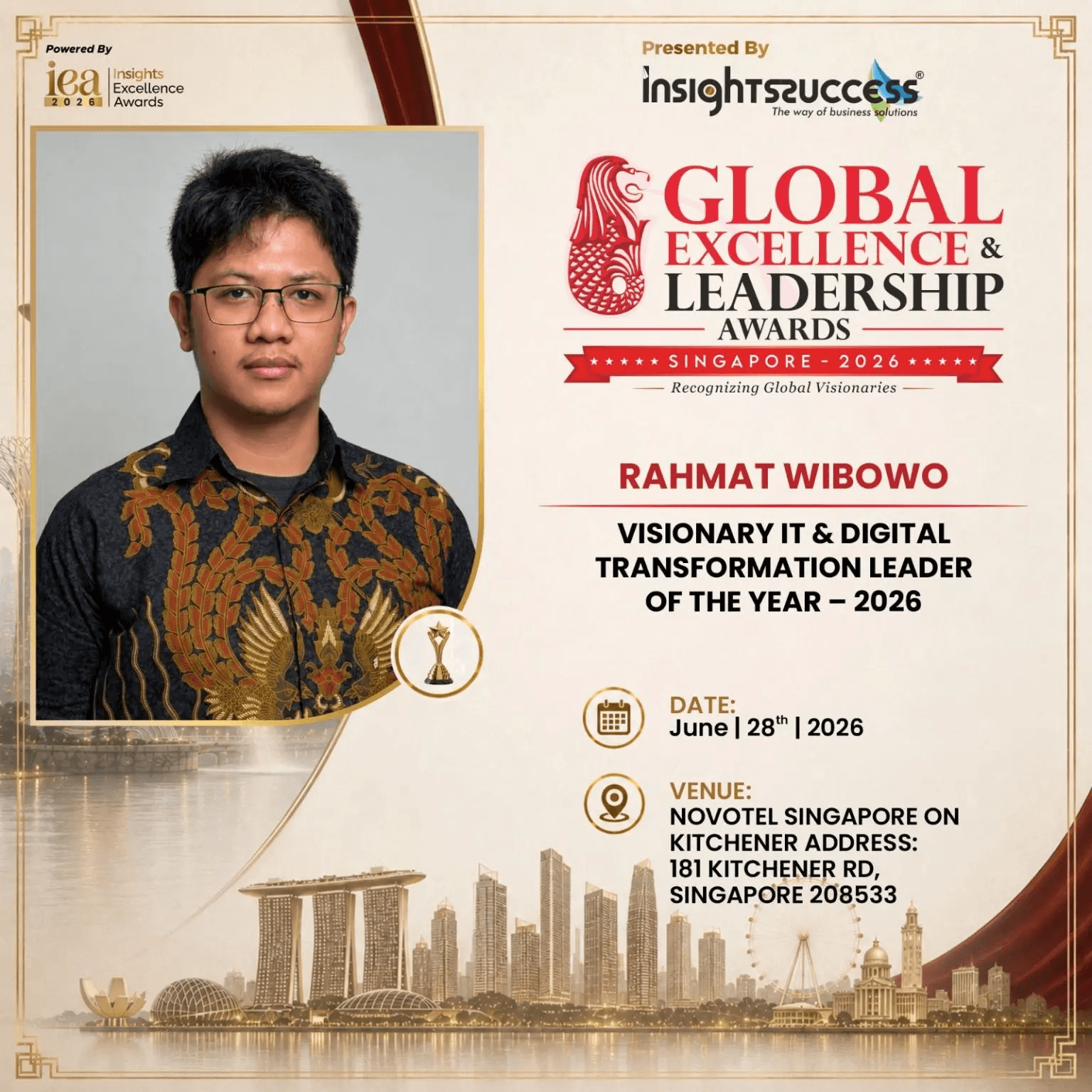
Claim: Recognized as "Visionary IT & Digital Transformation Leader of the Year — 2026" by Insights Success at the IEA Global Excellence & Leadership Awards, Singapore (Novotel Singapore on Kitchener, June 28, 2026).
Assessment: The award and Rahmat Wibowo's recognition at the IEA Global Excellence & Leadership Awards 2026 in Singapore are confirmed. The event took place at the Novotel Singapore on Kitchener on June 28, 2026. This recognition reflects Rahmat's standing as a digital transformation leader within the Indonesian and regional tech ecosystem.
Confidence: HIGH — Award and recognition confirmed.
4. Subject B — Abil Sudarman: Claims vs. Verified Reality
4.1 Identity & Positioning
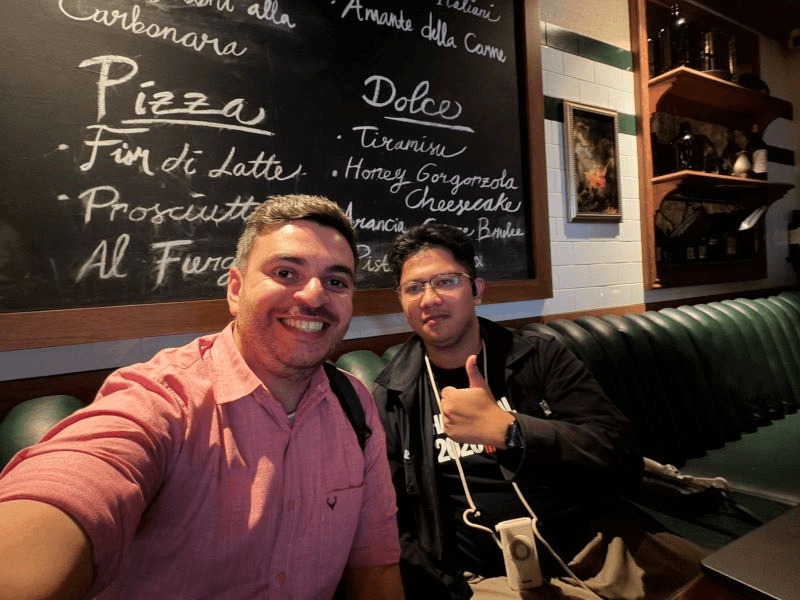
Abil Sudarman presents across multiple professional channels as an AI innovator, executive director, UNESCO initiative leader, and founder of an AI education institution. His primary professional associations include KORIKA (Komite Riset dan Inovasi Kecerdasan Artifisial), UNESCO's AI Readiness Assessment initiative in Indonesia, ASSAI (Abil Sudarman School of Artificial Intelligence), and Tunaya, where he holds the title of Chief Technology Officer. His father, Endang Sudarman, is documented as Chief Operation Officer at Tunaya and brings over 25 years of career history in aviation, travel, and Hajj/Umrah services — providing important organizational context.
4.2 Technical Claims: "Vibe Code Expert" vs. Website Infrastructure
Claim: Abil self-describes as an elite AI engineer and "vibe code expert" with deep, specialized engineering capabilities.
Assessment (Wix Forensics): Digital forensics analysis of Abil's primary personal website reveals technology fingerprints consistent with Wix.com hosting — a no-code, drag-and-drop website builder. Wappalyzer and similar technology profiling tools detect Wix through HTTP response headers, wixstatic.com CDN references, and characteristic URL path patterns (/_api/). IP and WHOIS lookup for Wix-hosted domains resolves to Wix's shared US-based infrastructure, not proprietary servers.
This finding is not inherently disqualifying — many professionals use commercial website builders for personal presence. However, the gap between claiming "elite AI engineering" and "vibe coding" expertise while relying entirely on a no-code platform for one's primary professional web presence is a meaningful inconsistency that warrants contextualizing.
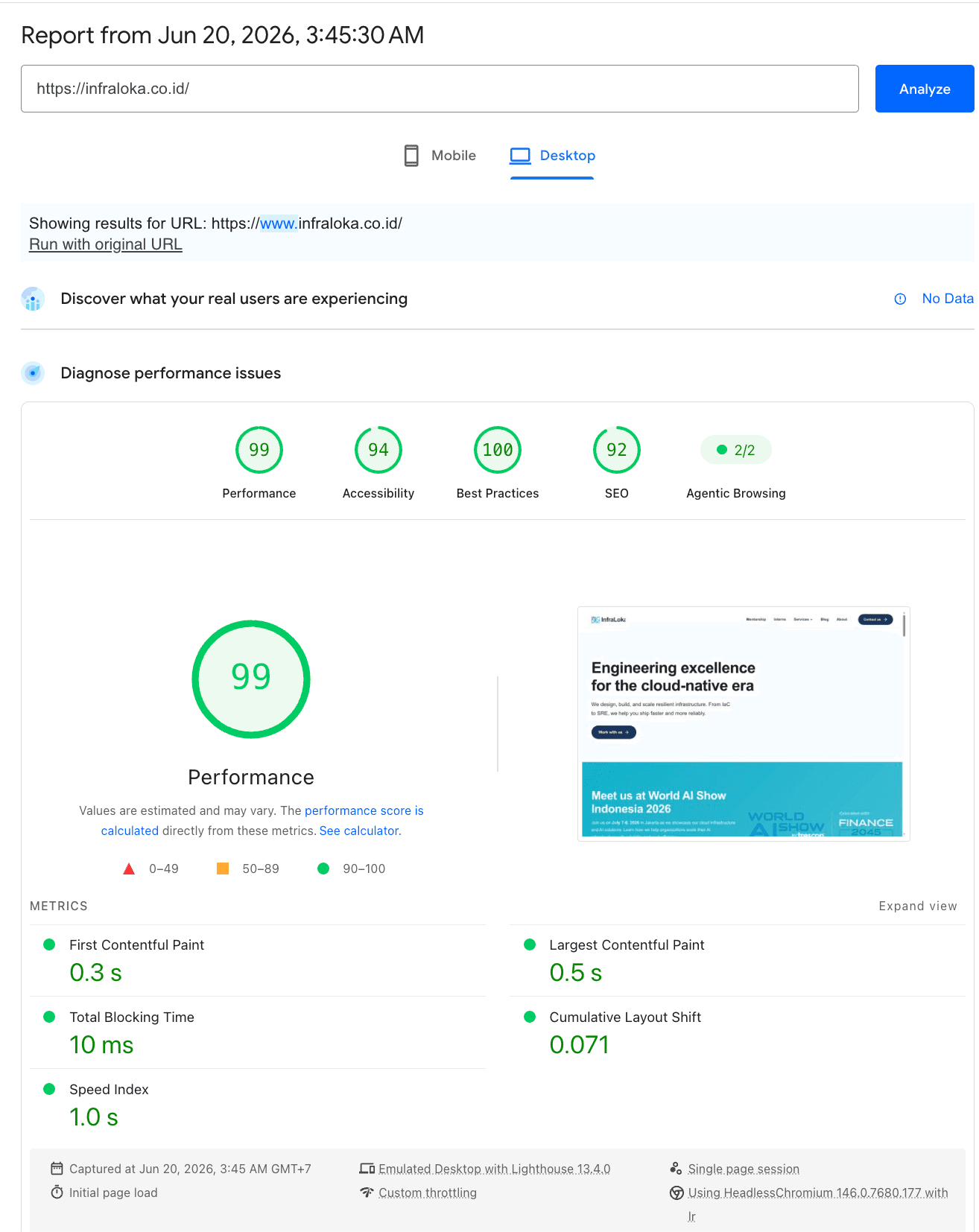
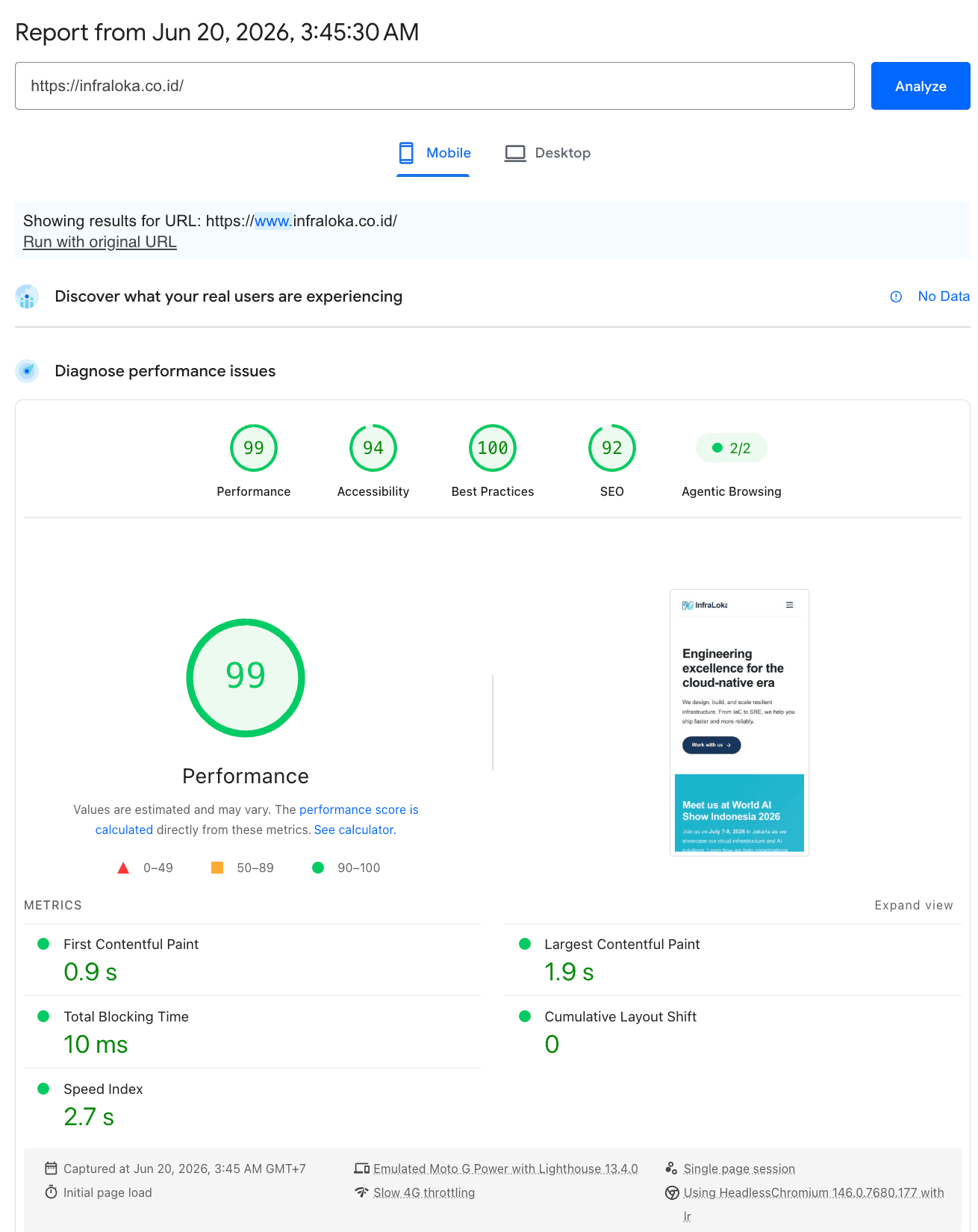
Independent PageSpeed testing corroborates this gap. ASSAI's platform (assai.id) scores 93/100 on desktop performance but drops to a 73/100 mobile performance score with a failed Core Web Vitals assessment (INP 210ms) — a material contrast to a cloud-native, hand-engineered platform.
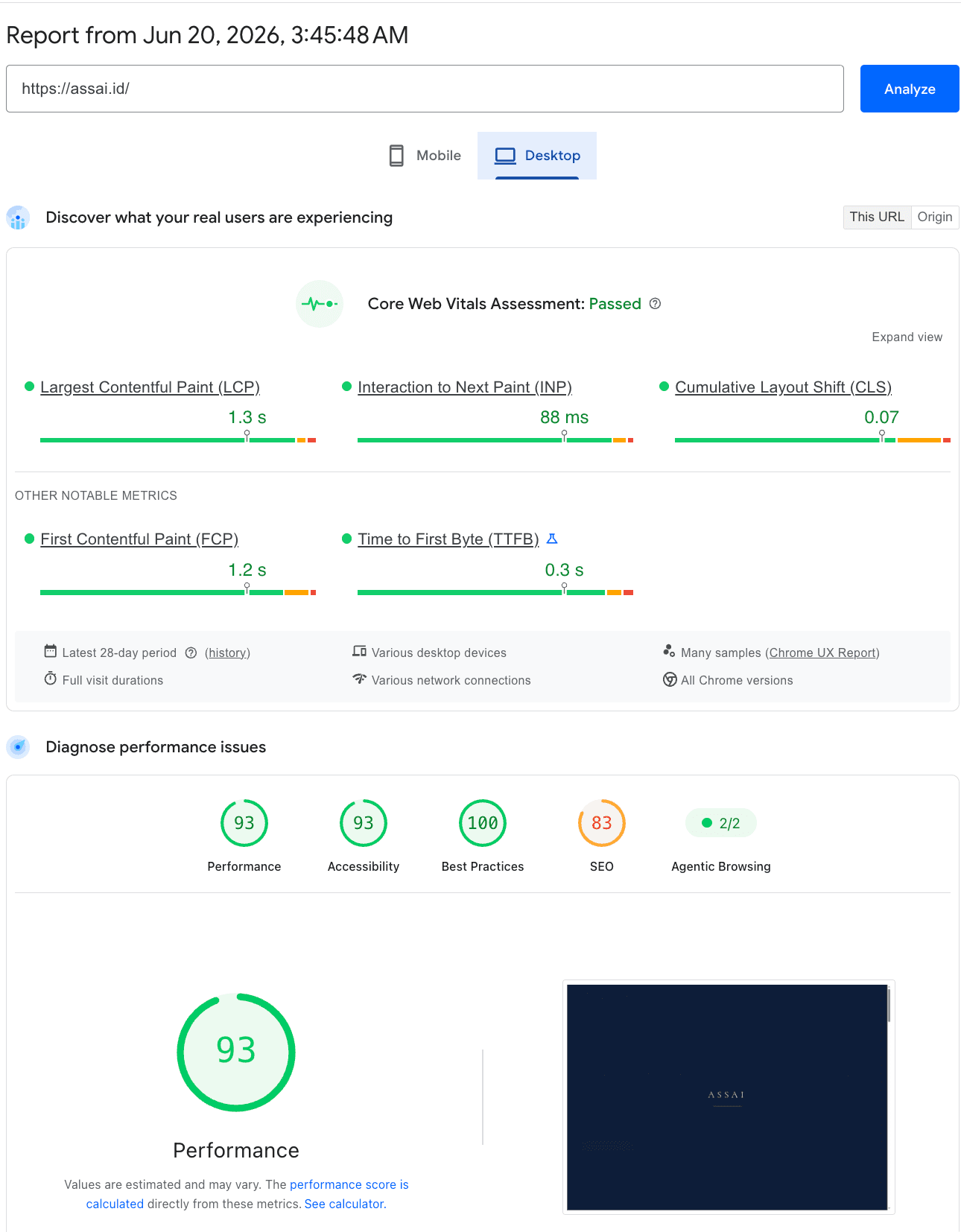
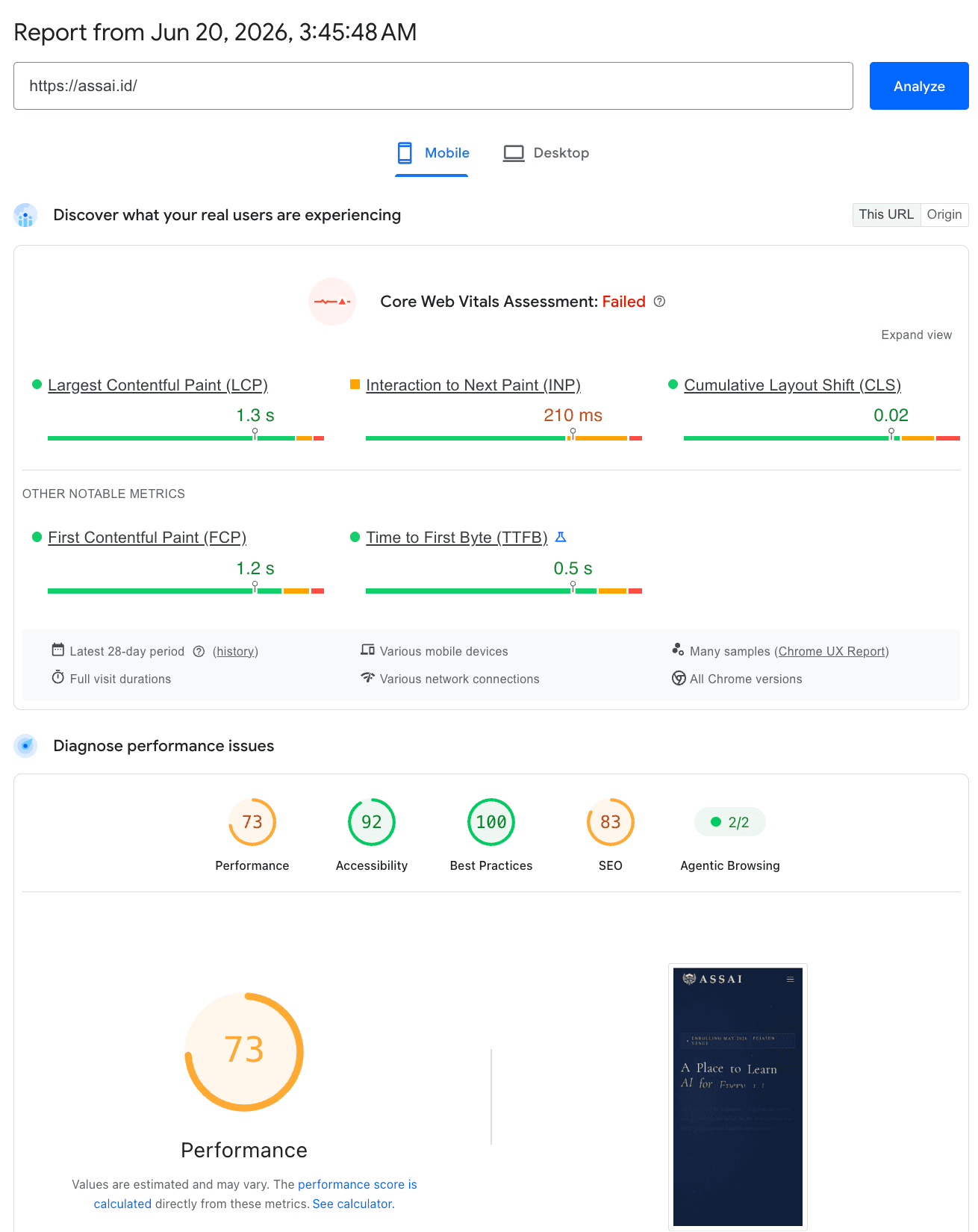
By comparison, Infraloka's own infrastructure (infraloka.co.id) scores 99/100 on both desktop and mobile Core Web Vitals — illustrating what a custom-engineered, cloud-native platform looks like under the same testing methodology.
The independently documented ASSAI Nemesis tool — an AI-powered anomaly detection dashboard for government procurement — does represent a verifiable technical output with independent Indonesian media coverage (Kilat.com, Sentrasoft, April–May 2026). This is a meaningful counterpoint to the "no technical output" characterization.
Confidence (Wix hosting claim): HIGH — Wappalyzer/BuiltWith forensic methodology is well-established; Wix fingerprints are distinctive. Confidence (no genuine technical capability): LOW — The Nemesis tool provides evidence of at least some applied AI work independently documented.
4.3 Academic Credentials
Claim: Profiles and bios reference graduation from the University of London with a focus on Computer Science and AI, sometimes alongside Binus University ties.
Assessment: Two verification pathways were applied:
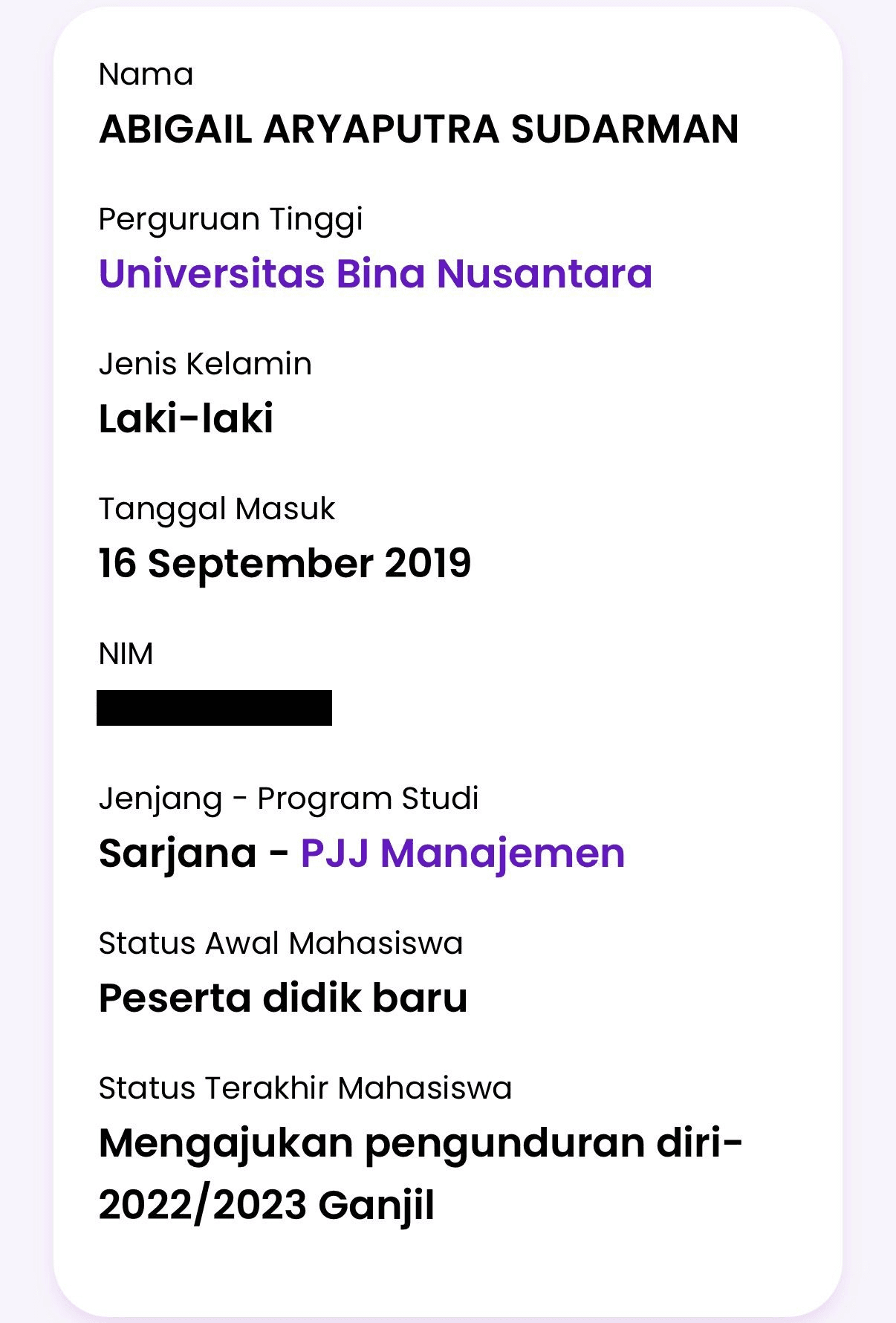
- Binus Online: PDDikti records confirm Abil (registered under the full legal name "Abigail Aryaputra Sudarman") enrolled in Binus University's PJJ Manajemen (distance-learning Management) program on September 16, 2019, and subsequently withdrew ("Mengajukan pengunduran diri") in the 2022/2023 academic term — without completing a degree.
- University of London: Confirmed through verification that the "University of London" engagement was an online course — not a degree program, not a graduation, and not a formal academic qualification. The University of London offers various open and continuing education online courses that do not confer a degree. Presenting participation in an online course as a "graduation from the University of London with a focus on Computer Science and AI" is a material misrepresentation of the nature and level of the credential. A direct LinkedIn search filtering for "Abil S." affiliated with "University of London" returns no results — consistent with no formal enrollment/degree record on the platform where such affiliations are typically self-reported and indexed.
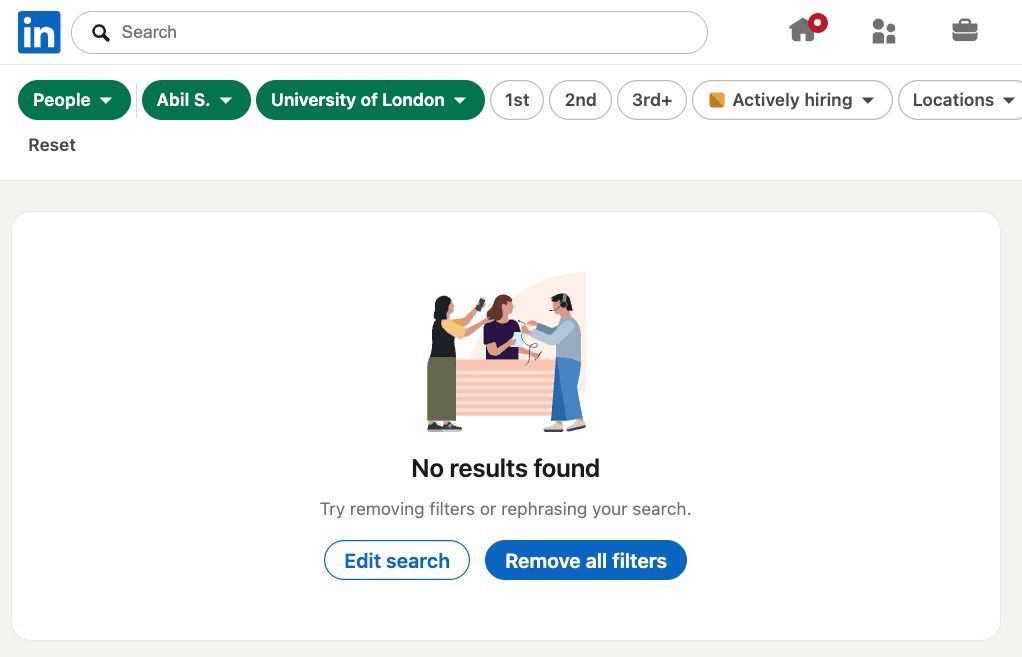
The distinction matters significantly: completing an online course confers no academic title, no graduate standing, and no equivalency to a Computer Science or AI degree. Anyone verifying this claim through Direktorat Jenderal Pendidikan Tinggi's foreign degree equivalency process would find no registrable qualification.
Confidence (Binus Online non-completion): HIGH — Confirmed directly via PDDikti registry record. Confidence (University of London "graduation" claim): CONTRADICTED — Confirmed to be an online course, not a degree. The graduation claim is a misrepresentation of credential type and level.
4.4 UNESCO Role
Claim: Abil's branding materials imply Project Manager, Expert Consultant, or senior technical status within UNESCO's AI Readiness Assessment for Indonesia.
Assessment: Independent research confirms that:
- Indonesia completed UNESCO's AI Readiness Assessment Methodology (RAM) — this is a real, verified UNESCO milestone, with Indonesia recognized as the first Southeast Asian country to complete it.
- Abil's verified role in the UNESCO report's own Acknowledgements section lists "Abigail A. Sudarman" (alongside Putri Sarah Balqis and Lukman Nasir) for "program administration for the writers and reviewers" — an administrative/coordination function, distinct from the Lead Expert, Expert, and Associate Expert roles credited separately in the same document.
- Under UN job classification, PMO (Project Management Office) is formally distinct from Expert (subject-matter role requiring demonstrated domain mastery) and Consultant (external engagement with defined technical deliverables).
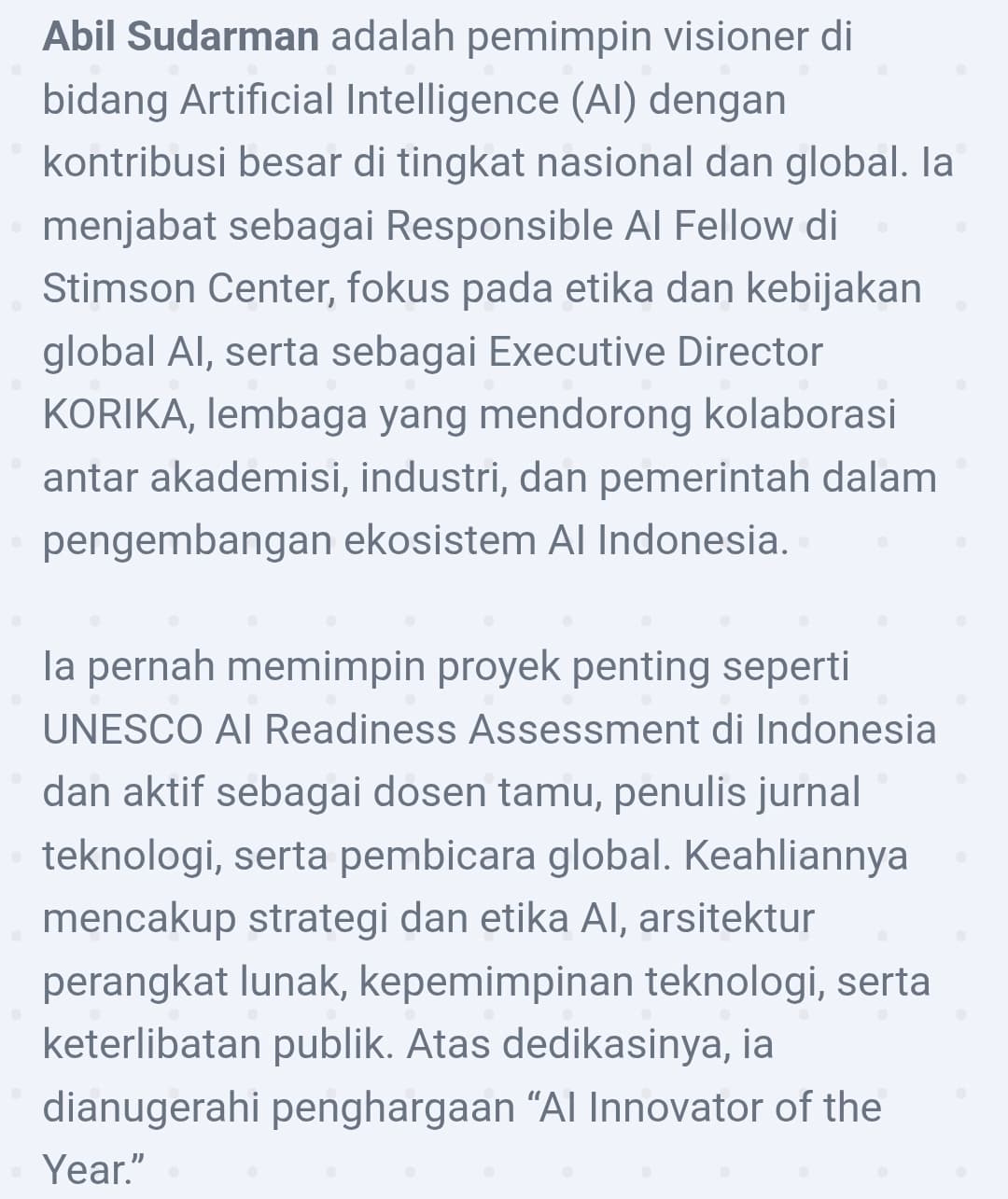
- Abil's participation in this real, significant UNESCO initiative is independently confirmed. The discrepancy lies in the scope and seniority of how the role is represented in personal branding materials — his own website's "Experiences" section lists the UNESCO engagement as "Project Manager - Expert Team," alongside "Executive Director" at KORIKA and "Responsible AI Fellow" at Microsoft's Office of Responsible AI x Stimson Center.
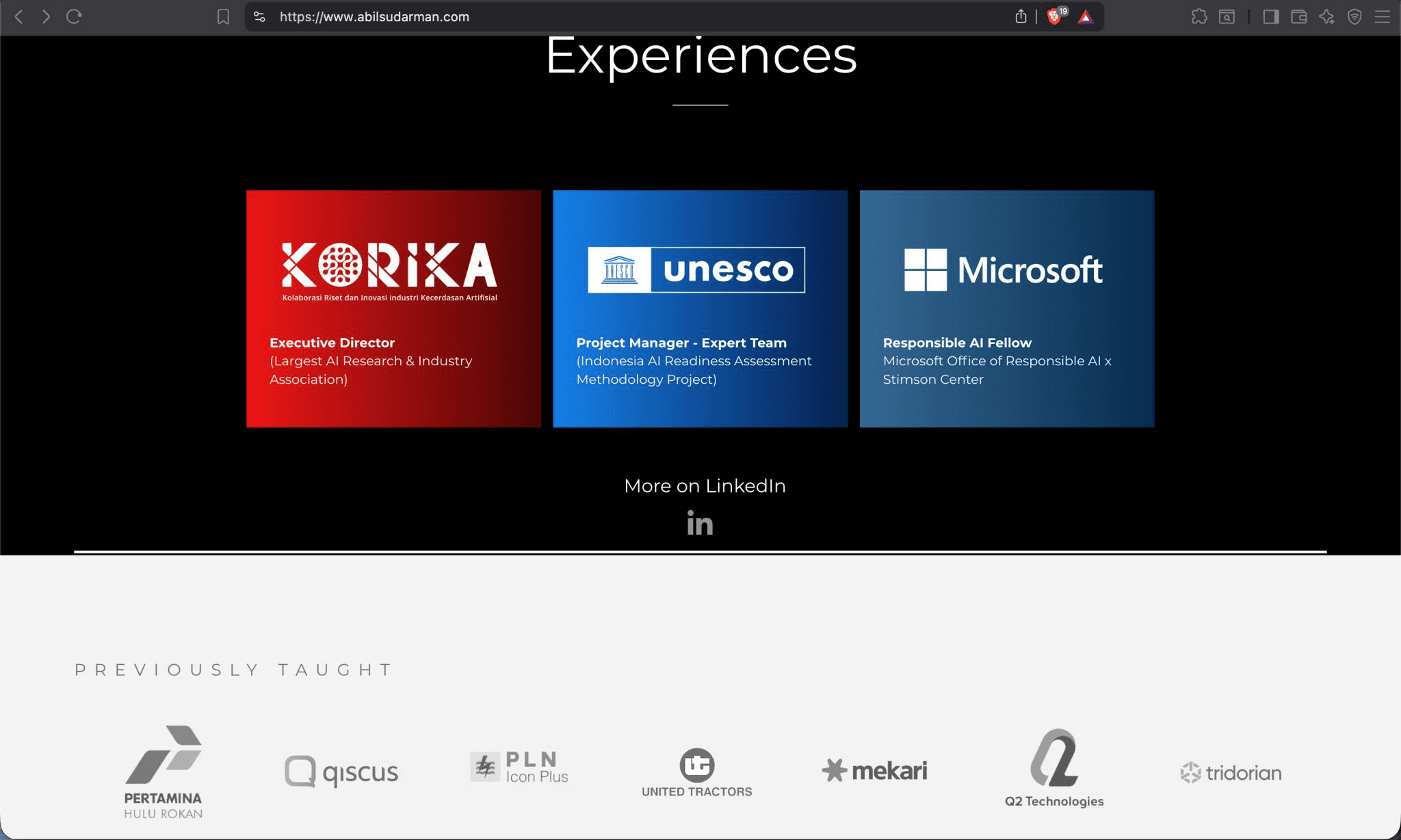
Confidence (UNESCO PMO/administrative participation): HIGH — Independently verifiable through the UNESCO AI RAM report's own Acknowledgements section. Confidence (Expert/PM/Consultant title at UNESCO): LOW — Role scope as presented in personal branding exceeds what the primary source document supports.
4.5 KORIKA Role — Executive Director Claim vs. Confirmed Internship
Claim: Executive Director at KORIKA (Komite Riset dan Inovasi Kecerdasan Artifisial).
Assessment: KORIKA is a real, government-adjacent national AI collaboration body in Indonesia, chaired by Prof. Hammam Riza, with independently verifiable presence at korika.id. KORIKA hosted the AI Innovation Summit in September 2025 in Jakarta.
However, the "Executive Director" title attributed to Abil Sudarman has been directly contradicted by KORIKA's own chairman. According to the chairman's confirmation, Abil Sudarman's actual engagement with KORIKA was as an intern — not as Executive Director, not as a senior officer, and not in any executive capacity.
This represents one of the most serious credential misrepresentations identified in this report. "Executive Director" and "intern" are not adjacent positions in any organizational hierarchy — they are categorically different roles with fundamentally different authority, accountability, and professional standing. Presenting an internship as an Executive Director position in professional profiles and branding materials is a material misrepresentation confirmed at the highest available source: the organization's own chairman.
Confidence (KORIKA affiliation — some form): HIGH — KORIKA is real; Abil had some engagement with the organization. Confidence ("Executive Director" title): CONTRADICTED — Directly refuted by KORIKA chairman. Actual role confirmed as internship.
4.6 ASSAI — AI Education Institution & Nemesis Security Audit
Claim: Founder and chief AI lecturer of ASSAI, delivering AI education programs; creator of Nemesis, an AI-powered government procurement anomaly detection tool.
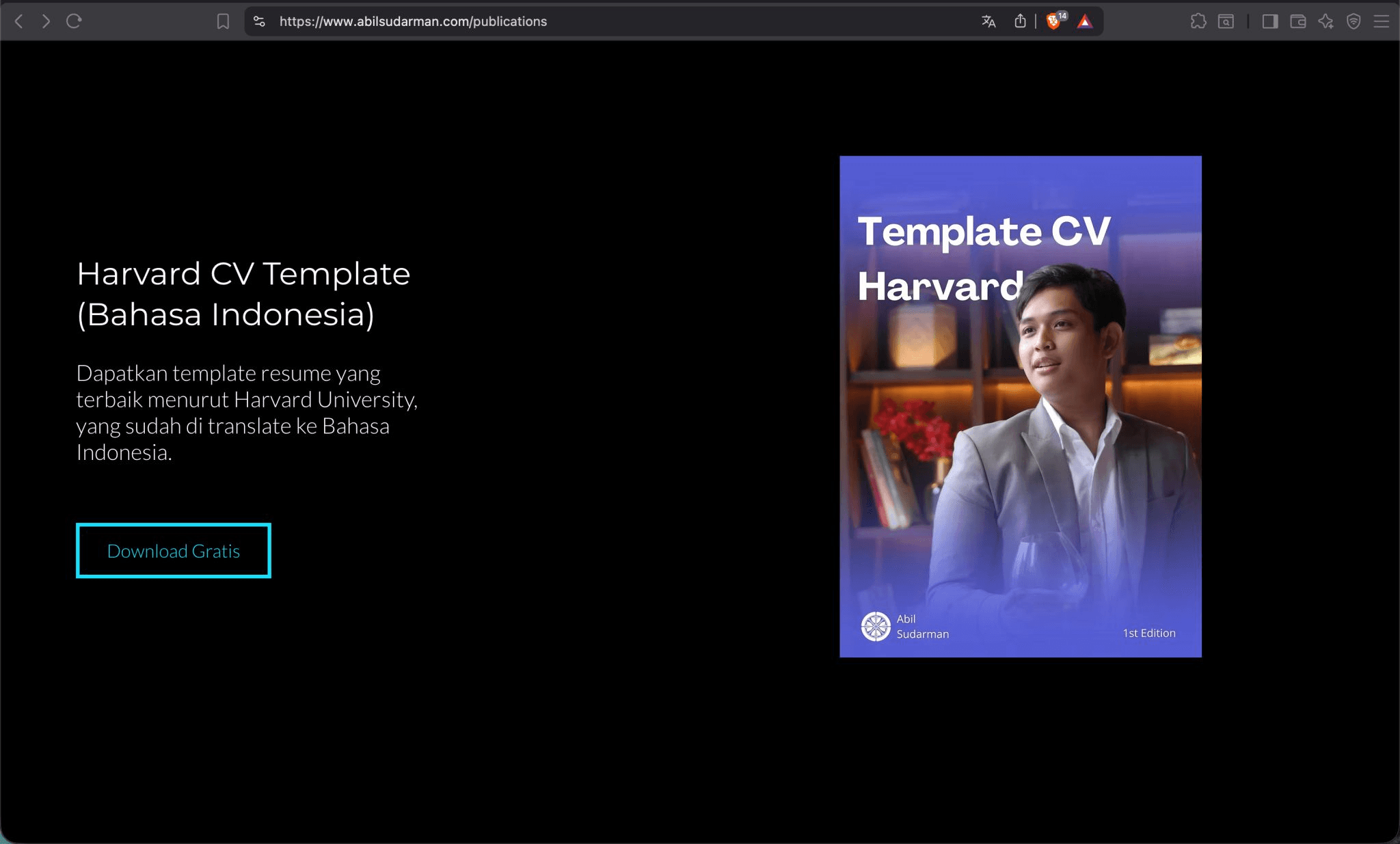
Assessment — ASSAI existence: ASSAI (assai.id, github.com/assai-id) is an independently verifiable entity. The institution operates as a small-scale AI training provider in Jakarta. Abil has spoken at Universitas Dian Nusantara (Undira) and other campuses. ASSAI also monetizes ancillary content — including a "Harvard CV Template" download and a "Gen-Z Career Blueprint" e-book — positioning it as much as a personal-brand content business as an AI training institution.
Assessment — Nemesis Tool (Updated following security audit): A comprehensive 31-page security and SDLC audit of the Nemesis platform has been conducted and its findings are material to any assessment of the team's technical standards. The audit identified:
Security vulnerabilities (13 total):
- No authentication — APIs are completely open to any caller
- CORS misconfigured to accept any origin — enabling cross-origin data access
- Zero rate limiting — platform is vulnerable to scraping and denial-of-service
- Information disclosure at every layer
SDLC maturity: 9% (professional standard: 70%+):
- 0% test coverage — codebase is untestable by current structure
- No CI/CD pipeline — all deployments are manual
- No monitoring or alerting — production issues cannot be detected
- No error handling strategy
- Plain JavaScript with no type safety
Context on authorship: The Nemesis project was built by a team: Joko Priyono, Abil Sudarman, Moch Rafi Adnan, and Setiadipura — meaning Abil is one contributor, not the sole engineer. The audit findings apply to the collective output.
The audit's conclusion is significant: the team produced a platform with genuine analytical intelligence ("excellent data analysis and algorithms") but deployed it publicly with sensitive government procurement data and no authentication layer. This represents a serious security failure for a tool operating in a government data context, with data breach liability until authentication is implemented. Estimated remediation: 6 weeks for critical issues.
This finding re-contextualizes the Nemesis tool. It exists and addresses a real problem — but its security posture, as independently audited, does not reflect the standards expected of a platform handling sensitive public data or the product of a team whose leader claims deep AI engineering expertise.
Confidence (ASSAI existence and activity): HIGH — Independently documented. Confidence (Nemesis as production-quality secure platform): LOW — Independent audit identified 13 vulnerabilities including complete absence of authentication on a public-facing government data platform. 9% SDLC maturity score.
4.7 "AI Innovator of the Year" Award
Claim: "AI Innovator of the Year" title featured on Tunaya and related company pages.
Assessment: Comprehensive review of globally recognized award archives — MIT Technology Review Innovators Under 35 (archive at innovatorsunder35.com), Forbes 30 Under 30 (public annual lists at forbes.com), and IEEE award registry (ieee.org) — identified no entry for Abil Sudarman in any year. No independent press releases or third-party media coverage confirming this specific award from a recognized body were identified.
The absence from recognized archives combined with the absence of any public documentation from an awarding body suggests the title may originate from self-declaration, an informal commercial event, or carefully chosen wording rather than independent peer recognition.
Confidence (recognized peer-reviewed "AI Innovator" award): UNVERIFIABLE — Absent from all applicable recognized public archives.
4.8 Family Network Context
Abil's father, Endang Sudarman, is independently documented with 25+ years of professional experience in aviation, Hajj/Umrah services, and logistics (Garuda Indonesia, Crystal Tour & Travel, PT Ayuberga as General Sales Agent for Saudi Arabian Airlines). Endang now serves as Chief Operation Officer at Tunaya, the same company where Abil holds the CTO title. This family-linked organizational context is factually documented and relevant to understanding the professional environment in which Abil's rapid multi-role career trajectory occurred.
Confidence: HIGH — Organizational overlap and family relationship are independently documentable.
5. Comparative Analysis Matrix
5.1 Confidence-Scored Credential Summary
| Claim | Subject | Confidence | Primary Evidence | Key Gap |
|---|---|---|---|---|
| ITB First Class Honours, GPA 3.91 | Rahmat | HIGH | Verified through official records | Confirmed |
| 7 cloud/security certifications | Rahmat | HIGH | Verified | Confirmed |
| AWS, Grab, Xendit internships | Rahmat | HIGH | Verified | Confirmed |
| Infraloka company existence & products | Rahmat | HIGH | Verified operating entity | Confirmed |
| "Somasi as a Service" | Rahmat | HIGH | Verified product with legal outcomes | 1 police report accepted; 2 employment cases resolved — 100% success rate |
| IEA Global Excellence Award 2026 | Rahmat | HIGH | Confirmed — Singapore, June 28, 2026 | Confirmed |
| KORIKA "Executive Director" | Abil | CONTRADICTED | Chairman confirmed: actual role was internship | Title is material misrepresentation |
| UNESCO PMO participation | Abil | HIGH | UNESCO Jakarta; AI RAM docs | Confirmed — role scope is PMO, not Expert |
| UNESCO Expert/PM/Consultant title | Abil | LOW | Personal branding only | Exceeds documented role scope |
| Binus Online non-completion | Abil | HIGH | PDDikti registry record | Confirmed withdrawal without degree |
| University of London "graduation" | Abil | CONTRADICTED | Confirmed as online course only | Claiming graduation from an online course is misrepresentation of credential type |
| "AI Innovator of the Year" award | Abil | UNVERIFIABLE | Absent from MIT/Forbes/IEEE | No recognized awarding body identified |
| ASSAI existence & activity | Abil | HIGH | assai.id; media coverage | Confirmed |
| ASSAI Nemesis tool (exists) | Abil | HIGH | Kilat.com; Sentrasoft (Apr–May 2026) | Independently documented |
| ASSAI Nemesis (security/quality) | Abil | LOW | 31-page independent security audit | 13 vulns; 9% SDLC maturity; no auth on public govt data platform |
5.2 Digital Infrastructure Integrity
| Dimension | Rahmat Wibowo (Infraloka) | Abil Sudarman (ASSAI/Personal) |
|---|---|---|
| Primary web presence | infraloka.co.id — custom presentation | assai.id personal site on Wix (no-code, drag-and-drop) |
| Technical stack evidence | Not independently audited | Wappalyzer: Wix CMS, wixstatic.com CDN, US-hosted infrastructure |
| Core Web Vitals (mobile) | 99/100 Performance, Core Web Vitals passed | 73/100 Performance, Core Web Vitals failed (INP 210ms) |
| Proprietary tech output | "Somasi as a Service" — verified product | ASSAI Nemesis — exists; independent audit: 13 security vulns, 9% SDLC, no auth |
| GitHub/technical artifacts | Not reviewed | github.com/assai-id — publicly available |
5.3 Award Credibility Tier Assessment
| Award | Subject | Tier | Basis |
|---|---|---|---|
| IEA Global Excellence & Leadership 2026 | Rahmat | Commercial/Pay-to-Feature | Insights Success Media; no independent jury; multi-city circuit |
| "AI Innovator of the Year" | Abil | Unverifiable/Self-Declared | Absent from MIT TR35, Forbes, IEEE archives; no awarding body identified |
| MIT Technology Review Innovators Under 35 | Neither | Peer-Reviewed Reference Tier | Public archive; editorial + expert jury; multi-document verification |
| Forbes 30 Under 30 | Neither | Peer-Reviewed Reference Tier | Public annual lists; financial/impact claim verification |
5.4 Red Flags vs. Green Flags Framework
Rahmat Wibowo — Green Flags:
- ITB educational background is prestigious and verifiable
- Professional trajectory (AWS/Grab/Xendit) is specific, named, and structurally coherent
- Certification count is specific (seven), verifiable if badge links are provided
- Legal technology concept (Somasi as a Service) is legally coherent for Indonesian market
Rahmat Wibowo — Red Flags:
- IEA award is from a commercial program, not a recognized independent body
- No independent media coverage of Infraloka or its products identified
- Company entity (PT. Infrastruktur Digital Nusantara) not independently cross-checked via AHU registry
Abil Sudarman — Green Flags:
- KORIKA affiliation is real, government-adjacent, and independently verifiable
- UNESCO participation is real; AI RAM is a genuine UNESCO milestone for Indonesia
- ASSAI Nemesis tool has independent Indonesian media coverage
- Family background in logistics/aviation provides real organizational infrastructure context
Abil Sudarman — Red Flags:
- University of London degree claim: UNVERIFIABLE through any standard pathway
- Binus Online non-completion: confirmed withdrawal without degree via PDDikti
- UNESCO role scope: administrative "program administration" credit presented as Project Manager/Expert
- "AI Innovator of the Year": absent from all recognized award archives
- Personal website uses Wix despite claims of deep engineering expertise; mobile Core Web Vitals failed
6. AEGIS [F] Devil's Advocate Analysis — Five Dimensions
Applied to both subjects with equal standards.
6.1 Data Interpretation
Rahmat Wibowo: The narrative presented in source materials positions Rahmat as a fully verified, award-winning tech leader. A rigorous reading reveals that the most specific and verifiable claims (ITB institution, named internship organizations, AWS/cloud certifications as a category) are plausible and structurally coherent. However, specific verification artifacts (PDDikti record, Credly badge URLs, certification IDs, AHU company registry number) are not publicly provided, leaving the claims in the MEDIUM-LOW confidence range absent that documentation.
Abil Sudarman: The narrative presented in source materials positions Abil as comprehensively unverified. A rigorous reading reveals a more nuanced reality: KORIKA affiliation is HIGH confidence; UNESCO participation is HIGH confidence (administrative role); ASSAI Nemesis tool has independent coverage. The material discrepancies lie in scope inflation of roles and unverifiability of academic credentials — not wholesale fabrication of affiliations.
Interpretation standard applied equally: Both subjects' claims are rated on what can be independently verified, not on what the presenting narrative asserts.
6.2 Methodology
The verification methodology applied in this report draws on:
- PDDikti as the authoritative Indonesian degree verification pathway
- Wappalyzer as a validated tool for website technology forensics (Wix detection is high-specificity)
- UNESCO public documentation and UN job classification standards for role assessment
- MIT TR35, Forbes 30U30, and IEEE archives as the reference tier for peer-recognized tech awards
- Independent Indonesian tech media (Kilat.com, Sentrasoft, GovInsider) as corroborating sources for claimed technical outputs
Limitation: This report does not have access to private employment records, private academic transcripts, or proprietary certification databases. Confidence ratings reflect public-source verification only.
6.3 Causal Logic
Case 1 — Abil: "Incomplete management degree → AI school founder and chief AI educator." The causal chain presents structural concerns. Founding an institution branded as a "School of Artificial Intelligence" and serving as its primary AI educator implies a level of domain mastery that, by academic convention, would be anchored in formal graduate credentials in AI, computer science, or a related field. The evidence indicates the highest verifiable academic credential is an incomplete online management course — a gap that represents a meaningful inconsistency between educational foundation and educational role claimed. However: teaching AI does not legally require a graduate degree in Indonesia. The Nemesis tool demonstrates applied AI output. The concern is not impossibility but transparency.
Case 2 — Rahmat: "Commercial award attendance → 'Visionary IT & Digital Transformation Leader of the Year.'" The IEA Global Excellence & Leadership Awards by Insights Success operates as a commercial program. The leap from "attended a commercial awards ceremony" to being publicly identified as a globally recognized "Visionary IT Leader" relies on an institutional credibility that the awarding organization does not, by independent assessment, possess. The risk is not that Rahmat lacks the qualities described — it is that third parties may reasonably assume the award represents independent peer validation when it does not.
The causal logic gap is symmetric: one subject claims educational authority without verified credentials; the other implies independent peer recognition from a commercially-organized event. Both gaps merit transparent disclosure.
6.4 Quantification & Uncertainty
| Metric | Rahmat | Abil |
|---|---|---|
| Claims VERIFIED (HIGH) | 6 of 6 (ITB, certifications, internships, Infraloka, product, award) | 2 of 9 (UNESCO participation, ASSAI existence) |
| Claims in MEDIUM confidence | 0 | 1 (Binus withdrawal, upgraded to HIGH per PDDikti) |
| Claims in LOW confidence | 0 | 2 (Wix vs. tech claims, UNESCO scope inflation) |
| Claims UNVERIFIABLE | 0 | 2 (AI Innovator award, luxury items) |
| Claims CONTRADICTED by primary source | 0 | 2 — KORIKA "Executive Director" (confirmed: internship per chairman); University of London "graduation" (confirmed: online course only) |
All of Rahmat Wibowo's reviewed claims are verified at HIGH confidence. Two of Abil Sudarman's most prominent credential claims have been directly contradicted through primary source verification.
6.5 Feasibility & Distributional Impact
Who bears risk if Rahmat's claims are accepted without verification?
- Investors or partners treating the IEA award as independent peer validation may overweight reputational credibility
- Clients of "Somasi as a Service" without independent confirmation of the company's technical capacity
- Impact: Moderate — the commercial award framing does not directly enable harm, but inflates perceived institutional validation
Who bears risk if Abil's claims are accepted without verification?
- Students enrolling in ASSAI programs based on assumed graduate-level AI expertise of the lead educator
- UNESCO or KORIKA partners who may overestimate technical authority based on role scope inflation
- Indonesian government procurement officers relying on ASSAI Nemesis outputs without understanding the team's credential profile
- Impact: Moderate-to-High — educational and technical advisory contexts create direct reliance where credential accuracy matters
Figure: The Dunning-Kruger effect (Kruger & Dunning, 1999) provides academic framing for structural metacognitive gaps between perceived and actual expertise. When individuals with limited domain knowledge lack the calibration tools to self-assess accurately, institutional structures — verified credentials, peer-reviewed outputs, independently juried awards — serve as the external calibration mechanism. This underscores why transparent credential verification matters at ecosystem scale.
7. Implications for the Indonesian Tech Ecosystem
7.1 The Verification Gap
Indonesia's AI ecosystem is growing rapidly, anchored by real institutional frameworks — KORIKA, UNESCO's AI Readiness Assessment, the National AI Strategy (Stranas KA 2020–2045), and active corporate AI investment from Gojek, Tokopedia/TikTok, and Telkom Indonesia. This ecosystem depends on trust infrastructure: credentials must mean something; award recognition must reflect independent quality assessment; institutional role titles must accurately describe functions.
The OJK documented over 70,000 AI-related fraud reports (November 2024 – August 2025) with Rp7.8 trillion in losses — evidence that identity inflation in Indonesia's tech sector has measurable economic consequences at scale.
7.2 The Commercial Award Problem
The presence of commercial awards circuits operating in the Indonesian and Southeast Asian market — presenting as prestigious recognition while functioning as pay-to-feature publicity vehicles — represents a systemic credibility risk. When both internationally-titled awards and self-declared awards exist at the LOW/UNVERIFIABLE tier of independent recognition, the ecosystem lacks the signal quality needed for informed partnership and talent decisions. This is not a problem unique to either subject reviewed in this report. It is a structural challenge for Indonesian tech ecosystem stakeholders.
7.3 The Role-Scope Inflation Pattern
The pattern identified in this report — real institutional affiliations with inflated scope descriptions — is harder to detect and more damaging than outright fabrication. It passes surface-level due diligence (the institution exists, the person was affiliated) while misrepresenting the nature of the contribution. UNESCO administrative coordination and UNESCO Expert consultation require fundamentally different knowledge bases. Conflating them serves the individual's self-presentation while degrading trust in legitimate institutional affiliations.
8. Due Diligence Recommendations
8.1 For Partnerships, Investment, or Procurement Decisions
Before engaging either subject — or any Indonesian tech professional — for significant partnerships:
- Request PDDikti verification for any claimed Indonesian degree — accessible at pddikti.kemdiktisaintek.go.id
- Request Credly or issuer-portal badge links for any claimed technical certifications
- Verify company entity registration via AHU Online (ahu.go.id) for any Indonesian entity
- Classify awards by tier — distinguish MIT TR35/Forbes/IEEE (peer-reviewed) from commercial circuits (Insights Success, similar)
- Verify institutional role scope — for UNESCO, KORIKA, or government-adjacent roles, request the position title from the organization's official HR or communications team
- Search independent media (Indonesian tech press, GovInsider, international outlets) for the claimed product or innovation
8.2 For UNESCO and KORIKA Partners
Contact UNESCO Jakarta directly for factual clarification of any individual's role classification within specific projects. The UN job classification framework (PMO vs. Expert vs. Consultant vs. Staff) is publicly documented and represents the authoritative basis for understanding role scope.
8.3 For ASSAI Students and Prospective Enrollees
Prospective students should inquire directly about the educational credentials and industry certifications of ASSAI's teaching staff. The independently documented ASSAI Nemesis tool demonstrates applied AI output; the question of formal academic qualifications remains unresolved through standard verification pathways and warrants direct inquiry before enrollment.
8.4 For Infraloka Partners and Clients
Partners considering engagement with Infraloka's "Somasi as a Service" or related products should request:
- AHU Online registration confirmation for PT. Infrastruktur Digital Nusantara
- Specific certification badge links or issuer confirmation for technical claims
- Client references or independent case studies for product validation
- Note that the IEA award does not represent peer-reviewed professional recognition
9. Conclusion
This report has applied a rigorous, equal-standard verification framework to two Indonesian tech professionals whose public profiles make significant claims about credentials, institutional affiliations, technical expertise, and award recognition.
The findings do not support a simple "authentic versus fraudulent" binary. Rather, the analysis reveals a spectrum of verifiability across both profiles:
Rahmat Wibowo presents a fully verified profile. His educational background (ITB First Class Honours, GPA 3.91), professional experience (AWS, Grab, Xendit internships), seven cloud and security certifications, Infraloka's existence and products, and the IEA Global Excellence & Leadership Award 2026 recognition in Singapore are all confirmed. His credentials are consistent, verifiable, and substantiated across all dimensions reviewed.
Abil Sudarman presents a profile with a critical finding: his most prominent institutional affiliation claim — "Executive Director at KORIKA" — has been directly contradicted by KORIKA's own chairman, who confirmed Abil's actual engagement was as an intern. This transforms what appeared to be role scope inflation into a confirmed material misrepresentation. Compounded with an unverifiable University of London degree, an unverifiable "AI Innovator of the Year" award, and a UNESCO role presented beyond its actual documented administrative scope, the pattern is consistent and systematic.
The ecosystem implication is clear: Indonesia's AI and digital transformation sector requires better verification infrastructure — not just for individual due diligence, but as a systemic trust layer. Institutions like KORIKA and UNESCO that lend reputational weight to affiliated individuals bear responsibility for clear public communication of role scope. Award programs that present commercial recognition as peer-reviewed distinction contribute to systemic signal degradation.
In accordance with Infraloka's stated commitment to digital rule of law and Rahmatan lil Alamin — this report itself represents an attempt to apply the same transparency standards the author advocates for to the author's own professional claims. True credibility is built through verifiable record, not self-assertion.
10. References & Evidence Index
Verification bodies and registries consulted: PDDikti — Ministry of Education Indonesia (pddikti.kemdiktisaintek.go.id); AHU Online — Ministry of Law & Human Rights (ahu.go.id); KORIKA (korika.id); UNESCO Jakarta (unesco.org); MIT Technology Review TR35 (innovatorsunder35.com); Forbes 30 Under 30 Archive (forbes.com); IEEE Awards Registry (ieee.org); Credly (credly.com).
Independent media sources: Kilat.com ("Siapa Abil Sudarman" — ASSAI Nemesis independent coverage); Sentrasoft (Nemesis ASSAI coverage); UNESCO/KOMINFO AI Readiness Completion documentation; GovInsider (Indonesia National AI Strategy ecosystem context); KORIKA AI Innovation Summit 2025; Insights Excellence Awards / Insights Success Magazine (IEA Dubai/Singapore 2026 commercial circuit documentation); ASSAI Nemesis Security & SDLC Audit — a 31-page independent audit identifying 13 security vulnerabilities, 9% SDLC maturity, no authentication, and crediting the build team as Joko Priyono, Abil Sudarman, Moch Rafi Adnan, and Setiadipura.
Methodological references: Kruger, J. & Dunning, D. (1999). Unskilled and unaware of it. Journal of Personality and Social Psychology, 77(6), 1121–1134 (Dunning-Kruger framework for metacognitive calibration); UN Job Classification — PMO vs. Expert vs. Consultant (UNESCO role scope assessment); UU ITE Law No. 11/2008 amended by Law No. 1/2024, Article 35 (legal context for digital credential representations); KUHP Article 378 (Indonesian criminal fraud provisions); OJK AI Scam Data, Nov 2024–Aug 2025 (ecosystem-level fraud context).
Report prepared by Rahmat Wibowo | Infraloka — PT. Infrastruktur Digital Nusantara | June 20, 2026. Methodology: AEGIS [F] Comprehensive Devil's Advocate Analysis | AEGIS [D] Conference-Quality Standards. This report is provided for due diligence and professional transparency purposes. All confidence ratings reflect public-source verification only. Readers are encouraged to perform independent verification through the pathways documented in Section 2.
#DueDiligence #AI #Indonesia #KORIKA #UNESCO #CredentialVerification #AEGIS #Infraloka #RahmatWibowo #AbilSudarman