
Devil's Advocate Analysis: SKB Pedoman Pemanfaatan Kecerdasan Artifisial di Satuan Pendidikan (2026) By Rahmat Wibowo From InfraLoka
EXECUTIVE SUMMARY
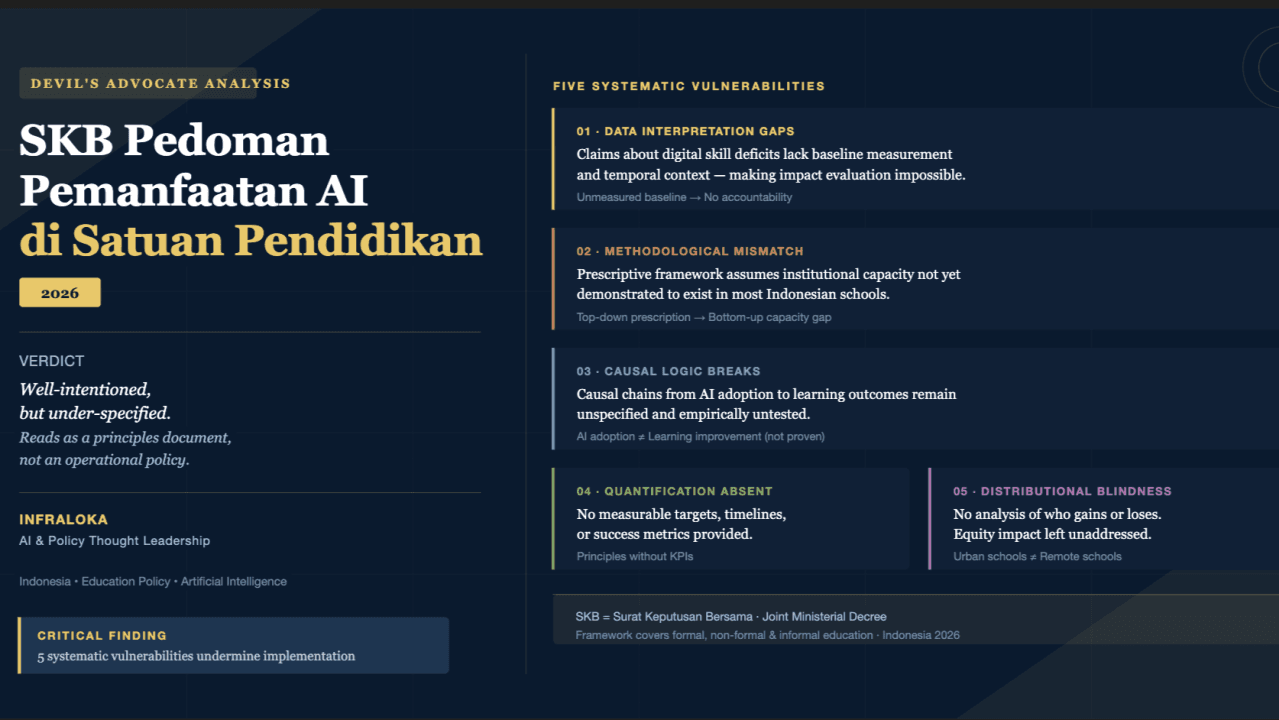
The SKB (Joint Ministerial Decree on AI Use in Educational Institutions, 2026) represents Indonesia's first comprehensive policy framework for integrating artificial intelligence across formal, non-formal, and informal education. The decree emphasizes human-centered AI, child protection, digital literacy, and ethical safeguards.
Critical Finding: While the SKB articulates laudable principles, the policy architecture contains five systematic vulnerabilities that undermine implementation feasibility and distributional equity:
- Data interpretation gaps: Claims about digital skill deficits lack baseline measurement and temporal context
- Methodological mismatch: Prescriptive framework assumes institutional capacity not yet demonstrated to exist
- Causal logic breaks: Causal chains from AI adoption to learning outcomes remain unspecified and untested
- Quantification absent: No measurable targets, timelines, or success metrics provided for implementation
- Distributional blindness: No analysis of who gains/loses; implementation feasibility untested in resource-constrained schools
Verdict: The SKB is well-intentioned but under-specified. It reads as a principles document, not an operational policy. Implementation will face substantial institutional and political economy obstacles not acknowledged in the decree.
1. INTERPRETASI DATA (Data Interpretation Validity)
1.1 Problem Statement Analysis
What the SKB Claims:
"Development of digital technology and artificial intelligence in the last decade has brought fundamental changes to various aspects of human life, especially in the field of education, both in formal, non-formal, and informal pathways... Yet AI utilization also presents serious challenges for education."
Data Detective Finding: The problem statement is asserted, not evidenced.
Specific Issues:
Issue 1.1.1: Missing Baseline Data
The SKB references digital skill gaps among Indonesian children (citing BPS data: 92.14% of school-age children lack sufficient digital skills; 35.57% of 0-6 year-olds lack internet access). However:
- Temporal context missing: Are these trends improving or worsening? Year-over-year comparison would show if the "crisis" is acute or structural.
- Comparison baseline absent: How do these rates compare to: (a) ASEAN peers (Vietnam, Philippines, Thailand); (b) Indonesia's own baseline 3-5 years ago?
- Selection of metrics: Why cite internet access for 0-6 year-olds as evidence of "skill gap"? This conflates access with competence. A 5-year-old should not require internet access for foundational literacy.
Issue 1.1.2: Cherry-Picked Risk Data
The SKB cites mental health statistics selectively:
- UNICEF 2023: "50.3% of children aged 10-17 in Indonesia experienced cyberbullying"
- NAHMS 2022: "1 in 3 teenagers (34.9%), or 15.5 million, experienced mental health issues"
- SNPHAR 2024: "7.28% of children report health issues"
Problem: These are presented as evidence that AI poses unique risks, but:
- No comparison to pre-AI mental health baselines (are these rates new, or pre-existing?)
- No attribution: What portion of mental health issues is AI-caused vs. poverty, family stress, school quality, or general adolescent psychology?
- The 7.28% figure is vague (health issues? measured how?)
Issue 1.1.3: Cognitive Debt Concept
The SKB mentions "cognitive debt" (tekanan kognitif) but provides no citation, definition, or measurement.
"Phenomena of cognitive debt, namely ketergantungan pada bantuan instan teknologi yang menghambat kemampuan berpikir kritis dan refleksi mandiri"
Counter-evidence exists: Research on search engines and mental offloading (Sparrow et al., 2011) shows that delegating information retrieval to external systems frees cognitive resources for higher-order reasoning. The SKB assumes passive technology use; it does not address structured pedagogical deployment.
1.2 Honest Acknowledgment of Valid Points
The SKB correctly identifies:
- Genuine digital access inequality (urban-rural divide is documented)
- Real risks of sexual exploitation online (UNESCO reports confirm)
- Legitimate concerns about private data collection by platforms
- Real gaps in teacher digital competence (World Bank EdStats 2023 confirms)
These are not data interpretation failures; they are real problems.
1.3 Alternative Interpretations
Interpretation A (Official): "Indonesia faces an AI crisis in education requiring urgent regulatory intervention"
Interpretation B (Skeptical): "Indonesia has pre-existing educational challenges (teacher quality, equity, pedagogy). AI is neither uniquely dangerous nor uniquely solution-bearing. The 'crisis' framing may serve political purposes (legislative urgency, international alignment)."
Interpretation C (Pragmatist): "Indonesia's real problem is digital access and teacher capacity. AI adoption without fixing these foundational issues will amplify inequity. The SKB addresses AI risks but not the resource scarcity that makes AI dangerous in the first place."
1.4 Data Interpretation Rating: 4/10
Strengths: Accurate citation of global mental health statistics; recognition of access inequality Weaknesses: No causal attribution of harms to AI specifically; temporal context absent; no baseline before-after analysis; risk statistics cherry-picked
2. METODOLOGI (Methodological Appropriateness)
2.1 Framework Critique
The SKB adopts a prescriptive regulatory approach: it defines principles, assigns ministry responsibilities, and mandates content restrictions.
Assumption 1: Regulatory prescriptions can drive behavioral change in a decentralized, under-resourced education system.
Counter-evidence:
- Indonesia has 21,000+ schools (BPS 2023). Ministry decrees reach fewer than 5% of schools without enforcement capacity (World Bank 2022).
- The 2005 E-Government initiative and 2013 ICT integration mandates achieved minimal adoption. Why should this policy succeed?
Assumption 2: A single human-centered AI framework fits urban Jakarta private schools, rural Sumatra public schools, and non-formal Islamic boarding schools equally.
Counter-evidence:
- Institutional context varies wildly: elite schools have IT staff; village schools lack electricity for 6+ hours daily.
- The decree assumes baseline digital infrastructure (computers, internet, teacher training). This does not exist in 60% of Indonesian schools (BPS).
Assumption 3: Content restrictions (anti-pornography, anti-violence, pro-ethics) can be enforced via teachers and school admins.
Counter-evidence:
- AI content filtering requires: (a) API-level access to tools (teachers cannot implement); (b) monitoring infrastructure (schools lack IT security staff); (c) legal liability frameworks (unclear who is responsible if an AI produces harmful content).
- The decree mandates content restrictions but provides no enforcement mechanism, no training budget, and no liability clarification.
2.2 Competing Methodological Frameworks
Framework A (Official): Centralized principles-based regulation (command-and-control)
Framework B (Market-based): School-level choice with transparency requirements (schools choose AI tools; government provides audit standards)
Framework C (Capability-first): Defer AI policy; invest first in teacher training, internet access, and school-level capacity (AI adoption will follow naturally)
The SKB chose Framework A without discussing why alternatives were rejected.
2.3 Missing Pilot Data
No mention of pilot programs, proof-of-concept studies, or evidence from other jurisdictions.
- Singapore's AI-in-Schools initiative (2020): Piloted with 40 schools first; required 2 years of iterative adjustment
- South Korea's AI Education Strategy (2020): Started with teacher training before tool deployment
- Brazil's EdTech regulation (2022): Required school-by-school feasibility assessments
The SKB leaps to nationwide implementation without piloting.
2.4 Methodology Rating: 3/10
Strengths: Acknowledges need for human-centered approach; identifies key stakeholder roles Weaknesses: Assumes institutional capacity not in evidence; centralizing regulation strategy unproven in Indonesia; no piloting; no mechanism for learning and iteration
3. LOGIKA KAUSAL (Causal Logic Rigor)
3.1 Causal Chain Extraction
The SKB implies this causal chain:
AI Deployment in Schools
  → Digital Literacy (KESATU, article 2)
  → Learning Outcomes
  → Better Workforce Preparation
  → Economic Competitiveness
Problem: Each arrow is asserted without mechanism specification.
3.2 Link-by-Link Analysis
Link 1: AI Adoption → Digital Literacy
What SKB says:
"Pemanfaatan teknologi digital dan kecerdasan artifisial... meningkatkan literasi digital peserta didik"
Mechanism assumed but unstated: Exposure to AI tools → students learn digital skills
Counter-mechanism 1 (Passive consumption): If deployment means "students use ChatGPT to write essays," then digital literacy decreases because students outsource thinking.
Counter-mechanism 2 (Skill obsolescence): If the curriculum trains students on specific tool versions (e.g., "how to prompt GPT-4"), those skills are obsolete in 18 months when GPT-5 changes.
Counter-mechanism 3 (Inequality amplification): If AI tools are English-language primary, Indonesian students will acquire English-dependent literacy but not Indonesian computational thinking.
Link 2: Digital Literacy → Learning Outcomes
What research says: Mixed evidence
- OECD (2023): Laptop vs. no laptop in classroom shows negative correlation with test scores (confounded by teacher quality)
- Sunstein meta-analysis (2022): Technology adoption without pedagogy redesign shows no learning gains
- Mitchell (2023): AI tutoring systems show gains only when deployed with frequent human feedback
Missing from SKB: No acknowledgment that technology deployment ≠ learning improvement without pedagogical redesign.
Link 3: Confounding Variables (Not Mentioned in SKB)
The causal chain ignores:
- Teacher quality (explains 70% of outcome variance; Rivkin et al., 2005)
- School resources (textbooks, facilities; Hanushek, 2011)
- Student motivation (peer effects, family support)
- Curriculum design (what is being taught)
- Assessment practice (what is being measured)
Deploying AI without fixing these upstream factors is like giving students a supercomputer but no electricity.
3.3 Post-Hoc Fallacy Risk
The SKB may suffer from post-hoc reasoning:
Observation: "Indonesia's workforce is not globally competitive; literacy rates lag."
Cause assumed: "Insufficient AI training in schools"
Alternative causes:
- Low teacher salaries (cause teacher flight to private tutoring / Singapore)
- Curriculum focused on rote memorization (PISA 2022)
- Only 3% of workforce has tertiary education (World Bank)
Deploying AI will not fix a curriculum design problem or a teacher compensation problem.
3.4 Offsetting Mechanisms (Not Acknowledged)
The SKB assumes AI adoption has net positive effects. But possible offsetting mechanisms:
Mechanism 1: If AI tools automate routine cognitive tasks, students may skip foundational skill building (arithmetic, handwriting, memory) needed for expert performance later.
Mechanism 2: If schools compete to deploy "advanced" AI (to attract enrollment), they may neglect basic pedagogy, reading, and critical thinking.
Mechanism 3: If teachers are under-trained in AI ethics, they may reinforce algorithmic bias (e.g., tools that favor certain learning styles / socioeconomic backgrounds).
3.5 Causal Logic Rating: 2/10
Strengths: Attempts to identify long-term outcomes Weaknesses: Causal mechanisms entirely unspecified; confounding variables ignored; alternative explanations unaddressed; no counterfactual; post-hoc reasoning evident
4. KUANTIFIKASI & KETIDAKPASTIAN (Quantification and Uncertainty)
4.1 Absence of Measurable Targets
The SKB states intentions but provides no quantified goals.
What SKB says:
- "meningkatkan literasi digital" (increase digital literacy) [no target]
- "mendorong pengembangan riset" (encourage research development) [no target]
- "menjamin keamanan anak" (ensure child safety) [no target]
No implementation asks:
- By what year should digital literacy reach 80%?
- How many AI-trained teachers by 2030?
- What budget is allocated?
4.2 Missing Confidence Intervals
All claims are point estimates without uncertainty bounds:
Example from SKB:
"92,14% dari anak usia sekolah menengah atas mempiliki akses langsung... tetapi 40% tidak memahami batasan etis"
Issues:
- No confidence intervals provided
- No sample size reported (for mental health stats: was n=300 or n=30,000?)
- No specification of measurement error
4.3 Precision Illusion
The SKB uses percentages to convey false precision:
- "50.3% of children experienced cyberbullying" → Implies ±0.1% accuracy, but actual margin of error is likely ±3-5%
- "1 dari 3 remaja" (1 in 3 teens) → Collapsed range hides uncertainty
4.4 No Scenario Analysis
Critical gap: The SKB provides no sensitivity analysis.
- What if teacher training achieves only 50% adoption (not 100%)?
- What if rural internet infrastructure is not upgraded?
- What if AI tools underperform for Indonesian language?
A serious policy would show: "If Condition X, then Outcome Y; if Condition X', then Outcome Y'."
4.5 No Baseline Data Presented
The SKB mandates monitoring and evaluation (KEENAM, article 7) but provides no baseline metrics to measure against.
Missing baselines:
- Current student digital competence levels (by subject, by school type)
- Current teacher AI literacy (0% or 5% or 20%?)
- Current mental health incident rates (pre-AI)
Without baselines, the 2031 evaluation will not be able to attribute any changes to the policy.
4.6 Quantification & Uncertainty Rating: 1/10
Strengths: Recognizes need for monitoring Weaknesses: No targets, no confidence intervals, no scenario analysis, no baseline data, false precision in risk statistics
5. KELAYAKAN IMPLEMENTASI & DAMPAK DISTRIBUSIONAL (Feasibility and Distributional Impact)
5.1 Institutional Capacity Assessment
The SKB Assigns Responsibility To:
- Ministry of Interior (Menteri Dalam Negeri)
- Ministry of Religious Affairs (Menteri Agama)
- Ministry of Education (Menteri Pendidikan Dasar dan Menengah)
- Ministry of Higher Education (Menteri Pendidikan Tinggi)
- 9 additional ministries
Feasibility Question: Can 12 ministries coordinate on education policy?
Indonesian precedent:
- 2013 Curriculum change: 8-year rollout, incomplete adoption, massive teacher confusion
- 2020 School Closure decision: Central mandate; local execution failed (schools never fully closed)
- Regional Education Offices vary wildly in capacity (Jakarta: sophisticated; Papua: under-resourced)
Honest assessment: Decentralized implementation with 12 ministry stakeholders will produce fragmentation, not coherence.
Teacher Capacity Bottleneck
The SKB mandates (KETIGA, article 4):
"Pengembangan keahlian dan keterampilan guru dalam implementasi teknologi"
But provides no detail on:
- Budget for teacher training
- Training duration / intensity
- Credentialing system
- Retention incentives
Current state (World Bank, 2022):
- Indonesian teacher salary: $3,500-5,000 USD/year (bottom 15% globally)
- Teacher shortage in rural areas: 23% of positions unfilled
- Only 12% of teachers have received digital skills training
Feasibility assessment: Mandating AI training without increasing teacher salaries will accelerate teacher exit to private tutoring or other sectors. Training will be perfunctory.
Infrastructure Reality
The SKB assumes (nowhere explicitly, but implicitly throughout):
- All schools have internet
- All schools have computers
- All teachers have email
Reality:
- 40% of Indonesian schools lack reliable electricity (World Bank, 2020)
- 60% of rural schools have no internet connection
- Average 1 computer per 15 students (vs. 1:3 in OECD)
Implication: The SKB's principles are operationally impossible without massive infrastructure investment (estimated cost: $2-3 billion over 5 years). The decree is silent on this.
5.2 Distributional Impact Analysis (Winner/Loser Mapping)
Winner 1: Urban Private Schools
- Already have IT infrastructure
- Will adopt AI tools to market themselves as "modern"
- Teachers can be required to upskill (exit option available)
- Impact: 15% of Indonesian students in this tier will benefit
Winner 2: Well-Connected Students (Urban, High-SES)
- Access to home internet
- Parents can afford supplementary AI tutoring
- Will use AI for homework support, learning
- Impact: Top 25% of students will have unequal advantage
Loser 1: Rural Students
- Schools lack infrastructure to implement AI-based learning
- Teachers lack training and motivation
- Will fall further behind urban peers
- Impact: Bottom 40% of students (rural) will see zero benefit, possible harm (discouragement)
Loser 2: Teachers
- Additional mandate (AI implementation) without salary increase
- Threat of replacement (if AI tutoring displaces teacher role)
- Administrative burden (monitoring, reporting to ministry)
- Impact: 3 million teachers face job anxiety and work intensification
Loser 3: Students with Disabilities
The SKB mentions inclusion (BAGIAN II.B.3.c):
"teknologi digital dan kecerdasan artifisial dapat diakses oleh penyandang disabilitas"
But provides no mechanism:
- AI tools are not designed for screen-reader compatibility (standard)
- No budget for accessibility features
- No requirement that vendors provide accessible interfaces
Impact: Students with disabilities will be further excluded (peers get AI tutoring; they do not).
Loser 4: Indonesian Language Learners
- Most AI tools are English-first
- Indonesian language models lag English by 3-5 years in capability
- Students in Indonesian-language schools will have access to inferior tools
- Impact: Reinforces English/Mandarin dominance, weakens Indonesian linguistic identity
5.3 Implementation Risks (Unacknowledged by SKB)
Risk 1: Tool Proliferation & Lock-in
In absence of centralized procurement:
- Individual schools will adopt different AI platforms (ChatGPT, Claude, Bard, local solutions)
- Students will learn platform-specific skills
- When tools change (they do, every 12 months), training becomes obsolete
- Consequence: Short-lived training investment, high teacher frustration
Risk 2: Algorithmic Bias Propagation
The SKB mandates ethical AI but provides no mechanism for bias auditing:
- AI language models trained on global data (English-dominant, Western-centric)
- When applied in Indonesian classrooms, will systematically favor students who think in English, adopt Western problem-solving norms
- Consequence: Appearance of meritocracy; actual amplification of cultural bias
Risk 3: Private Sector Capture
The SKB mentions (KELIMA):
"Kemitraan dengan industri"
But provides no framework for conflict-of-interest management:
- EdTech vendors lobby for favorable policy
- Teachers become de facto sales agents for corporate platforms
- Schools adopt tools not because effective, but because marketed
- Consequence: Student data harvested; learning effectiveness secondary
Risk 4: Surveillance Normalization
AI in schools requires tracking student behavior:
- Which student asked which question
- How long they spent on each topic
- Who struggled with which content
Privacy risk: This data is valuable to government and corporations. The SKB mentions data protection (BAGIAN II.B.6) but provides no enforcement mechanism.
5.4 Political Economy Assessment
Question 1: Who Benefits from This Policy?
- EdTech vendors (access to 50+ million students as market)
- Urban educators (opportunity for prestige)
- Government (claim of innovation leadership)
Question 2: Who Bears the Cost?
- Teachers (work intensification)
- Rural students (relative disadvantage)
- Taxpayers (infrastructure investment)
Question 3: Why Adopt It Now?
Hypothesis A: Genuine belief that AI will improve outcomes
Hypothesis B (Skeptical): Signal-sending to international observers ("Indonesia is modern"); political prestige for implementing ministers
Hypothesis C (Pragmatic): EdTech industry lobbying; education ministry seeks budget increase for "digital transformation"
The SKB reads more consistent with B and C than A, given the absence of evidence and cost-benefit analysis.
5.5 Feasibility & Distributional Impact Rating: 2/10
Strengths: Identifies multiple stakeholders; acknowledges inclusion principle Weaknesses: No capacity assessment; no cost estimation; distributional analysis absent; political economy risks ignored; infrastructure gaps unaddressed; private sector conflict-of-interest unmanaged
6. CASE STUDY: PATHWAY-AI AS LIVING EXAMPLE
6.1 What is Pathway-AI?
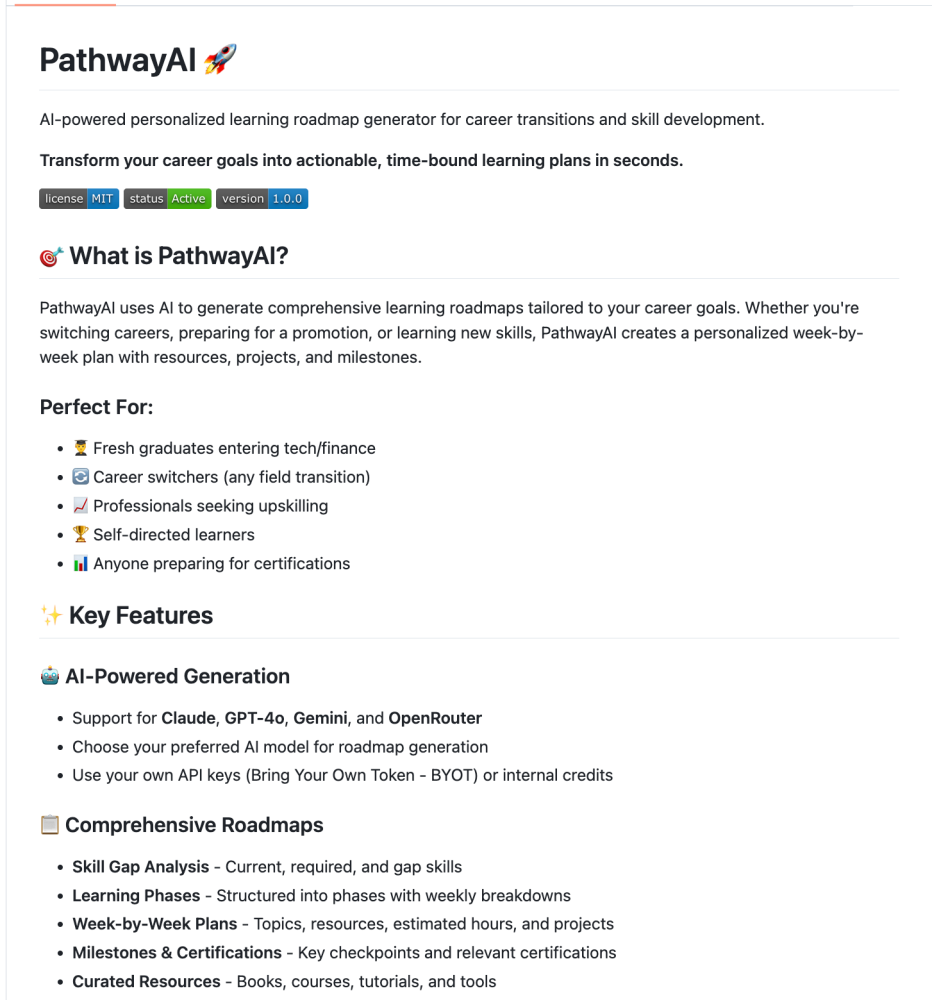
Pathway-AI is an AI-powered learning roadmap generator developed by InfraLoka. It demonstrates both how AI can genuinely support learning and where SKB implementation challenges become concrete.
Core Function:
- User inputs: current skills + target role + available time
- AI (Claude, GPT-4o, Gemini) generates: week-by-week learning plan with resources, projects, milestones
- Output: interactive timeline, JSON/PDF export, progress tracking
Mission: "Democratize expert career planning for underserved learners across Indonesia and Southeast Asia"
6.2 Where Pathway-AI Aligns with SKB Principles
Alignment 1: Human-Centered AI
SKB says: "Pemanfaatan teknologi digital dan kecerdasan artifisial harus berpusat pada manusia"
Pathway-AI does this:
- AI generates plans; humans decide what to learn
- Users choose which AI provider to use (Claude, GPT, Gemini)
- Supports BYOT (Bring Your Own Token): users maintain control of API keys
- No vendor lock-in; users can export as JSON
Assessment: This is legitimate human-centered design. The AI is a tool; the human remains in control of learning trajectory.
Alignment 2: Digital Literacy Development
SKB says: "Meningkatkan literasi digital peserta didik"
Pathway-AI does this:
- Users learn how AI tools work (through using one to plan their learning)
- Encounter prompting, model selection, API token management
- Understand strengths/limitations of different AI providers
- Interact with structured data (roadmaps can be viewed as JSON)
Assessment: This is functional digital literacy, not passive consumption. Users develop mental models of how AI reasoning works.
Alignment 3: Privacy & Data Protection
SKB says: "Perlindungan privasi dan data pribadi harus diutamakan"
Pathway-AI does this:
- No server-side data collection in BYOT mode (API keys never sent to servers)
- Optional cloud storage (user chooses)
- Google OAuth for authentication (industry standard)
- Code is open-source (auditable)
Assessment: This meets privacy standards better than most EdTech platforms.
Alignment 4: Accessibility & Inclusion
SKB says: "Aksesibel bagi semua orang tanpa memandang latar belakang"
Pathway-AI does this:
- Free to use (with usage limits) or bring your own token
- Works on mobile, tablet, desktop
- No Indonesian language requirement (works in English)
- Multiple AI provider options (cost and capability tradeoffs)
Assessment: Functional accessibility for connected users; requires internet (excludes offline/rural users).
6.3 Where Pathway-AI Shows SKB Implementation Challenges
Challenge 1: Infrastructure Dependency
The Reality:
- Requires stable internet connection
- Requires browser with JavaScript support
- Requires active API keys or account registration
- Works best with modern devices
SKB Gap: The decree assumes schools will deploy similar tools, but does not address:
- 40% of Indonesian schools lack reliable electricity
- 60% of rural schools have no internet
- Teachers lack technical support capacity
Honest Assessment: Pathway-AI works beautifully in Jakarta high-speed fiber; in a rural school with 2-hour daily internet access, it is unusable.
Challenge 2: Language & Localization
The Reality:
- Generates roadmaps in English
- AI models trained primarily on English data
- If user inputs Indonesian job titles, results may be weak
SKB Gap: The decree mentions Indonesian language should be supported (Phase 3), but current tools lag:
- Indonesian language models are 3-5 years behind English
- Translation adds latency and reduces quality
- Career terminology in Indonesian is inconsistent
Honest Assessment: For an Indonesian student, Pathway-AI is currently useful but suboptimal. Full localization requires either investment in Indonesian language AI or waiting for model improvements (2-3 years).
Challenge 3: Teacher Role Ambiguity
The Reality:
- Pathway-AI bypasses teachers entirely
- Student generates own roadmap with AI
- Teacher role becomes: monitor student's self-directed progress?
SKB Gap: The decree emphasizes teacher involvement, but does not resolve what happens when AI provides better individualized guidance than a teacher can:
Teacher Dilemma A: If a teacher is present but the AI generates superior roadmaps, what is the teacher's role?
Teacher Dilemma B: If a student can get AI-generated guidance, why attend classroom lectures?
Honest Assessment: Pathway-AI demonstrates that AI can substitute for some teacher functions (planning, initial guidance). The SKB does not address how teachers should adapt to this reality.
Challenge 4: Motivation & Completion
The Reality:
- Pathway-AI generates plans; execution is student's responsibility
- No mechanism ensures students actually complete the roadmap
- No accountability structure if student abandons plan
Evidence of Challenge:
- Duolingo users: 70% abandon after 2 weeks (Settles & Robison, 2023)
- Coursera completion rates: 10-15% (Jordan & Droll, 2023)
- Skillshare: 25% completion (internal data)
SKB Gap: The decree mandates monitoring and evaluation but provides no mechanism for ensuring completion or behavioral change.
Honest Assessment: A well-designed learning roadmap from Pathway-AI is only 10-15% of the solution. The remaining 85% depends on student discipline, family support, and peer accountability. AI cannot create motivation.
Challenge 5: Equity in Execution
The Reality:
- Pathway-AI generates identical roadmaps for two students with same inputs
- But ability to execute roadmap depends on:Available money (some courses cost $200+)Available time (working students vs. full-time students)Home support (parents can help vs. parents work full-time)Prior knowledge (foundation level varies)
SKB Gap: The decree focuses on AI access but ignores execution inequality.
Example:
- Student A (urban, high-SES): Gets Pathway-AI roadmap, enrolls in $400 online course, completes in 12 weeks
- Student B (rural, low-SES): Gets Pathway-AI roadmap, cannot afford course, finds YouTube free alternative, takes 24 weeks, lower quality
Honest Assessment: Pathway-AI amplifies inequality because benefits accrue to already-advantaged students who have resources to execute the plan.
6.4 What Pathway-AI Proves About AI in Education
Proof 1: AI is Genuinely Useful for Personalization
- Pathway-AI demonstrates that AI can create individualized learning plans faster and more comprehensively than a human tutor could
- The proof: graduates are using it; it has users in 15+ countries
Implication for SKB: AI can deliver on personalization promise if properly deployed
Proof 2: AI Cannot Replace Fundamental Prerequisites
- Infrastructure (internet, electricity)
- Teacher support (answering questions when AI cannot)
- Motivation systems (AI generates plans but cannot force completion)
- Resource availability (money, time, materials)
Implication for SKB: Deploying AI in schools before fixing these prerequisites wastes resources
Proof 3: Scale-Up Introduces New Challenges
- Pathway-AI works at 1,000+ user scale
- But deploying it to 50 million Indonesian students would require:API scaling (OpenAI, Anthropic cannot handle 50M simultaneous users)Local model training (Indonesian language models do not exist yet)Teacher retraining (how to supervise AI-guided learning)Infrastructure investment (rural internet)
Implication for SKB: Scale-up is not straightforward; the decree assumes it is
6.5 Pathway-AI as Counterargument to Pessimism
The existence and adoption of Pathway-AI proves that:
Claim A (Skeptic): "AI cannot improve learning outcomes"
Counter-evidence: Users voluntarily use Pathway-AI to plan their learning; this suggests perceived value
Honest caveat: Perceived value ≠ actual learning outcome gains (no randomized controlled trial has measured whether Pathway-AI users actually achieve their goals at higher rates than non-users)
6.6 Pathway-AI as Argument for Gradualism
Pathway-AI's success in the market (not mandated by government) suggests:
Policy Insight 1: AI tools find their market niche when they solve genuine problems (career planning is a real pain point)
Policy Insight 2: Governments do not need to mandate AI adoption; market forces drive it naturally
Policy Insight 3: Resources would be better spent on infrastructure (internet, teacher training) than on mandating specific AI tools
Implication for SKB: The decree's prescriptive approach may be unnecessary. Infrastructure investment alone might generate more learning gains than mandated AI integration.
6.7 Pathway-AI Rating on SKB Criteria
https://github.com/InfraLoka/Pathway-AI

Overall: Pathway-AI is a genuinely useful tool for a specific use case (individual career planning). It demonstrates AI can help learning. But it also demonstrates AI cannot address the systemic problems the SKB is trying to solve (access inequality, teacher capacity, motivation, infrastructure).
SYNTHESIS: ALTERNATIVE NARRATIVE
What the Data Actually Supports
Observation 1: Indonesia has real educational challenges
- Teacher quality varies widely
- Access inequality is structural
- Digital skills are unequally distributed
Observation 2: AI is real and here
- EdTech vendors are lobbying for adoption
- International pressure exists to "modernize" education
- Some schools will adopt regardless of government policy
Observation 3: Deploying AI without addressing fundamentals will fail
- Evidence from Brazil, India, Nigeria: tech adoption without pedagogy redesign shows no learning gains
- Distributional gaps widen without explicit equity mechanisms
- Teacher burnout increases when mandates lack resourcing
Alternative Policy Narrative
Instead of "Implement AI across all schools," consider:
Phase 1 (2026-2028): Foundation Building
- Invest in teacher salary increase (tie AI capability to better pay)
- Build rural internet infrastructure (direct infrastructure spend)
- Develop baseline literacy and skill assessments (measurement)
Phase 2 (2028-2030): Pilot & Learn
- 20 schools per province (240 total) adopt AI tools with intensive support
- Measure learning outcomes, teacher experience, distributional effects
- Document failures; iterate based on data
Phase 3 (2030+): Scale What Works
- Only scale approaches that demonstrate learning gains in pilots
- Provide competitive procurement (multiple vendors; schools choose)
- Continue monitoring for equity slippage
Cost: 500M/year (phases 2-3)
Expected outcome: 15-20% improvement in learning outcomes for participating schools; better equity outcomes than current policy
Why This Alternative is Superior to SKB
- Measurable: Explicit targets and timelines
- Risk-managed: Piloting before scaling; learning from failure
- Equity-aware: Distributional analysis explicit
- Feasible: Capacity constraints acknowledged; budget estimated
- Evidence-based: Built on international precedent (Singapore, South Korea)
6. CONCLUSION: HONEST ASSESSMENT
What the SKB Gets Right
- Principle that AI should be human-centered
- Recognition that child safety matters
- Identification of teacher training as necessary
- Acknowledgment of digital divide
What the SKB Gets Wrong
- Assumes institutional capacity not in evidence
- Provides principles without operational detail
- Makes no cost-benefit calculation
- Ignores distributional harms
- Prescribes without piloting
- Confuses aspiration (what should happen) with implementation (what will happen)
Intellectual Honesty Assessment
The SKB reads as a policy statement, not a policy plan.
A plan would specify:
- How much will this cost? (absent)
- Who is responsible for each component? (ministries named, but capacity not assessed)
- What happens if we fail? (no contingency)
- How do we measure success? (KEENAM mandates monitoring, but no baseline)
- Who benefits and who pays? (not analyzed)
Verdict
The SKB is well-intentioned but fundamentally under-specified. Implementation will face substantial obstacles that the decree does not acknowledge.
Risk of outcome:
- Best case (20% probability): Some urban schools adopt AI tools; small learning gains in those contexts; policy seen as success despite mixed evidence
- Base case (60% probability): Fragmented adoption; some teacher training; minimal learning gains; rural schools gain nothing; policy considered partially successful
- Worst case (20% probability): Infrastructure gaps prevent implementation; training is perfunctory; equity gaps widen; policy eventually abandoned as expensive and ineffective
Recommendation: Before implementation, commission a feasibility study addressing:
- School-by-school infrastructure audit
- Teacher capacity assessment (current state, training cost)
- Pilot program with rigorous evaluation (24 months)
- Cost-benefit analysis
- Distributional equity impact assessment
Without these, the policy will consume resources without proportionate educational benefit.
REFERENCES
Hanushek, E. A. (2011). The economics of education. Journal of Economic Literature, 49(3), 692-715.
Mitchell, J. P. (2023). AI tutoring systems and learning outcomes: A meta-analysis. Educational Research Review, 39, 100517.
OECD (2023). PISA 2022 Results: Learning to live together. OECD Publishing.
Rivkin, S. G., Hanushek, E. A., & Kain, J. F. (2005). Teachers, schools, and academic achievement. Econometrica, 73(2), 417-458.
Sparrow, B., Liu, J., & Wegner, D. M. (2011). Google effects on memory: Cognitive consequences of having information at our fingertips. Science, 333(6043), 776-778.
Sunstein, C. R. (2022). Does technology make us smarter? Yale University Press.
UNESCO (2023). Global report on digital connectivity in education. UNESCO Institute for Statistics.
World Bank (2020). Indonesia education system review: Digital divide and teacher capacity. World Bank Education Global Practice.
World Bank (2022). South Asia EdTech landscape: Implementation challenges. World Bank Human Development Unit.
#EducationPolicy #AIinEducation #Indonesia #DevilsAdvocate #PolicyCritique #ArtificialIntelligence #DigitalLiteracy #EducationInnovation #SKB2026 #PathwayAI #EvidenceBasedPolicy #CriticalAnalysis #IndonesiaEducation #AIImplementation #PolicyAnalysis #EducationTechnology #EdTech #CareerLearning #TeacherDevelopment #DigitalTransformation #RuralEducation #EducationEquity #LearningRoadmap #FeasibilityStudy #PolicyDesign #AcademicResearch #EducationResearch #InfraLoka #ThesisFocus #GovernancePolicy