
Do Graduate Studies Corrupt the Soul? A Study Case of Doctoral Villain, Dr. Inaki Anduaga and Sulthan Bimo Rizqullah
From the viral observation that fiction's greatest villains wear doctoral hoods to the very real crisis playing out in universities worldwide — an investigation across culture, psychology, and the ethics of knowledge.
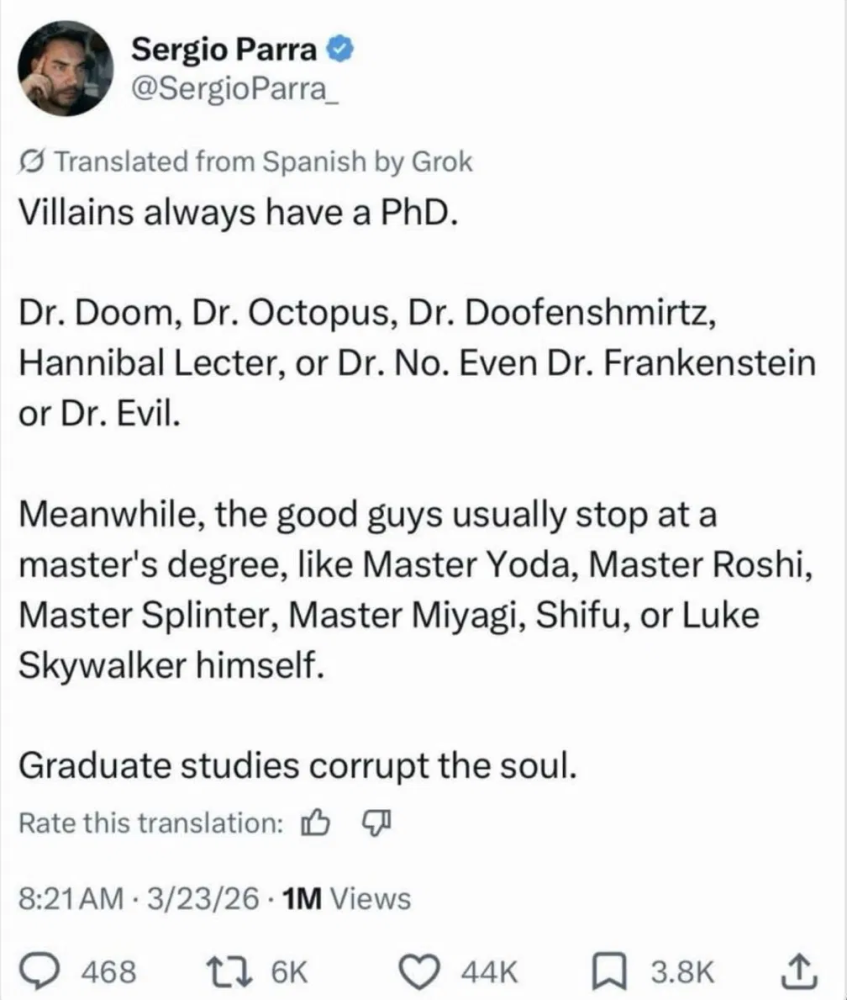
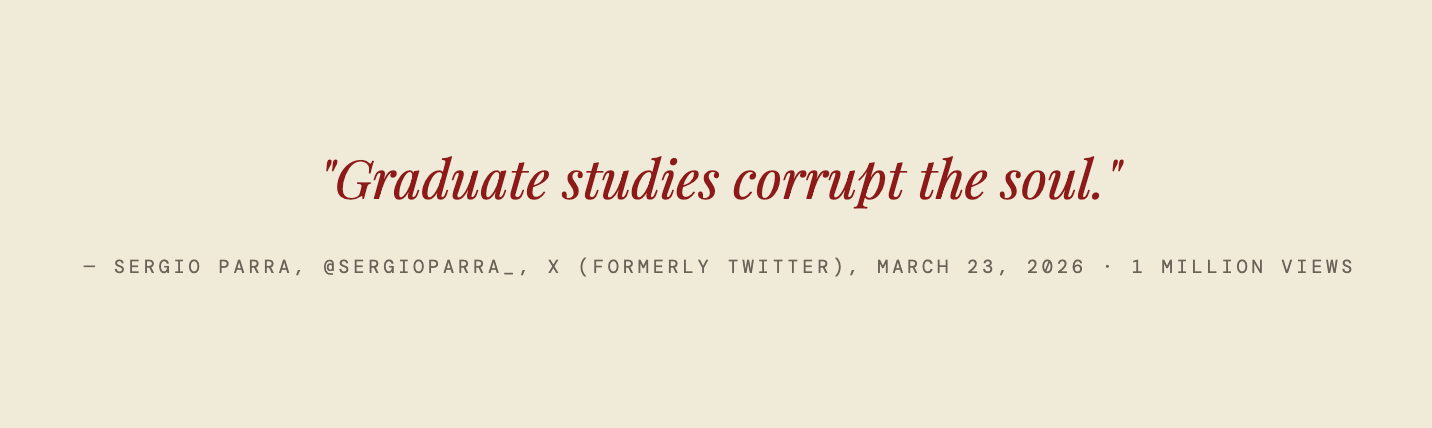
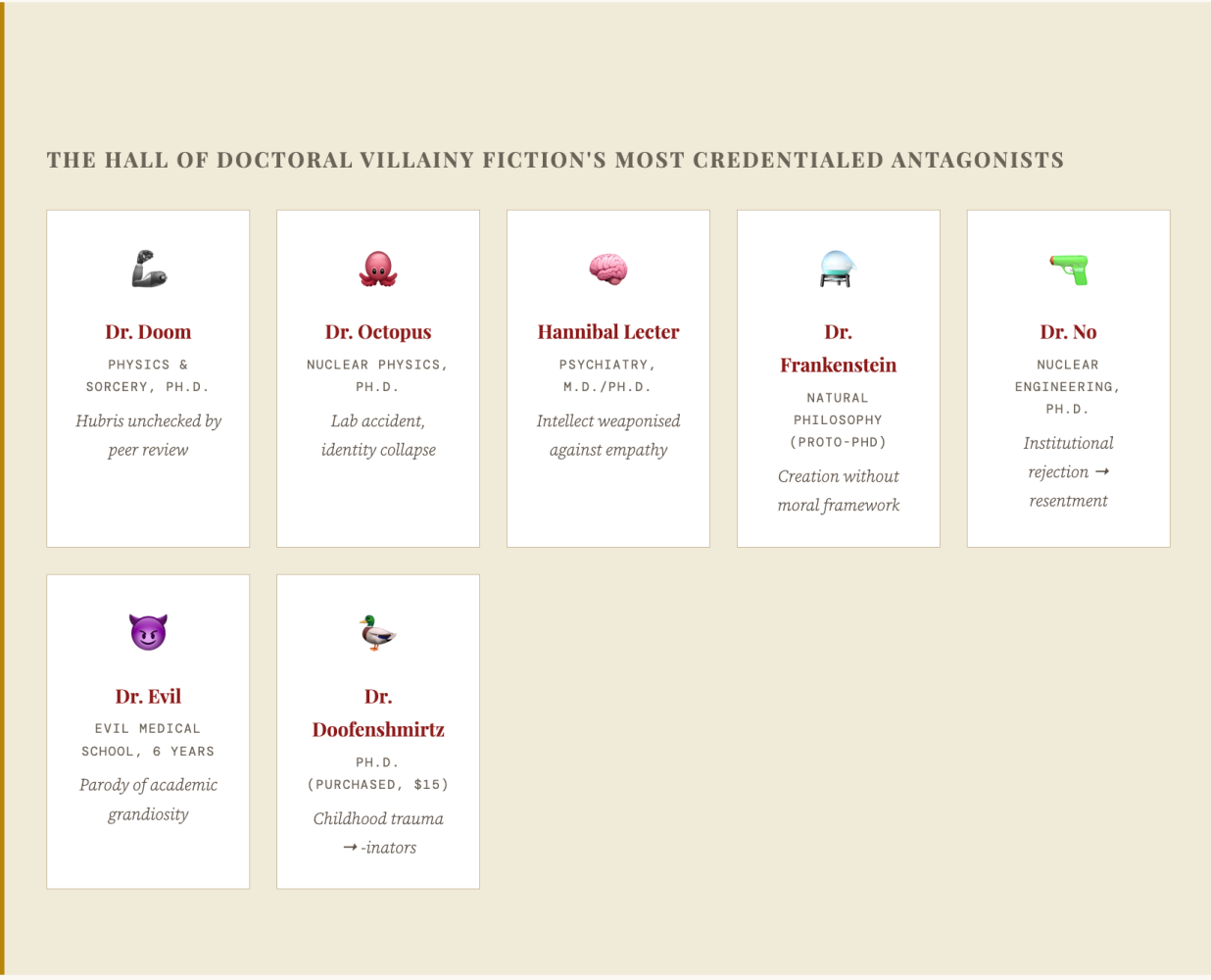
A single tweet translated from Spanish, fired off at 8:21 in the morning became a small internet sensation because it voiced something millions instinctively recognised but had never articulated quite so cleanly. "Villains always have a PhD," wrote Sergio Parra, and then he listed them: Dr. Doom, Dr. Octopus, Dr. Doofenshmirtz, Hannibal Lecter, Dr. No, Dr. Frankenstein, Dr. Evil. Meanwhile, he noted, the heroes of our stories Yoda, Roshi, Splinter, Miyagi, Shifu, Skywalker stop at a master's degree. His punchline: Graduate studies corrupt the soul.
The observation is, of course, comic. It is also, as the best comedy is, uncomfortably close to something true. This article takes the joke seriously not to endorse it, but to trace the threads it pulls on. What is it about the doctorate, in culture and in lived experience, that earns this reputation? And what does the actual research say?
I. The Villain with a Diploma: A Cultural Anatomy
The association between advanced learning and moral danger is ancient. Marlowe's Faust sells his soul not for wealth but for knowledge. Mary Shelley's Victor Frankenstein is destroyed not by a monster but by the untempered ambition of a university-trained mind. Conan Doyle's Moriarty holds a chair in mathematics. The "Morally Ambiguous Doctorate" is a named and documented trope in the study of popular narrative: [1] the "Dr." prefix functions as cultural shorthand for a character who possesses extraordinary intelligence and correspondingly extraordinary danger.
[2] As one analysis noted, the PhD in fiction operates as "a compact, believable way to explain technical competence, provide institutional settings and resources, and explore cultural anxieties about expertise and technology." The villainous doctorate is efficient storytelling and efficient myth-making. It persists because audiences accept it, because somewhere in the collective unconscious, learning beyond a certain point feels transgressive.
There is a notable asymmetry in the fictional hierarchy Parra identifies. The good teacher Yoda, Miyagi, Splinter is designated a Master: a word rooted in mastery of self and of craft, in transmission rather than accumulation. The villain is a Doctor: a word derived from the Latin for "teacher," but in practice signifying someone who has completed an original, solitary investigation into the furthest edges of knowledge. One title implies relationship; the other implies singular achievement. Fiction, apparently, distrusts the singular.
Doctor vs. Master
Fiction's moral hierarchy of academic titles and what it reveals about us
The Mental Health Reckoning
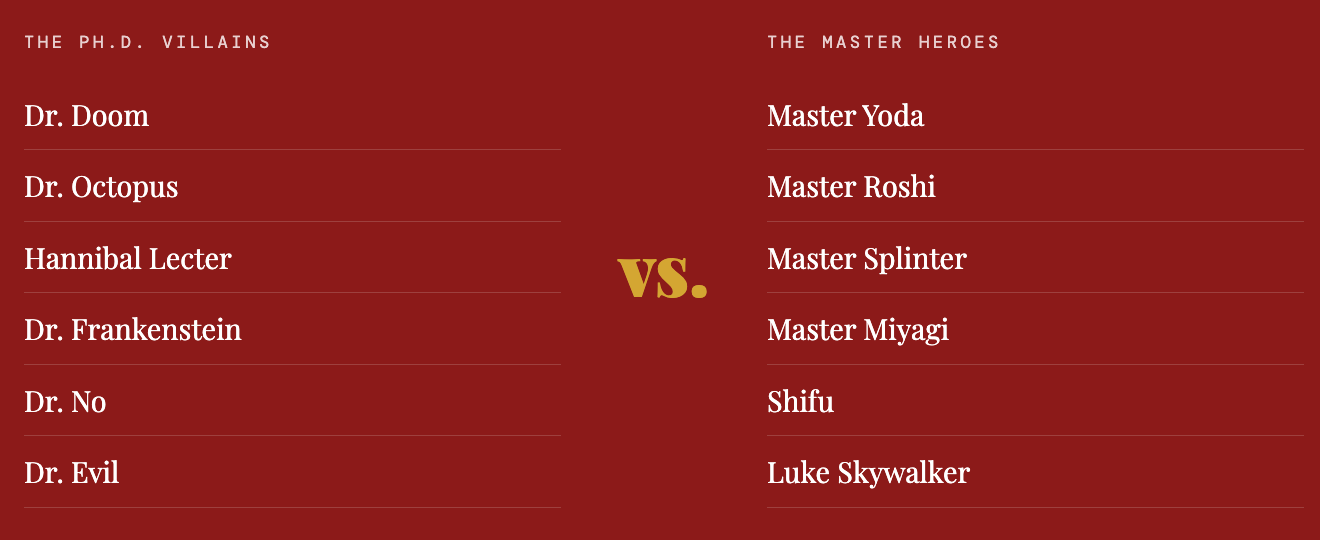
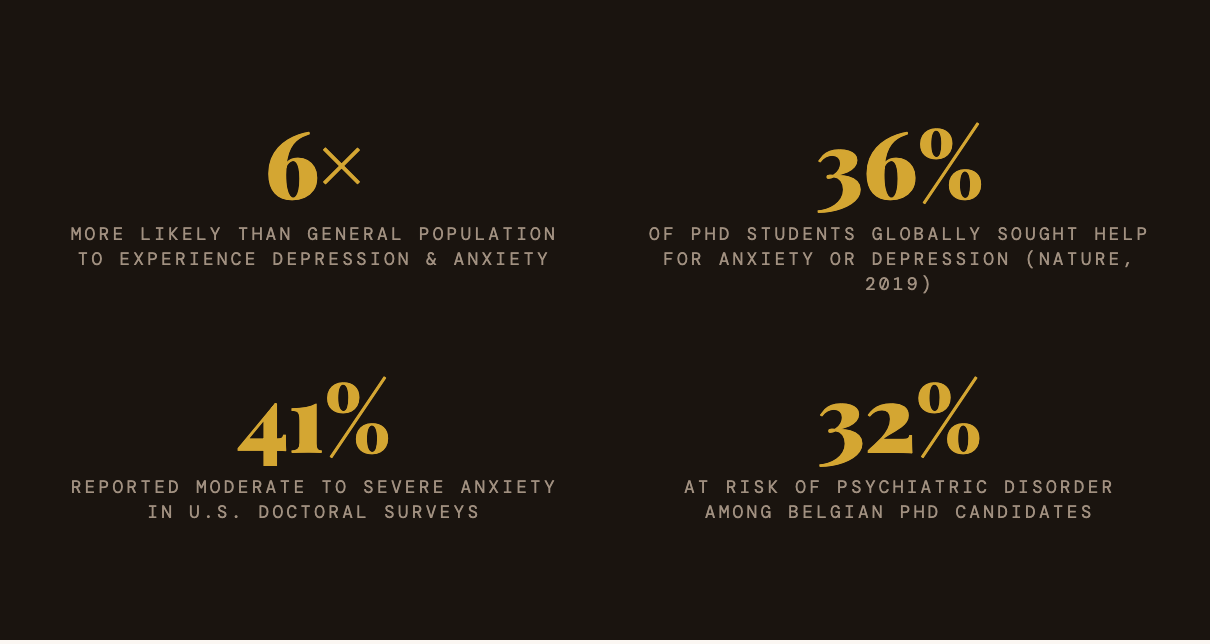
[3] A 2019 survey of 6,300 graduate students across North America, South America, Africa, Asia, Australia, and Europe published in Nature found that 36% had sought help for anxiety or depression related to their PhD studies. This was up from 29% just two years prior in the same survey series. A separate UK survey of 50,000 graduate students published in the same period echoed these findings. [4] One survey of 2,279 graduate students, 92% based at U.S. institutions, identified that 41% reported moderate to severe anxiety and 32% reported moderate to severe depression. Doctoral students, according to the same research, are six times as likely as the general population to experience both depression and anxiety.
[5] A Belgian study found that 32% of PhD candidates were at risk of developing a psychiatric disorder. [6] A comprehensive review of 163 studies on PhD wellbeing identified four major external stressors supervision quality, personal life demands, departmental structures, and financial precarity and five internal ones: motivation, writing anxiety, academic identity, self-worth, and self-efficacy.
The Impostor at the Lectern
[7] Doctoral students describe the transition from undergraduate to graduate study as moving from being a "big fish" to a "small fish in a sea" from visibility to invisibility, from structured success to uncharted uncertainty. The PhD offers no clear benchmarks: How many papers constitute success? What if experiments yield nothing? What constitutes progress when the frontier of knowledge is, by definition, where the maps run out?
[8] In this environment, impostor syndrome becomes epidemic. More than half of postgraduate students meet criteria consistent with depression. Those who feel like impostors tend to avoid asking questions, hide weaknesses, decline to collaborate, and resist applying their knowledge creating, paradoxically, the very gap in competence they fear being discovered to have. The doctorate, meant to produce confidence in original thought, can instead systematically undermine it.

Publish or Perish: The Ethics of Survival
[9] The "publish or perish" culture defines modern academia: career advancement depends not on the depth or originality of ideas but on the quantity and venue of publications. [10] For doctoral students, this pressure arrives early. Research has linked it to increased depressive symptoms, sleep disturbances, and critically research misconduct. The drive to publish can lead to p-hacking (manipulating statistical analysis to achieve publishable results), HARKing (Hypothesising After Results are Known), and a systematic avoidance of replication studies contributing directly to what scientists call the "reproducibility crisis."
[11] The pressure can also accelerate ethical transgressions: data manipulation, plagiarism, "salami publishing" (slicing one study into many to multiply output), and submission to predatory journals that accept anything for a fee. The graduate student who entered academia to pursue truth may find themselves, years later, playing an elaborate institutional game in which truth is one variable among many.
[12] As one analysis puts it starkly: "publish or perish can result in unethical or even hazardous practices, an erosion of research quality, and a shift in priorities from teaching, mentoring, and knowledge-creation toward the academic success of individuals and institutions." The very institution built to produce knowledge may, under these conditions, systematically incentivise its distortion.
III. The Anatomy of Corruption What Actually Goes Wrong
The "corruption" Parra's tweet gestures at is not, in the real world, a sudden transformation into villainy. It is slower, quieter, and far more sympathetic. It is what happens when exceptionally capable people are placed inside a system that is structurally misaligned with the values that brought them to learning in the first place.
Identity Erosion
The doctoral process requires a student to internalise a new identity that of the researcher, the expert, the original thinker. This is profoundly destabilising. The old self (high-achieving student, "the smart one") must be dismantled. The new self is perpetually unfinished. In the gap between these two states, many students experience what psychologists describe as a crisis of academic identity: a sense that they are performing expertise they do not yet possess, inside an institution that cannot afford to acknowledge the performance.
The Power Asymmetry
[3] One-fifth of doctoral respondents in the Nature survey reported being bullied; one-fifth reported experiencing harassment or discrimination nearly always from those senior to them in the academic hierarchy. The supervisor-student relationship, structurally similar to a feudal relationship of patronage and dependence, creates conditions in which abuse intellectual, professional, sometimes personal goes unchallenged because the power differential makes challenge existentially costly.
The Loneliness Laboratory
Research is, at its core, a solitary endeavour. The dissertation the central artefact of the doctorate is explicitly a demonstration of individual, unaided capacity. This structural solitude, combined with the social dynamics of a competitive department, can erode the cooperative instincts that healthy intellectual communities depend on. The scholar who enters the PhD wanting to advance collective knowledge may emerge having learned, deeply and by necessity, the arts of self-protection and individual advancement.
IV. The Counter-Evidence: Not All Doom
[13] A longitudinal study from Aotearoa New Zealand, comparing students who entered PhD programmes with those who did not, found something more nuanced than popular narrative suggests. PhD students showed a small decrease in mental wellbeing relative to baseline but the effect was "orders of magnitude smaller than one might expect based on previous cross-sectional research." The more striking finding was that those who did not enter doctoral study showed an increase in wellbeing, which made the PhD group appear worse by comparison. A marked deterioration in mental health, the study concluded, is "not an inevitable consequence of entering graduate study."
[14] A Swedish cohort study reached similar conclusions: PhD students are not significantly more vulnerable to depression or anxiety than comparable peers. What disparities exist appear to develop within doctoral programmes which suggests that the problem lies not in the act of advanced study itself, but in the conditions under which it is conducted.
This is a crucial distinction. The soul, it turns out, is not corrupted by knowledge. It is corrupted by isolation, by impossible expectations, by systems that value output over inquiry and quantity over truth. These are institutional failures and institutional failures can, in principle, be reformed.
V. Wisdom Without a Title: What the Masters Know
Return, for a moment, to Parra's heroes. What distinguishes Master Yoda, Master Miyagi, Master Splinter from their doctoral counterparts in fiction? It is not merely a credential. It is a relationship to knowledge itself. The Master's knowledge is embodied, transmitted, relational. It exists to be given away. The villain's knowledge is possessed, defended, hoarded a resource in a competitive landscape.
There is something here that the best graduate programmes try to cultivate and that the worst ones systematically destroy: the understanding that the point of knowing is not to know more than others, but to understand more fully, and to use that understanding in service of something larger than oneself. The Islamic tradition speaks of ilm nafi' beneficial knowledge as distinct from knowledge that serves only its possessor. The Sufi teachers who shaped so much of global intellectual heritage understood that the student who learns in order to surpass has already missed the lesson.
The fictional villain with a PhD has, in a sense, mastered the technique of a discipline while failing its spirit. Dr. Frankenstein knows how to create life; he does not know why he should. Dr. Doom is the smartest man in the room; he has never learned that the room is not the world. Hannibal Lecter understands human psychology with forensic precision; he has no compassion. The doctorate, in these stories, is a vehicle for the intellect that has grown faster than the soul.
VI. The Real World Villains
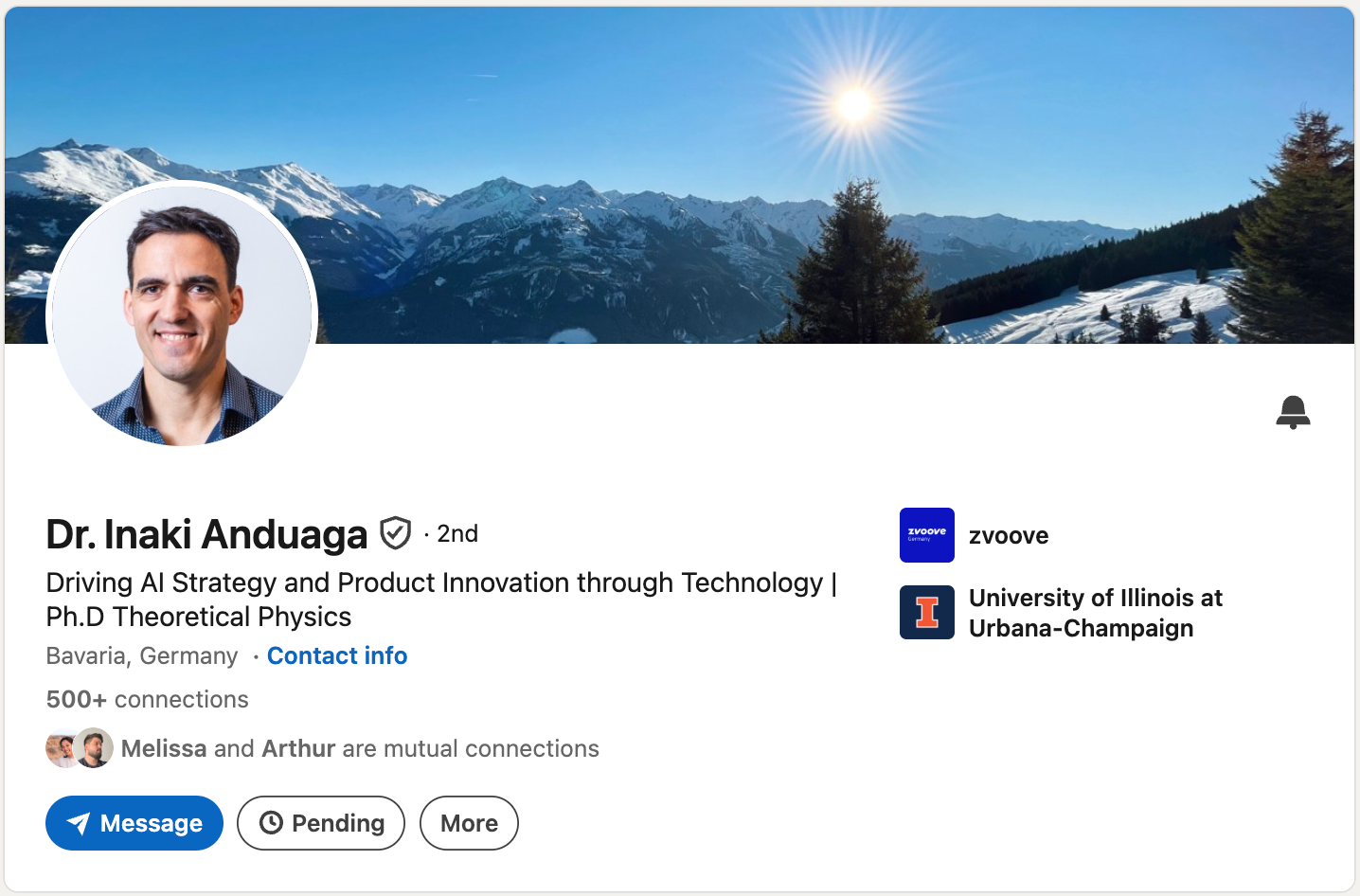
Potrait of Dr. Inaki Anduaga from University of Illinois Urbana-Champaign
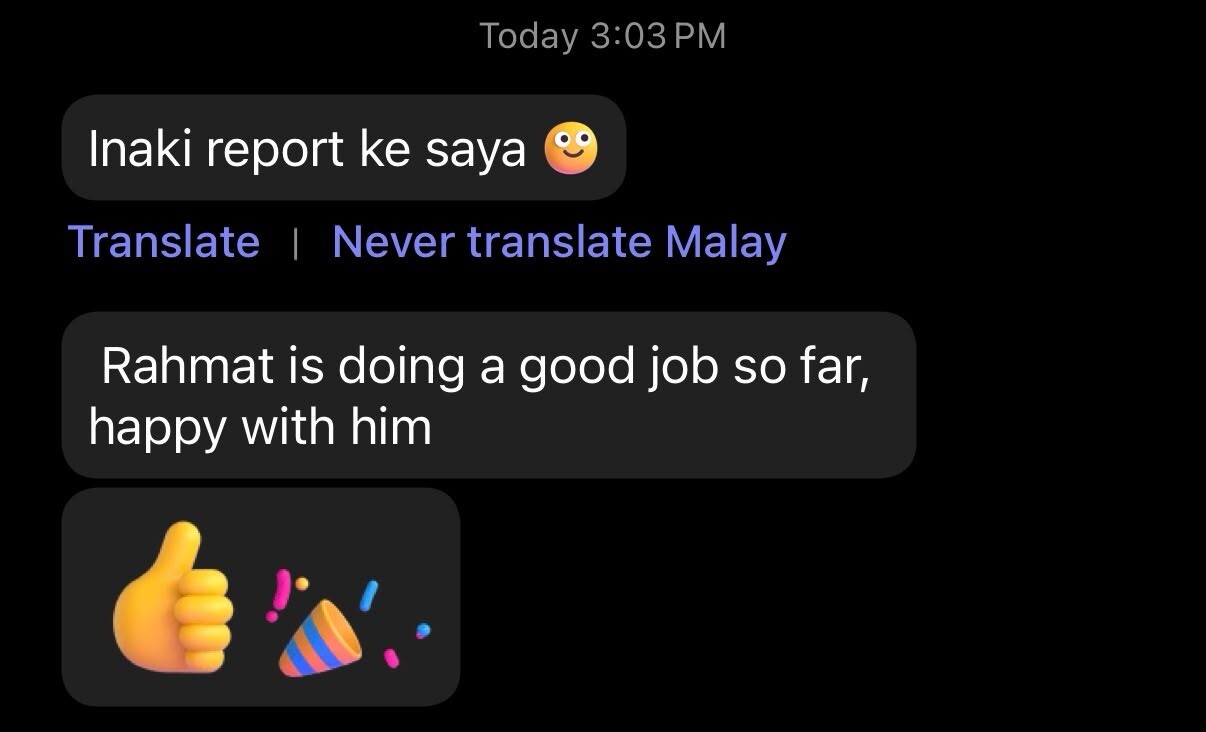
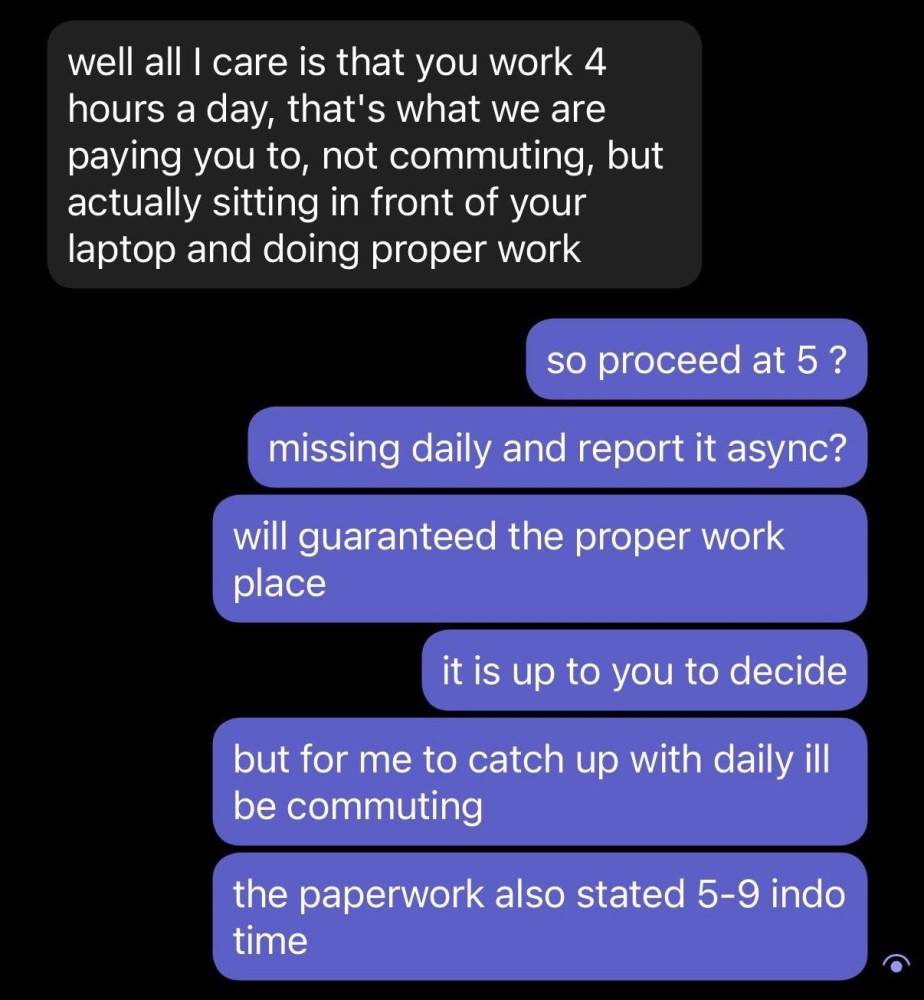

Micromanagement & Clock-Watching Inaki fixates on "4 hours physically sitting in front of a laptop" rather than outcomes. This is textbook presenteeism — measuring input time instead of deliverable quality, which kills trust and autonomy.
Contradiction on Work Arrangements He complains about commuting time eating into work hours, yet the paperwork he approved states 5–9 Indonesia time. He created the structural problem himself, then blamed you for it.
Competency Gatekeeping Without Context "Do you know how to do this without AI?" is a loaded, dismissive question. A good manager asks what approach you're taking and why, not whether you can do it the "hard way." Using AI for IaC generation while understanding the output is a legitimate and modern engineering practice.
Two-Faced Management Image 3 is the most telling: Inaki tells someone else "Rahmat is doing a good job, happy with him" with celebration emojis — while simultaneously interrogating your competency and monitoring your screen time. Positive feedback should go to the employee, not about them to a third party.
No Psychological Safety The interrogative tone ("are you relying on AI to do everything?") creates an environment where you can't be honest about your tools and workflow.
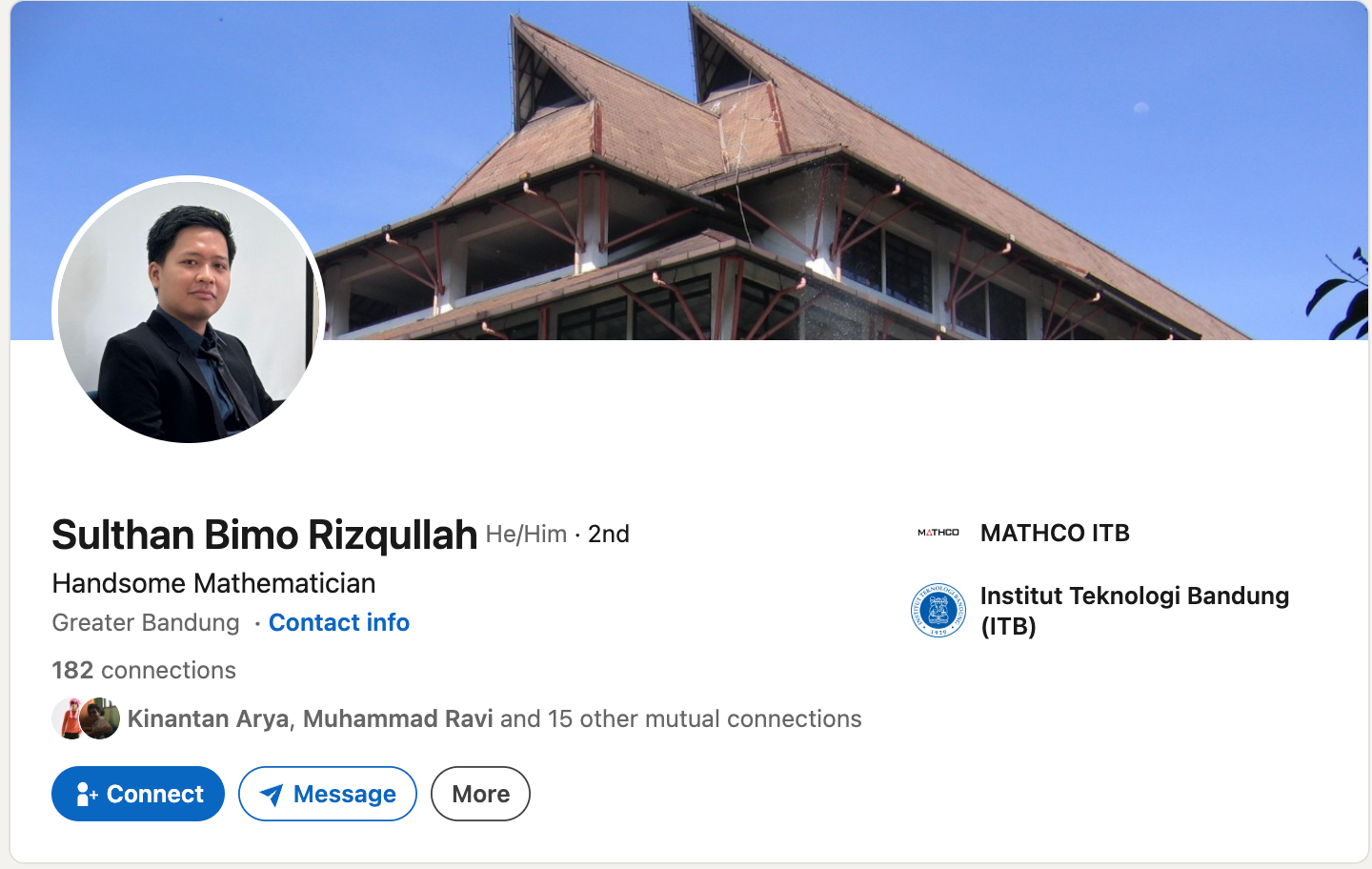
Sulthan Bimo Rizqullah from Institut Teknologi Bandung


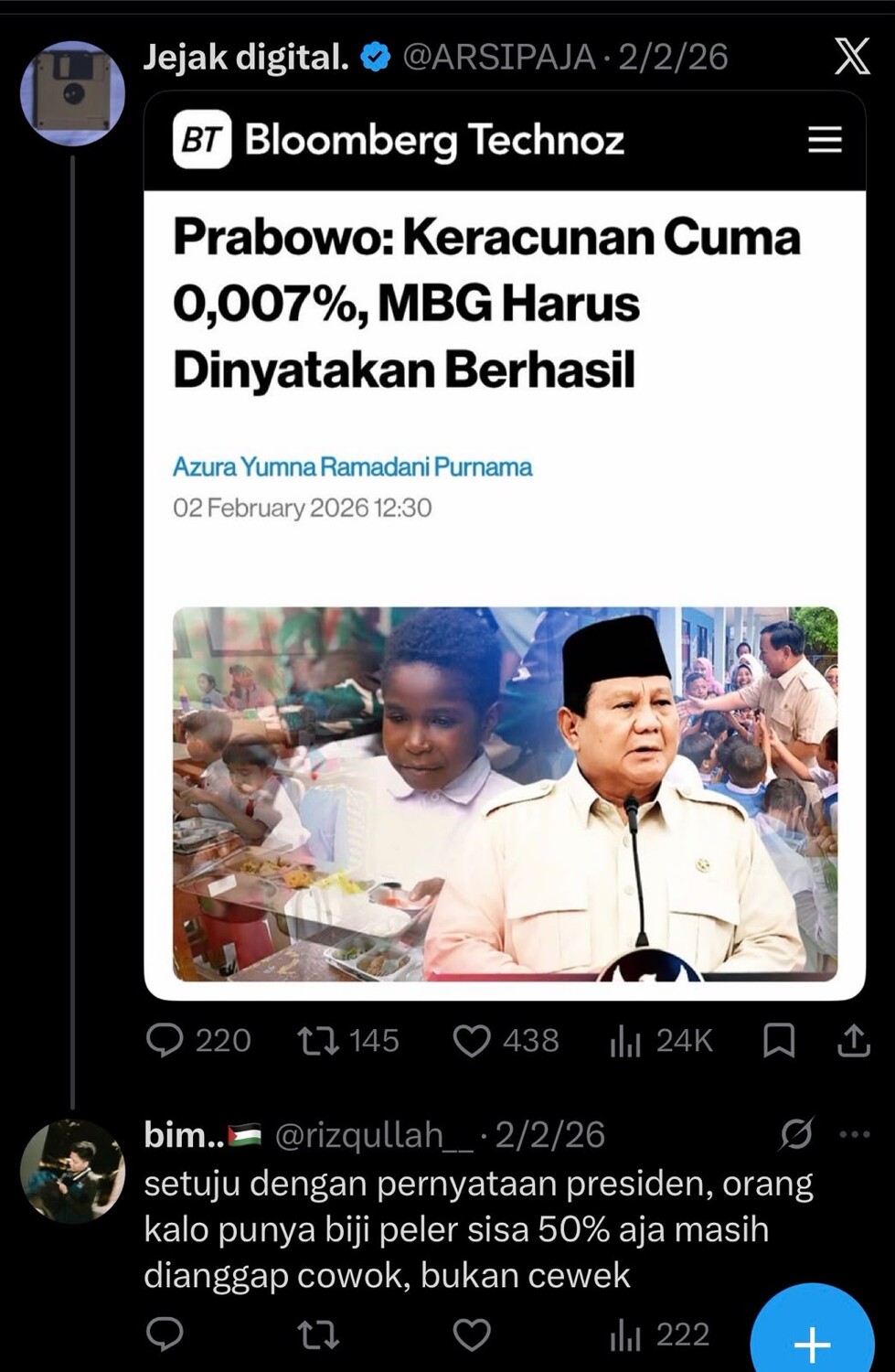
On the Curse Tweet
Wishing that bad karma won't return to someone's children and then justifying it not through divine mercy but through the claim that "no sane woman would have children with someone like this" is cruel and misogynistic in its framing. It weaponizes relationship status as an insult.
On the Vulgarity
The comment under the MBG/Prabowo article is simply crude and adds nothing of substance to political discourse. Reducing policy critique to a crude anatomical joke reflects poor judgment, especially in a public forum.
Overall Pattern
Bimo presents himself as intelligent and principled, yet his public posts consistently prioritize self-glorification and shock value over substance. The gap between his self-image ("nearly perfect," OSN medalist) and his actual online conduct is the real story here.
VII. Toward a Healthier Doctorate
If graduate studies can corrupt not through magic but through conditions then the corrective is a change of conditions. Researchers and institutions are beginning to articulate what this looks like in practice.
[5] In the United Kingdom, Research England and the Office for Students launched a dedicated Catalyst Fund for interventions in doctoral researcher wellbeing, funding seventeen university-led projects. The Student Minds charity launched the Wellbeing Thesis; the UK Council for Graduate Education convenes an annual international conference on researcher mental health. [9] Voices within academia are calling for a fundamental rethinking of evaluation metrics: away from publication quantity and impact factors, toward research depth, collaboration, and integrity. Pre-registration of studies, open peer review, and the deliberate rehabilitation of replication research are among the structural proposals on the table.
The goal, ultimately, is not to produce fewer doctors but better ones scholars whose advanced study has deepened their humanity rather than narrowed it. Scholars who know, in the oldest sense: not merely in the head, but in the bone.
Conclusion: The Degree Is Not the Destination
Graduate studies do not corrupt the soul. But they can, under the wrong conditions, create the conditions for corruption: isolation, competition, ethical compromise, identity fragmentation, and the slow substitution of knowledge-as-power for knowledge-as-understanding. The tweet that spawned a million views was not wrong to sense the danger. It was only too efficient to locate the cause in the credential rather than the culture.
The villain with a PhD is a mirror, not a destiny. He shows us what advanced learning becomes when the institution forgets its purpose. The master without one is a reminder of what it could be when it remembers.
The soul, it turns out, is not corrupted by the degree. It is corrupted by what we are asked and what we agree to become in order to earn it.
References
- TV Tropes. Morally Ambiguous Doctorate. TV Tropes Wiki. tvtropes.org/pmwiki/pmwiki.php/Main/MorallyAmbiguousDoctorate
- Quora discussion. How come so many supervillains have PhDs? quora.com/How-come-so-many-supervillains-have-PhDs
- Nature Editorial (2019). The mental health of PhD researchers demands urgent attention. Nature, 575, 257–258. doi.org/10.1038/d41586-019-03489-1
- Evans, T.M., Bira, L., Gastelum, J.B., Weiss, L.T., & Vanderford, N.L. (2018). Evidence for a mental health crisis in graduate education. Nature Biotechnology, 36, 282–284. doi.org/10.1038/nbt.4089
- Understanding the Mental Health of Doctoral Students. Encyclopedia, 3(4). MDPI, 2023. mdpi.com/2673-8392/3/4/109
- Van der Haert, M. et al. (2020). In the eye of the storm: the mental health situation of PhD candidates. Perspectives on Medical Education, 9, 353–355. PMC7737569
- Chakraverty, D. (2020). Impostor Syndrome: When your accomplishments make you feel like a fraud. Doctoral Supervision Blog, IIM Ahmedabad. supervisingphds.wordpress.com
- University of North Carolina, Department of Pharmacology. Shining a Spotlight on Imposter Syndrome. med.unc.edu/pharm
- González Flores, J.E. (2025). Academic Fatigue of Young Researchers: The Price of the Publish or Perish Culture. Cureus, 17(11), e97223. PMC12715826
- Poppelaars, E.S. et al. (2021). Publish-or-perish culture: A PhD student perspective. Research Communities by Springer Nature. communities.springernature.com
- Psychological Science Observer. Research Ethics at the Graduate Level. APS, February 2016. psychologicalscience.org
- Marjanovic, Z. et al. (2024). The card game of publish or perish: a satirical approach to the reality of academic publishing. NCBI/PMC. PMC11399718
- Stuart, M., & Jacobson, L. (2021). A Longitudinal Study of Mental Wellbeing in Students in Aotearoa New Zealand Who Transitioned Into PhD Study. Frontiers in Psychology, 12, 644189. PMC8172967
- CEPR / VoxEU. (2024). Reassessing the mental health crisis among PhD students. cepr.org/voxeu/columns/reassessing-mental-health-crisis-among-phd-students
- Zhang, F., Litson, K., & Feldon, D.F. (2022). Social predictors of doctoral student mental health and well-being. PLOS ONE, 17(9), e0274273. doi.org/10.1371/journal.pone.0274273
- Parra, S. [@SergioParra_]. (2026, March 23). Villains always have a PhD… [Tweet/X post]. X (formerly Twitter). 1M views.