
Ensnaring Corporate Criminals By Rahmat Wibowo From Infraloka, A comprehensive deep dive into Menjerat Pelaku Tindak Pidana Korporasi Di Indonesia by Dr. Yurizal, SH. MH.
A comprehensive deep dive into Menjerat Pelaku Tindak Pidana Korporasi Di Indonesia by Dr. Yurizal, SH. MH.
Foreword: Prof. Kusno Aji, SH. MH. · Komjen. Pol. Drs. Unggung Cahyono · DR. Bambang Sugiri, SH. MH.
There is a legal fiction that has haunted criminal law for centuries: the idea that a corporation — being an abstraction, a piece of paper, a registered name — cannot truly commit a crime. It has no soul to condemn, no body to imprison, and no conscience to violate.
That fiction is now under sustained attack in Indonesia.
Dr. Yurizal's book is one of the most important works in Indonesian criminal law precisely because it dismantles this fiction piece by piece — not through rhetoric, but through rigorous doctrinal analysis, comparative jurisprudence, and a thorough examination of how the tools already available in Indonesian law can and must be deployed to hold corporations accountable.
Part I : The Foundations — What Is Criminal Liability and Why Does It Matter?
Before addressing corporations specifically, Dr. Yurizal begins with the bedrock question: what does it actually mean to be criminally responsible?
A criminal act (tindak pidana) is meaningless unless paired with criminal accountability (pertanggungjawaban pidana). The law does not punish events — it punishes people. The principle is ancient: verwijtbaarheid — blameworthiness — must be objectively demonstrated and subjectively attributed.
The Indonesian Criminal Code (KUHP) establishes that four conditions must all be present before punishment is possible: (1) a criminal act was committed; (2) there is an element of fault (kesalahan); (3) the perpetrator was mentally capable of being held responsible; and (4) no grounds for excuse or justification exist.
Nulla poena sine culpa — no punishment without fault.
This framework was designed for human beings. The problem — and the entire challenge of corporate criminal law — is that corporations are not persons in any biological or psychological sense. They cannot intend anything in the ordinary sense of the word.
So how do you punish one?
Part II : The Historical Barrier — "Corporations Cannot Commit Crimes"
The Indonesian KUHP is a direct inheritance from the Dutch colonial administration — the Wetboek van Strafrecht (WvS), never designed to account for corporate criminal subjects. The colonial-era law operated entirely within the framework of naturlijk persoon — natural persons, human beings.
"Societas delinquere non potest" — a legal entity cannot commit a crime.
The justification rested on two arguments. First: a company has no actual consciousness. Without a mind, there can be no mens rea, and without mens rea, there can be no crime. Second: whatever is done in a corporation's name is done by human beings. If a director commits a crime, the director is the criminal — not the company.
The Ultra Vires Doctrine
This principle was reinforced by the doctrine of ultra vires: if a director commits a crime exceeding the scope of the corporation's charter (anggaran dasar), the director personally is the violator. The doctrine had intuitive appeal but created an obvious evasion problem — virtually any crime can be characterized as "beyond scope," since no corporation's charter authorizes fraud, bribery, or corruption.
Part III : The Shift — Why Indonesia Had to Evolve
The legal landscape was ultimately unsustainable. Corporations had become vehicles for crime. As the national business environment expanded, corporations were increasingly weaponized: used to launder proceeds of crime, shield assets from enforcement, and externalize costs of criminal conduct onto the public while internalizing profits.
Without corporate criminal liability, the enforcement equation is always asymmetric: the benefit is institutional, the punishment is individual.
Individual officers may lack the personal assets to pay fines matching the scale of harm done. They resign, are replaced, and the institution that benefited continues operating without consequence. Indonesia's response was to amend the Corruption Law (Undang-Undang Tipikor) to formally recognize corporations as criminal subjects.
Part IV : Five Theories of Corporate Criminal Liability
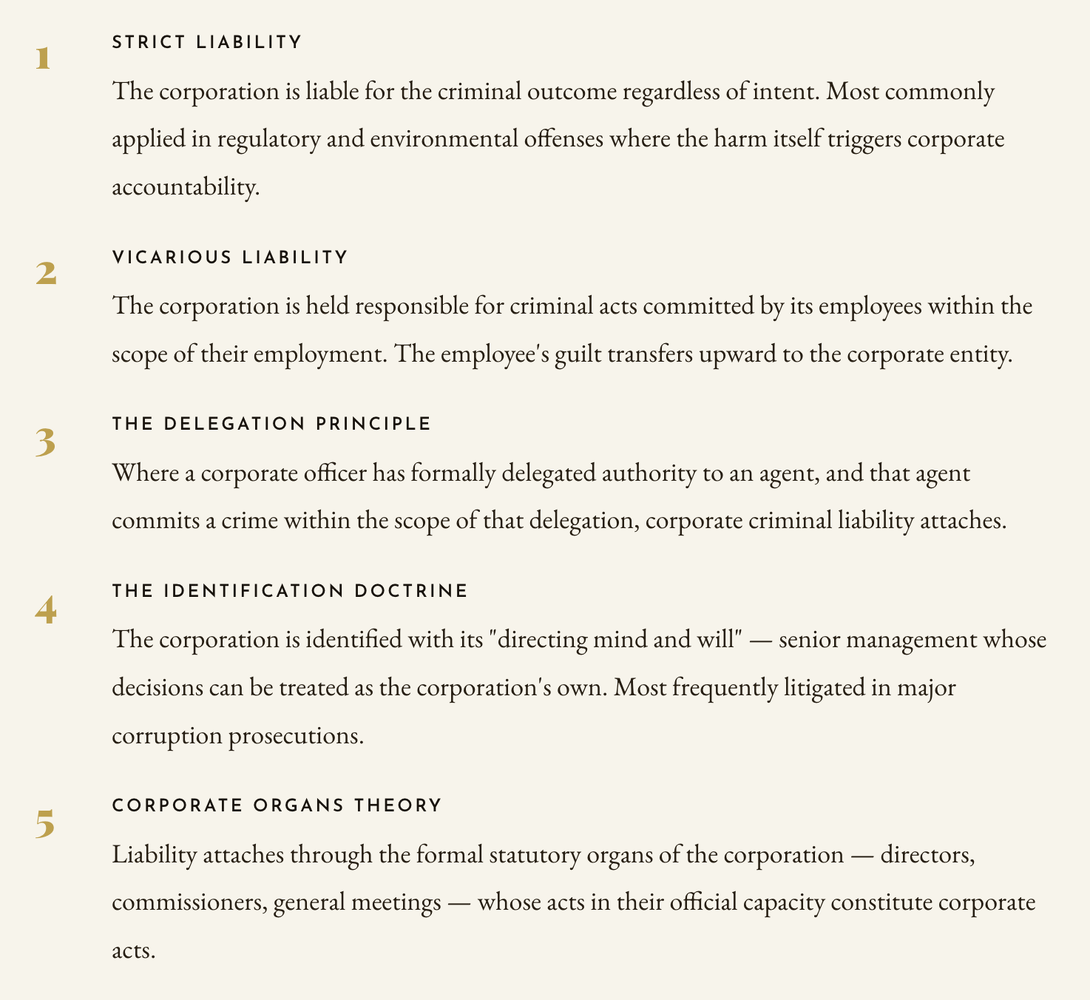
With the statutory gateway open, the doctrinal question becomes urgent: how exactly do you prove a corporation committed a crime? Dr. Yurizal systematically examines five theories — and notes that prosecutors are free to choose whichever best fits the case. These are tools in a toolkit, not competing dogmas.
Part V : Who Can Be a Corporate Criminal Subject?
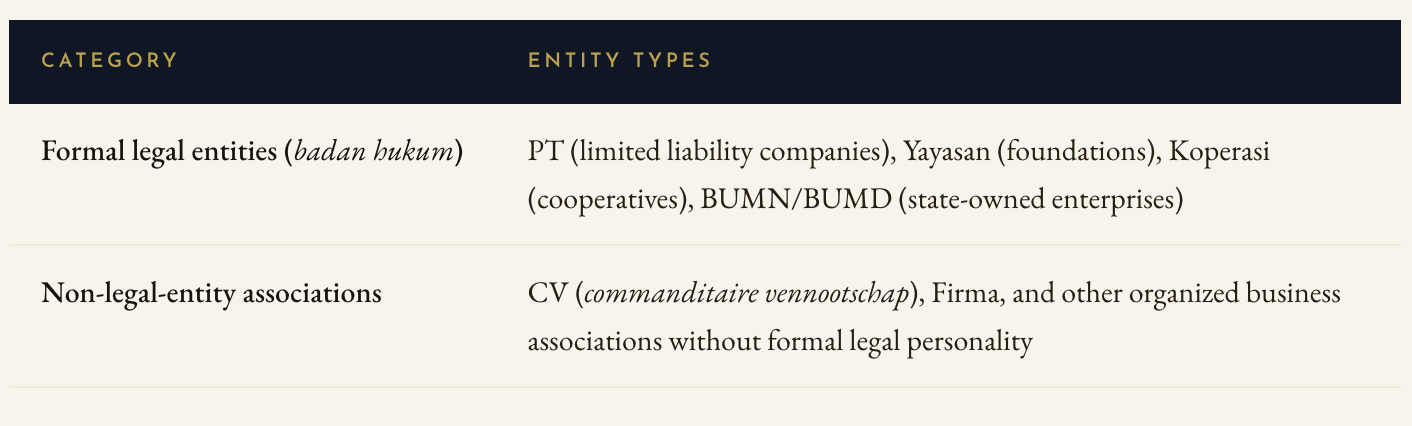
Under contemporary Indonesian jurisprudence and Supreme Court Regulation (PERMA) No. 13 of 2016, the following entities can be prosecuted:
Part VI : The Evidentiary Challenge — Proving Corporate Fault
If proving individual criminal fault is demanding, proving corporate criminal fault is vastly more complex. Dr. Yurizal identifies three central evidentiary challenges:
The decision chain problem: In a large corporation, criminal decisions rarely originate from a single identifiable moment of intent. They emerge from institutional cultures, budget pressures, performance incentives, and layers of managerial approval — none of which individually constitutes dolus, but which collectively produce criminal outcomes.
The documentation problem: Corporate records are simultaneously the most valuable evidence and the most controlled resource. Their evidentiary weight depends heavily on proper investigative procedure.
The BAP complication: Corporate entities cannot "speak" in interrogations the way natural persons can. The Berita Acara Pemeriksaan — the official examination record backbone of Indonesian criminal procedure — must be adapted for corporate defendants.
Part VII : Sanctions — What Can Courts Actually Do to a Corporation?
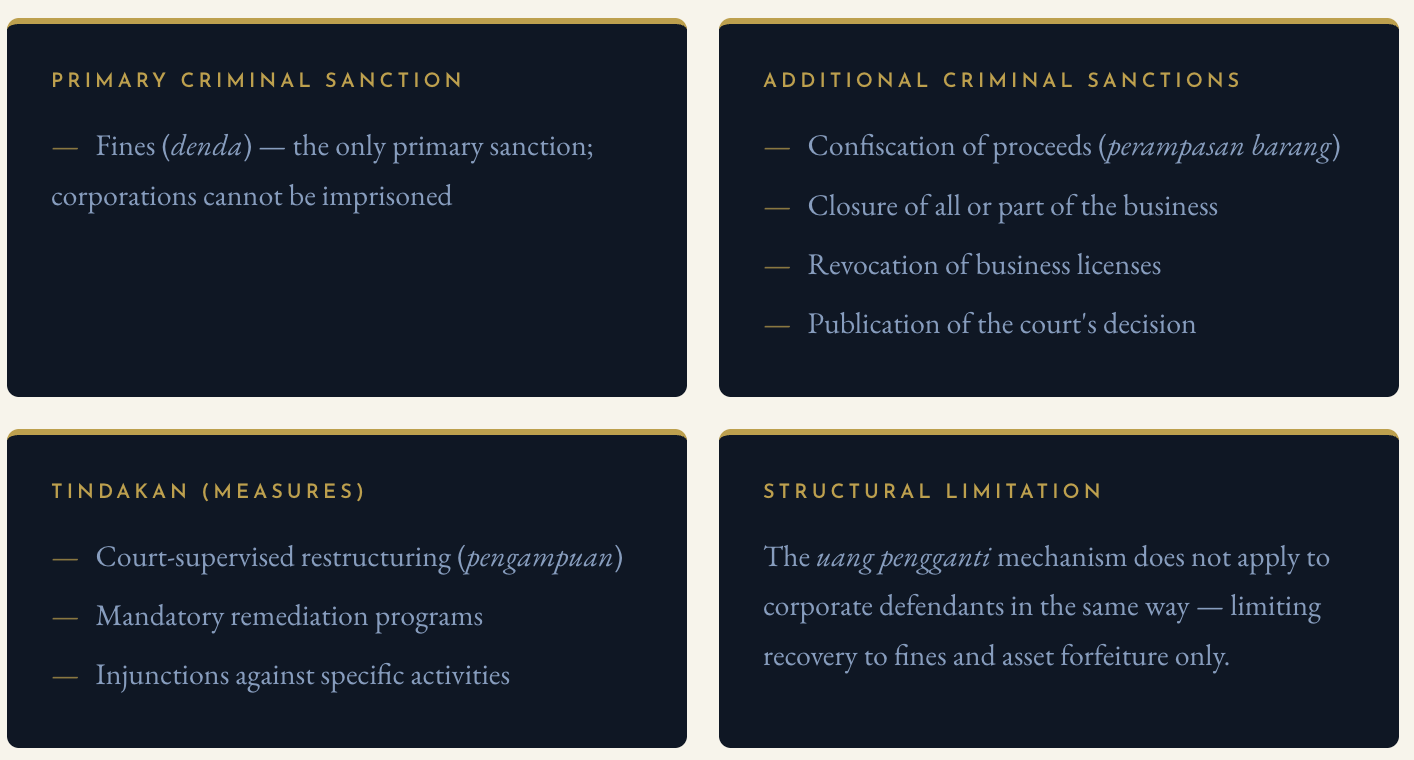
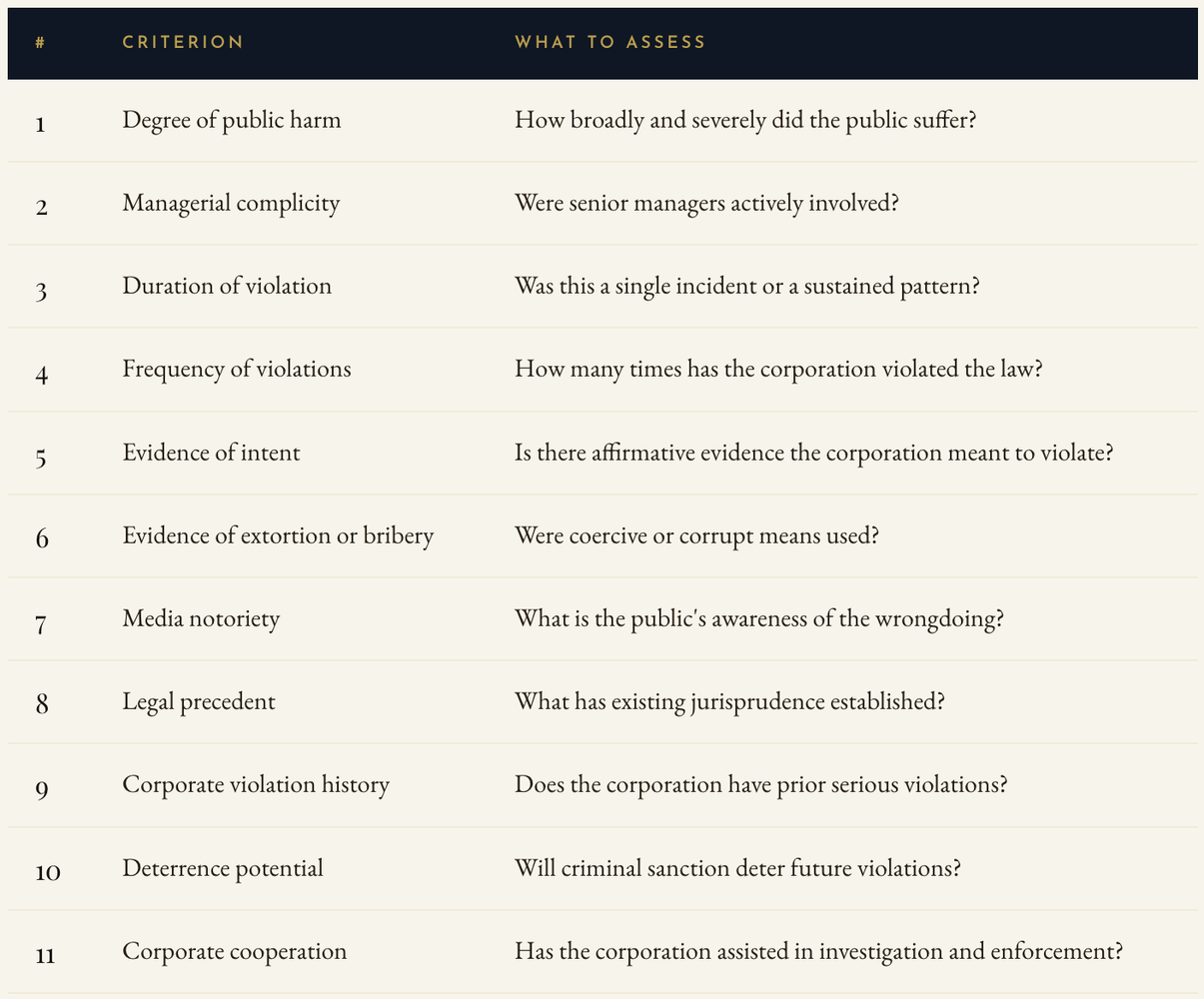
The Eleven-Factor Framework: Criminal vs. Civil Sanctions
One of the book's most practically useful contributions is a structured framework for determining when criminal sanctions are the appropriate response:
When monetary sanctions fall short, Dr. Yurizal argues for active use of adverse publicity orders — requiring corporations to publicize their own convictions at their own expense. Reputational destruction may be more devastating than any fine.
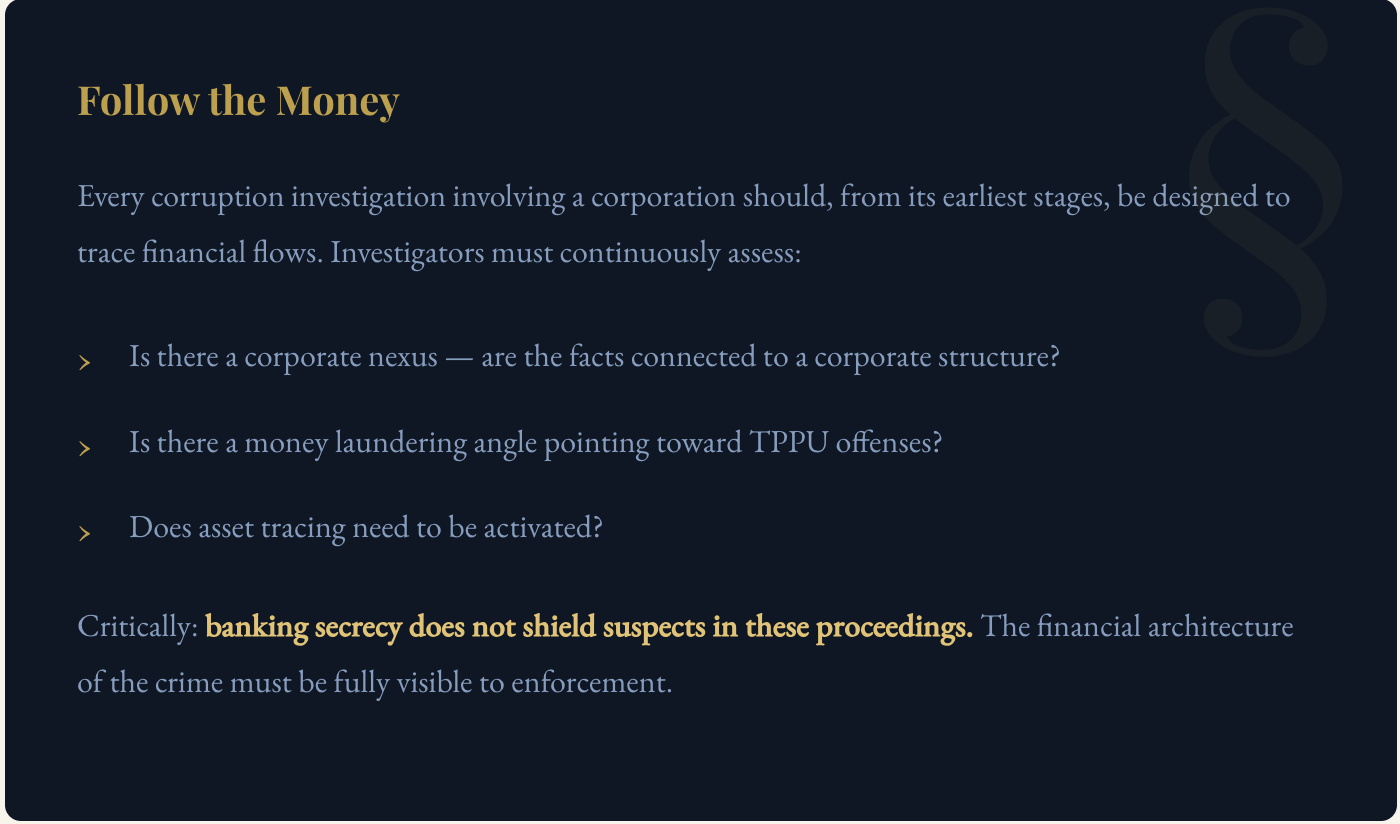
Part VIII : The "Follow the Money" Imperative
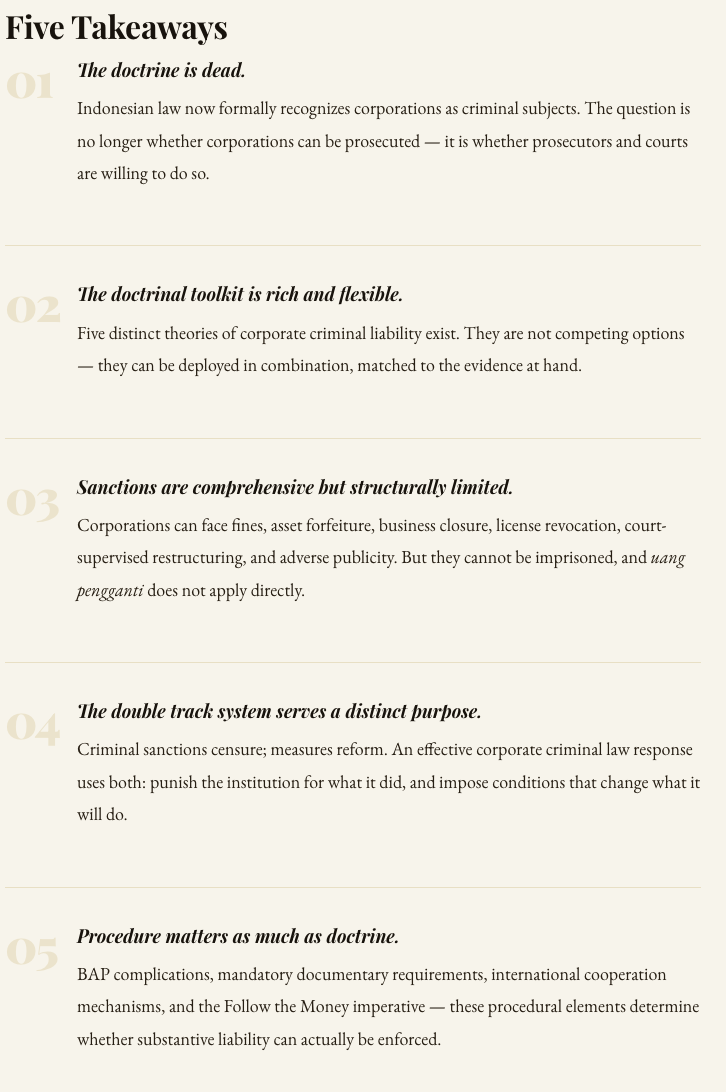

The corporations operating in Indonesia today are not the small colonial-era trading companies that the Dutch Wetboek van Strafrecht was designed to regulate. They are sophisticated, powerful, globally connected entities that employ thousands, manage billions, and shape public life in profound ways. When they commit crimes — particularly corruption crimes that drain the state and distort public contracting — the harm is massive, systemic, and deeply difficult to attribute to any single individual.
Dr. Yurizal has given Indonesian law enforcement, the judiciary, and legal practitioners a comprehensive framework for reaching these entities — not merely the individuals within them. It is long past time to leave the old fiction behind.
If you work in Indonesian criminal law, compliance, corporate governance, or anti-corruption enforcement — I'd love to hear your perspective on how these principles are being applied in practice today.
#CorporateCriminalLaw #AntiCorruption#Indonesia #Tipikor #CorporateGovernance #LegalAnalysis #Compliance #WhiteCollarCrime #IndonesianLaw #FollowTheMoney