
Feng Shui Driven Development
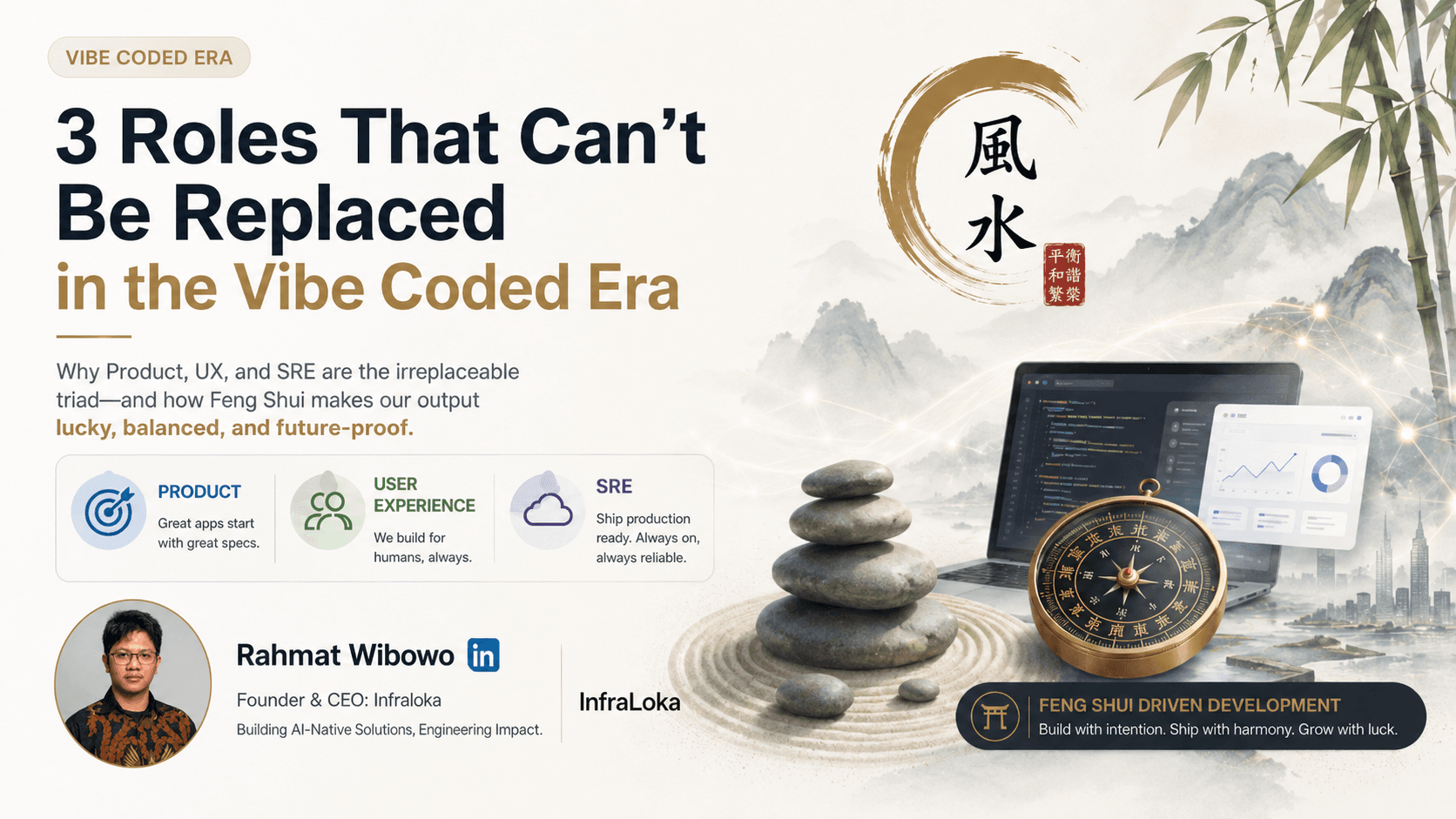
AI can compress the distance between idea and implementation. It cannot remove the need for judgment. In the vibe-coded era, Product, User Experience, and SRE become more—not less—important.
Vibe coding has changed the software conversation. A founder can describe an idea in plain language, generate an interface, connect an API, and have something demoable before lunch. That is a genuine leap. But speed is easy to confuse with completeness.
The closer software creation gets to natural language, the more valuable the surrounding disciplines become. When implementation friction falls, the bottleneck moves upward into deciding what should exist, how it should feel, and whether it can survive contact with reality.
AI can generate code. It cannot inherit accountability.
In other words, vibe coding does not erase the software team. It changes where the leverage sits. Three roles become especially durable: Product, User Experience, and Site Reliability Engineering.
01 / Product — Good prompts are not a substitute for good specs.
Vibe coding rewards articulation. The quality of the generated application is constrained by the quality of the problem definition: the user, the job-to-be-done, the edge cases, the data model, the permissions, the acceptance criteria, and the trade-offs.
Product becomes the discipline of turning ambiguity into executable intent. A strong product person does not merely say "build a dashboard." They define which decision the dashboard must improve, which inputs are trustworthy, what latency is acceptable, what a failure looks like, and what should explicitly not be built.
02 / User Experience — The interface may be generated. Human friction is not.
AI is already excellent at producing plausible interfaces. Plausible, however, is not the same as usable. A screen can look polished while hiding weak information architecture, unclear hierarchy, inaccessible interactions, bad defaults, or flows that force the user to understand the implementation.
UX remains essential because software exists inside human attention, habit, fear, expectation, and context. The real question is not "can AI draw this screen?" but "does this screen help the human finish the job with less cognitive load and more confidence?"
03 / Site Reliability Engineering — A demo is not a production system.
This is where the vibe-coded dream meets physics. Production requires observability, access control, rollback, capacity planning, incident response, disaster recovery, security boundaries, secrets management, deployment discipline, and clear service-level objectives.
An AI-generated application can be brilliant in the happy path and still be dangerously incomplete. SRE is the discipline that asks what happens at 3:17 a.m. when a dependency times out, a queue grows, a region degrades, or a deploy silently doubles latency.
Product asks: Are we building the right thing, with enough precision that AI can execute the intent?
UX asks: Can a human understand, trust, and use what we built without thinking like an engineer?
SRE asks: Can this system survive real traffic, bad days, deploys, dependencies, and human mistakes?
Then I wanted to make the process luckier.
Software culture likes to borrow metaphors from architecture: foundations, blueprints, interfaces, structure, systems. So I propose borrowing one more—this time from Chinese feng shui.
Not as superstition disguised as engineering. Not as a replacement for evidence. But as a design philosophy: arrange the system so that energy, information, ownership, and failure can flow with less friction.
A proposed philosophy: Feng Shui Driven Development
A way to treat software as an environment whose flow can be designed: clear intent enters, useful experiences emerge, operational feedback returns, and complexity is not allowed to stagnate.
- Qi → Flow. Optimize how context, data, decisions, and feedback move.
- Bagua → Balance. Balance product value, user clarity, and operational resilience.
- Clutter → Debt. Remove stale abstractions, dead code, unused dashboards, and ambiguous ownership.
- Placement → Architecture. Put responsibilities where they naturally belong; avoid forcing every concern into one layer.
In this framing, Product gives direction to the flow. UX shapes the flow around humans. SRE protects the flow under pressure. AI accelerates the flow everywhere in between.
The operating model Intent × Empathy × Reliability × AI = Better Software Flow
The role of AI is not to replace the team. It is to increase the surface area of judgment.
When implementation becomes cheap, teams can explore more ideas. That means more decisions, more interfaces, more edge cases, and more production paths. The paradox of vibe coding is that the faster we can create software, the more aggressively we need disciplines that decide what deserves to be created.
The future team may be smaller. It may use agents for coding, testing, documentation, refactoring, design variations, and infrastructure scaffolding. But the durable human layer will still answer three questions: What should we build? How should it feel? Can we trust it in production?
And if we can arrange those forces with enough clarity, balance, and flow—perhaps a little feng shui is exactly what vibe-coded software needs.
Written by Rahmat Wibowo · InfraLoka. "Feng Shui Driven Development" is presented here as a creative software-design philosophy, not a claim of technical causation.
#Technology #Product #SRE #AI