
From the Stars Above to the Streets Below By Rahmat Wibowo From Infraloka
How a boy who once looked up at the heavens now works to lift others up — carrying the spirit of Habibie, the audacity of Musk, and the mercy of the Prophets.
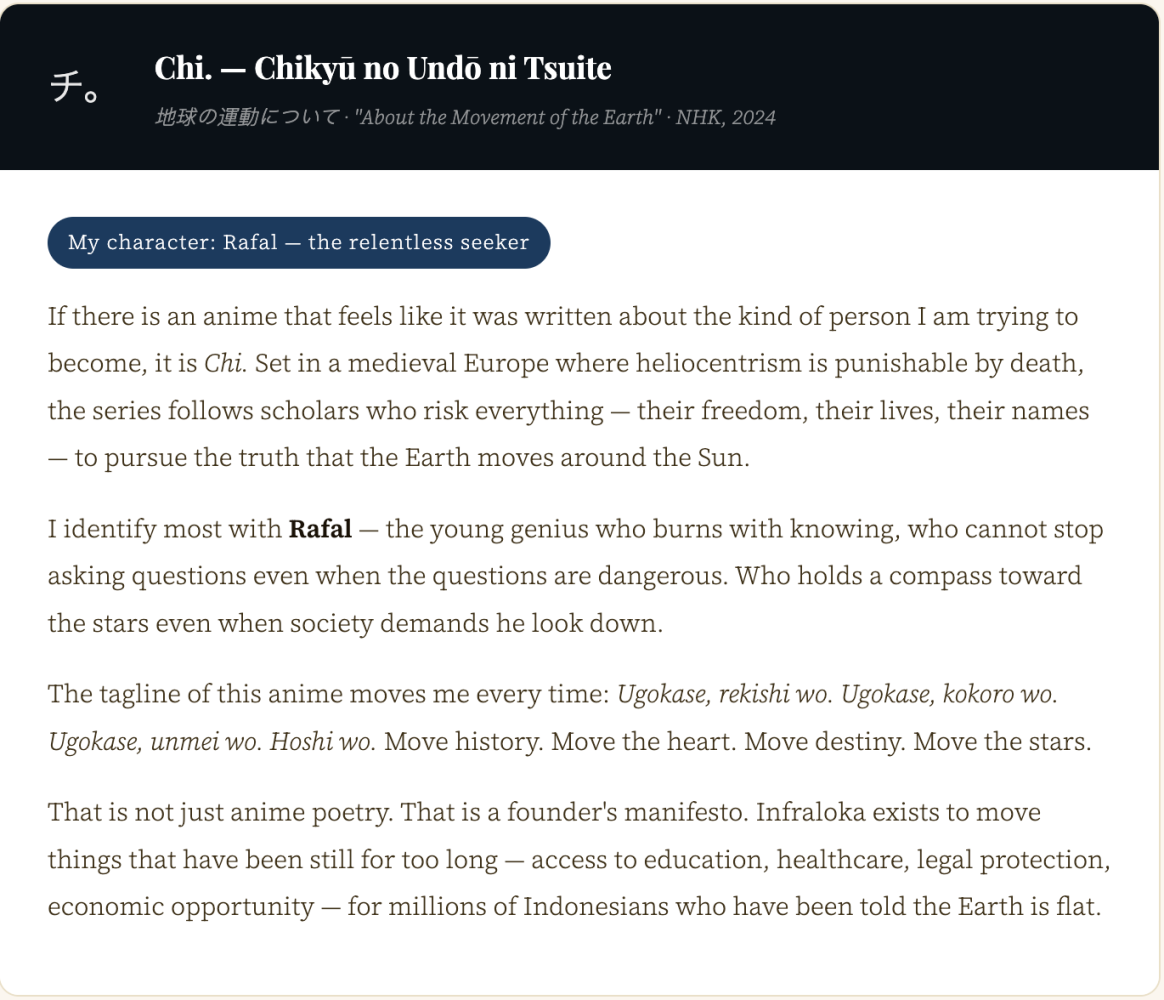
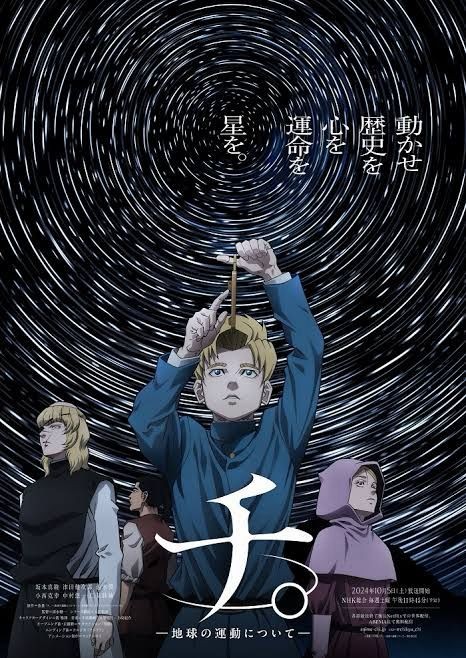
Rafal: - "Why should I fear death? If I am, then death is not. If Death is, then I am not. Why should I fear that which can only exist when I do not?" by Epicurus
"To fear death is nothing other than to think oneself wise when one is not; for it is tothink one knows what one does not know. No man knows whether death may noteven turn out to be the greatest blessing for a human being; and yet people fear itas if they knew for certain that it is the greatest of evil." by Socrates
"Life is long if you know how to use it." by Seneca
Nowak: "Those words are from Heathens from more than 200 years ago! Their words would not be of use to you"
Rafal: "Their words can move hearts, they moved me. I think the inspiration gifted by others is something more precious than life, I want their words to live on."
Nowak: "You are giving up your life just for some words. That's insanity"
Rafal: "Maybe, but I believe I will call it Love"
The Night I Fell in Love with the Universe
There is a specific kind of silence that comes when you tilt your head back and truly see the sky — not as wallpaper, but as a question. I was a teenager in SMA Negeri 31 Jakarta when that silence first found me. My school's astronomy textbook felt like a doorway into something ancient and enormous, and I walked through it with everything I had.
I did not just study stars. I obsessed over them. I memorized orbital mechanics the way other kids memorized song lyrics. I mapped constellations the way others mapped their city. And in 2018, that obsession earned me something I still hold as one of the proudest moments of my life.
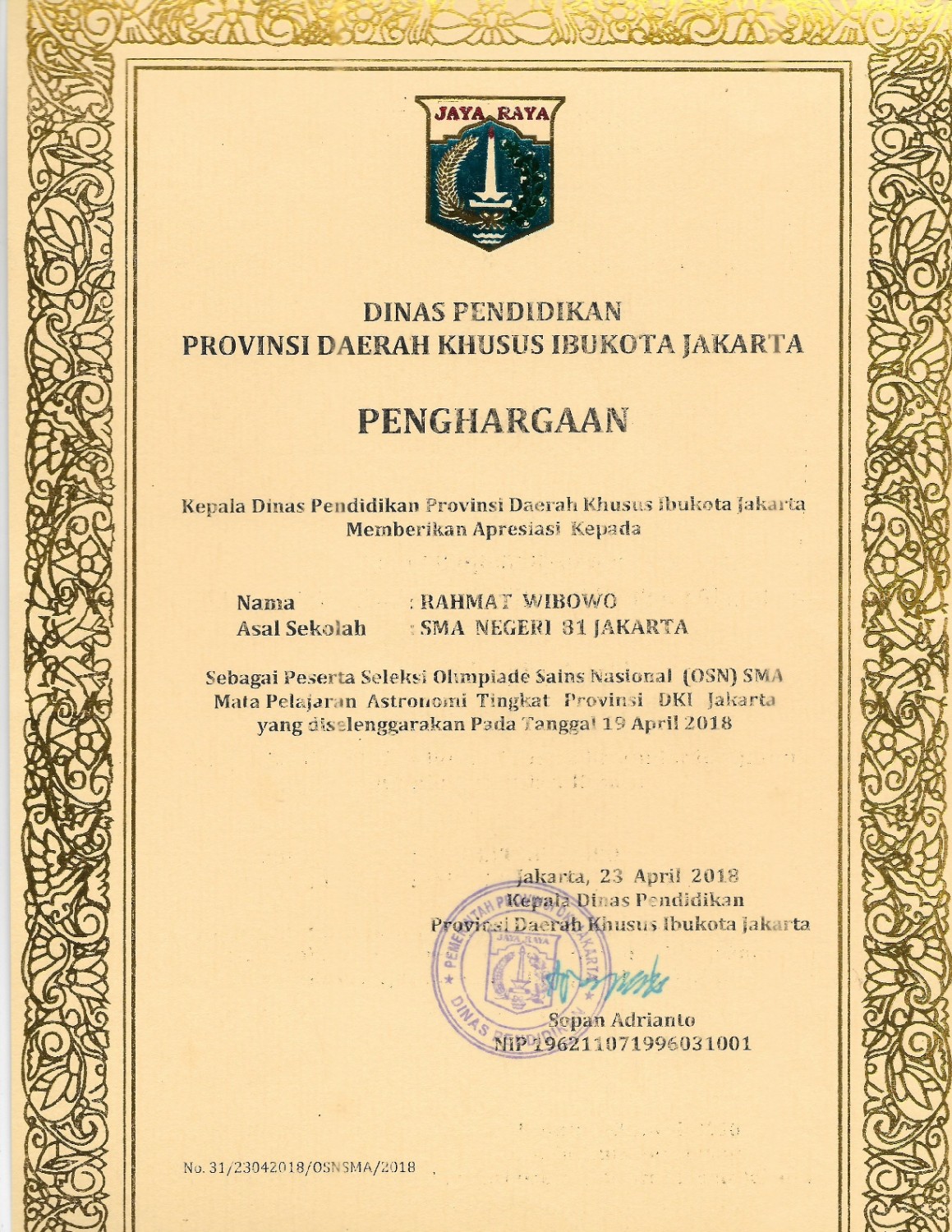
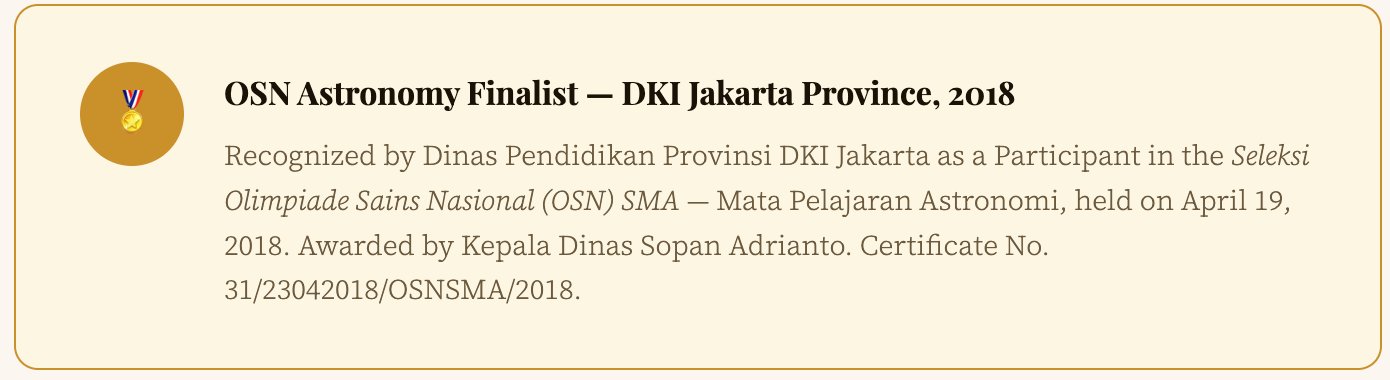
I was a finalist at the provincial level. The competition was fierce, the problems were beautiful in their cruelty, and I walked away not with a national medal — but with something more lasting: the knowledge that I could compete with the sharpest minds in the city, and that the universe had chosen me to know its name.
That boy standing in front of a problem about planetary motion — head full of equations, heart full of wonder — is still inside me. He drives everything I do today.
The Figures Who Shaped My Soul
Long before I discovered Habibie or Musk, I discovered men whose stories were written not in silicon valleys or engineering labs, but in deserts, in trade routes, in courtrooms of history. These are the figures I return to when the world feels heavy.
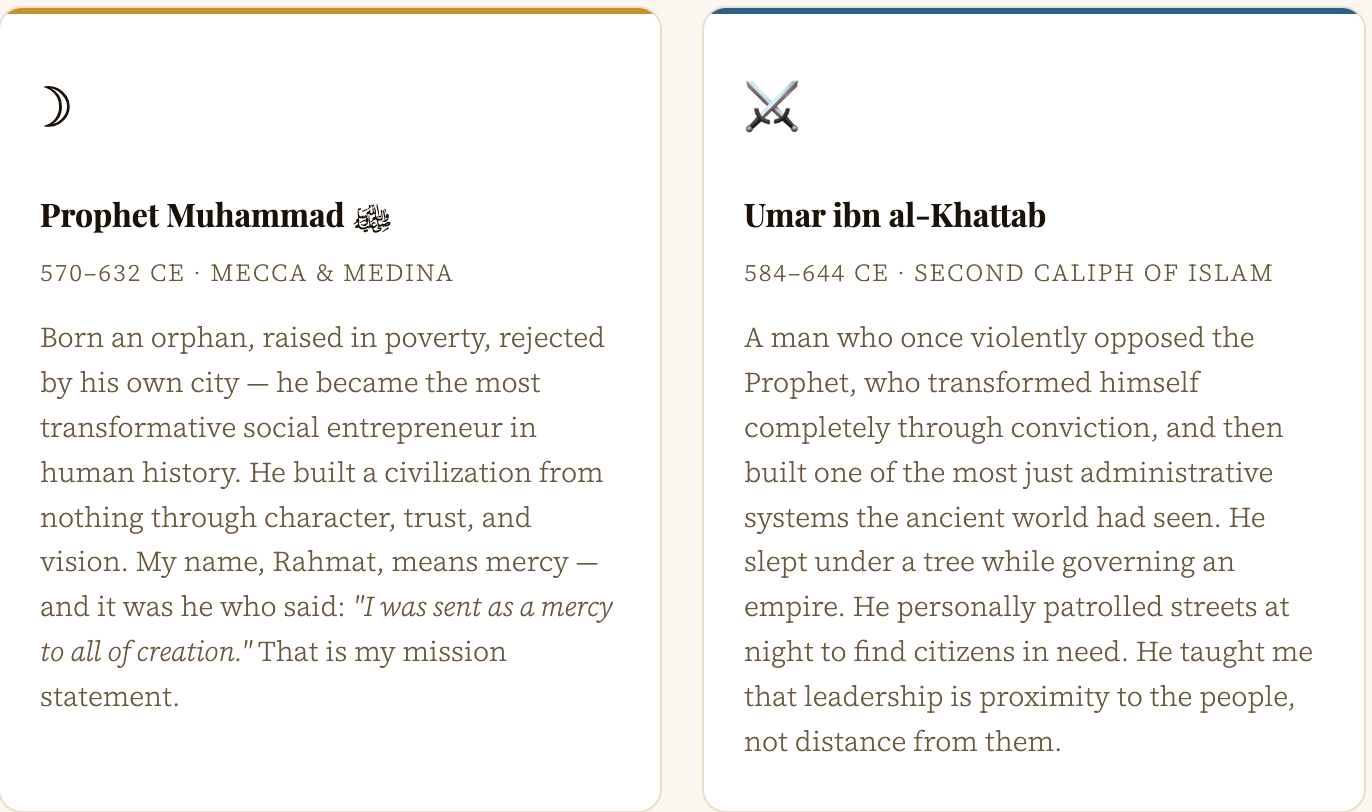
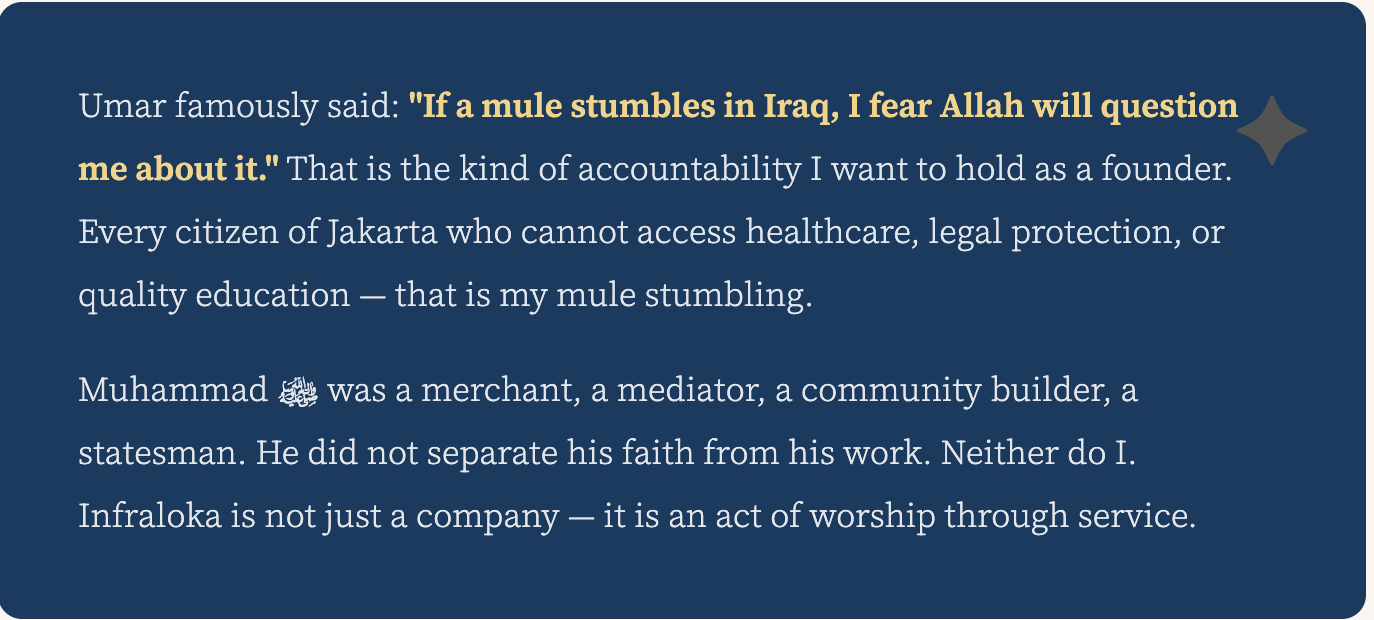
These are not abstract historical figures to me. I read their biographies — Kisah Para Nabi by Ibnu Katsir, Sirah Nabawiyah by Syaikh Shafiyurrahman al-Mubarakfuri, Biografi Umar bin Khattab, and Ibrah 45 Tokoh Islam — not as religious obligation, but as a startup founder studies case studies. These men faced resource constraints, hostile markets, hostile communities, and impossible odds. And they shipped.
Two Giants, One Dream
If Islamic history gave me my moral foundation, then two engineers gave me my professional fire.
B.J. Habibie — The Indonesian Who Dared to Dream in Equations
I have read BJ Habibie dalam Kenangan: Ragam Kesan dan Pengalaman Bersama Abahrian more than once. There is a kind of ache in that book — the ache of a man who loved his country so deeply he returned from Germany to build aircraft, who carried the weight of Indonesia's technological dignity on his shoulders, who cried when he spoke about this archipelago's potential.
Habibie did not just build planes. He built the idea that an Indonesian could master the hardest problems on earth. He was a scientist who saw technology as sovereignty. And he came from a country that was told, again and again, to buy and not to build. He refused. That refusal is the most Indonesian thing I have ever witnessed, and I want to refuse the same way.
When I stood as an astronomy finalist in 2018, I thought of Habibie — a young man from Sulawesi, staring at machines in Germany, becoming someone his country had never imagined possible.
Elon Musk — The Madman Who Bet Everything on the Future
I have read Walter Isaacson's biography of Elon Musk — the full, unvarnished account of a man who is difficult, brilliant, reckless, and undeniably consequential. I do not idolize him blindly. But I study him the way you study a storm: because understanding the force is how you navigate it.
What Musk taught me: the problems worth solving are the ones that feel impossible. SpaceX should not have worked. Tesla should not have survived. He made them work by refusing to accept the established ceiling as the actual ceiling. He also grew up reading and reading and reading — devouring encyclopedias, sci-fi novels, engineering texts — until knowledge became instinct.
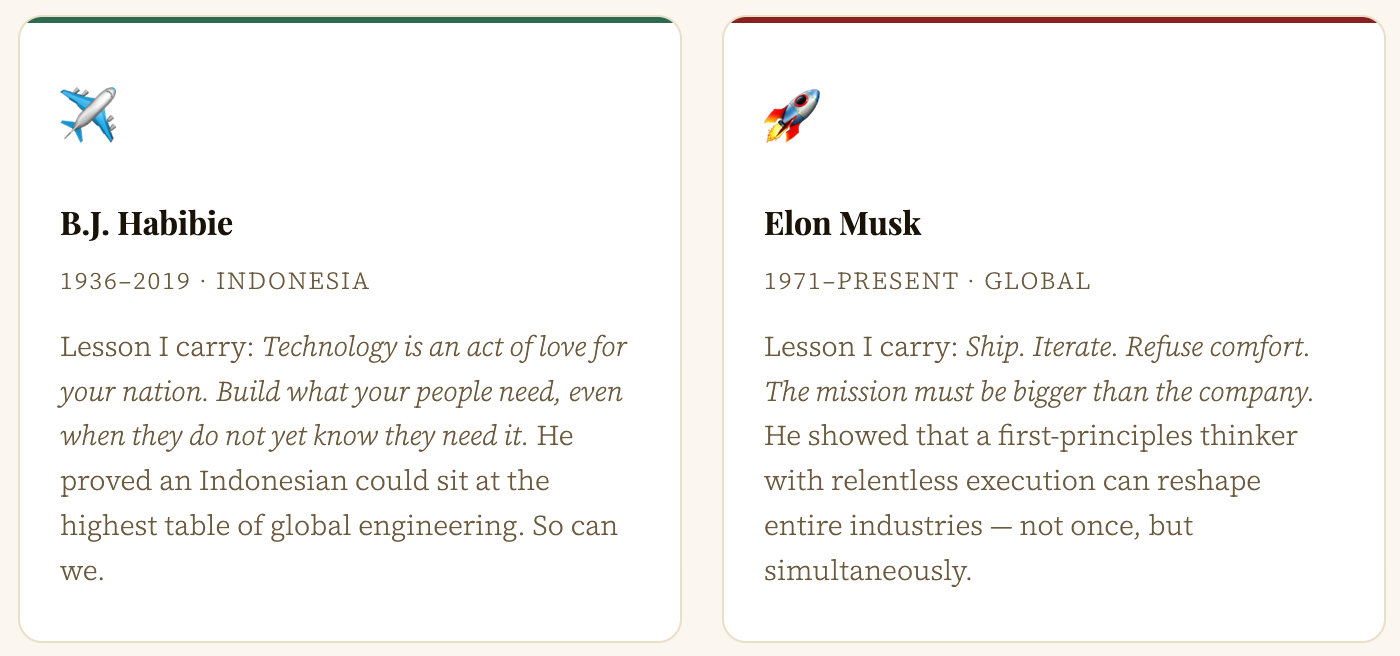
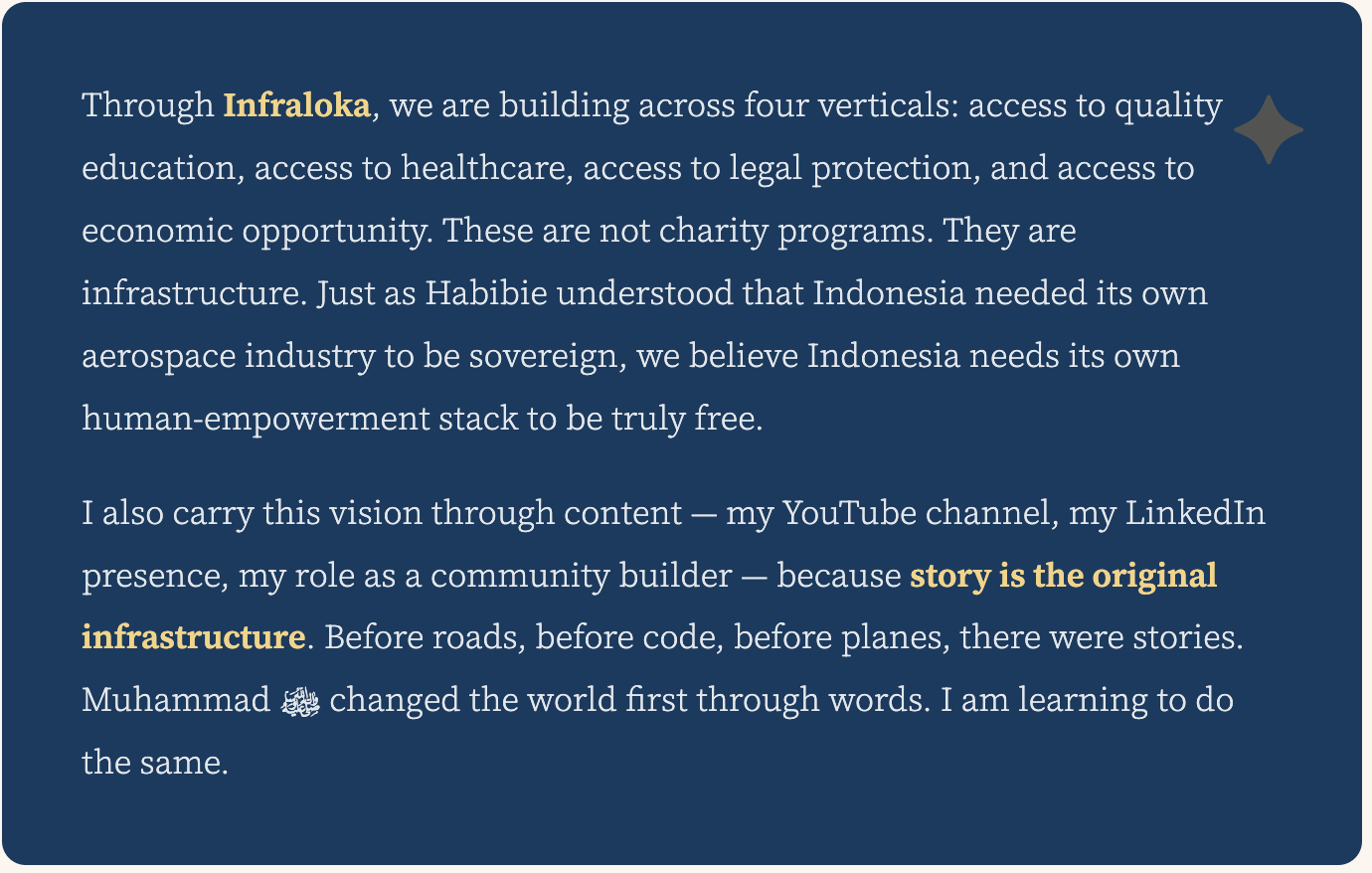
I want to be the bridge between these two figures for Indonesia — the soul of Habibie combined with the velocity of Musk, anchored in the mercy of Muhammad ﷺ and the accountability of Umar. This is not arrogance. This is a direction. A compass, not a crown.
The Library I Am Building Myself With
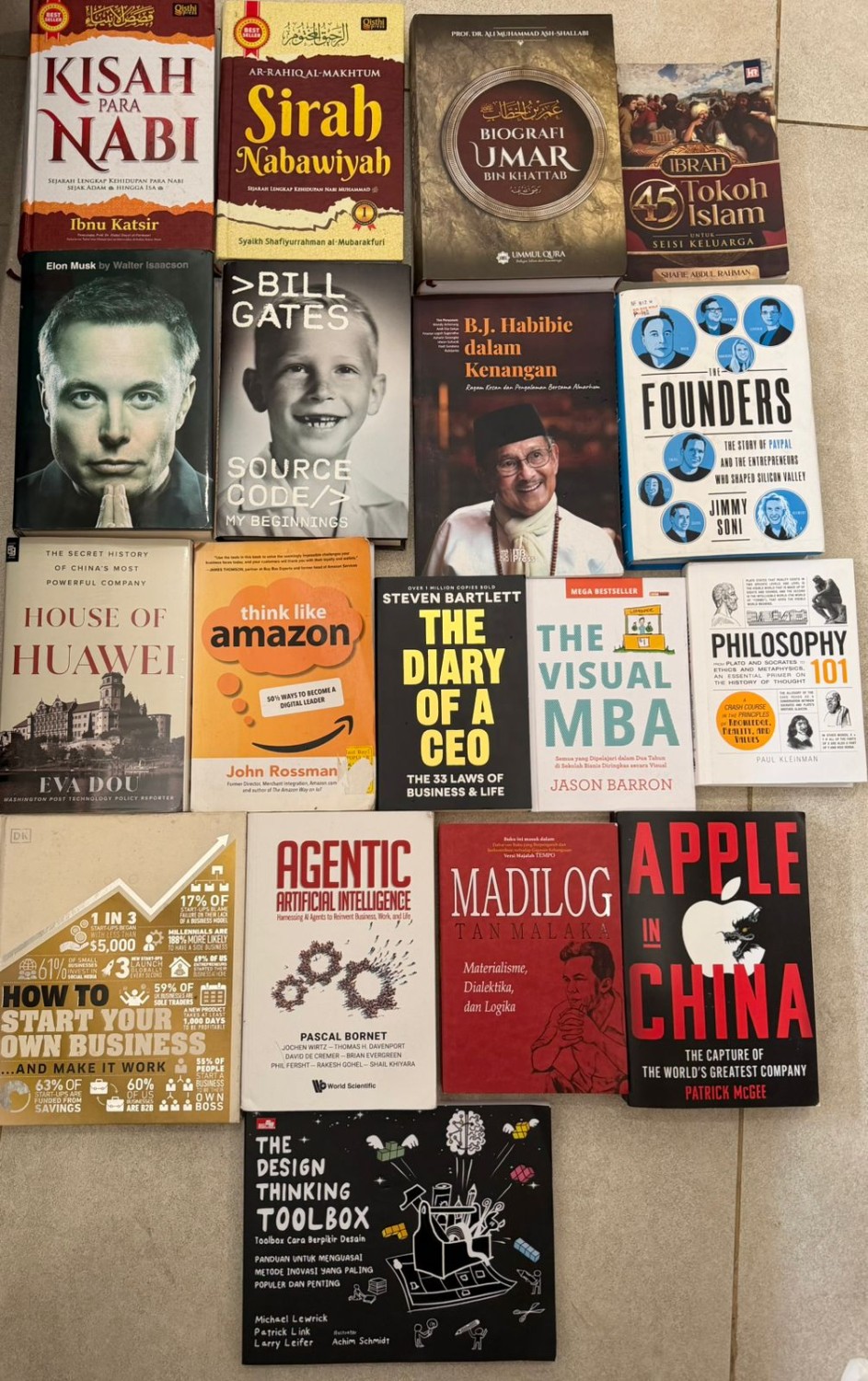
My bookshelf is my autobiography in progress. Every title I own is a conversation I chose to have, a mind I chose to sit with. Here is what my shelves say about what I am trying to become:
Islamic History & Character
Kisah Para Nabi — Sejarah Lengkap Kehidupan Para Nabi Sejak Adam hingga Isa
Ibnu Katsir
Ar-Rahiq Al-Makhtum (Sirah Nabawiyah) — Sejarah Lengkap Kehidupan Nabi Muhammad ﷺ
Syaikh Shafiyurrahman al-Mubarakfuri
Biografi Umar bin Khattab
Prof. Dr. Ali Muhammad Ash-Shallabi
Ibrah 45 Tokoh Islam untuk Seisi Keluarga
Shafie Abdul Rahman
Biographies of Giants
Elon Musk
Walter Isaacson
Bill Gates: Source Code — My Beginnings
BJ Habibie dalam Kenangan: Ragam Kesan dan Pengalaman Bersama Abahrian
Various Contributors
The Founders: The Story of PayPal and the Entrepreneurs Who Shaped Silicon Valley
Technology, Business & Strategy
House of Huawei: The Secret History of China's Most Powerful Company
Think Like Amazon: 50½ Ways to Become a Digital Leader
The Diary of a CEO: The 33 Laws of Business and Life
Apple in China: The Capture of the World's Greatest Company
Patrick McGee
Agentic Artificial Intelligence: Harnessing AI Agents to Reinvent Business, Work, and Life
Pascal BORNET , Jochen Wirtz, Thomas H. Davenport, David De Cremer, Brian Evergreen, Phil Fersht, Rakesh Gohel, Shail Khiyara
The Visual MBA: Semua yang Dipelajari dari Dua Tahun di Sekolah Bisnis Diringkas secara Visual
Jason Barron
How to Start Your Own Business and Make It Work
DK Publishing
The Design Thinking Toolbox — Panduan untuk Menguasai Metode Inovasi yang Paling Populer dan Penting
Michael Lewrick, Ph.D, MBA , Patrick Link, Larry Leifer · Illustrator: Achim Schmidt
Philosophy, Ideas & Nation
Madilog: Materialisme, Dialektika, dan Logika
Tan Malaka
Philosophy 101: From Plato and Socrates to Ethics and Metaphysics — An Essential Primer on the History of Thought
Paul Kleinman
This library is not decoration. It is a training regimen. Every morning I wake up, I am in conversation with Umar ibn al-Khattab, with Habibie, with Tan Malaka, with Elon Musk. They argue inside my head. The friction between them is where my thinking sharpens.
The Boy Who Still Keeps Planets on His Shelf
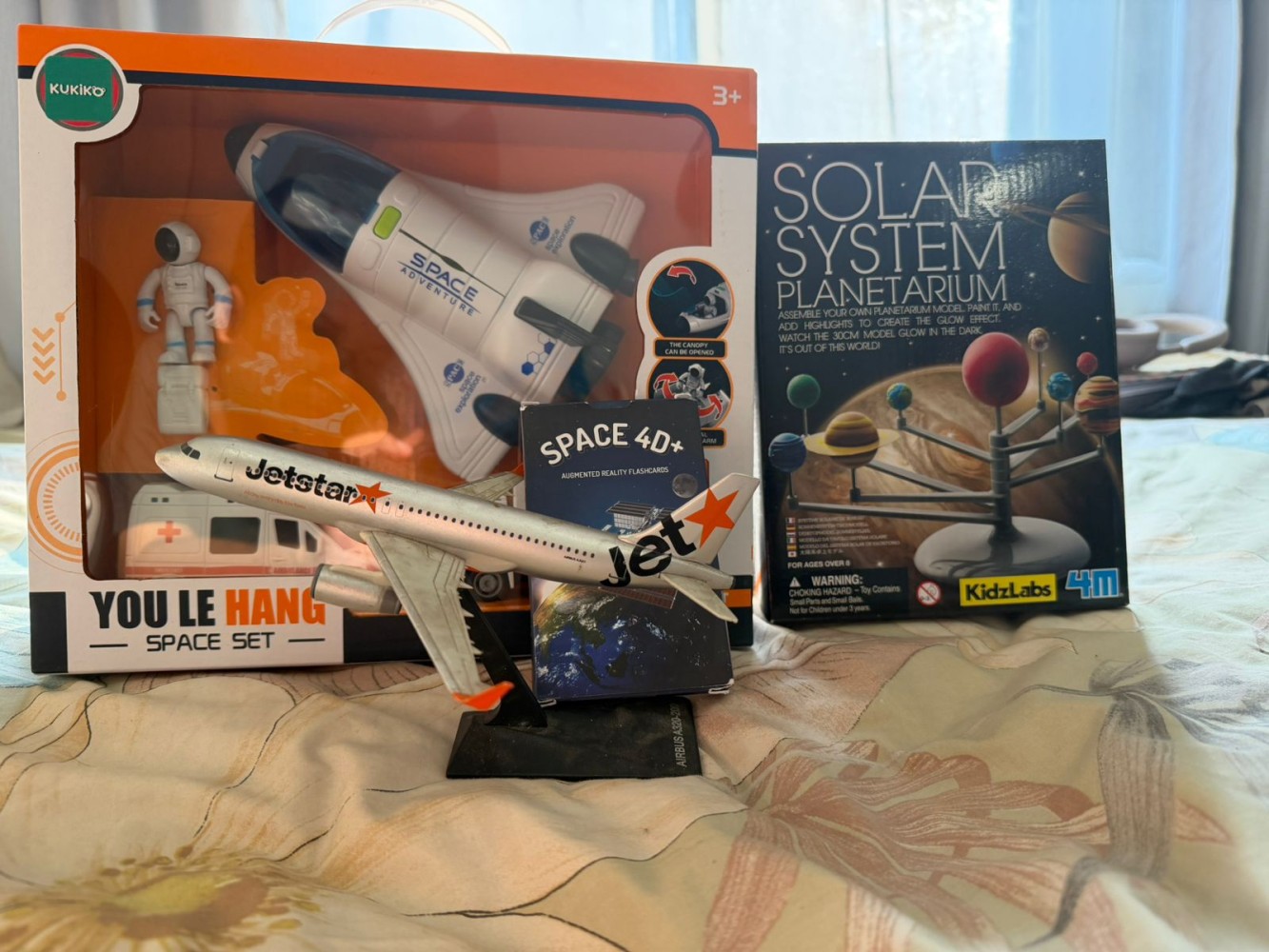
On the shelf above my desk, there is a KidzLabs Solar System Planetarium kit — eight planets on their orbital arms, waiting to glow in the dark. Next to it: a Kukiko space shuttle set with a tiny astronaut who can open his cockpit canopy. A Jetstar Airbus A320 replica. A deck of Space 4D+ augmented reality flashcards.
People ask me why a startup founder keeps children's toys on his desk. Because wonder is infrastructure. The moment you stop being astonished by the solar system, you have lost the most important fuel a builder has.
Habibie kept aircraft blueprints on his walls. Musk keeps rockets in his backyard. I keep eight glowing planets above my desk and call it market research.
The OSN certificate on my wall is not a museum piece. It is a reminder that I have been asking the hardest questions since I was seventeen. The planetary system on my shelf is not nostalgia. It is a daily compass. The books stacked across my floor are not décor. They are the board of advisors I cannot yet afford.
And somewhere in the space between Habibie's blueprints, Musk's rockets, the Prophet's mercy ﷺ, Umar's justice, Rafal's burning curiosity, and the eight planets glowing in my dark room — that is where I live. That is where Infraloka was born.
"My name means mercy. Rahmatan lil alamin — a mercy for all creation. This is not something I was given. It is something I am building, one line of code, one conversation, one policy, one student, one patient, one citizen at a time."
If you are building something for Indonesia's future, or if the stars have ever made you feel both small and called — I would love to connect.
🌍 Infraloka | ✨ Astronomy. Books. Service. Stars.
#Infraloka#Indonesia#Astronomy#StartupFounder#Habibie#ElonMusk#RahmataLilAlamin#LinkedInArticle#Chi地球の運動について#OSN2018#Technology#IslaminAction