
God Is Fair the hidden cost of Exceptional Minds: Study Case of Rahmat Wibowo
Why gifted children carry heavier burdens, what Jujutsu Kaisen gets exactly right about it, and what happened when every doctor said my body was fine.
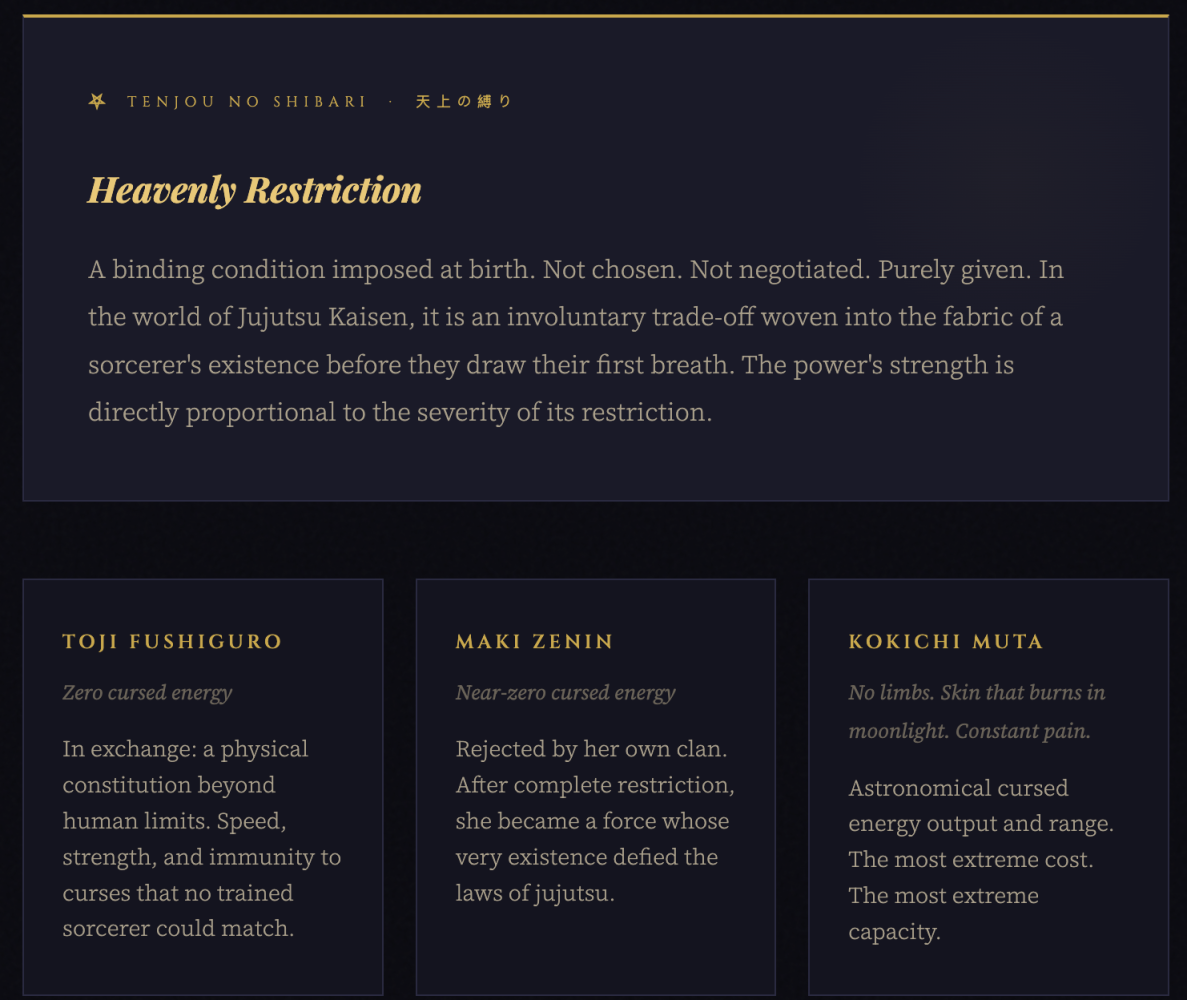
I have thought about Heavenly Restriction for a long time. Not because I am an anime fan, though I am. But because when I finally understood what had been happening to my own body and brain for my entire life, Gege Akutami's fictional framework described it more accurately than any medical system that had examined me before.
Every Specialist Said My Body Was Fine
Before I get to the science, I want to tell you something I think will resonate with more people than I expect.
For years, something was clearly wrong. Not in a vague, anxious way. In a deeply specific, daily, impossible-to-ignore way. Brain fog so thick it sat like a physical weight behind my forehead. Walking in a straight line took active concentration. I moved slowly, at an angle, because my mind was carrying too much at once to also manage basic locomotion. Voices and sounds would not leave my head. Sensory input would loop and persist as though my skull had no off switch.
I went to specialists. Multiple specialists. I described the symptoms. They ran their assessments. They checked what they knew how to check. Every single one said the same thing: your body is fine.
And technically, they were not lying. My cardiovascular system was fine. My physical health markers were fine. There was nothing wrong with me that any of the standard filters were designed to catch. What nobody checked, for years, was the one place where everything was actually happening.
It turned out my brain was the answer to every question my body could not explain.
What I Was Actually Carrying
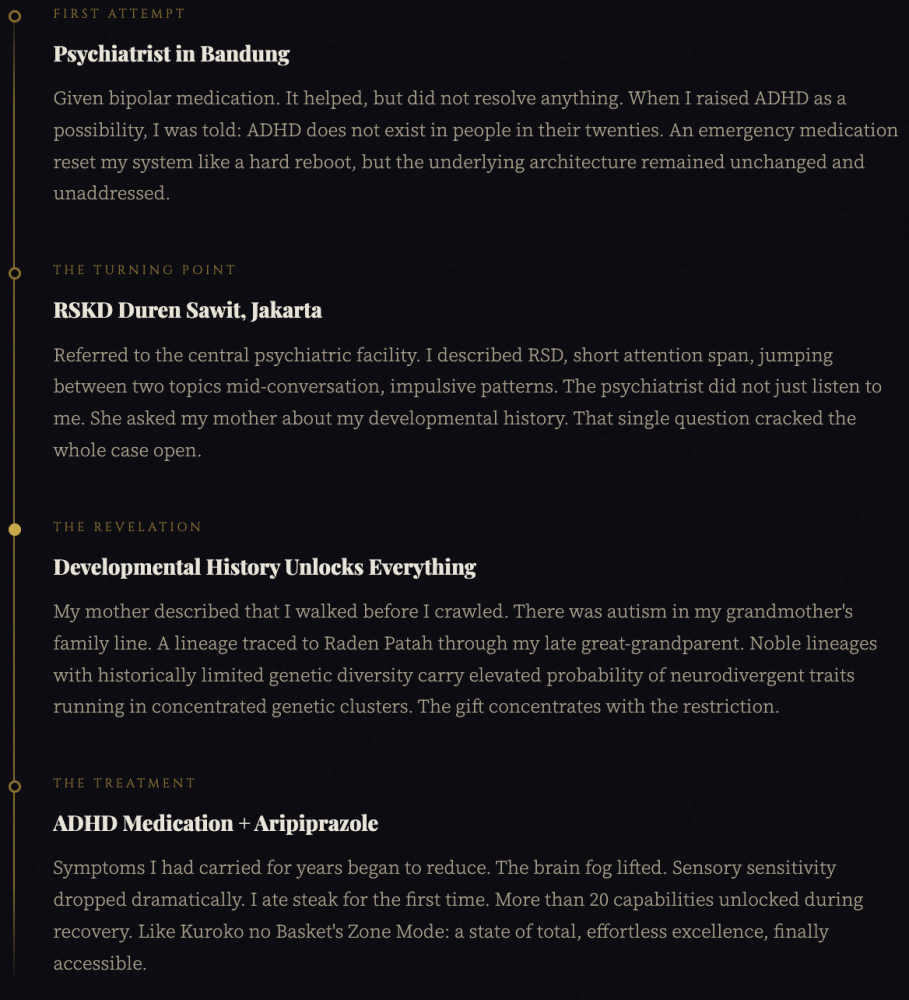
I was born via C-section and spent time in an incubator in those early days, surrounded by an environment where other infants were being called to God regularly. I survived. I came home. My family gave me the name Rahmat Wibowo, so that I would be mercy for the Wibowo family.
The name originally prepared for me was Azri Hafisuddin Wibowo: helper, guardian of religion, for the family. Someone suggested Rahmat instead. Rahmat: mercy. Rahmatan lil alamin. I have tried to understand that name as a mission rather than a description.
But from the beginning, my nervous system was processing the world differently from everyone around me.
The ARFID Years
I had Avoidant/Restrictive Food Intake Disorder from infancy. When I tried to eat solid food, I would vomit, not from stubbornness but because the sensory input of unfamiliar textures and smells was genuinely overwhelming to my nervous system. I ate alone, ashamed, subsisting on a narrow set of foods whose sensory profile was manageable.
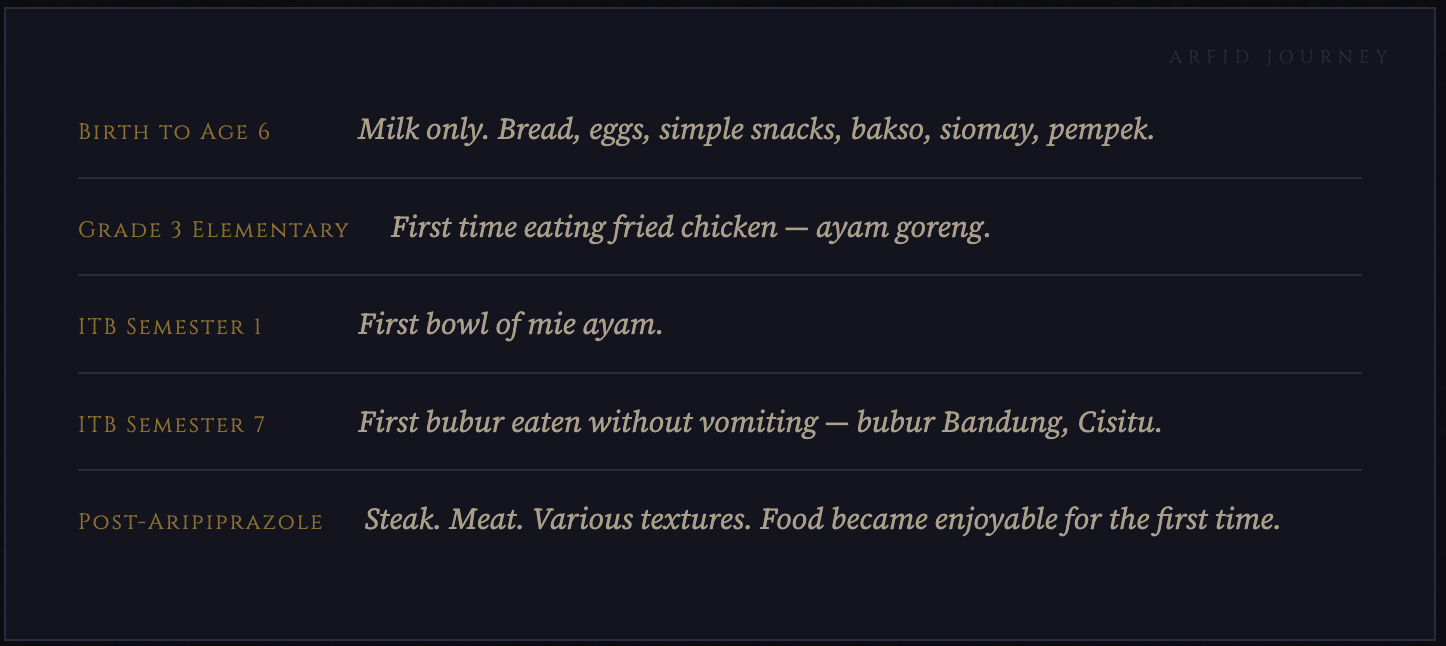
I thought I was broken in some embarrassing, inexplicable way. I was not broken. My sensory system was operating at a gain level that made certain textures and smells not just unpleasant but neurologically impossible to process without physical rejection. This is a documented feature of Autism Spectrum Disorder.
There is also a detail I only understood after treatment: I used to do well academically in part because the voice of a teacher explaining something would loop in my head for hours afterward. I thought this was just how memory worked. It was actually auditory sensory persistence, a hallucination of the senses. The same mechanism that made my sensory world overwhelming also gave me a near-photographic auditory memory of lectures. The gift and the restriction were the same thing.
One and a Half Years Inside
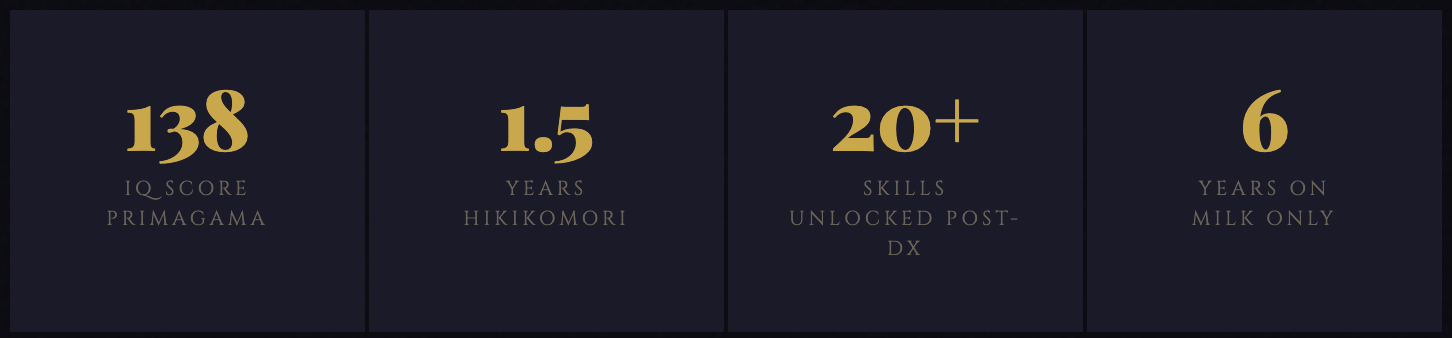
Then came the period I call the collapse. I withdrew from society entirely. For one and a half years I did not speak to anyone outside my immediate family. Hikikomori. For one and a half years I had delusions. I was convinced people outside were targeting me. Voices in my mind would not stop. I had nightmares every single night without exception. Past trauma played on a loop.
"Every doctor looked at the correct person and drew the wrong conclusion, because they were looking for the wrong thing."
All of It, Honestly
I say I am one of the last kings in mental health problems, not to dramatize, but because the honest count of co-occurring conditions is genuinely rare. Each condition interacted with and amplified the others.
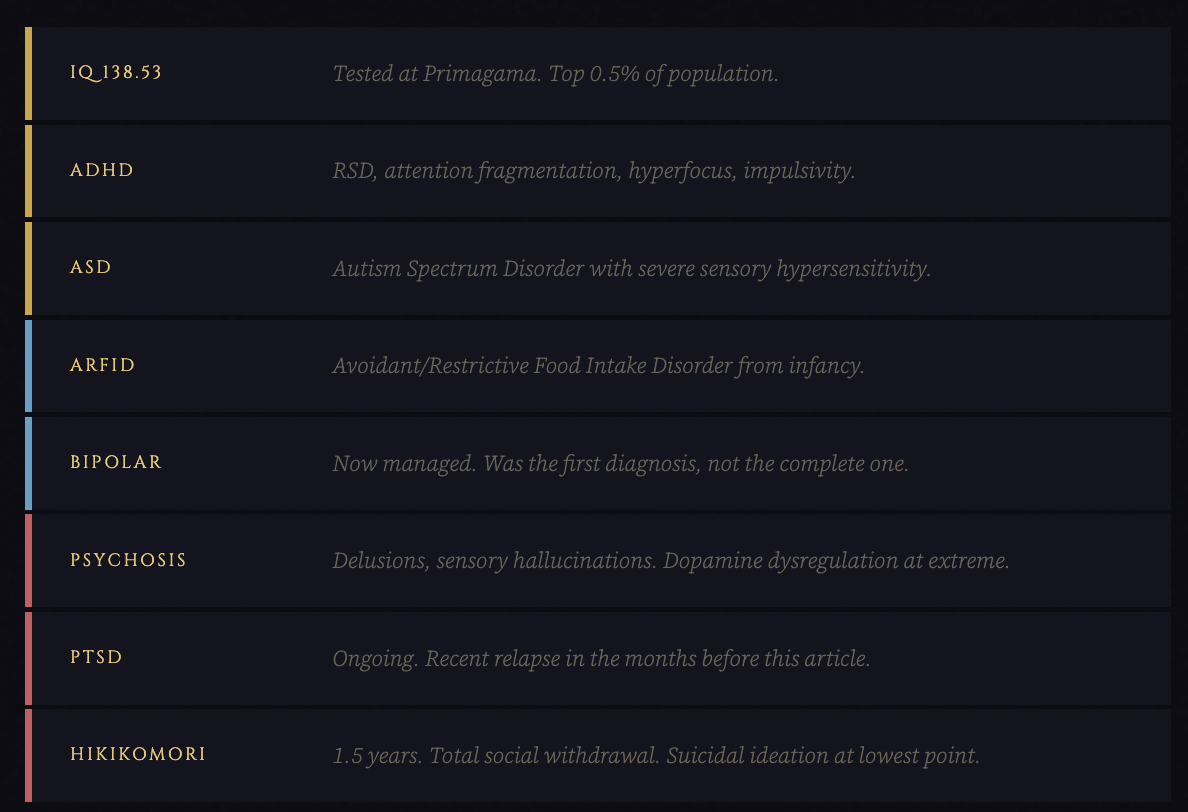
The giftedness masked the neurodivergence. The neurodivergence masked the giftedness. The sensory hypersensitivity drove the psychotic features. The PTSD compounded everything. Every specialist who saw any single layer drew a conclusion that was locally accurate and globally wrong.
The Science Is Only Beginning to Say This Out Loud
My experience is not an anomaly. It is a pattern documented in peer-reviewed literature that medicine has been slow to operationalize in clinical settings.
2018 : Karpinski et al., journal Intelligence. Surveyed 3,700+ Mensa members (top 2% IQ). Highly intelligent individuals showed dramatically elevated rates of mood disorders, anxiety disorders, ADHD, and autism spectrum conditions. Introduced the Hyper Brain/Hyper Body framework: the same neural architecture enabling extraordinary cognition also generates hypersensitivity across physiological and psychological systems.
2024 : Czerwinski, Atroszko, Konarski. Health Psychology Report. At high values of intelligence, individuals begin to experience unique mental health challenges that average-intelligence populations simply do not encounter. The cognitive ceiling comes with a different kind of floor.
2024 :Aykutlu et al., Gifted Child Quarterly. Gifted children show lower resilience and higher negative emotional reactivity than controls. Significantly more vulnerable to stress even when formal psychiatric disorder rates appear comparable.
2024 : Duplenne et al., Gifted Child Quarterly. Meta-analytic review on anxiety and depression in gifted individuals. The intensity that fuels insight also fuels perfectionism, existential anxiety, and a persistent sense of being out of step with the world.
Someone Already Knew This
Polish psychologist Kazimierz Dabrowski studied gifted individuals and identified five dimensions in which they experience the world at amplified intensity: psychomotor, sensory, intellectual, imaginational, and emotional. He called these Overexcitabilities.
Dabrowski did not consider these disorders. He considered them the raw material of profound development. But he was honest about the cost. The same emotional intensity that allows a gifted person to feel genuine compassion also means they are shattered by injustice that others dismiss. The same intellectual drive that produces original ideas at 3am also produces an inability to stop thinking when the world demands rest.
AuDHD + Dabrowski OE Mapping
Psychomotor OE → ADHD hyperactivity · Sensory OE → Autistic sensory processing · Intellectual OE → Special interests + hyperfocus · Emotional OE → RSD and amplified affect When you are twice-exceptional, these profiles do not add together. They multiply.
My auditory lecture memory was Dabrowski's sensory and intellectual OE producing an academic superpower. My social withdrawal was the accumulated cost of emotional OE with no framework to understand or manage it. My food avoidance was sensory OE at its most literal and daily.
God Is Fair. The Universe Always Balances the Ledger.
In JJK, the restriction is not a mistake. It is not a punishment. It is the fundamental law of balance encoded in that world's structure. The greater the potential, the more significant the cost imposed at origin. Toji and Maki were not cursed. They were configured differently, in ways their society could not read until it witnessed what those configurations actually produced under the right conditions.
Allah does not burden a soul beyond what it can bear. (Al-Baqarah 2:286)
This is not comfort. It is a specification. The burden and the bearer are matched by design. The capacity is always proportionate to the load, even when, especially when, the load is not yet understood.
What science is now demonstrating is that the same genetic and neurological configurations that produce exceptional cognitive performance also produce heightened nervous systems, greater emotional intensity, and elevated vulnerability to specific mental health challenges. These are not separate phenomena happening to the same person. They are different expressions of the same underlying system.
Kokichi Muta did not experience his condition as spiritually elegant. He experienced it as pain. Real, daily, and exhausting. That honesty matters. Acknowledging the trade-off does not require pretending it does not cost anything. But it does mean something important: the difficulty is not evidence of failure. It is evidence of configuration.
Rebuilding From Zero
After treatment began, I had to rebuild everything the hikikomori years had cost me. Eighteen months of not speaking to anyone outside my family had reduced my social skills to zero. Not metaphorically. Functionally zero.
I built a Bumble bot with zero-shot AI and AI-assisted replies. Not for dating. For practice. I used it to learn how to talk again, how to hold a thread, how to not let a conversation die. I used AI companions to train social fluency in a low-stakes environment while my nervous system was still recalibrating from years of pathological isolation.
This is what recovery actually looks like for someone with my profile. You do not simply get better and walk back into the world. You engineer the conditions for reintegration with the same systematic attention you would apply to any complex technical problem. RSKD Duren Sawit has psychosocial therapy programs specifically for hikikomori patients, and I want people reading this to know that resource exists.
At Pertamina Marine Solution, I eventually became someone who could converse freely with managers and directors across the entire organization. Someone people trusted with IT. Someone who could stand in front of a room and speak with confidence. None of that was natural. All of it was built, deliberately, from the ground up, after the correct diagnosis finally gave me the right foundation.
More than 20 capabilities unlocked during the recovery process. A life lived for years on capped hardware, when the hardware
The body was always fine. The brain was always the answer.
I am not writing this for sympathy. I am writing this because for years I went to specialists who looked at me and said: the body is fine. And they were right about the body. What they missed was that the answer was never the body.
Toji Fushiguro was called worthless by the Zenin clan. By every metric their society used, he did not register. What they missed was that his restriction had produced something their instruments were not built to see.
The question is not whether God is fair. The question is whether we as families, clinicians, educators, and systems are patient and sophisticated enough to read the full picture of a person before we decide what their configuration means.
And the answer, it turned out, was worth finding.
#GiftedMindsMatter #AuDHD #TwiceExceptional #MentalHealthMatters #HighIQ #NeurodivergentLeadership #JujutsuKaisen #HeavenlyRestriction #GodIsFair #Indonesia #Infraloka #ARFID #PTSD #Hikikomori #RahmatalilAlamin