
Green Data Centers in Indonesia: Solutions & Landscape By Rahmat Wibowo From InfraLoka
Executive Summary
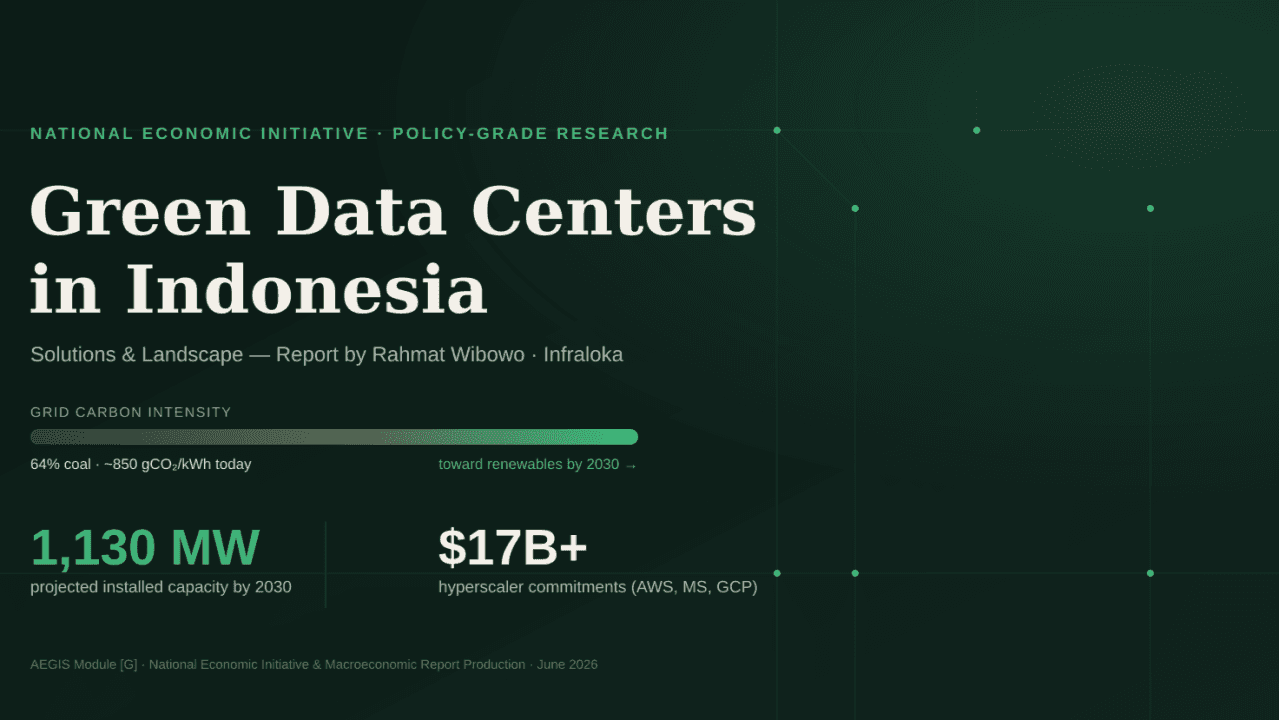
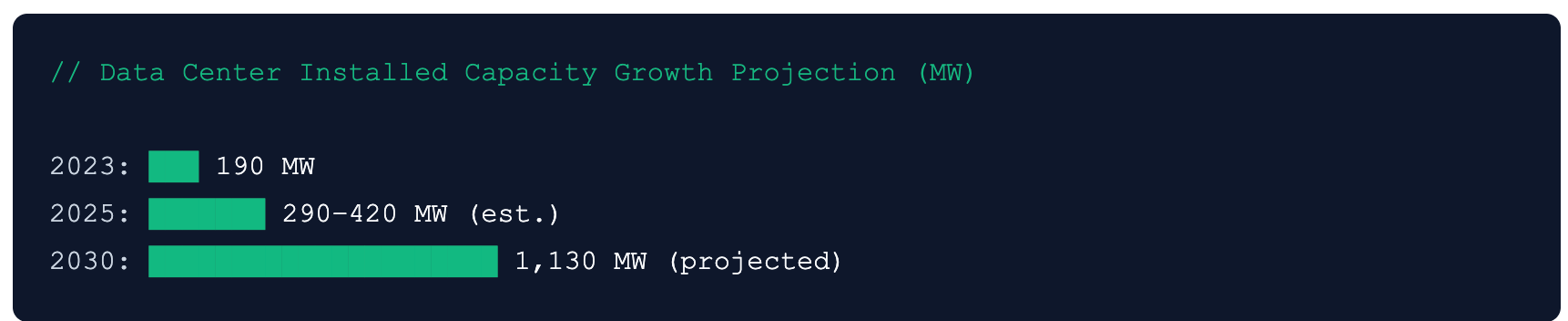
Indonesia's data center sector stands at a crossroads [cite: 1]. With installed capacity growing from approximately 190 MW (end-2023) to a projected 1,130 MW by 2030 — a CAGR of ~7.99% — the country is rapidly becoming a major force in Southeast Asia's digital infrastructure landscape [cite: 1]. Yet this growth is occurring on one of the most carbon-intensive grids in the region: PLN's generation mix remains approximately 64% coal-fired, yielding a grid carbon intensity of roughly 850 gCO₂/kWh [cite: 1]. This gap between digital ambition and energy reality is the binding constraint on Indonesia's green data center transition [cite: 1].
The stakes are significant [cite: 1]. AWS, Microsoft, and Google Cloud have collectively committed over USD 17 billion to Indonesia's digital infrastructure, with renewable energy sourcing conditions attached [cite: 1]. These hyperscaler commitments are conditional on Indonesia's ability to supply credible, verifiable renewable energy at scale [cite: 1].
Headline Findings
- Supply-side regulation is the binding constraint, not technology: Green cooling, solar PV, and renewable procurement mechanisms all exist [cite: 1]. What is absent is a regulatory framework permitting corporate-to-generator bilateral PPAs, a mandatory national Green Data Center Standard, and a financing taxonomy that classifies data centers as eligible green assets [cite: 1].
- PLN's stranded coal asset problem is the structural blocker: PLN holds Rp 40–60 trillion in coal take-or-pay contracts through 2035 [cite: 1]. Without a RUPTL revision or a coal-retirement mechanism, the energy transition framework breaks at the PLN node [cite: 1].
- The window is closing: Vietnam and Malaysia are aggressively deploying competitive frameworks (such as Malaysia's CGPP programme) [cite: 1]. Indonesia must move from framework to implementation within 18 months or risk permanent displacement as the regional green data center hub [cite: 1].
1. Introduction and Context
1.1 Indonesia's Digital Infrastructure Moment
Indonesia is Southeast Asia's largest digital economy by population served, with a digital economy GDP contribution projected to reach USD 360 billion by 2030 [cite: 1]. This trajectory is driving unprecedented demand for data center capacity [cite: 1].
The major operators — DCI Indonesia, NeutraDC/Telkom Group, NTT DATA, Princeton Digital Group, and ST Telemedia GDC — are expanding rapidly [cite: 1]. Foreign hyperscalers are also deeply committed, launching major cloud regions and AI capacity expansions in the Jakarta and Karawang areas [cite: 1].
1.2 The Carbon Problem
Indonesia's data center boom is occurring against a grid with one of the highest carbon intensities in Southeast Asia [cite: 1]:
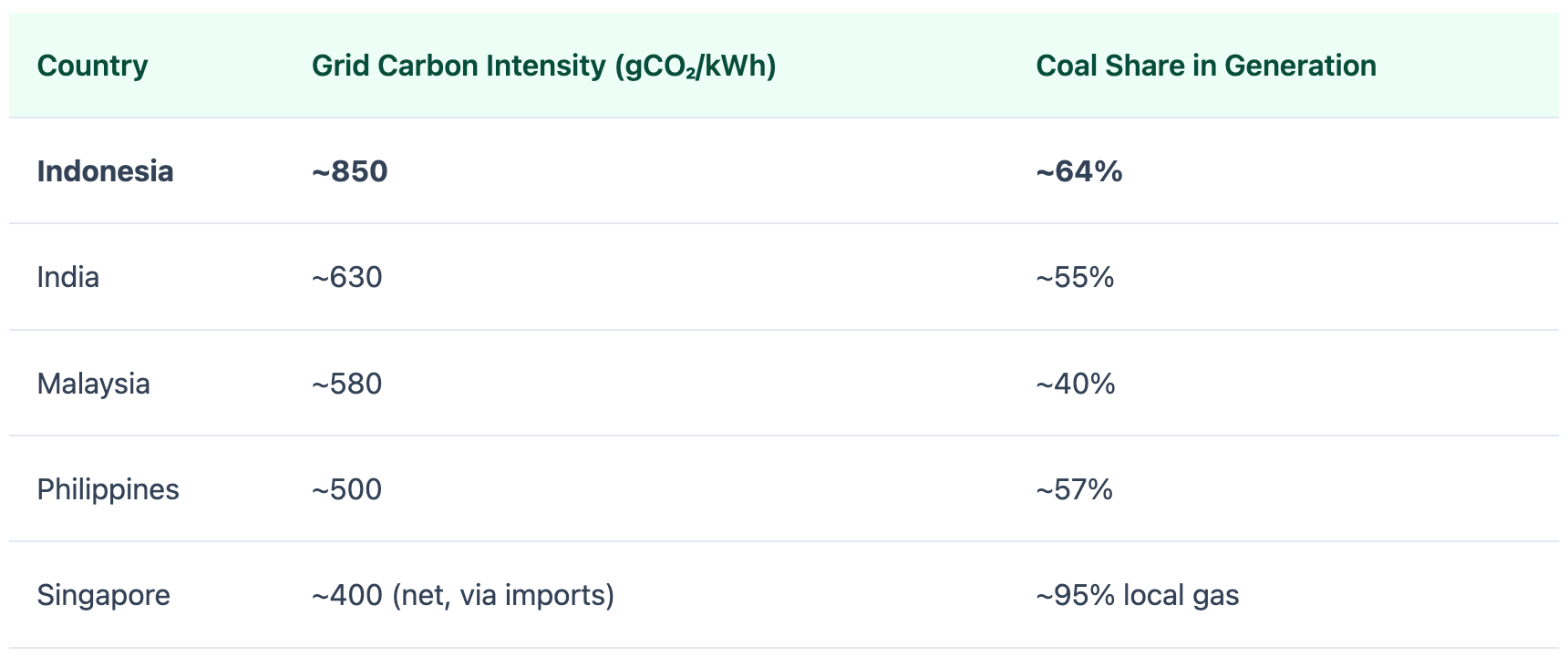
Sources: U.S. EIA; Ember Global Electricity Review [cite: 1]
AWS, Microsoft, and Google all report against a 100 gCO₂/kWh operational threshold for Scope 2 market-based emissions under Science Based Targets initiative (SBTi) requirements [cite: 1]. Indonesia's grid is more than 8× above this threshold [cite: 1].
2. Diagnostic & International Comparators
2.1 Problem Classification
Indonesia's green data center gap fits an industrial upgrading + energy transition mid-transition trap pattern [cite: 1]:
- Demand is not the problem: Hyperscalers want to invest, and renewable technology (solar, geothermal) is available and increasingly cost-competitive [cite: 1].
- Supply-side regulatory failure is the issue: The legal framework restricts the mechanisms (like bilateral PPAs or corporate VPPAs) that would allow operators to directly procure renewable energy from private generators [cite: 1].
2.2 Regional Benchmarks
- Singapore — The High-Standard Standard: PUE ≤1.3 is mandatory for new builds, alongside a ≥30% renewable energy requirement [cite: 1]. The key lesson here is tying data center capacity allocations directly to strict sustainability metrics [cite: 1].
- Malaysia — The Corporate Green Power Programme (CGPP): Utilizes a defined, capped corporate RE quota with a Virtual PPA (VPPA) structure [cite: 1]. The takeaway is unlocking Third-Party Access (TPA) frameworks to allow private generators to sell to corporate buyers via grid wheeling [cite: 1].
- Vietnam — The Direct Competitor: Launched a Direct Power Purchase Agreement (DPPA) pilot to bypass traditional single-buyer monopolies [cite: 1]. This highlights the need for rapid execution to capture migrating hyperscaler FDI [cite: 1].
3. Limitations and Reflexivity
- Data Currency: PLN generation mix data naturally experiences reporting lags [cite: 1].
- Financial Modeling Constraints: Fully modeling PLN’s Rp 40–60 trillion stranded coal asset problem requires a separate deep-dive financial analysis involving macro credit rating impacts [cite: 1].
- Author Interest Disclosure: Infraloka operates within Indonesia's digital infrastructure ecosystem [cite: 1]. This analysis is structured to maximize national competitive advantage through open quotas and transparent, market-wide criteria rather than protecting incumbent positions [cite: 1].
Collaborative Roadmap Execution
The extensive 5-Tier Operational Roadmap spanning from Immediate Stabilization to Architectural Innovation has been removed for brevity as requested. When you are ready, we can co-create and explore specific elements—such as unlocking the bilateral Corporate VPPA framework or defining Technical Screening Criteria.
Big opportunity ahead.
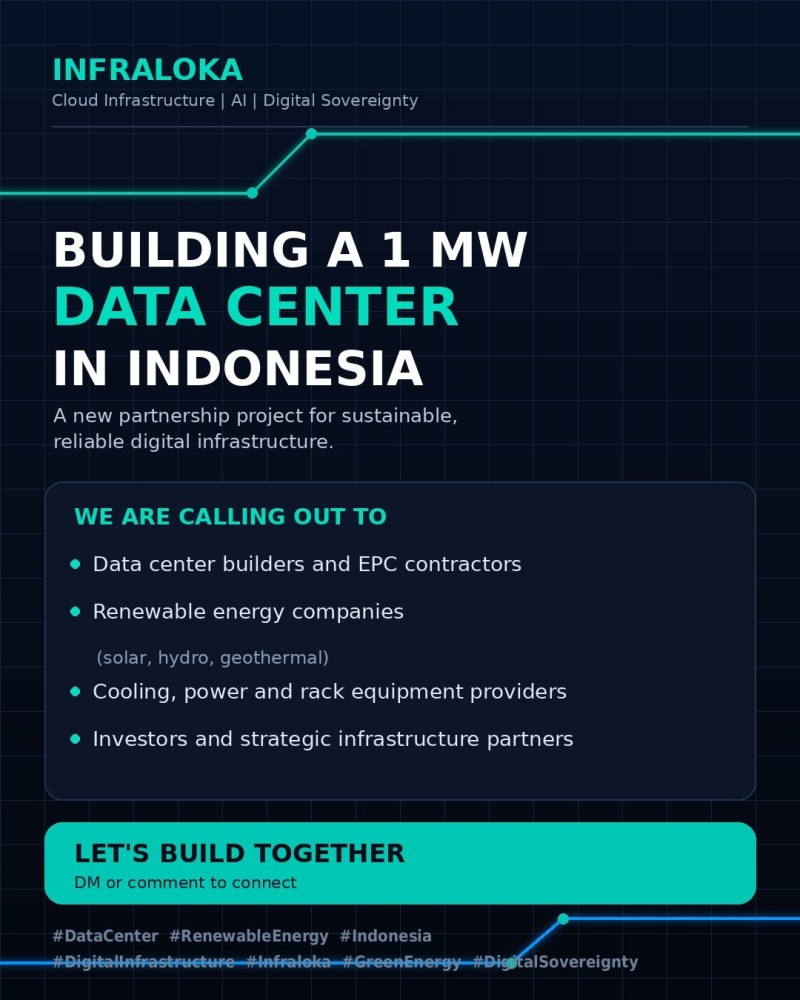
My partner and I are planning to build a 1 MW data center in Indonesia, and we are looking for the right collaborators to make this happen.
We are specifically calling out to:
-
Data center builders and EPC contractors with experience in modular or containerized facilities
-
Renewable energy companies (solar, hydro, geothermal) interested in powering sustainable digital infrastructure
-
Equipment and hardware providers (cooling systems, racks, power systems)
-
Investors and strategic partners who believe in Indonesia's digital sovereignty and growing demand for local compute capacity Indonesia's digital economy is growing fast, and reliable, sustainable infrastructure is the backbone of that growth.
We want to build something that is efficient, green, and built for the long term.
If you or your company works in data center construction, renewable energy, or related infrastructure, let's talk.
Drop a comment or send me a DM.
Let's build the future of Indonesia's digital infrastructure together.
#DataCenter #RenewableEnergy #Indonesia #DigitalInfrastructure #CloudComputing #GreenEnergy #Infraloka #DigitalSovereignty #Sustainability #TechPartnership