
Have You Been Studying Diligently? Study Case of Rahmat Fabhian Aminuddin

A deep reading of Metode Belajar 24 Jam by Prof. Ir. Amrinsyah Nasution, MSCE, Ph.D. and what it means for every student navigating the new era of Indonesian higher education
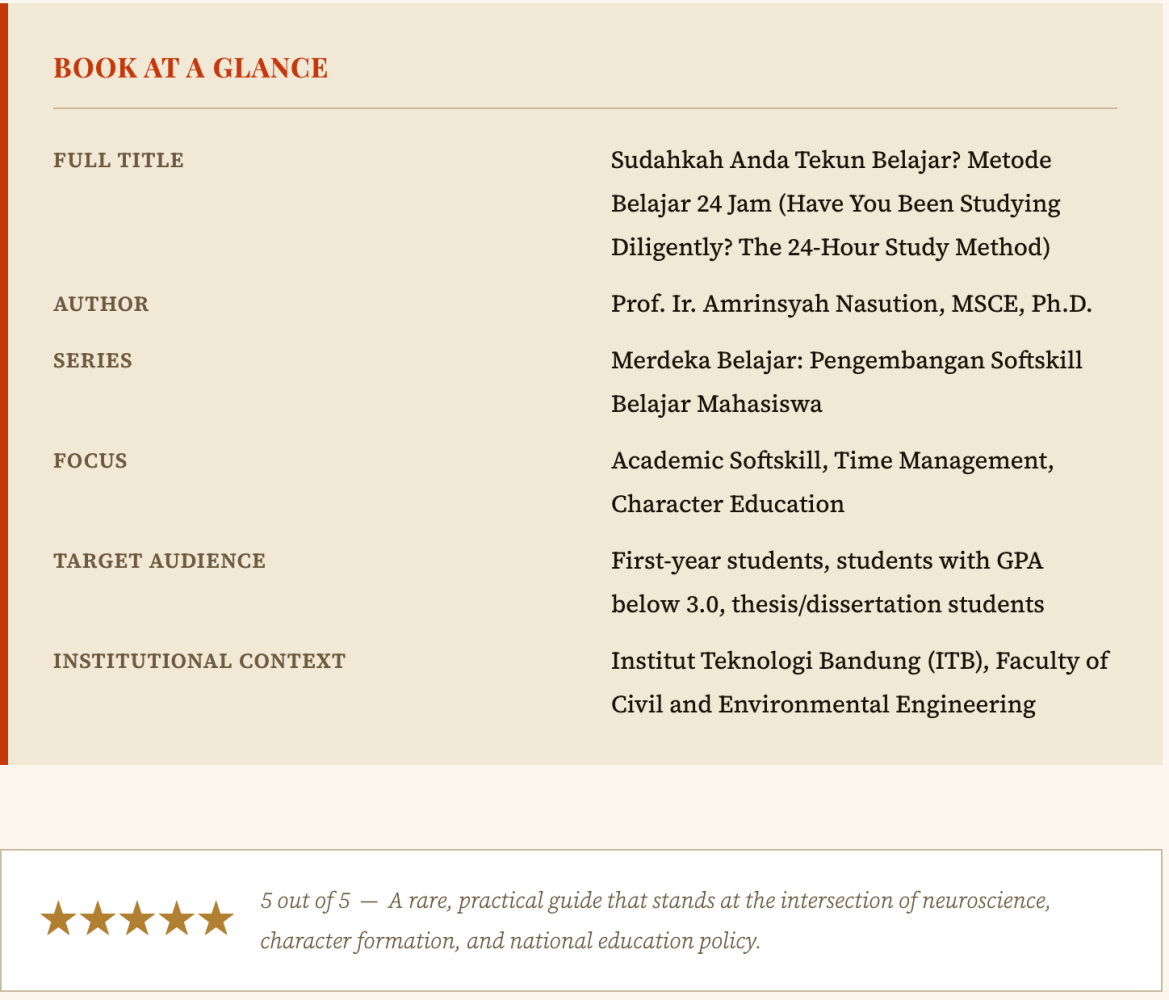
There is a question on the cover of this book that is simultaneously simple and devastating: "Have you been studying diligently?" Most students would instinctively answer yes. Prof. Amrinsyah Nasution spends the entire book proving, with data, testimonies, and neuroscience, that the honest answer for the majority of us is no, and that the way we have been defining "studying" is itself the problem.
This is not another motivational pamphlet dressed as a textbook. The 24-Hour Study Method (MB 24) is a structured, evidence-backed, and field-tested behavioral intervention developed over five years at ITB's Civil Engineering program. It has been applied to undergraduate (S1), graduate (S2), and doctoral (S3) students alike. The results recorded in this book are not anecdotal feel-good stories. They are measurable: students achieving Dean's List awards, graduating on time, winning national competitions, and describing a fundamental transformation in their relationship with time, focus, and responsibility.
The National Context: Why This Book Exists Now
The book opens with a critical and timely policy frame. The Ministry of Education, Culture, Research, and Technology (Kemendikbudristek) issued Permendikbudristek No. 53 of 2023 on Higher Education Quality Assurance, fundamentally changing what it means to complete a university degree in Indonesia.
Under the new regulation, undergraduate (S1) and applied bachelor (D4) students are no longer required to write a thesis as a graduation requirement, provided their program has adopted a project-based curriculum or an equivalent alternative. Final assignments can now take the form of prototypes, group projects, or other innovative outputs. This shift is positioned as a liberation, hence the series title "Merdeka Belajar" (Freedom to Learn), but it also places a heavier responsibility on both institutions and students.
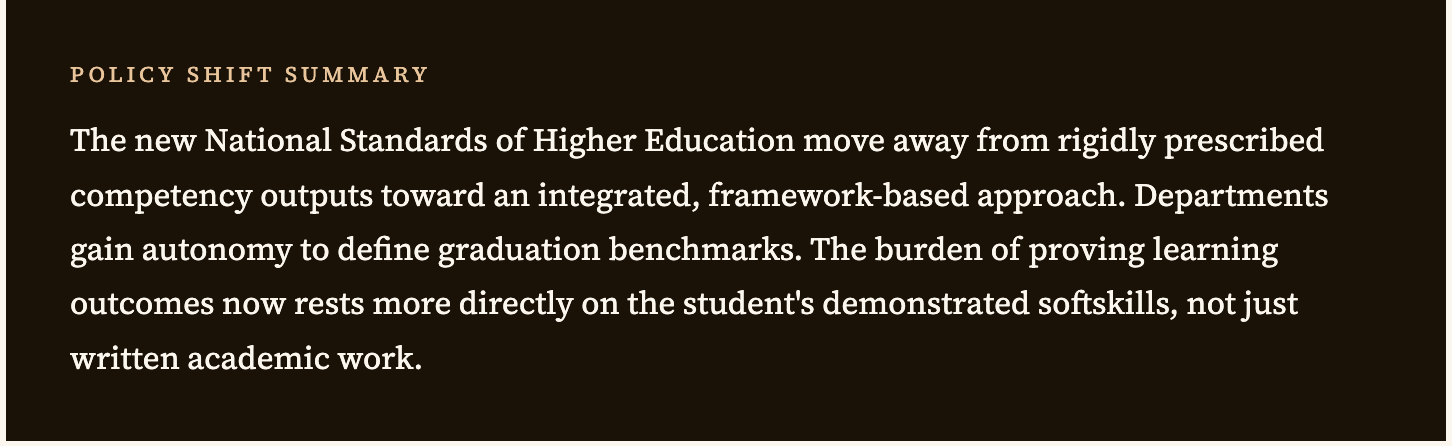
Prof. Amrinsyah's argument is precise: when you remove the compulsory structure of thesis writing, you expose something that was always true but previously hidden behind procedural compliance. The ability to learn, to self-manage, and to sustain effort over time is a softskill, and Indonesian higher education has never formally taught it.
This is where MB 24 enters, not as a workaround to academic rigor, but as the missing infrastructure beneath it.
*
Chapter 1: The Softskill of Learning
The first chapter grounds the book in regulation before moving to practice. The author walks through the standards governing learning processes under the new framework, specifically Pasal 14, which mandates that learning must be enjoyable, inclusive, collaborative, creative, and effective, while guaranteeing equal opportunity regardless of educational, social, economic, or cultural background.
What the regulation does not specify, the author points out, is the method. How do you create an enjoyable and effective learning environment? How do you train a student to be collaborative when their entire secondary education rewarded individual performance? The policy creates the aspiration. MB 24 provides one concrete pathway toward it.
The chapter establishes a tripartite framework for learning softskills drawn from Stephen Covey's work:
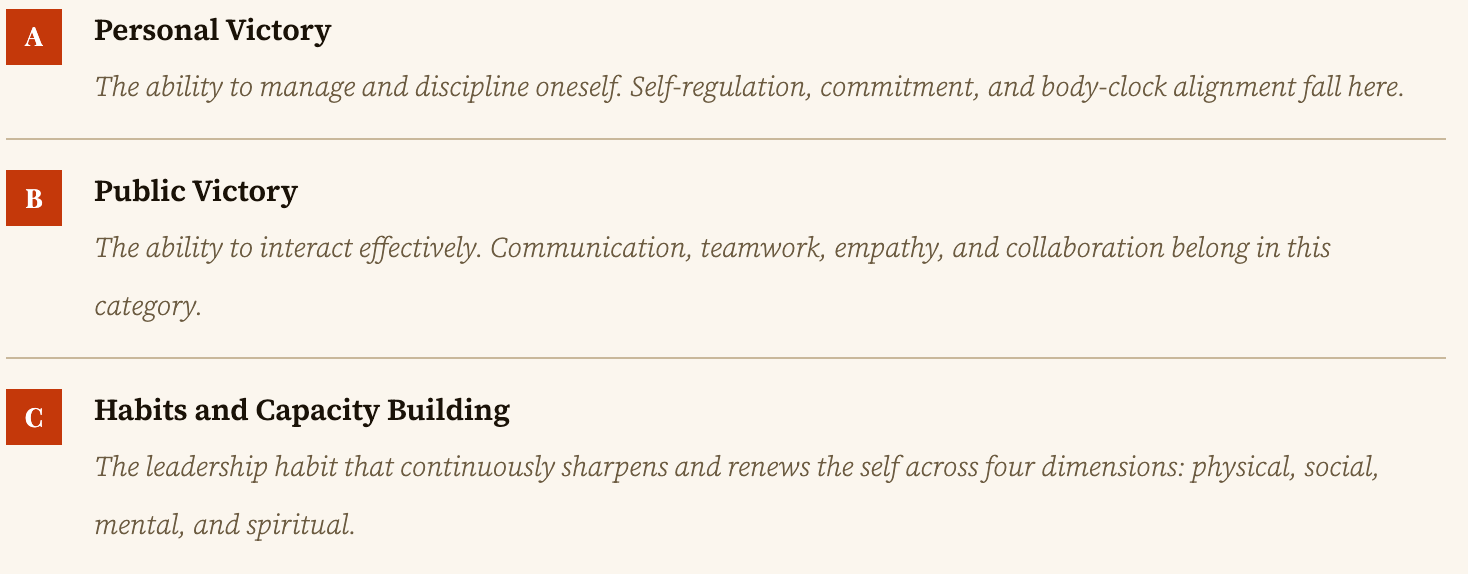
MB 24 is positioned as the practical engine for developing personal victory first. Without the foundation of being able to manage your own time, energy, and attention, no amount of collaborative learning or curriculum flexibility can produce excellent graduates.
Chapter 2: Lessons Learned from Real Students
This chapter is the emotional heart of the book. Rather than theorizing about student behavior, Prof. Amrinsyah collects first-person testimonies from students who applied MB 24 across multiple semesters. The accounts are striking for their honesty.
"I never thought that there was any kind of study method like MB24. It was really hard to get used to it at the first time. But, as the time passes, your body clock will get used to it. Before I got MB24, all my schedule felt rough for me and I will go home in fully exhausted condition."Nyoman Triani Herlina Dewi, SE, ST, MT
One student describes how, before MB 24, she consistently returned home exhausted with no clear understanding of where her time went. After two semesters of tracking her daily activities against a minimum study target of 11 hours, she noticed her body clock recalibrating naturally. She stopped needing external enforcement. The habit had become internal.
Another student, Hanang Pandu Himawan, credits MB 24 directly with his ability to win a 2nd-place award in the CENS competition organized by Universitas Indonesia while simultaneously managing heavy academic loads in his 5th semester at ITB. His tracking charts, included in the book, show the correlation between consistent study hours and performance spikes during high-stakes periods.
A third student narrates applying MB 24 from his very first week at ITB, introduced to it during a Bidikmisi matriculation event. He graduated with an IP of 4.0 for two consecutive years and received the Dean's List award from FTSL. He attributes this not to intelligence, but to the maturity of his study planning.
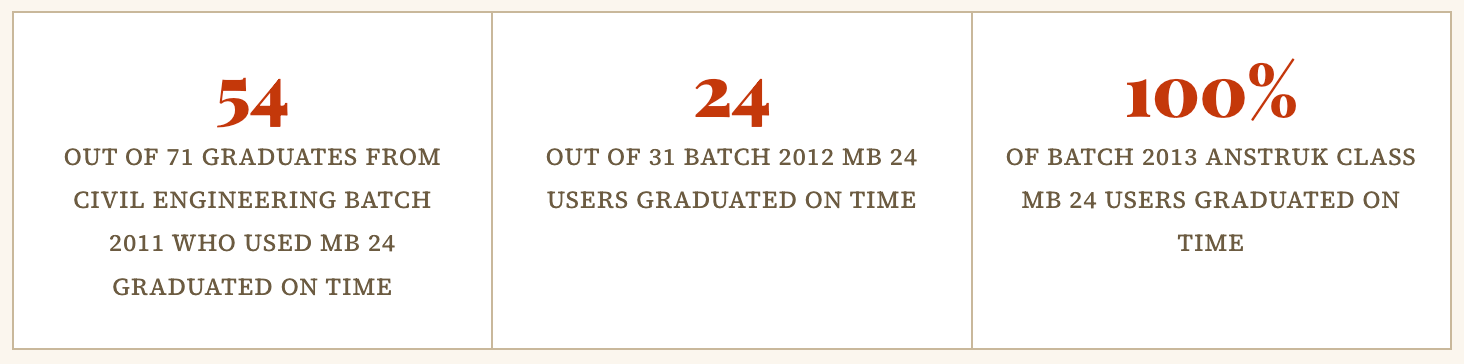
These numbers are not presented as marketing. They are presented as evidence. The difference between students who applied the method and those who did not is visible in graduation rates, GPA trajectories, and competition performance. The data is the argument.
*
Chapter 3: Are You Studying Diligently? The Science of Grit and Body Clock
This is where the book shifts into learning science, and it does so with genuine intellectual depth. The author opens with the work of Angela Lee Duckworth, psychologist at the University of Pennsylvania, who concluded that IQ and innate talent are not reliable predictors of long-term success. What matters more is a combination of self-control and grit, defined not as a sprint but as a marathon.
The Body Clock (Jam Tubuh) Framework
The most original and scientifically grounded contribution of this chapter is the concept of the body clock as a learnable and trainable system. The author explains that the human body clock is governed by the hypothalamus, a brain organ coordinating a cluster of roughly 10,000 nerve cells. This biological system regulates when we feel alert, when we feel hungry, and when we feel ready for rest.
MB 24 is designed to leverage this system rather than fight it. By consistently performing specific activities at specific times across many weeks, a student trains the hypothalamus to anticipate and prepare for those activities. The result, confirmed in multiple student testimonies and tracking charts in this book, is that studying at a fixed hour eventually stops feeling like discipline and starts feeling like a natural bodily need.
"Slowly, without realizing it, I became far more diligent and felt guilty whenever I had not yet met my 11-hour study target."Amatulhay Pribadi, ITB student testimony
This is not a metaphor. The author is describing a genuine neurobiological conditioning process. When the body clock takes over, the student no longer relies on motivation, willpower, or external pressure. The behavior has been internalized at a physiological level.
Chapter 4: Kampus Merdeka and the Mechanics of MB 24
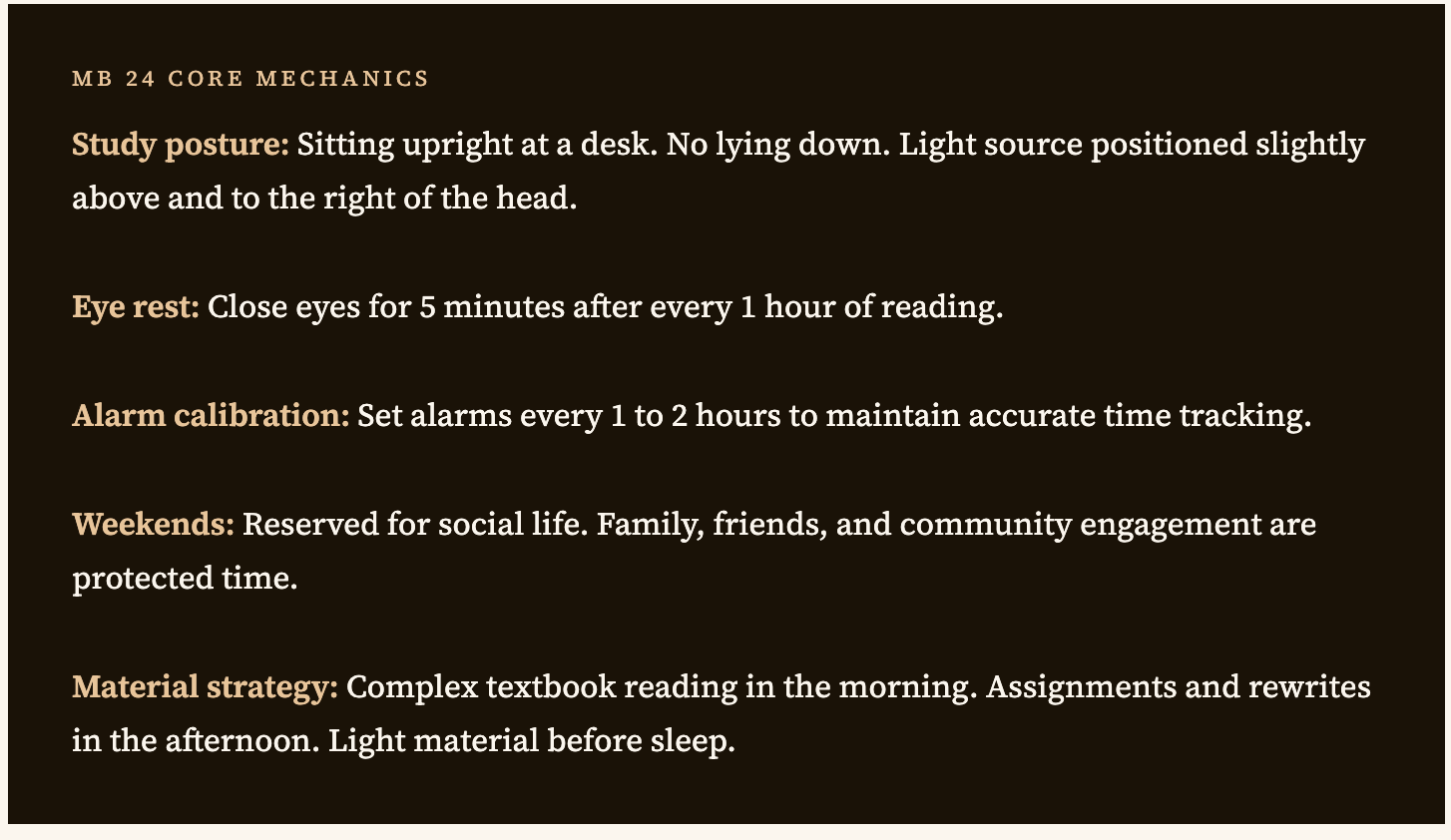
This chapter is the operational guide. It breaks down how MB 24 actually works in practice, covering compensation rules, material allocation, posture during study, eye rest intervals, and the distinction between morning, afternoon, and evening study categories.
The Compensation and Make-Up Rule
One of the most underrated features of MB 24 is its built-in accountability mechanism. If a student fails to meet the minimum daily study hours for any activity, that shortfall must be compensated the following day by taking time from other non-essential activities. The system does not allow students to simply "reset" each morning and ignore yesterday's failure.
For example, if extracurricular study time outside class is only 2 hours when the target is 4 hours, the next day that student's leisure time is reduced by 2 hours to repay the debt. This creates a cascading incentive to meet daily targets consistently rather than cramming before exams.
The Drop-Out Reality at ITB
The chapter does not avoid the uncomfortable statistics. Between 5 and 10 percent of each new cohort at ITB drops out during the first four semesters. They fail to clear the TPB (Basic Preparation Phase) minimum GPA requirement. The Rector of ITB, quoted in this book, identifies the primary cause not as lack of intelligence but as failure to adapt socially and academically after the transition from high school.
Students who were top performers in their high schools often arrive at ITB and find themselves surrounded by equally capable peers. Without the social scaffolding they relied on previously, and without self-management skills, many collapse. The problem is not cognitive. It is behavioral. MB 24 addresses this directly.
Chapter 4 (continued): The Seven Habits Framework Applied to University Life
Prof. Amrinsyah explicitly integrates Stephen Covey's Seven Habits of Highly Effective People into the pedagogical framework of MB 24. He acknowledges the need to adapt it for an engineering faculty context and adds integrity as an explicit, named value rather than leaving it implicit in Habit 7.
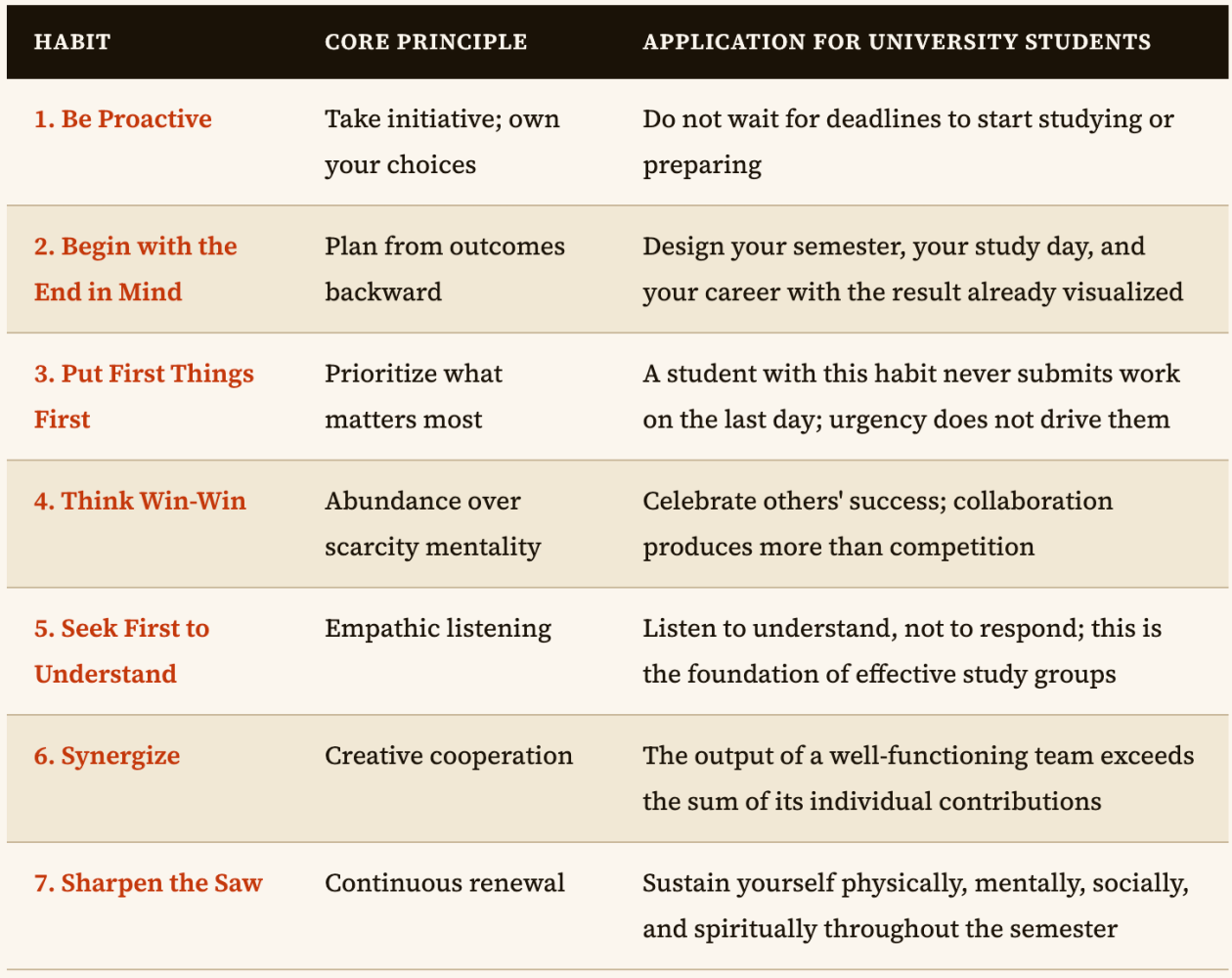
The author adds a note that professors must model these habits. If a professor consistently arrives late, they have no moral authority to demand punctuality from students. If a professor cannot work collaboratively, they cannot realistically expect teamwork from their class. Character is transmitted through example, not instruction.
The Multi-Tasking Problem: A Research-Backed Warning
One of the most important and practically relevant sections of the book is its treatment of multi-tasking, a behavior that defines how most modern students study. The author cites multiple research studies to build a devastating case against it.
A study of 263 students from junior high school, senior high school, and university levels found that when observed during 15-minute study sessions, students were actually studying for only 65 percent of that time. Within two minutes of beginning, they had already started checking social media and replying to messages.
Research by Professors Kraushaar and Novak from University of Vernon found that students used their laptops for non-academic purposes during 42 percent of class time, even while knowing their activity was being monitored.
David Meyer, a psychology professor at the University of Michigan, explains the cognitive cost precisely. The brain cannot genuinely execute two complex tasks simultaneously. What it does instead is rapid task-switching, which carries four compounding costs: extended time to complete each task due to re-familiarization, increased error rates from mental fatigue, degraded memory formation due to distraction during encoding, and storage of information in a less useful form when attention is divided.
"Maintaining concentration and focus is what distinguishes an expert from an amateur, and a star performer from an average one."Daniel Goleman, as cited by Prof. Amrinsyah
The implication for MB 24 is that the method's insistence on focused, undistracted, posture-correct study at a desk is not arbitrary strictness. It is a direct response to what neuroscience tells us about how learning is encoded, retained, and retrievable.
The Three Learning Curve Archetypes
The final analytical section introduces what the author calls the three typical tracking curves that reveal a student's study character and habits. These curves emerge naturally when students plot their actual weekly study hours against their targets over a full semester.
Curve A: Undisciplined Time Management Study hours begin high in the first weeks of the semester, then collapse dramatically as habits and the novelty of the new method fade. There is a brief spike before midterms, then collapse again, and a frantic recovery before final exams. This is the "instant effort" student: reactive, inconsistent, and always exhausted.
Curve B: Natural Body Clock Alignment This curve shows consistent, relatively stable study hours throughout the semester with only minor fluctuations around exam periods. The student's focus and attention have become habitual, meaning they do not need the pressure of approaching deadlines to activate their discipline. This is the target outcome of MB 24.
Curve C: The Workaholic This curve shows chronically excessive study hours that exceed what is healthy or sustainable. While it might appear admirable at first glance, the author warns that this pattern correlates with physical deterioration, anti-social behavior, an attitude of self-reliance to the point of isolation, and dismissiveness toward peers. Workaholism is not excellence. It is a form of imbalance that ultimately undermines the public victory dimension of student development.
What Makes This Book Exceptional
Several qualities distinguish this book from the vast library of generic "how to study" literature that clutters university bookshops across Indonesia.
It is empirically grounded. Every claim in this book is supported either by data from ITB students who applied the method, by peer-reviewed research in psychology and neuroscience, or by official policy documents. The author does not make assertions without evidence.
It respects student agency. MB 24 does not tell students what to study or how to think. It creates a structure of time and attention within which any student, regardless of major or academic level, can operate. The method is discipline-agnostic. An engineering student and a social science student can both apply it without modification.
It is honest about difficulty. Multiple student testimonies acknowledge that the first two to three months of applying MB 24 are genuinely hard. The body resists the new rhythm. The temptation to revert to old habits is powerful. The author does not promise a smooth transformation. He promises that the transformation is possible and worth pursuing.
It connects individual behavior to national outcomes. The author explicitly links the drop-out rate at ITB to the absence of structured softskill development. He connects this to the broader Kampus Merdeka agenda, arguing that freedom without discipline is not liberation; it is drift. This is a politically and educationally courageous position.
It embeds character education without moralizing. The integration of the Seven Habits framework, the emphasis on grit, the encouragement of social balance on weekends, and the warning against workaholism all reflect a holistic vision of what a university graduate should be. But none of this is delivered in a preachy or patronizing tone. The author lets the data and the student voices do the persuading.
Honest Critique
No review would be complete without acknowledging where the book has room to grow.
The book is written primarily from within the context of engineering education at ITB. The testimonies, the data, and the institutional references are almost entirely from FTSL. A reader from a social science, humanities, or arts program may find some of the quantitative framing of study hours somewhat mechanistic for their context. A future edition could benefit from voices and data across diverse disciplines.
Additionally, the book does not deeply address digital tools and their role in study management. In 2024 and beyond, students are navigating not just WhatsApp and SMS distraction but algorithm-driven short video platforms that operate on a scale of compulsive engagement unlike anything Covey or Goleman could have anticipated. The core insights of MB 24 remain valid, but an updated edition engaging with screen time management and digital focus tools would significantly extend the book's reach.
Finally, the book does not fully address students with mental health challenges, disabilities, or highly non-standard life circumstances. The 11-hour daily activity target may need contextual calibration for students managing chronic illness, significant family obligations, or other constraints. A brief framework for adaptation would make the method more inclusive, consistent with the equity mandate of Pasal 14 that the author himself cites.
A Tribute to the Architect of Merdeka Belajar: Nadiem Anwar Makarim
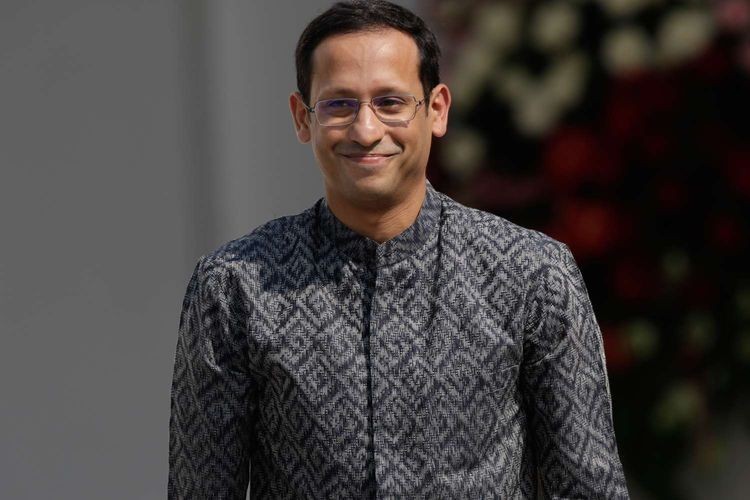
It would be intellectually dishonest to discuss this book, its series title, and the regulatory landscape it engages with, without pausing to honor the person who made all of it possible at a national scale. Nadiem Anwar Makarim, as Minister of Education, Culture, Research, and Technology of the Republic of Indonesia from 2019 to 2024, initiated and pushed through one of the most ambitious education reform agendas in modern Indonesian history: Merdeka Belajar.
Before Pak Nadiem took office, Indonesian higher education operated under a framework of centralized, prescriptive standards. Graduation requirements were uniform, outcomes were mandated from above, and the creative autonomy of universities, faculties, and students was significantly constrained. The system measured inputs, attendance, credit hours, written submissions rather than the genuine development of a graduate's capacity to think, adapt, and contribute.
Pak Nadiem arrived with a fundamentally different philosophy. He came from the world of building and scaling technology organizations, where the quality of a person's thinking, initiative, and collaborative capacity matters far more than their ability to comply with a fixed procedure. He saw clearly what decades of academic administrators had grown too accustomed to overlook: Indonesian students were graduating technically certified but too often underprepared for a world that demands creativity, self-direction, and resilience.
The Merdeka Belajar Legacy of Nadiem Anwar MakarimUnder his leadership, Kemendikbud launched over 26 episodes of Merdeka Belajar policy reforms. Key milestones include the abolition of the mandatory National Examination (UN) for secondary school, the Kampus Merdeka framework giving students freedom to learn outside their home faculty for up to 3 semesters, the Permendikbudristek No. 53/2023 liberating universities from mandatory thesis requirements, the MSIB (Magang dan Studi Independen Bersertifikat) program connecting students to real industry experience, and the Guru Penggerak program investing in transformative teacher leadership. Each of these reforms pointed in the same direction: trust the learner, liberate the process, and measure what truly matters.
The very fact that this book by Prof. Amrinsyah is framed under the banner of "Merdeka Belajar: Pengembangan Softskill Belajar Mahasiswa" is itself a testament to the intellectual space that Pak Nadiem opened up. Before Merdeka Belajar, a book arguing that softskill development should be treated as a core academic deliverable, on par with technical competence, would have struggled to find its policy home. After Merdeka Belajar, it fits naturally and urgently into the national conversation.
Critics of Pak Nadiem's tenure often focused on implementation pace, the disruption of transition periods, or the uneven readiness of institutions across Indonesia's vast archipelago. These are fair administrative observations. But the directional vision he brought to Indonesian education was correct. He asked the right question: not "have students fulfilled the requirements?" but "have students truly learned?" That shift in framing is precisely what gives books like this one its moral and policy legitimacy.
Reform in education is never painless. But the pain of change is always less than the pain of staying still in a world that is accelerating past you. Pak Nadiem chose movement, and Indonesia's students are the beneficiaries.Reflection from the reviewer
As Pak Nadiem moves forward beyond his ministerial chapter, I want to express, on behalf of every Indonesian student who benefited from Merdeka Belajar, genuine and deep gratitude. The reforms he drove may take a full generation to fully manifest in outcomes. The students entering university today under the Kampus Merdeka framework, guided by books like this one, will be the living proof of whether the vision was right. I believe they will be. I believe the vision was right. And I believe Pak Nadiem deserves to see that vindication with his own eyes in the years ahead.
Whatever path he walks next, may it be met with excellence, respect, and the knowledge that the seeds he planted in Indonesian education are still growing.
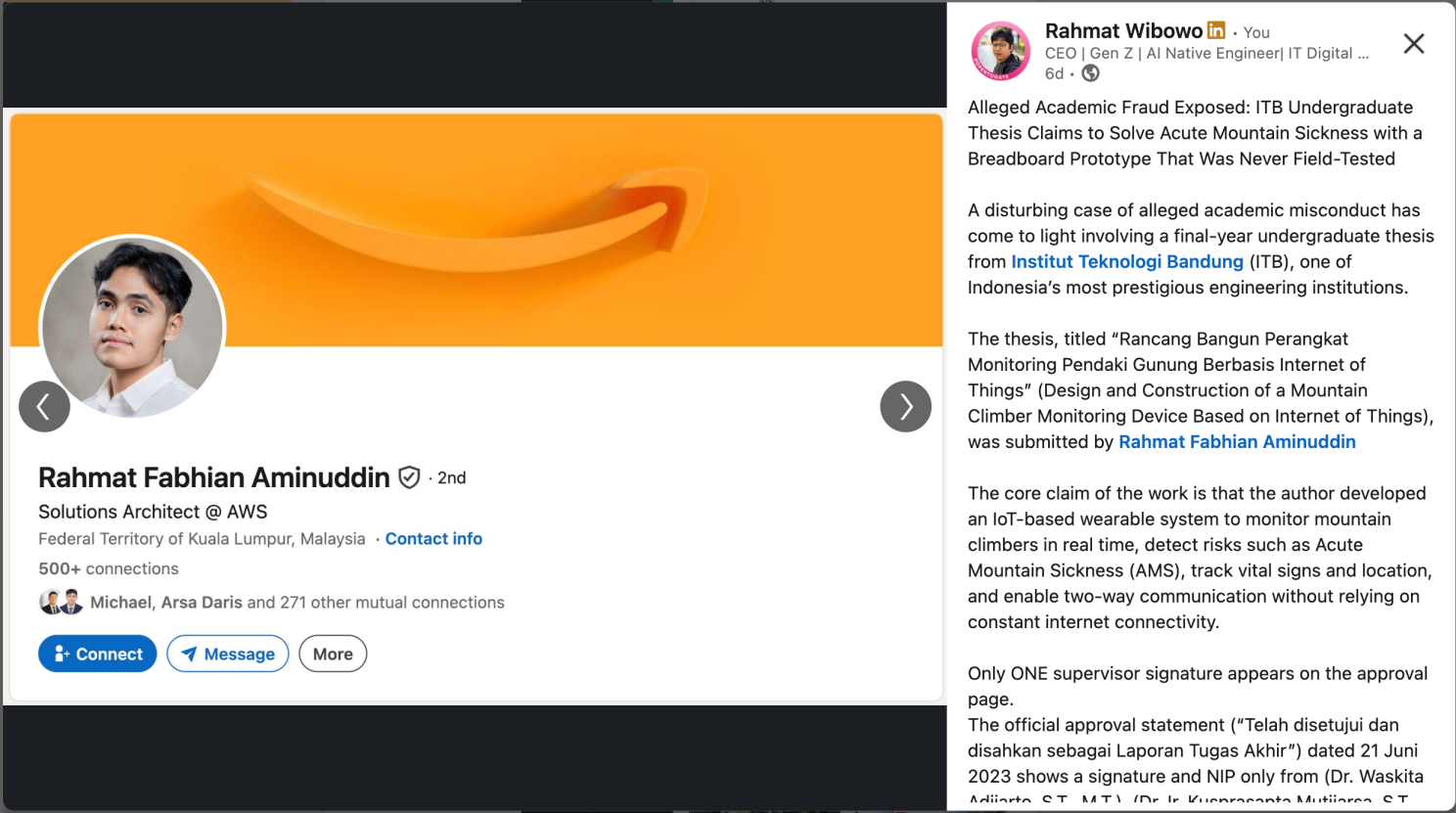
A Message For My Friends Rahmat Fabhian Aminuddin Who's Been Alleged For Academic Fraud With Below 3.0 GPA
Who Should Read This Book
The cover correctly identifies three audiences: first-year university students, students with a GPA below 3.0, and students working on thesis, master's, or doctoral research. I would add several more.
Lecturers and faculty members should read this book because it challenges professors to examine their own habits and how those habits model or undermine the culture they claim to want in their classrooms.
Parents of university students should read this book because it explains, clearly and without blame, why the transition from high school to university fails for so many students who were previously excellent. The issue is almost never intelligence. It is preparation for self-management.
Education policymakers and curriculum designers should read this book because it makes a compelling case that Merdeka Belajar without MB 24-style softskill development is an incomplete reform. Liberating students from mandatory thesis requirements without giving them the internal structures to direct their own learning is offering a map without a compass.
And finally, working professionals who feel chronically undisciplined with their time and attention should read this book. The body clock science applies to anyone. The Seven Habits integration is universally relevant. The warning about multi-tasking applies to every knowledge worker on the planet.
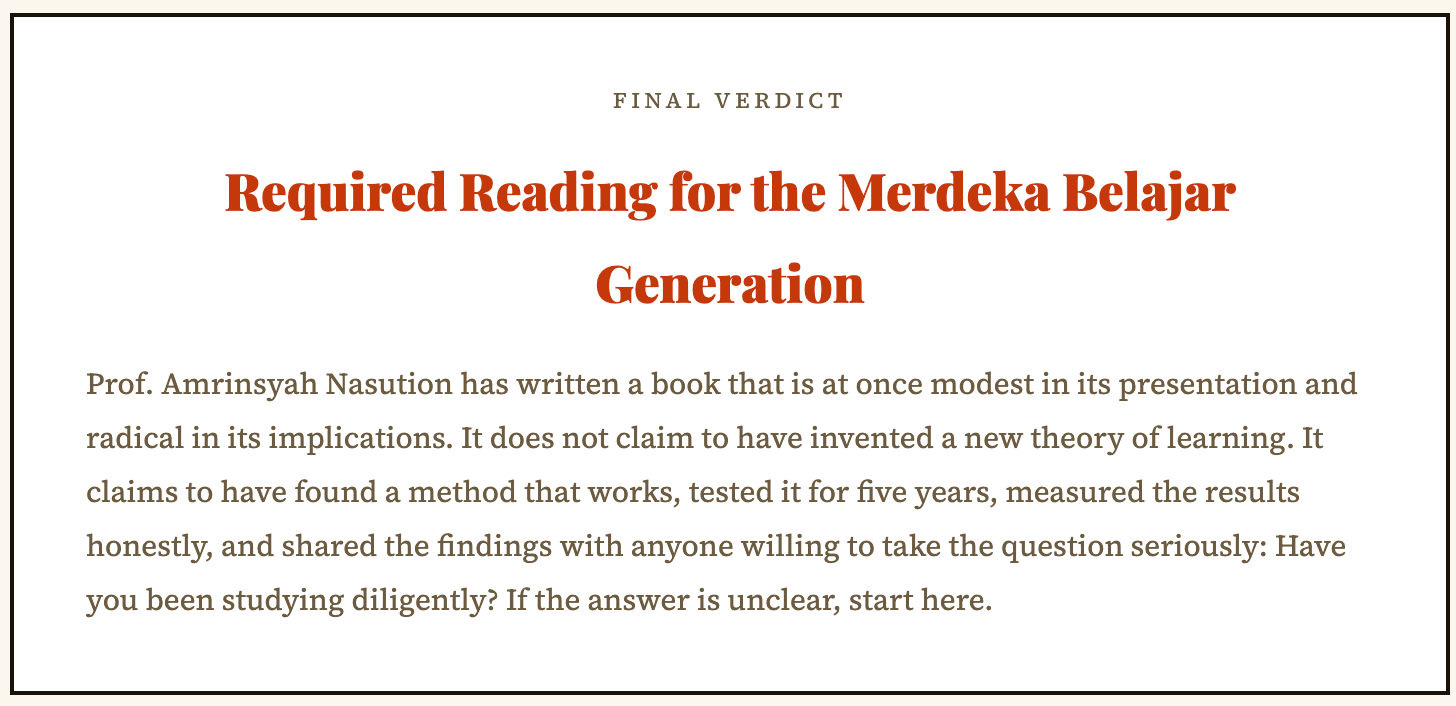
This article reflects a personal reading and review of the book. All factual content is drawn directly from the text, student testimonies, and data included by the author. The views expressed are those of the reviewer.
#NadiemMakarim #MerdekaBelajar #HigherEducation #StudyMethod #MetodeBelajar24Jam #ITB #LearningScience #Softskill #TimeManagement #IndonesiaEducation #CharacterEducation #Grit #BodyClock #StudentLife #KampusMerdeka #Neuroscience #SevenHabits #PersonalDevelopment #AcademicSuccess #BookReview #PendidikanTinggi #Infraloka #RahmatWibowo