
Hindustan to the World By Rahmat Wibowo from InfraLoka
The partition of a subcontinent, the birth of three nations, and the quiet exodus of millions who carried their heritage across the seas.
What Was Hindustan?
Hindustan — a Persian compound of Hind (the Indus River) and -stan (land of) was the name the Mughals, the Persians, and later the British gave to the Indian subcontinent. For centuries it was a single civilisational world: shared languages, shared rivers, shared spice routes, shared heavens mapped by the same astronomers.
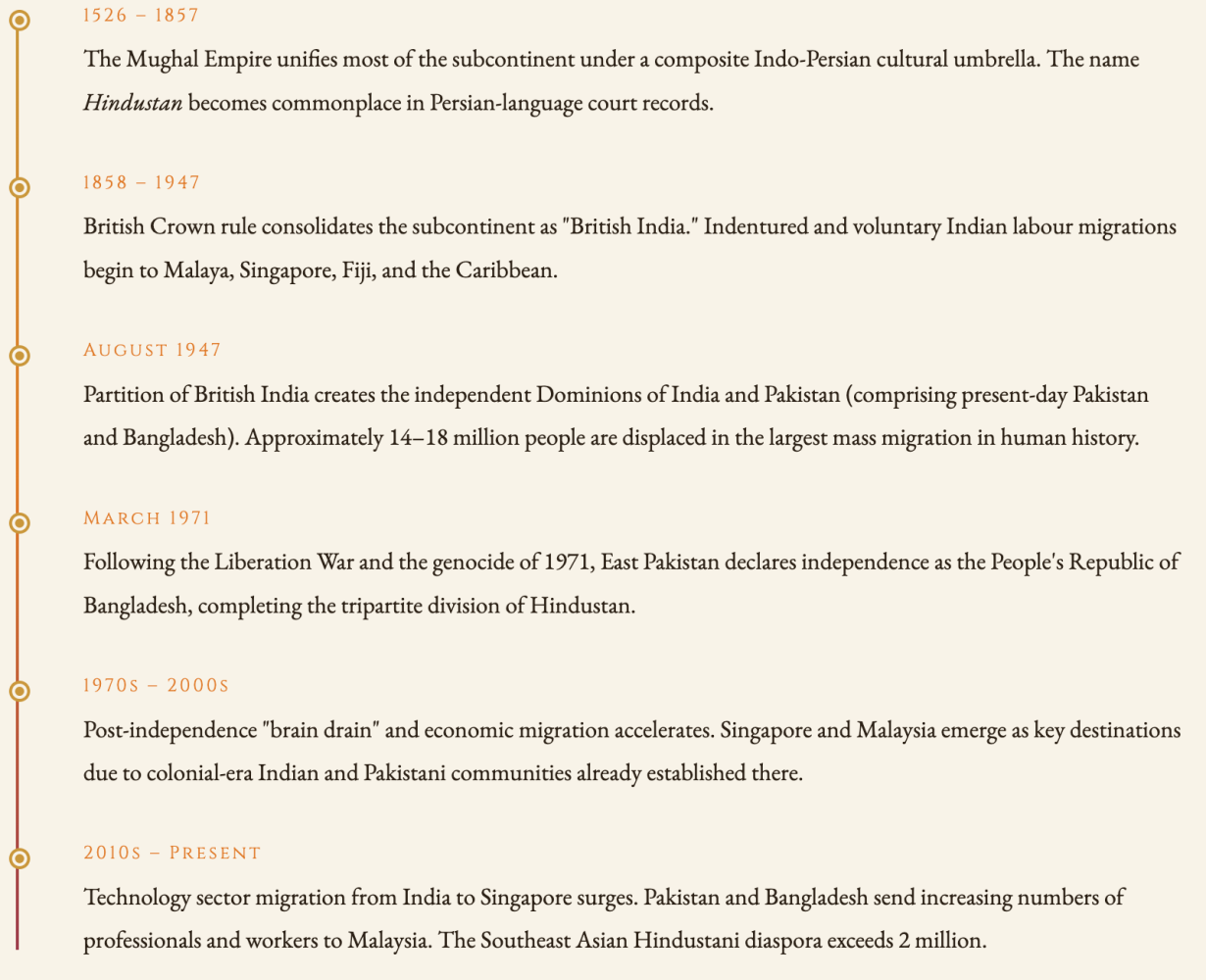
In 1947, under the painful logic of Partition, this world was divided. Three nations emerged over two decades: the Republic of India in 1947, the Islamic Republic of Pakistan in 1947, and the People's Republic of Bangladesh in 1971. Yet the people of this land Hindustanis in the broadest cultural sense continued to move, and continue to move today, seeking opportunity across the oceans.
"They did not merely migrate they transplanted civilisations, carrying their languages, their recipes, their prayers, and their stories to soils that had never heard them."
Paraphrase of the Hindustani diaspora experience, adapted from Amitav Ghosh, In an Antique Land, 1992
Key Milestones
Children of a Divided Subcontinent
The partition of 1947 and the emergence of Bangladesh in 1971 created three distinct national identities from a shared civilisational trunk. Each nation evolved its own diaspora culture, its own reasons to emigrate, and its own communities abroad yet all share the deep grammatical roots of Hindustani civilisation.
🇮🇳 India
Bharat · The World's Largest Democracy

Historical Background
India became independent on 15 August 1947, inheriting the majority of British India's territory, institutions, and civil service. The country has since grown into the world's fifth-largest economy and hosts one of the largest global diasporas some 32 million people of Indian origin live outside the subcontinent, according to the Ministry of External Affairs.
Cultural & Linguistic Heritage
India is home to 22 constitutionally recognised languages and hundreds of dialects. Hindi-Urdu — the classical Hindustani tongue serves as a lingua franca across the north, while Tamil, Telugu, Bengali, Marathi, Punjabi, and others define distinct regional civilisations. This linguistic richness means the Indian diaspora overseas is not monolithic but a mosaic of regional sub-communities.
Reasons for Emigration
Indian emigration has been driven by multiple waves: the colonial-era indentured labour system (1830s–1917), post-independence "brain drain" of skilled professionals to the UK and USA (1960s–1980s), Gulf migration of construction and service workers (1970s–present), and a surge of technology professionals to the United States, Canada, Singapore, and the UAE since the 1990s. The IT boom made Indian engineers among the most sought-after migrant professionals in the world.
🇵🇰 Pakistan
Pākistān · Land of the Pure

Historical Background
Pakistan was created on 14 August 1947 as the homeland for the Muslims of British India, carved from the northwestern and northeastern provinces of the subcontinent. Its traumatic birth accompanied by mass displacement, communal violence, and the loss of East Pakistan (Bangladesh) in 1971 has profoundly shaped a national identity simultaneously proud of its Mughal, Sufi, and Indus Valley heritage while navigating modern political instability.
Cultural Heritage
Urdu is Pakistan's national language and the literary vehicle of classical Hindustani culture the language of Ghalib, Iqbal, and Faiz Ahmad Faiz. Punjabi, Sindhi, Pashto, Balochi, and Saraiki are spoken by tens of millions. Pakistani classical music, qawwali (Sufi devotional music), and truck art have become globally recognised cultural exports.
Reasons for Emigration
Pakistan's diaspora is among the world's largest relative to population size. The primary drivers have been economic hardship, political instability, and security concerns. Gulf countries absorbed large waves of Pakistani labourers beginning in the 1970s petrodollar boom. The United Kingdom hosts the largest Pakistani community outside the Gulf, a legacy of Commonwealth migration. Since the 2000s, Malaysia and Southeast Asia have become increasingly important destinations for Pakistani workers and traders.
🇧🇩 Bangladesh
Bāṃlādeś · Country of Bengal

Historical Background
Bangladesh emerged on 26 March 1971, following one of the most harrowing episodes of the twentieth century the Liberation War and the genocide committed by Pakistan's military forces, in which an estimated 300,000 to 3 million Bengalis were killed. The country's birth was sealed by the military intervention of India and the surrender of Pakistani forces on 16 December 1971.
Cultural Heritage
Bangladeshi culture is rooted in the Bengali language, declared a national symbol after the Language Movement of 1952 when students died defending Bengali's status against the imposition of Urdu. Bangla literature the tradition of Tagore, Nazrul Islam, and Jasimuddin forms the spiritual core of the nation's identity. The country's syncretic tradition blends Islamic faith with folk Hinduism, Sufism, and the ancient Baul mystical movement.
Reasons for Emigration
Bangladesh has one of the world's highest rates of emigration relative to its size, driven by chronic poverty, natural disasters (cyclones, flooding, and the long-term threat of sea-level rise), and economic aspiration. The garment industry made Bangladesh the world's second-largest apparel exporter, funding development, but overseas remittances — primarily from the Gulf, Malaysia, and Southeast Asia remain the country's economic lifeline, exceeding $21 billion annually.
Hindustanis in Southeast Asia
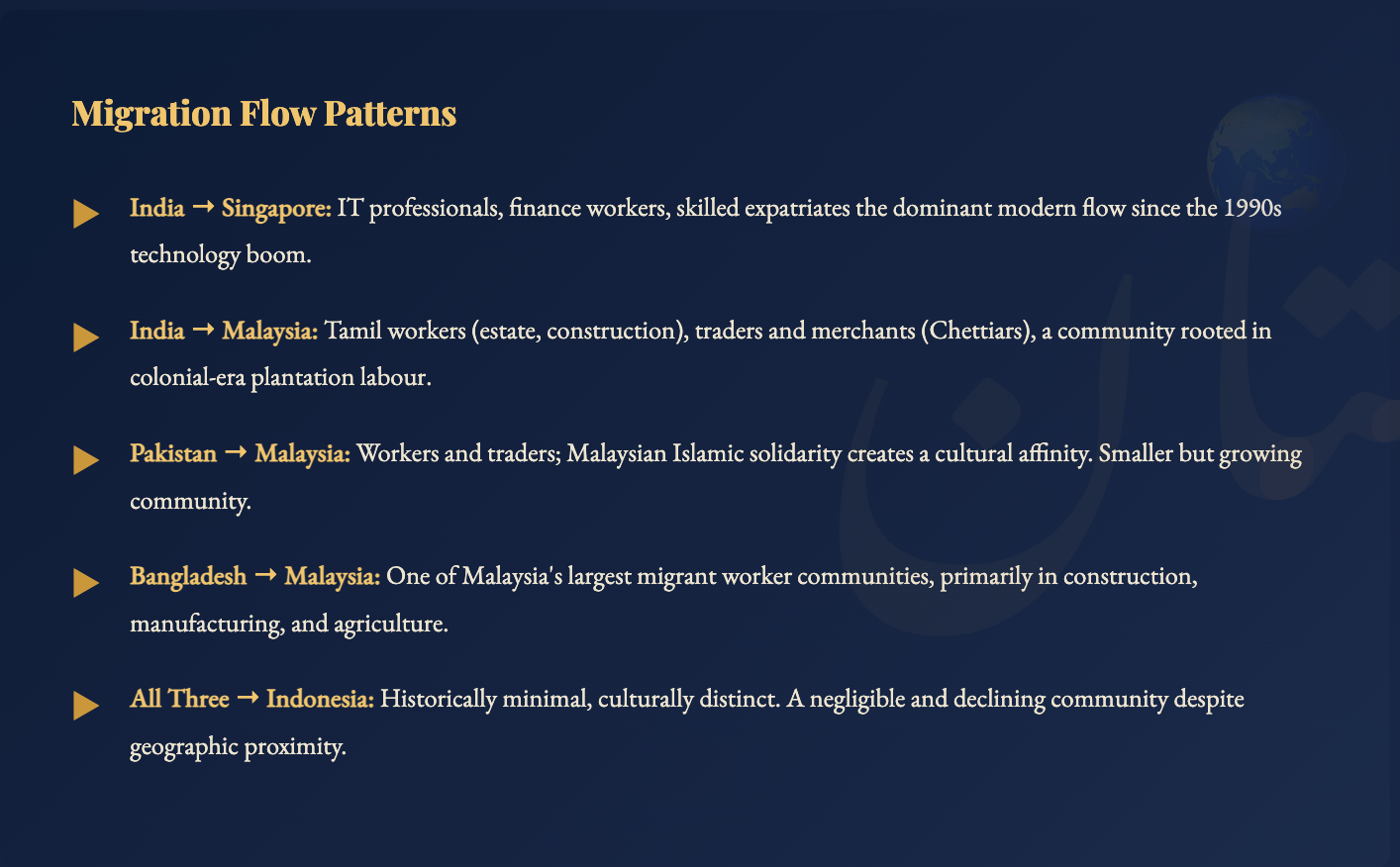
Southeast Asia has long been a recipient of South Asian migration. The British colonial enterprise connected the Indian subcontinent to Malaya and Singapore through labour demand, administrative need, and merchant capital. These colonial roots deepened into permanent communities, and post-independence economic growth in Singapore and Malaysia drew fresh waves of Hindustani professionals and workers across the Bay of Bengal.
Singapore & Malaysia: The Hindustani Strongholds
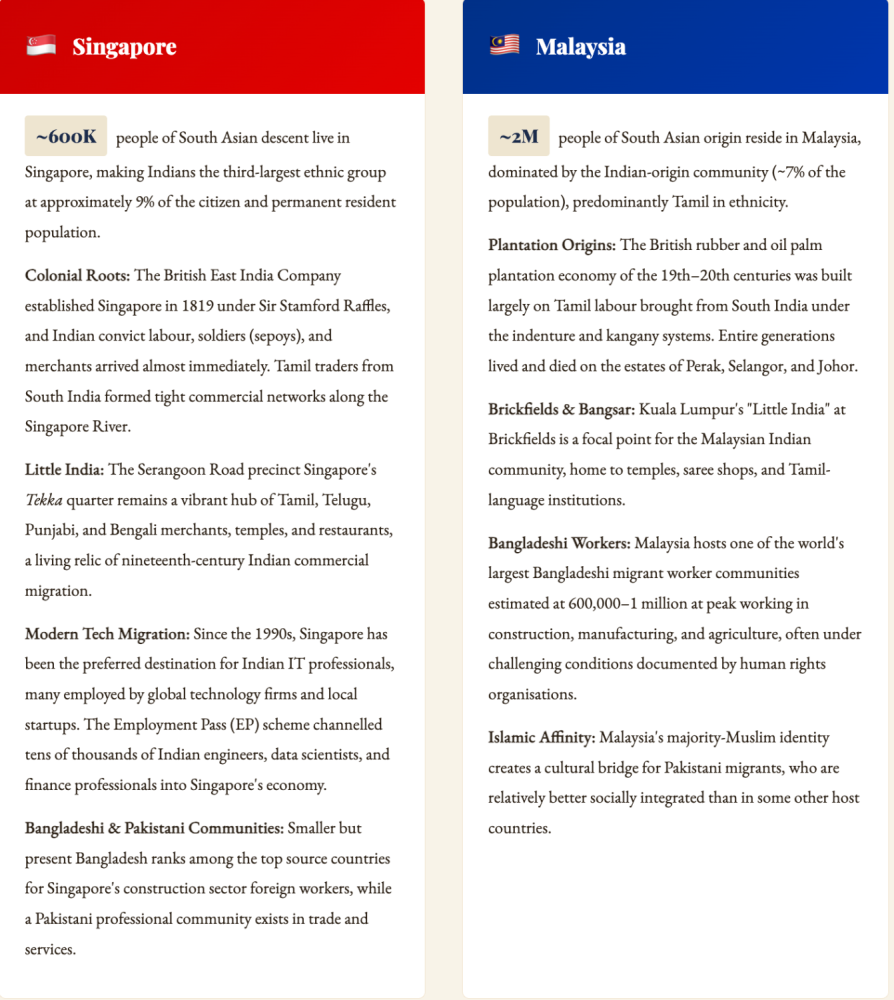
Singapore's Indians are not a single community but a confederation of regional identities Tamils, Malayalees, Punjabis, Sindhis, Gujaratis who share a hyphen but not necessarily a language or a temple.
Adapted from Rajesh Rai, Indians in Singapore, 1819–1945, NUS Press, 2014
🇮🇩 Indonesia: The Exception in the Archipelago
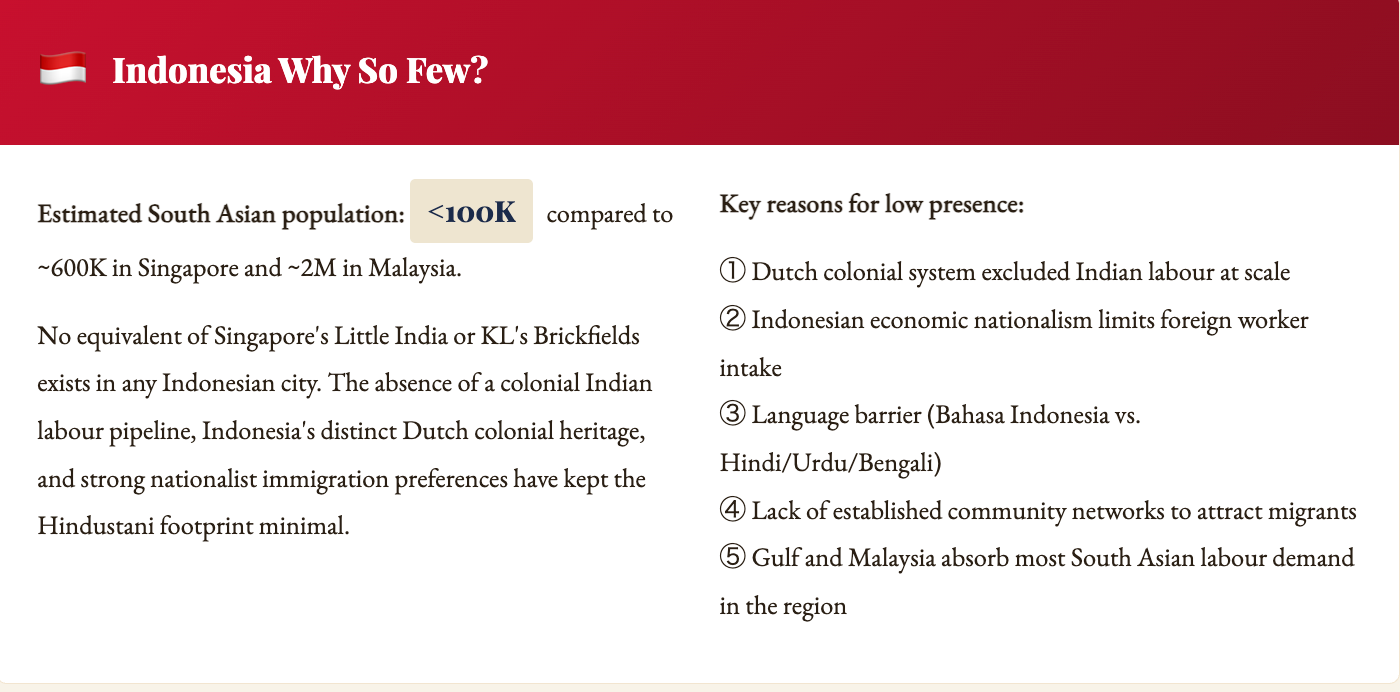
Despite being Southeast Asia's largest nation and geographically proximate to the Indian subcontinent, Indonesia is strikingly absent from the map of Hindustani diaspora settlement. The reasons are structural, historical, and cultural.
Colonial Divergence: Where British Malaya and Singapore were directly administered from India, the Dutch East Indies (colonial Indonesia) operated within a separate imperial network. The Dutch did not import Indian labour at scale; Javanese, Madurese, and Sundanese workers filled plantation and infrastructure roles instead. This severed the colonial pipeline that brought South Asians to Malaysia and Singapore.
Historical Gujarati Merchants: A small but historically significant community of Gujarati and Sindhi traders settled in port cities like Surabaya, Makassar, and Medan during the 19th and early 20th centuries, active in the textile trade. Their descendants remain but are thoroughly assimilated often holding Indonesian citizenship and speaking Bahasa Indonesia as their primary language.
Religious Bridge: Islam is a profound shared bond between Indonesia and Pakistan and Bangladesh in particular. Yet this religious commonality has not translated into significant migration flows. Indonesia's own enormous labour surplus, its nationalistic economic policies, and its cultural preference for intra-ASEAN or Middle Eastern labour sourcing limit opportunities for Hindustani workers.
Current Presence: Estimates place the South Asian population of Indonesia at fewer than 100,000 people a tiny fraction of the millions across Malaysia and Singapore. Most are in Jakarta, working in international trade, hospitality, and the diplomatic sector. The community is too small to sustain dedicated cultural institutions of the scale found in Kuala Lumpur or Singapore.
What Hindustanis Carried
Migration is never merely economic. Every Hindustani who crossed the Kala Pani the "black waters," the ocean carried not just tools and savings, but entire worlds: recipes, prayers, songs, scripts, ways of mourning and celebrating, architectural memories and agricultural knowledge. Across Singapore and Malaysia these transported worlds have taken root.
Language & Literature
Tamil has official language status in Singapore, the only Southeast Asian country to grant official recognition to a South Asian language. Tamil-medium schools, newspapers, and television channels have preserved the language across generations. Urdu literary traditions survive among Pakistani and older Indian Muslim communities in both countries.
Religion & Sacred Architecture
Hindu temples like the Sri Veeramakaliamman Temple in Singapore's Little India and the Sri Mahamariamman Temple in Kuala Lumpur stand as architectural anchors of the South Asian presence in Southeast Asia. The annual Thaipusam festival, in which devotees carry ornate kavadi burdens as acts of penance, draws hundreds of thousands of participants and is one of the most vivid public expressions of the Indian diaspora's religious vitality.
Cuisine as Memory
South Asian food has been so thoroughly absorbed into Malay and Singaporean cuisine that dishes like roti canai, curry laksa, mee goreng mamak, and nasi kandar are considered local staples. Indian Muslim (Mamak) restaurants are part of the social fabric of Malaysian life, open round the clock and visited by Malaysians of all ethnic backgrounds.
A Civilisation in Diaspora
The story of the Hindustanis whether they call themselves Indian, Pakistani, or Bangladeshi is ultimately a story of civilisational resilience. Partition divided a subcontinent but it could not sever the deep cultural grammar that binds these peoples together. The shared inheritance of the Mughal aesthetic, the Hindustani musical tradition, the Urdu and Sanskrit-derived vocabularies, the Sufi and bhakti devotional traditions: these persist in expatriate communities from Singapore's Serangoon Road to Kuala Lumpur's Brickfields.
Singapore and Malaysia stand as living evidence of what Hindustani civilisation looks like when transplanted to new soil: it adapts, hybridises, and endures. Indonesia, by contrast, shows how geography alone cannot predict migration patterns colonial history, administrative systems, and cultural networks matter far more than proximity.
As the twenty-first century unfolds, the children and grandchildren of these migrants navigate hyphenated identities Indian-Singaporean, Pakistani-Malaysian, Bangladeshi-Malaysian forging something new from the old. Hindustan, as a political entity, ended in 1947. As a civilisational current, it flows still.
#Hindustan #SouthAsianDiaspora #India #Pakistan #Bangladesh #Singapore #Malaysia #Indonesia #MigrationHistory #CulturalHeritage #Diaspora #SoutheastAsia #IndianDiaspora #BangladeshiDiaspora #History #LinkedInLearning #GlobalCitizen #CivilisationAndCulture #Infraloka
References
- Rai, Rajesh. Indians in Singapore, 1819–1945: Diaspora in the Colonial Port City. National University of Singapore Press, 2014.
- Amrith, Sunil S. Migration and Diaspora in Modern Asia. Cambridge University Press, 2011.
- Tan, Tai Yong & Kudaisya, Gyanesh. The Aftermath of Partition in South Asia. Routledge, 2000.
- Mohd. Taib Osman (ed.). Kebudayaan dan Kemanusiaan Melayu. Dewan Bahasa dan Pustaka, Kuala Lumpur, 1984. [On Malay cultural integration of Indian influences.]
- Werbner, Pnina. Pilgrims of Love: The Anthropology of a Global Sufi Cult. Hurst & Company, 2003.
- Ministry of External Affairs, Government of India. Annual Report on the Indian Diaspora. New Delhi, 2023.
- Bangladesh Bureau of Statistics. Population and Housing Census 2022. Government of Bangladesh, Dhaka, 2023.
- Pakistan Bureau of Statistics. Pakistan Economic Survey 2022–23. Ministry of Finance, Islamabad, 2023.
- Department of Statistics Singapore. Population in Brief 2023. Government of Singapore, 2023.
- Department of Statistics Malaysia. Demographic Statistics Malaysia 2023. DOSM, Putrajaya, 2023.
- Human Rights Watch. "Hidden Chains: Rights Abuses and Forced Labor in Thailand's Fishing Industry" cited for comparative migrant labour conditions analysis. HRW, New York, 2018.
- Ghosh, Amitav. In an Antique Land. Granta Books, London, 1992.
- Tinker, Hugh. A New System of Slavery: The Export of Indian Labour Overseas 1830–1920. Oxford University Press, 1974.
- Lal, Brij V. (ed.). The Encyclopedia of the Indian Diaspora. National University of Singapore Press, 2006.
- International Organisation for Migration (IOM). World Migration Report 2022. IOM, Geneva, 2022.
- World Bank. Migration and Remittances Data 2023: South Asia. World Bank Group, Washington D.C., 2023.
- Kaur, Amarjit. Wage Labour in Southeast Asia since 1840: Globalisation, the International Division of Labour and Labour Transformations. Palgrave Macmillan, 2004.
- Willford, Andrew C. Cage of Freedom: Tamil Identity and the Ethnic Fetish in Malaysia. University of Michigan Press, 2006.
- Embassy of India, Jakarta. Indian Community in Indonesia: Statistical Overview. Ministry of External Affairs, India, 2022.
- Ricklefs, M.C. A History of Modern Indonesia since c.1200. 4th ed., Stanford University Press, 2008. [Context on Dutch colonial labour systems and the absence of Indian indenture in the Dutch East Indies.]