
How Hanzi Cuts Your AI Token Bill in Half By Rahmat Wibowo From Infraloka
The case for Chinese characters in LLM pipelines, and how to build a vibe coding system that uses AI to do the translation work for you.
You Are Paying More Than You Need To
Every time you send a prompt to a large language model, the cost is calculated in tokens. Tokens are the atomic units that models use to read and generate text. A token is roughly 3 to 4 characters in English. That means a phrase like "large language model" costs you 4 tokens before you have even asked a single question.
Across thousands of API calls in a production system, this adds up fast. The invisible inefficiency sitting inside your prompts is the language itself.
Most developers write prompts in English. It feels natural. But English is one of the least token-efficient languages for modern LLMs. There is a better option sitting inside the Unicode standard, and it has been used by over a billion people for thousands of years.
"A single Chinese character can carry the semantic weight of an entire English word or phrase. That is not a linguistic curiosity. That is a compression algorithm."
THE INSIGHT
What Hanzi Actually Is and Why It Matters for LLMs
Hanzi (汉字) are the logographic characters used in written Chinese. Unlike alphabetic languages where individual letters combine to form words, each Hanzi character is already a complete semantic unit. The character 智 means intelligence or wisdom. The character 能 means capability or ability. Together, 智能 means "intelligent" or "AI capability." Two characters. One concept. One or two tokens.
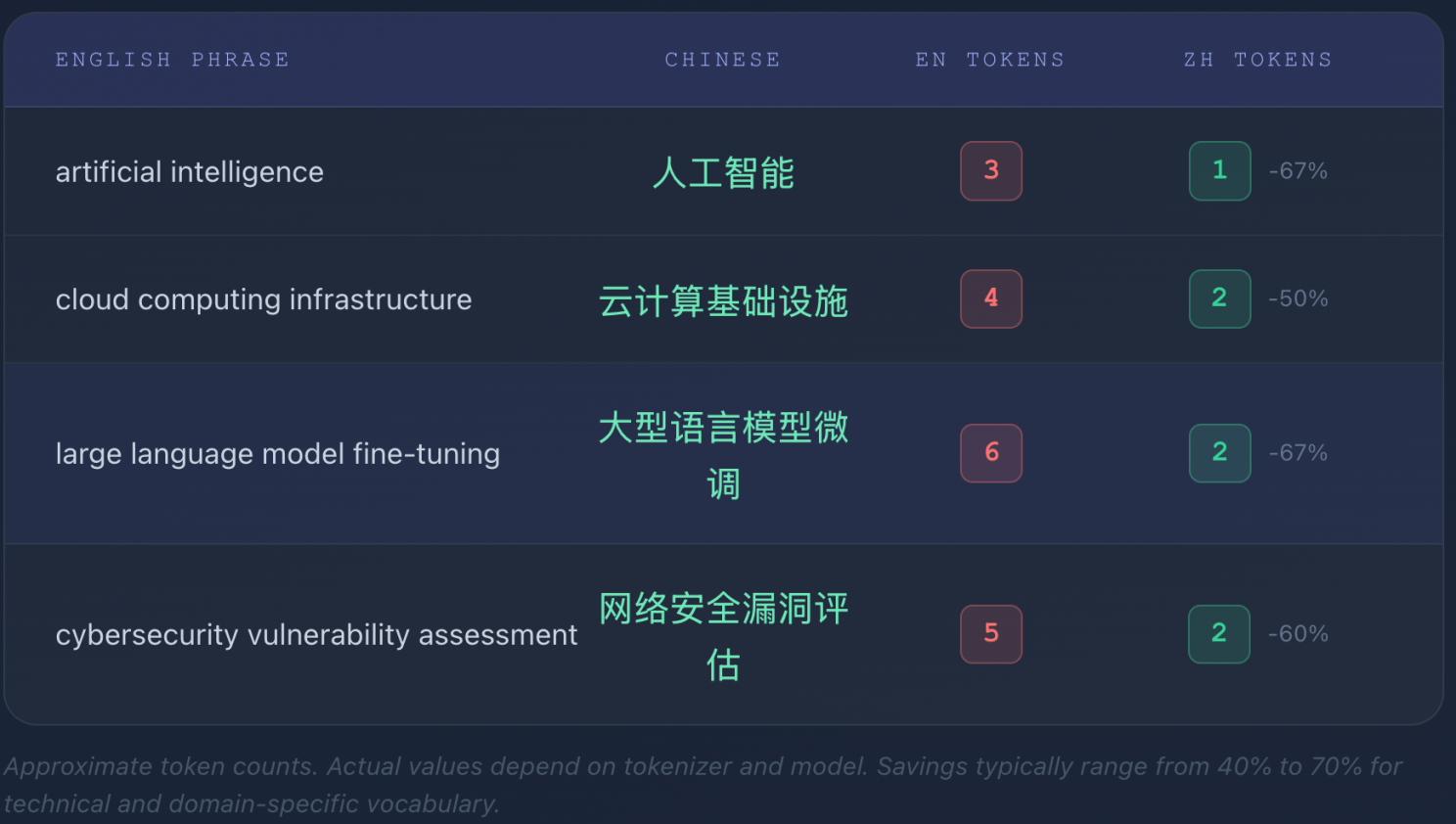
In English, "artificial intelligence" is two words, 24 characters, and roughly 3 tokens depending on the tokenizer. In Chinese, 人工智能 is 4 characters and consistently tokenizes to 1 to 2 tokens. The information density is dramatically higher per token.
Modern LLMs like GPT-4, Claude, and Gemini all understand Mandarin Chinese at a high level. They were trained on massive multilingual corpora. They can reason, summarize, generate code, and answer complex questions in Chinese with comparable quality to English. This means you are not sacrificing capability by switching languages. You are only reducing token cost.
Token Comparison: English vs Hanzi
The table below shows common technical phrases and their approximate token counts under standard tokenization (cl100k_base, used by GPT-4 and Claude). The savings are consistent and compounding.
What This Means at Scale
Imagine you run a SaaS application built on top of an LLM API. Your system processes 100,000 prompts per day. Each prompt averages 200 English tokens. At 60. That is $1,800 per month.
Now apply a conservative 50% token reduction by routing prompts through Chinese. Your daily input cost drops to 900. Annual savings: $10,800. For a startup, that is infrastructure runway. For an enterprise, that is budget reallocated to engineering or product.
Building a Hanzi Token Optimizer in Vibe Coding
Vibe coding is the practice of building software through natural language collaboration with AI tools. You describe what you want. The AI writes the code. You iterate. It is fast, accessible, and increasingly the dominant way individuals ship products.
The challenge is that vibe coding sessions involve many long prompts. Every instruction to your AI assistant, every context dump, every system description costs tokens. Now you can build a middleware system that compresses this cost automatically, entirely without changing your workflow.
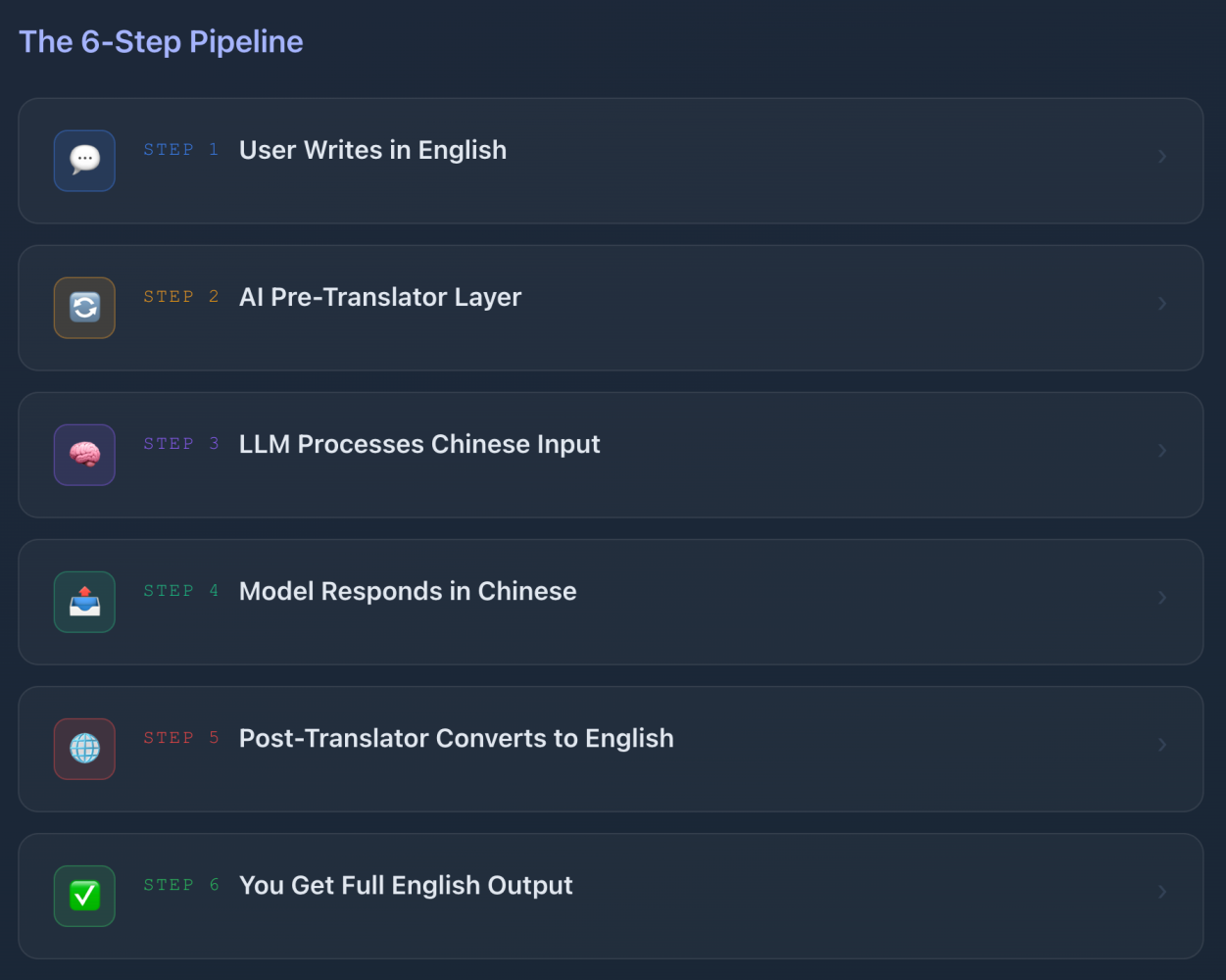
The architecture is simple. You always write and read in English. An AI translation layer handles the Hanzi conversion in the middle of the pipeline. The main LLM never sees your English prompt. It processes a compact Chinese representation and returns a compact Chinese response. A second translation step brings it back to English before you read it.
A Simple System Prompt Architecture
You do not need a complex framework. You need two Claude API calls and one system prompt on each side. Here is the conceptual structure in pseudocode, readable by any developer working in vibe coding:
// Hanzi Token Optimizer - Vibe Coding Middleware
async function optimizePrompt(userPrompt) {
// Step 1: Translate user English prompt to Chinese
const chinesePrompt = await callClaude({
system: "Translate the following prompt into Mandarin Chinese. Preserve technical meaning exactly. Return only the Chinese translation.",
user: userPrompt
});

// Step 2: Send Chinese prompt to main LLM
const chineseResponse = await callClaude({
system: "You are a helpful assistant. Respond in Mandarin Chinese.",
user: chinesePrompt
});

// Step 3: Translate response back to English
const englishOutput = await callClaude({
system: "Translate the following Chinese text to English. Preserve all meaning and technical terminology.",
user: chineseResponse
});

return englishOutput;
}
Honest Limitations You Should Know
This system is not a free lunch. There are real trade-offs to understand before deploying it in production.
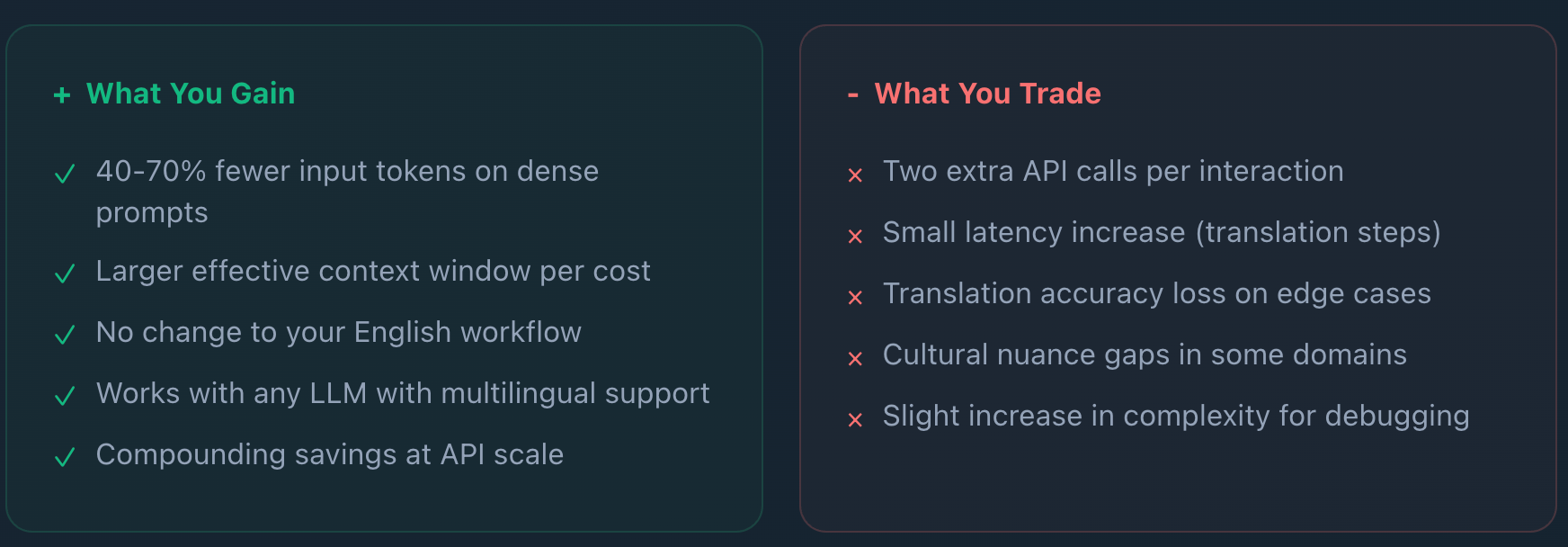
The trade-off is most favorable for high-volume, cost-sensitive pipelines with well-defined technical domains like code generation, data extraction, summarization, and structured output tasks. It is less favorable for creative writing or emotionally nuanced tasks where English expression carries intentional weight.
Why Chinese Works Better Than Other Languages
You might ask: why Chinese specifically? What about Japanese, Arabic, or other non-Latin scripts?
Japanese uses Kanji (Chinese-origin characters) alongside syllabic Hiragana and Katakana. It achieves good density but not as reliably as pure Chinese. Arabic is highly morphologically complex and tokenizes inconsistently across models. Korean Hangul is syllabic and also less dense than Hanzi.
Chinese wins for three reasons. First, it is purely logographic, meaning every character is a standalone semantic unit with no alphabet to break it into sub-components. Second, Mandarin Chinese has extremely high model quality across all major LLMs due to training data volume. Third, Chinese has no spaces between words or grammatical inflections, keeping character count minimal.
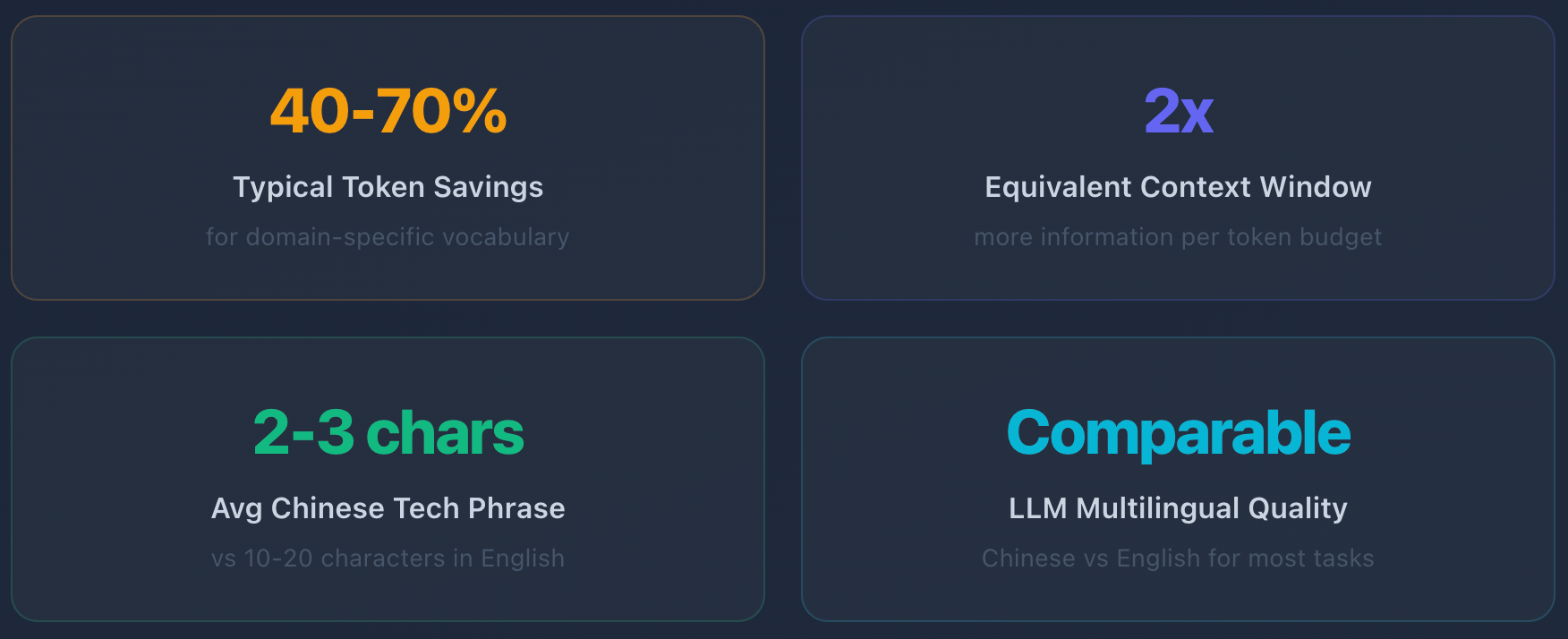
A 200-word English technical prompt can often be expressed in 80 to 100 Chinese characters without loss of meaning. In tokenization terms, 200 English tokens may reduce to 40 to 60 Chinese tokens. The compression ratio is structural, not accidental.
"The alphabet gave us literacy. Logographic writing gives us token density. In the age of LLM APIs, density is money."
Where This Goes Next
This technique is a short-term arbitrage that may narrow as tokenizers improve. Anthropic, OpenAI, and Google are actively working on tokenization strategies that better represent non-Latin scripts. Future models may tokenize Chinese even more efficiently, or may develop language-agnostic token representations.
But for now, the gap is real and measurable. If you are building on LLM APIs today, routing through Chinese is one of the highest-leverage infrastructure optimizations you can make with minimal engineering effort.
In the broader context of democratizing AI access, especially in regions like Indonesia and Southeast Asia where API costs represent a larger fraction of startup budgets, token efficiency is not an academic exercise. It is an equity issue. Every 50% reduction in token cost is a 50% expansion in who can afford to build.
#AI #LLM #TokenEfficiency #VibeCoding #ChineseNLP #AIInfrastructure #CloudCost #Infraloka #PromptEngineering #MachineLearning #AIOptimization #SoutheastAsia #TechIndonesia #OpenSource