
I Am Willing to Be Misunderstood By Rahmat Wibowo CEO of InfraLoka
And if that is the price of genuine engagement, I will pay it every single time.
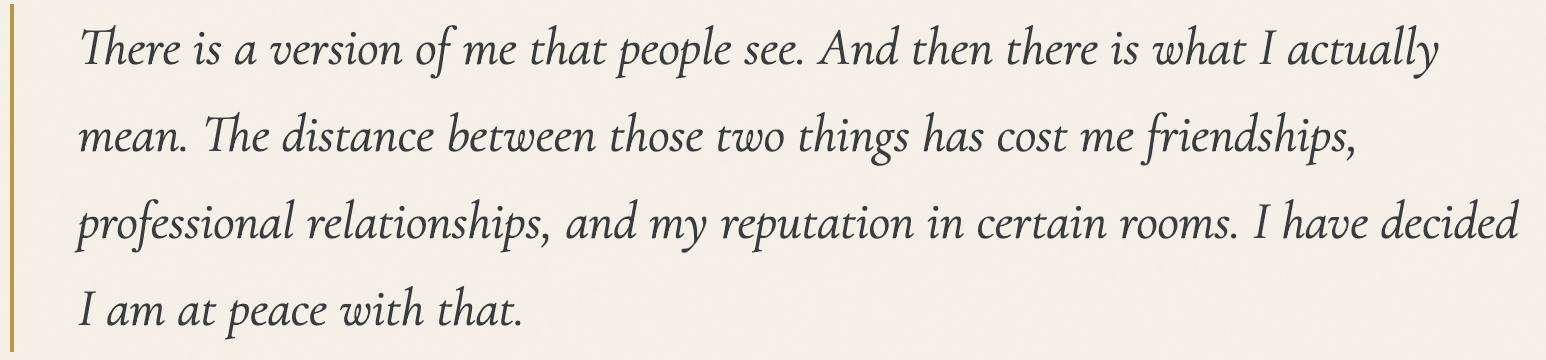
Over the years, I have been called arrogant, intense, overwhelming, and intrusive. People have walked away from conversations with me feeling talked down to, interrogated, or lectured. I have been labeled a stalker for asking questions. I have been called rude for paying attention. I have been dismissed as someone who talks nonsense for caring too much about context. I have been diagnosed, informally and by people with no clinical authority, as a narcissist with NPD. And I have been told, as though it were an insult, that I have "main character syndrome."
Let me offer you the other side of each of those verdicts.
1. I use precise, elevated language to honor you, not to impress you.
They said: "He thinks he's smarter than everyone."
When I choose my words carefully, when I reach for a specific term rather than a vague one, it is not because I want you to admire my vocabulary. It is because I believe you deserve exactness. Sloppy language is a form of disrespect. It says: I did not care enough to think clearly before speaking to you.
I was raised to believe that clarity is a gift you give to the person in front of you. When I use a technical term precisely or construct a careful argument, I am saying: you are worth my full mental effort. Some people read that as a performance of superiority. I am genuinely sorry for that impression. But I will not simplify my thinking as a courtesy if doing so means giving you something less true.
2. I ask many questions because I want to serve you well, not surveil you.
They said: "He's a stalker. Why does he need to know so much?"
I ask questions the way a good doctor takes a thorough history. Not to collect data for its own sake. Not to hold information over someone. But because the more I understand your situation, your context, your actual needs, the more useful I can actually be to you.
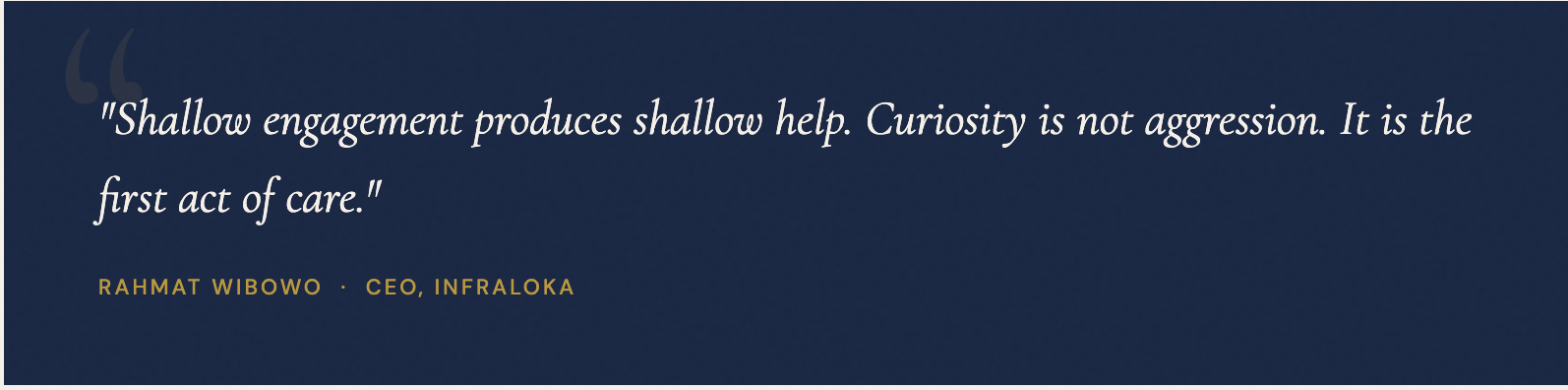
Shallow engagement produces shallow help. I have never been interested in giving generic advice to a person whose specific circumstances I have not tried to understand. If that makes me seem overly curious, I accept that verdict. I would rather be too curious than too indifferent.
3. I interrupt because I am with you in the conversation, not waiting for my turn.
They said: "He's rude. He doesn't let anyone finish."
I will admit this is the one I have worked hardest to examine in myself. And I understand how it reads. In many social contexts, silence is deference, and deference is respect.
But when I interject mid-thought, it is not because I have stopped listening. It is often because I am listening so actively that a connection, a question, a clarification surfaces before I can stop it. Engagement, for me, is not a spectator sport. When I am in a conversation with you, I am fully present. That presence has rough edges. I am learning to manage them. But I will not trade presence for the performance of patience.
4. I give you detail because I think you can handle the full picture.
They said: "Talking nonsense. Classic Dunning-Kruger."
There is an irony worth naming here. The Dunning-Kruger effect describes a cognitive bias where people with limited knowledge overestimate their competence. It is often invoked, loosely and incorrectly, to dismiss anyone who speaks at length or with confidence.
When I give you a thorough explanation, when I walk through the nuance rather than the shortcut, it is not because I have confused volume with expertise. It is because I have learned, often the hard way, that partial information creates partial solutions. I would rather give you too much context and let you calibrate than give you too little and watch you work from an incomplete map.
Call it what you want. I call it respect for the complexity of your situation.
5. I am the main character of my own story. And so are you.
They said: "NPD. Main character syndrome. Classic narcissist."
This one deserves its own reckoning, because it carries clinical weight that the others do not. To be told you have Narcissistic Personality Disorder by someone who is not your clinician, in the middle of a disagreement, is not a diagnosis. It is a dismissal wearing the costume of psychology.
Yes, I move through the world with intention. Yes, I take up space. Yes, I show up with energy and direction and a strong sense of where I am going. People who find that threatening have a name ready for it: narcissism. People who find it inspiring call it leadership. The behavior is identical. What changes is the eye of the beholder.
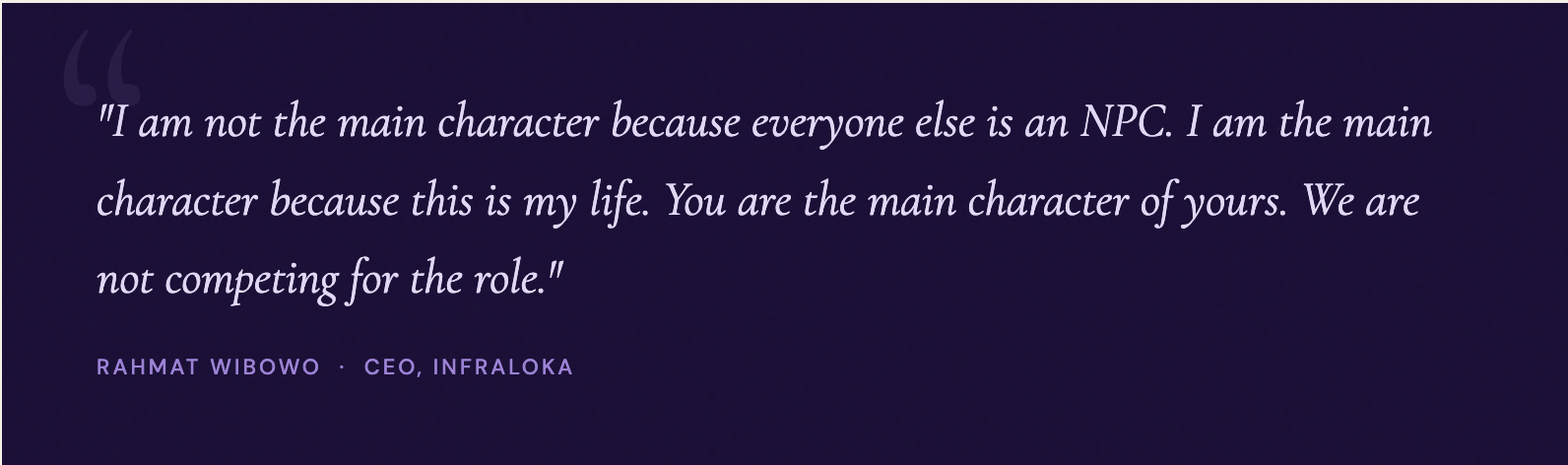
When I said I am the main character of my own story, here is what I meant with every word of it: I am the one responsible for writing my narrative. I make choices with intention. I do not drift through life waiting for someone to cast me in their plot. I author my own.
What I did not say, and what the people who labeled me refused to hear, is the second half of that belief: every single person around me is the main character of their own story too. Not a supporting character in mine. Not background. Not an NPC placed there for my development arc. A full human being, with a complete inner life, a story as dense and as sacred as mine, unfolding in parallel.
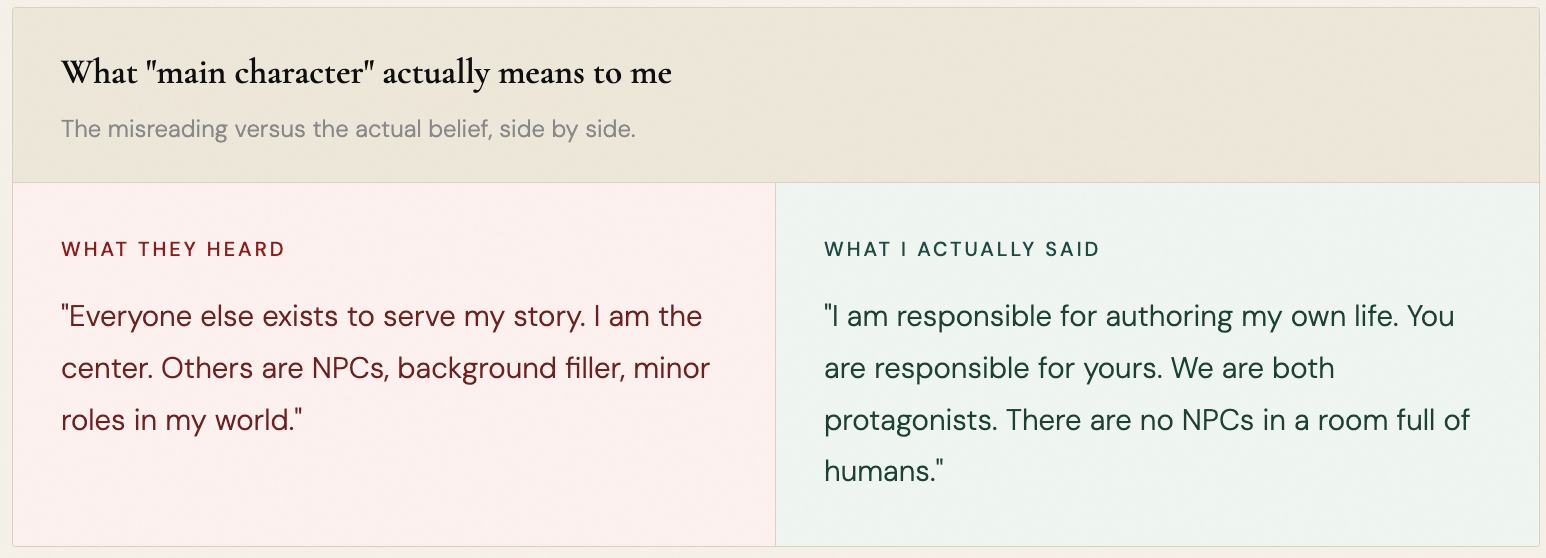
The irony is that the "main character syndrome" accusation, leveled at someone who invests deeply in understanding other people, who asks exhausting numbers of questions to know them better, who gives long detailed answers because he believes the person in front of him deserves the full truth, is almost perfectly inverted. A true narcissist does not care enough about your inner world to ask. I ask because your story matters to me.
Narcissism is characterized by a fundamental inability to grant others their full humanity. Every question I ask, every piece of careful attention I give, every detailed explanation I offer, is evidence of the opposite. I see you. Fully. That is the whole point.
I am aware that none of these explanations guarantee I will be understood. Some people will read this and still think I am constructing elaborate justifications for behavior they find exhausting. That is their right.
But I have come to understand that being misread is not the same as being wrong. Some of the greatest acts of care look, from the outside, like overreach. Some of the deepest forms of respect look, to the recipient, like condescension. Some of the most engaged presences in a room look, to those who prefer comfortable distance, like intrusion.
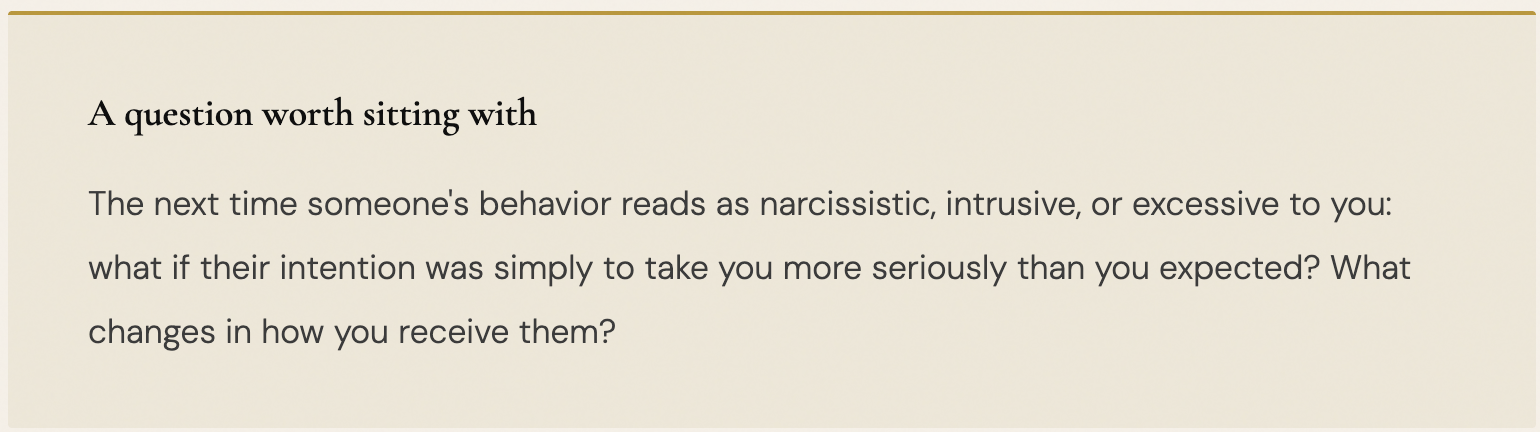
I am not asking you to agree with how I show up. I am asking you to consider that there may be an intention behind it that deserves a moment of genuine curiosity before judgment.
I am Rahmat. I am complex in ways I am still mapping. I am willing to be misunderstood if the alternative is being something smaller than I actually am.
Rahmatan lil Alamin, mercy for all creation, has to begin somewhere. For me, it begins with taking people seriously enough to be fully present with them, even when that presence is inconvenient.
#WillingToBeUnstood #Leadership #PersonalGrowth #Authenticity #Communication #InfraLoka #RahmatanLilAlamin #MainCharacter #NPD #MentalHealthAwareness #ProfessionalDevelopment #LinkedInCreator #Indonesia #ThoughtLeadership #SelfAwareness #CEOLife