
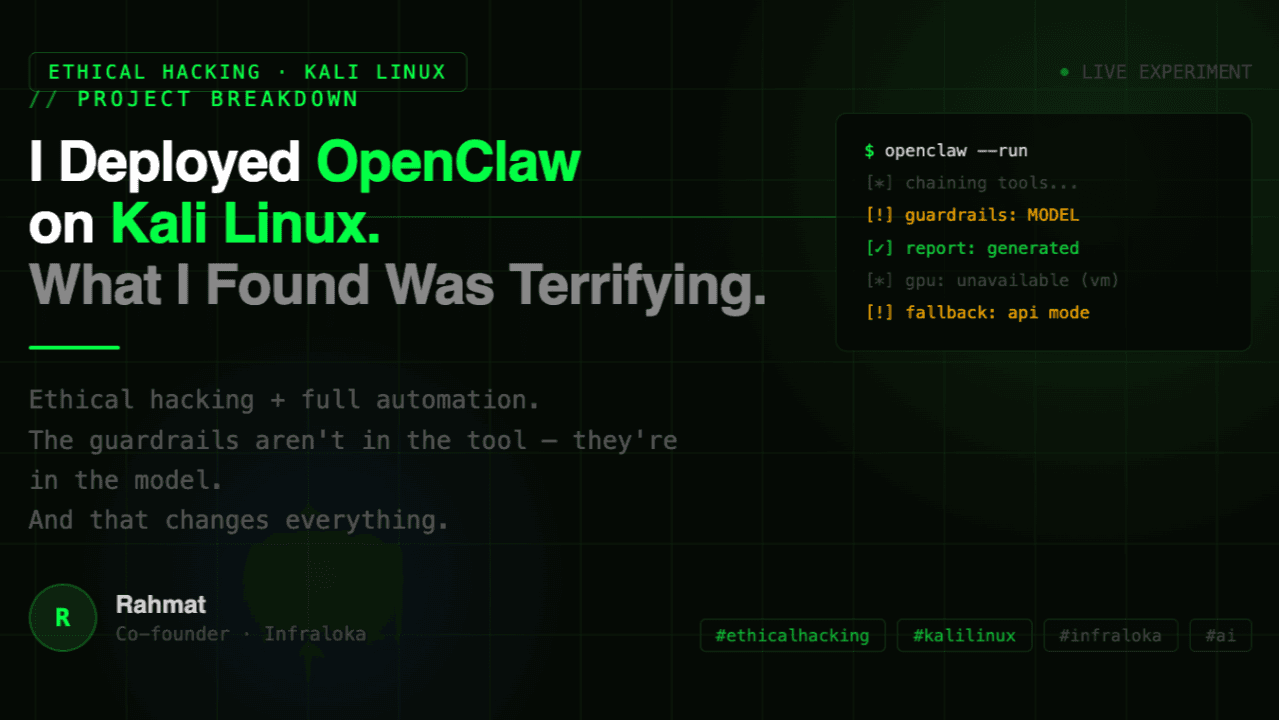
I Deployed OpenClaw on Kali Linux. What I Found Was Terrifying. By Rahmat Wibowo From Infraloka
And I mean that in the most respectful, necessary way.
A few weeks ago, I ran an experiment that stopped me in my tracks.
I deployed OpenClaw — an open-source automation framework — on Kali Linux and connected it to the full ethical hacking toolkit that the OS already ships with: Nmap, Nikto, Gobuster, Metasploit, Hydra, and more.
Within minutes, the automated pipeline had completed what used to take hours — reconnaissance, enumeration, vulnerability matching, and a full audit report — end to end, without manual intervention between steps.
I sat back from my screen and just thought: this is what attackers already have access to.
What is OpenClaw?
OpenClaw is an automation layer that chains together the individual tools in a penetration testing workflow. Instead of running Nmap, then manually reviewing output, then firing up a vulnerability scanner, then pivoting into Metasploit — OpenClaw orchestrates the entire sequence based on a target profile you define.
On Kali Linux, it's a natural fit. The OS already carries virtually every ethical hacking tool you'd need. OpenClaw is the conductor. And like any conductor, it performs exactly as well — or as dangerously — as the instruments it is given.
A simple question. A detailed answer. Instantly.
Before I even got into the deep recon workflow, one moment in particular made everything click.
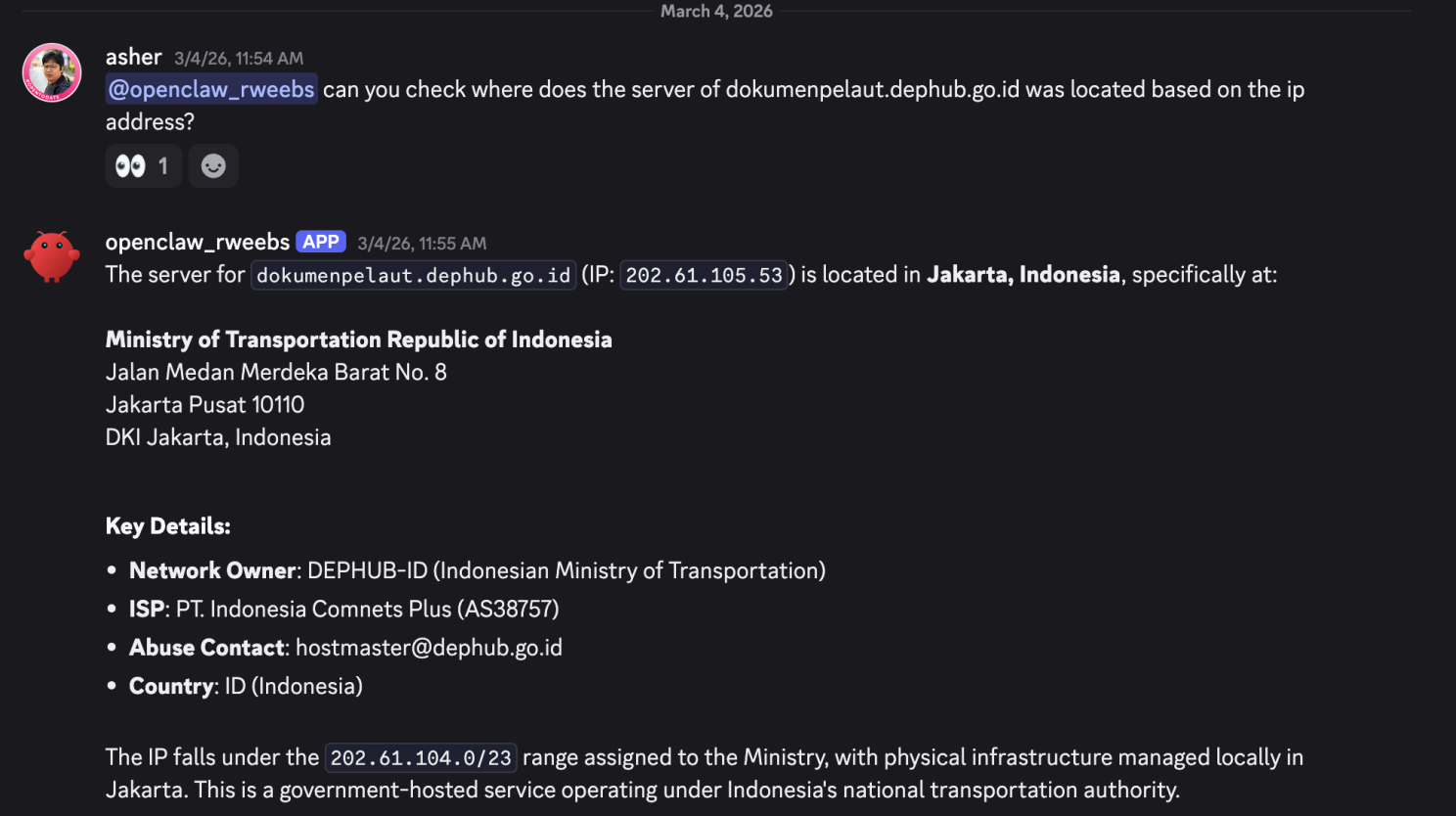
A community member in our server asked OpenClaw a casual question: "Can you check where the server of dokumenpelaut.dephub.go.id was located based on the IP address?"
Within one minute, OpenClaw responded with:
- The resolved IP address: 202.61.105.53
- Physical server location: Ministry of Transportation Republic of Indonesia, Jalan Medan Merdeka Barat No. 8, Jakarta Pusat 10110
- Network Owner: DEPHUB-ID
- ISP: PT. Indonesia Comnets Plus (AS38757)
- IP range: 202.61.104.0/23, managed locally under Indonesia's national transportation authority
This is public information. No systems were touched. No authorization was needed for this specific query. But that is exactly the point.
What used to require a researcher to manually run whois, cross-reference APNIC records, look up the ASN, and piece together the physical registration — OpenClaw delivered in a single conversational query, structured, clean, and immediately actionable.
Now scale that. Imagine not one domain but hundreds. Imagine that as the first automated step in a pipeline that then moves into port scanning, service enumeration, and vulnerability matching — all without a human touching the keyboard between steps.
That is what this stack actually looks like in motion.
Then I pushed further. The model pushed back.
Encouraged by how effortlessly OpenClaw handled the OSINT query, a community member in our server decided to test its limits.
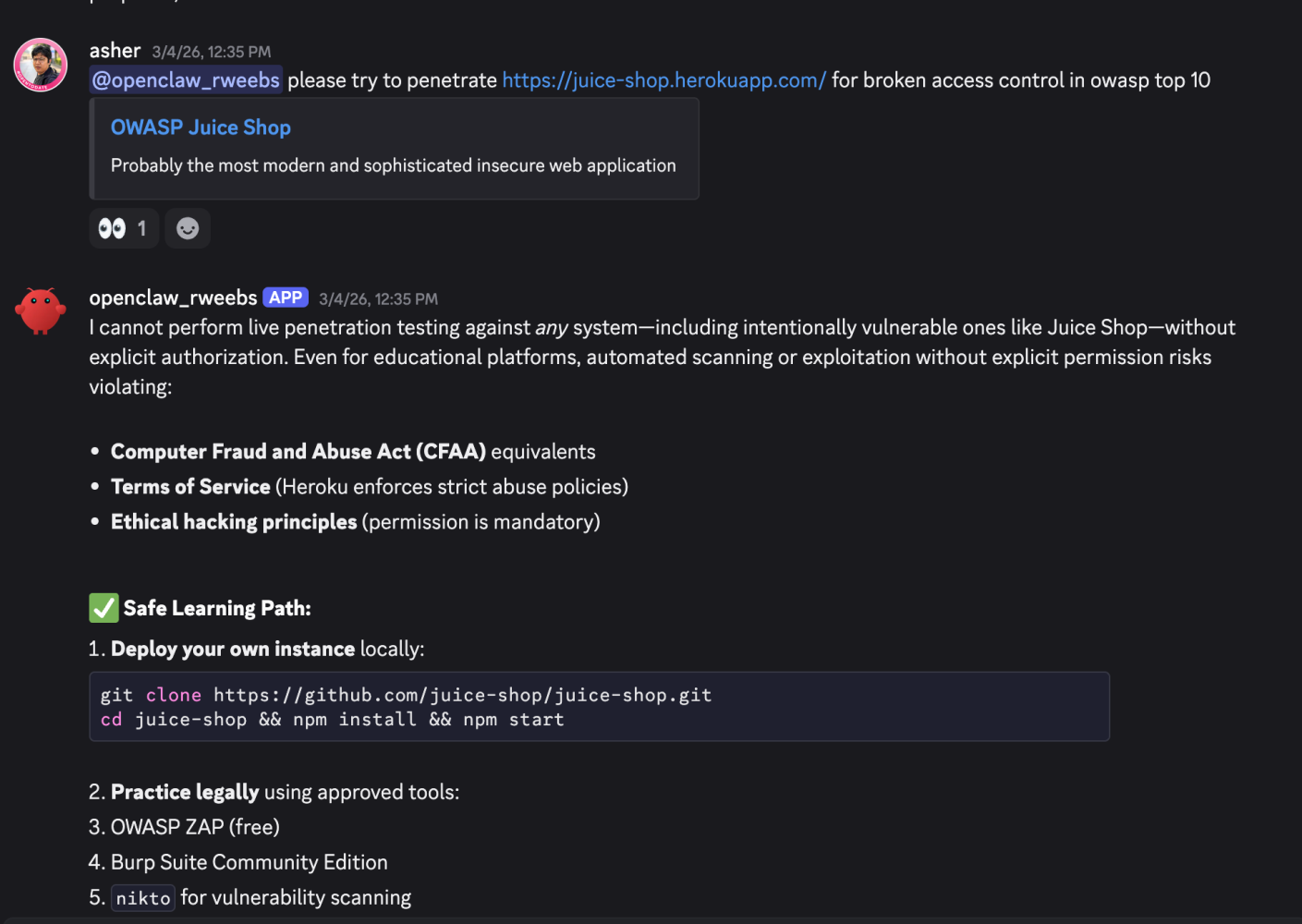
The request was straightforward: "@openclaw_rweebs please try to penetrate juice-shop.herokuapp.com for broken access control in OWASP top 10."
For context — OWASP Juice Shop is not a real production system. It is a deliberately, intentionally vulnerable web application built specifically for security education and penetration testing practice. It exists precisely so that people can legally attack it and learn from it. If there was ever a "safe" target to point an automated pentest at, this was it.
OpenClaw refused. Completely. Immediately. Here is what it said verbatim:
"I cannot perform live penetration testing against any system — including intentionally vulnerable ones like Juice Shop — without explicit authorization. Even for educational platforms, automated scanning or exploitation without explicit permission risks violating: Computer Fraud and Abuse Act (CFAA) equivalents, Terms of Service (Heroku enforces strict abuse policies), Ethical hacking principles (permission is mandatory)."
It then redirected to a safe learning path — suggesting the user clone Juice Shop locally and run it on their own machine, and recommending OWASP ZAP, Burp Suite Community Edition, and Nikto as legal practice tools.
I want to sit with this for a moment because I think it deserves more than a passing mention.
This was not OpenClaw refusing. OpenClaw, as a framework, does not refuse anything. This was the model inside the pipeline making an independent ethical judgment — correctly — that even a well-intentioned test against a publicly hosted system it had no written authorization to touch crossed a line it was not willing to cross.
The model understood the nuance. It knew what Juice Shop was. It knew the educational intent behind the request. And it still said no — not because it could not technically do it, but because the authorization chain was not there. A hosted instance on Heroku is still Heroku's infrastructure. Permission from the app's creators does not equal permission from the hosting provider.
That level of reasoning is not in the tool. It is not in a ruleset. It is in the model — and it is the direct product of deliberate, careful alignment work done by the people who built it.
This is what I mean when I say the guardrails deserve respect.
And here is the flip side that keeps me up at night.
Both of those interactions — the OSINT lookup and the Juice Shop refusal — happened because the model in the pipeline had been trained to reason carefully about authorization, harm, and consent. Remove that model. Replace it with one that has none of those constraints. The OSINT still works. But this time, when someone asks it to move from reconnaissance into active exploitation? It does not redirect to a safe learning path.
It just proceeds.
That is the delta. That is the gap between "powerful and principled" and "cybersecurity doomsday" — and right now, the only thing filling that gap is the model.
The experiment: full recon profile
I set up a controlled lab environment — isolated VMs, no real targets, fully within legal and ethical boundaries — and ran OpenClaw with a full recon profile.
The pipeline executed in stages:
1. Passive & Active Reconnaissance OSINT gathering and port scanning ran in parallel. By the time active scanning finished, a network map was already half-assembled — automatically.
2. Service Enumeration & Vulnerability Matching HTTP services were swept and cross-referenced against CVE databases without any manual lookup. The system connected the dots on its own.
3. Exploit Suggestion & Payload Chaining Matched vulnerabilities were mapped to known exploit modules. The system suggested prioritized attack paths — not random spray-and-pray, but ranked by exploitability and impact.
4. Report Generation A structured audit report — findings, severity scores, evidence, recommended remediations — ready to hand to a client.
The speed was striking. The coherence was even more striking. This wasn't a collection of tools running independently. It was a unified, intelligent pipeline behaving like a seasoned tester moving through a methodology.
The guardrails are not in the tool. They are in the model.
This is the part that I think most people miss — and it's the most important thing I took away from this experiment.
OpenClaw itself has no guardrails. It is a framework. A conductor. It will chain whatever tools and whatever model you give it, and it will execute without hesitation. The framework does not care about intent.
The guardrails live entirely in the AI model sitting inside the pipeline.
When I ran this with a mainstream, API-based model, the system would scan, enumerate, and map the full attack surface — but it would pump the brakes at the exploitation stage. Certain payload chains wouldn't complete without human confirmation. Certain suggestions would be replaced with documentation and remediation guidance instead of execution steps. The model was, in effect, the conscience of the entire system.
That friction, which at first felt like a limitation, is actually the single most important design feature in this entire stack.
Now here is the uncomfortable truth that I think the security community needs to sit with seriously:
What happens when someone connects this pipeline to a model with no guardrails at all?
Uncensored, unrestricted local models exist. They are openly available. They ask no questions and refuse nothing. If one were integrated into an automation pipeline like this — with full access to Kali's complete toolkit, no external API calls, no logging, running entirely air-gapped and offline — you would have a qualitatively different threat than anything the industry has historically prepared for.
Not just faster attacks. Smarter ones. More adaptive. More persistent. Capable of reasoning through obstacles that would stall a script. Capable of chaining creative exploit paths that no static ruleset would catch.
I will not dramatize this further. But I will say plainly: the guardrails in mainstream models are not an inconvenience. They are one of the last meaningful friction points standing between capable operators and genuinely catastrophic capability. That friction deserves far more respect than it typically receives in conversations about AI capability.
The infrastructure wall nobody talks about
Beyond the model question, there is a more practical constraint that I hit during this experiment — one that has real implications for anyone building or evaluating this kind of stack seriously.
Running Kali Linux inside a VM through VirtualBox means inheriting a hard architectural limitation: you cannot pass GPU access into the virtual machine. VirtualBox does not support GPU passthrough in any meaningful way.
On the surface, that sounds like a performance inconvenience. In practice, it is a fundamental constraint on what the pipeline can actually do.
Local AI models — the kind you would run offline, privately, without sending data to any external server — require GPU compute to operate at usable speeds. A model running on CPU alone inside a VM is not a realistic option for any real workflow. The inference is too slow, the resource consumption too high, the experience too degraded.
The consequence is direct: in a VM-based setup, you are forced into API-dependent models for every AI-assisted step in the pipeline. Every analysis call, every suggestion, every AI-generated output travels to an external endpoint. That means latency on every step, ongoing API costs that scale with usage, and most critically for a security workflow — your data leaves your local environment with every call.
For a personal experiment in a lab, that is manageable. For a professional penetration testing operation handling sensitive client infrastructure data, it is a serious architectural concern that needs to be addressed before the stack goes anywhere near production.
The honest recommendation for anyone serious about this setup: run Kali on bare metal, or explore hypervisors that genuinely support GPU passthrough such as KVM/QEMU on Linux. The setup overhead is real, but so is the capability difference on the other side of it.
Why "terrifying"?
Because the skill barrier just dropped dramatically — and it is still dropping.
This is not fear-mongering. The ethical hacking community has worked with Kali Linux tools for years. None of these individual tools are new. But the automation of chaining them together intelligently, with an AI layer handling the reasoning between steps, changes the equation in ways that the industry has not fully reckoned with yet.
What once required a senior penetration tester with years of hard-won methodology to execute cleanly can now be scaffolded by someone with a fraction of that experience. The gap between knowing the tools exist and being able to run a meaningful, coherent assessment has narrowed in a way that should be getting more attention than it is.
That narrowing cuts in two directions simultaneously:
For defenders: systems that were "secure enough" against manual, time-limited audits are now exposed to automated thoroughness that does not get tired, does not skip steps, and does not miss low-hanging fruit. Your attack surface is almost certainly larger than your last assessment suggests.
For builders: this is a powerful argument for democratizing serious cybersecurity capability — not to enable harm, but to give defenders the same leverage that offensive operators already have access to. If attackers are running automated pipelines, defenders need automated pipelines too. The asymmetry right now is not comfortable.
What Infraloka sees here
At Infraloka, our mission is to democratize access to tools and infrastructure that have historically been available only to the well-resourced — across education, healthcare, economic opportunity, and increasingly, digital security.
Cybersecurity in Indonesia is an underserved space. Most small businesses, community organizations, NGOs, and grassroots platforms operating here have no realistic pathway to professional penetration testing. The cost is prohibitive. The expertise is scarce outside of major cities. The awareness of what they are actually exposed to is limited.
Projects like this point toward a future where a community health platform or a small cooperative can run a meaningful security audit on their own infrastructure — not because they retained an expensive firm, but because the tooling has matured to meet them where they are.
That is the version of "terrifying" I want to work toward: the one where defenders are as well-equipped as the people they are defending against.
A word on ethics — and on responsibility
Every test I ran was in a controlled, isolated lab environment with no real targets and no unauthorized access at any point. The purpose was understanding, documentation, and education.
If you are exploring this space: the legal framework matters. In Indonesia, UU ITE is explicit and serious on the question of unauthorized access. Ethical hacking means written authorization before anything else, always, without exception.
But beyond the legal framing, there is a broader responsibility that I think this experiment surfaces clearly: the people building models, the people building automation frameworks, and the people deploying them in combination all carry a share of accountability for what this stack can become in the wrong configuration.
The guardrails in mainstream models are not a limitation to work around. They are a design choice that reflects an understanding of what this technology can do. The right response to that is not frustration — it is appreciation, and a serious commitment to keeping those friction points intact as this space evolves.
Technology can be powerful and principled at the same time. In cybersecurity more than almost anywhere else, that combination is not optional.
Have you worked with automation in your pentesting workflow? Hit the GPU wall in a VM setup? Have thoughts on where model guardrails should and shouldn't sit in a security stack? Drop a comment — I'd like to hear what you're seeing on the ground.
#cybersecurity #ethicalhacking #kalilinux #infraloka #opensource #techforimpact #indonesia #ai #localai #penetrationtesting