
Imre Nagi and the Personal Blacklist Comparison: Airing a Private Dispute Versus Keeping a List
In my critique of Imre Nagi's post I wrote "Same as a personal blacklist". This post says what I meant. I compare the effect of two public acts. I do not suggest that Imre Nagi and Ibrahim Arief are connected. It is my opinion, not a finding by any court.
Other posts in this series: the X post of 22 November 2026, the LinkedIn post and how the two are linked, my critique, translated and right of reply.
The comparison I made
My critique says the person "does not have to be punished by having their fault known to everyone. Same as a personal blacklist." The personal list I had in mind is the one Ibrahim Arief (@ibamarief) wrote about on X, which I set out in his posts of 1 October 2023 and 24 August 2024.
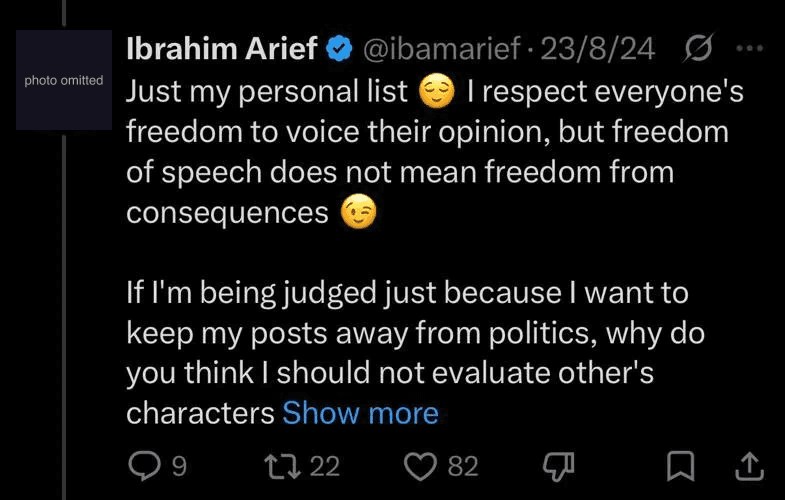
This capture shows another post from the same account, dated 23/8/24, which I read as 23 August 2024. It is cut off at "Show more", with 9 replies, 22 reposts and 82 likes. The visible text reads:
Just my personal list 😌 I respect everyone's freedom to voice their opinion, but freedom of speech does not mean freedom from consequences 😉
If I'm being judged just because I want to keep my posts away from politics, why do you think I should not evaluate other's characters
A post from another account sits below it in the original capture. I do not reproduce it. I also cover the photo.
What the two share
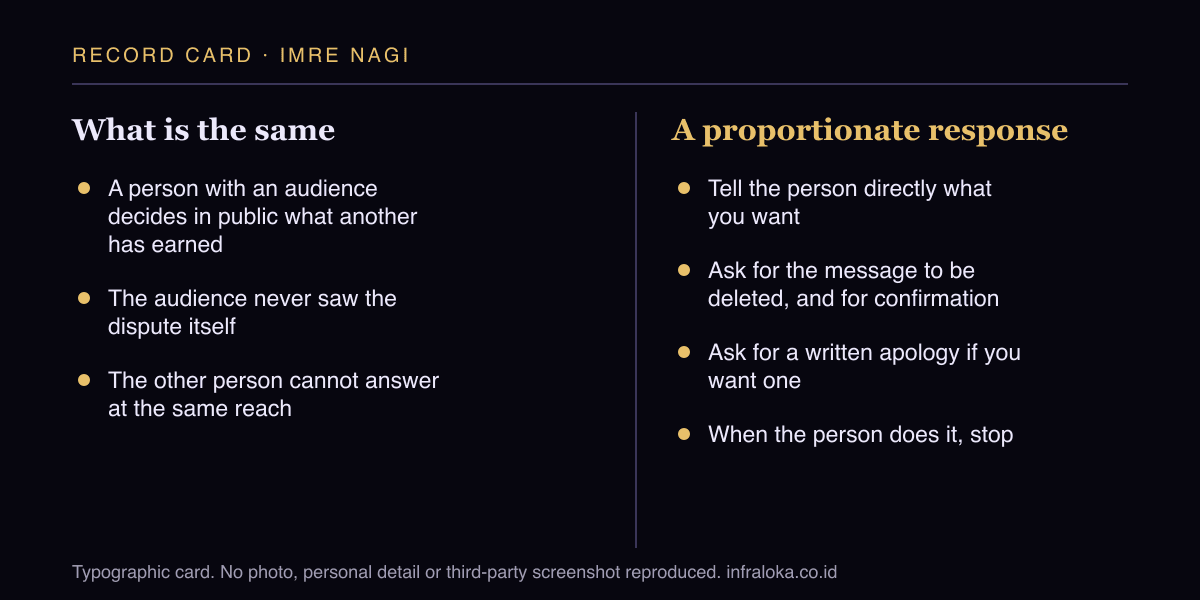
- A voice with an audience announces a consequence in public. In one case the consequence is a place on a list. In the other it is a description of a person as sulking and maneuvering.
- The audience cannot see the dispute. Readers get one side, and they cannot test it.
- The person described cannot answer at the same reach. A reply from a private person does not travel as far as a post from an account with tens of thousands of followers.
A proportionate response, in my reading
For someone whose contact was shared in a group without consent:
- Tell the person directly what you want.
- Ask them, or the group's admin, to delete the message, and ask for confirmation.
- Ask for a written apology if you want one.
- If it happens again, tell the program or event organizer.
- Keep screenshots in case you need them.
- Decide beforehand what would be enough. When the person does it, stop.
The LinkedIn author says the message was withdrawn and an apology was made twice, which covers steps 2 and 3. A public post goes further than those steps need. I have written about lists of this kind in general in whether a permanent never-hire list is legal and ethical in Indonesia and what fair process looks like when a candidate is rejected.
Right of reply and correction policy
Imre Nagi is invited to answer the comparison. A substantive response may be published alongside this article, subject to reasonable editing for privacy, safety and relevance. If reliable evidence shows a factual statement here is wrong, I will correct it promptly and note the change.
Published by Rahmat Wibowo at InfraLoka: infraloka.co.id
#ProfessionalBlacklist #ImreNagi #PersonalBlacklist #NeverHireList #FairRecord