
Indonesia Is Sitting on a Gold Mine It Cannot Read By Rahmat Wibowo From Infraloka
Why the largest archipelago on Earth keeps exporting raw materials instead of research-backed products, and what executives, universities, and tech companies must do to change that.
The Opening Argument
New Zealand turned a "worthless scrubby bush" into a billion-dollar export. Indonesia is still selling the same raw honey in bulk.
In 1980, a jar of Manuka honey sold for 200 in luxury shops from Tokyo to London. New Zealand exports over 1 billion.
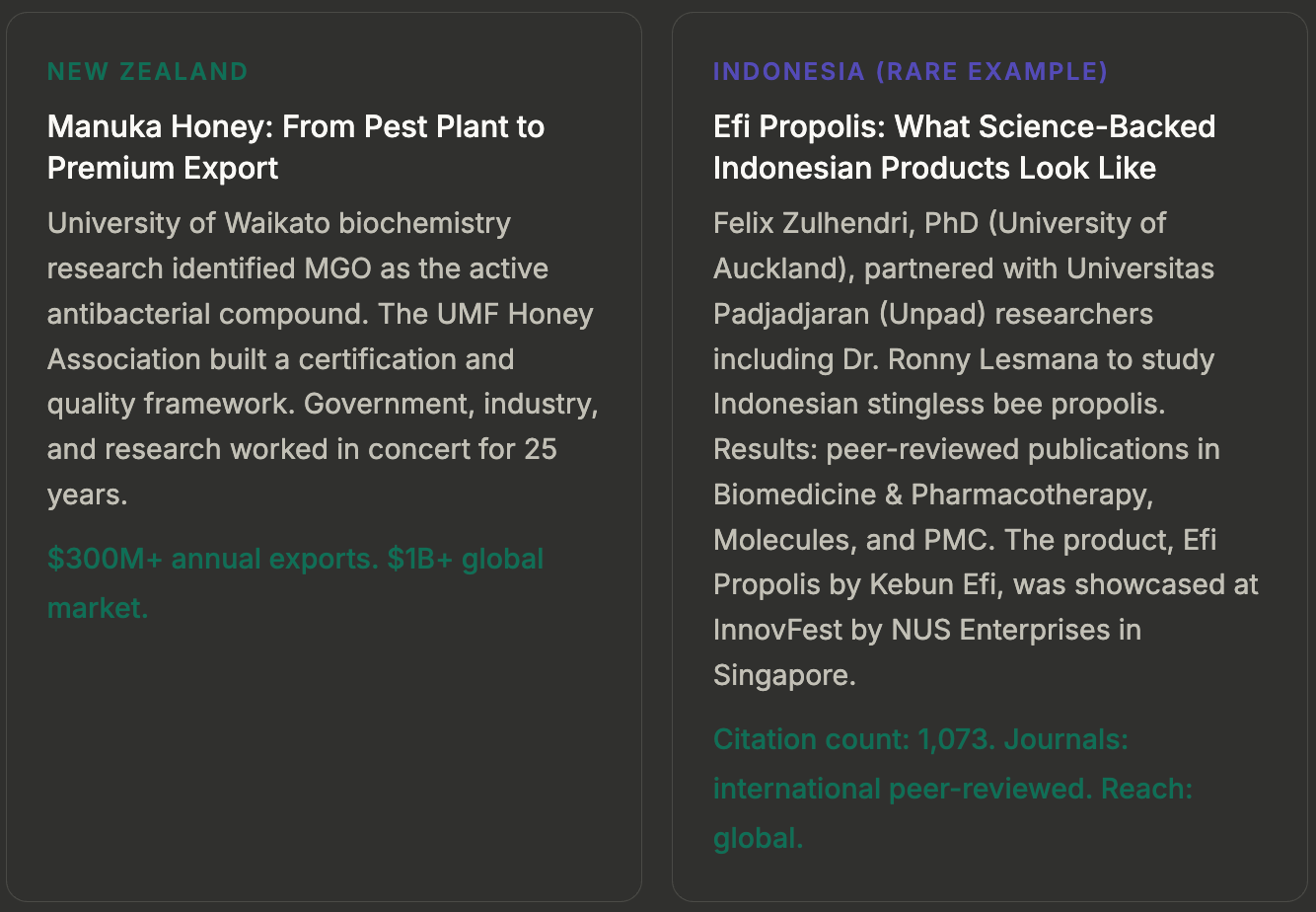
One professor. One research center. One compound identified, measured, and quantified. That is all it took to transform a pest shrub into New Zealand's most valuable natural export.
Indonesia has 17,000 islands. The world's second-largest tropical rainforest. The most biodiverse marine ecosystems on the planet. A climate that produces stingless bees whose propolis is pharmacologically distinct from anything found in Europe or East Asia. And we are still, largely, exporting raw materials while other nations process, certify, brand, and sell them back to us at 40x markup.
"The gap is not in our natural resources. The gap is in the bridge between our laboratories and our markets."
The Numbers That Should Embarrass Every Executive in the Room
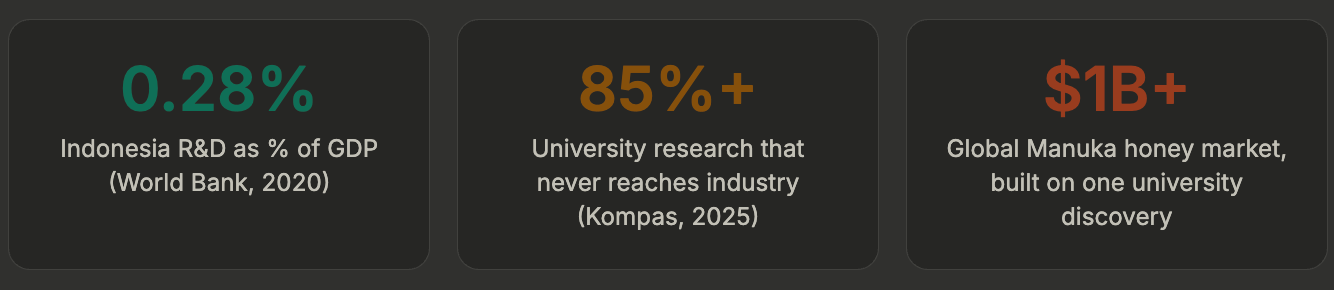
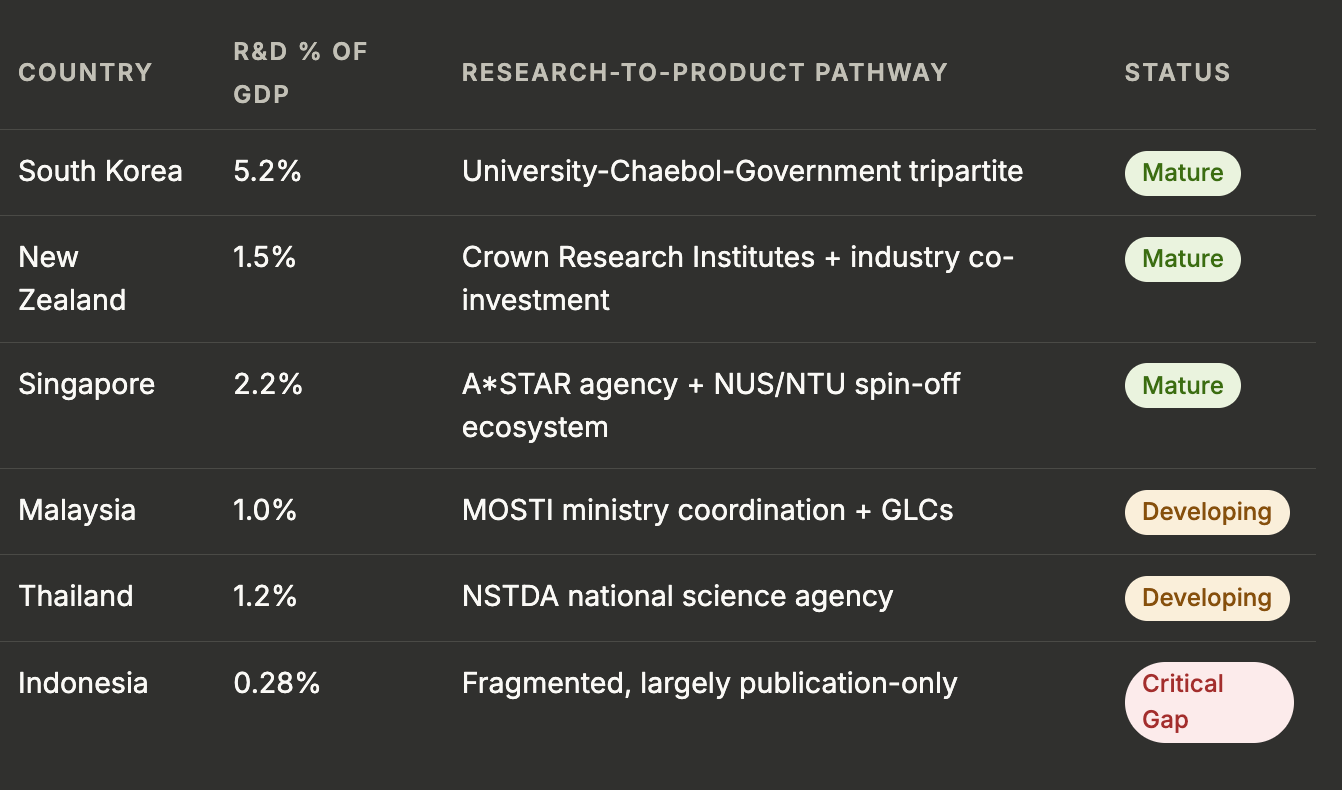
Indonesia spends 0.28% of GDP on R&D. The ASEAN average is 0.84%. South Korea spends 5.2%.
Let that comparison land. South Korea was poorer than Indonesia in the 1960s. The policy divergence on research investment is a major explanatory variable for why one country now sells semiconductors, K-beauty, and BTS merchandise to the entire world, while the other debates whether to build another nickel smelter.
More damning is what happens to the research that does get produced inside Indonesia's universities. According to a 2025 Kompas analysis citing the Ministry of Higher Education, over 85% of university research stops at the publication or prototype level and is never adopted by industry. The root cause is not laziness. It is structural: there are no effective bridges between academia and industry. Publications are career incentives for academics. Industry partnerships require time with little promise of promotion. The incentives are misaligned by design.
Case Studies: What Proof of Concept Looks Like
Two countries. Two products. Both built on rigorous science. Only one built by Indonesia.
Indonesia (The Norm)
The Jamu Problem: Pseudo-Science Dressed as Tradition
For every Efi Propolis, there are thousands of products built on what I will bluntly call "ilmu tukang jamu" - the science of mixing things together without rigorous clinical evidence, pharmacological grounding, or repeatable methodology. These products borrow the cultural authority of Jamu but strip it of what would make it globally credible: standardized extraction, bioavailability data, peer-reviewed efficacy trials, and a defensible IP position. This is not an attack on Indonesian traditional medicine. Jamu has real pharmacological potential. But potential is not proof. And in a global market where South Korean and German cosmeceuticals carry clinical trial data, blending turmeric with honey without a research protocol is not a product strategy. It is wishful thinking with a label.
Structural Diagnosis
Why Indonesian university research stays in journals instead of factories
Brawijaya University in Malang is a rare exception worth celebrating. It has partnered with 13 companies across beauty, health, and telecommunications, and is commercializing the Pamugas Firewall (a locally developed cybersecurity system) and Boumi, a beauty product made from corn fiber. The Minister of Higher Education Brian Yuliarto has publicly called for research outcomes to advance to the industrial stage and replace imported goods. This is the right direction. But one university's example does not a national ecosystem make.
The structural problems are well-documented in academic literature. Indonesian universities increasingly measure academic performance by publication count, making industry collaboration low-priority work for individual researchers. There are no significant national intermediaries, analogous to New Zealand's Crown Research Institutes or Singapore's A*STAR, that explicitly exist to translate research into commercial products. Private sector R&D investment is almost absent. And crucially, intellectual property law training and enforcement at the university level is too weak to give researchers and companies confidence in joint commercialization agreements.
"Despite universities' capacity to make innovation, they do not have experts when it comes to product commercialization." - Prof. Ainun Na'im, Ministry of Research and Technology/BRIN, Universitas Gadjah Mada collaboration launch.
Indonesia is a consumer of innovation rather than an originator. Indonesia's manufacturing sector has fallen from 25-30% of GDP in the 2000s to roughly 10% today. This deindustrialization is directly linked to the failure to build knowledge-intensive industries grounded in domestic research. We are not losing because we lack raw materials or human talent. We are losing because we have not built the institutional bridges that turn science into products and products into exports.
A Direct Call to Indonesian Executives, Rectors, and Policymakers
- Build co-located research centers, not MoUs. A memorandum of understanding without a physical lab, a funded research chair, and a commercialization mandate is a photo opportunity. New Zealand's Manuka industry did not emerge from a signing ceremony. It emerged from a biochemist spending years in a lab at Waikato. Fund the lab, not the press release.
- Change the incentive structure for academics. If the promotion pathway rewards publications and penalizes time spent on industry work, you will always get publications and no products. Reform the Tri Dharma assessment criteria to weight commercialization outcomes, technology transfer deals, and spin-off creation alongside journal output.
- Demand evidence, not tradition, as the product claim. Indonesian biodiversity is an extraordinary asset: stingless bee propolis, temulawak, mangrove bioactives, noni, marine microorganisms. None of these need pseudo-scientific marketing. They need rigorous extraction protocols, bioavailability studies, and clinical trial data. What Felix Zulhendri built with Unpad for propolis, we can replicate across dozens of Indonesian natural compounds with international scientific credibility.
- Partner with technology infrastructure companies, not just science labs. Research-backed products in 2026 require AI-assisted discovery, computational pharmacology, cloud-scale genomics databases, and digital supply chain certification. Companies like Infraloka exist precisely to provide this infrastructure to Indonesian researchers and enterprises who cannot afford hyperscaler complexity. A campus-industry collaboration today is not a beaker and a boardroom. It is cloud compute, AI pipelines, and open-source research tooling sitting inside a university's research center.
- Create a national research-product pipeline with export ambition from day one. Indonesia discovered 19 new species of plants and animals in 2025 alone. These are not curiosities. They are potential pharmaceutical leads, cosmetic actives, and agricultural innovations that, with proper IP protection and research infrastructure, could launch globally competitive products within a decade. The window is closing. As Indonesia's forests shrink, so does the biodiversity that makes our research uniquely differentiated.
What a research-backed Indonesia actually looks like
It is not radical. It is not even expensive relative to what we already spend on roads. It is a network of campus-anchored research centers, each co-invested by industry, with explicit mandates to take natural Indonesian resources from lab to licensed product within five years. It is a cadre of researchers who are incentivized to file patents and sign licensing agreements, not just submit papers. It is infrastructure companies providing the compute, the data pipelines, and the AI tools that compress the discovery cycle from decades to years.
Efi Propolis reaching InnovFest in Singapore in 2024 is proof that the talent exists. Felix Zulhendri is Indonesian. The bees are Indonesian. The research methodology came from rigorous academic training, not from tradition alone. The product is competitive on a global stage. That story should be replicated ten thousand times across our islands, not treated as an inspirational exception.
New Zealand has 5 million people and turned one shrubby plant into a billion-dollar category. Indonesia has 280 million people, the world's greatest biodiversity, and centuries of ethnomedical knowledge waiting to be validated by science. The question is not whether Indonesia has the raw material for world-class research products. The question is whether Indonesian executives, rectors, and policymakers have the will to build the bridges that turn that raw material into something the world will pay for.
What Infraloka is doing about this
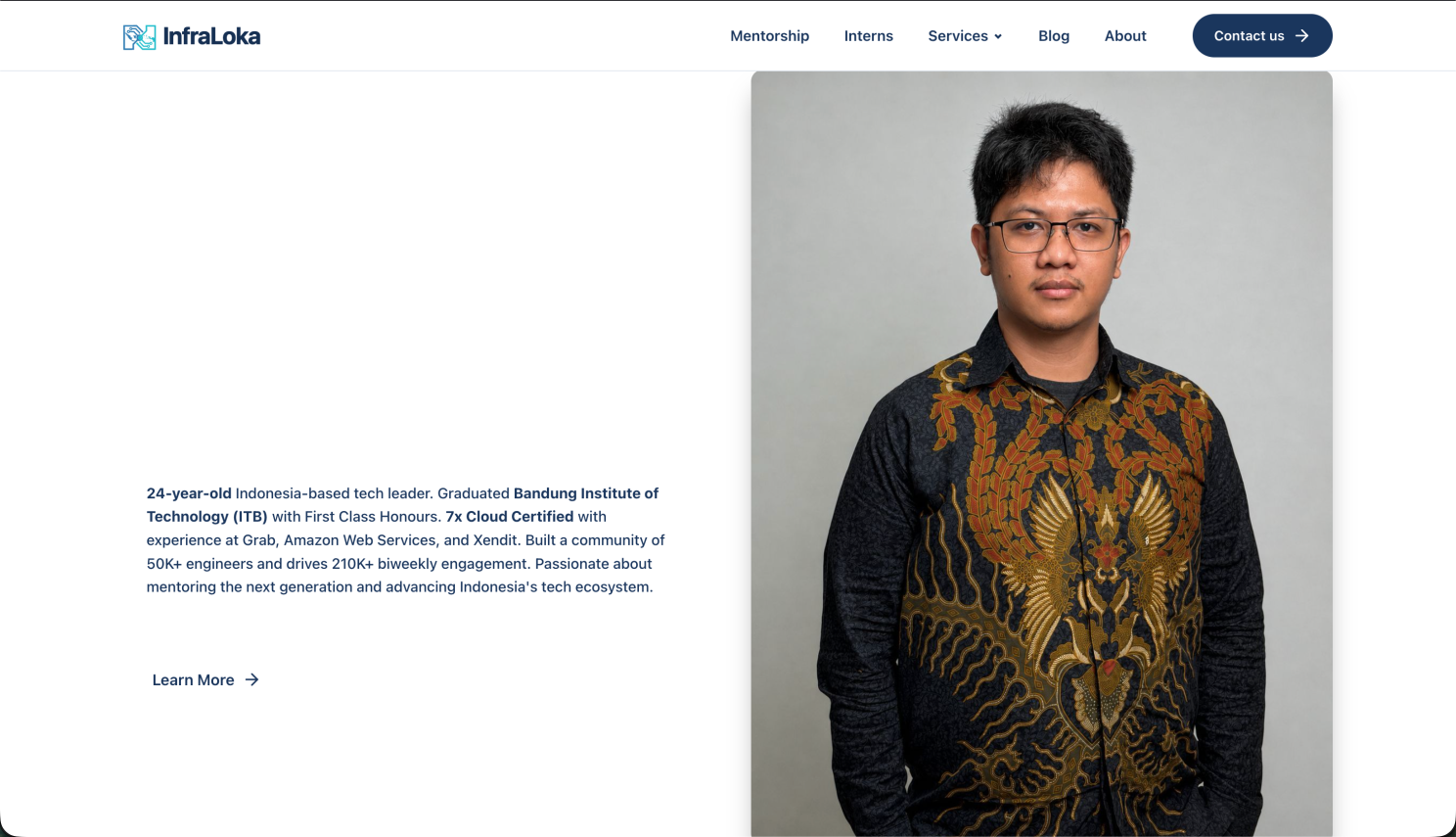
InfraLoka (PT Infrastruktur Digital Nusantara) is actively seeking partnerships with Indonesian universities and research institutions to provide cloud infrastructure, AI tooling, and digital systems for research-to-product pipelines. We believe that democratizing access to research infrastructure is as important as democratizing access to education or healthcare.
If you are a rector, a research director, a biotech founder, or a corporate executive who wants to build Indonesia's first genuinely scalable research-product ecosystem, reach out. The Manuka moment for Indonesian biodiversity is available. It just needs an architecture.
References
[1] Kompas.id (December 2025). "Academics and Industry Join Hands to Bridge the Research Commercialization Gap." Ministry of Higher Education, Science, and Technology, Director General Fauzan Adziman. kompas.id
[2] ANTARA News (October 2025). "Campus-Industry collaboration opens market access for research." Minister Brian Yuliarto, Brawijaya University. antaranews.com
[3] ScienceDirect (March 2025). "Bridging the gap: Indonesia's research trajectory and national development through a scientometric analysis using SciVal." sciencedirect.com
[4] NZ Bees (November 2025). "The Export Phenomenon: How a Native NZ Shrub Became a Billion-Dollar Industry." University of Waikato, Peter Molan; Thomas Henle MGO identification 2008. nzbees.nz
[5] UMF Honey Association (2025). "UMF Manuka Honey Research Database." Ongoing international research programme. umf.org.nz
[6] Unpad.ac.id (April 2025). "Unpad dan Kebun Efi Luncurkan Dua Produk Hasil Kolaborasi Riset." unpad.ac.id
[7] Unpad.ac.id (June 2024). "Produk Inovasi Unpad 'Efi Propolis' Tampil di Ajang InnovFest di Singapura." NUS Enterprises. unpad.ac.id
[8] Zulhendri F. et al. (2022). "The Potential Use of Propolis as a Primary or Adjunctive Therapy in Respiratory Tract-Related Diseases." Biomedicine & Pharmacotherapy. doi:10.1016/j.biopha.2021.112595. Kebun Efi / Universitas Padjadjaran.
[9] Zulhendri F. et al. (2021). "Antiviral, Antibacterial, Antifungal, and Antiparasitic Properties of Propolis: A Review." PMC. pmc.ncbi.nlm.nih.gov
[10] World Bank Development Indicators. "Research and Development Expenditure (% of GDP) - Indonesia." Last updated 2020: 0.28068%. data.worldbank.org
[11] Lowy Institute Asia Power Index. "R&D Spending (% of GDP)." South Korea 5.2%, Singapore 2.2%, New Zealand 1.5%, Indonesia 0.3%. power.lowyinstitute.org
[12] IFG Progress (December 2023). "ASEAN must nurture growth at epicenter." ASEAN R&D average 0.84% of GDP; Indonesia manufacturing share declining from 25-30% to 10%. ifgprogress.id
[13] ResearchGate. "University, Industry, and Government Partnership: Its Present and Future Challenges in Indonesia." Gap between universities and industry continues to widen. researchgate.net
[14] UGM SDGs Center (2019). "UGM Establishes University Research Collaboration for Indonesia." Prof. Ainun Na'im, BRIN Secretary, on commercialization gap. ugm.ac.id
[15] PlantYourTip (August 2025). "Indonesia's Remarkable Discovery: 19 New Species Unveiled." Ministry of Forestry, Nature Conservation Day 2025. plantyourtip.com
[16] NCM/PMC (2024). "Characteristics of Indonesian Stingless Bee Propolis and Study of Metabolomic Properties." Universitas Indonesia / BRIN. ncbi.nlm.nih.gov
#Indonesia #Research #Innovation #UniversityIndustry #FoodScience#Biotech #ResearchCommercializaton #SciencePolicy #Infraloka #Propolis #ManukHoney #NaturalProducts #ASEAN #Biodiversity #TechTransfer #DeepTech #StartupIndonesia #HigherEducation #LeadershipInAction #RDPolicy