
Kepercayaan Asli Nusantara: Indigenous Belief and the Indonesian Identity Card By Rahmat Wibowo From InfraLoka
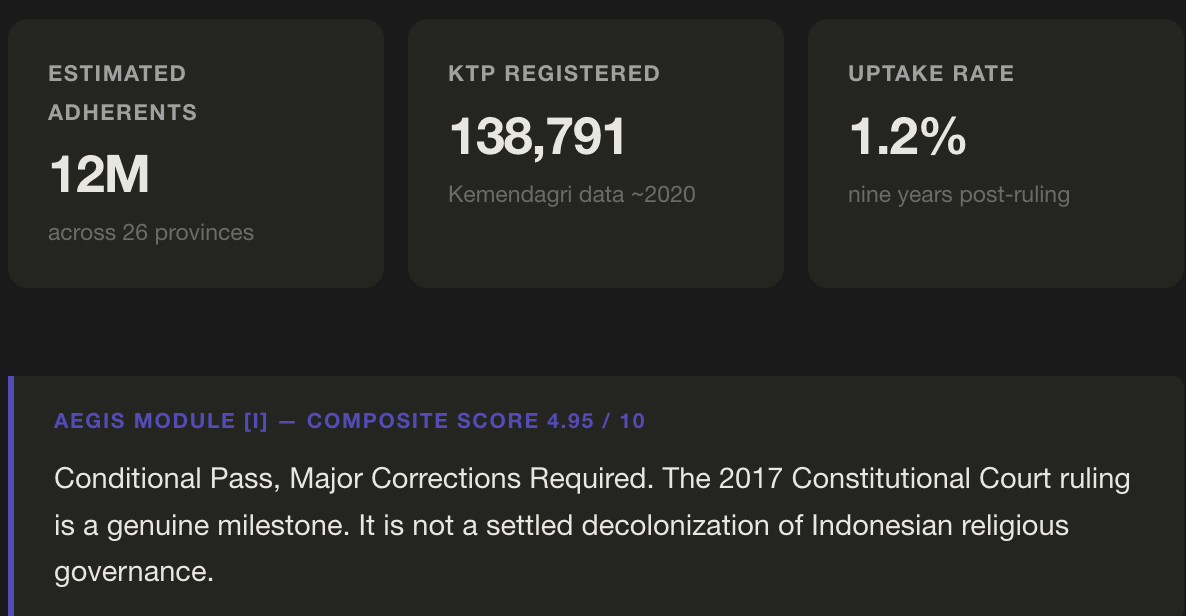
Twelve million Indonesians follow indigenous spiritual traditions. Nine years after a landmark Constitutional Court ruling, only 138,791 have obtained legal recognition on their national ID — a 1.2 percent uptake rate. This report traces how that gap was built, and what it will take to close it.
The central finding
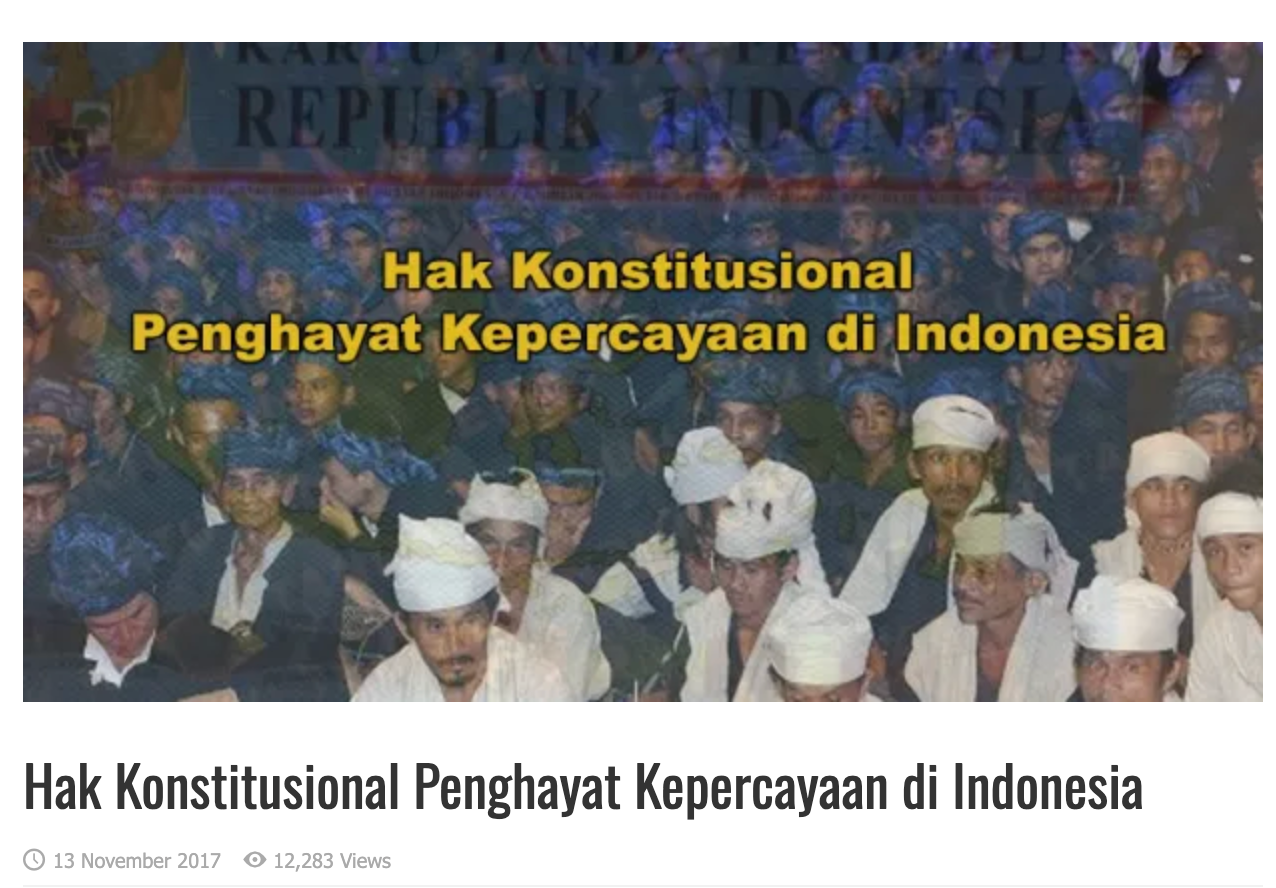
Since July 1, 2018, Indonesian national identity cards (KTP) may carry the entry “Penghayat Kepercayaan terhadap Tuhan Yang Maha Esa” for followers of indigenous spiritual belief traditions. This became legally operative through Putusan MK No. 97/PUU-XIV/2016 (November 7, 2017) — a landmark Constitutional Court ruling that ended seven decades of administrative statelessness for kepercayaan adherents.
The milestone has not translated into administrative reality. The gap between 12 million estimated believers and 138,791 registered individuals constitutes the defining failure of kepercayaan governance in contemporary Indonesia — not primarily a story of prejudice, but of institutional design failure: an unfunded mandate imposed on civil registry offices without the resources to implement it.
The governing legal architecture rests on four instruments: UUD 1945 Pasal 28E and Pasal 29(2); UU No. 23/2006 on Population Administration (as amended by UU No. 24/2013); Putusan MK No. 97/PUU-XIV/2016; and Permendagri No. 118/2017. Together they created a right that 98.8 percent of its intended beneficiaries cannot access.
“The colonial-era four-criteria framework for what counts as a ‘religion’ — monotheism, scripture, a prophet, international recognition — remains the operative architecture of Indonesian law in 2026.”
The six traditions
Indonesia’s kepercayaan landscape spans the archipelago. These are the six most significant traditions by population and legal visibility. Population figures are lower bounds: strategic misrepresentation on official documents has systematically undercounted the true population for decades.
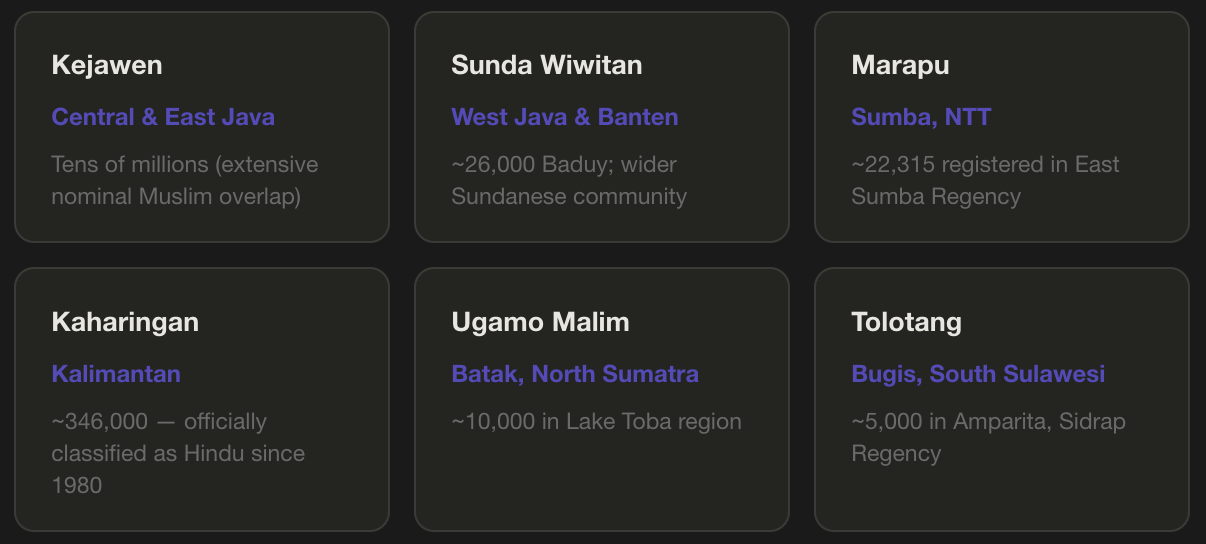
The Directorate of Belief in God Almighty and Indigenous Communities (Kemendikbud) recognizes 177 registered penghayat organizations with approximately 1,000 branch-level organizations across 17 provinces. These represent only those communities that have successfully navigated a complex bureaucratic registration process — not the full breadth of kepercayaan practice in Indonesia.
Colonial roots of the agama / kepercayaan binary
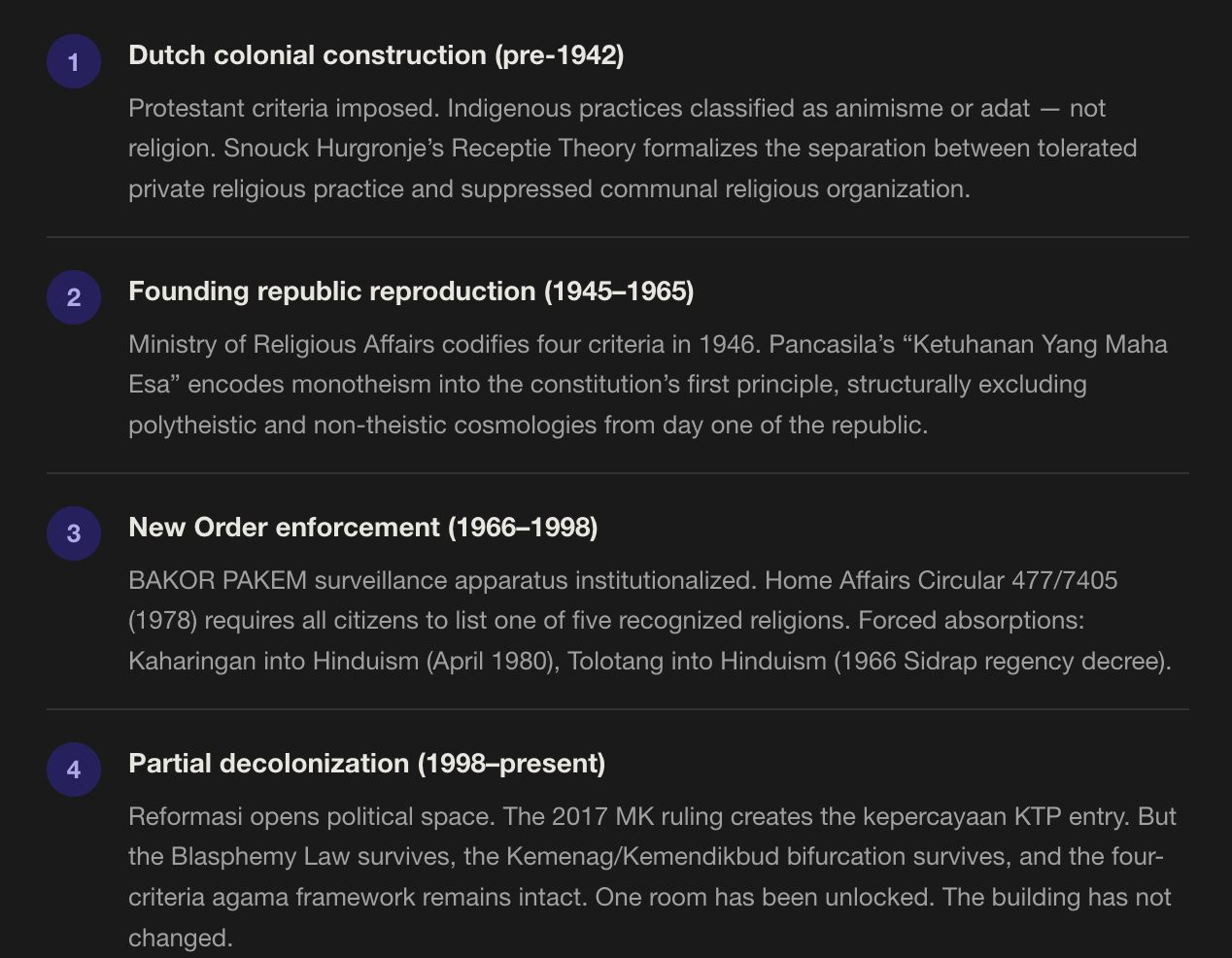
The divide between agama (religion) and kepercayaan (belief) is not indigenous to Indonesia. It is a colonial inheritance. Dutch administrators, drawing on European Protestant epistemology, required four criteria for a practice to qualify as a “religion”: monotheism, a revealed scripture, a founding prophet, and international institutional recognition. Traditions that failed these tests were classified as animisme or adat — custom, not religion.
The intellectual architecture was formalized by Christiaan Snouck Hurgronje and Cornelis van Vollenhoven at Leiden University. Their frameworks survived the 1945 proclamation of independence, were reproduced wholesale into the new republic’s Ministry of Religious Affairs (established January 1946), and were then weaponized by the Suharto New Order into an active suppression apparatus.
The 2017 Constitutional Court ruling
Case: Putusan Mahkamah Konstitusi No. 97/PUU-XIV/2016. Date: November 7, 2017. Panel chair: Chief Justice Arief Hidayat.
The petition was filed by four kepercayaan adherents from across the archipelago: Nggay Mehang Tana (Marapu, NTT), Pagar Demanra Sirait (Parmalim, Batak), Arnol Purba (Ugamo Bangsa Batak), and Carlim (Sapto Darmo, Javanese). Their deliberate geographic diversity was strategic — demonstrating that the blank-KTP problem was national, not merely Javanese.
The Court held that the word “agama” in the Population Administration Law is conditionally unconstitutional insofar as it does not include “kepercayaan.” Disdukcapil offices became legally required to enter “Penghayat Kepercayaan terhadap Tuhan Yang Maha Esa” for adherents who request it. Permendagri No. 118/2017 followed within two months. Operative date: July 1, 2018.
What the ruling did NOT decide
It did not equate kepercayaan with agama. It did not strike down the Blasphemy Law (UU No. 1/PNPS/1965). It did not create a marriage registration pathway. It did not mandate a national kepercayaan curriculum in public schools. It imposed no penalties on Disdukcapil offices that refuse to comply.
The implementing regulation (Permendagri No. 118/2017) created a three-step process — Dinas Kebudayaan, then Kesbangpol, then Disdukcapil — that imposes a burden with no equivalent for recognized religion adherents. The organizational membership requirement means individual practitioners outside registered penghayat organizations have no administrative pathway at all.
Implementation reality, 2017–2026
Nine years after the operative date, the central empirical finding is stark.

Root causes of the implementation gap
The gap is not primarily explained by individual prejudice. Four structural mechanisms drive it: fear of discrimination in employment, marriage registration, and education enrollment; bureaucratic friction from the three-step registration process; organizational gatekeeping that excludes the majority of Kejawen practitioners who belong to no formal association; and Pemda fiscal reality — Permendagri No. 118/2017 imposed an unfunded mandate on local civil registry offices with no Dana Alokasi Khusus (DAK) transfer to fund implementation.
Regional distribution (Central Java, 2025)
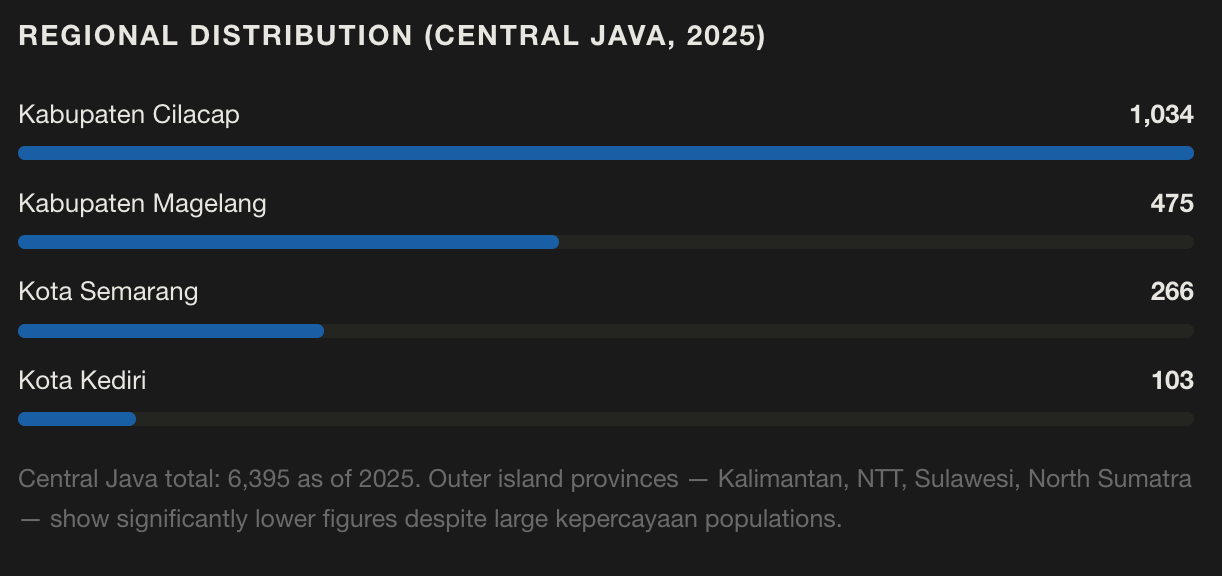
Central Java total: 6,395 as of 2025. Outer island provinces — Kalimantan, NTT, Sulawesi, North Sumatra — show significantly lower figures despite large kepercayaan populations.
“SETARA Institute recorded 260 incidents and 402 acts of religious freedom violation in 2024. Blasphemy prosecutions spiked from 15 cases in 2023 to 42 cases in 2024 — a 180 percent increase in one year. The trend is moving in the wrong direction.”
AEGIS Module [I] adversarial assessment
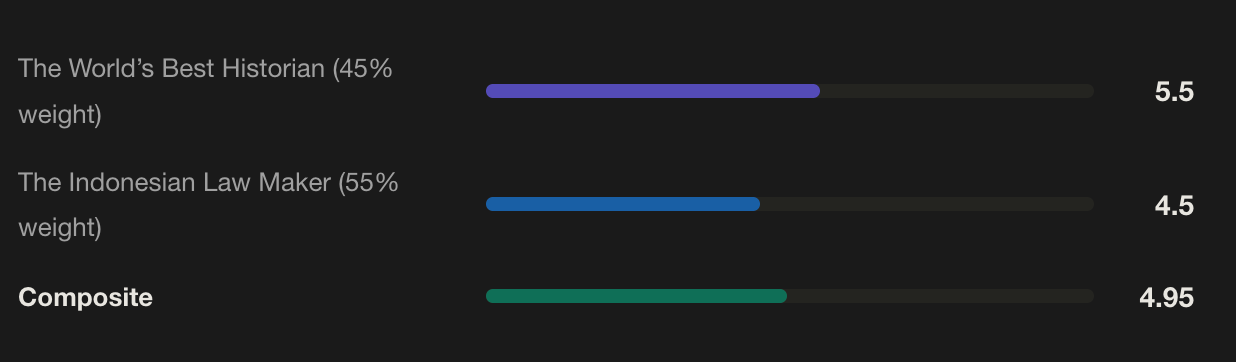
Two adversarial personas evaluate the current state of kepercayaan governance. The Historian evaluates historical framing and colonial legacy acknowledgment. The Law Maker evaluates legal implementation gaps against the Constitutional Court’s mandate.
Verdict
Conditional Pass — Major Corrections Required. The framework for kepercayaan recognition exists and represents a genuine constitutional advance. But it has produced 1.2 percent uptake in nine years against a backdrop of increasing religious intolerance. The historical colonial structure remains architecturally intact.
The Historian’s core finding: the 2017 ruling adds “Penghayat Kepercayaan” as a seventh administrative category beneath the six recognized agama, managed by a different ministry, with different legal consequences and a more burdensome registration process. The four-criteria framework that Dutch colonial administrators constructed and the 1946 Ministry of Religious Affairs codified remains operative. True decolonization would require repealing the Blasphemy Law, dissolving the Kemenag/Kemendikbud bifurcation, and creating a rights framework that does not require organizational membership to access individual civil rights.
The Law Maker identifies nine implementation gaps, with two triggering automatic score-cap rules: no comprehensive PP on kepercayaan marriage registration (score capped at 5.5 before further deductions), no national education curriculum for kepercayaan students, no Disdukcapil penalty mechanism, and no government monitoring obligation. The Module [I] Pemda Fiscal Reality Rule predicts non-compliance rates exceeding 60 percent for unfunded mandates. The 1.2 percent uptake data is consistent with this prediction.
Comparative context
Indonesia’s experience with indigenous belief recognition is not unique in Southeast and South Asia. The comparison is constrained to states sharing at least two of three structural variables: a colonial history that imposed a European religious classification framework; an ID card system that includes a religion field; and a post-independence state that defines its national identity partly through religious terms.
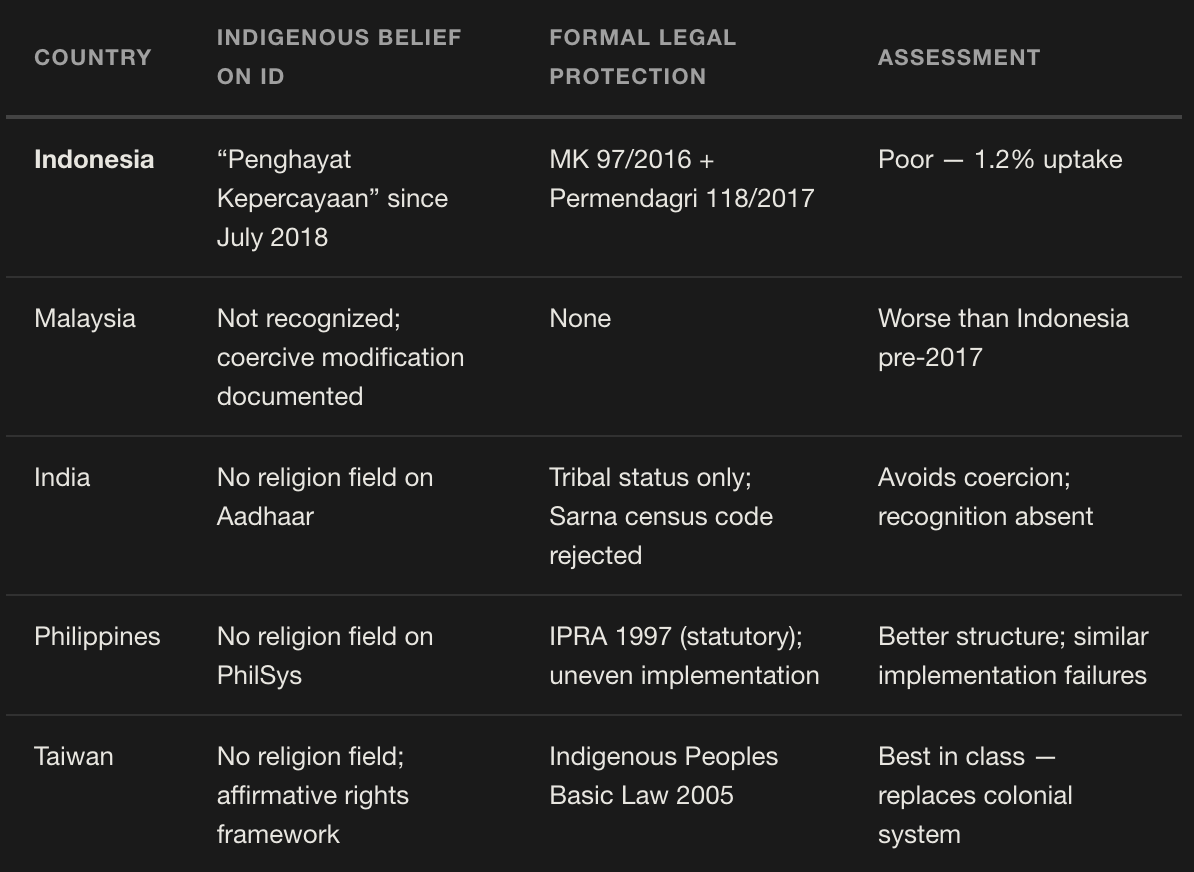
Indonesia’s 2017 ruling represents a genuine advance over Malaysia’s framework. Taiwan’s model — which replaces the colonial classification system rather than operating within it — is the aspirational endpoint rather than a directly applicable comparator.
The 2026 legislative threat vector
On April 7, 2026, Minister of Human Rights Natalius Pigai proposed to DPR Komisi XIII a RUU Kebebasan Beragama (Bill on Religious Freedom). The terminology is not semantic. “Kebebasan beragama” (religious freedom) implies a negative liberty framework in which kepercayaan would logically be included as a protected category. “Perlindungan umat beragama” (protection of religious communities) — the framing preferred by Ministry of Religious Affairs aligned parties — implies a positive framework in which the legislature decides which communities are protected, historically meaning only the six recognized agama.
The DPR has expressed significant opposition to the Pigai proposal. An earlier draft RUU Perlindungan Umat Beragama from 2011 has never moved to enactment — a 15-year history of non-advancement that illustrates the structural legislative barrier. As of June 2026, the bill remains in the proposal and early discussion phase.
Recommendations
2026–2027
Kemendagri service level agreement circular
14-working-day maximum for kepercayaan KTP requests, prohibition on additional documentation beyond Permendagri No. 118/2017, and an administrative complaint mechanism. Responsible: Menteri Dalam Negeri. Timeline: 60 days.
2026–2027
Kemendikbud penghayat registry expansion
Extend the registry to regional and community-level associations, prioritizing outer island provinces: Kalimantan, NTT, Sulawesi, North Sumatra. Responsible: Direktur Kepercayaan terhadap Tuhan YME dan Masyarakat Adat. Timeline: 6 months.
2026–2027
Annual monitoring report to DPR Komisi VIII
Mandatory joint Kemendagri/Kemendikbud annual report on KTP uptake by province, marriage registration incidents, education access incidents, and discrimination complaints. Timeline: 12 months for first report.
2027–2029
PP on kepercayaan marriage registration with DAK mechanism
Government Regulation establishing kepercayaan marriage as a separate civil event category administered by Disdukcapil, with Dana Alokasi Khusus transfers to fund Pemda implementation capacity. Responsible: Presiden/Menko Polhukam, lead ministry Kemendagri. Timeline: 24 months.
2027–2029
National kepercayaan curriculum (Pendidikan Kepercayaan)
Equivalent institutional support to Pendidikan Agama. Pilot curriculum 24 months; national rollout 48 months. Responsible: Dirjen Pendidikan Dasar dan Menengah, Kemendikbud.
2027–2029
Amend Permendagri to clarify individual rights
Organizational membership should be a facilitative mechanism, not a prerequisite. Individuals who can demonstrate kepercayaan practice without organizational membership should have an alternative pathway. Timeline: 6 months.
2029–2035
RUU Kebebasan Beragama with kepercayaan inclusion
Support the “kebebasan” framing proposed by Menteri HAM Pigai. Explicit kepercayaan protection, civil registration rights for kepercayaan marriages, and an enforcement mechanism. Requires a DPR coalition transcending Kemenag-affiliated bloc resistance. Timeline: 36–60 months.
2029–2035
Blasphemy Law review (ICCPR compatibility)
Joint Komnas HAM / Menkumham review of UU No. 1/PNPS/1965 against Indonesia’s ICCPR Article 18 obligations and post-2017 Constitutional Court Pasal 28E jurisprudence. Timeline: 36 months.
2029–2035
2030 national census category reform
Introduce a separate kepercayaan enumeration category in the 2030 census, replacing the practice of absorbing kepercayaan adherents into recognized religion categories. Without accurate population data, evidence-based policy design is impossible. Planning begins 2027 with BPS.
The 2017 Constitutional Court ruling is a genuine milestone — the first formal acknowledgment, in 72 years of Indonesian law, that kepercayaan adherents are not second-class citizens. What has followed is a 1.2 percent uptake rate, rising intolerance incidents, and nine unaddressed legislative gaps. The architecture of colonial religious classification remains standing. The door to one room has been unlocked. The building has not changed.
#Infraloka #IndonesianLaw #Kepercayaan #HumanRights #LegalResearch #Decolonization #PublicPolicy #DataAnalysis #TechAndLaw
Key sources
Primary legal instruments
UUD 1945, Pasal 28E, 28I, dan 29 · UU No. 1/PNPS/1965 (Blasphemy Law) · UU No. 23 Tahun 2006 tentang Administrasi Kependudukan · UU No. 24 Tahun 2013 (amendment) · Putusan MK No. 97/PUU-XIV/2016 (November 7, 2017) · Putusan MK No. 140/PUU-VII/2009 · Permendagri No. 118 Tahun 2017 · Permendikbud No. 27 Tahun 2016
Data & reports
SETARA Institute, “State of Freedom of Religion or Belief in Indonesia 2024” · U.S. Department of State, “Indonesia 2023 International Religious Freedom Report” · CRCS Universitas Gadjah Mada, “Pasca Putusan MK 2017” · Kemendagri/infopublik.id, “Penghayat Kepercayaan Capai 138.791 Jiwa” · CNN Indonesia, “Menteri Pigai Usul RUU Kebebasan Beragama” (April 7, 2026)
Scholarly works
Hefner, Robert W. Civil Islam. Princeton UP, 2000 · Ricklefs, M.C. A History of Modern Indonesia Since c. 1200. Stanford UP, 2008 · Beatty, Andrew. Varieties of Javanese Religion. Cambridge UP, 1999 · Bowen, John R. Islam, Law and Equality in Indonesia. Cambridge UP, 2003 · Benda, Harry J. “Christiaan Snouck Hurgronje and the Foundations of Dutch Islamic Policy in Indonesia.” Journal of Modern History 30, no. 4 (1958)
Section 11a: Indonesia's International Human Rights Obligations and Kepercayaan
Indonesia's ICCPR Obligations
Indonesia ratified the International Covenant on Civil and Political Rights (ICCPR) in 2005 through UU No. 12 Tahun 2005. Article 18 of the ICCPR guarantees freedom of thought, conscience, and religion or belief, and specifically prohibits coercion that impairs freedom to adopt a religion or belief. Article 18(2) states: "No one shall be subject to coercion which would impair his freedom to have or to adopt a religion or belief of his choice."
The blank-KTP requirement that the 2017 MK ruling addressed was an arguable violation of Article 18(2): requiring citizens to leave the religion field blank or enter a religion they do not practice constitutes coercion in the context of an administrative system where the religion field has significant downstream consequences. The MK ruling's resolution of this coercive mechanism is consistent with Indonesia's ICCPR obligations.
However, the nine-year implementation gap (1.2 percent uptake) and the ongoing barriers to marriage registration and education access raise a separate question: whether Indonesia is meeting its positive obligation under ICCPR Article 2 to take steps to ensure that the rights guaranteed in the Covenant are effectively available to all persons within its jurisdiction. A government that acknowledges a constitutional right but fails to create the administrative infrastructure for its exercise may be in technical compliance with the letter of the Covenant while violating its spirit.
Indonesia's periodic reports to the UN Human Rights Committee under the ICCPR have acknowledged the kepercayaan recognition issue since the 2017 ruling. Civil society organizations have submitted shadow reports documenting the implementation gaps. The Human Rights Committee's Concluding Observations on Indonesia's most recent periodic review would be a relevant primary source for any advocacy work in this space -- this report was unable to verify the exact content of the most recent Concluding Observations as of June 2026 and recommends direct verification.
The ASEAN Human Rights Declaration
The ASEAN Human Rights Declaration (2012), of which Indonesia is a signatory, Article 22 guarantees every person the right to freedom of thought, conscience, and religion. However, Article 7 of the Declaration includes a broad limitation clause allowing restrictions consistent with "national security, public order, public health, public morals, or the rights and freedoms of others" -- a clause that has historically been interpreted broadly by ASEAN governments to limit religious freedom claims. The ASEAN Declaration does not provide a robust enforcement mechanism and is generally considered a weaker protection than the ICCPR framework.
The kepercayaan recognition issue in Indonesia is thus primarily a matter of domestic constitutional law (UUD 1945, the MK ruling) and international treaty obligation (ICCPR), rather than a matter of ASEAN regional human rights law. The domestic constitutional framework is, in this case, stronger and more actionable than the regional framework.
Appendix A: Key Legal Texts Referenced in This Report
A.1 Pasal 29 UUD 1945 (Full Text)
"(1) Negara berdasar atas Ketuhanan Yang Maha Esa. (2) Negara menjamin kemerdekaan tiap-tiap penduduk untuk memeluk agamanya masing-masing dan untuk beribadat menurut agamanya dan kepercayaannya itu."
[Translation: "(1) The State shall be based upon the Belief in the One Almighty God. (2) The State guarantees all persons the freedom of worship, each according to his or her own religion and belief."]
The word "kepercayaannya" (their belief) in Pasal 29(2) is the textual anchor for kepercayaan advocates. The Constitutional Court's 2017 ruling ultimately rested more heavily on Pasal 28E and Pasal 28I, but the Pasal 29(2) text demonstrates that the constitutional founders explicitly contemplated "belief" (kepercayaan) as distinct from and alongside "religion" (agama).
A.2 Core Holding of Putusan MK No. 97/PUU-XIV/2016 (Summary Translation)
The Constitutional Court held that:
- The provisions of Pasal 61(1) and Pasal 64(1) of UU No. 23/2006 (as amended by UU No. 24/2013) are conditionally unconstitutional and without binding legal force insofar as the word "agama" is not interpreted to include "kepercayaan terhadap Tuhan Yang Maha Esa."
- The Civil Registration Authority (Disdukcapil) must record "Penghayat Kepercayaan terhadap Tuhan Yang Maha Esa" in the religion/belief column of the Family Card (KK) and KTP-el for adherents who request this.
- The respondent (the national government) is directed to implement this decision within the framework of existing law and to make the necessary adjustments to civil registration infrastructure.
A.3 Permendagri No. 118/2017 -- Key Provisions
Signed by Menteri Dalam Negeri Tjahjo Kumolo on December 5, 2017, and promulgated December 11, 2017. Key provisions:
- Establishes the form "Penghayat Kepercayaan terhadap Tuhan Yang Maha Esa" as a valid entry in the religion column of KK and KTP-el
- Sets July 1, 2018 as the operative date for Disdukcapil offices to begin accepting kepercayaan KTP requests
- Requires kepercayaan applicants to demonstrate membership in a registered penghayat organization recognized by Kemendikbud
- Does not include a service level agreement, a penalty provision for non-compliance, or a DAK mechanism for Pemda implementation costs
Appendix B: Module [I] Scoring Rubric Applied in This Report
This report applied AEGIS Module [I] v1.0 (Historical and Legal Adversarial Engine, released June 22, 2026) to evaluate the current state of kepercayaan governance in Indonesia. The scoring in Section 9 followed the rubrics defined in module-i-historian-lawmaker-engine.md. Key scoring decisions:
Historian score (5.5/10): Baseline manipulation test (PASS -- the report correctly identifies the 2017 and 1946 baselines). Colonial legacy test (FAIL -- official discourse does not acknowledge colonial inheritance). Comparative validity test (PASS -- comparisons use structurally equivalent states). New Order periodization test (MEDIUM -- discourse treats Reformasi as rupture without theorizing continuity). Precedent policy test (MEDIUM -- forced absorptions not fully engaged in post-2018 analysis). Long-arc test (FAIL -- 2024 intolerance data shows worsening trend, not progress). Teleology cap not triggered (analysis does not assume Western institutional endpoint).
Law Maker score (4.5/10): Implementing Regulation Gap Rule triggered (no comprehensive PP on kepercayaan marriage registration) -- score capped at 5.5. Additional deductions for: absence of national education curriculum for kepercayaan students (-0.5), no Disdukcapil penalty mechanism (-0.25), organizational membership requirement potentially exceeding MK mandate (-0.25), no government monitoring reporting obligation (-0.25), no regulatory response to 2024 blasphemy prosecution spike (-0.25). Net score: 5.5 - 1.5 = 4.0, rounded to 4.5 with credit for functional (if limited) implementation framework.
End of Report
This report was produced using the AEGIS Academic Research Engine, Modules [D] and [I] v1.0. Infraloka (PT Infrastruktur Digital Nusantara) | https://infraloka.co.id | admin@infraloka.co.id | June 22, 2026.