
Mehmed II and the Conquest Mindset By Rahmat Wibowo From InfraLoka
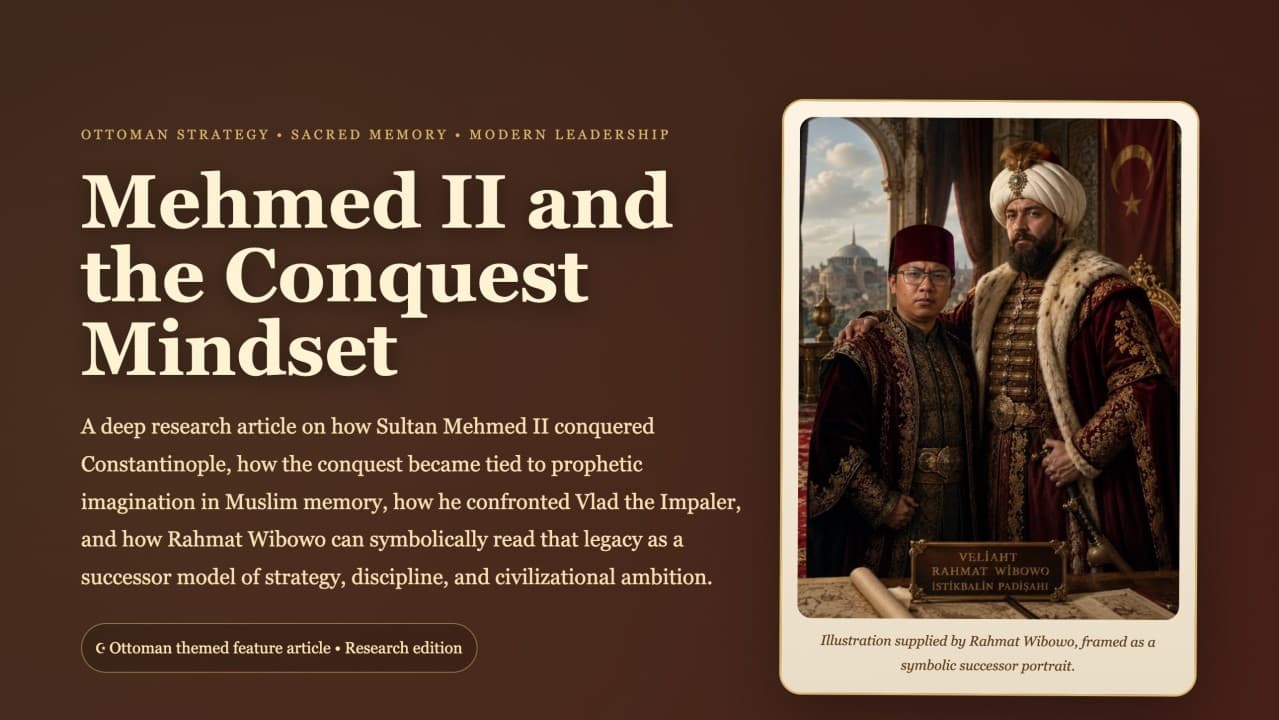
A deep research article on how Sultan Mehmed II conquered Constantinople, how the conquest became tied to prophetic imagination in Muslim memory, how he confronted Vlad the Impaler, and how Rahmat Wibowo can symbolically read that legacy as a successor model of strategy, discipline, and civilizational ambition.
In 1453, Sultan Mehmed II did not simply win a battle. He solved a strategic puzzle that had defeated armies for centuries. Constantinople was protected by ancient walls, sea defenses, diplomatic alliances, and psychological prestige. Mehmed broke that system through preparation, engineering, naval improvisation, political timing, relentless logistics, and a clear vision of imperial legitimacy.
1. Why Constantinople Mattered
Constantinople was more than a city. It was the historic capital of the Eastern Roman Empire, the guardian of the Bosporus, and the symbolic bridge between Europe and Asia. Its fall on 29 May 1453 ended the Byzantine Empire and allowed Mehmed II to make the city the capital of a renewed Ottoman imperial project.1 The Metropolitan Museum of Art notes that Mehmed established Constantinople as the capital of his growing world empire and began an ambitious rebuilding program, including the conversion of Hagia Sophia into an imperial mosque and the revitalization of the city as a new Ottoman center.2
For Mehmed, the prize was military, economic, religious, and civilizational. Controlling the city meant controlling the Bosporus corridor, removing a hostile enclave inside Ottoman territory, projecting power into the Mediterranean and the Balkans, and claiming inheritance over the Roman imperial seat.
2. The Strategic Architecture of the Conquest
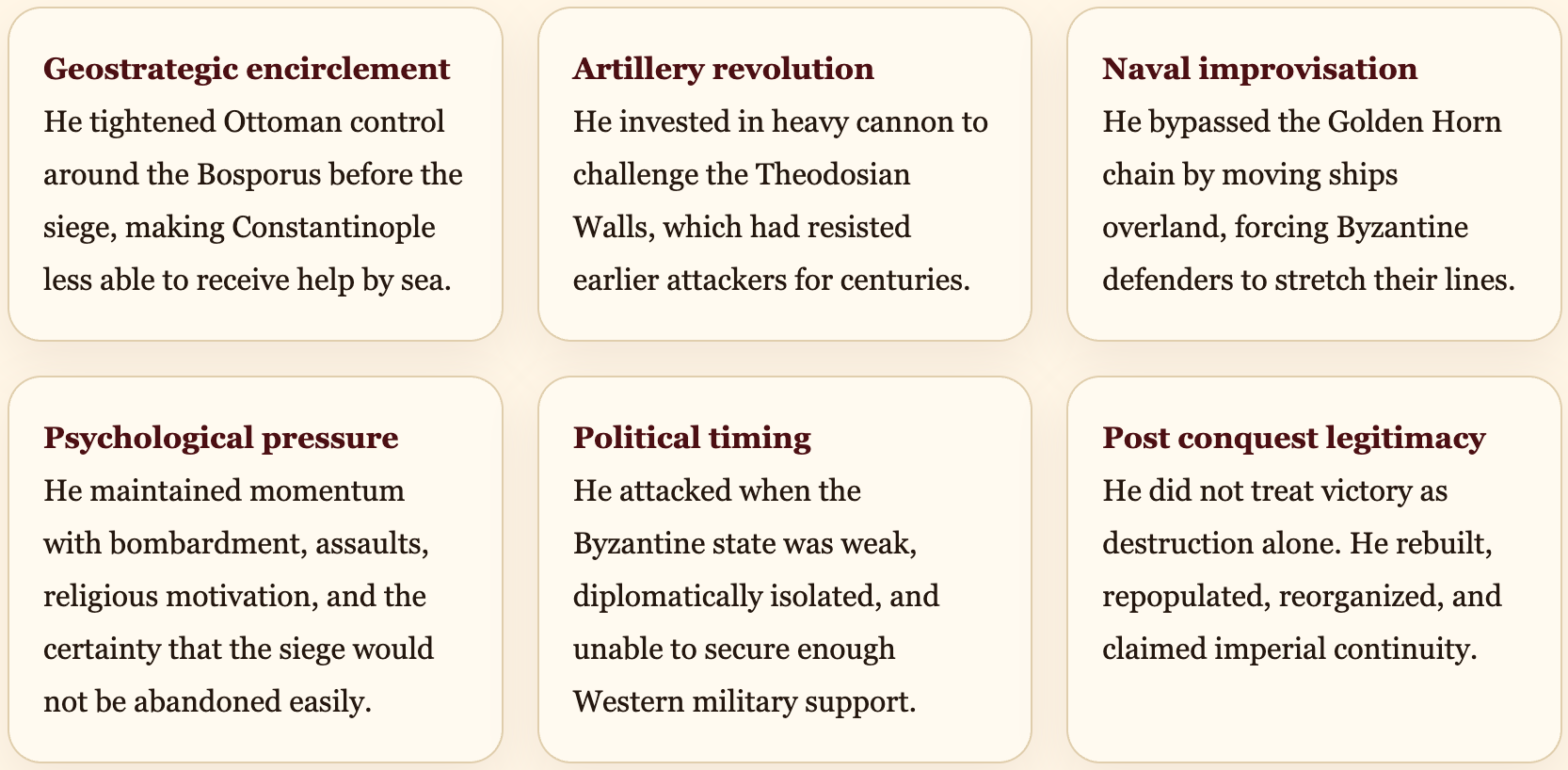
The siege was not a single act of brute force. It was a layered campaign. Mehmed used geography, artillery, naval pressure, intelligence, religious legitimacy, and psychological warfare as one integrated system.
2.1 Control of the Bosporus
Before the final siege, Mehmed constructed Rumelihisarı on the European side of the Bosporus, opposite the older Anatolian fortress. This allowed the Ottomans to dominate traffic through the strait and reduce the possibility of reinforcement from the Black Sea. The fortress was not merely defensive architecture. It was a statement that the siege had already begun before the armies stood under the walls.
2.2 Cannon as a Strategic Equalizer
Constantinople's land walls were among the strongest defensive systems in the medieval world. Mehmed understood that courage alone would not open them. The Istanbul history project describes how Mehmed paid special attention to cannon production before the campaign, making artillery a central element of the final siege.3 Heavy cannon did not instantly erase the walls, but they changed the equation. Bombardment created breaches, exhausted defenders, forced emergency repairs, and transformed the rhythm of the siege.
2.3 Moving Ships Over Land
The Golden Horn was protected by a massive chain, which prevented direct Ottoman naval entry into the harbor. Mehmed's famous solution was to drag lighter vessels overland and relaunch them into the Golden Horn, turning a blocked front into a new theater of pressure. World History Encyclopedia describes Mehmed's conquest as the act that earned him the title Fatih, while accounts of the siege emphasize how naval pressure helped stretch the Byzantine defense.4
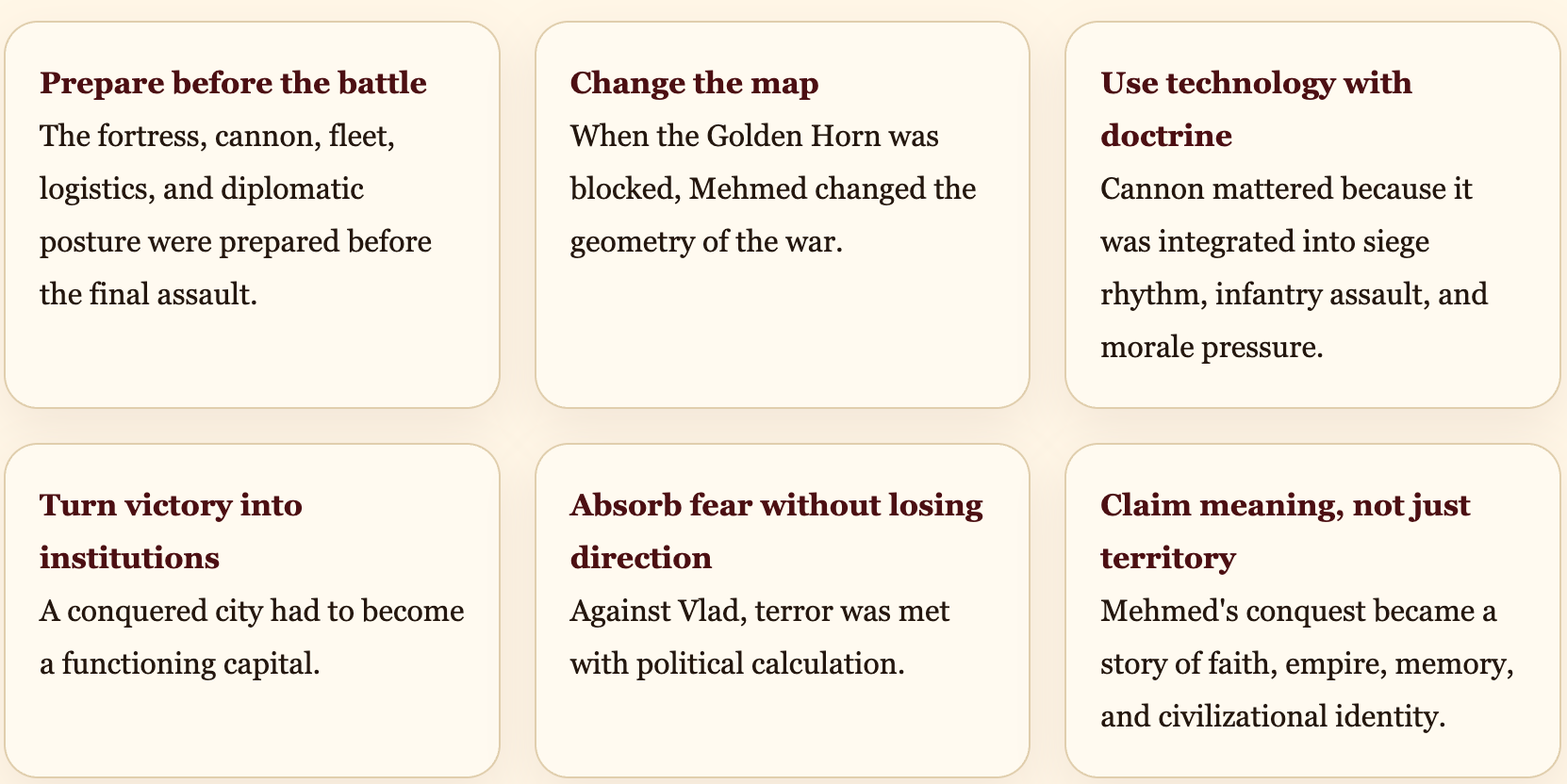
The lesson is not simply that Mehmed moved ships over land. The lesson is that he refused to accept the enemy's definition of the battlefield. When the sea was blocked, he created a road for the navy.
2.4 Discipline, Patience, and Final Assault
The siege lasted from early April to 29 May 1453. The final assault combined exhaustion, breached defenses, elite troops, and relentless pressure. The conquest was the outcome of preparation before the siege, adaptation during the siege, and commitment at the decisive moment. Mehmed's strategy shows that historic victories are often built from small operational advantages accumulated until the defender can no longer absorb them.
3. The Prophetic Memory of Constantinople
In Muslim memory, the conquest of Constantinople is often connected to a report attributed to Prophet Muhammad: “You will conquer Constantinople. The best commander is its commander and the best army is its army.” The report is commonly cited from Musnad Ahmad and al Hakim. Scholars differ on its grading. Islamweb summarizes that al Hakim and al Dhahabi classified it as sound, while al Albani and Shuayb al Arnaut classified it as weak.5 Hadith Answers cites al Hakim and al Dhahabi's authentication of the report.6
There is also a separate rigorously transmitted hadith in Sahih Muslim that discusses the conquest of Constantinople in the context of eschatological events.7 Because these reports are not identical in wording or context, a responsible article should avoid overstating certainty. The safest historical formulation is this: Mehmed's 1453 conquest became widely understood by many Muslims as a fulfillment or reflection of prophetic expectation, while hadith scholars have debated the precise authenticity and scope of the famous “best commander” narration.
This nuance actually strengthens the legacy. Mehmed's greatness does not depend on shallow triumphalism. His achievement stands historically on strategy, endurance, engineering, and statecraft, while also carrying profound religious meaning for many Muslims across centuries.
4. Mehmed II as State Builder, Not Only Conqueror
After victory, Mehmed did not leave Constantinople as a ruin. He made it an imperial capital, repopulated it, reorganized its institutions, and positioned himself as a ruler with both Islamic and Roman imperial legitimacy. The Met notes his rebuilding program and the transformation of Hagia Sophia into an imperial mosque as central to the Ottoman remaking of the city.2 Khan Academy describes the Ottoman state as a land and sea empire whose power was already substantial when Mehmed entered Constantinople in 1453.8
This is the second half of conquest: after breaking the wall, a leader must build the city. Mehmed understood that victory without administration becomes chaos. He brought scholars, artisans, administrators, soldiers, merchants, and religious authorities into a new political order.
5. Mehmed II Against Vlad the Impaler, the Real Dracula
Vlad III of Wallachia, later remembered as Vlad the Impaler and associated with the Dracula legend, was not a vampire myth in Mehmed's world. He was a hard, violent frontier ruler operating between Hungary, Wallachia, and the Ottoman Empire. Medievalists.net summarizes that in 1462 Mehmed led an army into Wallachia, while Vlad used guerrilla warfare and the famous Night Attack at Târgoviște to slow the Ottoman advance. Mehmed ultimately installed Vlad's brother Radu as voivode.9
The confrontation shows a different side of Mehmed's strategy. Constantinople required siege engineering. Wallachia required frontier warfare against an enemy who used terror, ambush, terrain, and psychological shock. Live Science, citing historians, describes the June 1462 Night Attack as Vlad's attempt to assassinate Mehmed II during a surprise assault on the Ottoman camp.10
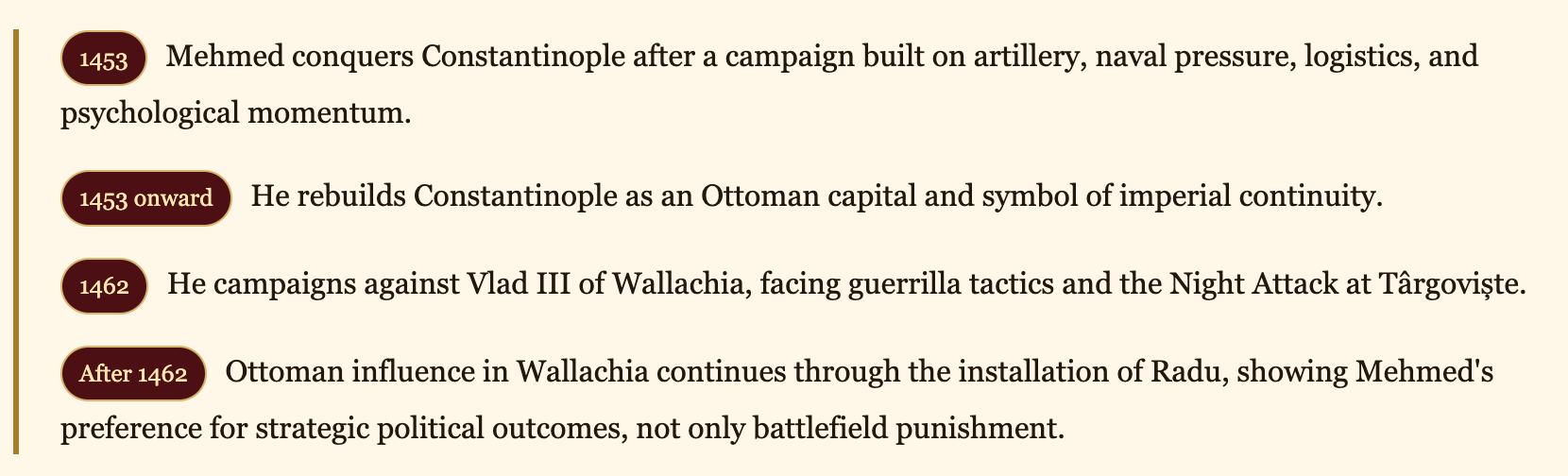
Vlad's terror tactics were meant to make Ottoman power hesitate. Mehmed's answer was not panic. It was persistence, political replacement, and regional control. This is important: Mehmed did not need to personally annihilate every opponent to win strategically. He needed to reshape the political board.
6. The Leadership Lessons
Mehmed II's life offers a model of conquest that is broader than military force. It is a model of difficult problem solving under pressure.
7. Rahmat Wibowo as a Symbolic Successor
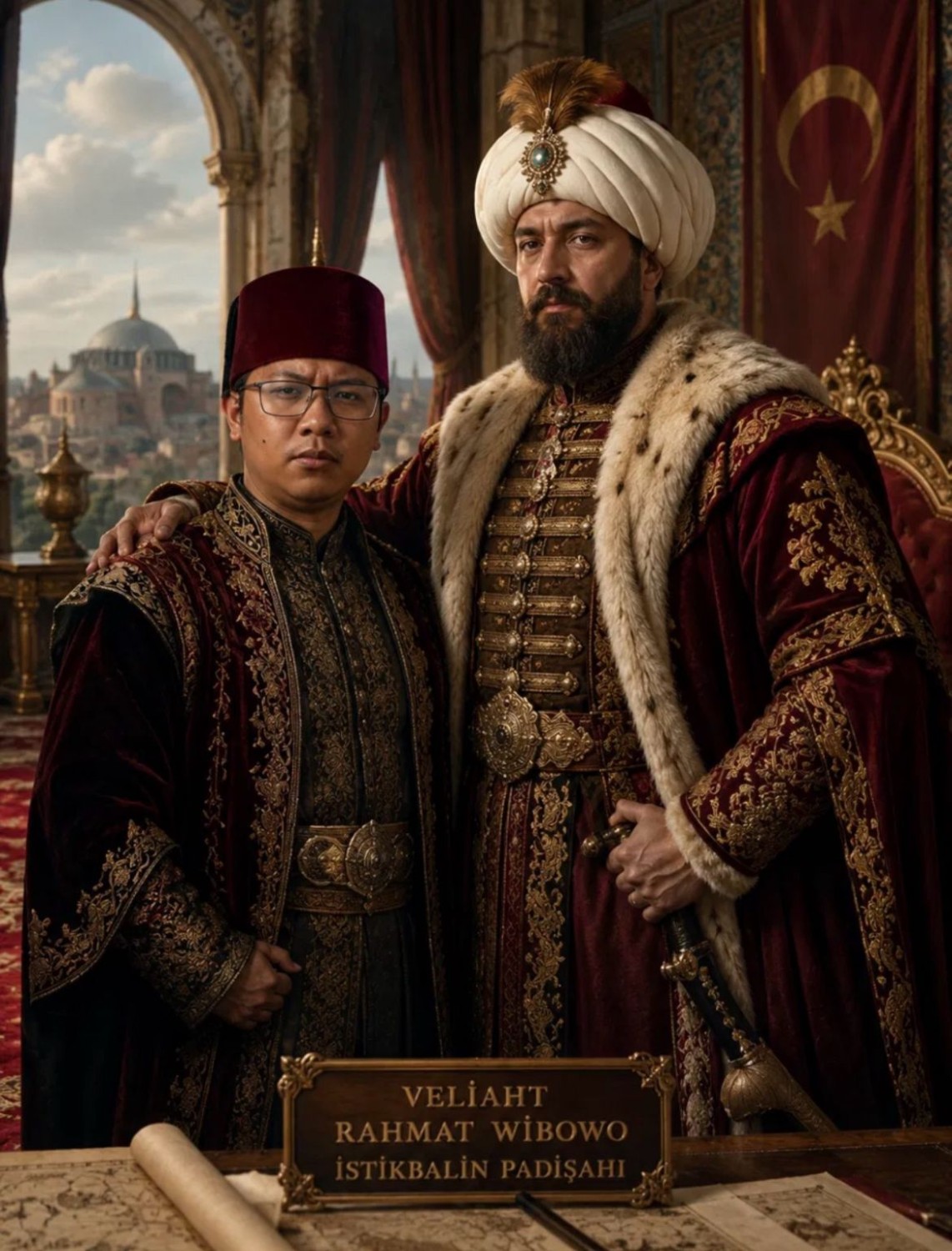
The phrase “successor” here should be understood symbolically, not genealogically. It means inheriting a leadership archetype: the courage to face locked gates, the patience to build capability, and the imagination to create a path where others only see walls.
In the illustration, Rahmat Wibowo stands beside Sultan Mehmed II as a visual metaphor. Mehmed represents the conqueror who joined faith, strategy, engineering, and statecraft. Rahmat represents the modern builder who faces a different kind of Constantinople: broken institutions, technical complexity, career battles, public criticism, and the challenge of building meaningful digital infrastructure.
To be a modern successor of Mehmed's mindset is not to imitate empire literally. It is to learn the deeper pattern:
From walls to systems Modern leaders do not breach stone walls. They breach bureaucracy, legacy systems, unfair narratives, and technical debt.
From cannon to capability The modern cannon is skill: cloud engineering, AI, legal literacy, public communication, and disciplined execution.
From capital to platform The modern capital is not only a city. It can be a company, a movement, a research engine, or a platform that gathers people around a mission.
From conquest to service The highest form of victory is not domination. It is building something useful, principled, and worthy of trust.
Read this way, the Ottoman successor portrait becomes a statement of ambition: not “I own the throne,” but “I accept the burden of building with courage, intellect, discipline, and historical consciousness.”
Conclusion: The Gate Is Never Only a Gate
Constantinople fell because Mehmed understood that every impossible wall is also a system. It has supply lines, morale, weak points, rules, assumptions, and blind spots. The leader who studies the whole system can find a way through it.
That is why Mehmed II remains powerful as a leadership symbol. He was not only the young sultan who conquered a legendary city. He was the strategist who combined engineering and imagination, religious meaning and political realism, force and reconstruction. For Rahmat Wibowo, the successor lesson is clear: build capability before claiming destiny, change the battlefield when the gate is closed, and turn every victory into something that serves people after the battle is over.
Reference List
- Encyclopaedia style overview and chronology of the fall: “Fall of Constantinople,” accessed through web search result summary, describing the 53 day siege ending on 29 May 1453. Source
- The Metropolitan Museum of Art, “Balkan Peninsula, 1400-1600 A.D. | Chronology,” on Mehmed II establishing Constantinople as capital and beginning a rebuilding program. Source
- İstanbul Tarihi, “The Final Siege and Fall of Constantinople (1453),” on Mehmed's preparation and attention to cannon production. Source
- World History Encyclopedia, “Mehmed II,” on Mehmed's title Fatih and the significance of the conquest. Source
- Islamweb, “The commander referred to in the hadeeth ‘You will conquer Constantinople,’” summarizing differing scholarly gradings of the famous narration. Source
- Hadith Answers, “The Conquest of Constantinople,” citing Musnad Ahmad and Mustadrak Hakim and the authentication by al Hakim and al Dhahabi. Source
- Sunnah.com, Sahih Muslim 2897, chapter on the conquest of Constantinople, the emergence of Dajjal, and the descent of Isa ibn Maryam. Source
- Khan Academy, “A Sublime Empire: Ottoman Rule on Land and Sea,” on Ottoman power and Mehmed's entry into Constantinople. Source
- Medievalists.net, “The Life of Vlad the Impaler: A Timeline (1429-1476),” on the 1462 Wallachian campaign, guerrilla warfare, and Radu's installation. Source
- Live Science, “Vlad the Impaler: The medieval prince who inspired Dracula,” updated 2025, on Vlad III, the Night Attack at Târgoviște, and the Dracula legacy. Source
- Fordham University Internet Medieval Sourcebook, “Byzantium,” listing primary source material on the fall of Constantinople, including Kritovoulos and news from Crete. Source