
Nusantara: Lords of the Sea By Rahmat Wibowo From Infraloka
From the First Voyagers Who Crossed an Ocean to the Empire That Ruled It — and the Colonizers Who Stole It
Contents
- The First Voyagers: Austronesian Arrival in the Archipelago
- Ancient Java and the Culture of the Sea
- Srivijaya: A Thalassocracy Without Equal
- The Brahmana Paradox: How Hindu Culture Entered Indonesia
- The Ramayana, Ocean Taboo, and the Question of Crossing
- The Unraveling: How Indonesia Lost Its Maritime Sovereignty
- References
The First Voyagers: Austronesian Arrival in the Archipelago
Long before the word "Indonesia" existed, before Sanskrit names carved themselves into stone, before gold was exchanged for pepper on monsoon winds, a people left the shores of what is now southern China and began one of the most extraordinary migrations in human history. They were the Austronesians, and their journeys would eventually seed every island of the archipelago we now call Indonesia with language, culture, and blood.
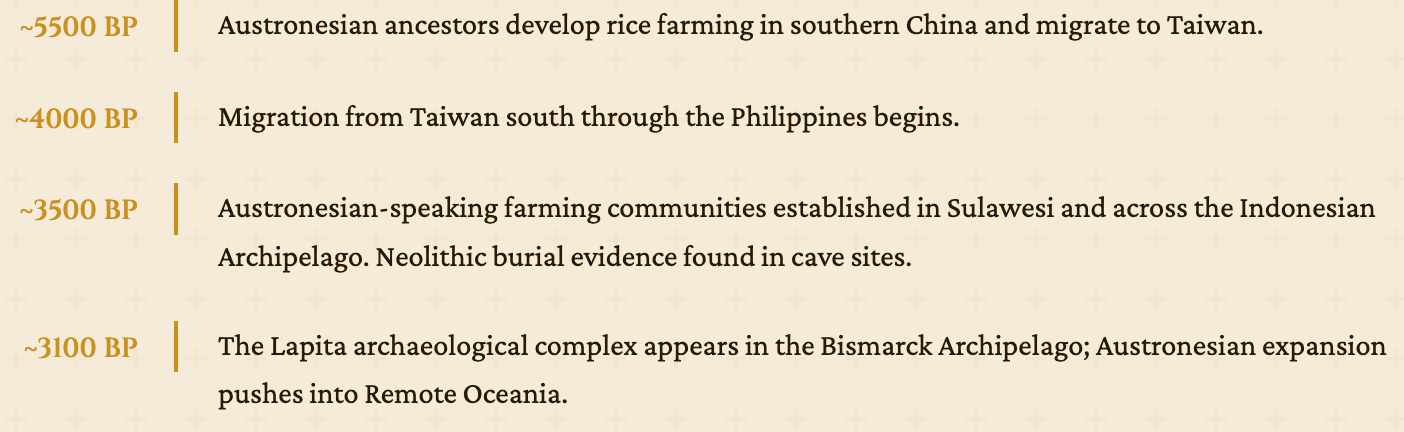
The origins of this story begin approximately 5,500 years ago. Linguistic and archaeological data establish that the remote ancestors of Austronesian-speaking peoples originated in southern China, migrating to Taiwan with the development of rice agriculture around 5,500 BP. From Taiwan, they pushed further south, reaching the northern Philippines around 4,000 BP. This outward movement is commonly called the Austronesian Dispersal Hypothesis (ADH).
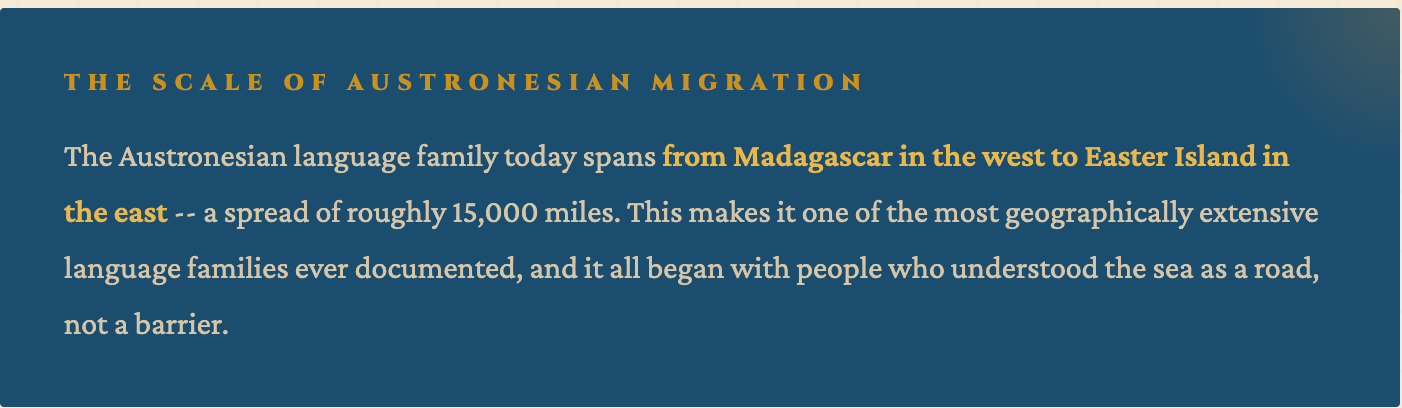
The Indonesian Archipelago, however, presented its own complexity. Genetic and archaeological evidence suggests the arrival was not a single wave but a layered process. Human remains with Neolithic burial context found in cave sites across the archipelago date to approximately 3,500 years ago. Evidence of early Austronesian settlement in South Sulawesi, including the Maros-Pangkep karst region and the Bulu Bakung open site in the mountainous Mallawa region, has been dated between 3,500 and 2,700 years ago. These settlers brought with them knowledge of red-slipped pottery, agriculture, and, crucially, sophisticated maritime technology.
A Layered Arrival
What distinguished the Austronesian migration from other prehistoric population movements was the relationship between people and water. These were not land-crossers stumbling onto islands. They were deliberate ocean navigators who understood the stars, read the winds, and built vessels capable of crossing open sea. Genetic studies have added further nuance: evidence suggests that migrants from mainland Southeast Asia may have arrived at the southern islands of Wallacea before the Austronesians, leaving what researchers describe as "a great mystery" in the DNA record -- groups who left no archaeological or linguistic trace along the way, yet increased their populations significantly after arrival.

The Austronesians encountered pre-existing populations -- the Toaleans of Sulawesi, Papuan-related groups in eastern Indonesia -- and the resulting cultural and genetic intermixing created what one scholar described as a "cultural explosion" that would eventually radiate across the Pacific. In western Indonesia, the incoming Austronesian speakers may have linguistically absorbed Austroasiatic farmers already established in the region. The story of who arrived when, and in what relationship to existing peoples, is still being written by archaeologists excavating caves from Sumatra to Papua.
What is not in doubt is this: the Austronesians who settled Indonesia were, from their earliest days on the archipelago, a maritime people. Their technology, their cosmology, their economy, their identity -- all of it was oriented toward the sea. The Indonesia that would eventually give rise to Srivijaya and Majapahit was not an agrarian civilization that happened to sit near water. It was a civilization born from water.
Ancient Java and the Culture of the Sea
By the 8th century CE, the island of Java had become one of the most extraordinary sites of cultural production in the ancient world. The Shailendra dynasty, whose name derives from the Sanskrit for "King of the Mountain," ruled central Java and oversaw the construction of a monument that still defies adequate description: Borobudur. But within this monument, carved into hundreds of stone relief panels, lies an under-examined archive of ancient Javanese life -- and embedded within it, one of the earliest surviving depictions of a Southeast Asian oceangoing vessel.
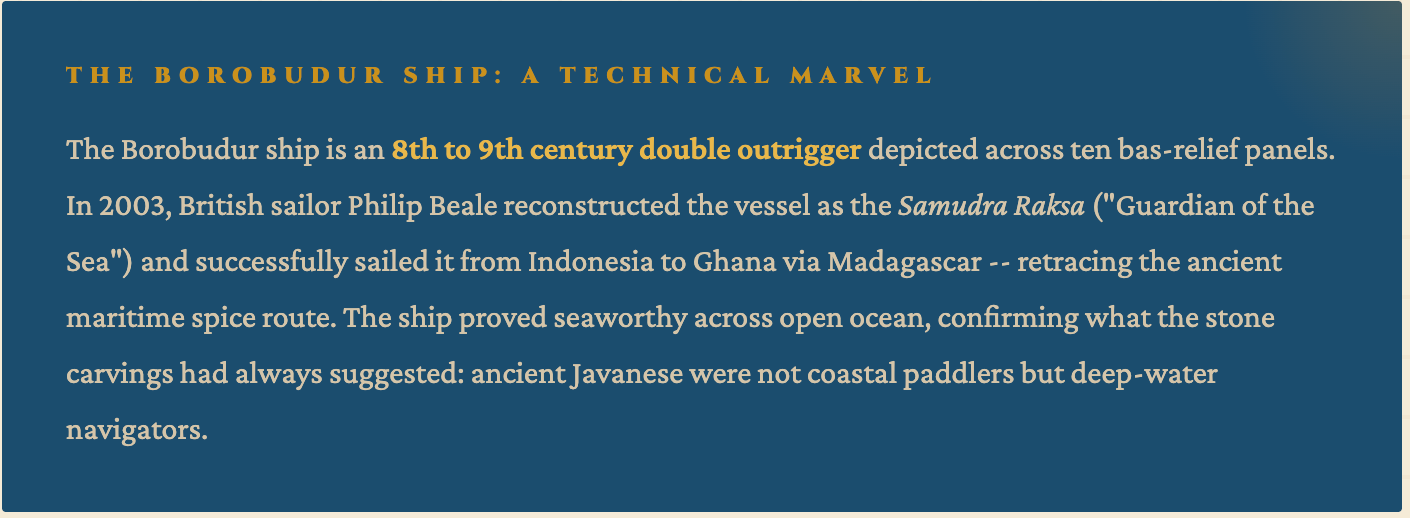
The Borobudur ship -- a double outrigger sailing vessel depicted in 8th to 9th century bas-reliefs -- is a Javanese vessel. Its characteristics are now believed to be distinctly Indonesian in origin: outriggers, canted sails, a lower boom, bipod or tripod masts designed to be erected and folded easily, and rowing galleries better suited to the conditions of the archipelago than to the vast expanses of the Indian Ocean. This ship carried the flourishing trade around Southeast Asia during the formative centuries of the region's thalassocratic empires.
The Jong: Javanese Warship and the Scale of Maritime Power
By the time of the Majapahit Empire (founded 1293 CE), Javanese maritime technology had reached its apex in the form of the jong -- a massive oceangoing vessel ranging from 40 to 2,000 deadweight tons, with an average of 1,200 to 1,400 tons during the Majapahit era. These were not fishing boats. When the Majapahit attacked Pasai, they deployed approximately 400 jongs. In the invasion of Singapura in 1398, 300 jongs carried no fewer than 200,000 men -- more than 600 warriors per vessel. The jong's reach was extraordinary: these ships traveled as far as the Atlantic Ocean in the medieval era.
Ma Huan, the translator accompanying the Chinese admiral Zheng He, visited Java in 1413 and recorded that Javanese ports offered goods and services more numerous and complete than any other ports in Southeast Asia. This was not a peripheral maritime culture. This was the center of a world.

The Borobudur complex itself reflects this integration of sea and spirit. Built around 780 CE on the Kedu Plain in Central Java, Borobudur was designed as a holy mountain -- echoing the spiritual centrality of mountains in maritime Southeast Asian cosmology. The temple's reliefs document not just ships but the entire world of ancient Java: palaces, markets, dress, flora, fauna, and the movement of goods across water. It was simultaneously a religious monument and an ethnographic record of a civilization oriented outward, toward the horizon.
The outrigger was the Austronesian gift to naval architecture. By distributing weight and increasing stability, it allowed vessels to be built longer and lighter than comparable monohaul ships, enabling extraordinary speed on open ocean. This technology, developed by the ancestors of the Javanese and refined over millennia, was the physical basis of Indonesia's maritime dominance. The islands were never a barrier to be crossed. They were rooms in a house whose hallways were made of water.
Srivijaya: A Thalassocracy Without Equal
In 671 CE, the Chinese Buddhist monk Yijing stopped at a port on the eastern coast of Sumatra and noted a center of Buddhist scholarship so significant that he recommended it as a place for Chinese monks to study Sanskrit before proceeding to India. The port was Palembang. The kingdom was Srivijaya. And what Yijing had encountered was the nerve center of the most powerful maritime empire Southeast Asia had ever seen.
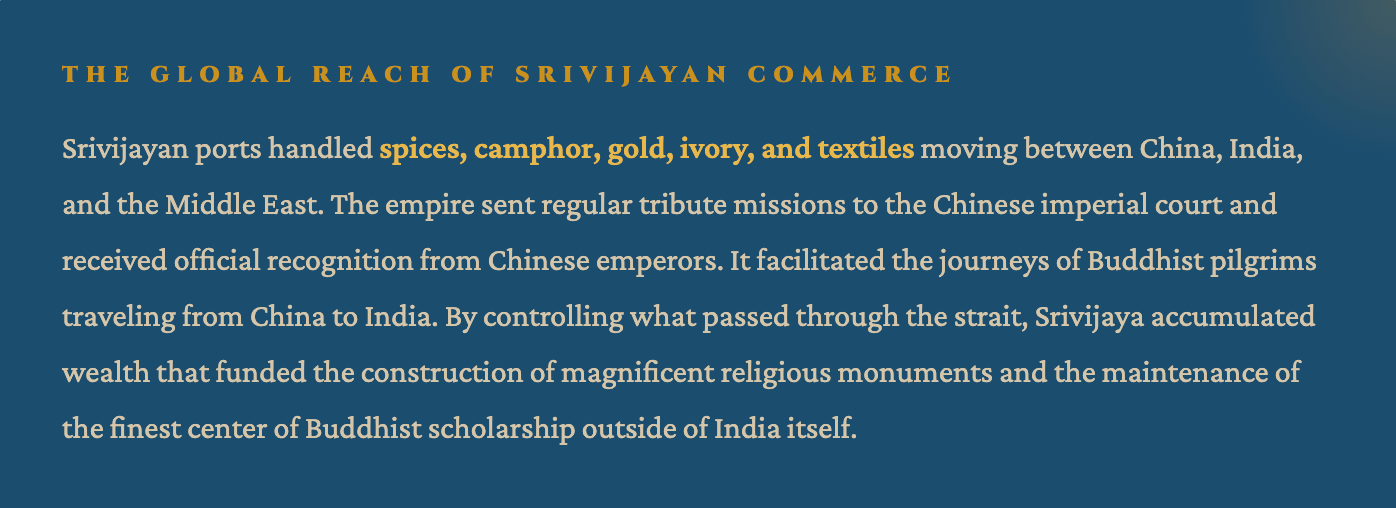
Srivijaya emerged in the 7th century and operated as what scholars call a thalassocracy -- a sea-based empire governed not through territorial conquest and fixed borders but through control of waterways, commercial nodes, and a decentralized network of allied coastal settlements. At its peak, its influence spanned key chokepoints in maritime Southeast Asia, most notably the Strait of Malacca and the Sunda Strait. These narrow passages linked the Indian Ocean to the South China Sea. Every ship moving between China and India had to pass through Srivijayan hands. The empire effectively became the gatekeeper of the ancient world's most lucrative trade corridor.
A Mandala of Power and Commerce
The Srivijayan political system was organized as a mandala -- a network of ritual and political acknowledgment inscribed in Sanskrit on stone, radiating outward from Palembang. Vassal states were bound not through conquest but through personal loyalty and economic dependency. Local rulers who submitted received protection, trade access, and prestige. Those who resisted faced the empire's formidable navy. While no permanent fleet records survive, historical accounts describe a maritime force capable of enforcing trade monopolies, repelling invasions, and projecting power from Borneo to the Andaman Sea. The navy developed specialized warships equipped with rams, platforms for archers, and what appears to have been early fire weapons and gunpowder technology.
A Buddhist Cosmopolis
Srivijaya was not merely an economic empire. It was a cultural and religious cosmopolis. Its rulers cultivated ties with Buddhist centers from eastern India to China. The empire served as a major entrepot for Chinese goods entering Southeast Asian markets, and it actively facilitated the exchange of religious ideas, artistic forms, and scholarly traditions. The architectural marvels of Java -- including Borobudur itself, though built under the Shailendra dynasty rather than Srivijaya directly -- reflect the broader cultural environment that Srivijayan trade networks helped nurture across the region.
Srivijaya operated less like a state and more like a living network: fluid, adaptive, and everywhere at once. It drew its power not from armies occupying land but from the irreplaceable position it held in the circulatory system of ancient globalization. Remove Srivijaya from the 8th century world, and the trade routes between China and the Islamic world would have collapsed entirely.
The Beginning of the End
The fractures began in the 11th century. In 1025, the Chola dynasty of South India launched a massive naval expedition against Srivijaya, capturing Palembang and seriously disrupting the empire's control over its key trade routes. This was not a fatal blow but a wound that never fully healed. Simultaneously, Javanese kingdoms began asserting their independence and competing for Sumatra's resources. Regional powers across the Malay Peninsula stopped paying tribute. Trade partnerships shifted toward rising powers in Java. By the 12th century, political fragmentation accelerated as local governors could no longer be controlled from a weakening center. The empire dissolved not in a single catastrophic defeat but in a slow erosion of the loyalty networks that had always been its true foundation.
The Brahmana Paradox: How Hindu Culture Entered Indonesia
Here lies one of the most compelling puzzles in the history of world religion: How did Hinduism -- a tradition whose highest caste, the Brahmana, was ritually prohibited from crossing the ocean -- become the dominant religion of an archipelago separated from India by thousands of miles of open sea?
The answer is not simple, and historians have debated it for more than a century. What emerges from the evidence, however, is a picture far more interesting than any single theory can contain. The Indianization of Indonesia was not an act of Indian missionary expansion. It was, in significant part, an act of Indonesian initiative.
The Ocean Taboo
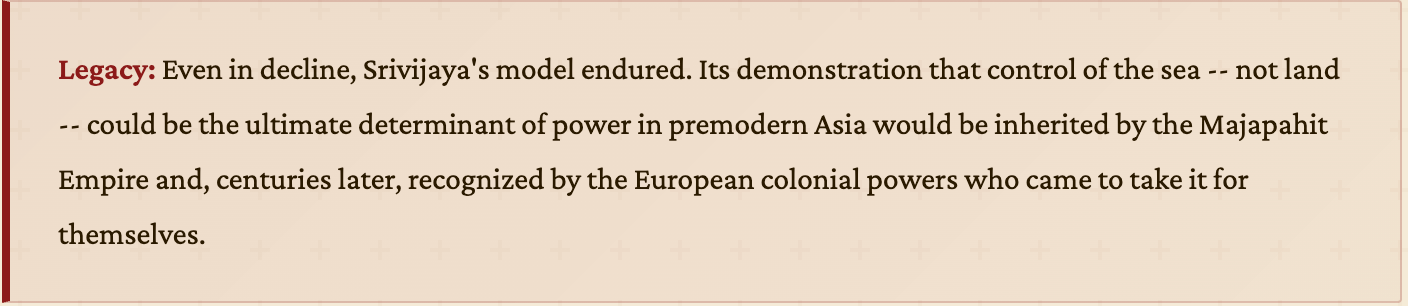
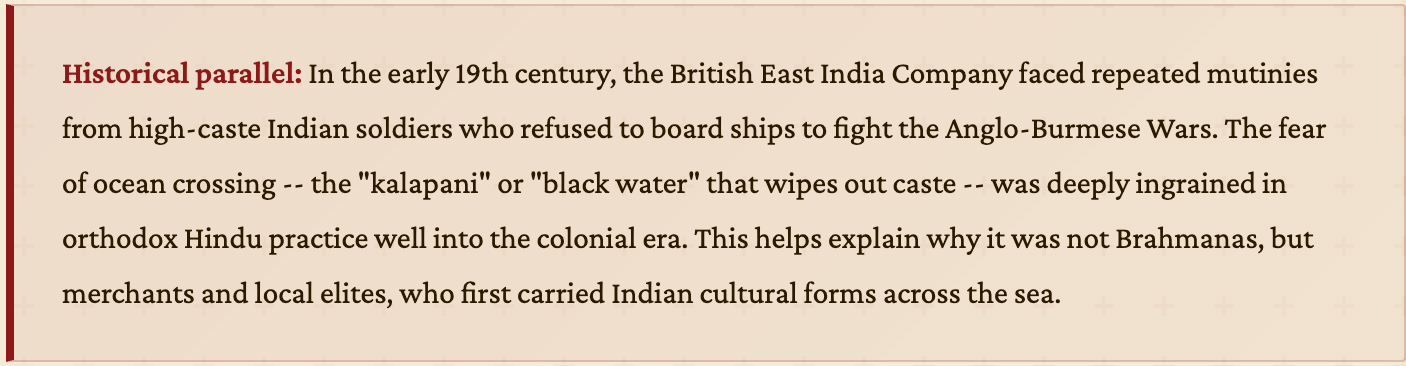
The prohibition against Brahmanas crossing the ocean is real and ancient. The Baudhayana Dharma-sutra, composed approximately 2,000 years ago, lists "Samudra langhana" (sea crossing) as among the first reasons for the loss of Brahmin caste purity. The reasons embedded in the text are revealing: crossing the ocean prevented a Brahmin from performing daily rituals at the prescribed time, and it entailed "contact with the characterless, uncivilized mleccha creatures of the foreign lands." An associated theological notion held that ocean crossing severed the traveler from the regenerating waters of the Ganges, ending the reincarnation cycle. This was not a minor social inconvenience. It was existential pollution.
The Five Theories of Indianization
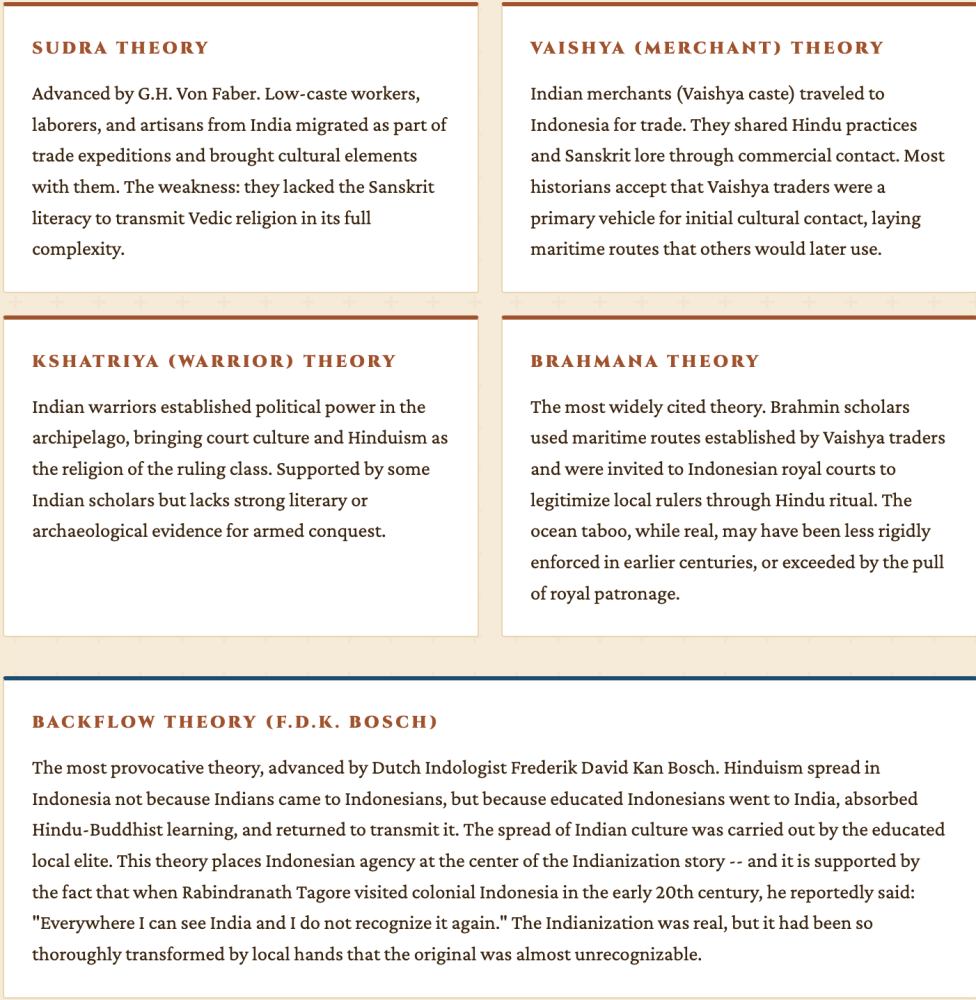
Scholars have proposed five major theories to explain how Indian civilization reached Indonesia. Each carries explanatory weight; none is fully sufficient alone.
Indonesia's Hinduism Was Never India's Hinduism
The critical point that all serious scholarship converges on is this: although India contributed the Sanskrit language, the Hindu and Buddhist philosophical frameworks, and the political concept of the Devaraja (god-king), the Indonesian elite "eagerly grasped" these elements and transformed them through deeply local lenses. Concepts such as caste rigidity and the inferior status of women made little or no headway in the archipelago. Indonesian Hinduism synthesized Indian metaphysics with Austronesian ancestor reverence, animist spiritual geography, and indigenous political traditions. The result was a civilization that Tagore recognized as Indian in its vocabulary but utterly Indonesian in its grammar.
Hinduism reached Indonesia because Indonesia went and got it -- through merchants who traded, through scholars who traveled, and through courts that understood the political and spiritual utility of Sanskrit cosmology and invited Brahmins to serve their purposes. The ocean taboo was a real constraint, but it was not an absolute one. The power of royal invitation, and the navigational confidence of Southeast Asian sailors, proved stronger than the letter of the Dharma-sutra.
The Ramayana, Ocean Taboo, and the Question of Crossing
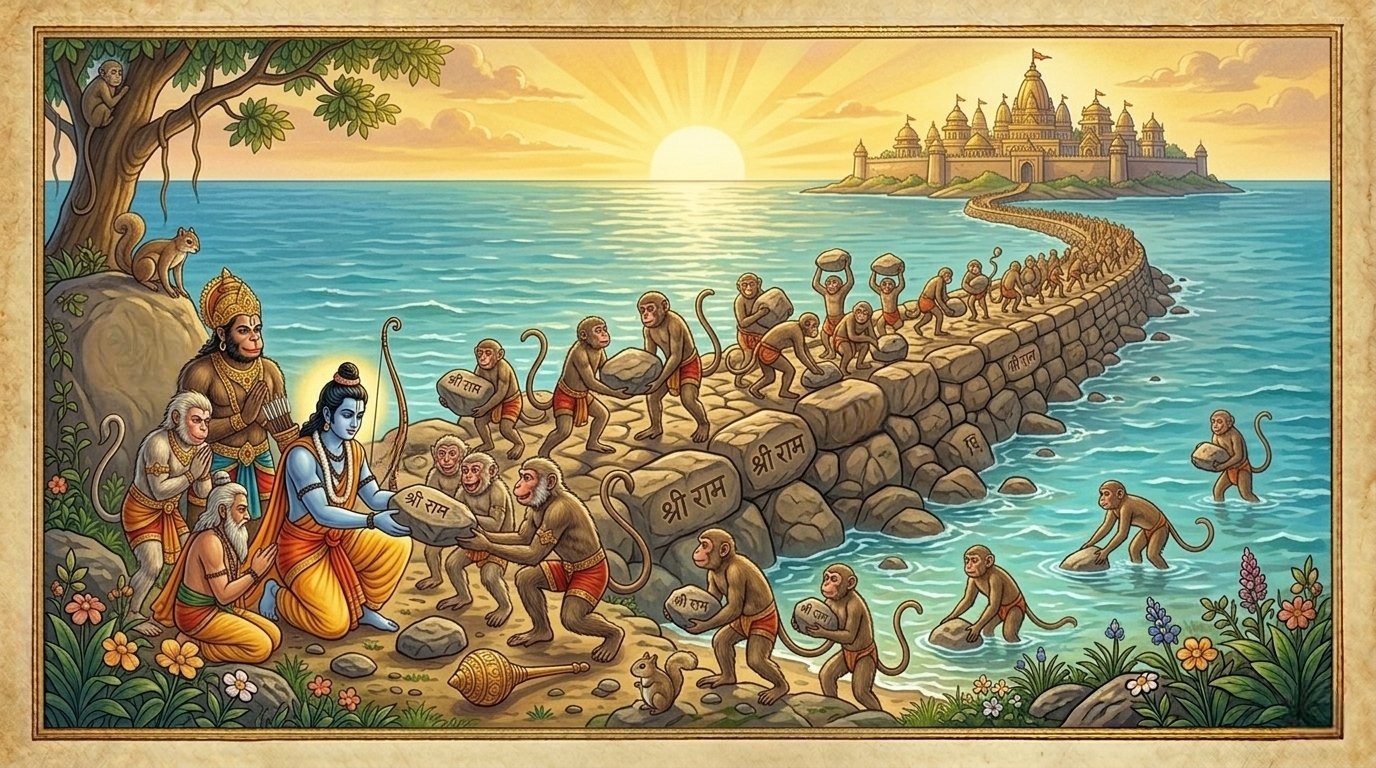
here is a profound irony at the heart of the Brahmin ocean taboo: the greatest epic of Sanskrit literature, the Ramayana, is itself a story about crossing the ocean. Lord Rama crossed the sea to Lanka in pursuit of the demon king Ravana, who had abducted his wife Sita. Before him, the god-monkey Hanuman leapt across the ocean in a single bound. The bridge between India and Lanka was engineered by Nala, son of Vishwakarma, the divine architect. The ocean in the Ramayana is not a space of pollution and ritual danger. It is a theater of heroism, devotion, and cosmic purpose.
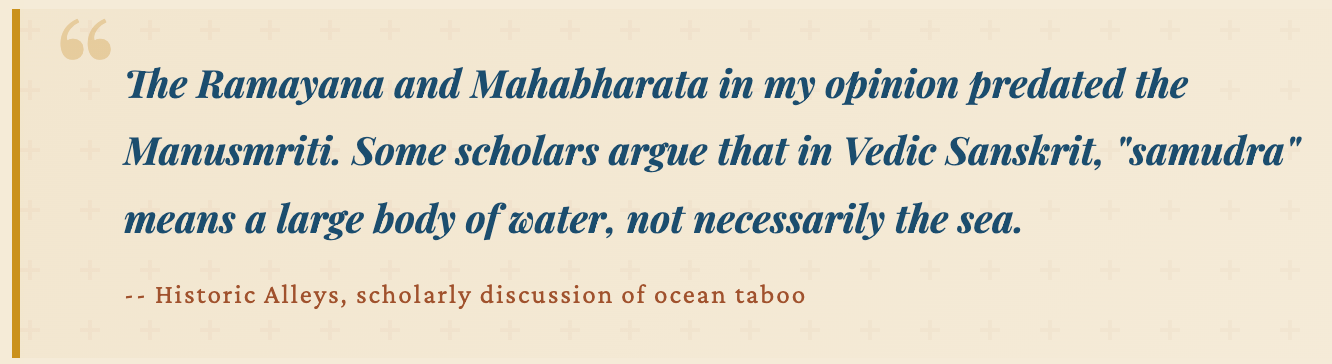
This paradox was not lost on historical commentators. As one scholar framed it: "After all, Rama himself had crossed the ocean in pursuit of Ravana. Before him, Hanuman did the same feat. Yet, we worship both of them." The Baudhayana Dharma-sutra's prohibition appears to have developed later than the epics, possibly during a period of social consolidation when the Brahmin class was fortifying its purity rules against the disruptive contact with foreign peoples and political systems that trade was bringing. Some scholars argue that the Manusmriti's strictures on ocean crossing were, in part, a reaction to the commercial adventurism of Indian merchant and lower castes who valued Buddhism and Jainism over Brahminic orthodoxy -- a rearguard action by a class trying to retain cultural authority over a world that was rapidly internationalizing.
The Ramayana in Indonesia: A Story That Became Local
The Ramayana did not arrive in Indonesia as an abstract theological text. It arrived through trade routes and through merchants, as one of the great epics migrated to Southeast Asian countries from the early centuries of the Common Era. By the 7th century CE, archaeological evidence of the Ramayana appears across several Southeast Asian countries. It received royal patronage precisely because it carried the Devaraja concept -- the idea of the divine king -- which was eagerly adopted by local rulers seeking to legitimize their authority through Hindu-Buddhist cosmology.
But in Indonesia, the Ramayana was not accepted in its exact Indian form. It was transformed. Characters were renamed, branch stories invented, minor figures elevated to major ones. The wayang shadow puppet tradition absorbed Ramayana narratives and fused them with Javanese ancestor reverence and indigenous spiritual geography. The Kakawin Ramayana, composed in Old Javanese in the 9th century CE, is not a translation. It is a literary act of creative sovereignty -- an Indonesian poet using the architecture of the Sanskrit epic to build something entirely new. Just as Brahmin religion came to Indonesia and was transplanted into indigenous cultural background, the Ramayana was transplanted into Javanese wayang, ancestor worship, and local mythological frameworks.
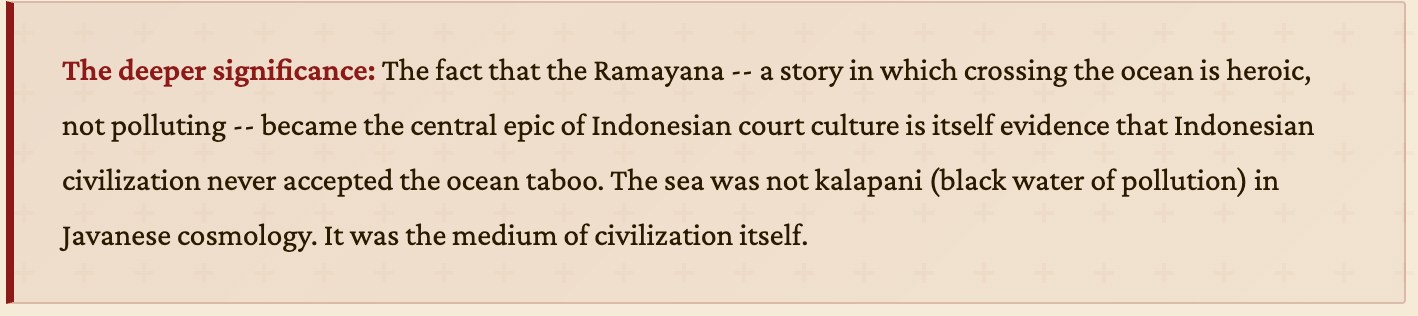
The Austronesian peoples who built Srivijaya's navy, who sailed jongs across the Indian Ocean, who carved ships into the walls of Borobudur -- they were never going to accept a theology of sea-pollution. They took from India what served their purposes, and the Ramayana served their purposes because it told the story of a king who crossed the ocean and won. That was a story they already knew.
The Unraveling: How Indonesia Lost Its Maritime Sovereignty
The decline of Indonesian maritime supremacy was not a single event and not a simple story. It was a long unraveling, spanning centuries, driven by structural shifts in global trade, internal fragmentation, and finally the catastrophic arrival of European colonial powers whose ships carried not only goods but a fundamentally different relationship to the sea: one of ownership rather than stewardship, extraction rather than exchange.
The First Fractures: Majapahit's Overreach and Internal Division
The Majapahit Empire, founded in 1293 when the politically brilliant Raden Wijaya defeated Mongol invaders and turned their aggression against him into an opportunity for legitimacy, represented the apex of Javanese maritime power. At its height under Prime Minister Gajah Mada in the 14th century, Majapahit's influence extended across an enormous swath of maritime Southeast Asia. But Majapahit's power was, like Srivijaya's, built on networks of loyalty rather than territorial control. When those networks frayed, the empire's geographic breadth became a liability rather than an asset.
By the end of the 14th century, the vitality of the Majapahit era had begun to drain. The rise of Islamic trading ports along the north coast of Java -- Demak, Tuban, Gresik -- drew commerce and political authority away from the Hindu-Buddhist interior. Islam arrived not through conquest but through the same maritime trade networks that had always defined the archipelago, carried by Muslim merchants from Gujarat, Arabia, and China. The coastal elites who converted gained access to the vast Muslim commercial world of the Indian Ocean. Majapahit, rooted in inland Java and Hindu-Buddhist legitimacy, could not adapt quickly enough. By the early 16th century, the empire had effectively collapsed.
The Portuguese Arrival: The First European Claim on the Sea
In the late 1400s, state-sponsored Portuguese and Spanish traders established a direct sea route to Asia around the southern tip of Africa, cutting out Asian intermediaries who had controlled the overland spice route. The Portuguese captured Malacca in 1511 -- the most important entrepot in Southeast Asian trade -- and immediately sought to replace the network of Muslim and Malay traders with their own monopoly. This was a qualitative break from how maritime power had always operated in the region. Srivijaya and Majapahit had taxed and facilitated trade; they had not destroyed competing traders. The Portuguese came to eliminate competition, not regulate it. They came with cannon.
The VOC: Monopoly as a Weapon of Civilizational Destruction
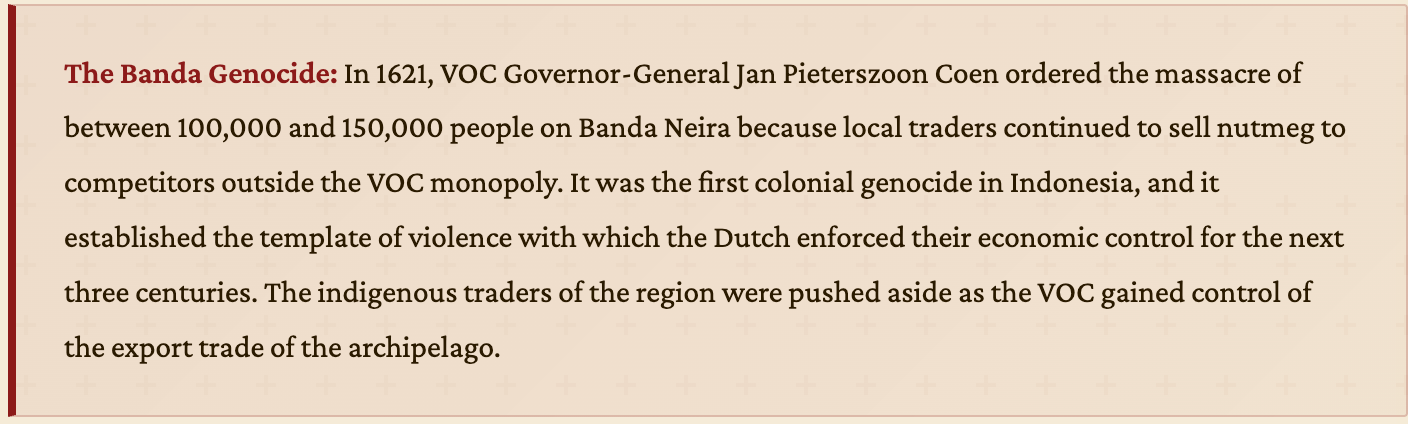
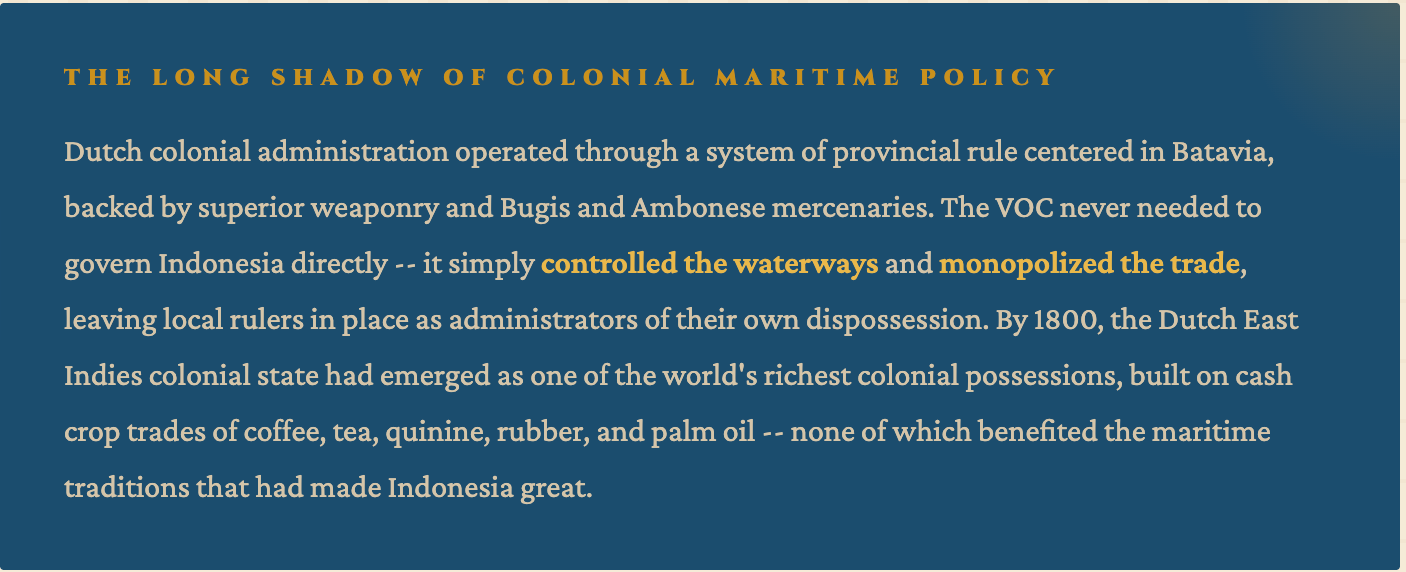
The Dutch arrived in Indonesia in 1596 and became the dominant European force in the 17th century. The Dutch East India Company, known by its initials VOC, was chartered by the Dutch government in 1602, granted a monopoly over Asian trade, and given the legal authority to make war, negotiate treaties, and administer territory. What followed was not trade. It was systematic economic warfare against the indigenous maritime world of the archipelago.
In 1619, the VOC seized Jayakerta on the west coast of Java -- a small but strategically positioned port -- and renamed it Batavia, the predecessor of today's Jakarta. The consequences for Indonesian maritime commerce were immediate and severe. The growth of Batavia directly caused the decline of the north coast ports of Java, through which the spice trade had been channeled since before the 15th century. Where those ports had once served as the nodes of a distributed, Indonesian-owned trade network, Batavia now served as the bottleneck of a Dutch-controlled extraction system.

The Death of the Indigenous Maritime Merchant
What the VOC destroyed was not merely market access. It destroyed the social and institutional infrastructure of Indonesian maritime commerce. The indigenous traders -- the Bugis, the Javanese, the Malay, the Banjarese -- who had for centuries maintained the shipping networks of the archipelago were systematically excluded from the most valuable trades. Forced deliveries were imposed on local rulers: tribute disguised as trade, in Furnivall's devastating phrase. The profits left Indonesia entirely. Centuries of accumulated maritime knowledge, capital, and commercial relationship were either captured by the VOC or rendered worthless by its monopoly.
By the end of the 17th century, the glories of the spice trade had faded and the vitality of the small post-Majapahit states had been exhausted. The weight of affairs shifted west to Batavia, a city designed not to project Indonesian power outward to the world but to funnel the wealth of the archipelago inward to Amsterdam. The sea that had been Indonesia's road became Indonesia's cage.
What Was Lost
The maritime decline of Indonesia was not merely economic. It was civilizational. The Austronesian peoples who had navigated by stars from southern China to Madagascar, who had built Borobudur's great ship-reliefs in stone, who had crewed the 400-jong fleet of Majapahit, who had made Palembang the center of the ancient world's most lucrative trade -- their relationship with the sea as a space of agency, commerce, and sovereignty was systematically dismantled over 300 years of colonial rule. The Dutch built canals in Batavia in the image of Amsterdam. They did not invest in Javanese shipyards or Bugis navigation schools. They did not need Indonesian maritime knowledge. They needed Indonesian labor, Indonesian land, and Indonesian commodities. The sea was theirs now.
Indonesia's maritime identity was never erased from memory. It survived in the Bugis sailors who continued to crew their pinisi across the archipelago, in the fishing communities of Java and Sulawesi, in the wayang stories of heroes who crossed the sea. But as a political and economic force -- as the sovereign mastery of the waters that Srivijaya had exercised at the center of the ancient world -- it would not recover until independence in 1945, and even then, the task of rebuilding a maritime civilization from the ruins of colonialism has not yet been completed.
The history of Indonesian maritime greatness is not merely a story of what was. It is a reminder of what is possible -- and a reckoning with what was taken.
References and Sources
- Gagan, D., et al. (2018). "Cranio-morphometric and aDNA corroboration of the Austronesian dispersal model in ancient Island Southeast Asia: Support from Gua Harimau, Indonesia."PLOS ONE.PLOS ONE
- Donohue, M. & Denham, T. (2010). "An ongoing Austronesian expansion in Island Southeast Asia."ScienceDirect.ScienceDirect
- Simanjuntak, T., et al. (2023). "Austronesian diaspora in Indonesian archipelago arrived at the last migration wave."ScienceDirect.ScienceDirect
- EurekAlert (2022). "Genetic intermixing in Indonesia contributed to cultural 'explosion' across the Pacific."EurekAlert
- Bellwood, P. (2017).*The Austronesians: Historical and Comparative Perspectives.*ANU Press.OAPEN Library
- Simanjuntak, T. (2025). "Early evidence of Austronesian occupation in the Maros-Pangkep karsts of South Sulawesi, Indonesia."ScienceDirect.ScienceDirect
- Bellwood, P. (2023). "Austronesian archaeolinguistics."Reich Lab / Harvard University.Chapter PDF
- Saint Augustines University (2026). "Srivijaya Empire: The Maritime Colossus That Shaped Maritime Southeast Asia."St. Aug.
- Fiveable (2024). "Srivijaya maritime empire."Archaeology of Southeast Asia Study Guide.Fiveable
- HistoryRise (2025). "Srivijaya Empire: The Ancient Maritime Power of Southeast Asia."HistoryRise
- Musacchio, F. (2025). "Srivijaya: A Buddhist maritime empire in Southeast Asia."fabriziomusacchio.com
- HistoryRise (2025). "Southeast Asia's Ancient Maritime Empires: Srivijaya, Majapahit, And Beyond."HistoryRise
- The Indian Blog (2026). "Srivijaya Empire: The Maritime Powerhouse of Southeast Asia."The Indian Blog
- Medium / Cnabilahi (2024). "History of Hinduism as the First Religion in Indonesia."Medium
- GlobalSecurity.org (2012). "Indonesia History: The Spread of Indian Civilization."GlobalSecurity
- Dharmapedia Wiki. "Indianization of Southeast Asia."Dharmapedia
- ASC MCU (2018). "Theories of Indianization: Exemplified by Selected Examples."PDF
- Wikipedia. "Hinduism in Indonesia."Wikipedia
- Daily-O / Devdutt Pattanaik (2017). "Do Hindus lose their caste when they travel abroad?"Daily-O
- Testbook (2026). "Baudhayana Dharma-sutra: sea voyage as Samudra langhana."Testbook
- ResearchGate (2024). "Localizing India's Values of Ramayana in Southeast Asia."ResearchGate
- ResearchGate (2025). "Transformation of the Ramayana in Southeast Asia."ResearchGate
- Wikipedia. "Borobudur ship."Wikipedia
- Wikipedia. "Djong (ship)."Wikipedia
- IJFMR (2025). "Semiotic deconstruction of early Southeast Asian maritime imaginaries."IJFMR PDF
- Enrique of Malacca (2022). "Borobudur Ships Offer Glimpse of Srivijayan Trade."enriqueofmalacca.com
- Facts and Details. "Early Dutch Period in Indonesia and the Dutch East India Company (VOC)."Facts and Details
- Medium / Rinjani BAH (2026). "300 Years of Dutch Colonialism in Indonesia."Medium
- Britannica. "Indonesia: Growth and impact of the Dutch East India Company."Britannica
- Wikipedia. "Economic history of Indonesia."Wikipedia
- Wolters, O.W. (1967).*Early Indonesian Commerce: A Study of the Origins of Srivijaya.*Cornell University Press. ISBN: 978-0801404610.
- Valmiki.Ramayana(Sanskrit original, c. 5th century BCE). Multiple translations. Wikipedia:Nala (Ramayana)
#IndonesiaHistory #Nusantara #AustronesianMigration #Srivijaya #Majapahit #MaritimeSoutheastAsia #Borobudur #Indianization #HinduismIndonesia #Ramayana# BrahmanaOceanTaboo #VOC #DutchColonialism #MaritimeDecline #DeepHistory #Kelautan #TalasokrasiNusantara #SejarahIndonesia #Infraloka #RahmatalilAlamin