
One Root, Two Rivers: The History of Malay and Bahasa Indonesia: How a Single Language Became Two Nations' Voices
A Language That Crossed Oceans Before Borders Did
Before Indonesia and Malaysia existed as nations, before the Dutch VOC planted its flag in Batavia and before the British East India Company anchored at Penang, a single tongue echoed across the archipelago. From the hills of Sumatra to the coasts of Borneo, from the bazaars of Malacca to the Buddhist monasteries of Srivijaya, one language served as the connective tissue of the greatest maritime civilisation Southeast Asia had ever known. That language was Malay.
Today, in two of the world's most populous nations, that tongue lives under different names. In Malaysia, Singapore, and Brunei it is called Bahasa Melayu. In Indonesia, home to over 270 million people, it became Bahasa Indonesia. They are close enough that a resident of Kuala Lumpur and a resident of Jakarta can hold a conversation and mostly understand each other. Yet they are distant enough that the same word can carry entirely different meanings, carry different spelling conventions born of different colonial rulers, and evoke entirely different cultural resonances.
This is the story of one root that grew into two rivers, each fed by its own history of empire, faith, and nationalism. To understand it fully, we must travel back not just centuries but millennia, to the very origins of human language in this part of the world.
The Deep Roots: Austronesian, the Mother of All
The Malay language does not begin in Sumatra. It does not even begin in Southeast Asia. Its deepest roots trace back some 6,000 years to the island of Taiwan, where linguists locate the homeland of the vast Austronesian language family.
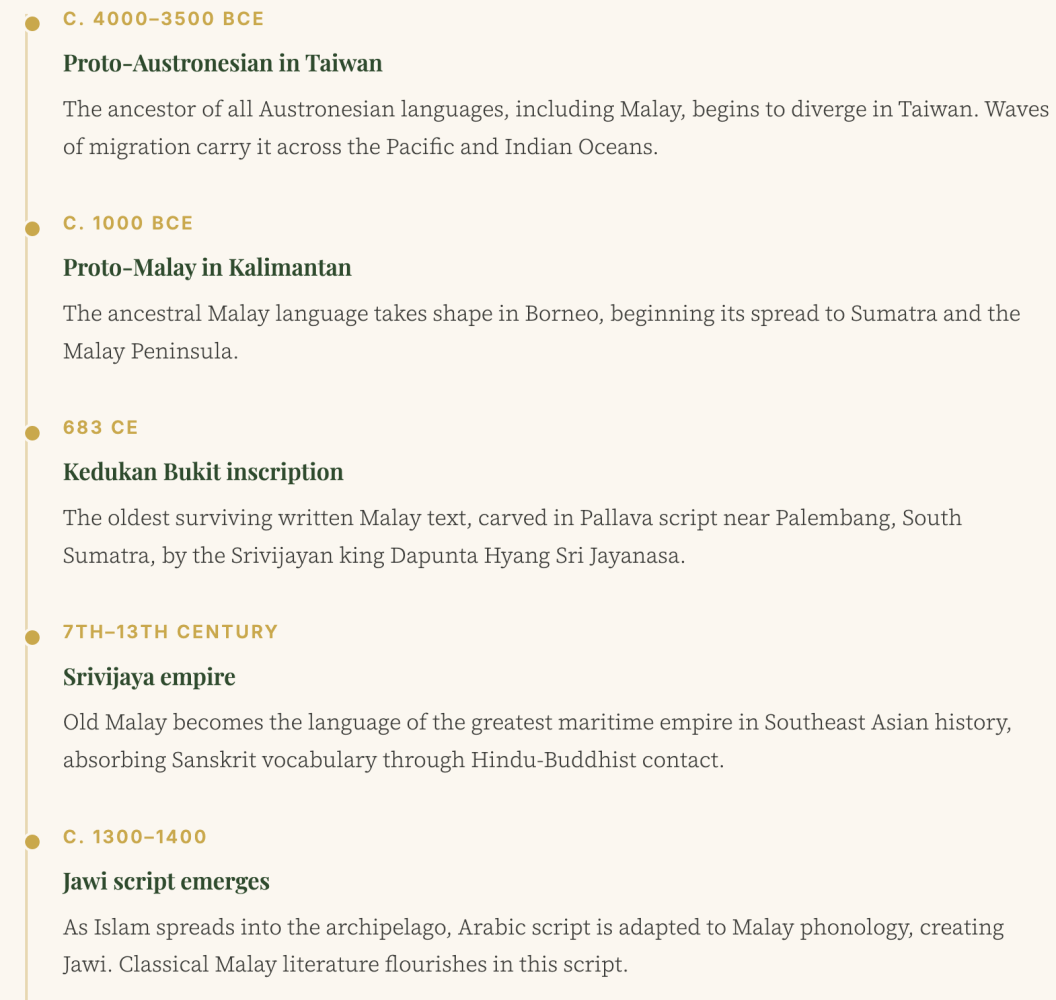
Proto-Austronesian (PAN), which began to diverge around 4,000 to 3,500 BCE, is the reconstructed ancestor of a language family that today stretches from Madagascar in the west to Easter Island in the east, from Taiwan in the north to New Zealand in the south. With roughly 1,270 languages and 386 million speakers, Austronesian is one of the largest language families on earth.
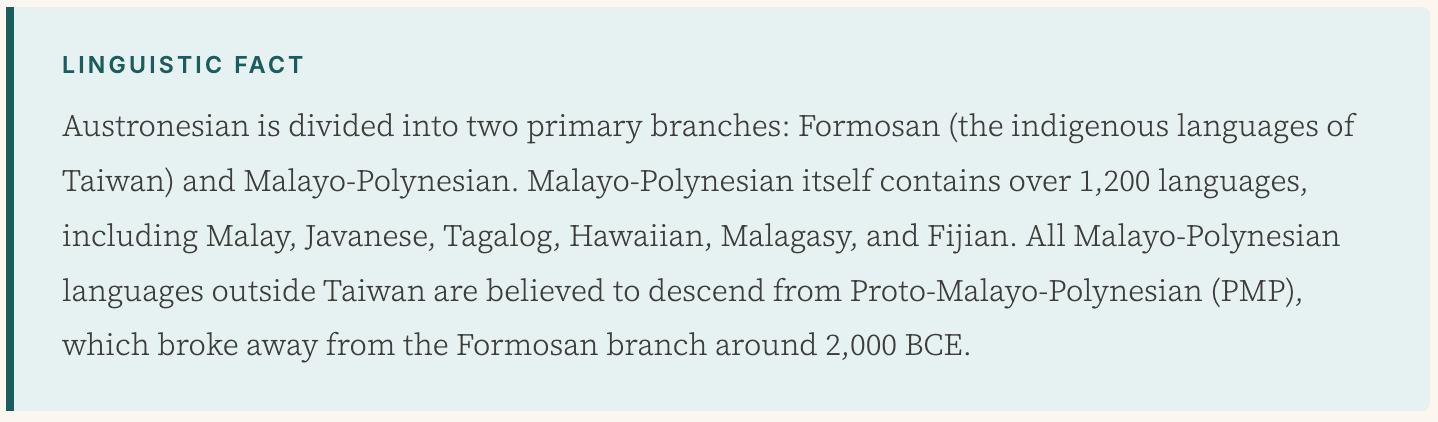
From PMP, a further sub-branch called Proto-Malayic emerged, believed to have been spoken in Borneo (Kalimantan) by at least 1,000 BCE. This is the common ancestor of all Malay dialects, from Minangkabau in West Sumatra to Iban in Sarawak to standard Malay itself. Phonological innovations that mark Proto-Malayic include the merger of the vowels e and a into /a/ (so Proto-Austronesian *gatel became gatal, meaning "itch") and the devoicing of final consonants. These subtle phonological shifts, invisible to the casual observer, are the fingerprints by which linguists trace the ancestry of modern Malay.
Proto-Malay speakers migrated from Kalimantan into the Malay Peninsula and Sumatra in several waves, displacing or absorbing earlier populations. The Austronesian expansion is one of the greatest prehistoric migrations in human history, its sailors navigating open ocean by stars and wind centuries before the age of European exploration.
Shared vocabulary across the Austronesian world
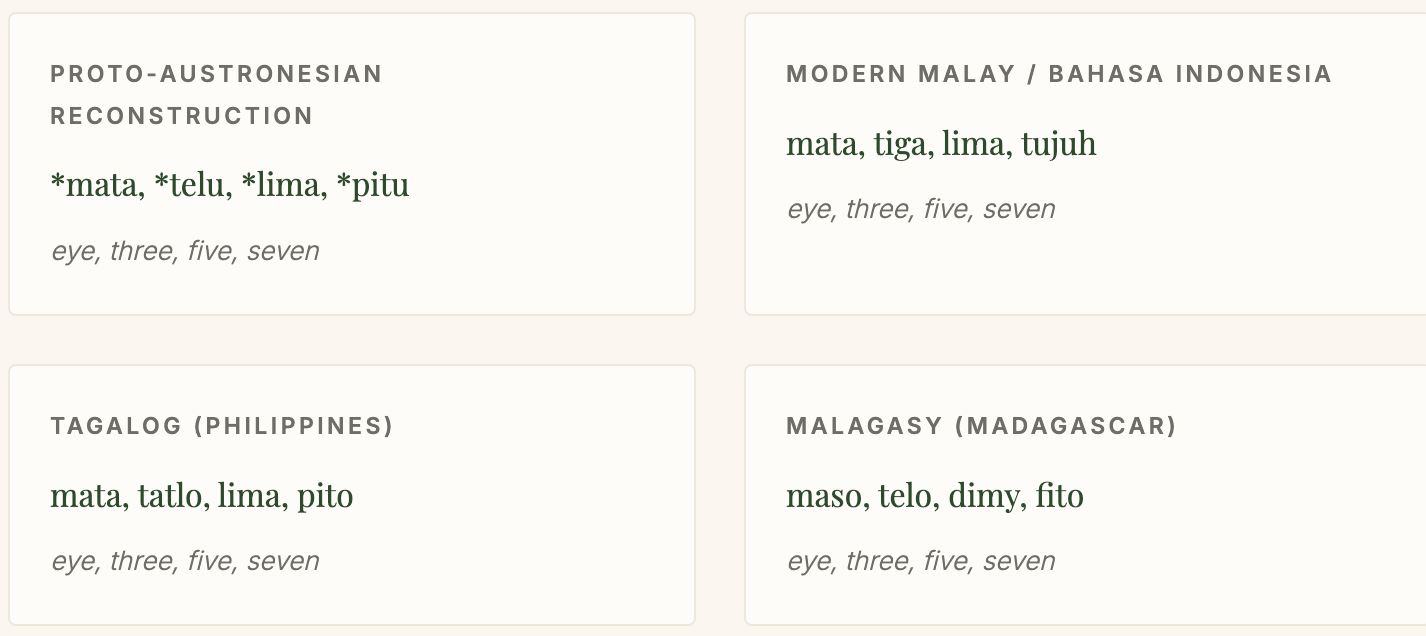
The shared core vocabulary across the Austronesian world is unmistakable. The word for "eye" (mata in Malay/Indonesian, mata in Tagalog, maso in Malagasy) echoes across an ocean-spanning family. Numbers, body parts, kinship terms, and words for the natural world all carry the ghost of Proto-Austronesian, the language spoken by a people who built the world's first oceanic civilisation.
The Empire of Words: Srivijaya and the Birth of Classical Malay
No civilisation shaped the Malay language more profoundly than Srivijaya. Rising in the 7th century CE on the banks of the Musi River near present-day Palembang, South Sumatra, Srivijaya was a thalassocratic empire: a realm whose power flowed not from territory but from mastery of the sea. Between the 7th and 13th centuries, it controlled the Strait of Malacca, the narrow chokepoint through which virtually all trade between India and China was forced to pass.
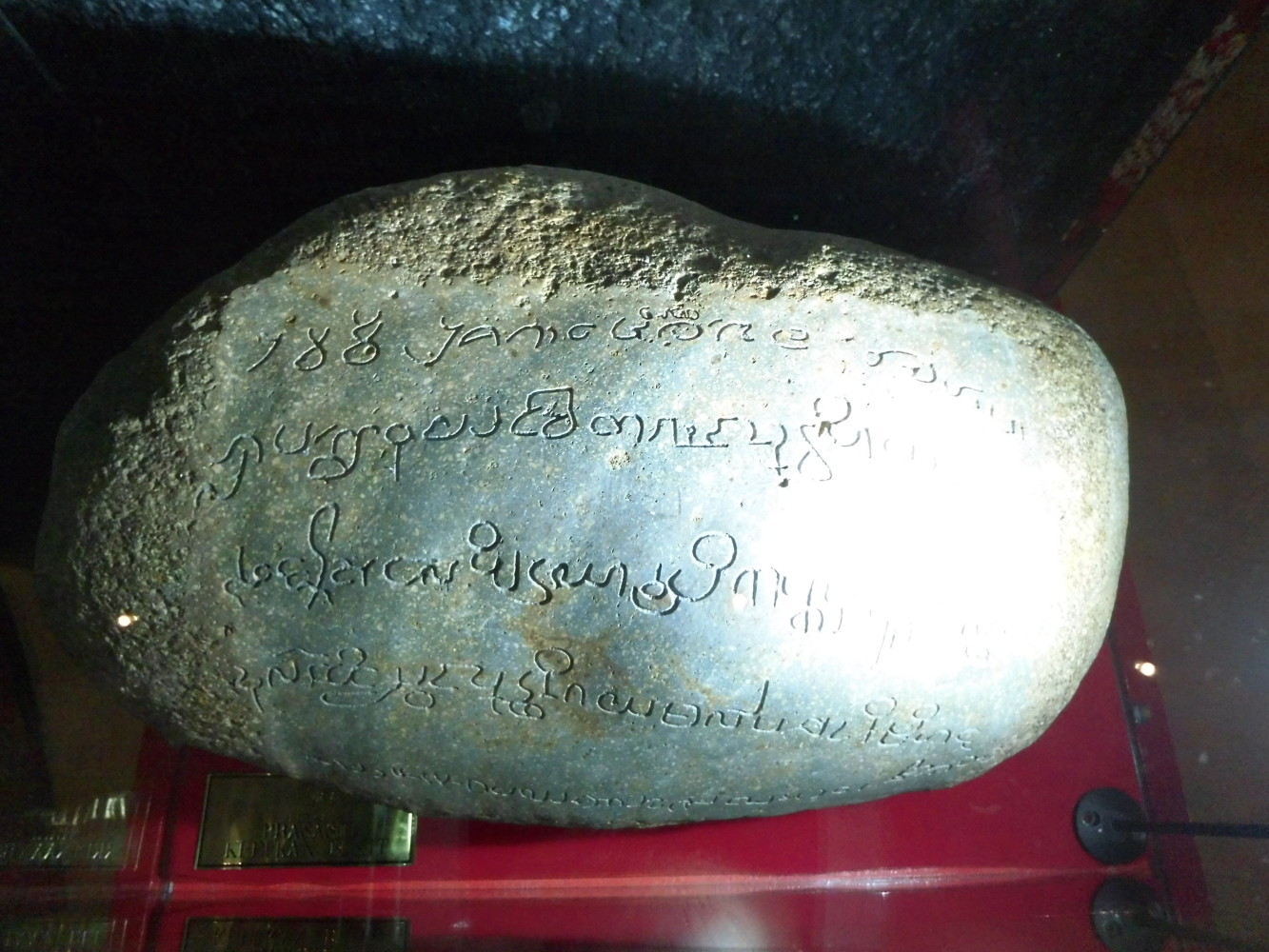
Srivijaya's language was the first form of written Malay we can read today. Four stone inscriptions dated between 683 and 686 CE, written in the Pallava script borrowed from South India, are the oldest surviving documents in the Malay language. They represent a language already sophisticated, already suffused with Sanskrit, already the voice of an imperial court.
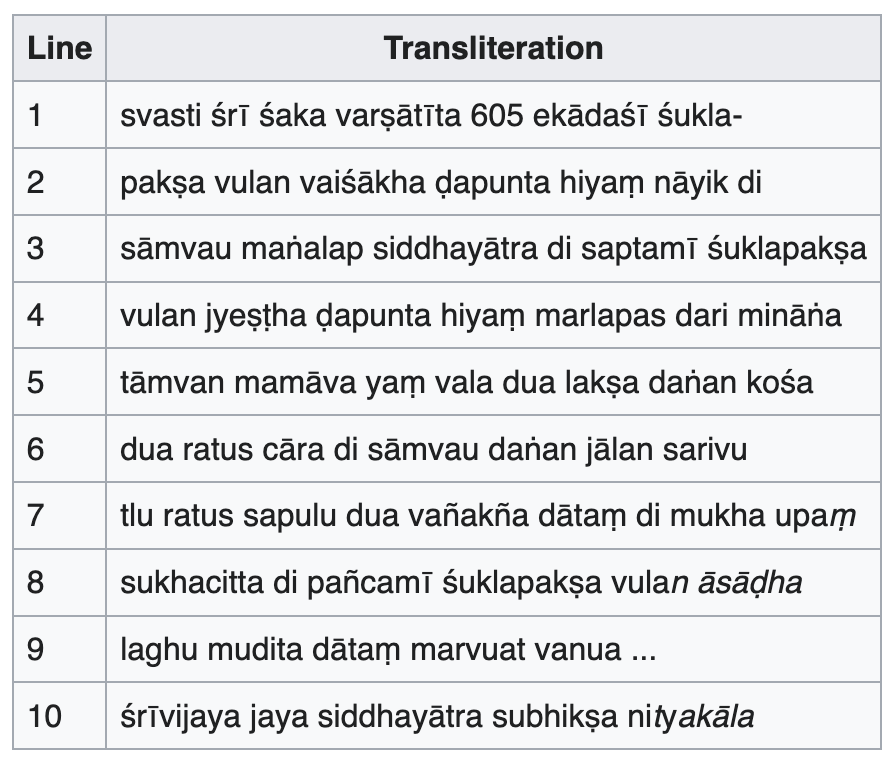
Om swasti astu! All hail and prosperity. In the year 605 of the Saka calendar, on the eleventh day at half-month of Waisaka, Sri Baginda took dugouts in order to obtain siddhayatra.[6] On Day 7, on the 15th day at half-month of Jyestha, Sri Baginda extricated himself from minānga tāmvan.[7] He took 20,000 troops with him ... as many as 200 in dugouts, with 1,312 foot soldiers. They arrived at ... Truly merry on the fifteenth day of the half-month..., agile, happy, and they made a trip to the country ... Great Sriwijaya! Prosperity and riches ...
The Kedukan Bukit inscription, dated 1 May 683 CE, is carved on a small stone measuring 45 by 80 centimetres, today housed in the National Museum of Indonesia in Jakarta. It was discovered by the Dutchman C.J. Batenburg in 1920 on the banks of the Tatang River, a tributary of the Musi. Its language, Old Malay, contains heavy Sanskrit borrowings and is written in the Pallava script, a style of writing originating from the Pallava dynasty of South India that spread throughout Southeast Asia via Buddhist and Hindu missionaries.
The Talang Tuwo inscription (684 CE) is perhaps the most poetic of the Srivijayan texts. It records King Sri Jayanasa's establishment of a public garden for the well-being of all creatures, phrased in language with a distinctly Buddhist compassion. The Kota Kapur inscription (686 CE), found on the island of Bangka, is an imperial proclamation asserting Srivijaya's authority over Java, written in an evolved form of the same Pallava script.
The role of Sanskrit
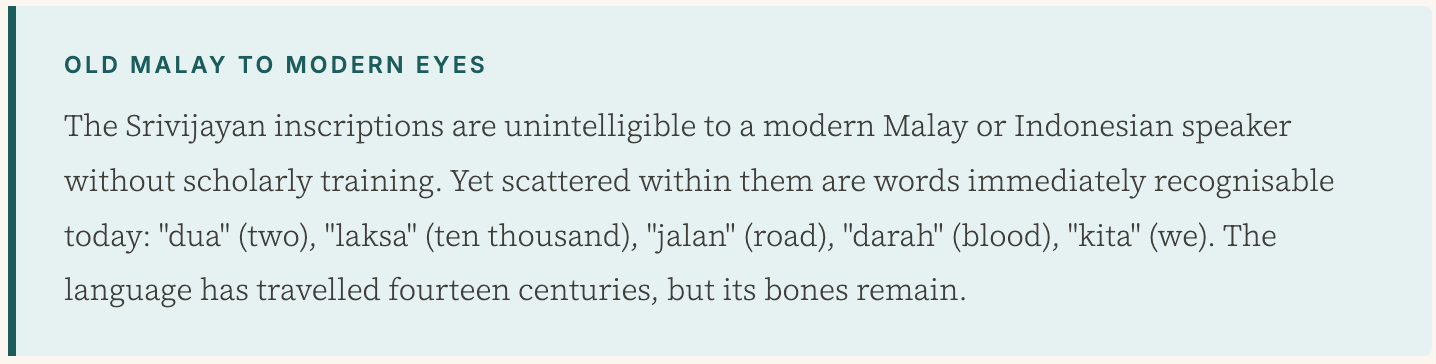
Sanskrit's influence on Old Malay was immense. Through Srivijaya's embrace of Mahayana Buddhism, then later through Hinduism in the Majapahit era, Sanskrit vocabulary entered the language in every domain: royalty (raja, maharaja, dewa), cosmic order (dharma, karma), beauty and knowledge (budaya, bahasa itself, from the Sanskrit bhasha, meaning "language"), and the arts. Scholars estimate that between 600 and 1,000 Sanskrit loanwords survive in modern Malay and Indonesian today.
Srivijaya's legacy was not merely linguistic but institutional. By establishing Malay as the language of commerce, diplomacy, and Buddhist scholarship across the archipelago, it planted the seed of what would, a thousand years later, become the national language of the world's fourth most populous country.
Writing the World: From Pallava to Jawi to Rumi
The history of the Malay language is also a history of its writing systems. To read Malay is to read the record of every civilisation that touched this part of the world: Indian, Islamic, European. Each brought its own alphabet, and each left its mark.

Pallava: the Indian gift
The Pallava script arrived in Southeast Asia with Hindu and Buddhist missionaries from South India between the 4th and 7th centuries. It was a brahmic script, written left to right, and was adapted by Srivijayan scribes to represent the sounds of Old Malay. All of the great Srivijayan stone inscriptions were carved in Pallava or its descendant, Kawi.
Jawi: when Islam rewrote the alphabet
The arrival of Islam in the Malay world in the 13th and 14th centuries transformed not just religion but writing itself. Arabic's prestige as the language of the Quran made its script feel sacred. Malay scribes adapted the Arabic alphabet to their language's sounds, adding six new characters that Arabic lacked: cha (چ), pa (ڤ), nga (ڠ), nya (ڽ), ga (ݢ), and va (ۏ). This adapted script became Jawi.
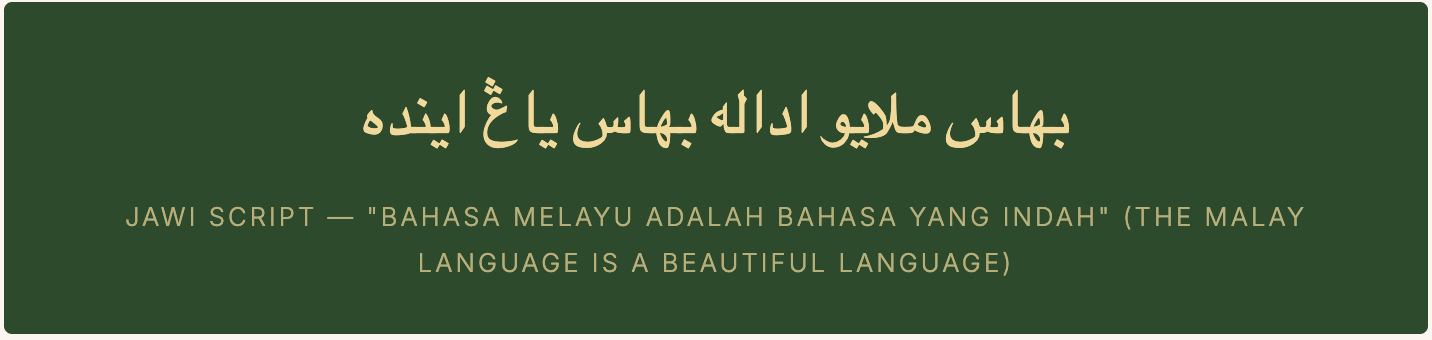
For nearly five centuries, Jawi was the prestige script of the Malay world. The great literary tradition of the Hikayat, the swelling romances and epics of classical Malay literature, was written in Jawi: Hikayat Hang Tuah, the epic of a legendary Malaccan warrior; Sejarah Melayu, the Malay Annals; Hikayat Raja-Raja Pasai, the history of the first Islamic sultanate in the archipelago. Government documents, legal codes, religious treatises, and royal correspondence all moved through Jawi.
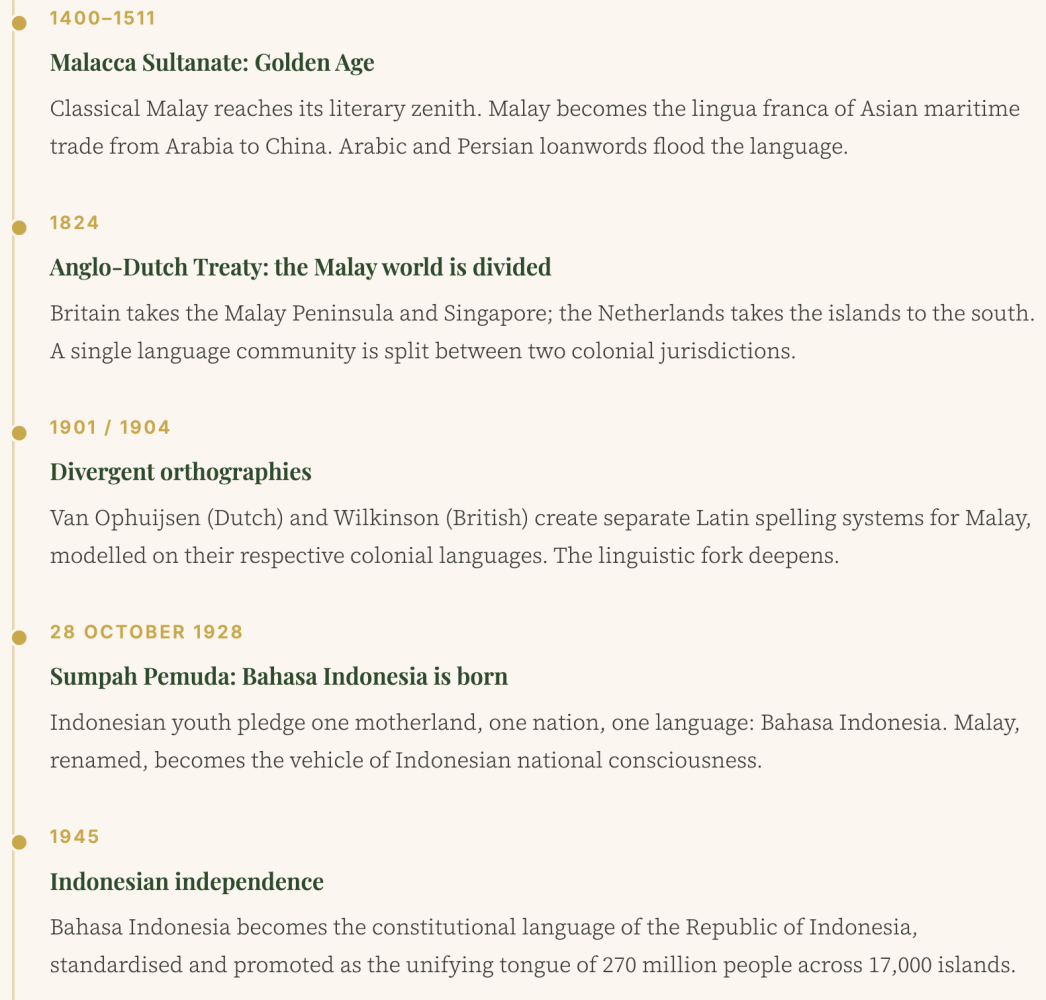
The Malacca Sultanate (1400–1511) was the golden age of Classical Malay, written in Jawi. Malacca's position as the greatest emporium of the medieval Asian trade world made Malay the lingua franca of merchants from Arabia, India, China, and all points between. The Malay of this period was absorbing not only Sanskrit but Arabic and Persian vocabulary at a rapid pace, as Islamic scholarship deepened its roots in the archipelago.
Rumi: the Latin script and colonial standardisation
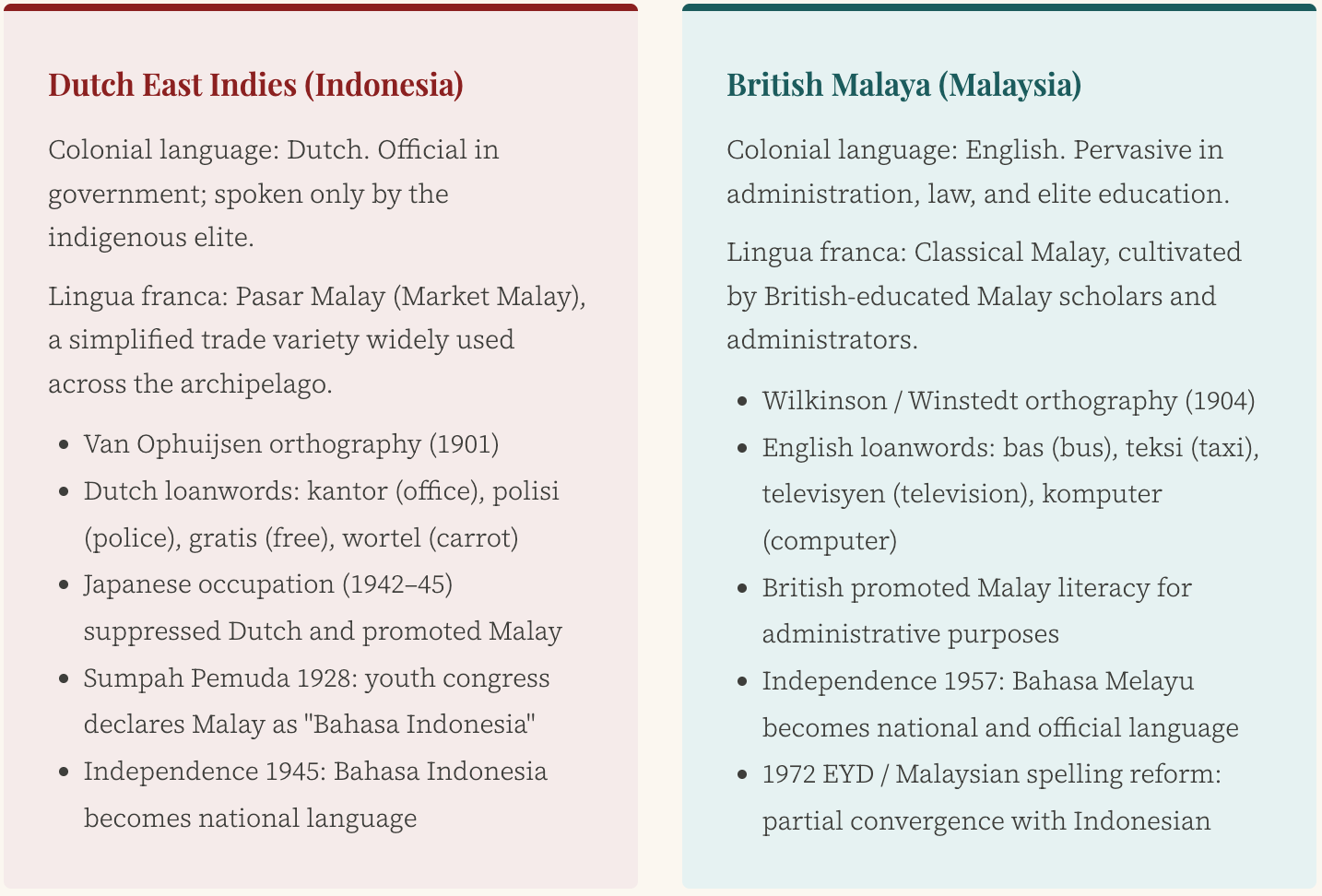
The Portuguese, Dutch, and British each attempted to romanise Malay for their own administrative and missionary purposes. It was the Dutch and the British, however, who created the divergent orthographic traditions that still separate Indonesian from Malay today.
In 1901, Dutch colonial linguist Charles van Ophuijsen created the Van Ophuijsen spelling system for Malay in the Dutch East Indies, modelled closely on Dutch phonology. The letter "j" was written as "dj" (so "jalan" became "djalan"), "c" was written as "tj", and "u" as "oe". These conventions would leave their mark on Indonesian spelling for decades.
In British Malaya, the Wilkinson orthography (1904) and later the Winstedt system created a parallel tradition, reflecting English phonological conventions. The same Malay sound was written differently on each side of what would become a national border.
The Great Fork: How Colonialism Divided a Language
To understand why Bahasa Indonesia and Bahasa Melayu are not the same language today, one must understand a single historical fact: the lines drawn on maps by European powers in the 18th and 19th centuries were not linguistic boundaries. They were commercial ones. When the Dutch and the British carved up maritime Southeast Asia between themselves, they did not ask what language the people spoke. They asked what was worth trading.
The 1824 Anglo-Dutch Treaty was the instrument that formally divided the Malay world. Britain received the Malay Peninsula and Singapore; the Dutch received the islands to the south and east, which would become the Dutch East Indies and eventually Indonesia. A people, a language, a culture was sliced by a treaty negotiated in London, thousands of miles away.
The Birth of Bahasa Indonesia: The Youth Pledge of 1928
On 28 October 1928, in a boarding house on Jalan Kramat Raya 106 in Batavia (modern Jakarta), something extraordinary happened. Delegates from across the Dutch East Indies, representing youth organisations from Java, Sumatra, Sulawesi, and beyond, gathered for the Second Indonesian Youth Congress. At the end of three days of debate, they read aloud three sentences that would change history.
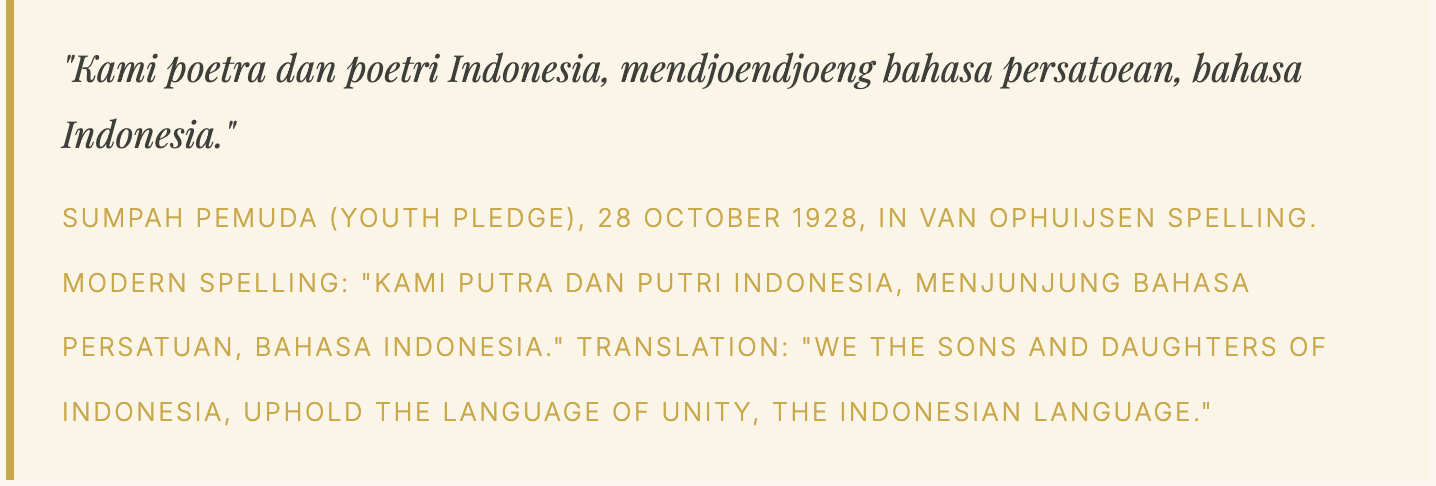
This was the moment Bahasa Indonesia was named. The pledge declared one motherland, one nation, and one language. It was a political act as much as a linguistic one: by naming the language "Indonesian" rather than "Malay", the youth movement was creating a new identity for a colonial subject people who had no nation yet but were already imagining one.
The choice of Malay (rebaptised as Indonesian) over Javanese was deliberate and diplomatically sensitive. Javanese, with its complex levels of speech (ngoko, madya, krama) that encoded social hierarchy in the very grammar, was felt to be inappropriate as a democratic national tongue. Malay, long the language of trade and inter-ethnic communication, carried no such hierarchical baggage. It was, in the words of the nationalist generation, milik bersama, a shared inheritance.
Same River, Different Banks: Comparing Bahasa Melayu and Bahasa Indonesia
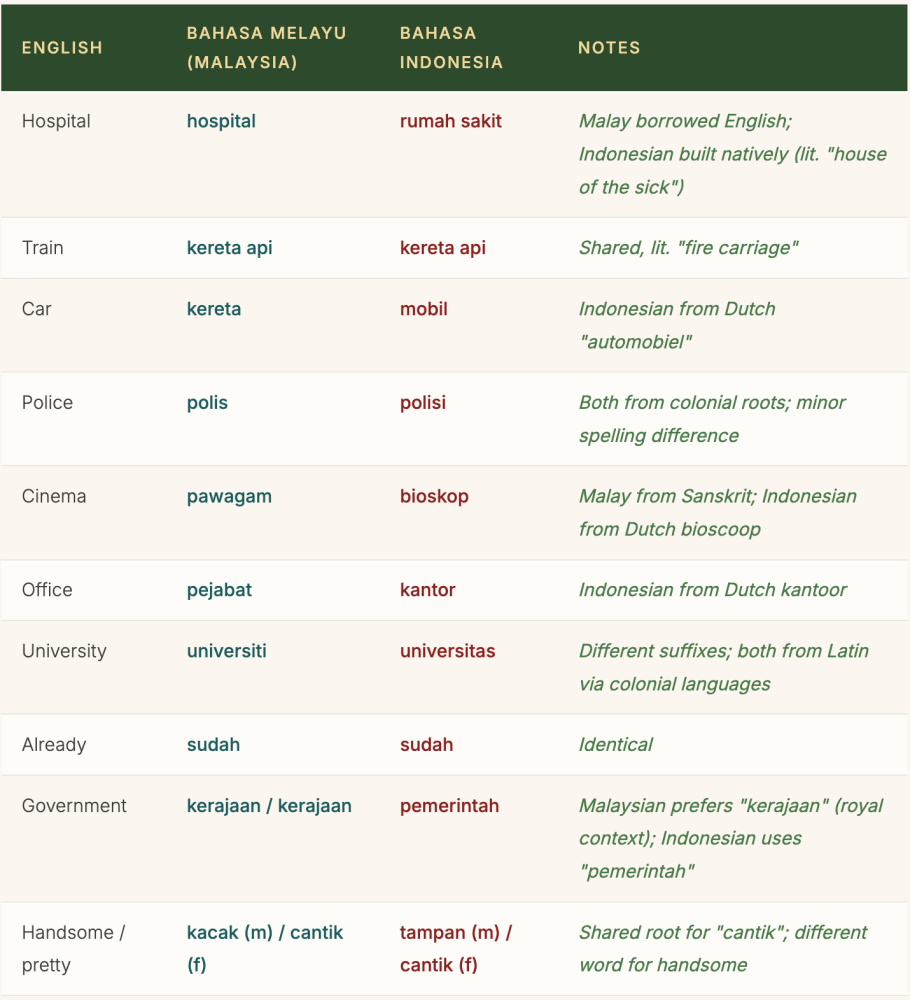
The two languages share the same grammar, the same basic vocabulary, the same system of affixation (prefixes, suffixes, and circumfixes that build meaning from root words), and the same Austronesian soul. A speaker of one can, with some effort, read a newspaper in the other. But the differences are real and, in some cases, striking.
Vocabulary divergences
Spelling convergence and divergence
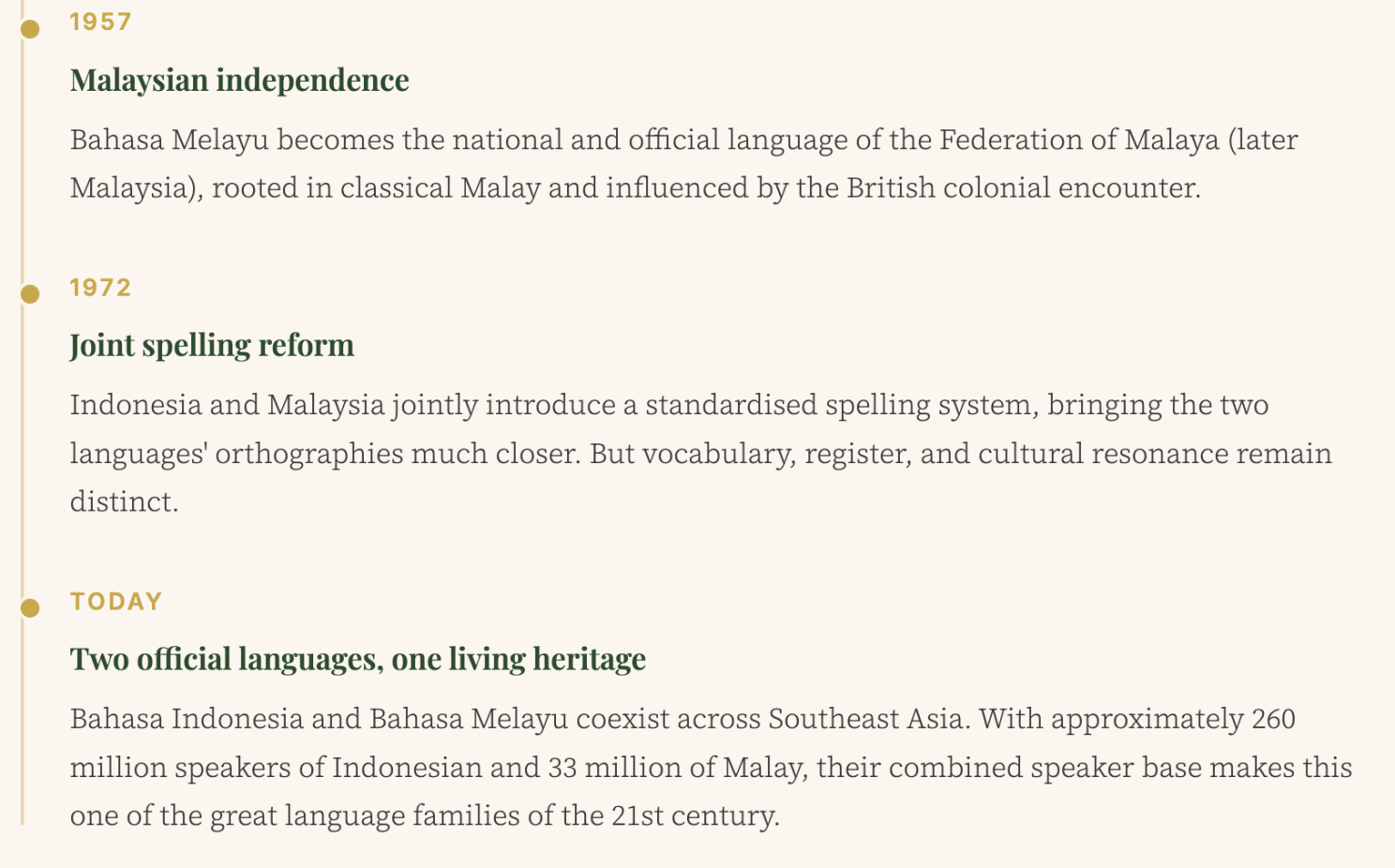
The 1972 joint spelling reform, known as EYD (Ejaan Yang Disempurnakan) in Indonesia and as the Rumi spelling reform in Malaysia, brought the two orthographies significantly closer. The old Indonesian "dj" became "j" (matching Malay), "tj" became "c", "nj" became "ny", and "ch" became "kh". A sentence that once read "Tjobalah mendjaga kebersihan" now reads identically in both countries: "Cobalah menjaga kebersihan" (Try to maintain cleanliness).
Yet remnant differences persist. Indonesian retains the suffix "-kan" in verb forms where Malaysian often uses "-kan" too, but pronunciation and register differ. Certain letters, like "f" and "v" in loanwords, are handled differently. And above all, the vocabulary of modernity, the words that have flooded both languages in the 20th and 21st centuries, entered through different colonial doors and took different forms.
A text across the divide
To illustrate the similarity and difference in practice, consider the same sentence rendered in modern forms of both languages:
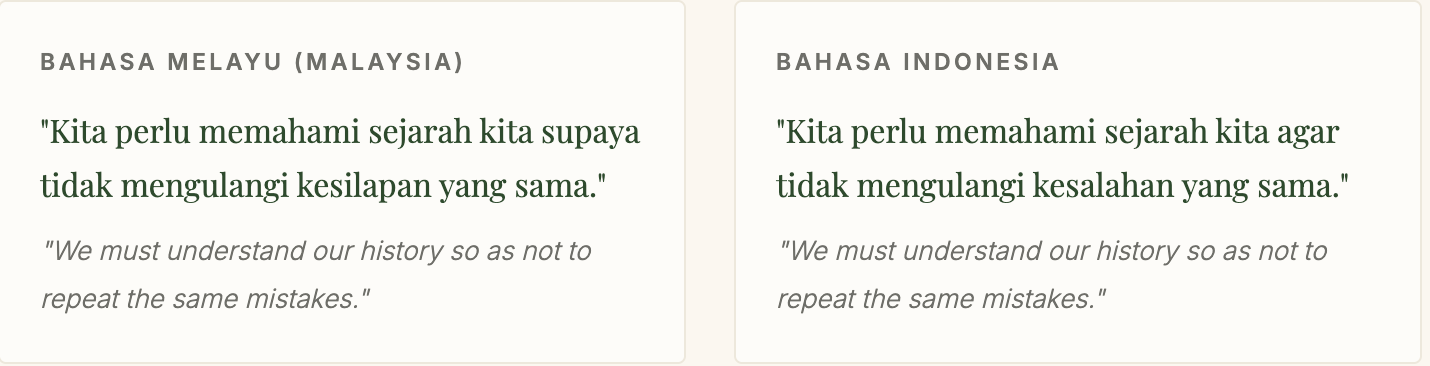
The structural parallel is perfect. The words "kita", "perlu", "memahami", "sejarah", "tidak", "mengulangi", "yang", "sama" are identical. Only two words differ: "supaya" (Malay, meaning "so that") vs "agar" (Indonesian, same meaning), and "kesilapan" (Malay, meaning "mistake") vs "kesalahan" (Indonesian, same meaning). Two rivers, one spring.
The Language of Faith: Islam and the Soul of Malay
No force shaped the Malay language more deeply after Srivijaya than Islam. The arrival of Muslim traders and scholars from Arabia, Persia, and Gujarat in the 13th and 14th centuries transformed not just Malay theology but Malay vocabulary, literature, script, and identity itself.
The Malacca Sultanate's conversion to Islam in the early 15th century set off a cultural revolution. Arabic replaced Sanskrit as the prestige foreign tongue. The Quran made Arabic writing sacred. Jawi script became the vehicle of Malay civilisation. And a vast wave of Arabic and Persian vocabulary entered the language in the domains of religion, law, philosophy, science, and aesthetics.
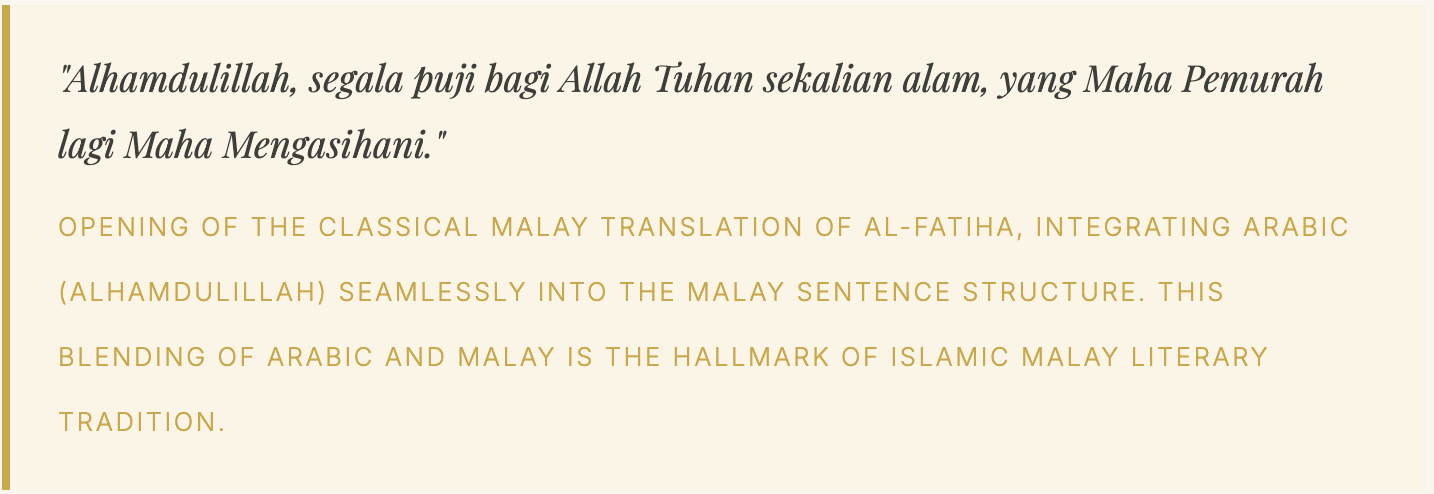
Key Arabic and Persian loanwords that now form the core of both Malay and Indonesian include: "ilmu" (knowledge, from Arabic ilm), "kitab" (book, from Arabic kitab), "waktu" (time, from Arabic waqt), "masjid" (mosque, from Arabic masjid), "dunia" (world, from Arabic dunya), "hakim" (judge, from Arabic hakim), "kabar" (news, from Arabic khabar), "selamat" (safe, from Arabic salamat), and hundreds more.
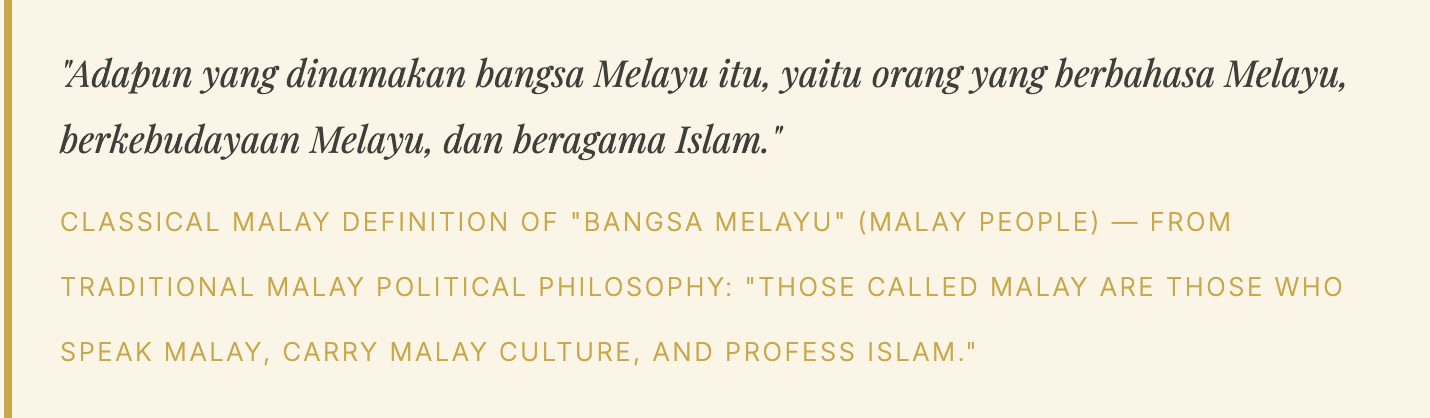
In modern Malaysian Malay, the Islamic identity of the language is more institutionally prominent, as Malay ethnicity is constitutionally linked to Islam in Malaysia. In Indonesian, the language is more explicitly separated from religious identity, as a national language that serves Muslims, Christians, Hindus, Buddhists, and animists alike. This difference in the sociolinguistic relationship between language and religion continues to subtly inflect vocabulary choices, formal registers, and public discourse in the two countries today.
A Thousand Years of Language History
One River Runs Beneath Both
The story of Malay and Bahasa Indonesia is ultimately a story about what survives. It is a story about a language that began with a few thousand people on the coast of Borneo 3,000 years ago and today is spoken by more than 290 million. It is a story about a civilisation, Srivijaya, that built its empire not on armies alone but on words, making its language the common tongue of a civilisation that stretched from Madagascar to the Philippines.
Colonialism did not destroy Malay. In a paradox worthy of history's darkest irony, it amplified it. The Dutch and the British, by suppressing regional languages and operating through Malay intermediaries, inadvertently strengthened the language they sought to subordinate. Indonesian nationalism seized Malay precisely because it was not the language of any single ethnic group, making it the perfect banner for a multi-ethnic anti-colonial struggle.
Islam gave the language its soul, its script, and hundreds of its most resonant words. Sanskrit gave it its classical grandeur. Dutch and English gave it the vocabulary of modernity. And through all of these encounters, the bones of Proto-Austronesian endured: the same word for "eye", the same for "hand", the same for "water", spoken today in a thousand variants from Madagascar to Hawaii, from Jakarta to Auckland.
When a Malaysian says "Selamat datang" and an Indonesian says "Selamat datang," they are both saying welcome. When a Malaysian writes "bahasa" and an Indonesian writes "bahasa," they both mean language. Fourteen centuries after a Srivijayan king carved his victory into a stone on the banks of the Musi River, the language he used, changed almost beyond recognition yet unmistakably continuous, still lives in the mouths of hundreds of millions of people across the world's largest archipelago.
One root. Two rivers. One ocean.
#BahasaMelayu#BahasaIndonesia#Srivijaya#AustronesianLanguages#MalayHistory#ColonialLinguistics#SumpahPemuda#JawiScript#KedatanganIslam#DutchColonialism#BritishMalaya#LanguageHistory#SEAsiaHistory#MalaccaSultanate#MelayuKuno#ProtoBahasaMelayu#RumiScript#IndigenousLanguages#IslandSoutheastAsia#LanguageEvolution
References & Further Reading
- Adelaar, A. & Himmelmann, N. (Eds.) (2005). The Austronesian Languages of Asia and Madagascar. Routledge.
- Blust, R. (2013). The Austronesian Languages. Pacific Linguistics, ANU Press.
- Casparis, J.G. de (1975). Indonesian Palaeography: A History of Writing in Indonesia from the Beginnings to c. A.D. 1500. Brill.
- Coedes, G. (1968). The Indianized States of Southeast Asia. University of Hawaii Press.
- Collins, J.T. (1998). Malay, World Language: A Short History. Dewan Bahasa dan Pustaka.
- Hooker, V.M. (Ed.) (1993). Culture and Society in New Order Indonesia. Oxford University Press.
- Wikipedia: Kedukan Bukit Inscription. Retrieved from en.wikipedia.org.
- Wikipedia: History of the Malay Language. Retrieved from en.wikipedia.org.
- Wikipedia: Youth Pledge (Sumpah Pemuda). Retrieved from en.wikipedia.org.
- Wikipedia: Van Ophuijsen Spelling System. Retrieved from en.wikipedia.org.
- NLB BiblioAsia (2010). "Unveiling Secrets of the Past Through the Passage of Malay Scripts." Vol. 6, Issue 2.
- Paauw, S. (2009). "The Malay Contact Varieties of Eastern Indonesia." University of Buffalo dissertation.
- Pepinsky, T. (2020). "Colonial Imprints: English, French, and Dutch Compared." tompepinsky.com.
- ResearchGate (2025). "Language and Colonialism: A Historical Study on the Development of Dutch Loanwords in Indonesian." doi: 10.13140.
- Sundaland Research Program (2017). "Austronesian Language Family." atlantisjavasea.com.