
OXIUM's Claims Under Pressure: Blacklist Raihan Aqilah Setiawan, a Material Engineering Master, for Promoting It and Spreading Disinformation
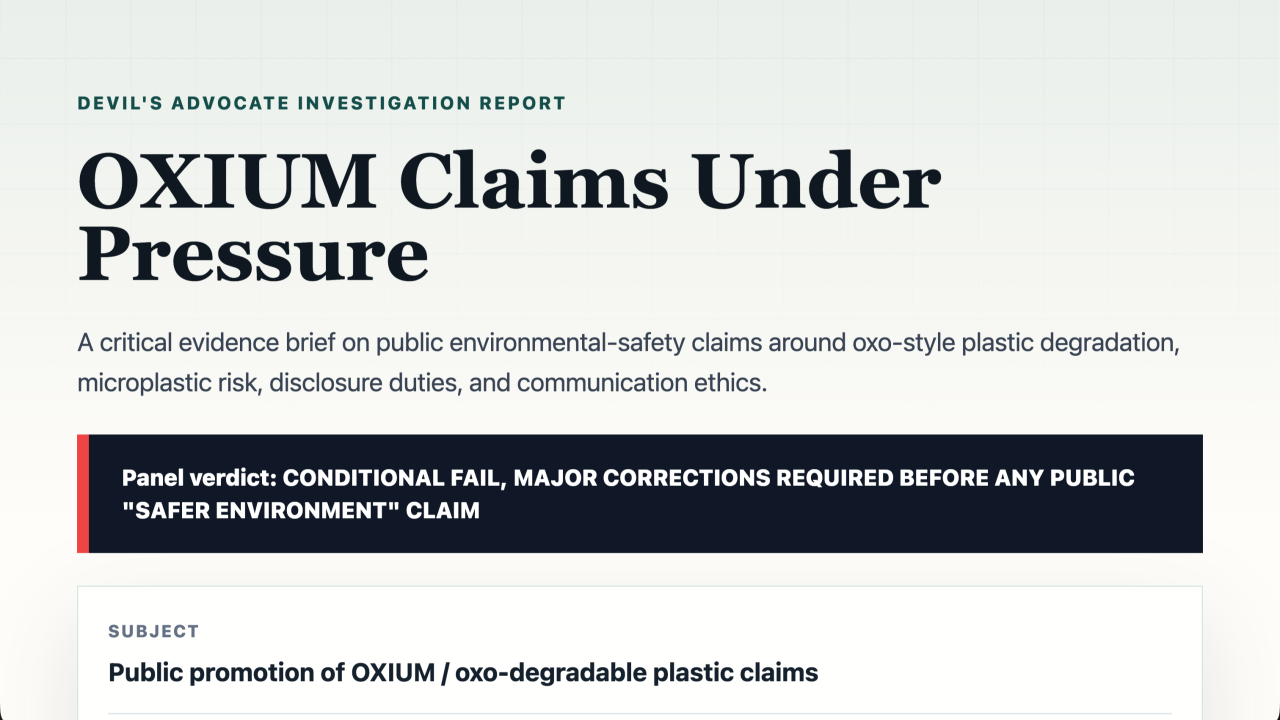
A critical evidence brief on public environmental-safety claims around oxo-style plastic degradation, microplastic risk, disclosure duties, and communication ethics.
Important legal and ethical caveat
This report does not find that Rayhan Aqilah Setiawan, "Material Raqil", OXIUM, or any associated party committed fraud, committed a crime, or intentionally deceived the public. The available source material is too thin for any finding about intent. The adversarial conclusion is narrower and evidence-based: a public environmental safety claim about oxo/oxo-degradable plastic is high-risk unless it proves real biodegradation or mineralization in the relevant receiving environment, discloses limitations, and avoids implying that fragmentation equals ecological safety.

1. Executive Summary
The core claim under attack is that OXIUM is being promoted as a safer option for the environment. If OXIUM refers to an oxo-degradable or pro-oxidant additive system for conventional plastic, the claim sits in one of the most contested zones in plastics communication: a product can become less visible faster while not becoming ecologically safer. That distinction is not a technical footnote. It is the entire case.
The adversarial review finds five major weaknesses. First, the environmental claim appears to rely on visual disappearance, not proven mineralization. Second, the claim risks confusing oxo-degradation with biodegradation or compostability. Third, faster fragmentation can plausibly increase the number of smaller plastic particles available for ingestion, transport, and ecosystem exposure. Fourth, the public communication context is unusually sensitive because the screenshot shows more than 500,000 followers and an explicit material-science education signal. Fifth, the claim appears to lack disclosure about conditions, time scales, residues, ecotoxicity, recyclability, and waste-management compatibility.
The strongest evidence against broad oxo claims comes from institutional and scientific consensus. The Ellen MacArthur Foundation's oxo statement says evidence suggests oxo-degradable plastics fragment into small pieces that contribute to microplastic pollution and supports banning oxo-degradable plastic packaging worldwide until the evidence changes. The European Union went further: Directive 2019/904 prohibits products made of oxo-degradable plastic from being placed on the market. The U.S. Federal Trade Commission has warned that oxo-degradable claims may be deceptive without competent and reliable scientific evidence.
The adversarial position is therefore blunt: a large-audience materials communicator should not promote OXIUM as environmentally safer unless the content clearly answers the proof burden. What exactly is the polymer? What additive chemistry is used? Under what exposure conditions does it degrade? Does it mineralize to CO2, water, biomass, and benign residues? What happens in Indonesian landfills, rivers, beaches, tropical UV exposure, and low-oxygen environments? What is the microplastic particle-size distribution after weathering? What ecotoxicology assays were run? Can recyclers accept it? If these questions are absent, the claim is not education. It becomes environmental persuasion with missing controls.
AEGIS scoring: Environmental claim rigor: 2.0/10. Communication ethics: 3.0/10. Evidence transparency: 1.5/10. Public-risk management: 2.5/10. Composite: 2.3/10.
2. Scope, Method, and Source Constraints
This review uses the provided folder as primary local evidence. The folder contains a one-line allegation document and one screenshot of the public profile. Because the source evidence is limited, the report separates observed facts, reasonable inferences, and unverified allegations.
Observed facts from the screenshot: the account name appears as material.raaaqil, the profile name is "Material Raqil", the profile displays a verified badge, the follower count is approximately 509K, and the bio claims "Creative Learner, S1-S2 Teknik Material ITB". It also displays a company or collaboration reference and a contact number. These observations support an authority-and-reach analysis. They do not by themselves prove a specific OXIUM claim or motive.
Observed facts from the local docs.md: the user alleges that Rayhan promotes OXIUM as safer for the environment, and alleges that OXIUM makes plastic degrade into microplastic faster. The document also asserts that this masks harm and suggests personal benefit. Those motive claims are not treated as proven. The report instead asks what a severe reviewer would demand before accepting or rejecting the public claim.
External evidence was used to evaluate oxo-degradable plastic claims generally. The sources include institutional statements, regulatory material, and environmental marketing guidance. The report does not assume that every OXIUM product is identical to every oxo-degradable material. It does, however, apply a strict burden of proof: if the public-facing message uses the same environmental logic as oxo-degradable marketing, it must answer the same scientific objections.
The structure follows AEGIS devil's advocate practice: evidence inventory, claim decomposition, science attack, regulatory attack, communication ethics, risk matrix, strongest counterarguments, and remediation.
3. Claim Decomposition
The phrase "safer option to the environment" contains several hidden claims. A responsible communicator must not hide those claims inside a friendly phrase.
First, "safer" implies a comparison. Safer than what? Conventional polyethylene? Compostable plastic? Reusable containers? No packaging? Paper? A claim without a comparator is scientifically soft because the audience cannot evaluate the baseline.
Second, "environment" implies a receiving system. Which environment? Industrial composting, managed landfill, open soil, beach, river, marine water, mangrove sediment, or recycling stream? Oxidative fragmentation depends on conditions such as oxygen, heat, UV exposure, moisture, and residence time. A product that behaves one way in a lab oven may behave differently in a shaded drainage canal or low-oxygen landfill.
Third, "degrades" is not the same as "biodegrades". Degradation can mean physical breakdown, molecular weight reduction, oxidation, embrittlement, fragmentation, or biological mineralization. A public claim that compresses these meanings into one green word is vulnerable to greenwashing.
Fourth, "safer" must include endpoints. Does the product reduce macro-litter? Does it reduce microplastic load? Does it reduce ecotoxicity? Does it reduce greenhouse emissions? Does it improve recyclability? Does it improve waste-management economics? It can improve one endpoint while worsening another.
Fifth, "option" implies a policy recommendation. If a creator tells 509K followers that an additive plastic is an environmental solution, the content may influence purchasing, brand acceptance, and disposal behavior. The communication burden rises because the claim may change behavior at scale.
The adversarial conclusion: the claim is under-specified at every level. Unless the original content contains rigorous qualifiers not present in the provided source, the phrase is too broad to survive a hostile materials, ecology, or consumer-protection review.
4. Science Attack: Fragmentation Is Not Disappearance of Risk
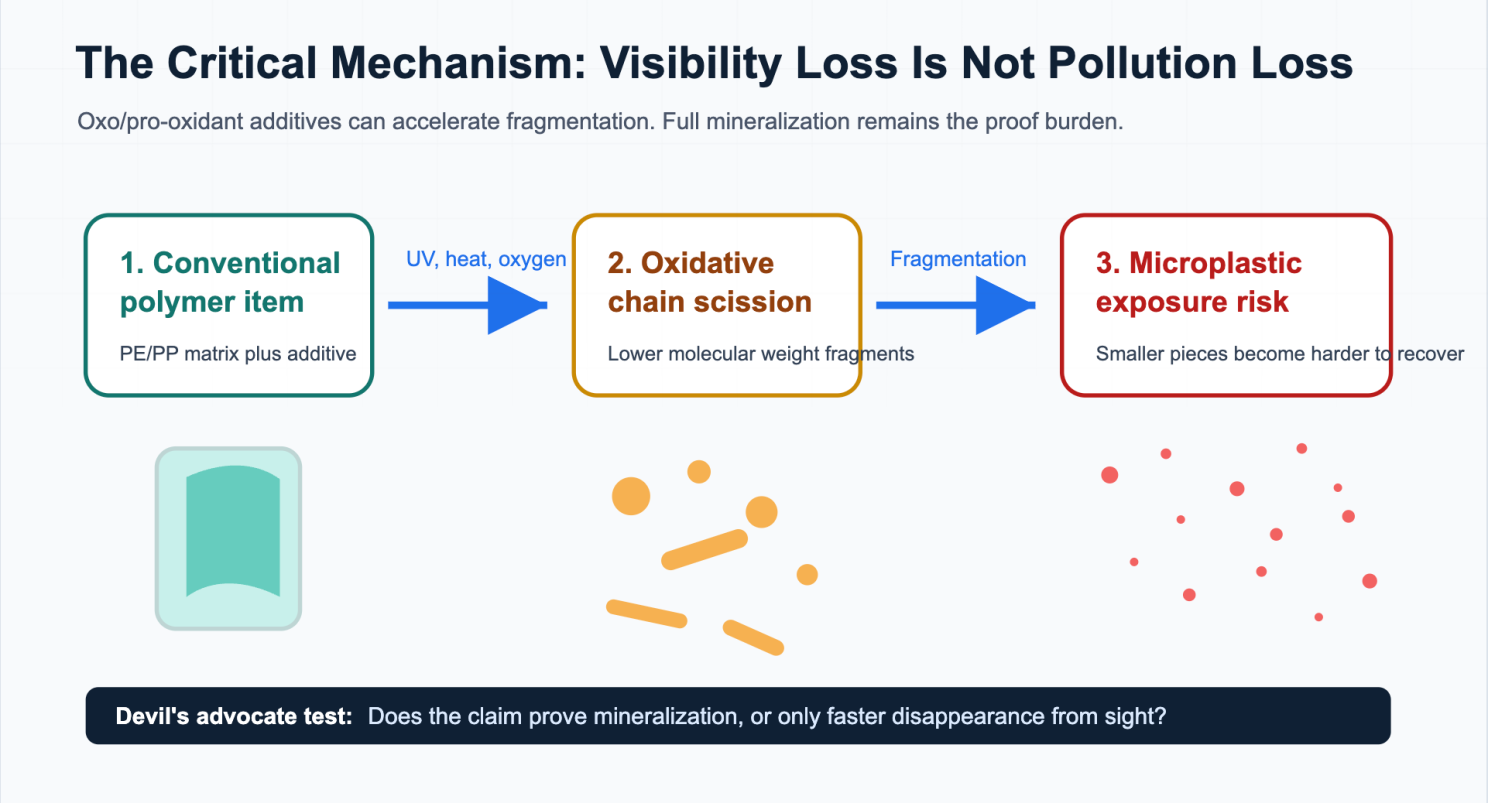
Figure 2. Oxo-style environmental claims often benefit from the visual effect of faster fragmentation. The ecological endpoint must be mineralization and harm reduction, not disappearance from sight.
The central weakness is mechanistic. Oxo-degradable plastics typically use additives that accelerate oxidative breakdown of the polymer chain. That can make the plastic embrittle and fragment faster. But the environmental claim only becomes strong if fragmentation is followed by sufficiently rapid biodegradation and mineralization under real-world conditions.
This is where the devil's advocate attack becomes severe. A plastic item that breaks into smaller fragments can be harder to recover, easier to transport, easier for organisms to ingest, and more likely to enter sediment or water-column pathways. The public may see less visible litter and infer success. The ecosystem may receive more dispersed particles.
The phrase "degrade faster" is therefore a trap. Faster is not automatically better. Faster fragmentation can be worse if it increases microplastic generation before collection. A material-science communicator should know this distinction and should state it explicitly.
The burden of proof should include particle-size distribution over time, residual molecular weight, mineralization percentage, ecotoxicity outcomes, heavy metal or additive residue analysis, and field performance in relevant Indonesian waste pathways. Without those data, the claim remains a marketing story with a science costume.
AEGIS severity: Critical. The claim's core mechanism can be interpreted as a defect, not a benefit, unless full environmental fate is demonstrated.
5. Microplastic Exposure and Marine Animal Risk
The allegation says faster fragmentation accelerates marine animal toxification. That specific causal chain needs careful wording. "Toxification" is too broad if it implies a measured outcome in a specific species without evidence. The stronger, more defensible critique is this: faster fragmentation plausibly increases microplastic exposure risk if material enters aquatic systems before complete mineralization.
Microplastics can be ingested by marine organisms. They can cause physical stress, false satiation, inflammatory responses, and act as carriers for additives or sorbed pollutants depending on polymer, particle size, organism, and exposure context. The risk is not identical for every particle and every ecosystem, but the precautionary logic is powerful: making plastic smaller before it is captured shifts pollution from visible litter management into diffuse ecological exposure.
The environmental defense of oxo systems often argues that fragmentation is only the first step and biodegradation follows. A hostile examiner asks: where is the field proof? What percentage mineralizes before the fragments reach marine systems? Under what humidity, UV, salinity, temperature, and microbial conditions? What happens in the monsoon-driven river-to-ocean pathway common in Indonesian coastal pollution? What happens when plastics are buried under sediment, shaded by organic matter, or trapped in low-oxygen landfill cells?
The public claim must not present a best-case lab sequence as an ordinary environmental outcome. If the content says "safer" but does not say "only under these conditions, over this time scale, with these residues, and not as a license to litter," it fails basic science communication ethics.
6. Regulatory Attack: EU Ban as a Warning Signal
The EU Single-Use Plastics Directive prohibits placing products made of oxo-degradable plastic on the market in the EU. This does not automatically determine Indonesian law, and it does not prove that every OXIUM claim is illegal. It does, however, provide a strong regulatory warning signal. When a major jurisdiction explicitly targets a material category, public communicators should treat promotional claims as high-risk.
The regulatory logic is not merely aesthetic. It reflects concern that oxo-degradable plastics may not properly biodegrade and may contribute to microplastic pollution. From a devil's advocate perspective, that means any creator promoting the category as environmentally safe must explain why the EU concern does not apply to the specific product being promoted.
A credible public post would say something like: "This is not compostable; it is not a reason to litter; performance depends on conditions; regulators in some jurisdictions have banned oxo-degradable plastics; here is independent evidence showing the product's actual fate." A weak post skips that and presents the material as a green shortcut.
The severe critique is that omission of regulatory context can mislead by silence. Audiences do not know what questions to ask. A materials communicator does.
Severity: High to Critical. The EU position does not end the debate, but it makes simplistic "safer" messaging irresponsible unless specifically rebutted.
7. Marketing Law Attack: Substantiation or Silence
The U.S. Federal Trade Commission has warned that oxo-degradable claims may be deceptive if marketers lack competent and reliable scientific evidence. This is not just an American legal footnote. It is a useful global standard for environmental claims: if a green claim is likely to influence consumer behavior, the claim-maker must substantiate it.
For an influencer or science communicator, the burden is ethically similar even if the legal category differs. A creator should not be able to evade substantiation by saying, "I am only educating" while communicating a sponsor-aligned environmental advantage. If the content has commercial context, affiliate benefit, collaboration benefit, or brand lift, the demand for clarity rises.
The attack is especially strong if the original content uses terms such as "eco", "safe", "green", "biodegradable", "degradable", "environmentally friendly", or "solution" without exact qualification. Environmental language has persuasive force. It can lower skepticism and make audiences feel virtuous about consumption.
The minimum substantiation package should include independent tests, product formulation boundaries, disposal pathway assumptions, comparative lifecycle analysis, microplastic endpoint analysis, and plain-language disclaimers. If the claim lacks those, the correct public posture is not confident promotion. It is uncertainty disclosure.
Severity: Critical. Environmental benefit claims require proof before reach, not after backlash.
8. Authority Attack: Material-Science Credentials Raise the Standard
The screenshot shows an education signal: "S1-S2 Teknik Material ITB". That matters because the audience can reasonably infer technical competence. If a person with material-science training promotes an environmental material claim, the communication is not received as casual opinion. It is received as expert-filtered information.
This creates an ethical asymmetry. The average follower cannot distinguish oxidative chain scission, biodegradation, compostability, mineralization, and ecotoxicological safety. The communicator can, or should. Therefore, failure to distinguish them is not a minor simplification. It is a material omission.
The adversarial question is brutal: if the creator knows the difference, why was the difference not centered? If the creator does not know the difference, why present the claim to 509K followers with confidence?
This is not an accusation of bad faith. It is an accountability standard. Expertise is not just a credential that makes content more persuasive. It is a responsibility to reduce confusion, especially where the market has a history of green claims that outpace evidence.
Severity: High. The same words from a non-expert might be sloppy; from a materials educator, they are potentially audience-shaping misinformation unless carefully qualified.
9. Reach Attack: 509K Followers Converts Error Into Systemic Risk
The screenshot shows approximately 509K followers. At that scale, even a small misunderstanding can matter. If 1% of viewers accept the claim uncritically, that is thousands of people. If brands reuse the content, the claim can spread beyond the original post. If the post normalizes additive-based plastic as a sustainability solution, it can weaken public pressure for reduction, reuse, refill, collection, and true circularity.
Large reach also changes the evidentiary duty. A private classroom discussion can entertain hypotheses. A public promotion should separate hypothesis from established fact. The creator's content should not simply ask, "Can this material break down faster?" It should ask, "Does this material reduce total environmental harm under realistic disposal conditions?"
The harshest reading is that high-reach promotion of oxo claims creates a moral hazard: consumers may feel less guilt about single-use plastic because the product is framed as safer. That can increase consumption or reduce proper disposal effort. Even if the material slightly reduces one form of visible litter, the behavioral rebound can erase gains.
Severity: High. Reach does not prove harm, but it increases the potential blast radius of an under-qualified claim.
11. Greenwashing Architecture
Greenwashing does not require a lie in every sentence. It often works through selective truth. "This plastic breaks down faster" may be true under certain conditions. The misleading leap is "therefore it is safer for the environment."
The report identifies a likely greenwashing architecture:
- Use a technical additive story to create novelty.
- Show or imply faster degradation.
- Let audiences interpret disappearance as ecological benefit.
- Avoid hard endpoints such as mineralization, toxicity, and recyclability.
- Use a trusted educational persona to lower skepticism.
- Keep the message emotionally simple: old plastic bad, OXIUM better.
This architecture is persuasive because it meets a psychological desire. People want plastic convenience without plastic guilt. Oxo claims offer a clean narrative: keep the product, add chemistry, solve the problem. A devil's advocate rejects that narrative unless the evidence is unusually strong.
The correct educational framing should be more uncomfortable: "A material can fragment faster and still be environmentally problematic. The sustainability hierarchy still prioritizes reduction, reuse, collection, recycling quality, and verified compostability or biodegradation in defined conditions."
Severity: Critical if the original content lacked these distinctions.
12. Evidence Burden: What Must Be Proven
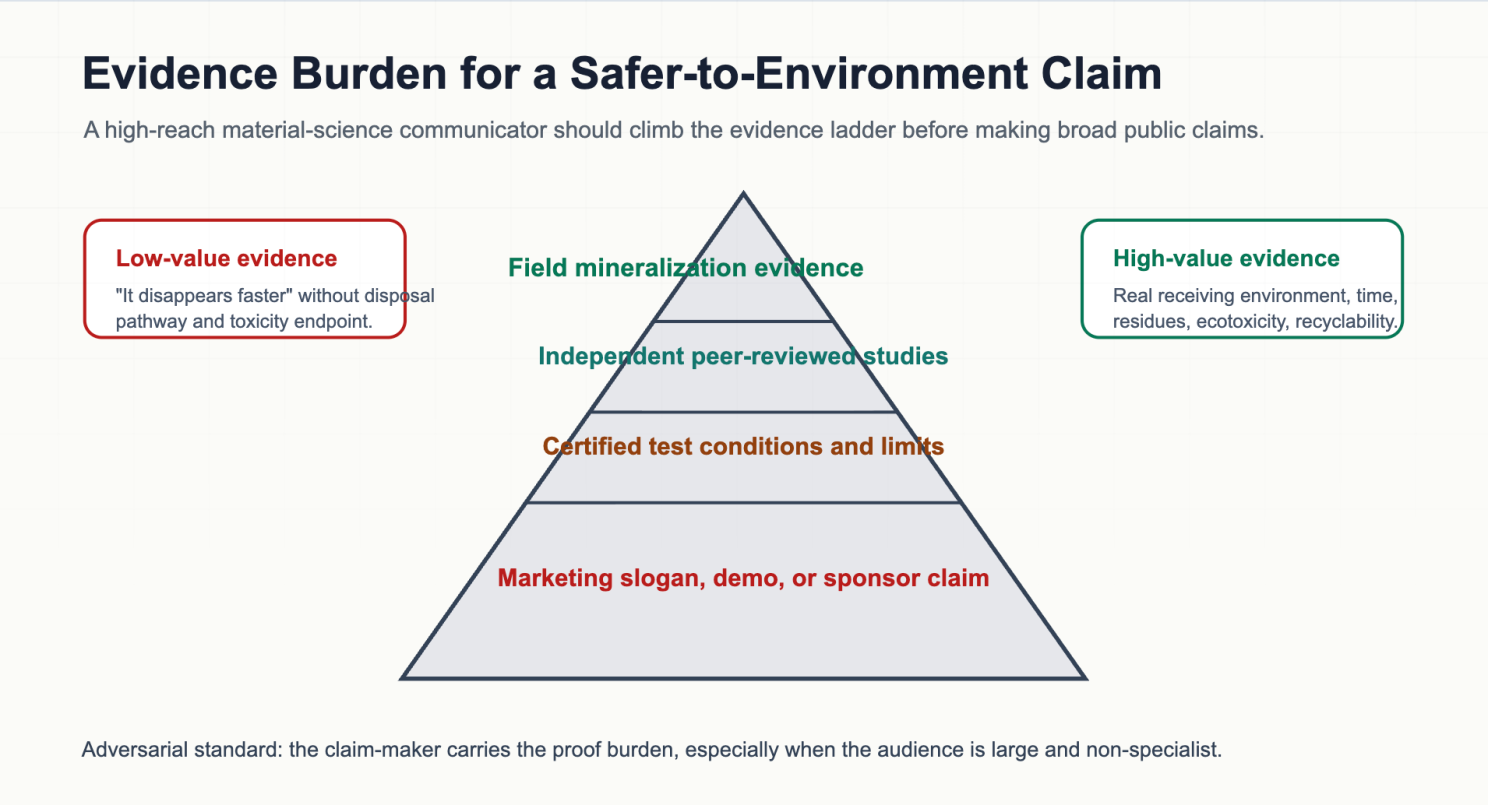
Figure 3. Evidence hierarchy. A broad environmental claim should rest near the top of the pyramid, not on slogans, demonstrations, or brand-provided tests alone.
The product promoter should answer at least twelve evidence questions.
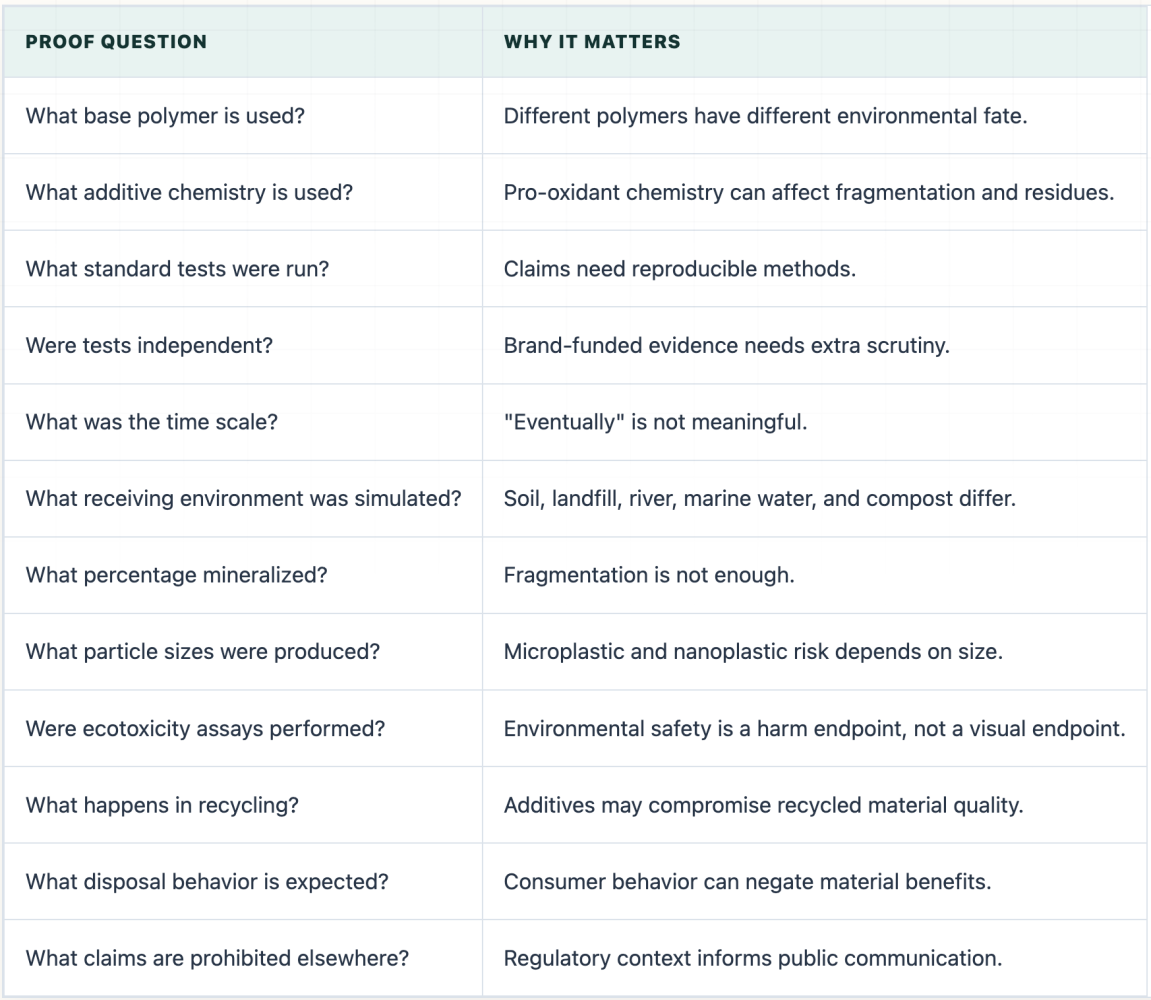
If these questions are not answered, the claim should be downgraded from "safer" to "unproven under real-world conditions."
13. Recyclability Attack
Oxo-degradable additives can create concern for recycling streams because they are designed to alter polymer stability. Recyclers need predictable material performance. If additive-treated plastic enters a recycling stream, it may affect durability, processing consistency, or downstream product quality depending on formulation and concentration.
The public environmental claim is incomplete if it talks only about degradation after littering. A responsible circular-economy claim should first ask whether the material supports high-value collection and recycling. A product that fragments faster after escape may still be inferior to one that is collected, sorted, and recycled.
This critique matters in Indonesia because waste systems are heterogeneous. Some material may be collected by formal systems, some by informal waste pickers, some burned, some buried, some leaked into waterways. An additive that makes plastic less durable could harm recycling value while not solving leakage. The result can be a double failure: weaker circularity and continued pollution.
The adversarial question: did the creator discuss recycling compatibility? If not, the "safer" claim is missing a major environmental dimension.
Severity: Medium to High. The exact risk is product-specific, but omission of the issue is a serious communication gap.
14. Indonesian Context Attack
Indonesia's plastic-waste context makes simplistic degradation claims especially dangerous. A meaningful claim should be tested against local waste pathways: dense urban collection gaps, river leakage, coastal transfer, informal recycling economics, open burning, landfill conditions, tropical heat, monsoon transport, and marine biodiversity exposure.
The claim "safer to the environment" is not portable unless it is local. A result from a controlled test or foreign certification does not automatically answer Indonesian exposure. The public should not be asked to infer that a material works in Indonesian rivers, beaches, and landfills unless those pathways were studied.
The severe critique is that OXIUM promotion may shift attention away from upstream solutions that are more robust: less single-use packaging, refill systems, stronger collection, deposit return, reuse logistics, and better sorting. Additive claims are attractive because they promise less behavior change. That is precisely why they need strict scrutiny.
If the promoted message did not address Indonesian waste realities, it is not just incomplete. It may be locally misleading.
Severity: High. Local environmental fate is not optional when the audience and market are local.
15. Public Health and Food Chain Attack
Public health claims must be handled carefully. It would be overstatement to say that a specific OXIUM item has been proven to poison humans without product-specific exposure data. But it is fair to say that microplastic generation raises legitimate public-health and food-chain questions.
Particles can move through aquatic food webs. Seafood exposure is one pathway of concern. Additives and sorbed contaminants create additional uncertainty. The public-health problem is not just toxicity in a narrow chemical sense; it is chronic exposure uncertainty at scale.
A responsible communicator should not reassure the public merely because a plastic becomes less visible. The correct public-health posture is: "Smaller plastic particles are not automatically safer; in some cases they are harder to monitor and recover." If the original content failed to communicate that, it created false reassurance.
The adversarial standard: any claim that a plastic additive is safer should include a toxicological uncertainty statement. Absence of a warning should be treated as a weakness, not a neutral omission.
Severity: Medium to High. Product-specific harm is unproven from the local evidence, but the risk pathway is serious enough to demand disclosure.
16. The Strongest Case Against the Promotion
The strongest case is not "Rayhan is a scammer." That is too motive-dependent and under-evidenced. The strongest case is: a materials-educated, high-reach creator appears to have promoted an environmental safety frame for a contested oxo-style plastic technology without the disclosures necessary to prevent public misunderstanding.
That case can be made even if the creator believed the claim. It can be made even if OXIUM has some laboratory evidence. It can be made even if the content was intended to educate. The issue is not only intention. The issue is the expected effect on audience belief.
If the audience comes away thinking "this plastic is safe because it breaks down faster," the communication has failed. If the audience is not told that regulatory bodies and circular-economy institutions dispute oxo claims, the communication has failed. If the audience is not told that fragmentation can produce microplastics, the communication has failed. If the audience is not told that disposal conditions matter, the communication has failed.
The panel's harsh conclusion: the promotion, as described, deserves public correction, evidence disclosure, and a stronger disclaimer. It should not be treated as a harmless science fact.
17. Counterarguments and Stress Test
A fair report must test the other side.
Counterargument 1: OXIUM may not be ordinary oxo-degradable plastic. Response: possible. Then the promoter should publish the mechanism, standards, and independent evidence. Until then, a safer-environment claim remains unproven.
Counterargument 2: Fragmentation plus biodegradation can occur after oxidation. Response: possible under some formulations and conditions. The claim still needs real-world mineralization and ecotoxicity evidence. The public cannot be asked to trust the phrase "biodegradable" without conditions and time scales.
Counterargument 3: Conventional plastic is worse because it persists visibly for decades. Response: visible persistence is a real problem. But replacing visible macroplastic with invisible microplastic is not automatically an improvement.
Counterargument 4: The content may have included disclaimers not present in the source folder. Response: if so, the verdict should be updated. This report is conditional on the provided evidence and the alleged promotional frame.
Counterargument 5: Critics are biased against industry innovation. Response: innovation is welcome, but environmental claims require proof. Skepticism is not anti-innovation; it is quality control.
The counterarguments reduce certainty about product-specific harm. They do not rescue an under-qualified public claim.
18. Risk Matrix
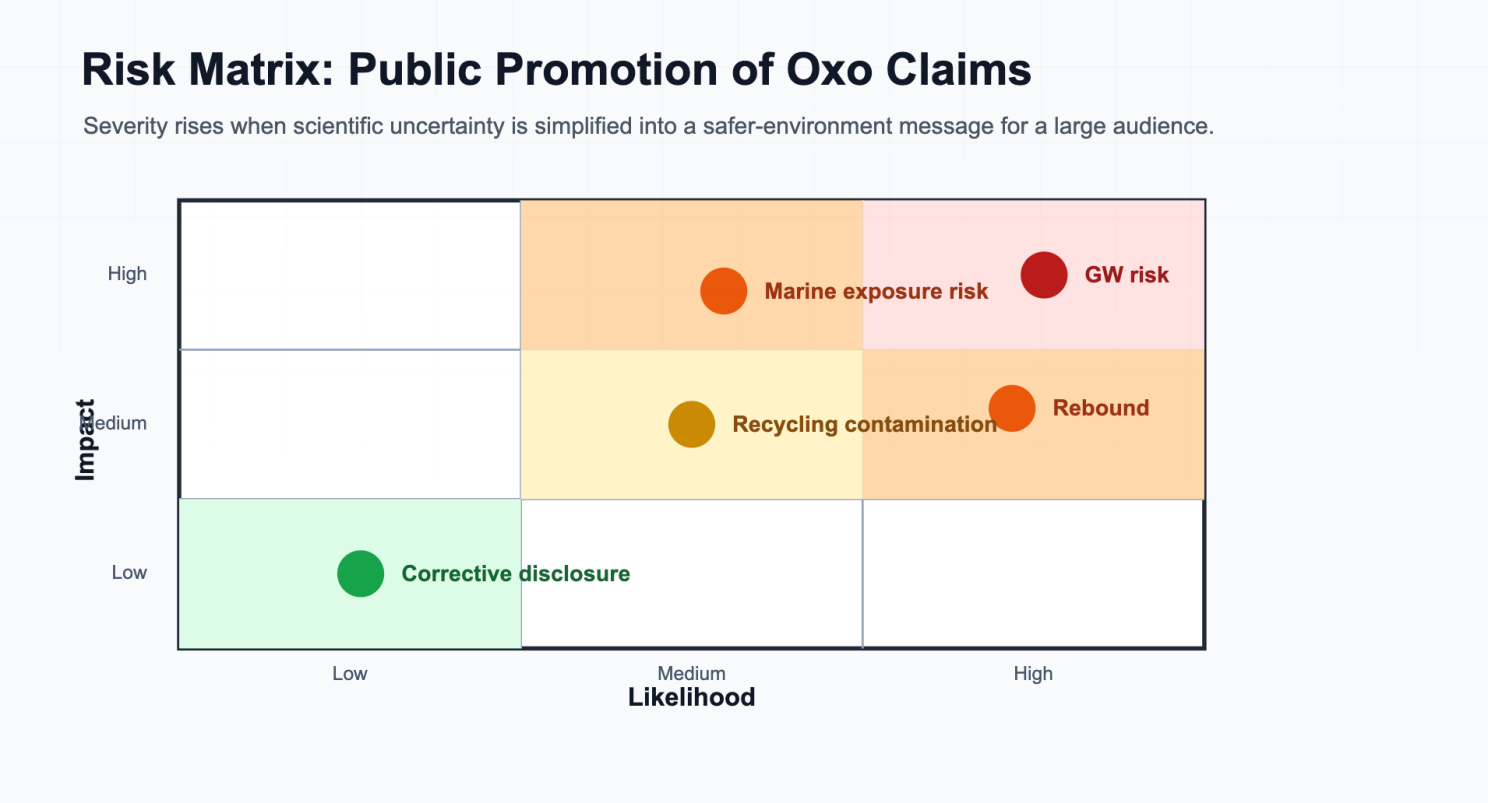
Figure 4. The highest risks sit where likelihood and impact combine: greenwashing, audience behavior change, and ecological exposure uncertainty.
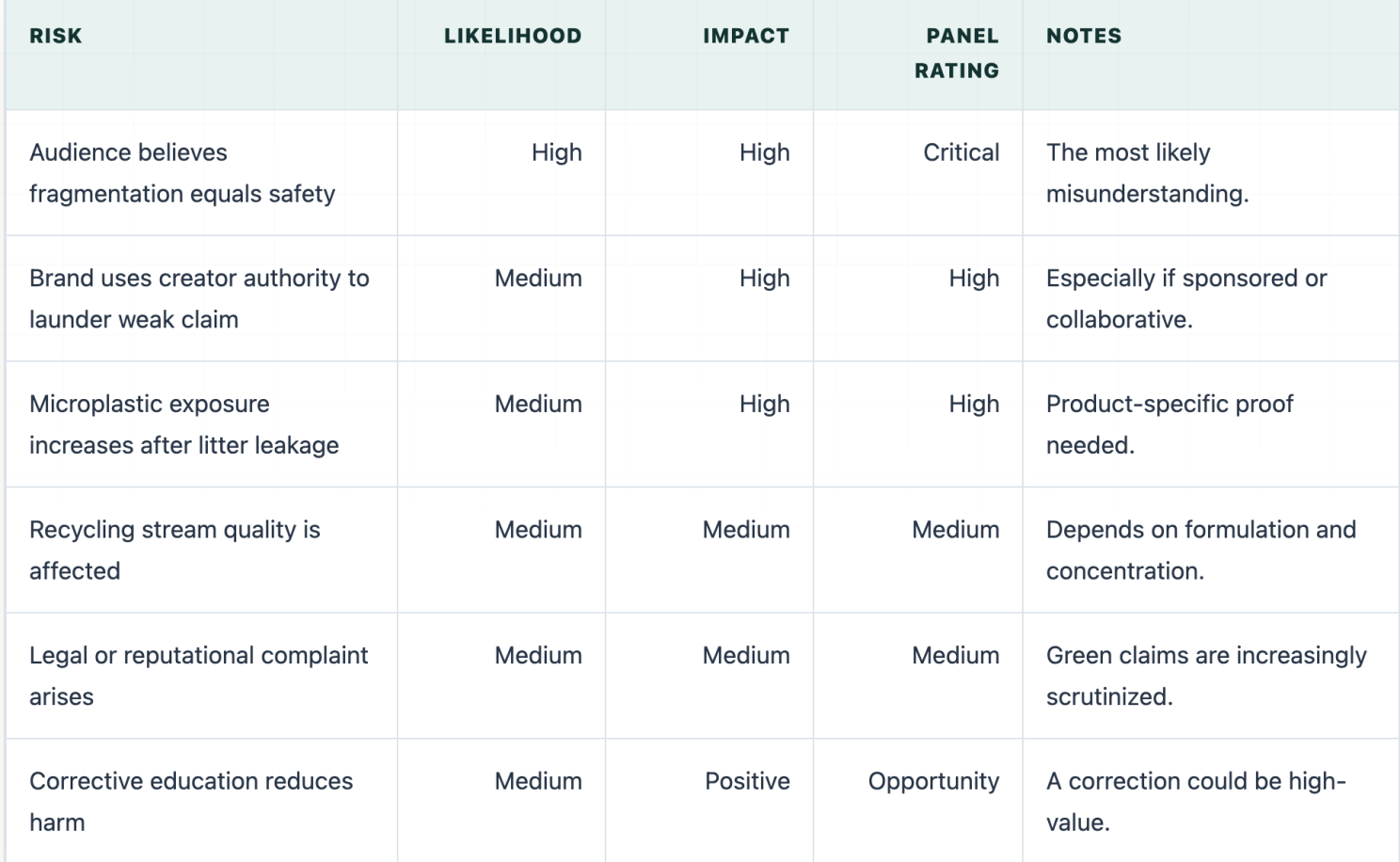
The highest-risk scenario is not that every follower litters. It is that environmental skepticism is softened. People may accept additive plastic as "good enough", delaying better interventions.
19. AEGIS Examiner Questions
Basic questions
- What exact claim was made about OXIUM?
- Was the claim about degradation, biodegradation, compostability, or environmental safety?
- What polymer and additive system were being discussed?
- What evidence was shown to the audience?
- Was the content sponsored, paid, gifted, affiliate-based, or collaborative?
- Were limitations disclosed?
- Was microplastic formation mentioned?
Intermediate questions
- What standard test method supports the claim?
- What receiving environment does the evidence represent?
- How much material mineralized and over what time scale?
- Were residues and ecotoxicity tested?
- Is the product recyclable in practice?
- How does the claim compare with EU and FTC concerns?
- Was a lifecycle assessment performed against alternatives?
Advanced hostile questions
- Are you using "degradation" to avoid proving biodegradation?
- Are you using visibility reduction as a proxy for ecological safety?
- Did the content disclose that oxo-degradable plastics are banned in the EU?
- Did any independent laboratory verify full environmental fate?
- What prevents this campaign from functioning as greenwashing?
- Why should a 509K-follower audience trust a claim that lacks particle-size and mineralization data?
- If the material fragments into microplastics faster, what exactly has been solved?
20. Red-Team Rebuttal Script
If the promoter claims, "OXIUM helps plastic degrade faster," the rebuttal should be:
Faster degradation is not the same as safer environmental fate. Please show independent evidence of mineralization, particle-size distribution, ecotoxicity, and real-world disposal conditions. Otherwise the claim may only show faster fragmentation into smaller plastic pieces.
If the promoter claims, "This is better than ordinary plastic," the rebuttal should be:
Better on which endpoint: macro-litter visibility, greenhouse emissions, microplastic load, recyclability, marine toxicity, or collection economics? A broad "better" claim is not scientific unless the comparator and endpoint are defined.
If the promoter claims, "It is biodegradable," the rebuttal should be:
Under what standard, in what environment, at what temperature, with what oxygen and moisture, over what time scale, and with what residue? Undefined biodegradability claims are consumer-confusing.
If the promoter claims, "Critics are anti-innovation," the rebuttal should be:
The critique is not anti-materials innovation. It is anti-unsubstantiated environmental persuasion. Real innovation can survive independent tests and precise disclosure.
21. Communication Ethics Finding
The ethical failure mode is not only falsehood. It is confidence without constraints. Science communication often fails when a creator translates a complex conditional result into a simple consumer conclusion. That is especially dangerous for environmental materials because the audience usually cannot inspect the system-level outcomes.
The creator's responsibility is to prevent three confusions:
- "Breaks down" means "goes away."
- "Goes away" means "safe."
- "Safe" means "I can keep consuming or disposing as usual."
Each confusion benefits the promotional narrative. Each confusion harms public understanding.
Because the screenshot signals material-science training, the duty to prevent confusion is stronger. A trained communicator should actively teach the difference between degradation, biodegradation, compostability, mineralization, and circularity. If the content did not do so, it underperformed the speaker's own authority signal.
Panel finding: major communication ethics defect.
22. What a Scientifically Defensible Post Would Look Like
A defensible public post would avoid broad safety language and say something like:
"This material uses an additive intended to accelerate oxidative degradation of conventional plastic. That does not automatically mean it is compostable, biodegradable in all environments, or harmless. Some institutions have criticized oxo-degradable plastics because fragmentation can contribute to microplastic pollution. Before treating it as environmentally preferable, we need independent evidence on mineralization, residue, ecotoxicity, recyclability, and performance in Indonesian waste pathways."
That version is less marketable but more honest. It teaches the audience how to think instead of what to buy.
The post should also include a visual hierarchy: reduce and reuse first, collect and recycle where possible, compost only certified compostables in proper infrastructure, and treat additive degradation claims as conditional. It should not present additive technology as a shortcut around waste-system design.
If the creator wants to repair trust, the easiest path is not defensiveness. It is a correction thread or video that says: "I should have been more precise. Degradation is not the same as environmental safety. Here is the evidence and here are the limits."
23. Remediation Demands
Immediate public correction
Publish a correction clarifying that oxo-style degradation should not be equated with environmental safety. Mention microplastic concerns and disposal-condition dependence.
Evidence disclosure
Release independent test reports, including methods, receiving environments, mineralization percentage, time scales, particle-size distribution, ecotoxicity, additive residues, and recycling compatibility.
Sponsorship transparency
Disclose whether the OXIUM content was sponsored, gifted, paid, affiliate-linked, collaborative, or otherwise commercially connected.
Claim narrowing
Replace "safer for the environment" with a precise, test-bound claim. For example: "In test condition X, product Y showed Z change over N days." Avoid implying broad ecological safety.
Audience education
Create a follow-up explaining degradation vs. biodegradation vs. compostability vs. mineralization. Use the platform reach to repair the knowledge gap.
Independent review
Invite a polymer degradation researcher, ecotoxicologist, waste-management practitioner, and Indonesian recycling-sector representative to review the claim before further promotion.
24. Panel Scores
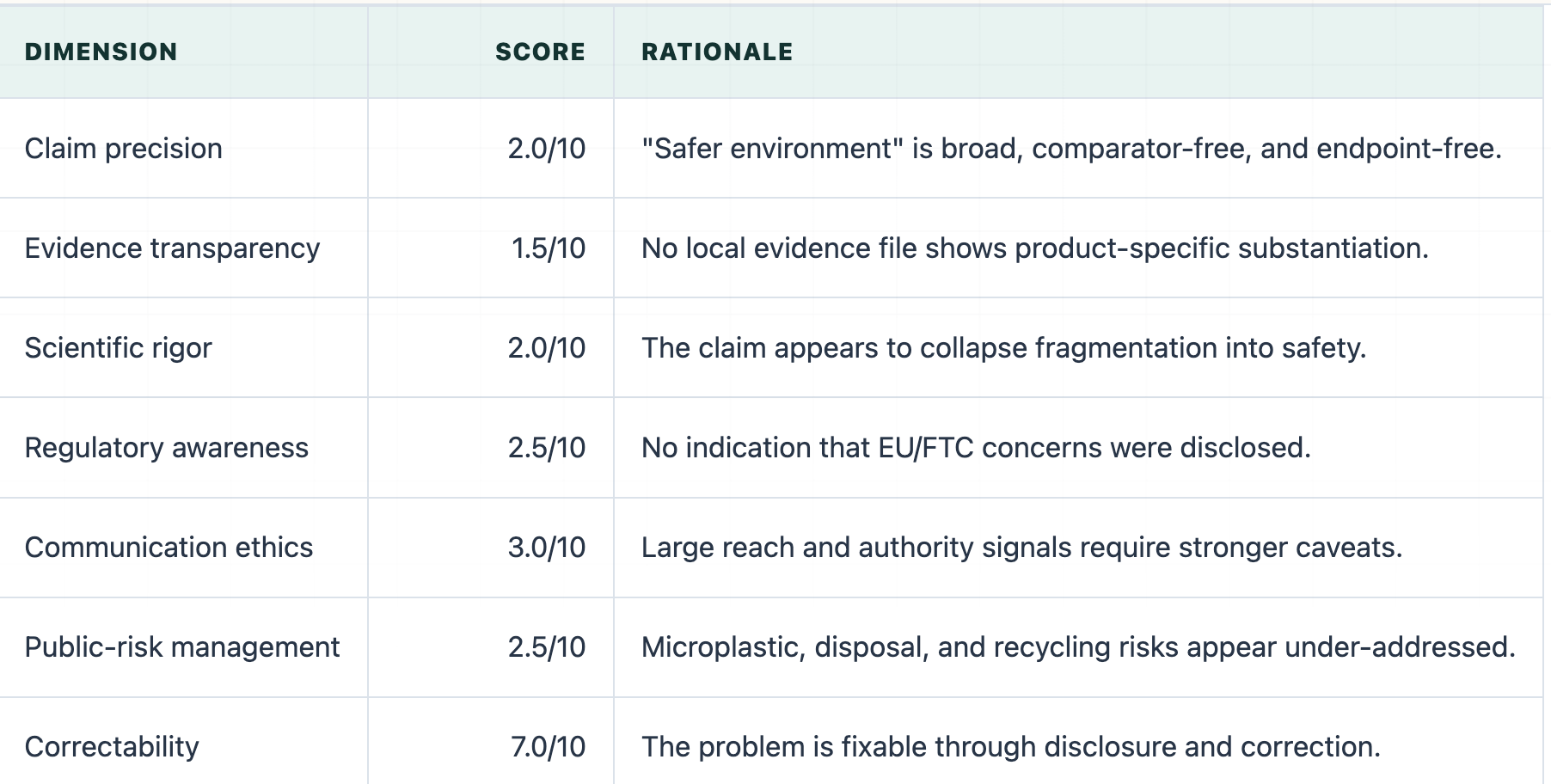
Composite score: 2.3/10.
Verdict: CONDITIONAL FAIL, MAJOR CORRECTIONS REQUIRED.
The score is not a judgment of the person's worth or entire body of work. It is a judgment of the alleged OXIUM environmental safety promotion under a hostile review standard.
25. Final Adversarial Brief
The allegation has a strong scientific core but a weak motive layer. The strong core is that oxo-style plastic claims can mislead audiences by making plastic disappear from sight while leaving unresolved microplastic and environmental-fate questions. The weak layer is any claim that the promoter intentionally deceived the public for personal benefit. That may be investigated, but it is not proven by the folder.
The best attack therefore avoids personal speculation and focuses on proof. A material-science communicator with 509K followers should not promote a "safer for the environment" message unless the claim is precise, independently substantiated, locally relevant, and explicitly caveated. If those conditions were absent, the content deserves severe criticism.
The harshest fair conclusion is:
The OXIUM promotion, as described in the provided source, is scientifically under-substantiated, environmentally risky, and communication-ethically deficient. It appears to convert a contested degradation mechanism into a public-facing sustainability claim without carrying the burden of proof required for a high-reach material-science educator.
That is enough to justify a public rebuttal, a demand for evidence, and a correction request. It is not enough to claim criminal fraud or proven intentional deception.
26. References and Source Notes
- Ellen MacArthur Foundation. "Oxo statement." Published 13 October 2021. The statement says evidence suggests oxo-degradable plastics take longer than claimed to degrade and fragment into small pieces contributing to microplastic pollution. URL: https://www.ellenmacarthurfoundation.org/oxo-statement
- European Parliament and Council. Directive (EU) 2019/904 on the reduction of the impact of certain plastic products on the environment. The directive includes market restrictions for products made from oxo-degradable plastic. URL: https://eur-lex.europa.eu/eli/dir/2019/904/oj
- European Commission / Eunomia. "The impact of the use of oxo-degradable plastic on the environment: final report." Publications Office of the European Union, 2016. URL: https://op.europa.eu/en/publication-detail/-/publication/bb3ec82e-9a9f-11e6-9bca-01aa75ed71a1
- U.S. Federal Trade Commission. "FTC Staff Warns Plastic Waste Bag Marketers That Oxodegradable Claims May Be Deceptive." 21 October 2014. URL: https://www.ftc.gov/news-events/news/press-releases/2014/10/ftc-staff-warns-plastic-waste-bag-marketers-oxodegradable-claims-may-be-deceptive
- European Commission, Group of Chief Scientific Advisors. "Biodegradability of plastics in the open environment." Scientific Opinion No. 10, 2020. URL: https://research-and-innovation.ec.europa.eu/knowledge-publications-tools-and-data/publications/all-publications/biodegradability-plastics-open-environment_en
- SAPEA. "Biodegradability of plastics in the open environment." Evidence Review Report, 2020. URL: https://sapea.info/topic/biodegradability-of-plastics/
- Thompson, R. C., Moore, C. J., vom Saal, F. S., and Swan, S. H. "Plastics, the environment and human health: current consensus and future trends." Philosophical Transactions of the Royal Society B, 2009. URL: https://royalsocietypublishing.org/doi/10.1098/rstb.2009.0053
- Local source file: source/Rayhan Aqilah Setiawan/docs.md. Used as allegation prompt, not as verified proof.
- Local screenshot: source/Rayhan Aqilah Setiawan/SCR-20260702-tbdn.png. Used as profile evidence only.
Endnote
This report intentionally uses a severe devil's advocate posture. Its strongest recommendation is not harassment, defamation, or personal attack. Its strongest recommendation is rigorous public correction: define the claim, show the evidence, disclose the conflict context, and stop equating faster fragmentation with environmental safety.