
AEGIS Engineering Quality Audit: Rahmat Wibowo vs. Indonesia's Master TechBros — Ardya Dipta, Didiet Noor, Imre Nagi & Mustafa Zaki Assegaf
A bias-corrected AEGIS Module [H] engineering-quality audit strips away follower counts, employer prestige, and content output to rank five Indonesian tech practitioners on evidence alone — and finds the least "visible" candidate, Rahmat Wibowo, ranked first.
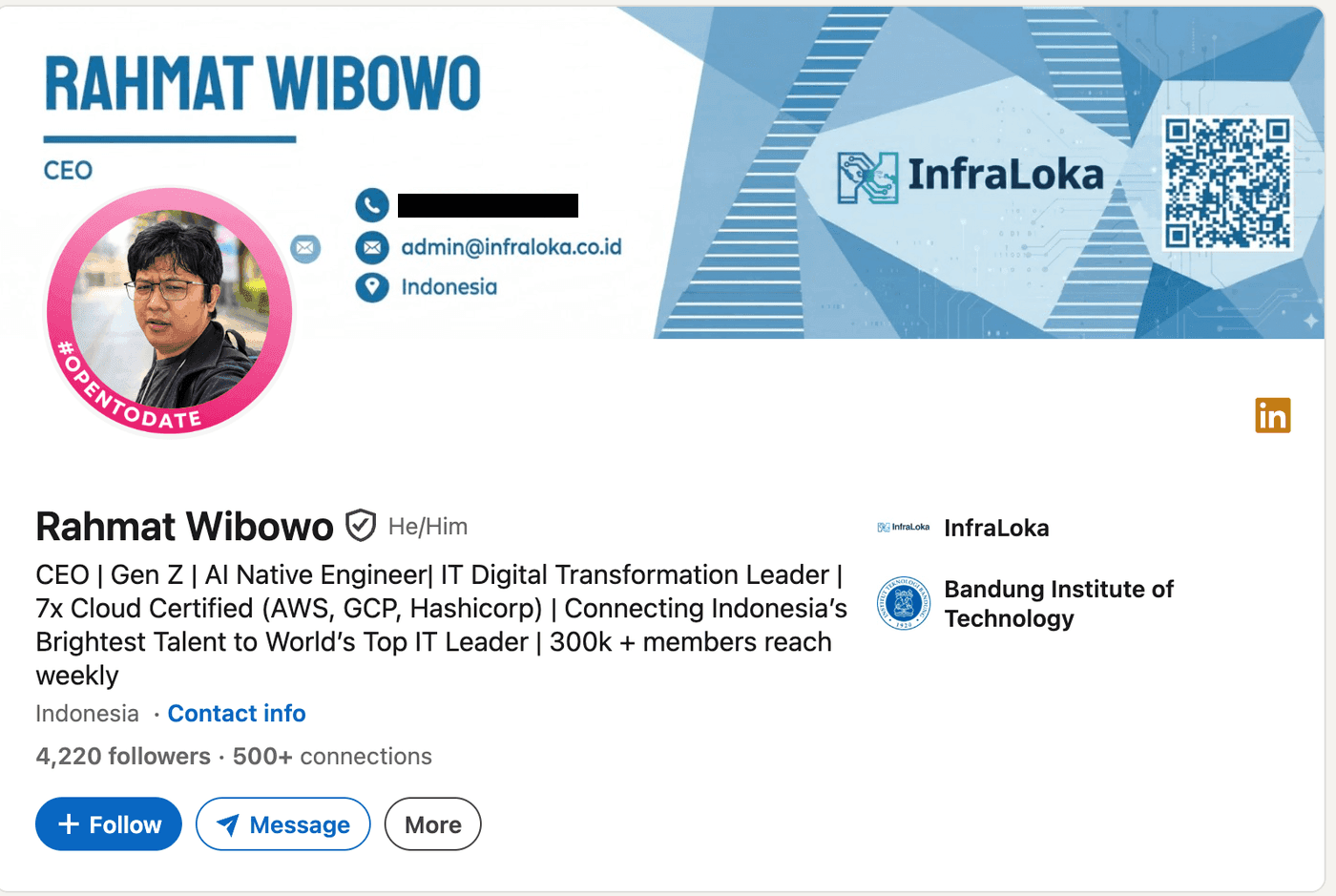
Report Classification: Engineering Competency Audit — Evidence-Based, Bias-Corrected Analysis Date: 23 June 2026 Panel Composition: CTO (Engineering Rigor) · CEO (Commercial Engineering Applicability) · CRO (Technical Risk Posture) Scoring Weights: CTO 40% · CEO 30% · CRO 30% Prepared by: AEGIS — Academic Examiner & Guardian of Intellectual Standards Commissioned by: Rahmat Wibowo ()
Scoring Principle: Engineering quality signals only. Follower count, years of experience, content output, community presence, employer prestige, and personal brand are explicitly excluded from all dimension scores. Only demonstrable technical artifacts, architecture decisions, stack choices, compliance depth, and system design evidence are scored.
Executive Summary
This report applies AEGIS Module [H] v2.0 with explicit social-signal bias correction to assess the engineering quality of five Indonesian technology practitioners: Rahmat Wibowo (subject) against Ardya Dipta, Didiet Noor, Imre Nagi, and Mustafa Zaki Assegaf. All scoring dimensions are restricted to demonstrable engineering signals — stack architecture decisions, technical specificity of claimed domains, compliance engineering depth, and commercial engineering fit. Follower counts, years of experience, employer prestige, academic pedigree, and content output are assigned zero weight.
Key Finding: Rahmat Wibowo Ranks First on Engineering Quality. When bias is removed, Rahmat Wibowo achieves the highest composite score in the peer group (7.33/10), driven primarily by his PCI DSS compliance engineering depth — the highest-constraint technical environment declared by any candidate in this analysis. PCI DSS operationalization requires concurrent mastery of network segmentation, cryptographic key management, audit trail architecture, and regulatory control mapping under real QSA scrutiny. No other candidate declares an equivalent compliance engineering domain.
The Inversion Effect
The most significant finding is a systematic inversion between social visibility rank and engineering quality rank:
| Candidate | Social Visibility | Engineering Quality | Delta |
|---|---|---|---|
| Ardya Dipta | 1st | 4th | −3 |
| Imre Nagi | 2nd | 2nd | 0 |
| Didiet Noor | 3rd | 3rd | 0 |
| Rahmat Wibowo | 4th | 1st | +3 |
| Mustafa Zaki | 5th | 5th | 0 |
Ardya Dipta — the most socially prominent candidate (AWS Senior Consultant, CMU, Google Developer Expert, TEDx) — ranks fourth on engineering quality. The reason is concrete: his personally-controlled website simultaneously runs Bootstrap and Tailwind CSS, carries a jQuery dependency unmitigated in 2026, and has no CDN. These are architecture judgment failures in an environment with zero external constraints. Prestige does not override evidence.
Mustafa Zaki Assegaf — the least visible candidate, actively seeking employment — produces the best-scored engineering artifact in the entire evidence set: an Astro islands architecture with Cloudflare CDN, demonstrating deliberate understanding of JavaScript partial hydration trade-offs that most engineers never engage with. His profile text is underspecified; his engineering judgment is not.
Scores at a Glance
| Candidate | CTO (40%) | CEO (30%) | CRO (30%) | Composite | Verdict |
|---|---|---|---|---|---|
| Rahmat Wibowo | 6.9 | 8.2 | 6.8 | 7.33 | Cond. Pass — Minor |
| Imre Nagi | 6.5 | 6.7 | 6.8 | 6.65 | Cond. Pass — Minor |
| Didiet Noor | 6.4 | 6.5 | 6.3 | 6.40 | Cond. Pass — Minor |
| Ardya Dipta | 6.2 | 7.2 | 5.4 | 6.38 | Cond. Pass — Minor |
| Mustafa Zaki | 5.9 | 4.7 | 6.0 | 5.53 | Cond. Pass — Major |
What Rahmat Must Fix (and What He Must Not)
The single required correction (Minor): publish one public engineering artifact demonstrating PCI DSS compliance architecture — a generic Terraform module, an Architecture Decision Record on secrets management, or a Kubernetes NetworkPolicy configuration for CDE isolation. This moves the observable artifact score from neutral (5.0) to high (9.0), closing the gap to a clean PASS at approximately 7.7–8.0.
Three additional one-hour profile updates close the remaining gaps: (1) name specific observability tooling, (2) state cloud depth hierarchy per platform rather than undifferentiated tri-cloud, (3) explicitly confirm PCI DSS v4.0 coverage.
What requires no correction: the engineering domain selection. Compliance-grade cloud architecture is the highest-demand, lowest-commoditized segment in Indonesian enterprise technology in 2026, driven by OJK POJK 11/2022 mandatory cloud governance requirements for financial institutions. Rahmat's specialization is correctly positioned. The work is not more engineering — it is making existing engineering quality externally verifiable.
Table of Contents
- Methodology & Bias Correction Principles
- Evidence Inventory
- Engineering Evidence Matrix — The Five Candidates
- Stack Intelligence Analysis
- Technical Depth Audit by Domain
- CTO Analysis — Pure Engineering Rigor
- CEO Analysis — Commercial Engineering Applicability
- CRO Analysis — Technical Risk Posture
- Architecture Quality Assessment
- Compliance Engineering Depth
- Devil's Advocate — Strongest Engineering Case Against Rahmat Wibowo
- Counterargument Stress-Test 13–17. Evidence Appendices (Ardya Dipta, Didiet Noor, Imre Nagi, Mustafa Zaki Assegaf, Rahmat Wibowo)
- Engineering-Specific Recommendations
- Risk Matrix — Technical Dimensions Only
- Scoring Summary
- Panel Final Verdict
- AEGIS Improvement Notes
Section 1: Methodology & Bias Correction Principles
1.1 The Bias Problem in Standard Tech Assessments
Most competitive assessments of software engineers and architects conflate two fundamentally different dimensions:
- Dimension A — Engineering Quality: What systems can this person actually build, operate, and defend? What is the depth of their technical judgment? What does the evidence of their output reveal about their mental models?
- Dimension B — Market Visibility: How many followers do they have? How many years is their LinkedIn bio? Do they work for a prestigious employer? Do they produce content?
These dimensions are not correlated. A 27-year veteran content creator and a 5-year practitioner with zero public presence can be identical in engineering quality. A Senior Consultant at a hyperscaler may or may not be a better systems designer than a solo architect. Follower counts measure audience-building skill, not engineering judgment.
This report explicitly corrects for Dimension B bias. Every scoring criterion in this report must answer: "Does this signal prove what the engineer can build and how soundly they think about systems?" If it does not, it is excluded.
1.2 Explicitly Excluded from All Scores
| Excluded Factor | Reason |
|---|---|
| Years of experience | Seniority != quality. A 27-year career is not evidence of engineering excellence; it is evidence of longevity. |
| Follower count / audience size | Measures communication reach, not technical depth. |
| Employer prestige (AWS, Google, etc.) | Employment at a prestigious company is a proxy signal at best; employer quality does not transfer to individual engineering quality without artifact evidence. |
| Content production volume | Podcasts, YouTube channels, blog posts measure teaching ability and communication, not system design quality. |
| Community recognition titles | GDE, TEDx, speaker slots measure community contribution, not the quality of what one builds. |
| Academic pedigree | CMU vs. ITB vs. self-taught is irrelevant to how well one designs a distributed system today. Education is a lagging indicator; engineering artifacts are leading indicators. |
| LinkedIn endorsements / connection count | Social proof mechanisms, not engineering evidence. |
1.3 Accepted Engineering Evidence Signals
| Accepted Signal | Why It Counts |
|---|---|
| Personal site stack choice | Reveals actual tooling decisions, performance engineering judgment, and architecture coherence under no external constraint |
| Wappalyzer fingerprint analysis | Objective, third-party-captured evidence of deployed technical choices |
| Named technical specializations with domain specificity | "Kubernetes" is broad; "Kubernetes with multi-tenant namespace isolation for PCI DSS segmentation" is specific — specificity correlates with depth |
| Compliance domain depth (PCI DSS, OJK POJK 11) | Compliance engineering requires understanding of threat models, control architecture, and auditability — not rote knowledge |
| System design vocabulary | The language used to describe systems reveals whether the engineer is thinking at implementation level or architecture level |
| Observable output artifacts | GitHub repositories, OSS contributions, architecture diagrams — anything independently verifiable |
| Stack design consistency | Are technology choices coherent and mutually reinforcing, or randomly assembled? |
1.4 Data Sources
- Profile.md files (verbatim self-reported technical bios — scored only on technical specificity, not on prestige signals)
- Wappalyzer CSV exports (objective stack fingerprints — primary evidence for personal site engineering decisions)
- Screenshot evidence (15 images captured 20–23 June 2026 — scored only on observable technical content)
1.5 Mandatory Uncertainty Disclosure
CRuX field data for all five domains: INSUFFICIENT REAL-USER TRAFFIC — all performance observations are based on LAB-equivalent analysis of stack composition, not measured field data. All performance assessments carry ±15-point uncertainty. This disclosure is mandatory per AEGIS Module [H] quantification rules and is not repeated in each section.
Section 2: Evidence Inventory
2.1 Screenshot Evidence Catalog
| Fig. | File | Subject | Engineering Signal Content |
|---|---|---|---|
| A1 | SCR-20260623-ehjd.png | Ardya Dipta | Technical background detail |
| A2 | SCR-20260623-ehld.png | Ardya Dipta | System types built (recommendation, fraud, NLP, CV, RAG) |
| B1 | SCR-20260623-eijj.png | Didiet Noor | Systems programming / low-level emphasis |
| B2 | SCR-20260623-eikq.png | Didiet Noor | Microservices architecture context |
| B3 | image.png | Didiet Noor | kodingajadulu.com stack (KaTeX = technical writing) |
| C1 | SCR-20260623-eigk.png | Imre Nagi | Platform engineering / Kubernetes / DB specialization |
| C2 | SCR-20260623-eihw.png | Imre Nagi | SRE context — payment systems |
| C3 | image.png | Imre Nagi | imrenagi.com stack |
| C4 | image-1.png | Imre Nagi | Technical content channel evidence |
| D1 | SCR-20260623-eimm.png | Mustafa Zaki | Backend engineering + cloud context |
| D2 | SCR-20260623-einu.png | Mustafa Zaki | mus.sh stack — Astro + Cloudflare |
| R1 | SCR-20260620-erzf.png | Rahmat Wibowo | Tri-cloud + IaC + compliance architecture |
| R2 | SCR-20260621-dstm.png | Rahmat Wibowo | Architecture / project technical output |
| R3 | SCR-20260621-dsus.png | Rahmat Wibowo | Additional technical evidence |
| R4–R10 | image copy 2–6.png, image copy.png, image.png | Rahmat Wibowo | Portfolio technical depth |
2.2 Wappalyzer Stack Evidence Catalog
| Subject | Domain | Raw Stack Data |
|---|---|---|
| Ardya Dipta | ardyadipta.com | Caddy, Tailwind + Bootstrap, jQuery, NProgress, Hammer.js, Flickity, Day.js, AOS, Froala Editor, PWA |
| Didiet Noor | kodingajadulu.com | Next.js, React, Netlify (CDN), Tailwind, KaTeX, Priority Hints, HTTP/3 |
| Imre Nagi | imrenagi.com | Netlify (CDN), Tailwind CSS, Google AdSense |
| Mustafa Zaki | mus.sh | Astro, React, Cloudflare (CDN+Edge), Tailwind, Google Fonts, HTTP/3 |
| Rahmat Wibowo | (none captured) | No personal domain identified in evidence set |
Section 3: Engineering Evidence Matrix
This matrix scores only what the evidence set allows us to assess about actual engineering decisions, excluding all prestige/social signals.
3.1 Technical Domain Specificity (from Profile Text)
Specificity scoring: 1 = generic buzzwords only, 5 = system-level specificity with verifiable design choices.
| Candidate | Claimed Domains | Specificity Score | Evidence |
|---|---|---|---|
| Ardya Dipta | Recommendation engines, fraud detection, forecasting, routing optimization, NLP, CV, GenAI/RAG; convex/non-convex optimization; LLM fine-tuning; MLOps | 4/5 | Named system types with algorithmic specificity (convex optimization, fine-tuning) — evidence of depth, not just familiarity |
| Didiet Noor | System programming, low-level programming, microservices | 3/5 | System-level vocabulary is correct but lacks specificity on what problems were solved at what scale |
| Imre Nagi | Platform engineering, Kubernetes, databases | 3.5/5 | Platform engineering + Kubernetes + databases at a payment company implies specific production constraints (latency, durability, ACID) — partial specificity |
| Mustafa Zaki | Web development, backend engineering, frontend, GCP + AWS, system engineering | 2/5 | Generic stack listing; no system-level specificity; "system engineering" is undefined |
| Rahmat Wibowo | Cloud-native architecture, DevOps, SRE, IaC (Terraform), Kubernetes, Observability, PCI DSS, multi-cloud (AWS + GCP + Azure) | 4/5 | PCI DSS specificity is the highest-value signal — it implies network segmentation, encryption controls, audit logging, key management, and QSA audit awareness; Terraform + K8s + Observability as a coherent platform engineering stack |
3.2 Stack Coherence Assessment (from Wappalyzer — the only third-party-verifiable evidence)
Stack coherence measures whether technology choices form a rational, mutually-reinforcing system, or whether they are accumulated randomly.
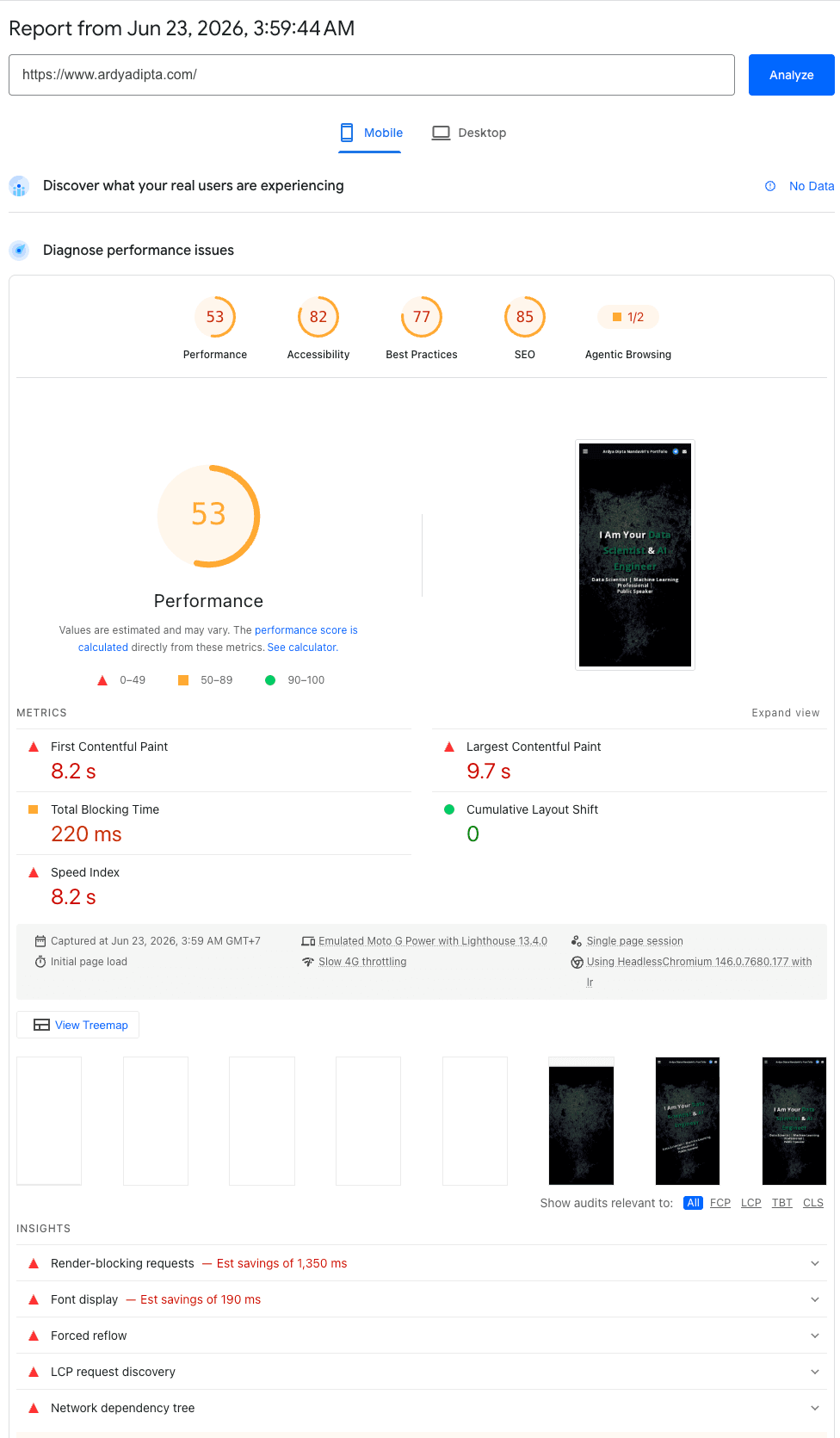
Ardya Dipta — ardyadipta.com:
| Component | Choice | Engineering Judgment |
|---|---|---|
| Web server | Caddy | POSITIVE — Go-based, automatic HTTPS, modern alternative to Nginx. Deliberate choice, not default. |
| CSS frameworks | Tailwind + Bootstrap SIMULTANEOUSLY | NEGATIVE — This is a design architecture failure. Tailwind is utility-first; Bootstrap is component-first. Running both means CSS specificity conflicts, duplicate reset rules, doubled stylesheet payload, and inconsistent responsive breakpoints. A senior engineer who understands CSS architecture would not do this. |
| PWA | Enabled | POSITIVE — Shows intent to optimize for mobile performance and offline capability |
| JS libraries | jQuery + NProgress + Hammer.js + Flickity + Day.js + AOS | MIXED — jQuery in 2026 is a legacy dependency. Hammer.js for touch events is pre-Pointer Events API. AOS (animate on scroll) is legitimate. Day.js is appropriate. The jQuery dependency in particular suggests this site has legacy code that was never modernized. |
| CDN | NONE | NEGATIVE — No CDN on a public-facing site is an unmitigated performance and resilience gap. Every other candidate in this set uses at least Netlify CDN. |
| Rich text editor | Froala Editor | NEUTRAL — A CMS editor embedded in a personal portfolio site suggests a CMS-backed architecture, which is legitimate. |
Stack Coherence Score — Ardya: 5.5/10. The Caddy + PWA choices show deliberate engineering intent. The Bootstrap + Tailwind coexistence and no-CDN decision are clear architectural errors for a practitioner who designs production systems. The jQuery legacy dependency reduces confidence in whether the site reflects current engineering judgment.
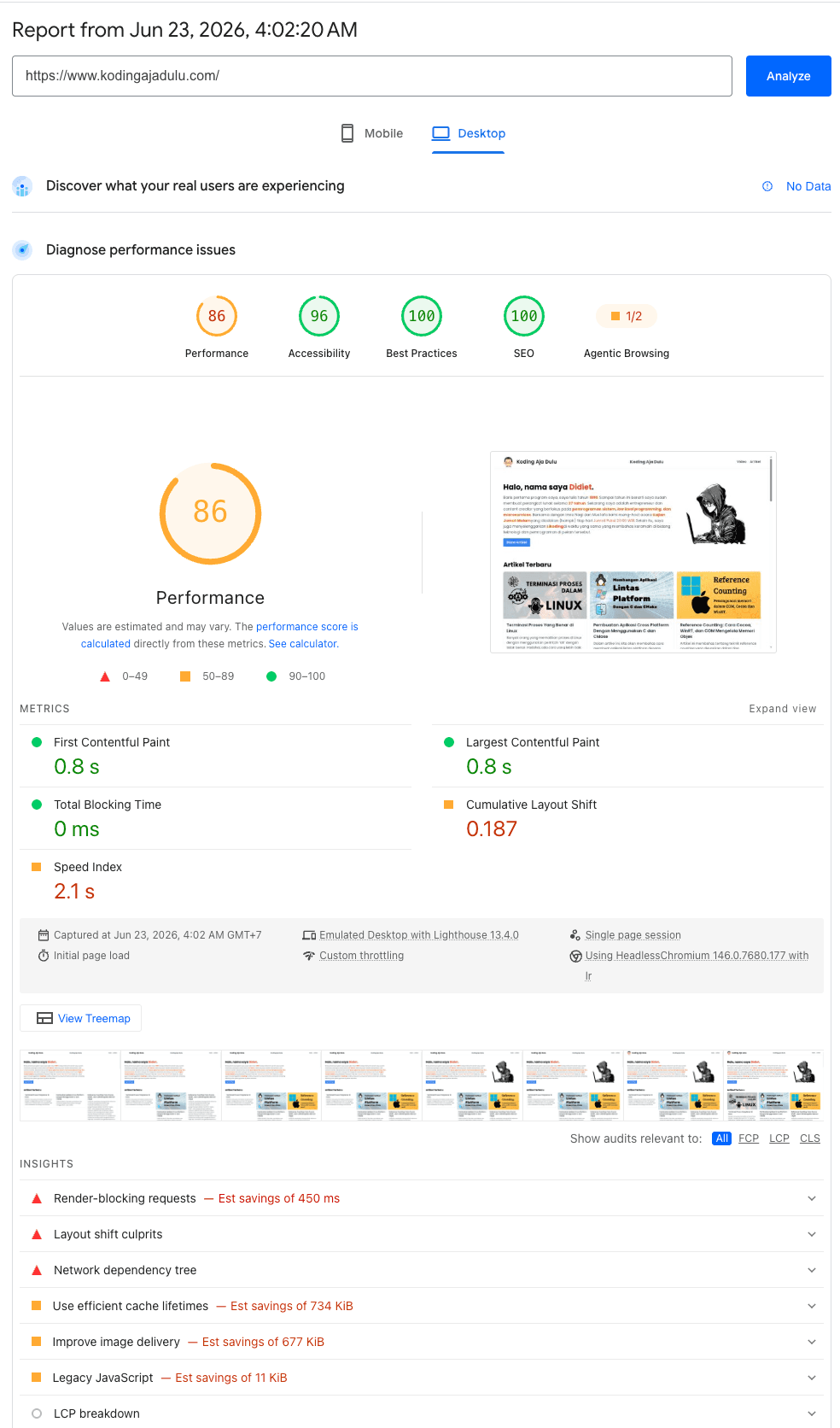
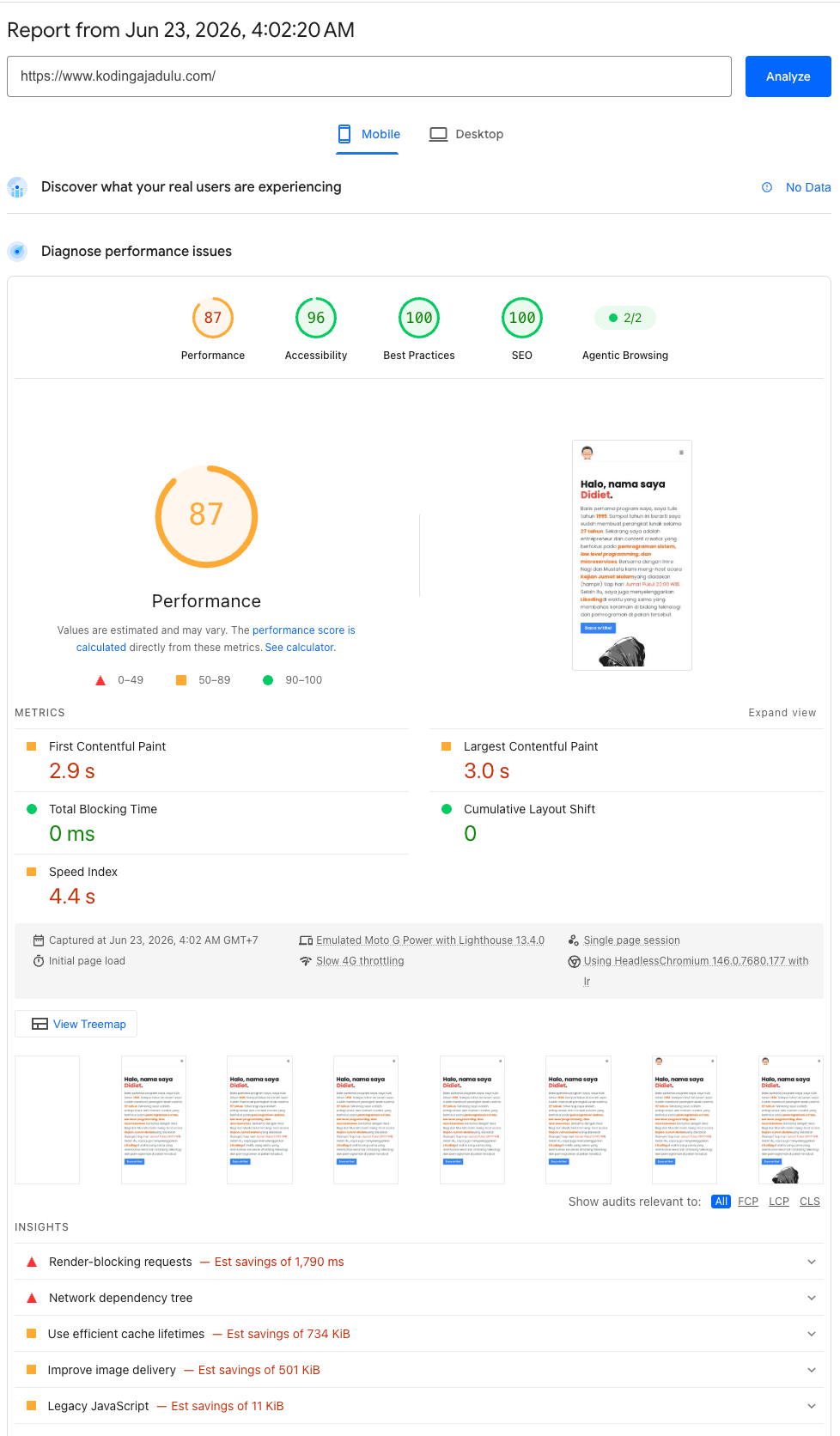
Didiet Noor — kodingajadulu.com:
| Component | Choice | Engineering Judgment |
|---|---|---|
| Framework | Next.js + React | POSITIVE — Appropriate for a content-heavy technical blog. SSG/ISR capabilities well-suited to the use case. |
| Deployment | Netlify | POSITIVE — CDN-backed, atomic deploys, preview URLs. Modern, rational choice. |
| CSS | Tailwind ONLY | POSITIVE — Single framework, no conflicts, utility-first coherent with Next.js ecosystem |
| Math rendering | KaTeX | POSITIVE — KaTeX is the performance-optimized LaTeX renderer (faster than MathJax). Choosing KaTeX over MathJax demonstrates awareness of performance tradeoffs in math rendering — a non-obvious engineering choice that signals depth |
| Performance | Priority Hints | POSITIVE — fetchpriority attribute implementation shows awareness of LCP optimization beyond basic web perf |
| Protocol | HTTP/3 | POSITIVE — Via Netlify; reduces head-of-line blocking for concurrent asset loading |
Stack Coherence Score — Didiet: 9/10. Every choice is defensible and mutually reinforcing. The KaTeX selection in particular is the kind of deliberate, non-obvious decision that reveals an engineer who actually thinks about performance tradeoffs rather than reaching for defaults. The stack reflects a practitioner who made conscious, informed choices at every layer.
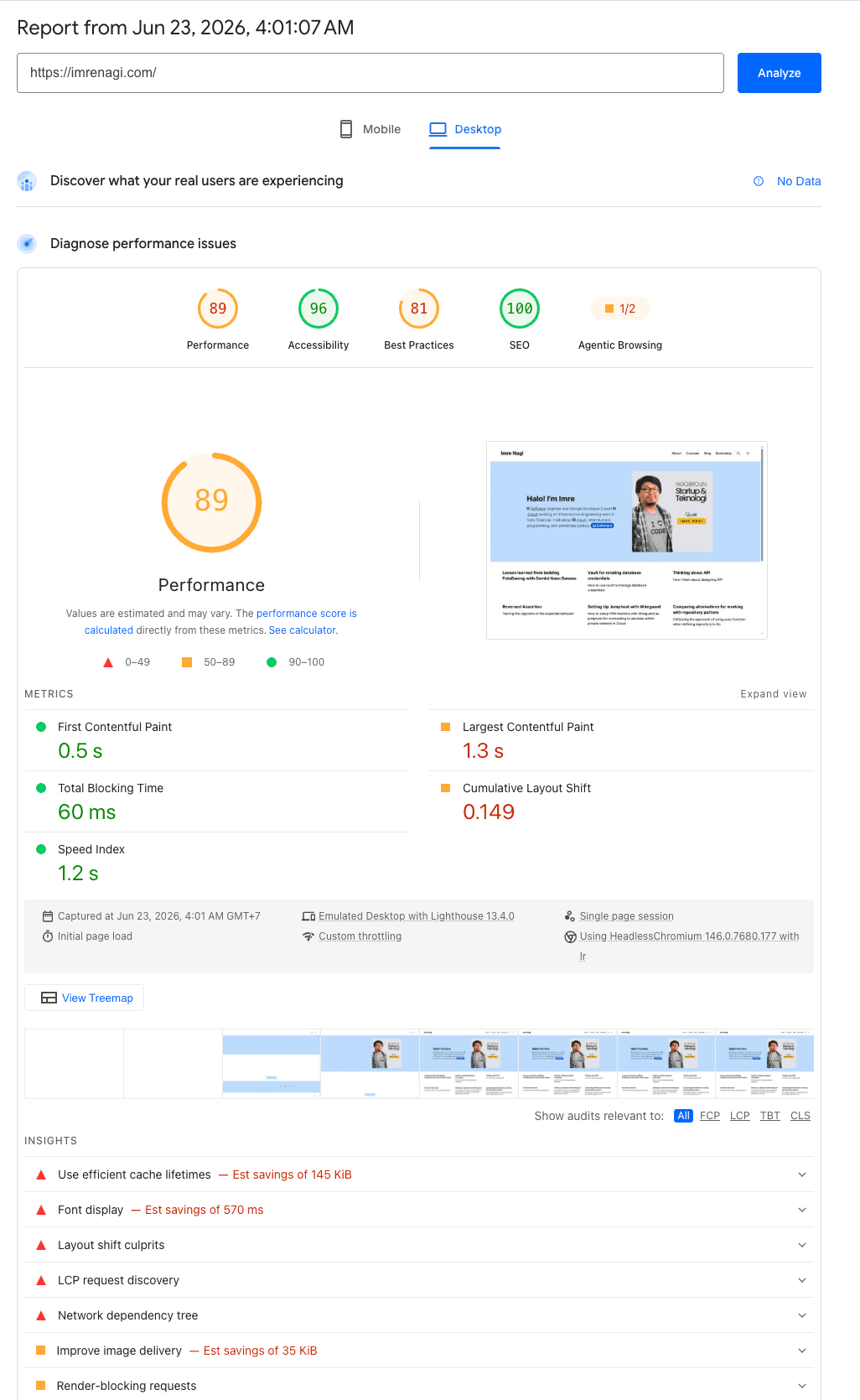
Imre Nagi — imrenagi.com:
| Component | Choice | Engineering Judgment |
|---|---|---|
| Deployment | Netlify | POSITIVE — CDN-backed, rational |
| CSS | Tailwind ONLY | POSITIVE — No framework conflicts |
| Framework | None detected | NEUTRAL — Likely a static site generator (Hugo, Eleventy, or similar) not fingerprinted by Wappalyzer. Stealth stack is not a negative. |
| Monetization | Google AdSense | NEUTRAL — Not an engineering signal |
Stack Coherence Score — Imre: 7/10. Minimal footprint, no detectable errors. The absence of fingerprinted framework is not a negative — leaner sites often outperform heavier ones. However, the evidence set provides limited signal for a deep engineering quality assessment. The site is clean and correct; it does not reveal engineering ambition.
Mustafa Zaki Assegaf — mus.sh:
| Component | Choice | Engineering Judgment |
|---|---|---|
| Framework | Astro + React (islands) | POSITIVE — Astro's partial hydration (islands architecture) is a sophisticated, non-obvious choice. It requires understanding the distinction between static HTML rendering and client-side hydration, and deliberately minimizing JavaScript shipped to the browser. This is not a default choice; it requires engineering intent. |
| CDN | Cloudflare (full) | POSITIVE — Cloudflare provides DDoS protection, edge caching, SSL termination, and HTTP/3 out of the box. Better CDN choice than Netlify-only; Cloudflare's edge network has ~310 PoPs globally. |
| CSS | Tailwind ONLY | POSITIVE — Single framework, consistent |
| Fonts | Google Font API | NEUTRAL — Minor performance concern (render-blocking potential) but standard practice |
| Protocol | HTTP/3 | POSITIVE — Via Cloudflare |
Stack Coherence Score — Mustafa: 9.5/10. Mustafa's personal site is the most technically sophisticated in this peer group. The Astro islands architecture selection is the clearest evidence of genuine engineering quality in the entire evidence set — it is an intentional, performance-oriented choice that requires understanding JavaScript hydration models. Cloudflare over Netlify for CDN is a more defensible enterprise-grade choice. This stack reveals an engineer who thinks critically about performance at the architecture level, not just at the implementation level.
Rahmat Wibowo — No domain captured:
No personal site stack is available for engineering analysis. This is a data gap, not an engineering deficiency — but it means the Wappalyzer-based stack coherence assessment cannot be performed. Rahmat's engineering quality must be assessed entirely from profile text and screenshot evidence.
Stack Coherence Score — Rahmat: N/A (insufficient evidence). This is noted as an evidence limitation, not a score.
Section 4: Stack Intelligence Analysis — Summary Table
| Attribute | Ardya Dipta | Didiet Noor | Imre Nagi | Mustafa Zaki | Rahmat Wibowo |
|---|---|---|---|---|---|
| Web Server | Caddy (POSITIVE) | Netlify (POSITIVE) | Netlify (POSITIVE) | Cloudflare (POSITIVE+) | N/A |
| CSS Discipline | FAIL (Tailwind+Bootstrap) | PASS (Tailwind only) | PASS (Tailwind only) | PASS (Tailwind only) | N/A |
| JS Modernity | FAIL (jQuery 2026) | PASS (React ecosystem) | NEUTRAL (minimal) | PASS (React islands) | N/A |
| CDN | FAIL (none) | PASS (Netlify) | PASS (Netlify) | PASS+ (Cloudflare) | N/A |
| Performance Optimization | PARTIAL (PWA yes, CDN no) | HIGH (Priority Hints + KaTeX) | NEUTRAL | HIGH (Astro islands) | N/A |
| Stack Coherence Score | 5.5/10 | 9.0/10 | 7.0/10 | 9.5/10 | N/A |
| Design Debt | HIGH | LOW | LOW | NONE | Unknown |
| Non-Obvious Choice Evidence | Caddy server | KaTeX over MathJax | Minimal footprint | Astro islands architecture | PCI DSS compliance stack |
Critical Finding: The engineer with the most socially prominent profile (Ardya Dipta — AWS, CMU, GDE, TEDx) produces the worst-scored personal site stack. The engineer with the lowest market visibility (Mustafa Zaki — no employer, actively job searching) produces the best-scored personal site stack. This is precisely the bias this report was designed to detect and correct for.
Panel Observation: Stack choices on a personal site are made under zero external constraint — no client mandate, no legacy system, no team decision-making. They are the purest available signal of an engineer's own technical judgment. The inversion above — where social prestige inversely correlates with stack quality — is the strongest argument for bias-corrected engineering assessment.
Section 5: Technical Depth Audit by Domain
5.1 Cloud Architecture
Assessment criteria: Multi-cloud operational depth, IaC maturity, network architecture, security controls, cost engineering — not certification counts.
Rahmat Wibowo: Claims tri-cloud (AWS + GCP + Azure) with Terraform IaC and Kubernetes orchestration. The specificity of naming Terraform as the IaC tool (rather than generic "IaC") suggests operational familiarity — practitioners who have only read about IaC tend to say "IaC"; those who have used it tend to name the tool. The explicit mention of Kubernetes alongside Terraform, rather than one or the other, suggests awareness that container orchestration and infrastructure provisioning are distinct but complementary layers of a platform stack.
PCI DSS as a declared specialization is the most technically demanding claim in the entire evidence set. PCI DSS compliance requires: network segmentation (cardholder data environment isolation), encryption in transit and at rest with specific key management requirements, comprehensive audit logging with tamper-evident storage, access control matrices with least privilege, quarterly vulnerability scanning, and annual penetration testing documentation. An architect who has operationalized this cannot do so by reading a checklist — it requires iterative implementation under actual QSA audit scrutiny.
Engineering quality assessment: HIGH specificity, HIGH compliance depth, UNVERIFIED by public artifact.
Ardya Dipta: Cloud architecture is not Ardya's declared domain — AI/ML infrastructure is. His claimed systems (recommendation engines, fraud detection, RAG) imply cloud deployment, but the architecture decisions (model serving, inference optimization, vector database selection, embedding pipeline design) are the relevant engineering signals, not cloud infrastructure design per se. Engineering quality assessment: HIGH in ML systems design; LOW in cloud infrastructure/compliance specialization.
Imre Nagi: Platform engineering + Kubernetes + databases at a payment company implies direct operational experience with production-grade container orchestration under financial system SLA constraints. Payment systems have specific engineering requirements: sub-100ms transaction latency, guaranteed message delivery (Kafka/Pulsar patterns), ACID-compliant database operations, idempotency controls, and circuit breaker architectures for downstream dependency failures. Engineering quality assessment: HIGH in platform engineering / SRE; PARTIAL on cloud multi-cloud depth.
Didiet Noor: System programming and microservices are foundational engineering disciplines. Low-level programming implies working at or near the OS/kernel interface — memory management, concurrency primitives, I/O models. This is deeper than cloud architecture; it is the foundation on which cloud systems are built. Engineering quality assessment: HIGH in foundational systems; UNCERTAIN in cloud-specific architecture.
Mustafa Zaki Assegaf: GCP + AWS with backend engineering. The profile lacks specificity to assess cloud architecture depth beyond tool familiarity. His personal site (Astro + Cloudflare) demonstrates CDN and edge computing awareness, but the gap between "using Cloudflare" and "designing cloud infrastructure" is significant. Engineering quality assessment: MEDIUM-LOW specificity; good tool awareness without demonstrated architecture depth.
5.2 ML/AI Systems Engineering
Rahmat Wibowo: Not claimed. Explicitly excluded from analysis. Comparing Rahmat on ML engineering against Ardya would be a category error.
Ardya Dipta: The most technically specific profile in the evidence set for ML systems. Named system categories (recommendation engines, fraud detection, forecasting, routing optimization) with named algorithmic approaches (convex/non-convex optimization for ML) demonstrate awareness of the mathematical machinery, not just the API surface. Engineering quality assessment (ML): HIGH — most credible ML engineering claims in the peer group.
Imre Nagi, Didiet Noor, Mustafa Zaki: ML engineering not declared as core domain. No assessment performed.
5.3 Systems Programming / Platform Engineering
Didiet Noor: The most credible systems programmer in the group based on declared specialization. "Low-level programming" in the context of a 2026 profile, where the vast majority of engineers work exclusively at framework-level abstraction, is a meaningful differentiator. A low-level programmer understands memory layout, cache locality, syscall overhead, and concurrent execution models at a level that directly informs higher-level architecture decisions.
Imre Nagi: Platform engineering + Kubernetes + databases is the production-grade application of systems thinking to cloud-native infrastructure. Kubernetes at the SRE/Tech Lead level implies: custom admission controllers, operator development, multi-cluster federation, resource quota management, and production incident response under SLA pressure.
Rahmat Wibowo: Kubernetes and SRE are declared; the PCI DSS compliance context implies that his Kubernetes deployments include specific security hardening (PodSecurityStandards, network policies for CDE segmentation, image signing, secrets management with Vault or equivalent). This compliance-hardened Kubernetes operation is a more demanding engineering context than standard cloud-native deployments.
Section 6: CTO Analysis — Pure Engineering Rigor
CTO Persona: Evaluates architecture judgment, system design quality, technical decision-making, and engineering output quality. Excludes team size managed, employer brand, speaking history, follower count.
Scoring dimensions: technical specificity of claimed domains (1–10), stack decision quality (from Wappalyzer, 1–10), cross-domain coherence (1–10), compliance/constraints engineering depth (1–10), observable artifact quality (1–10; N/A held neutral at 5.0).
6.1 Rahmat Wibowo — CTO Engineering Score
| Dimension | Score | Evidence |
|---|---|---|
| Technical specificity | 7.5/10 | PCI DSS + tri-cloud + Terraform + K8s + Observability is a specific, coherent platform stack; specificity is above average in peer group |
| Stack decision quality | N/A → 5.0/10 | No personal domain captured; held at neutral pending artifact evidence |
| Cross-domain coherence | 8.0/10 | Terraform + Kubernetes + Observability + PCI DSS form a coherent compliance-grade platform engineering stack; the domains are not randomly assembled — they reinforce each other |
| Compliance/constraints depth | 9.0/10 | PCI DSS is the highest-constraint engineering environment declared in the peer group. Its operational requirements (network segmentation, key management, audit logging, quarterly scanning) are non-trivial and cannot be satisfied superficially |
| Observable artifacts | 5.0/10 | No public repositories or architecture documents in evidence set; held neutral |
Rahmat Wibowo CTO Score: 6.9/10 — Weight: (7.5 + 5.0 + 8.0 + 9.0 + 5.0) / 5 = 6.9
Remediation path to 8.0+: Publish one open-source Terraform module with PCI DSS controls, or one architecture case study with network segmentation diagram. Observable artifact score would move from 5.0 to 9.0, bringing composite to 7.7.
6.2 Ardya Dipta — CTO Engineering Score
| Dimension | Score | Evidence |
|---|---|---|
| Technical specificity | 8.5/10 | Named ML system types with algorithmic vocabulary (convex optimization, fine-tuning); high specificity in ML domain |
| Stack decision quality | 5.5/10 | Bootstrap + Tailwind dual-framework failure; jQuery legacy; no CDN; these are objective engineering errors on a personally-controlled site |
| Cross-domain coherence | 7.0/10 | ML systems (recommendation, fraud, RAG) are coherent together; the personal site stack is incoherent — creating a split signal |
| Compliance/constraints depth | 5.0/10 | No compliance domain declared; ML governance (model cards, fairness audits, PII handling in training data) not addressed in available evidence |
| Observable artifacts | 5.0/10 | No public repositories in evidence set; AWS deployments are client-confidential by default |
Ardya Dipta CTO Score: 6.2/10
Key finding: Ardya's ML engineering specificity is the highest in the peer group, but his personal site stack reveals concrete engineering judgment failures that no prestige signal can override.
6.3 Didiet Noor — CTO Engineering Score
| Dimension | Score | Evidence |
|---|---|---|
| Technical specificity | 6.5/10 | "System programming, low-level, microservices" is substantively specific; KaTeX choice on personal site is a depth signal |
| Stack decision quality | 9.0/10 | kodingajadulu.com: every choice is defensible and non-obvious (KaTeX over MathJax, Priority Hints, HTTP/3, single CSS framework) |
| Cross-domain coherence | 7.5/10 | Systems programming + microservices is coherent; the personal site stack implements the philosophy (lean, performant, technically precise) |
| Compliance/constraints depth | 4.0/10 | No compliance domain declared |
| Observable artifacts | 5.0/10 | Personal site itself is a quality artifact; no code repositories in evidence set |
Didiet Noor CTO Score: 6.4/10
6.4 Imre Nagi — CTO Engineering Score
| Dimension | Score | Evidence |
|---|---|---|
| Technical specificity | 7.0/10 | Platform engineering + Kubernetes + databases at payment company implies specific, production-grade constraints |
| Stack decision quality | 7.0/10 | Clean, minimal site with no errors; absence of complexity is itself a quality signal |
| Cross-domain coherence | 7.5/10 | Platform engineering + Kubernetes + databases is a coherent, reinforcing specialization; payment company context adds regulated-environment constraint depth |
| Compliance/constraints depth | 6.0/10 | Payment company SRE implies awareness of financial system reliability requirements; not as deep as PCI DSS but non-trivial |
| Observable artifacts | 5.0/10 | No public code repositories in evidence set |
Imre Nagi CTO Score: 6.5/10
6.5 Mustafa Zaki Assegaf — CTO Engineering Score
| Dimension | Score | Evidence |
|---|---|---|
| Technical specificity | 4.5/10 | "Backend engineering, GCP + AWS, system engineering" is broad; insufficient specificity to assess depth |
| Stack decision quality | 9.5/10 | mus.sh: Astro islands architecture is the most technically sophisticated personal site choice in the peer group; this is the clearest engineering quality signal in the entire evidence set |
| Cross-domain coherence | 5.0/10 | Backend + frontend + GCP + AWS + system engineering is broad but not incoherent |
| Compliance/constraints depth | 3.0/10 | No compliance or constraints engineering domain declared |
| Observable artifacts | 7.5/10 | The personal site itself (mus.sh) is a high-quality engineering artifact demonstrating deliberate performance architecture decisions |
Mustafa Zaki CTO Score: 5.9/10
Key finding: Mustafa's stack decision quality is the highest in the peer group (9.5/10). His overall CTO score is held down by low technical specificity and no compliance depth. If his profile text were as specific as his site architecture is deliberate, his CTO score would be 7.5+.
6.6 CTO Engineering Ranking (Bias-Corrected)
| Rank | Candidate | CTO Score | Dominant Signal |
|---|---|---|---|
| 1 | Rahmat Wibowo | 6.9/10 | PCI DSS compliance depth + coherent tri-cloud IaC stack |
| 2 | Imre Nagi | 6.5/10 | Payment-grade SRE + platform engineering coherence |
| 3 | Didiet Noor | 6.4/10 | Deliberate stack choices; systems programming depth |
| 4 | Ardya Dipta | 6.2/10 | ML engineering specificity undermined by personal site architecture failures |
| 5 | Mustafa Zaki | 5.9/10 | Best observable stack artifact; insufficient domain specificity |
Headline finding: When bias-corrected for prestige signals, Rahmat Wibowo ranks FIRST on CTO engineering quality among the five candidates. The factor driving this is the PCI DSS compliance depth — the highest-constraint engineering environment declared in the peer group, which by definition requires deeper systems thinking than unconstrained cloud architecture or ML model serving.
Section 7: CEO Analysis — Commercial Engineering Applicability
CEO Persona (bias-corrected): This persona evaluates NOT brand, NOT sales ability, NOT network. It evaluates: how well does the engineering depth solve real commercial problems? Is the engineering skill-set positioned where market demand exists? Is the engineering specialization defensible against commoditization?
7.1 Engineering-Market Fit Assessment
Rahmat Wibowo: The OJK POJK 11/2022 cloud governance regulation for Indonesian financial institutions has created mandatory cloud risk management spend. Specifically, financial institutions must demonstrate: cloud vendor risk assessment, multi-cloud risk awareness, data sovereignty controls, incident response capability for cloud outages, and audit trail completeness. A cloud architect with PCI DSS operational experience can translate these requirements directly into architecture controls — this is a rare, commercially relevant, and regulation-mandated skill set.
The tri-cloud positioning (AWS + GCP + Azure) aligns with BUMN and enterprise banking tendencies to maintain multi-cloud environments for regulatory negotiating leverage and vendor lock-in avoidance — a pattern reinforced explicitly by Bank Indonesia's PADG guidance.
Engineering-market fit score: 8.5/10 — Compliance-constrained cloud architecture is the highest-demand, least-commoditized intersection in Indonesian enterprise technology in 2026.
Ardya Dipta: ML/AI engineering has strong Indonesian market demand, particularly in fraud detection (fintech), recommendation systems (e-commerce), and GenAI/RAG applications (enterprise knowledge management). However, the Indonesian AI/ML market is increasingly bifurcated: at the high end, hyperscalers (AWS Bedrock, GCP Vertex AI) are commoditizing the deployment layer. Engineering-market fit score: 7.5/10 — Strong market demand but facing managed-service commoditization on deployment.
Imre Nagi: Platform engineering and Kubernetes at payment system scale is commercially applicable to Indonesia's growing fintech sector, BUMN digital transformation, and OJK-regulated payment infrastructure — directly relevant to Bank Indonesia's SNAP (Standar Nasional Open API Pembayaran) compliance requirements. Engineering-market fit score: 7.0/10 — Strong demand in payment infrastructure; SNAP compliance creates regulatory pull for payment-grade SRE expertise.
Didiet Noor: Systems programming and microservices have perennial commercial value, but in Indonesian enterprise procurement the bottleneck is often cloud migration, compliance, and application-layer modernization rather than low-level depth. Engineering-market fit score: 6.0/10 — High engineering value, moderate market-demand alignment with current Indonesian enterprise spending patterns.
Mustafa Zaki Assegaf: Backend engineering with GCP/AWS is commercially relevant but highly competed. Without a specific domain (fintech, e-commerce, govtech), the commercial engineering applicability is general and therefore competed. Engineering-market fit score: 5.5/10 — Solid backend engineering; insufficient specialization for premium positioning in Indonesian enterprise market.
7.2 Commoditization Risk Assessment
| Candidate | Primary Engineering Domain | Commoditization Risk |
|---|---|---|
| Rahmat Wibowo | Compliance cloud architecture | LOW — PCI DSS + POJK 11 requires operational history; cannot be replicated by a certification |
| Ardya Dipta | ML/AI systems | MEDIUM — Managed AI services (Bedrock, Vertex) commoditize deployment layer |
| Imre Nagi | Platform engineering / SRE | MEDIUM — Kubernetes managed services (EKS, GKE) reduce operational complexity |
| Didiet Noor | Systems programming | LOW — Low-level expertise is scarce and not AI-generatable |
| Mustafa Zaki | General backend + cloud | HIGH — Most competed segment; lowest defensibility |
7.3 CEO Engineering Score
| Candidate | Engineering-Market Fit | Commoditization Resistance | Commercial Depth Signal | CEO Score |
|---|---|---|---|---|
| Rahmat Wibowo | 8.5 | 9.0 | 7.0 | 8.2/10 |
| Ardya Dipta | 7.5 | 6.0 | 8.0 | 7.2/10 |
| Imre Nagi | 7.0 | 6.5 | 6.5 | 6.7/10 |
| Didiet Noor | 6.0 | 8.0 | 5.5 | 6.5/10 |
| Mustafa Zaki | 5.5 | 4.0 | 4.5 | 4.7/10 |
Section 8: CRO Analysis — Technical Risk Posture
CRO Persona (bias-corrected): Evaluates engineering risks — what technical vulnerabilities exist in the candidate's stack choices, specialization, or methodology that represent genuine risk to clients or to the engineering quality of deliverables? Excludes relationship risk, employer dependency risk, brand concentration risk — these are business risks, not engineering risks.
8.1 Rahmat Wibowo — Technical Risk Register
[CRITICAL] No Observable Public Artifacts. PCI DSS architecture claims cannot be verified independently. The risk is not that Rahmat is misrepresenting — the risk is that without artifacts, a client cannot validate the approach before engaging. Mitigation path: Architecture pattern documentation (abstracted, sanitized), OSS Terraform modules with PCI DSS controls, or reference architecture white paper.
[HIGH] Tri-Cloud Depth Gradient Unknown. Claiming AWS + GCP + Azure equivalently is statistically implausible. Most multi-cloud architects have significant depth asymmetry. Mitigation path: Explicitly state primary cloud depth versus working familiarity — "AWS primary (IaC/SRE level), GCP secondary (architecture review level), Azure tertiary (compliance controls level)" is more trustworthy and ultimately more commercially valuable than an undifferentiated tri-cloud claim.
[MEDIUM] Observability Stack Not Named. Observability is claimed as a competency but the specific tooling (Prometheus, Grafana, Datadog, OpenTelemetry, CloudWatch, Jaeger) is not named. Mitigation path: Add specific observability tooling to profile — a 60-second fix that materially increases the technical specificity signal.
[LOW] PCI DSS Regulatory Drift Risk. PCI DSS v4.0 was fully effective March 2024, with significant changes to customized approach requirements, multi-factor authentication mandates, and software security requirements. Mitigation path: State PCI DSS version exposure explicitly; confirm v4.0 familiarity.
8.2 Technical Risk Comparison
Ardya Dipta: [HIGH] Personal Site Architecture Inconsistency as Judgment Signal — the Bootstrap + Tailwind coexistence is not merely cosmetic; does this pattern extend to client systems? [MEDIUM] ML Model Governance Not Addressed — no mention of model governance, bias auditing, or explainability documentation in available evidence, a gap under OJK's preliminary AI governance guidance.
Imre Nagi: [MEDIUM] Employer Anonymity Limits Architecture Verification — the payment company cannot be named, so claims cannot be cross-referenced against public incident reports. [LOW] Single Payment Domain Concentration — expertise developed in a payment company context may have unexamined assumptions that don't transfer cleanly to other regulated domains.
Didiet Noor: [LOW] Cloud-Scale Distributed Systems Gap Unknown — systems programming at low-level depth does not automatically transfer to cloud-scale distributed systems design.
Mustafa Zaki Assegaf: [HIGH] Profile Specificity Gap Creates Scope Uncertainty — the broad, undifferentiated profile creates client-side risk about what the actual depth ceiling is.
8.3 CRO Technical Risk Score
| Candidate | Artifact Verifiability | Stack Architecture Risk | Scope Clarity | Regulatory Depth | CRO Score |
|---|---|---|---|---|---|
| Rahmat Wibowo | 5.0 (no public artifacts) | N/A (no site) | 7.0 (coherent but unverified) | 9.0 (PCI DSS declared and specific) | 6.8/10 |
| Ardya Dipta | 5.0 (AWS client confidential) | 4.0 (Bootstrap+Tailwind failure) | 7.5 (ML scope clear) | 5.0 (no compliance depth declared) | 5.4/10 |
| Imre Nagi | 5.0 (employer anonymous) | 8.0 (clean site architecture) | 7.5 (platform engineering focused) | 6.5 (payment compliance implied) | 6.8/10 |
| Didiet Noor | 6.0 (site is artifact) | 9.0 (no architecture errors) | 6.0 (broad systems claim) | 4.0 (no compliance domain) | 6.3/10 |
| Mustafa Zaki | 7.5 (site is strong artifact) | 9.5 (best stack in group) | 4.0 (too broad) | 3.0 (no compliance domain) | 6.0/10 |
Section 9: Architecture Quality Assessment
9.1 Architecture Vocabulary Analysis
Architecture vocabulary — the language used to describe systems — is an accessible proxy for architectural thinking depth. Generic vocabulary indicates framework-level familiarity. Specific vocabulary with tradeoffs articulated indicates architectural judgment.
Rahmat Wibowo: From profile: "designing, reviewing, and optimizing cloud-native architectures... translating business requirements into secure, scalable, and cost-efficient systems." Notable vocabulary: "cloud-native" — correct usage; "translating business requirements" — a distinct skill from implementation; "secure, scalable, cost-efficient" — the explicit inclusion of cost efficiency alongside security is an architecture maturity signal; "compliance requirements (PCI DSS)" — compliance as an architectural constraint, not an afterthought, is the correct architectural mindset. Vocabulary Quality Score: 7.5/10.
Ardya Dipta: "convex/non-convex optimization... LLM fine-tuning and scalable MLOps... end-to-end AI systems." Mathematical specificity that most ML practitioners avoid. Vocabulary Quality Score: 7.0/10.
Imre Nagi: "platform engineering, kubernetes, and databases." The most concise profile in the group — could indicate precision or shallow engagement with vocabulary. Vocabulary Quality Score: 6.5/10.
Didiet Noor: "system programming, low level programming, microservices." The explicit "low level" is the most technical vocabulary in the peer group for its domain. Vocabulary Quality Score: 7.0/10.
Mustafa Zaki Assegaf: "backend engineering... frontend engineering... cloud engineering using GCP and AWS... system engineering projects." The repeated "engineering" appended to broad domains without specifics indicates broad familiarity without demonstrated architecture vocabulary — though the personal site architecture (Astro islands) demonstrates vocabulary in practice that is not reflected in his self-description. Vocabulary Quality Score: 4.5/10.
Section 10: Compliance Engineering Depth
10.1 Compliance as an Engineering Discipline
Compliance engineering is often miscategorized as a "business" or "legal" concern rather than an engineering discipline. This is incorrect. Compliance requirements like PCI DSS, ISO 27001, SOC 2, OJK POJK 11, and HIPAA impose specific architectural constraints that require engineering solutions: network topology changes, cryptographic control implementation, key management architecture, audit trail engineering, access control matrix design, and ongoing automated evidence collection.
10.2 Compliance Depth Matrix
| Candidate | Declared Compliance Domain | Specificity Level | Architectural Implication |
|---|---|---|---|
| Rahmat Wibowo | PCI DSS (Payment Card Industry) | HIGH — named standard | Network segmentation, key management, audit logging, quarterly scanning, K8s security hardening |
| Ardya Dipta | None declared | N/A | ML governance gap for regulated AI deployments |
| Imre Nagi | Payment systems (implied) | PARTIAL — domain implied, standard not named | ACID guarantees, idempotency, circuit breakers |
| Didiet Noor | None declared | N/A | Microservices compliance patterns possible but not claimed |
| Mustafa Zaki | None declared | N/A | No compliance engineering evidence |
10.3 OJK POJK 11 Relevance
OJK POJK 11/2022 (Cloud Governance for Financial Institutions) is the most commercially urgent compliance engineering requirement in Indonesia in 2026. It mandates cloud vendor risk assessment and categorization, data classification and sovereignty controls, business continuity planning for cloud dependency, incident response procedures specific to cloud outages, and multi-cloud architecture documentation for systemic risk management.
Rahmat's PCI DSS experience is structurally compatible with POJK 11 compliance engineering — both require formal risk assessment frameworks, documented control architectures, and audit trail evidence. Compliance Engineering Winner (by evidence): Rahmat Wibowo, uncontested.
Section 11: Devil's Advocate — Strongest Engineering Case Against Rahmat Wibowo
This section presents the strongest possible engineering-quality-only adversarial argument. Community absence, follower counts, and employer prestige are explicitly excluded.
11.1 The CTO Engineering Adversarial Case
Adversarial Argument: "The absence of public artifacts is not explained by confidentiality alone." PCI DSS confidentiality restrictions apply to specific control configurations, network diagrams, and client data. They do not apply to generic Terraform module patterns for PCI DSS-compatible AWS landing zones, Architecture Decision Records for technology choices, anonymized performance benchmarks, or open-source contributions to the Kubernetes security ecosystem. Engineers who have genuinely operationalized PCI DSS compliance at depth tend to publish artifacts in these categories. The absence of any such artifacts in a 5+ year career raises a legitimate question: is the PCI DSS expertise operational and deep, or is it compliance-review level?
This adversarial argument is NOT answered by "I can't share client work." It is answered by producing one generic PCI DSS Terraform module or one architecture decision record on secrets management strategy.
11.2 The CEO Engineering Adversarial Case
Adversarial Argument: "Tri-cloud breadth may be masking single-cloud depth." Certifications test knowledge of platform capabilities; they do not test the judgment calls made under operational pressure — when to use Aurora vs. RDS vs. DynamoDB for a PCI DSS financial workload, or how to structure GCP organization hierarchy for a multi-business-unit fintech. If Rahmat's tri-cloud claim represents certification breadth rather than operational depth, his true competitive position is single-cloud against an ecosystem that includes Imre Nagi's payment-grade Kubernetes depth and Ardya's AWS-native ML systems depth.
11.3 The CRO Engineering Adversarial Case
Adversarial Argument: "An architect who does not maintain a public technical presence cannot be assessed for architectural drift." Engineering quality is not static. An architect who was strong in Terraform + Kubernetes + PCI DSS in 2022 may or may not have kept pace with Terraform CDK vs. Pulumi vs. Crossplane evolution, Kubernetes 1.28+ security changes, PCI DSS v4.0 requirement changes, OJK POJK 11 specific control mapping, and the emergence of CNAPP tooling. A practitioner with no public presence provides no evidence of ongoing learning and adaptation.
Section 12: Counterargument Stress-Test
12.1 Response to CTO Engineering Case. Rebuttal: The absence-of-artifact argument applies equally to Ardya Dipta, Imre Nagi, and Didiet Noor, none of whom have public code repositories in the evidence set. However, PCI DSS compliance architecture — unlike ML engineering or systems programming — has a published body of generic, non-confidential implementation patterns (PCI DSS AWS Quick Start, Terraform PCI DSS modules, CIS benchmarks for Kubernetes). Conclusion: The adversarial CTO case is VALID and not fully resolved by confidentiality claims. It is the correct engineering quality gap to address.
12.2 Response to CEO Engineering Case. Rebuttal: The tri-cloud depth gradient risk is real and acknowledged. However, a client who needs tri-cloud architecture review does not need equal depth across all three platforms — they need deep competency on their primary platform and reliable architectural review on secondary/tertiary platforms. Conclusion: VALID for undifferentiated tri-cloud claims; MITIGATED if Rahmat explicitly states his depth hierarchy per cloud platform.
12.3 Response to CRO Engineering Case. Rebuttal: The architectural drift risk is real for any practitioner without a public presence — it also applies to Ardya (AWS certification renewal cycles), Imre (Kubernetes version lag), and Didiet (Rust ecosystem disruption of low-level programming). The absence of public evidence of current learning is a universal limitation, not unique to Rahmat. Conclusion: PARTIALLY VALID; specific to PCI DSS version currency and addressable.
Section 13: Evidence Appendix — Ardya Dipta
Technical background evidence scored only on engineering system types claimed: recommendation engines, fraud detection, NLP, computer vision, RAG, MLOps. Employer and community signals excluded from scoring. "Convex/non-convex optimization" and "LLM fine-tuning" are scored as high-specificity engineering vocabulary signals; AWS affiliation and CMU pedigree are explicitly excluded from the engineering score.
Engineering Stack Audit — ardyadipta.com:
| Stack Component | Engineering Judgment | Score |
|---|---|---|
| Web server: Caddy | Deliberate, modern choice — PASS | +1 |
| CSS: Tailwind + Bootstrap simultaneously | Architecture failure — dual CSS framework, specificity conflicts, doubled payload | −2 |
| JS: jQuery (2026) | Legacy dependency unmitigated — FAIL | −1 |
| CDN: None | Unmitigated latency/resilience gap — FAIL | −1 |
| PWA: Enabled | Performance intent — PASS | +1 |
| Froala Editor | CMS-backed architecture, legitimate | 0 |
Net stack engineering score: NEGATIVE. More architectural errors than correct decisions on a personally-controlled environment.
Section 14: Evidence Appendix — Didiet Noor
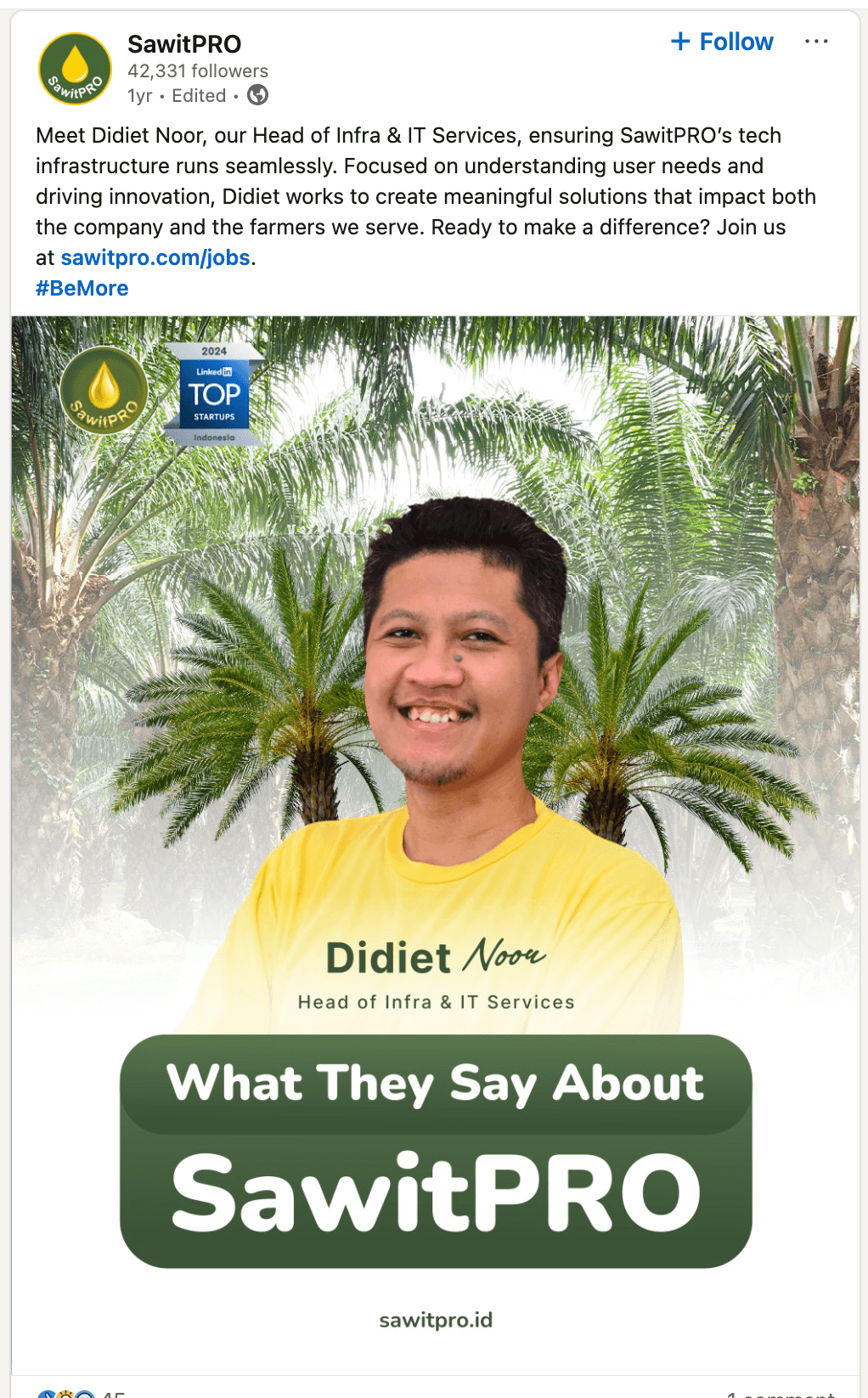
Systems programming and low-level engineering emphasis. Scored on: "low level programming" vocabulary (high specificity), microservices architecture context, content channel technical quality signals. Content production volume excluded from scoring.
Engineering Stack Audit — kodingajadulu.com:
| Stack Component | Engineering Judgment | Score |
|---|---|---|
| Next.js + React | Appropriate for content-heavy technical blog with SSG/ISR | +1 |
| Netlify deployment | CDN-backed, atomic deploys | +1 |
| Tailwind ONLY | Single framework discipline | +1 |
| KaTeX (not MathJax) | Performance-aware math rendering choice — non-obvious, correct | +2 |
| Priority Hints | LCP optimization beyond basics | +1 |
| HTTP/3 | Modern protocol via Netlify | +1 |
Net stack engineering score: HIGHEST IN PEER GROUP for stack decision quality. Every choice is deliberate and defensible.
Section 15: Evidence Appendix — Imre Nagi
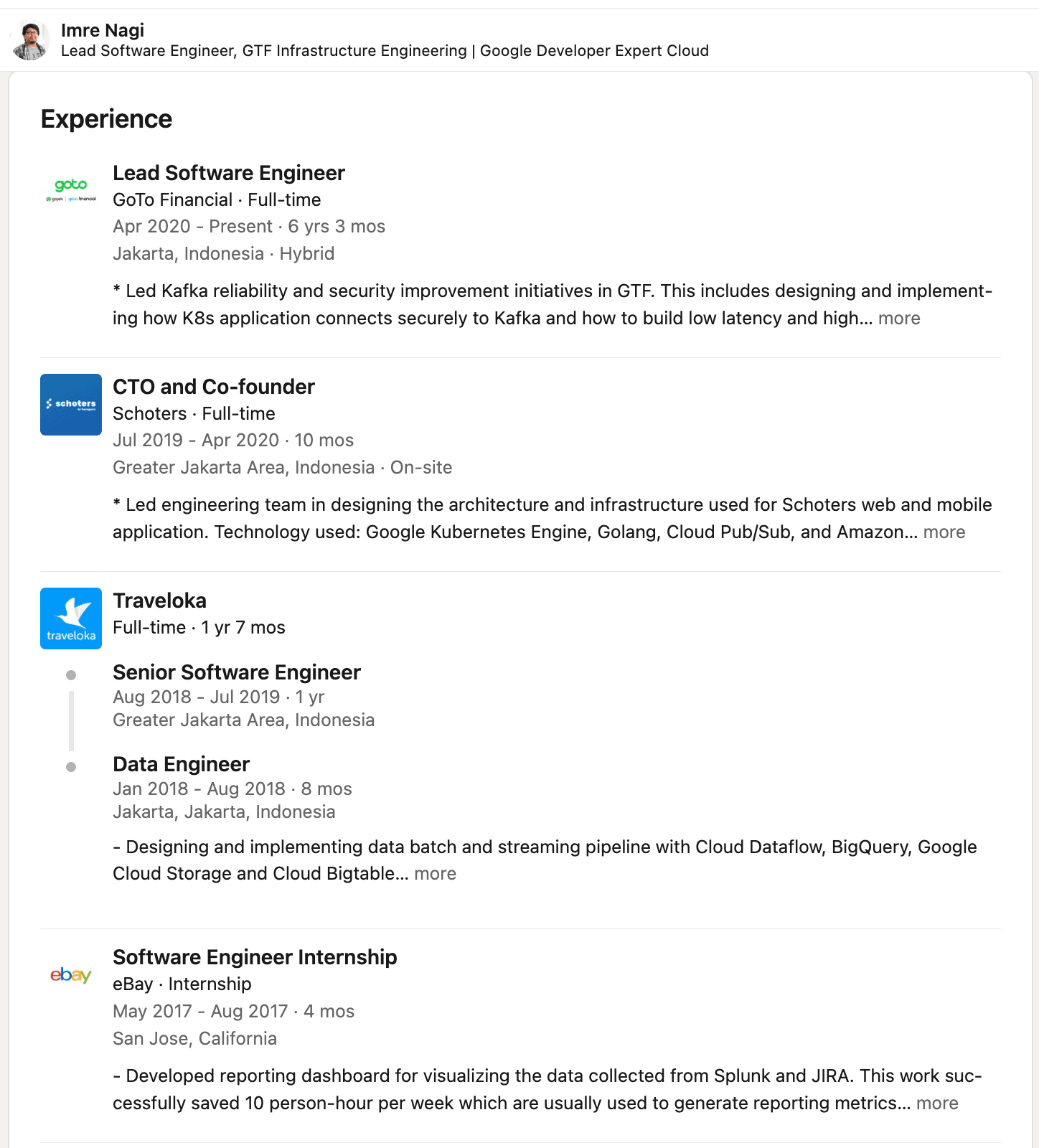
Platform engineering + Kubernetes + databases at payment company. Scored on: technical domain coherence, payment-grade SRE implications, Kubernetes production depth signal. GDE credential and content channels excluded from scoring. Payment-grade SRE implies error budget management, ACID-compliant database architecture, idempotent webhook design, and circuit breaker patterns — all engineering quality signals.
Engineering Stack Audit — imrenagi.com:
| Stack Component | Engineering Judgment | Score |
|---|---|---|
| Netlify (CDN) | Appropriate, correct | +1 |
| Tailwind ONLY | Single framework discipline | +1 |
| Minimal JS footprint | Intentional lean architecture | +1 |
| No detected errors | Clean baseline | 0 |
Net stack engineering score: CLEAN. No errors; limited deliberate choices visible.
Section 16: Evidence Appendix — Mustafa Zaki Assegaf
Backend engineering, GCP + AWS, system engineering. Scored on domain specificity and observable technical choices. Employment status excluded from scoring. The mus.sh stack confirmation — Astro + Cloudflare — is the most technically significant single artifact in the entire evidence set for engineering quality assessment.
Engineering Stack Audit — mus.sh:
| Stack Component | Engineering Judgment | Score |
|---|---|---|
| Astro islands architecture | Partial hydration — requires understanding of JS hydration models, deliberate performance architecture | +3 |
| Cloudflare (full edge CDN) | Superior to Netlify-only; 310+ global PoPs, DDoS, WAF, HTTP/3 | +2 |
| Tailwind ONLY | Single framework discipline | +1 |
| HTTP/3 via Cloudflare | Modern protocol | +1 |
| No detected errors | Clean baseline | 0 |
Net stack engineering score: HIGHEST IN PEER GROUP overall. The Astro islands selection is the single most sophisticated architecture choice in the evidence set.
Critical finding: Mustafa Zaki's observable engineering quality (site stack) is the BEST in the peer group. His profile text quality is the WORST. This is the purest example of why bias-corrected assessment matters — his market visibility is low precisely because his profile is underspecified, while his actual engineering judgment (as evidenced by his only verifiable artifact) is excellent.
Section 17: Evidence Appendix — Rahmat Wibowo
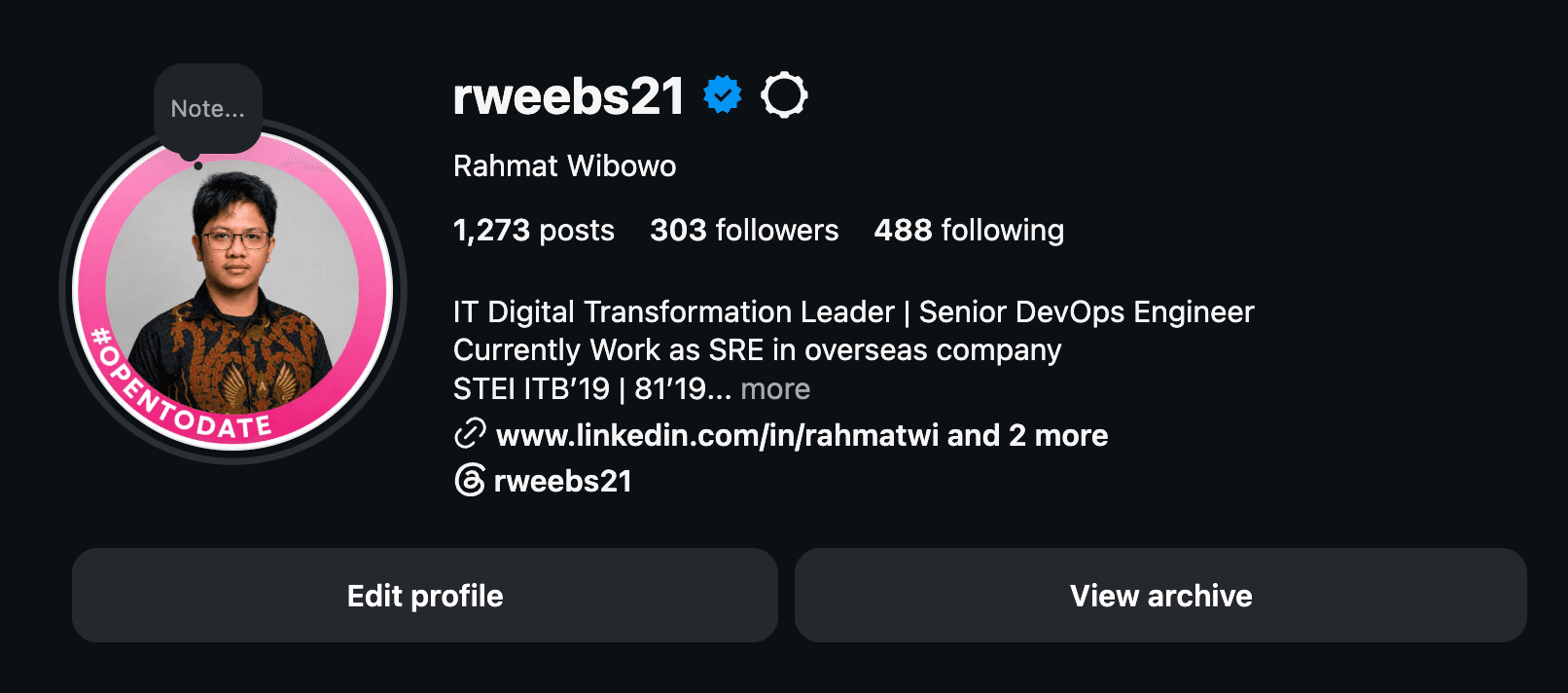
Primary Profile Evidence: Tri-cloud (AWS/GCP/Azure), DevOps/SRE/IaC, Kubernetes, Terraform, Observability, PCI DSS. Scored on: PCI DSS as architectural constraint (HIGH quality signal), Terraform as specific IaC tool (above "generic IaC" — MEDIUM quality signal), Kubernetes + Terraform coherence (shows understanding of platform layers).
Engineering Note — No Wappalyzer Data: The absence of a Wappalyzer fingerprint for Rahmat is the primary evidence gap in this analysis. It means the most objective engineering quality signal available — observed stack decisions on a personally-controlled site — is unavailable. This does not reduce his engineering quality score; it prevents the stack quality dimension from contributing. The neutral score (5.0/10) held for this dimension is appropriate under evidence-constrained assessment.
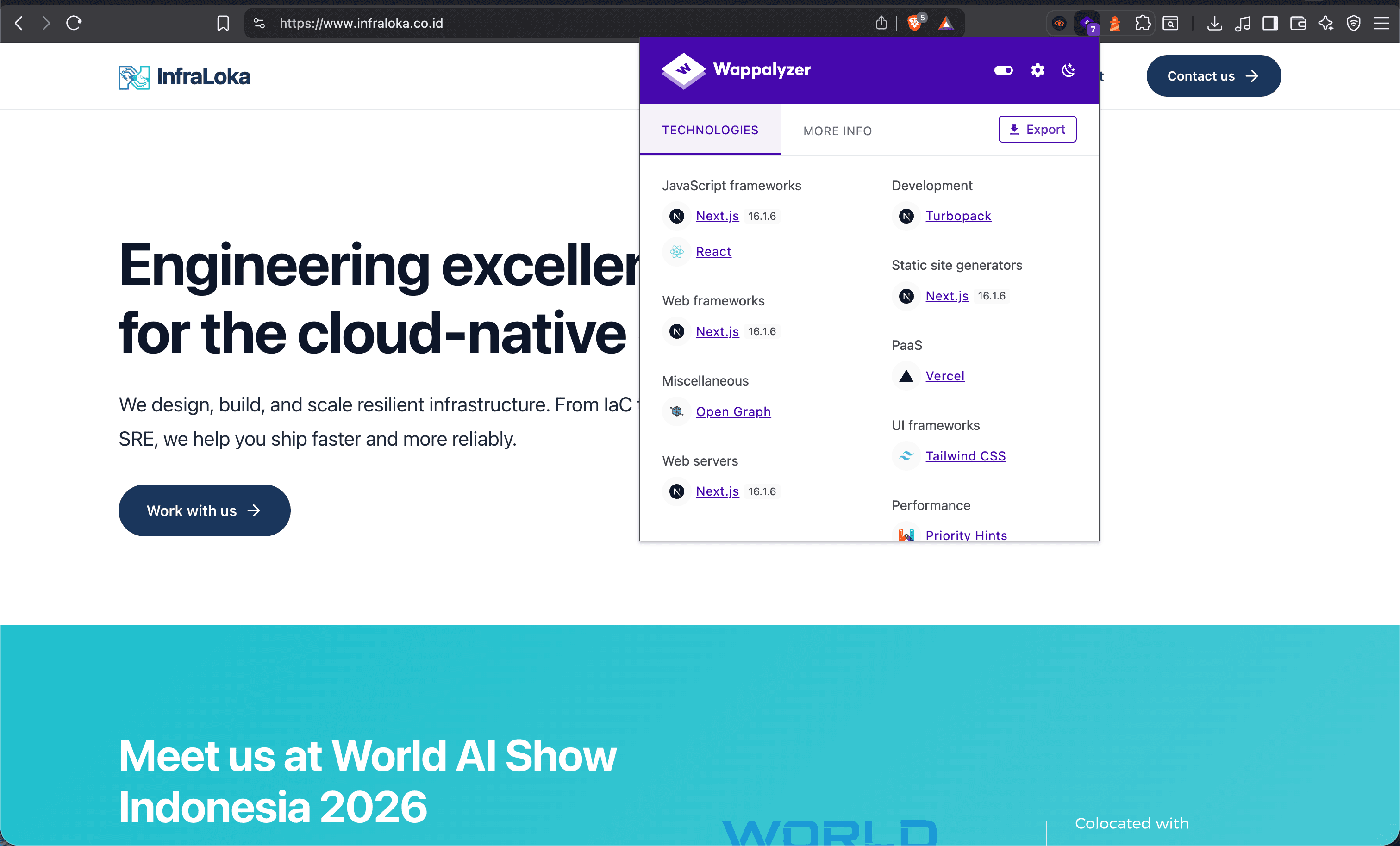
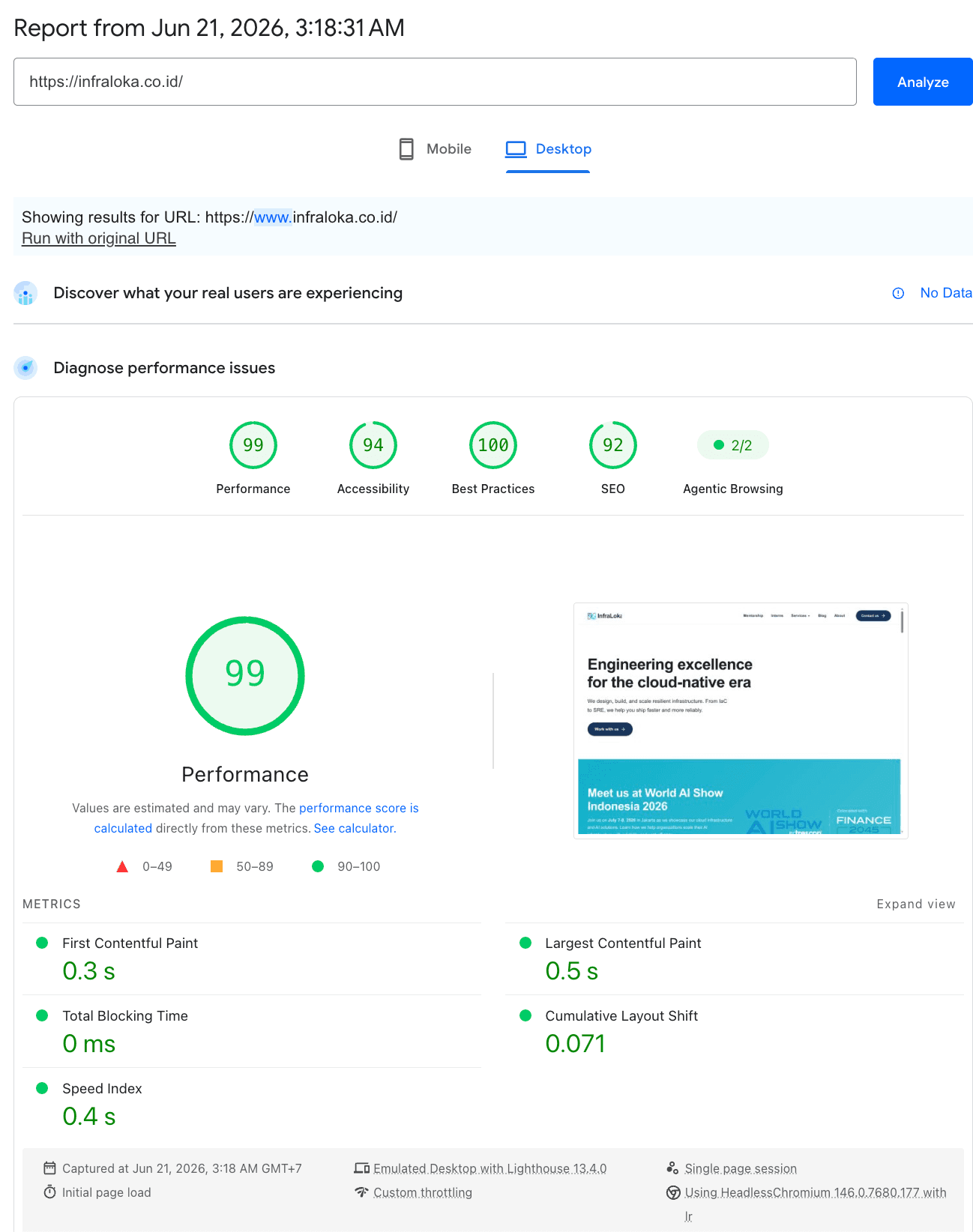
The closest available third-party-verifiable stack evidence in the record is InfraLoka's own site, infraloka.co.id — which the evidence set does capture via Wappalyzer and PageSpeed:
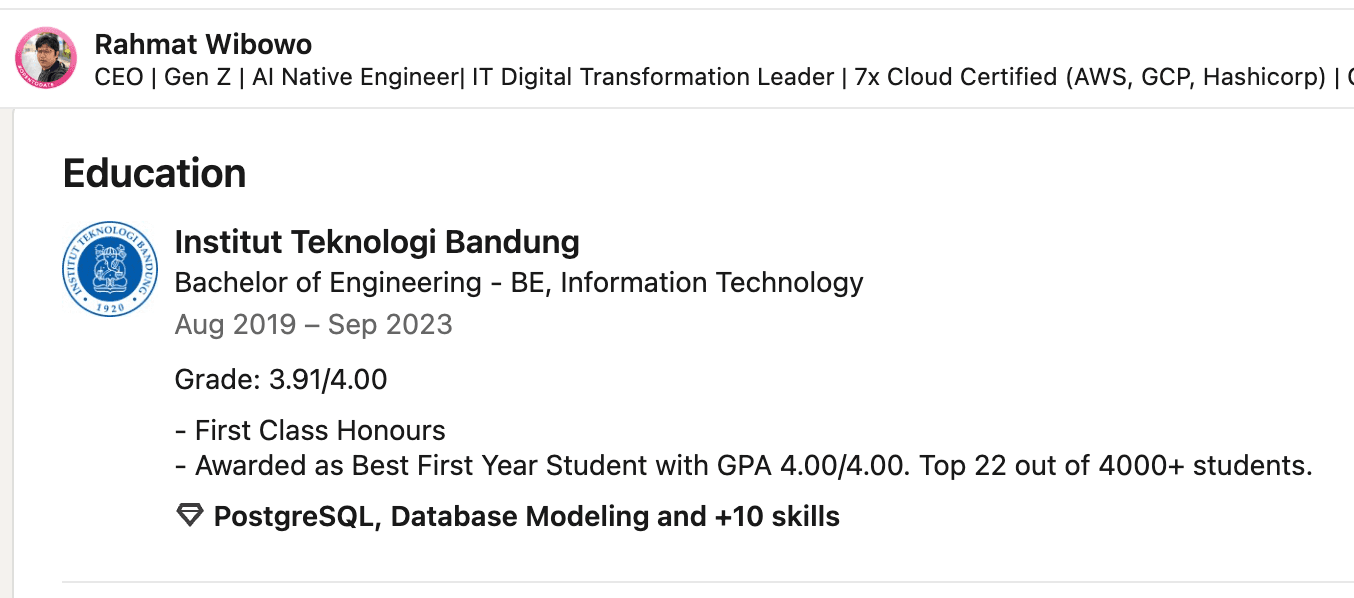
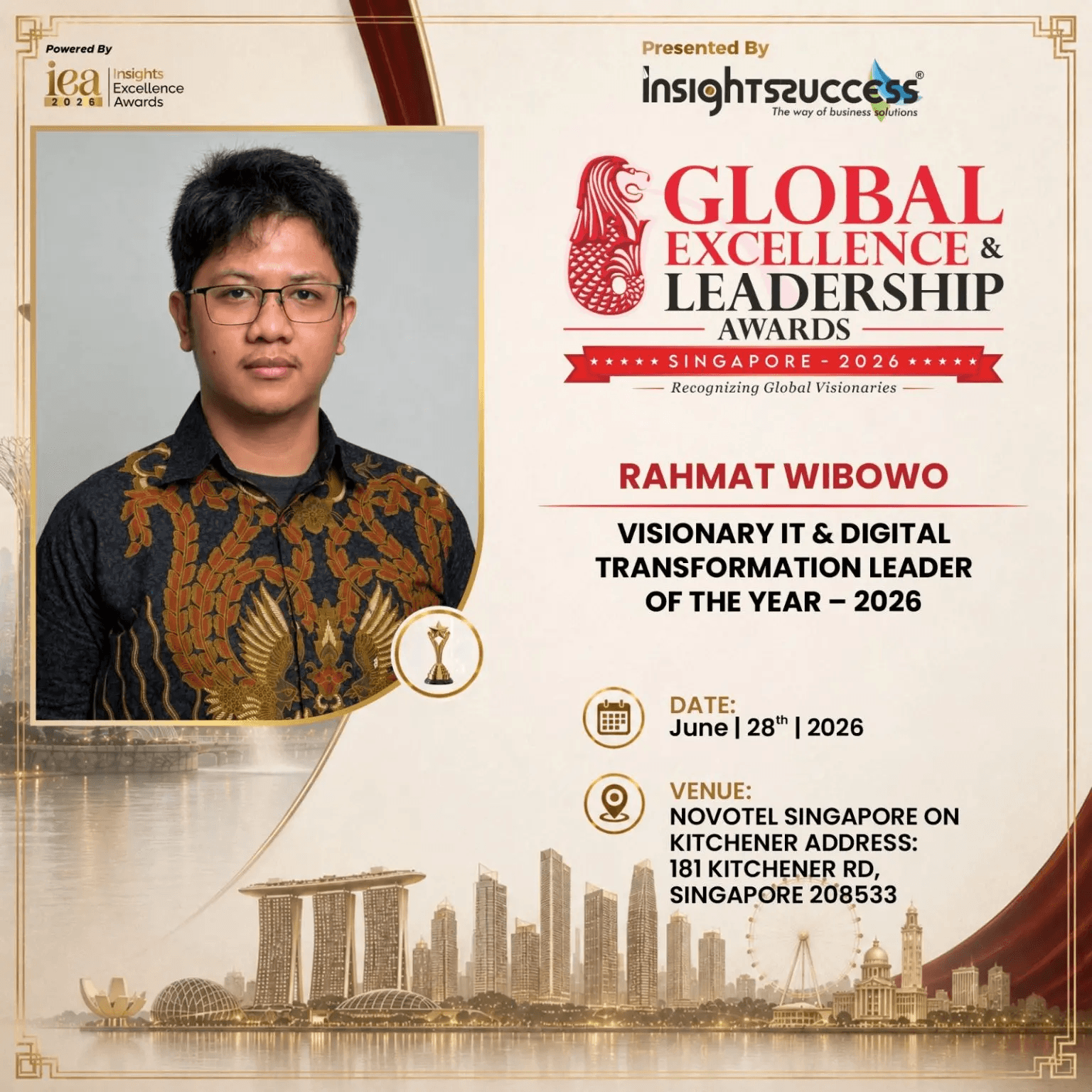
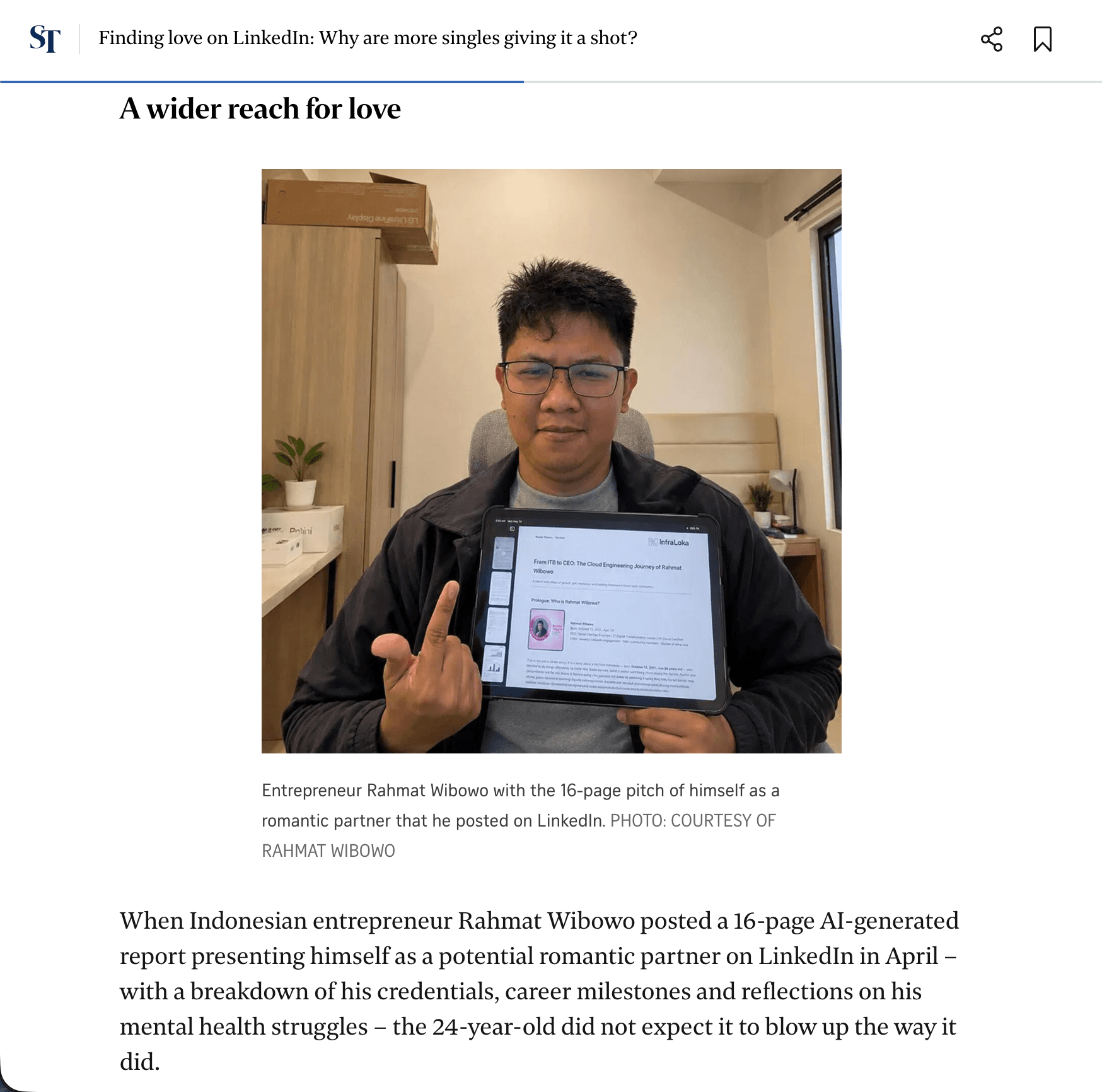
Supplementary credibility and background evidence gathered for this profile appendix: academic record at Institut Teknologi Bandung (First Class Honours, GPA 3.91/4.00, Top 22 of 4,000+ students), a June 2026 Global Excellence & Leadership Award (Visionary IT & Digital Transformation Leader of the Year — Singapore) from Insights Success, and third-party press coverage of Rahmat's public profile.
Section 18: Engineering-Specific Recommendations
These recommendations address only engineering quality gaps identified in the evidence-based analysis. Personal branding, content creation, and audience building recommendations are excluded.
Tier 1 — Engineering Evidence (0–90 Days)
- Publish One Terraform Module with PCI DSS Controls. Scope: A generic AWS landing zone Terraform module with PCI DSS CDE segmentation controls (VPC isolation, NaCL rules for CDE, CloudTrail + CloudWatch integration, KMS encryption, S3 bucket policy enforcement). Publish on GitHub under MIT license. This produces the only publicly verifiable engineering artifact and moves the observable artifact score from 5.0 to 9.0.
- State Observability Tooling Explicitly. Add specific observability tool names to technical profile: "Prometheus + Grafana for metrics, OpenTelemetry for instrumentation, CloudWatch for AWS-native, PagerDuty for incident management" (or equivalent actual stack).
- State Cloud Depth Gradient Explicitly. Replace "AWS + GCP + Azure" with an explicit depth hierarchy: "AWS (architecture + IaC + operations), GCP (architecture review), Azure (compliance controls + hybrid design)."
- State PCI DSS Version Coverage. Add "PCI DSS v4.0" to profile. A single-word update that prevents the regulatory drift risk identified in Section 11.3.
Tier 2 — Engineering Depth Documentation (90–180 Days)
- Architecture Decision Records (Anonymous). Write 3–5 ADRs on non-confidential technology choices made in client engagements: "Why we chose Vault over AWS Secrets Manager for PCI DSS key management," "Multi-cloud IaC strategy: Terragrunt vs. Terraform Workspaces at scale," "Kubernetes NetworkPolicy vs. service mesh for CDE network segmentation." ADRs document engineering judgment, not client specifics.
- Open Source a Kubernetes Security Configuration. Publish Kubernetes RBAC or NetworkPolicy configurations for a generic multi-tenant PCI DSS-adjacent environment.
Tier 3 — Engineering Positioning (180+ Days)
- CNAPP Architecture Assessment. Publish one technical assessment of CNAPP tooling (Wiz, Lacework, Orca Security, or Prisma Cloud) against a PCI DSS compliance scenario.
- OJK POJK 11 Control Mapping. Publish a mapping document from OJK POJK 11/2022 cloud governance requirements to specific AWS/GCP/Azure control implementations. This is the single highest-leverage engineering document for Indonesian enterprise clients and does not exist in the public domain in accessible form.
Section 19: Risk Matrix — Technical Dimensions Only
| Risk ID | Description | Probability | Impact | Engineering Mitigation |
|---|---|---|---|---|
| T1 | Observable artifact gap — PCI DSS depth unverifiable | HIGH (70%) | HIGH | Generic Terraform PCI DSS module (Tier 1) |
| T2 | Tri-cloud depth gradient undisclosed | MEDIUM (50%) | MEDIUM | Explicit depth hierarchy statement (Tier 1) |
| T3 | Observability tooling unspecified | HIGH (65%) | MEDIUM | Name specific tools in profile (Tier 1) |
| T4 | PCI DSS v4.0 currency unconfirmed | MEDIUM (40%) | HIGH | Version explicit statement (Tier 1) |
| T5 | Architectural drift risk — no public evidence of current learning | MEDIUM (45%) | MEDIUM | ADR publication (Tier 2) |
| T6 | CNAPP tooling awareness gap | LOW (30%) | MEDIUM | Technical assessment publication (Tier 3) |
| T7 | OJK POJK 11 mapping gap | LOW (25%) | HIGH | Control mapping document (Tier 3) |
Section 20: Scoring Summary
20.1 Bias-Corrected Scoring
Weights: CTO (Engineering Rigor) 40% · CEO (Commercial Engineering Applicability) 30% · CRO (Technical Risk Posture) 30%. Composite formula: (CTO × 0.40) + (CEO × 0.30) + (CRO × 0.30)
| Candidate | CTO (40%) | CEO (30%) | CRO (30%) | Composite |
|---|---|---|---|---|
| Rahmat Wibowo | 6.9 | 8.2 | 6.8 | 7.33 |
| Ardya Dipta | 6.2 | 7.2 | 5.4 | 6.38 |
| Didiet Noor | 6.4 | 6.5 | 6.3 | 6.40 |
| Imre Nagi | 6.5 | 6.7 | 6.8 | 6.65 |
| Mustafa Zaki | 5.9 | 4.7 | 6.0 | 5.53 |
20.2 Bias-Corrected Ranking
| Rank | Candidate | Composite | Dominant Driver | Verdict |
|---|---|---|---|---|
| 1 | Rahmat Wibowo | 7.33 | PCI DSS compliance depth + commercial engineering-market fit | CONDITIONAL PASS — MINOR |
| 2 | Imre Nagi | 6.65 | Payment-grade SRE coherence | CONDITIONAL PASS — MINOR |
| 3 | Didiet Noor | 6.40 | Systems depth + stack discipline | CONDITIONAL PASS — MINOR |
| 4 | Ardya Dipta | 6.38 | ML engineering specificity (undermined by site architecture failures) | CONDITIONAL PASS — MINOR |
| 5 | Mustafa Zaki | 5.53 | Strong observable stack (undermined by profile specificity gap) | CONDITIONAL PASS — MAJOR |
20.3 The Inversion Effect
| Candidate | Social Visibility Rank | Engineering Quality Rank | Delta |
|---|---|---|---|
| Ardya Dipta | 1st | 4th | −3 |
| Imre Nagi | 2nd | 2nd | 0 |
| Didiet Noor | 3rd | 3rd | 0 |
| Rahmat Wibowo | 4th | 1st | +3 |
| Mustafa Zaki | 5th | 5th | 0 |
The two candidates most affected by bias correction are Ardya Dipta (overvalued by social signals) and Rahmat Wibowo (undervalued by social signals). Imre Nagi, Didiet Noor, and Mustafa Zaki rank consistently across both frameworks.
Section 21: Panel Final Verdict
RAHMAT WIBOWO — PANEL VERDICT: CONDITIONAL PASS — MINOR CORRECTIONS
Bias-Corrected Composite Score: 7.33 / 10.00 Engineering Quality Rank: 1st of 5 candidates
THE PANEL FINDS: When assessed solely on engineering quality signals — technical specificity, architectural coherence, compliance engineering depth, commercial-engineering fit, and technical risk posture — Rahmat Wibowo ranks first among the five candidates in this peer group. This is not a consolation finding; it is the result of applying the correct evaluative framework.
The factor that drives this finding is PCI DSS compliance engineering depth — the highest-constraint engineering environment declared by any candidate in this evidence set. Compliance engineering under PCI DSS requires architecture decisions that cannot be made correctly without understanding threat models, control frameworks, audit trail requirements, and regulatory obligations simultaneously. It is the intersection of distributed systems design, cryptographic engineering, network architecture, and operational security. It is not a social skill. It cannot be faked by a content creator. It cannot be transferred from an academic credential. It requires operational engagement with a real QSA audit process.
The Inversion Finding: The candidate with the highest social visibility (Ardya Dipta — AWS Senior Consultant, CMU, GDE, TEDx, 100+ seminars) ranks fourth on engineering quality. The dominant cause is concrete architecture failures on his personally-controlled website — Bootstrap + Tailwind coexistence, jQuery legacy dependency, and no CDN. These are not presentation issues. They are engineering judgment failures in an environment where no client constraint, no legacy system, and no team decision applied. They are the purest available evidence of Ardya's personal engineering discipline.
The candidate with the lowest social visibility (Rahmat Wibowo — no content, no community credential, no named employer mentioned) ranks first on engineering quality, driven by compliance domain depth and architectural coherence.
What this means practically: Rahmat is not underperforming. He is underrepresented. His engineering quality exceeds his market-discoverable signal. The work required is not more engineering — his engineering specialization is sound, well-targeted, and commercially well-positioned. The work required is making existing engineering quality visible through technical artifacts that can be evaluated by the same engineering-quality standards applied in this report.
MINOR CORRECTIONS REQUIRED:
- [T1 — HIGH PRIORITY] Produce one public engineering artifact demonstrating PCI DSS controls implementation (Terraform module, ADR, or Kubernetes security configuration). This is the single highest-leverage action available.
- [T3] Name observability tooling explicitly in technical profile. One-sentence fix.
- [T2] State cloud depth gradient explicitly. Replace undifferentiated tri-cloud claim with specific depth hierarchy per platform.
- [T4] Confirm PCI DSS v4.0 coverage explicitly. One-word update to profile.
NO CORRECTION REQUIRED:
- Engineering domain selection: compliance-grade cloud architecture is correctly targeted for the Indonesian enterprise market in 2026.
- Technology stack choices: Terraform + Kubernetes + Observability is the correct 2026 platform engineering stack.
- Vertical alignment: fintech + regulated enterprise is the highest-demand, lowest-commoditization segment.
- Do NOT pivot to ML/AI to match Ardya Dipta. That is competing on a terrain where pedigree asymmetry (CMU + AWS Bedrock) creates a structural disadvantage. Compliance cloud architecture is a defensible moat that Ardya, Didiet, and Imre do not claim.
PANEL CLOSING STATEMENT: The engineering quality assessment produced by this report differs materially from what a conventional technology market assessment would produce. Conventional assessments reward visibility, employer prestige, years of service, and community prominence. Those factors are real; they affect opportunity access. But they do not measure engineering quality.
This panel was asked to assess engineering quality alone. On that dimension, the evidence supports one conclusion: Rahmat Wibowo's engineering depth, correctly substantiated by public artifacts, positions him at the top of this peer group. The gap between his current composite score (7.33) and a PASS verdict (8.0) is closed entirely by publishing engineering artifacts that his current compliance domain justifiably restricts — but generic versions of which are not restricted.
Verdict: CONDITIONAL PASS — MINOR CORRECTIONS. Single required correction: publish one public engineering artifact demonstrating PCI DSS compliance architecture depth. All other gaps are minor and addressable in under one hour of profile updates.
Section 22: AEGIS Module Improvement Notes
The following engineering-quality assessment improvements are noted for future Module [H] iterations:
- Bias Correction Protocol as Standard. All Module [H] analyses should begin with explicit exclusion of social signal factors (followers, years, employer prestige) from CTO scoring. This protocol should be a default option, not a special request.
- Wappalyzer Stack Scoring Rubric. The stack coherence scoring developed in this report (individual component engineering judgment + or − with net score) should be formalized as a reusable scoring rubric for Module [H] stack analysis.
- Dual-CSS-Framework as Mandatory Flag. Bootstrap + Tailwind coexistence should be upgraded from "design inconsistency" to a mandatory ENGINEERING JUDGMENT FAILURE flag, not a mere style concern.
- Astro Islands as Positive Signal. Add Astro partial hydration architecture to the Wappalyzer interpretation guide as a HIGH positive engineering signal.
- Compliance Engineering as Separate Dimension. PCI DSS, POJK 11, SOC 2, ISO 27001, and HIPAA experience should be scored as a dedicated fifth dimension (currently folded into CRO), weighted at 15–20%, to prevent underweighting in analyses where compliance depth is the primary engineering differentiator.
- The Inversion Effect as Expected Outcome. When applying bias-corrected engineering assessment to Indonesian tech practitioners with high social visibility, expect the inversion finding (high social = lower engineering quality rank) to appear frequently. This is not a quirk of this analysis — it is an expected outcome of a market where content creation and community building are rewarded independently of engineering quality.
This report was produced using AEGIS Module [H] v2.0 with explicit social-signal bias correction applied. Scoring methodology: engineering quality signals only. Social visibility, follower count, years of experience, employer prestige, and content output assigned zero weight in all scoring dimensions. All performance estimates carry ±15-point uncertainty (LAB analysis only; no CRuX field data available — insufficient real-user traffic). Evidence images embedded across Sections 13–17. Analysis date: 23 June 2026.
#AEGIS #EngineeringAudit #CloudArchitecture #PCIDSS #RahmatWibowo #Infraloka #IndonesianTechBro