
"Cacat Mental" and "Ambil Medications": Why I Call It Stigma, Not Criticism
The first two lines of a public Threads reply about me called me "cacat mental" and told me to "ambil medications". I live with bipolar disorder. This post explains why I treat that as stigma and not as an opinion about somasi.
This article does not claim that the author knew my diagnosis or that any court has found him in breach of the law. It explains my reading of the law and how the words landed. For the reply itself, see the main record.
This is my account and my opinion. It is not medical or legal advice.
Scope and what I am sharing
- I have disclosed my diagnosis, bipolar disorder, in my legal notice. I am not publishing my medical records here and do not need to.
- The Threads reply does not name my diagnosis. It says "mentally defective" and "take your medications".
What I observed
- The word "cacat" is the old Indonesian word for a person with a disability. The 2016 disability law, UU No. 8 Tahun 2016, uses "penyandang disabilitas" instead.
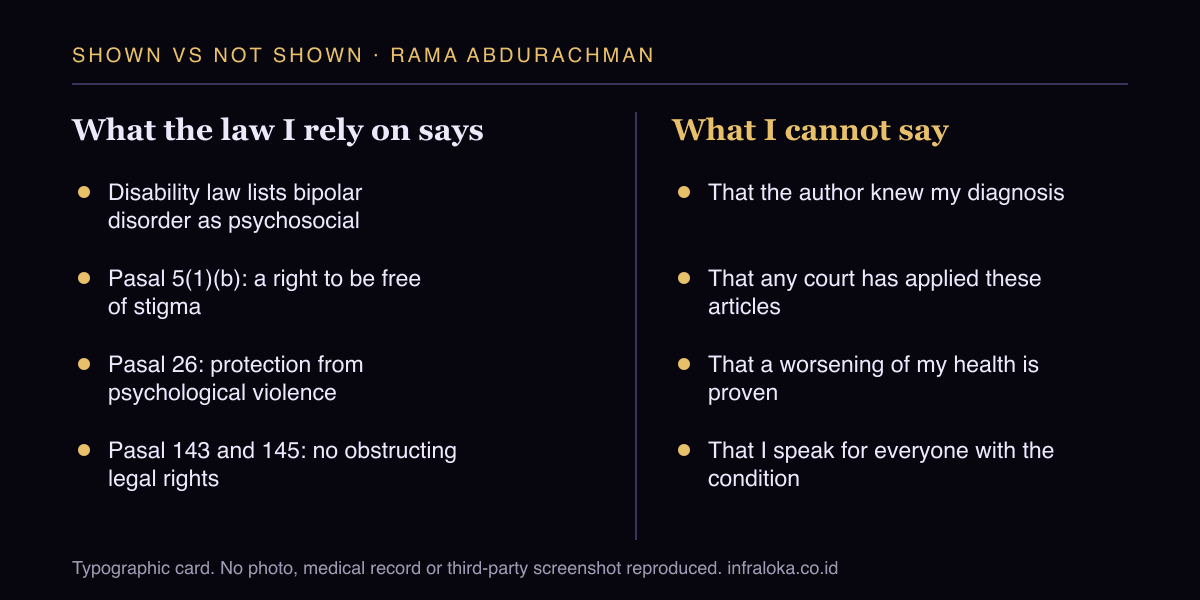
- That law says mental disability is a disturbance in thought, emotion and behaviour. Its explanation lists bipolar disorder among the psychosocial conditions.
- A person on medication for a mental health condition is doing what a clinician advised. Using it as an insult makes treatment a shameful thing, which makes it harder for the next person to admit they need it.
The articles I rely on
- Pasal 5(1)(b) gives people with disabilities a right to be free of stigma.
- Pasal 26 protects against discrimination and against psychological violence.
- Pasal 143 and 145 bar anyone from obstructing a person with a disability from claiming those rights, with a criminal penalty.
My letter argues that these apply. Whether "obstructing" is met depends on the effect of the words, which an investigator and a court will weigh. If it is not met, I rely on the same articles as the standard that was breached in a civil claim.
What I cannot say
- That the author knew my diagnosis. He did not need to for the words to be demeaning, but I cannot read his mind.
- That a court has applied these articles to a case like this.
- That my health has worsened because of the reply. I know bipolar disorder is episodic and can be affected by stress. I have said so to him, and I will only claim harm I can document.
- That I speak for everyone with a mental health condition.
Where I am probably wrong
"Cacat mental" is common online slang, and the author may not have meant it clinically. Intent matters in criminal law, and a slang term is not proof of a plan to demean. I may also be reading a harsher meaning than a casual reader would.
If this reads like your week
If words like these have hurt you, you are not weak. Talk to a clinician or someone you trust. Do not stop medication because a stranger mocked it.
Right of reply and correction policy
Rama Abdurachman is invited to send a response, correction or added context. A substantive response may be published alongside this article, subject to reasonable editing for privacy, safety and relevance. If reliable evidence shows that any factual statement here is wrong, I will correct it promptly and note the change.
Published by Rahmat Wibowo, InfraLoka — infraloka.co.id
#ProfessionalBlacklist #RamaAbdurachman #MentalHealth #RightOfReply