
Sacred Text, Evolving Truth: Why Religion and Science Must Not Be Conflated By Rahmat Wibowo From Infraloka
On the dignity of keeping divine postulates sacred and science free to revise itself
There is a particular intellectual hazard that has quietly colonized modern discourse: the tendency to validate religious texts by pointing to scientific discoveries, or conversely, to invalidate science by invoking scripture. Both moves, however well-intentioned, corrupt both domains simultaneously.
This essay argues for a principled, respectful, and necessary separation. Not the separation of hostility, as though faith and reason are enemies. Rather, the separation of recognition, acknowledging that religion and science operate on fundamentally different epistemological tracks, answer different questions, and derive authority from entirely different sources. Confusing the two does not elevate either. It diminishes both.
I. The Nature of Religious Postulates
The word "postulate" comes from the Latin postulatum, meaning something demanded or assumed as self-evident. In formal logic, postulates are foundational premises that do not require proof within the system they define. Euclidean geometry begins with five postulates. You do not prove them. You start from them.
Religious postulates function in an analogous way, but with a dimension that formal axioms lack: they are regarded by believers as divine revelation, communicated through prophets, preserved in texts, and transmitted across generations with a mandate of fidelity. In Islam, the Quran is understood as the literal word of Allah, preserved in its original Arabic, unaltered since its revelation to the Prophet Muhammad (peace be upon him). In Christianity, the Bible is received as divinely inspired scripture. In these frameworks, the text is not a hypothesis. It is a foundation.
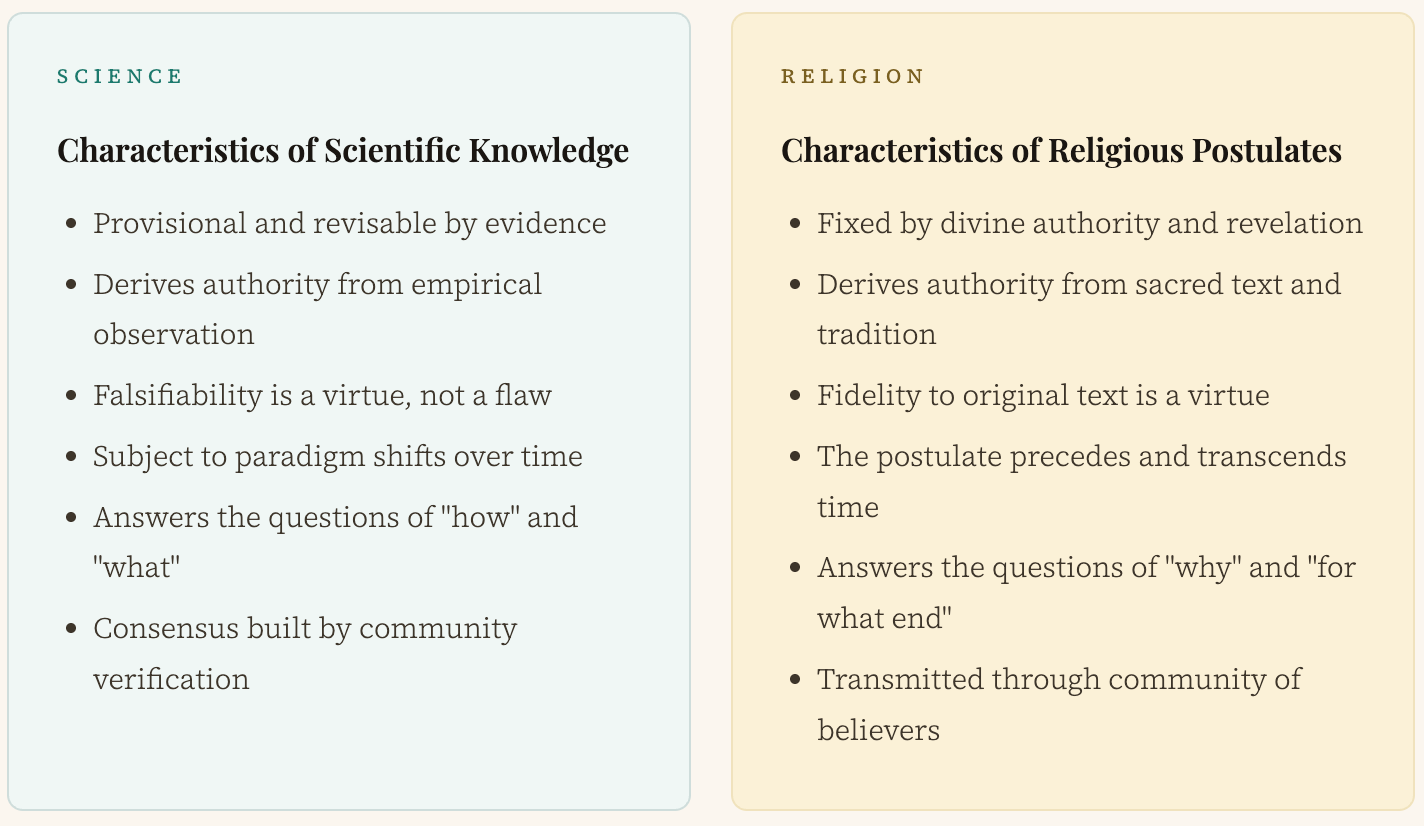
The sacred postulate is fixed not because it is ignorant of change, but because it claims a different order of authority. It does not derive its truth from human observation. It claims to precede and transcend it. To subject it to revision based on the current state of scientific knowledge is not to honor science. It is to fundamentally misunderstand what the text claims to be.
"Atheism, which people have tried for hundreds of years as the ways of reason and science, is proving to be mere irrationality and ignorance."
Harun Yahya, the Turkish-born author of over 300 books including The Evolution Deceit and The Atlas of Creation, represents one of the most prolific voices in the Islamic world engaging the science-religion boundary. His central argument is that Darwinian evolution is philosophically bankrupt and that modern scientific findings, properly understood, confirm the reality of divine creation. Whether one agrees with his conclusions or not, his work points to a live tension: when religion attempts to enter the domain of empirical claims, it invites empirical scrutiny. And that scrutiny can be unkind.[2]
The deeper problem is not Harun Yahya's specific conclusions. The deeper problem is the method itself. When religious interpretation is made dependent on current scientific understanding, it becomes hostage to the next revision. And in science, revisions always come.
II. The Nature of Scientific Knowledge: Built to Be Revised
Science is, by design, a self-correcting enterprise. This is not a weakness. It is science's greatest strength. A scientific claim that cannot in principle be falsified is not science at all. Karl Popper, one of the twentieth century's most influential philosophers of science, argued that falsifiability is the defining criterion separating science from pseudoscience. A claim must be capable of being proven wrong. If it is, the theory is updated or abandoned. That is not failure. That is the process working.
Thomas Kuhn, whose 1962 work The Structure of Scientific Revolutions remains one of the most cited academic books ever published, deepened this picture. Kuhn showed that science does not progress through smooth accumulation of facts. It advances through occasional ruptures he called paradigm shifts, moments when enough anomalies accumulate that the reigning framework collapses and a new one emerges.[3]
"A scientific revolution is non-cumulative in which a newer paradigm replaces an older one, either partially or completely."
The shift from Ptolemaic geocentrism to Copernican heliocentrism is the canonical example. For over a thousand years, the dominant scientific and philosophical consensus placed Earth at the center of the cosmos. [4] This was not mere religious dogma. It was the settled scientific position, backed by the best astronomical models of the time. Then Copernicus proposed otherwise. Galileo confirmed it with a telescope. The paradigm shifted. The Earth moved.
What should have been a lesson in humility about scientific consensus became instead a catastrophic case of category confusion. The Church had made the geocentric model part of its theological interpretation. When the science changed, the theology was embarrassed. This was not science's fault. It was the result of theology having improperly annexed an empirical claim as a divine one.[5]
III. The Danger of "Scientizing" Scripture
The practice of reading scientific discoveries back into religious texts, commonly called "scientific exegesis" or tafsir ilmi in the Islamic tradition, has grown significantly in the modern era. The intention is sympathetic: to show that revelation anticipated what science later discovered, and thus to defend faith against secular challenge. But the method carries a structural flaw.
Consider the following scenario. A verse in a sacred text uses a phrase that, in one interpretation, seems to describe the expanding universe. A commentator in 2010, excited by cosmological discoveries, publishes a volume arguing that this verse precisely predicted what Hubble observed in 1929. The interpretation gains popularity. Then, in 2040, a new cosmological model emerges that revises the expansion rate, or proposes that the observable universe is nested within a larger structure that complicates the "expansion" framing. Does the interpretation need revision? If so, you have now committed the text to the revision cycles of astrophysics.
You will produce volume upon volume of updated interpretation, each chasing the current scientific consensus, each slightly embarrassed by the previous volume. The sacred text has been made fragile by the very effort to make it seem scientific. As Jacques Monod, molecular biologist and Nobel laureate, wrote: the cornerstone of the scientific method is the postulate that nature is objective, that true knowledge cannot be obtained by interpreting nature in terms of final causes.[6] Religion traffics precisely in final causes. Purpose. Meaning. Telos. These are not empirically accessible categories.
A fundamental asymmetry: Science answers how the cosmos operates. Religion answers why it exists and what we owe to one another within it. These are not competing answers to the same question. They are answers to different questions entirely. A person who demands that religion answer scientific questions has confused the instrument. A person who demands that science answer religious questions has made the same error in reverse.
IV. Let the Postulate Remain Sacred
There is profound wisdom in the Islamic tradition's insistence on preserving the Quran in its original Arabic, transmitted through a chain of memorization (sanad) that stretches back to the Prophet. The text is held sacred not as a scientific document but as a covenant, a guide, a mercy for all creation. The word "rahmat" itself, mercy, appears in its most expansive form in the phrase rahmatan lil alamin: mercy for all worlds, for all creation.
That mercy is not contingent on whether neutrinos have mass or whether dark matter is confirmed. The moral imperatives of the text, the call to justice, compassion, prayer, stewardship of the earth, care for the orphan and the widow, do not become more or less true depending on what CERN discovers. They operate in a domain that is orthogonal to the empirical.
When interpreters attach theological weight to specific scientific claims, they risk something more than intellectual error. They risk the faith of believers whose trust is shaken when those scientific claims are overturned. A young Muslim who is told that a particular verse proves a specific biological mechanism, and who later learns that the mechanism has been revised, faces a crisis that need not have been manufactured. The verse stood before the scientific claim. It will stand after the next revision. Only the overlay was fragile.
"Reconstructions based on bone remains can only reveal the most general characteristics of the creature, since the really distinctive morphological features of any animal are soft tissues which quickly vanish after death."
Here Harun Yahya makes a methodological point that, whatever its polemical intent, captures something real: interpretive reconstructions involve assumptions. Soft tissue is gone. The inference involves imagination disciplined by evidence. This applies equally to the project of reading scientific content into scripture. Much of the "match" between verse and discovery is itself reconstruction. It fills in what is not explicitly there. And what is filled in can be unfilled when the science moves.
V. Let Science Evolve
The history of science is a history of revision, refinement, and occasional revolution. Newtonian mechanics was extraordinarily successful for over two centuries before Einstein showed that it was a special case of a more general relativistic framework. Quantum mechanics then arrived to complicate the picture further at subatomic scales. General relativity and quantum mechanics remain incompatible at their foundations: one of the great open challenges in theoretical physics is finding a unified theory that reconciles them.
This is not science failing. This is science being science. Each revision produces better predictions, more precise instruments, more effective medicines, more powerful technologies. The revisability is the engine. Remove the permission to revise, and you have frozen the engine. That is what happens when science is made to serve a fixed theological conclusion. The conclusion determines in advance what the science must find. Anomalies are explained away. The paradigm cannot shift. The result is not theology elevated. The result is science corrupted.
The correct arrangement is the reverse. Religion asks: what is the good life? What do we owe to God, to one another, to creation? Science asks: how does creation actually work, at every scale from quarks to galaxy clusters? These questions are not in competition. They are in complementarity. A scientist who is also a person of faith moves between two registers, each complete on its own terms, each enriched by the other's insights without either colonizing the other's domain.
VI. Harun Yahya and the Cautionary Lesson
Harun Yahya's intellectual project is, at its core, a defensive one. Faced with a scientific mainstream that he perceives as hostile to Islamic faith, particularly the neo-Darwinian synthesis, he attempted to mount a comprehensive counter-argument from within the domain of science. The Atlas of Creation, sent unsolicited to thousands of scientists, educators, and members of Congress in 2007, argued through fossil evidence that living species have not changed over geological time, challenging the evolutionary framework.[7]
The response from the scientific community was largely critical. Biologists pointed to significant errors in the photographs used, where fishing lures were mistakenly presented as fossils, among other documented problems. The project became, for many, an illustration of what happens when religious conviction drives the methodology rather than following where evidence leads.
But Harun Yahya's failure, if we call it that, is instructive precisely because his motivation was to defend sacred text by engaging scientific terrain. The lesson is not that his faith was wrong. The lesson is that the strategy was structurally misaligned. Faith does not need to win the fossil debate to remain authoritative on the questions that religion is actually equipped to answer: meaning, morality, transcendence, community, the arc of human life toward something worthy.
His quote that "the followers of intelligent design should openly and clearly declare the existence of Allah as the Creator"[1] points to a more honest position than scientific creationism: if the claim is ultimately theological, make the theological claim directly, on theological grounds. That claim does not require the fossil record to cooperate.
VII. Two Magisteria, One Flourishing
Stephen Jay Gould, the evolutionary biologist and science writer, proposed the concept of "Non-Overlapping Magisteria" (NOMA): the idea that science and religion each have a legitimate domain, and neither should trespass on the other's territory. Science covers the empirical realm of fact and theory. Religion covers the realm of ultimate meaning and moral value. Gould himself was not religious, but he recognized that the conflict narrative serves no one well.
The Stanford Encyclopedia of Philosophy frames it precisely: "methodological naturalism is concerned with the practice of science and the kinds of entities and processes that are invoked. It does not make any statements about whether or not supernatural entities exist. They might exist, but lie outside the scope of scientific investigation."[8]
This is not a defeat for religion. Science's silence on the supernatural is not the same as science's denial of it. It is simply science staying in its lane. Religion, equally, serves its community best when it stays in its own lane: not as a book of physics, but as a book of wisdom, covenant, and guidance for how to live.
The practical implication: Teach science in science classrooms on science's own terms. Teach religion in religious settings on religion's own terms. Train scholars of both who are literate enough to understand where the domains touch without confusing their foundations. Do not ask students to resolve a manufactured conflict between two things that, properly understood, are not in conflict at all.
VIII. A Note on Interpretation
None of this means that religious texts should be read in isolation from the world, or that religious scholars should be incurious about science. Quite the opposite. A theologian who understands cosmology can speak more richly about creation. A biologist who understands the depth of religious tradition can approach the question of consciousness with greater humility. Cross-literacy is not the same as conflation.
The danger is not curiosity. The danger is dependence. When a religious interpretation is made structurally dependent on a specific scientific claim, it has given that claim veto power over the text. The text is then only as stable as the most recent journal. That is an unstable foundation for anything, let alone for the orientation of a life.
The postulate does not need the theorem. The text precedes the microscope. Let both exist in their fullness. Let the sacred remain sacred, not because it fears scrutiny, but because its authority does not originate in the kind of evidence that scrutiny measures. Let science remain free: free to revise Newtonian mechanics, free to question the Standard Model, free to overturn today's consensus when tomorrow's data demands it.
That is not conflict. That is each domain being most fully itself. And in that fullness, there is room for the human being who is, at once, both a thinking animal and a creature oriented toward something beyond the measurable.
#ScienceAndReligion #Epistemology #IslamicThought #PhilosophyOfScience #HarunYahya #ReligiousLiteracy #ScientificMethod #KuhnianRevolution #FaithAndReason #TafsirIlmi #IndonesianThought #IntellectualHumility #Paradigm #RahmatalilAlamin
References
- Harun Yahya (Adnan Oktar), selected quotes on atheism, intelligent design, and creation. AZ Quotes. Available at: azquotes.com/author/19268-Harun_Yahya
- Harun Yahya, The Evolution Deceit: The Scientific Collapse of Darwinism and its Ideological Background. Global Publishing, Istanbul. Available via Goodreads: goodreads.com/author/quotes/164170.Harun_Yahya
- Thomas S. Kuhn, The Structure of Scientific Revolutions. University of Chicago Press, 1962. Summary via Britannica: britannica.com/biography/Thomas-S-Kuhn
- Thomas S. Kuhn, The Copernican Revolution: Planetary Astronomy in the Development of Western Thought. Harvard University Press, 1957.
- Dhayton, D. "The Use and Abuse of Kuhn's Paradigm Shift." Haverford College, January 2016. dhayton.haverford.edu
- Jacques Monod, Chance and Necessity: An Essay on the Natural Philosophy of Modern Biology. Alfred A. Knopf, 1971, p. 21. Referenced in: Plantinga, A. "Religion and Science." Stanford Encyclopedia of Philosophy. plato.stanford.edu/entries/religion-science
- Adnan Oktar / Harun Yahya biographical summary and Atlas of Creation context. Noor Library. noor-book.com
- Plantinga, A. "Religion and Science." Stanford Encyclopedia of Philosophy, 2017. plato.stanford.edu/entries/religion-science
- Alexanian, M. "Conflicts Between Science and Religion: Epistemology to the Rescue." University of North Carolina Wilmington, arXiv:2104.10776, April 2021. arxiv.org/pdf/2104.10776
- Rachman, A. et al. "The Scientific Revolution of Thomas S. Kuhn and its Contribution to the Conflict Resolution Paradigm in Indonesia." ResearchGate, September 2022. researchgate.net/publication/365467832
- "Search for an Epistemology: Three Views of Science and Religion." Dialogue Journal. dialoguejournal.com