
Schools That Change Communities & The Municipal Research Gap By Rahmat Wibowo From Infraloka
From a Quran school in Kranji, Bekasi to the global imperative of university-backed innovation districts. A call for Indonesia to build research centers that actually produce.
The House That Became a School
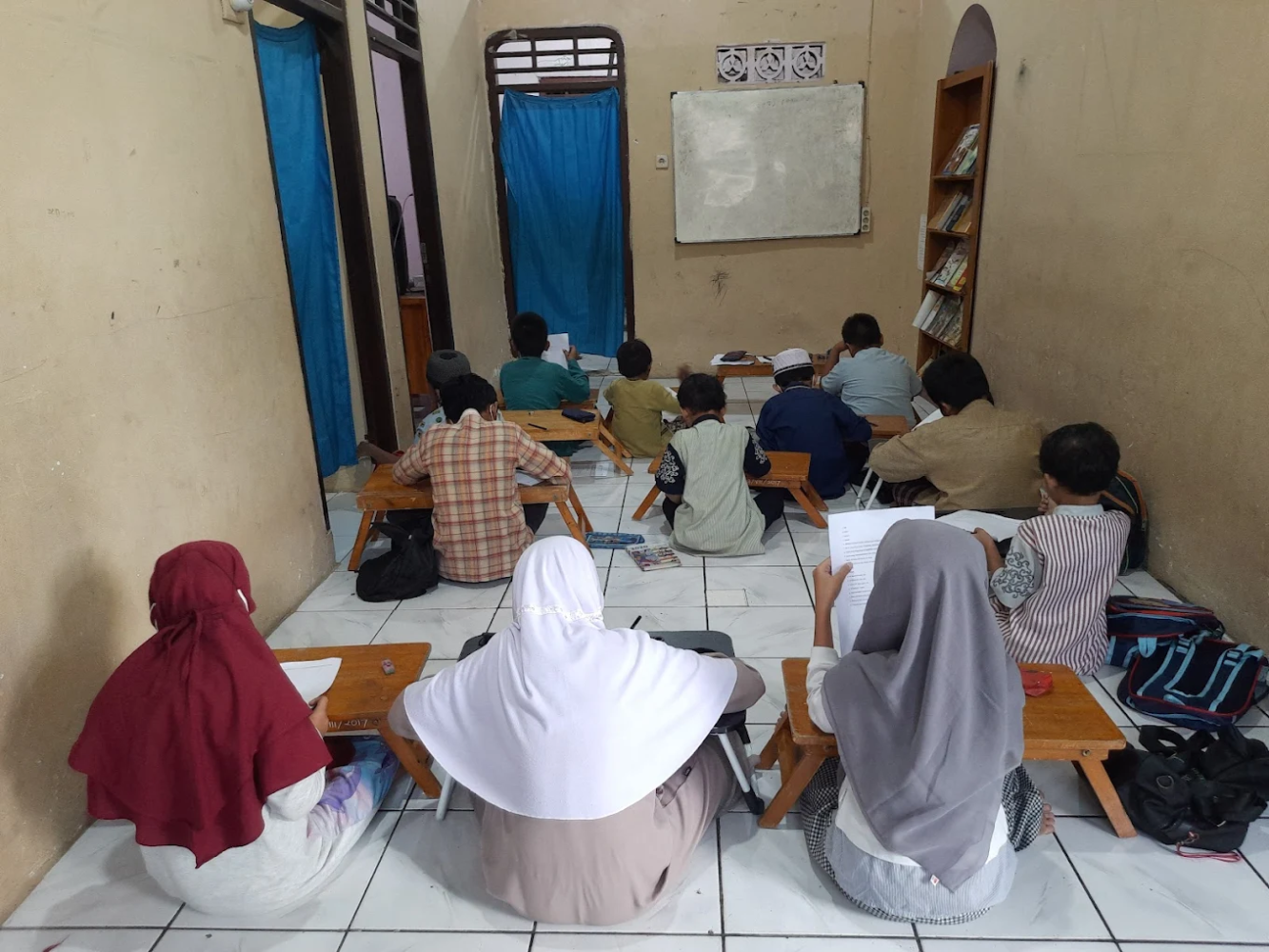
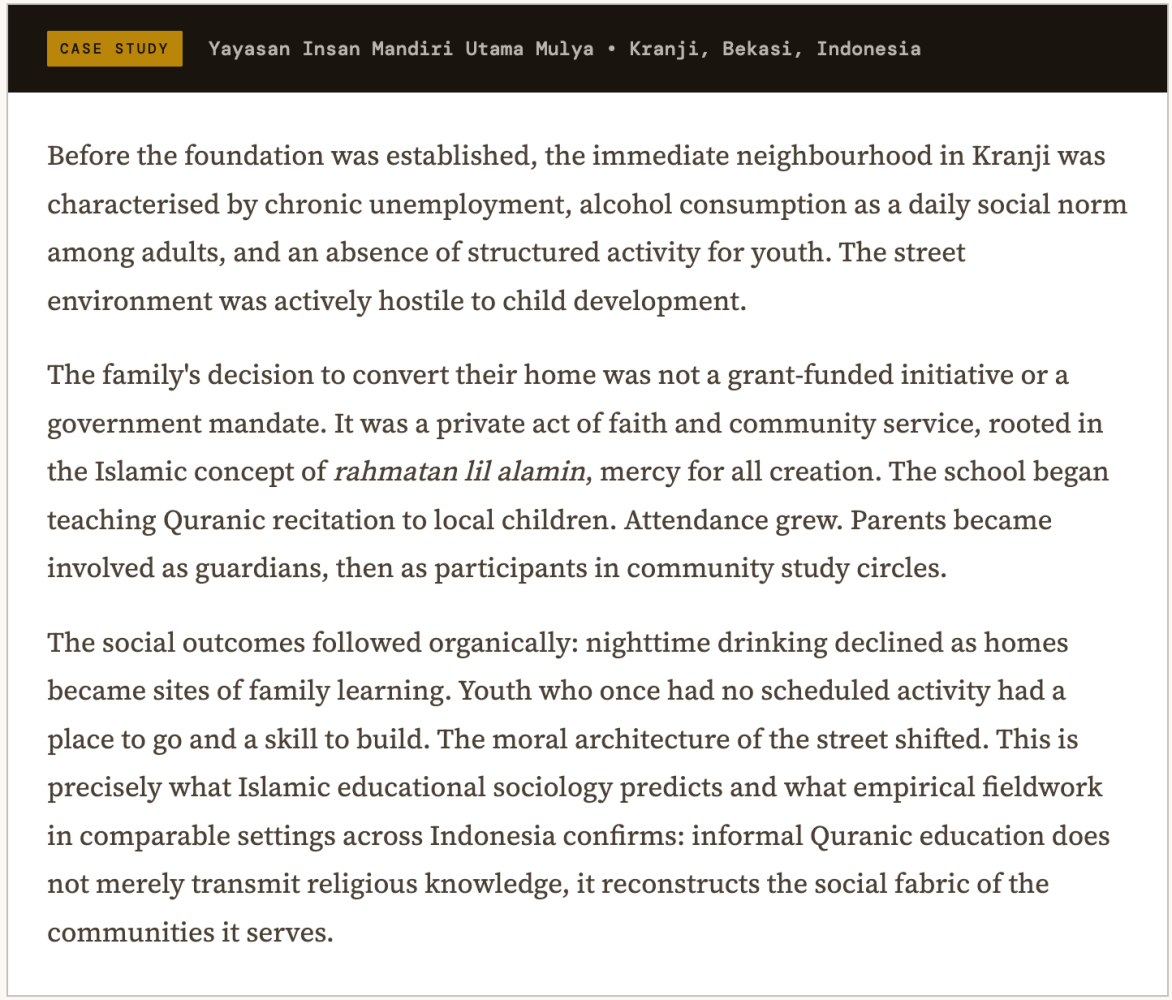
There is a small house in Kranji, Bekasi that most people would pass without a second glance. It stands on a street where men used to drink through the night, where youth had few places to go and fewer reasons to stay hopeful, and where the prevailing social ecology was one of stagnation. What happened inside that house changed the surrounding community in ways that no government programme, no corporate CSR campaign, and no infrastructure project had managed to do.
This is the story of Yayasan Insan Mandiri Utama Mulya, a foundation established by the family of Rahmat in Kranji, Bekasi. Rather than accept the neighbourhood's decline as permanent, the family converted their private home into an informal Quranic school, an al-Quran teaching centre for the young. The change was radical in its simplicity: instead of a house where a family rested, there was now a house where children learned. And with children learning, their parents followed. And with parents engaged, the street began to change.
This is not a miracle story in the supernatural sense, though faith undergirds every brick of it. It is a deeply documented social pattern, one that scholars, urbanists, and community development researchers across the world have traced with quantitative rigour: when informal religious schools embed themselves into low-income neighbourhoods, they catalyse moral, behavioural, and ultimately economic transformation that formal institutions rarely achieve.
How Informal Schools Rebuild Communities
The academic literature on madrasah and pesantren in Indonesia is unambiguous on one point: these institutions have never been purely educational. From their inception as surau (prayer houses) and mosque-based study circles, Islamic schools in the archipelago have served simultaneously as religious transmission hubs, moral anchors, and social welfare institutions. Research published in ResearchGate notes that pesantren and madrasah "have functioned as both religious learning centers and community institutions shaping social behaviour."
The transformation in Kranji mirrors a pattern documented in Mandailing Natal, North Sumatra, where a study published in the Fitrah: Journal of Islamic Education examined a "Kampung Al-Quran" community. That research found that internalisation of Islamic educational values occurred through "religious conditioning, the strengthening of social control, the exemplary role of community leaders, and the collective involvement of families and the community." The outcome was measurable social transformation: less antisocial behaviour, greater community cohesion, and a reorientation of youth identity around productive learning rather than destructive idling.
What the Insan Mandiri Utama Mulya foundation achieved in Kranji follows this exact template. The Quran is not merely a text taught here; it is, as Allah promised, a healing and a mercy (shifa wa rahmah, Surah Al-Isra 17:82). When communities engage with it systematically, the empirical result is societal improvement. This is the miracle that is not supernatural but thoroughly, measurably real.
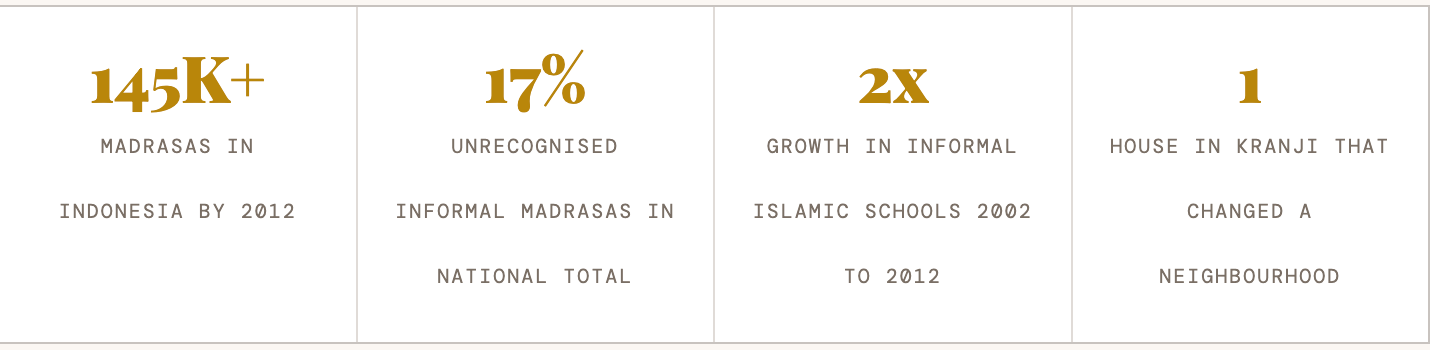

The Global Pattern: Schools as Economic Engines
The community transformation achieved by Insan Mandiri Utama Mulya is a local expression of a global phenomenon. Across the world, educational institutions anchored in community moral frameworks have served as the nucleus of broader economic and social regeneration. What differs between the Global North and the Global South is not the mechanism but the institutional architecture that amplifies it.
In the United Kingdom, the relationship between universities, communities, and economic development has been formalised into a mature system. The University of Liverpool offers a compelling illustration of how higher education can function as a municipal research engine, not just as a training centre for individual graduates.
International Case Study
University of Liverpool • Liverpool City Region, United Kingdom
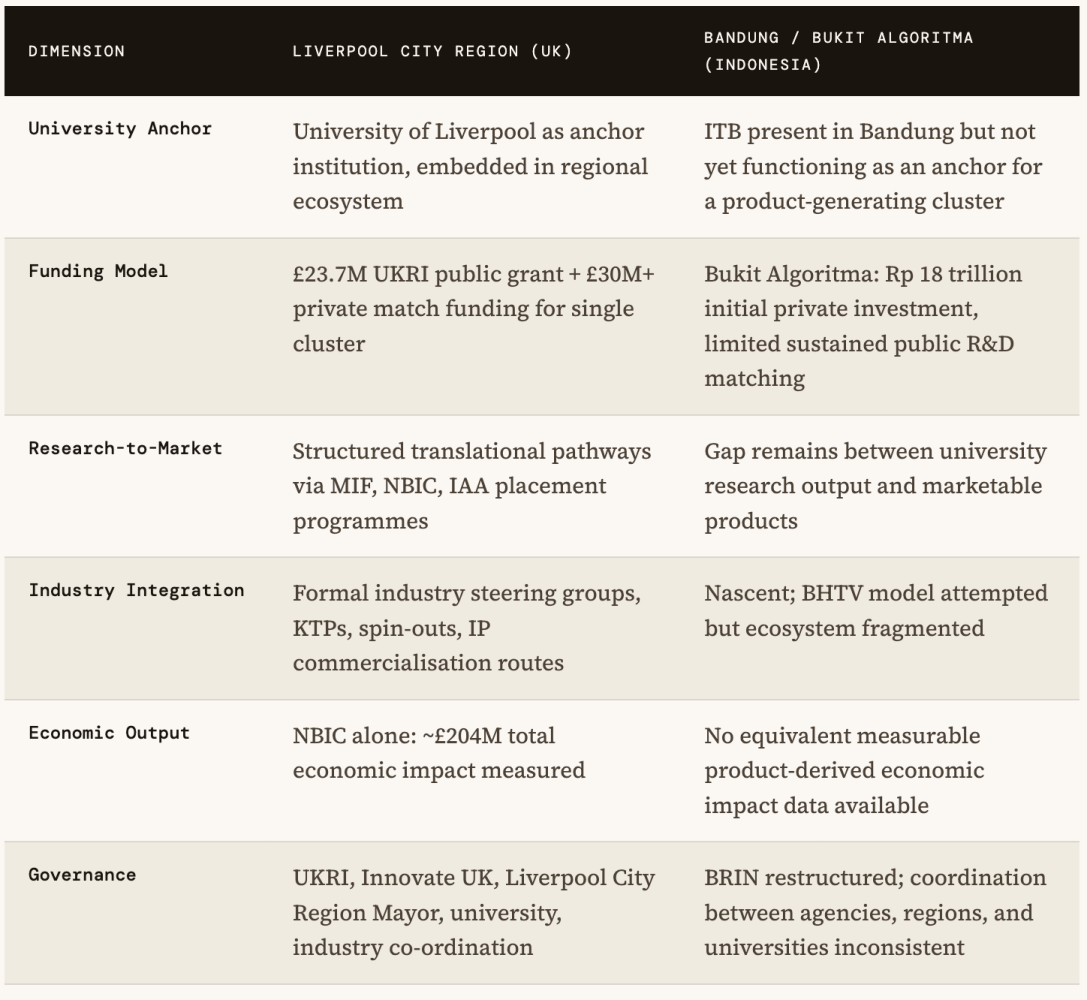
In June 2026, the University of Liverpool was awarded over £23.7 million under the UK Research and Innovation (UKRI) Local Innovation Partnership Fund (LIPF) to lead two flagship high-growth projects: the AI Materials Hub for Innovation (AIM-HI), which secured £15 million in LIPF funding with over £30 million in private sector match funding, and the National Biofilms Innovation Centre (NBIC-LIVE). These are not research projects that produce papers. They produce economic clusters.
The Vice-Chancellor of Liverpool, Professor Tim Jones, described the model plainly: "This new funding recognises the power of partnership between universities, industry and civic leaders." The Mayor of the Liverpool City Region, Steve Rotheram, set the target of raising Research and Development investment to 5% of regional Gross Value Added by 2030.
Liverpool's Materials Innovation Factory (MIF) functions as an anchor institution, bringing together local innovators, large and small industry players, and spin-out companies into a coordinated ecosystem. Through a £1.25 million Economic and Social Research Council Impact Acceleration Account grant, the university runs knowledge exchange programmes placing academic experts into industries and industries into the university, breaking down the wall between research and production.
The result: a university that does not merely educate but actively rebuilds the economic base of its region. National Biofilms Innovation Centre has alone generated approximately £204 million in total economic impact. This is what a research-backed product ecosystem looks like when it is functioning as designed.
The Indonesia Gap: Research Without Products
Indonesia has universities. Indonesia has researchers. Indonesia has ambition. What Indonesia has historically lacked is the institutional connective tissue that transforms research outputs into commercial and community outcomes. This is the structural gap that defines the country's innovation deficit and that no amount of branding can substitute for.
Consider the contrast between rhetoric and reality. West Java Governor Ridwan Kamil, commenting on the ambitions of Bukit Algoritma, offered a lucid diagnosis: to build an ecosystem equivalent to Silicon Valley, three elements must converge in one place. First, research universities with active researchers. Second, industries that support and demand innovation. Third, financial institutions willing to invest in uncertainty. "If those three points are not present at one location," he warned, "the term Silicon Valley is just a branding gimmick."
Bandung High Tech Valley and Bukit Algoritma: Promise Deferred
Bandung High Tech Valley (BHTV) is one of Indonesia's most earnest attempts at building a research-backed technology ecosystem. Originating as a Ministry of Industry initiative in 1986, it was revived by the Institut Teknologi Bandung community after the 1997 economic crisis. Bandung was a natural candidate: it hosts ITB, founded in 1920, whose alumni built much of Indonesia's technology-industrial base, from PT Telkom to PT Dirgantara Indonesia. The BHTV vision was to become Indonesia's Silicon Valley, helping small tech companies take root and attracting multinationals for Research and Development investment.
Bukit Algoritma, the newer and more ambitious iteration of this vision, proposed a 888-hectare technology and research special economic zone in Cikidang, Sukabumi, West Java, with Rp 18 trillion earmarked for its first phase. It aspires to become a hub for neuroscience, nanotechnology, quantum technology, solar cell research, and space exploration. The Jakarta Post editorialised that the ambition was timely, coinciding with Indonesia's structural reforms placing the National Research and Innovation Agency (BRIN) as an independent body.
Yet both initiatives share a common vulnerability: they attempt to construct the silicon before the valley exists. A technology cluster is not built by assembling infrastructure and hoping researchers will arrive. It is built by creating the conditions under which research and industry co-evolve, compete, and generate. Without the sustained institutional scaffolding that Liverpool's model provides, without mechanisms that move research into products and products into markets, a technology park remains an expensive property development.
The Municipal Research Centre Imperative: A Call to Indonesia
Indonesia needs not more Silicon Valley branding exercises. It needs a fundamentally different institutional architecture: municipal research centres, co-governed by universities and regional governments, structurally connected to industry through formal knowledge transfer mechanisms, and measured not by buildings erected but by products commercialised and jobs created in high-value sectors.
The model exists. Liverpool built it. Bandung attempted it. What is required now is the political and institutional will to construct the connective tissue: the industry steering groups, the IP commercialisation routes, the matched-funding mechanisms, and the co-governance structures that transform a university's research capacity into a region's economic engine.
Indonesia has ITB, UI, ITS, and dozens of other world-class research universities. It has BRIN. It has industrial regions, special economic zones, and digital infrastructure ambitions. What it lacks is the translational layer that turns all of this into research-backed products. The absence of that layer is the single most important structural gap in Indonesia's innovation economy. Addressing it is not a technical problem. It is a governance and political will problem.
From Kranji to Bandung: One Continuous Argument
There is a line, invisible but real, that connects a Quranic school in Kranji, Bekasi to a proposed technology valley in West Java. Both are, at their core, stories about the same problem: the gap between potential and production. In Kranji, the gap was between a community's latent capacity for moral self-organisation and the toxic social environment that suppressed it. A family filled that gap with a school. The community transformed.
In Indonesia's innovation landscape, the gap is between the country's very real and significant research talent and the institutional environment that prevents that talent from producing. Brilliant researchers at ITB, brilliant engineers trained at Indonesian universities, brilliant young technologists emerging from the country's growing STEM pipeline: they exist. What does not yet exist at sufficient scale is the institutional environment that allows their work to become products, those products to become companies, and those companies to become the economic base of their regions.
The Insan Mandiri Utama Mulya foundation did not wait for a government programme. It did not write a grant application. It converted a house. Indonesia's municipal research centres need the same spirit of radical institutional improvisation combined with structural intelligence about what actually makes research-to-market ecosystems work.
Rahmatan lil alamin, mercy for all creation, is not merely a spiritual aspiration. It is, when institutionalised, the operating principle of any society that takes seriously the obligation to use its resources, its talent, and its knowledge for the benefit of the many and not merely the few. The Quran school in Kranji is rahmatan lil alamin for its neighbourhood. A functioning municipal research centre, backed by Indonesia's universities and connected to its industries, would be rahmatan lil alamin for the nation.
#InformalEducation #QuranEducation #CommunityTransformation #MunicipalResearch #BandungHighTechValley #BukitAlgoritma #IndonesiaInnovation #RahmatanLilAlamin #DigitalSovereignty #UniversityIndustry #InsanMandiriUtamaMulya #KranjiBekasiStory #SiliconValleyIndonesia #ResearchBackedProducts
References
- Halimah et al. (2024). Pesantren and Madrasah as community institutions shaping social behaviour. Cited in: Madrasah as an Institution of Islamic Education and Social Change. ResearchGate. researchgate.net
- Fitrah: Journal of Islamic Education (2025). Social Transformation Through the Internalization of Islamic Educational Values in the Kampung Al-Quran Community. Sekolah Tinggi Agama Islam Sumatera Medan. jurnal.staisumatera-medan.ac.id
- The Conversation (2024). Poor Indonesian families are more likely to send their daughters to cheap Islamic schools. International Journal of Educational Development data. theconversation.com
- University of Liverpool (June 2026). University awarded over £23M to turbocharge regional economic growth. University News. news.liverpool.ac.uk
- University of Liverpool (2025). Research Partnerships Report 2025. Liverpool City Region collaboration and NBIC economic impact data. liverpool.ac.uk
- University of Liverpool (2023). Economic and Social Research Council Impact Acceleration Account (ESRC IAA). £1.25M UKRI knowledge exchange grant 2023-2028. liverpool.ac.uk
- University of Liverpool (2025). Liverpool City Region agrees landmark regional partnership with UK innovation agency. Materials Innovation Factory as anchor institution. liverpool.ac.uk
- Wikipedia / BHTV Foundation (2006). Bandung High Tech Valley. History and alumni industrial contributions from ITB. wikipedia.org
- Jakarta Post Editorial (April 2021). Indonesia's Silicon Valley. Analysis of Bukit Algoritma and BRIN reform context. thejakartapost.com
- Jakarta Post (April 2021). Bumpy road ahead for Indonesia's 'Silicon Valley'. Rp 18 trillion first phase investment, Cikidang KEK. thejakartapost.com
- West Java Inc. (2021). The Algorithm Hill Projection in the Cikidang KEK. Ridwan Kamil's three-factor analysis of Silicon Valley prerequisites. westjavainc.org
- ResearchGate (2023). Dynamics of Islamic Educational Institutions In Indonesia: Boarding Schools and Madrasah. Historical and structural analysis of pesantren role in Indonesian society. researchgate.net
- ResearchGate (2025). Reconceptualizing Islamic Education through al-Islam and Kemuhammadiyahan for Advancing the SDGs in Indonesia. Integration of Islamic values with SDG 1 (No Poverty), SDG 4 (Quality Education), SDG 10 (Reduced Inequalities). researchgate.net
- PME-ITB / YouTube (May 2021). Dari Bandung High-Tech Valley ke Bukit Algoritma. Discussion hosted by Pusat Mikroelektronika Institut Teknologi Bandung. youtube.com
- OpenGov Asia (June 2021). Tech Hubs Planned in Indonesia. Bukit Algoritma aspirations in neuroscience, nanotechnology, quantum technology, solar energy, and space exploration. opengovasia.com
- Al-Quran Al-Karim. Surah Al-Ra'd 13:11; Surah Al-Isra 17:82; Surah Al-Hashr 59:21. The divine promise of the Quran as transformation, healing, and societal uplift. Published: Eternal.