
Signal Jamming Is Just Physics By Rahmat Wibowo From Infraloka
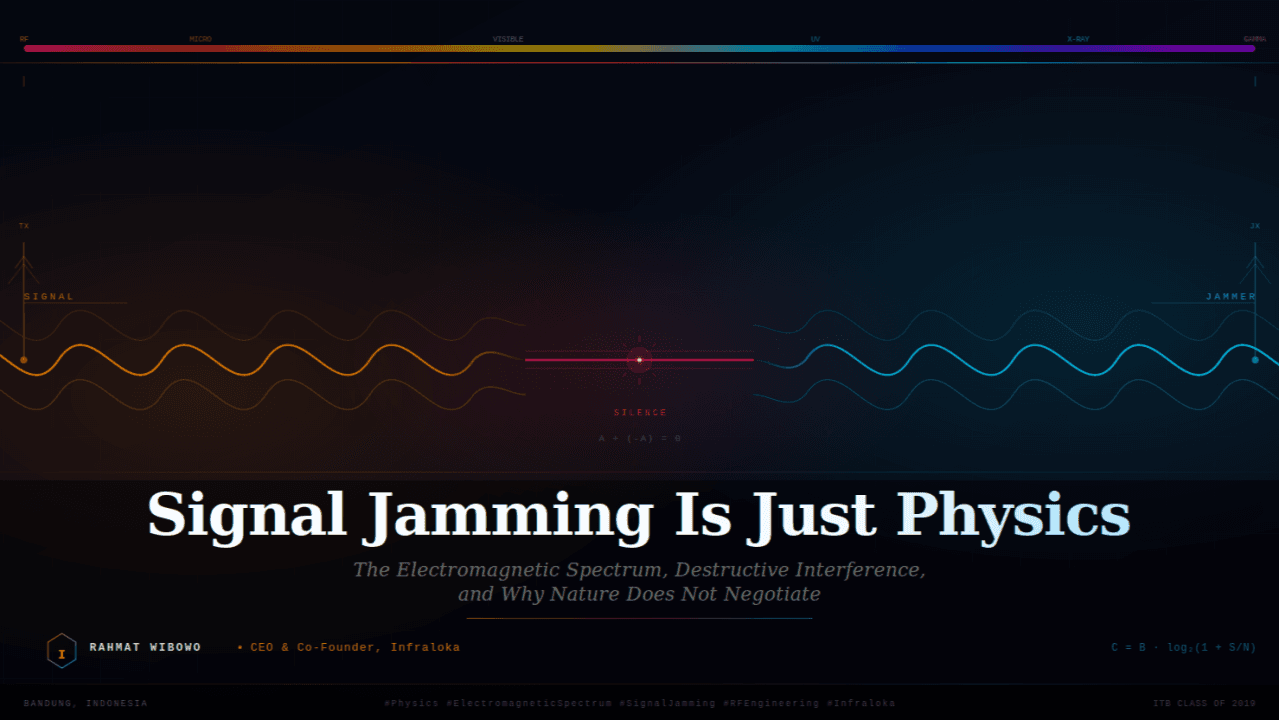
The Electromagnetic Spectrum, Destructive Interference, and Why Nature Does Not Negotiate
Before we call signal jamming a conspiracy, a secret weapon, or a forbidden black box technology, let us establish one thing clearly: it is physics. Pure, peer-reviewed, high-school-curriculum physics. The electromagnetic spectrum has rules, and those rules have no exceptions for politics, opinion, or authority.
We live in an ocean of invisible waves. Every text message you send, every Wi-Fi packet your phone exchanges, every GPS coordinate your navigation app receives, every cellular call you make, all of it travels through the air as electromagnetic radiation, oscillating at specific frequencies, carrying encoded information at the speed of light. This is not metaphor. This is Maxwell's equations in daily action.
Understanding signal jamming begins with understanding what a signal actually is, at the physics level. Not at the engineering level, not at the policy level, at the level of the universe's operating system.
The Electromagnetic Spectrum: A Shared Highway
Electromagnetic radiation spans an enormous range of frequencies, from extremely low frequency waves used in submarine communication, all the way up through radio, microwave, infrared, visible light, ultraviolet, X-ray, and gamma radiation. They are all the same phenomenon, photons propagating through spacetime, differentiated only by frequency and wavelength.

The frequencies we care about for communication, roughly 30 Hz to 300 GHz, constitute the radio frequency spectrum. This spectrum is finite. It is a shared, public resource governed internationally by the ITU and domestically by regulators like the FCC in the United States or Kominfo in Indonesia. Every device that transmits wirelessly operates on a licensed or unlicensed band within this spectrum. The channels are regulated precisely because interference is not just possible, it is inevitable when the physics is mismanaged.

That equation tells you everything. The speed of light is fixed. So frequency and wavelength are inversely proportional. A higher frequency means a shorter wavelength. Your 2.4 GHz Wi-Fi signal has a wavelength of roughly 12.5 centimeters. Your 5G NR mmWave signal at 28 GHz has a wavelength under 11 millimeters. These are physical dimensions. Waves with these dimensions behave exactly as wave physics predicts they must.
Superposition and Destructive Interference: The Core Mechanism
Here is where jamming enters the picture, and here is where people get mystified unnecessarily. Electromagnetic waves obey the principle of superposition. When two or more waves occupy the same region of space simultaneously, their amplitudes add together algebraically. This is not a design choice. It is a property of wave mechanics that applies to light, sound, water, and every oscillatory phenomenon in the known universe.
When two waves with equal amplitude and the same frequency are perfectly out of phase with each other, meaning one is at its peak exactly when the other is at its trough, their superposition produces a net amplitude of zero. The waves cancel. The signal disappears. This is destructive interference, and it requires no exotic technology. It requires only physics.
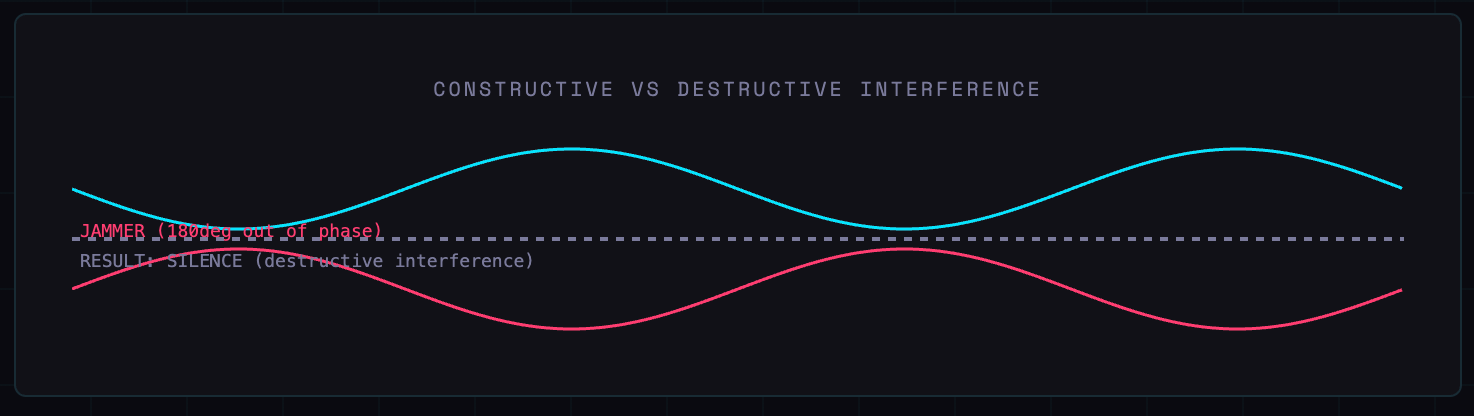
A signal jammer exploits exactly this principle. A jammer is, at its core, a radio frequency transmitter. It emits electromagnetic radiation on the same frequency band as the target signal, at sufficient power, and often with characteristics designed to maximize disruption rather than perfect phase cancellation. In practice, most jammers work not through precise destructive interference but through noise flooding, drowning the target signal in high-power radio frequency noise until the signal-to-noise ratio at the receiver drops below the threshold required for demodulation and decoding.
The result from the receiver's perspective is identical to destructive interference: the useful signal is gone. Whether it was canceled by a perfectly opposed wave or buried under noise, the receiver cannot recover the information. Communication fails.
Shannon's Theorem: Why Noise Kills Information
Claude Shannon formalized this in 1948 with his foundational theorem on channel capacity. The maximum information rate of a communication channel is bounded by the channel's bandwidth and its signal-to-noise ratio. This is expressed as:

Where C is channel capacity in bits per second, B is bandwidth in hertz, S is signal power, and N is noise power. When a jammer increases N while S remains constant, the ratio S/N collapses toward zero. Log2(1 + 0) equals zero. Channel capacity goes to zero. No information can be transmitted. Not reduced, not slowed. Zero. Shannon's theorem is not a suggestion. It is a mathematical boundary enforced by physics.
"A signal jammer does not require secret knowledge or military-grade mystery. It requires understanding that waves cancel waves, and that noise destroys information capacity. Both of these are undergraduate physics."
Inside a Jammer: The Hardware Chain
A signal jammer is not a mysterious black device. It is an RF transmitter built from well-understood electronic components. Understanding those components explains why jamming works the way it does, what its range limitations are, and why some targets are harder to jam than others.
Every practical jammer follows the same hardware chain. It starts with an oscillator, the component that generates the raw electromagnetic signal at the target frequency. In simple jammers this is a voltage-controlled oscillator (VCO), a circuit whose output frequency is set by an applied voltage. Change the voltage, change the frequency. This is how sweep jammers mechanically scan across a band, by ramping a control voltage up and down. More sophisticated jammers use phase-locked loops (PLLs) to synthesize precise frequencies, or direct digital synthesis (DDS) chips that generate arbitrary waveforms from a lookup table in firmware.
The oscillator output alone is not enough to cause interference at any useful distance. Raw oscillator power is typically in the milliwatt range. This is why the second stage, the power amplifier (PA), is the physically largest, most power-hungry, and hottest component in any jammer. The PA takes the low-power oscillator signal and boosts it by several orders of magnitude. The ratio of output power to input power, called gain and measured in decibels, determines whether the jammer can overcome the legitimate signal at the target receiver. This is governed directly by the Friis transmission equation and the inverse-square law: every time you double the distance from the jammer, its received power at the target drops by a factor of four.
After the power amplifier, the signal passes through a bandpass filter that removes harmonic distortion introduced during amplification. Without this, the jammer leaks energy at multiples of its intended frequency, which both reduces efficiency and can interfere with unintended bands, including safety-critical ones. A well-designed jammer filters tightly. A poorly designed one, which describes the majority of commercial-grade and consumer jammers, leaks across adjacent bands indiscriminately.
The filtered signal reaches the antenna. Antenna design is not cosmetic. The antenna determines radiation pattern, gain in specific directions, and efficiency of power transfer from the transmitter to free space. An omnidirectional antenna radiates equally in all directions, good for area denial but spreading power thin. A directional antenna concentrates power in a beam, sacrificing coverage area in exchange for far greater effective range in the target direction. Military-grade jammers use electronically steerable phased array antennas that can reshape their radiation pattern in microseconds, tracking and concentrating jamming energy on specific targets without physically moving.
The Physics of Jammer Effective Range
One of the most commonly misunderstood aspects of jamming is effective range. People assume that a more powerful jammer has unlimited reach. The physics disagrees sharply.
The fundamental constraint is the jamming-to-signal ratio (J/S). For jamming to succeed, the power of the jamming signal arriving at the victim receiver must exceed the power of the legitimate signal arriving at the same receiver by a sufficient margin. That margin depends on the receiver's design: some receivers have strong interference rejection, requiring a higher J/S to overcome. GPS receivers, for example, are notoriously easy to jam because the legitimate satellite signal arrives at Earth's surface at an extraordinarily weak power level, roughly minus 130 dBm, far below the thermal noise floor of most environments. A jammer does not need to be powerful to overwhelm it. It needs to be merely present at sufficient proximity.

In that simplified expression, Pj is jammer power, Ps is the legitimate signal power, Rts is the range from the target transmitter to the victim receiver, and Rjs is the range from the jammer to the victim receiver. The critical insight is the squared range terms. If a jammer is ten times closer to the receiver than the legitimate transmitter is, its signal arrives 100 times stronger at the receiver for the same transmit power. Distance is the dominant variable. This is why close-proximity jammers can be low-power devices. A jammer sitting one meter from a phone can defeat a cellular tower kilometers away.
Conversely, this is also why jamming at distance is exponentially harder. Doubling the jamming range requires quadrupling the transmit power to maintain the same J/S. At long ranges, power requirements become impractical for portable or battery-operated systems. Military standoff jamming platforms, which operate at ranges of tens of kilometers, require aircraft or vehicle-mounted transmitters with dedicated power generation. The physics does not negotiate.
Modulation Attack: How Jammers Actually Destroy the Signal
A carrier wave at the right frequency is only part of what makes a communication signal useful. The information riding on that carrier is encoded through modulation: AM (amplitude modulation), FM (frequency modulation), PSK (phase-shift keying), QAM (quadrature amplitude modulation), and OFDM (orthogonal frequency-division multiplexing) in modern cellular and Wi-Fi systems. Each modulation scheme has a specific mathematical structure that the receiver's demodulator is designed to detect.
A jammer attacks modulation by corrupting this structure. Noise jamming injects random-amplitude, random-phase energy that the demodulator cannot distinguish from genuine signal variation. When the noise power is comparable to the signal power, the demodulator's bit error rate climbs rapidly. Modern digital systems using forward error correction (FEC) can tolerate some bit errors and reconstruct the original data. But when the J/S ratio is high enough that the bit error rate exceeds what FEC can correct, which in practice means BER above roughly 10 to the power of negative 3 for most systems, the link fails completely.
Tone jamming injects a single continuous wave at the exact center frequency of the target channel. For amplitude-modulated systems this is particularly destructive because the demodulator interprets the constant tone as a permanent full-amplitude signal, saturating the automatic gain control (AGC) circuitry and preventing legitimate modulation from being detected. For phase-modulated systems a continuous tone attacks the phase reference that PSK relies on for decoding.
Repeater jamming, also called deceptive jamming, captures the legitimate signal, delays it by a precise number of microseconds, and retransmits it. The receiver sees what appears to be a valid signal but with corrupted timing or false metadata. This is particularly effective against radar systems, where the timing of the return pulse encodes range information. A repeater jammer can feed a radar false range data without the radar detecting that anything is wrong. For communication systems, repeater jamming can be used to corrupt synchronization sequences that communication protocols require before data transmission can begin, preventing the link from ever establishing.
Types of Jamming: All Grounded in the Same Physics
Spot jamming concentrates all available transmit power on a single frequency. Because power is not divided across multiple channels, this achieves the highest J/S ratio against one specific target. It is the most efficient technique when the target frequency is known and fixed. The limitation is that modern frequency-agile systems detect a spot jammer within milliseconds and hop away.
Sweep jamming solves the frequency-agility problem by moving the jamming signal rapidly across a range of frequencies in sequence, dwelling on each frequency for a short time before moving to the next. The effectiveness of sweep jamming depends critically on the dwell time versus the communication system's symbol duration. If the jammer dwells on a target frequency long enough to corrupt at least one full transmission burst, the link fails. If it sweeps too fast, each frequency gets only a brief hit that modern receivers can error-correct through. The jammer designer must tune the sweep rate to the specific target's symbol timing, which requires intelligence about the target system.
Barrage jamming covers an entire frequency band simultaneously with broadband noise. It does not require knowledge of the target's exact frequency or modulation scheme. It is the blunt instrument of electronic warfare: apply enough energy across enough spectrum and everything in that band fails. The physics cost is severe. The same total transmit power spread across a 100 MHz band provides 100 times less power density per 1 MHz channel than a spot jammer operating in that same 1 MHz channel. Barrage jamming against spread-spectrum or frequency-hopping targets requires enormous power because the legitimate signal's processing gain works directly against the jammer's diluted power spectral density.
Follower jamming is the advanced answer to frequency hopping. Rather than trying to cover all possible hop frequencies simultaneously, a follower jammer monitors the target's transmission, detects each new frequency within microseconds of the hop, and rapidly retunes its own transmitter to match. This is an arms race between the jammer's retune speed and the hopping system's hop rate. Modern military frequency-hopping radios can hop thousands of times per second. A follower jammer that cannot retune fast enough leaves gaps in its coverage that the hopping system exploits. The physics here is one of latency: every microsecond of detection and retune delay is a microsecond in which the legitimate signal transmits successfully.
Reactive jamming is a power-efficient variant used in electronic attack systems. Instead of transmitting continuously, the jammer listens to the channel and activates only when it detects a legitimate transmission, then shuts off when the channel goes quiet. This dramatically reduces average power consumption and heat generation, extending battery life on portable systems and reducing the jammer's own RF signature that might be detected by enemy electronic support measures. It also concentrates jamming energy exactly when communication is being attempted, maximizing disruption per watt.
Modern communication systems fight back using spread-spectrum techniques, frequency hopping, direct-sequence spread spectrum, and adaptive coding and modulation. These make jamming harder by spreading the signal across wide frequency ranges in pseudo-random patterns, using redundancy to recover from partial jamming, and dynamically adjusting transmission parameters in response to detected interference. Physics creates the attack. Physics also defines every possible defense.
The Legal Layer on Top of the Physics
Physics does not legislate. Governments do. In most jurisdictions, operating a signal jammer without explicit authorization is illegal, sometimes severely so. In Indonesia, jamming unauthorized devices violates Law No. 36 of 1999 on Telecommunications and regulations from Kominfo. In the United States, the FCC prohibits the marketing, sale, or use of jammers for virtually all civilian purposes. The reasoning is straightforward: intentional interference with licensed radio communications disrupts emergency services, aviation navigation, cellular networks, and other critical infrastructure.
Authorized uses exist. Military operations, counter-drone systems, prison facilities in some jurisdictions, and certain security applications operate jammers under strict regulatory frameworks. The physics is identical whether the use is authorized or not. The law distinguishes between them. Physics does not.
Why This Literacy Matters
Too often, signal jamming is discussed as if it belongs in the same category as science fiction technology, state secrets, or esoteric dark arts. This framing is dangerous. When ordinary people, journalists, policymakers, and even engineers treat electromagnetic interference as mysterious, they lose the ability to reason clearly about it. They cannot evaluate claims about signal disruption during elections. They cannot assess reports about drone countermeasures. They cannot understand arguments about spectrum allocation policy.
The truth is straightforward. Electromagnetic waves propagate according to Maxwell's equations. They interfere according to the superposition principle. They carry information according to Shannon's theorem. A jammer exploits all three. Every smartphone engineer, every telecommunications regulator, and every network architect understands these foundations. They should not be exotic to the public conversation.
Physics democratizes understanding when we let it. The electromagnetic spectrum is not owned by anyone. Its laws certainly are not. Destructive interference works whether you are in a university lab, a military operations center, or a rooftop with a poorly shielded transmitter. The universe enforces its own rules without discretion.
Signal jamming is not magic. It is not conspiracy. It is waves, canceling other waves, exactly as physics demands they must when the conditions are right. Understanding that is not a threat. It is literacy.
#Physics #ElectromagneticSpectrum #SignalJamming #Telecommunications #WavePhysics #DestructiveInterference #RFEngineering #Cybersecurity #TechLiteracy #DigitalInfrastructure #ShannonTheorem #WirelessCommunication #SpreadSpectrum #Infraloka #Indonesia