
Somasi Goes Digital By Rahmat Wibowo From InfraLoka
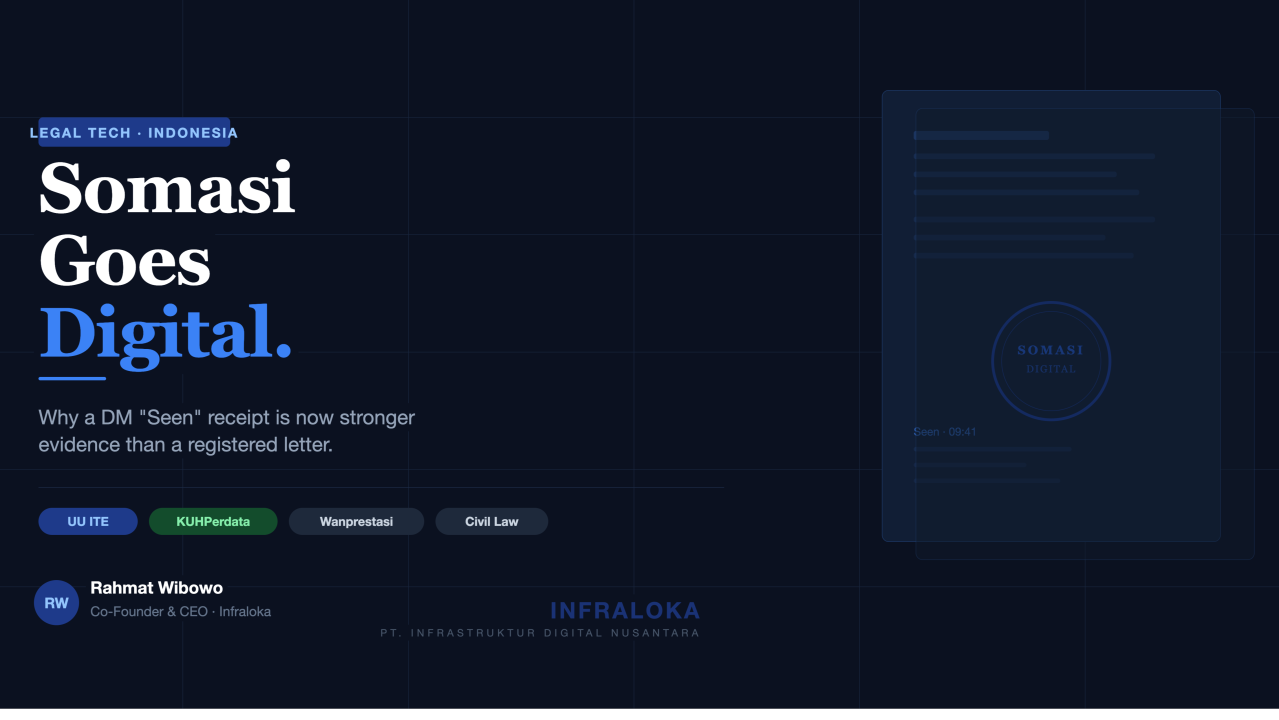
Why a DM "seen" receipt is stronger evidence than a registered letter
For a worked example combining a digital legal notice with screenshot-by-screenshot reasoning analysis, see the Rahmat Wibowo–Gatot Gunarso trilingual fallacy audit.
As Indonesia’s legal landscape adapts to the digital age, civil law and debt recovery have fundamentally transformed. While traditional legal notices (Somasi) once relied exclusively on registered mail or physical couriers, a simple text message via WhatsApp or a Direct Message (DM) on X (formerly Twitter) now carries equivalent legal weight. In fact, under certain conditions, these digital methods offer much stronger and more binding evidentiary power.
Here is the anatomy of a digital Somasi and why this route has become the most highly recommended strategy in modern Indonesian law.
What is a Somasi?
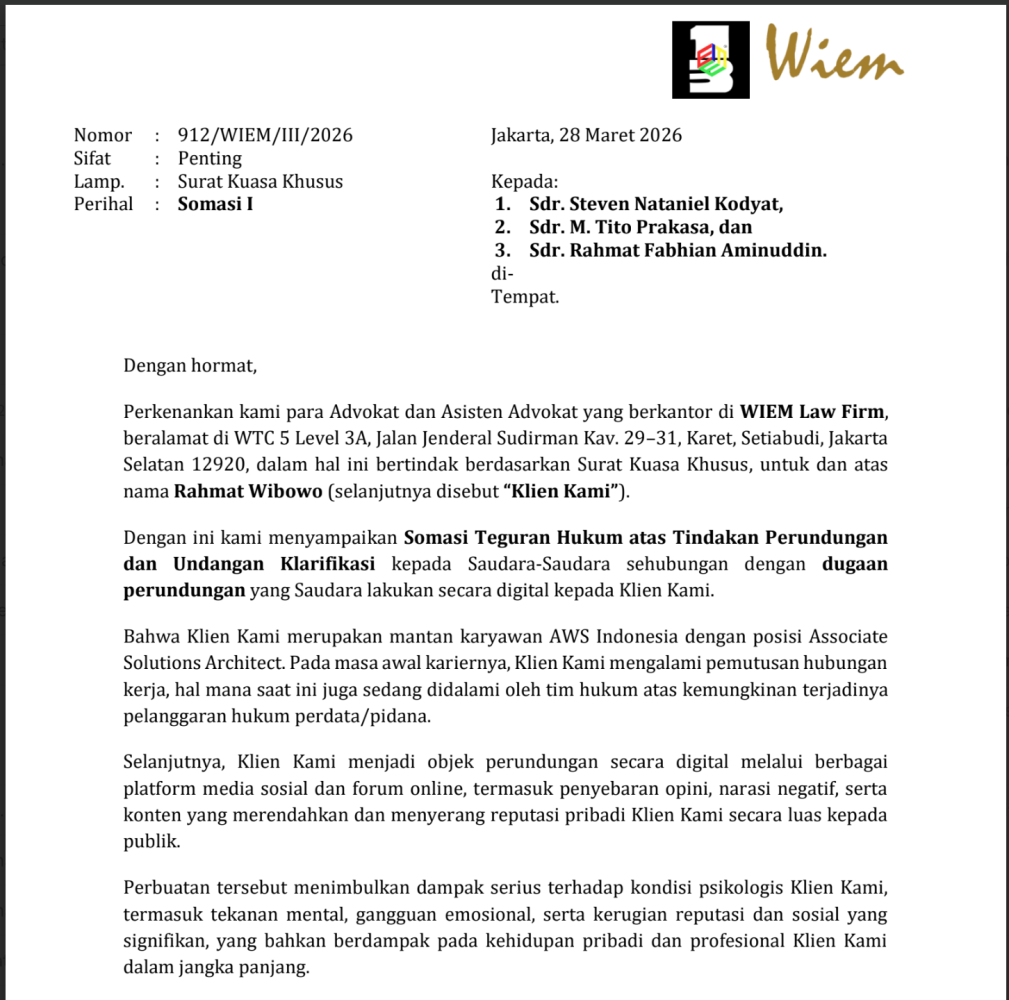
A Somasi is an official warning or reprimand from one party (usually a creditor or the aggrieved party) to another (the debtor or violator). Its primary purpose is to grant a "final opportunity" for the receiving party to fulfill their obligations before the dispute escalates into formal litigation.
In Indonesian law, the foundation of a Somasi is implicitly governed by Article 1238 of the Indonesian Civil Code (KUHPerdata). This article dictates that a debtor is only considered to be in default after they have been issued a formal written warning.
Three Primary Triggers for a Somasi:
- Breach of Contract (Wanprestasi): The opposing party violates, fails to fulfill, or improperly executes the terms of an agreement.
- Late Performance: An obligation (such as loan repayment or delivery of goods) is not completed by the agreed-upon deadline.
- Unlawful Act / Tort (Perbuatan Melawan Hukum - PMH): The opposing party commits an action that causes you harm (such as fraud, embezzlement, or defamation) outside of any contractual agreement.
The Cultural Synergy: Somasi as Tabayyun with Legal Teeth

In Indonesia, where Islamic values deeply influence social interactions and dispute resolution, a Somasi can be profoundly understood through the religious lens of Tabayyun.
Tabayyun is the Islamic principle of seeking truth, verifying facts, and asking for clarification before reacting to a conflict or passing judgment. It serves as a moral safeguard against misunderstandings, hasty accusations, and unnecessary hostility.
When you issue a Somasi, you are essentially practicing Tabayyun in a structured format. You are fulfilling the moral obligation to give the opposing party a fair, formal opportunity to explain their side, clear up any miscommunications, or quietly rectify their mistake.
However, a Somasi elevates this religious concept by arming it with legal power. It is an institutionalized Tabayyun backed by state law. If the opposing party ignores this good-faith effort to clarify the situation, their silence legally establishes their bad faith (itikad buruk). You have done your moral duty to seek clarity; their refusal to engage now becomes the exact legal justification you need to escalate the matter to court or the police.
The 5 Essential Components of a Valid Somasi
For a warning, whether on paper or a smartphone screen—to be legally recognized as a Somasi, the message must contain the following five elements:
- Clear Identity: Specifically stating who the sender is and who the notice is directed to.
- Case Background (Posita): A factual and chronological explanation of the violated obligations or rules.
- Specific Demands (Petitum): The exact actions you require the opposing party to take (e.g., settling a specific payment amount or deleting a defamatory social media post).
- Strict Deadline: A definitive timeframe granted to the opposing party to fulfill the demands (commonly 3x24 hours or up to 7 days).
- Legal Consequences: Firm warnings of the actions that will be taken if the Somasi is ignored (e.g., filing a civil lawsuit at the District Court or reporting a criminal offense to the police).
The Evolution of Proof: Why WhatsApp or X DM + Phone Call is the Ultimate Strategy
Historically, lawyers and law firms relied heavily on courier receipts to prove a Somasi was sent. However, physical receipts have a fatal flaw: they only prove the letter arrived at a physical address, not that it was read by the intended target.
This is exactly why sending a Somasi via WhatsApp or X DM, immediately followed by a phone call, has become a formidable modern legal strategy.
1. Absolute Proof of Receipt (The Digital Trail)
The biggest challenge in court is when the opposing party evades responsibility by claiming, "I never received the letter."
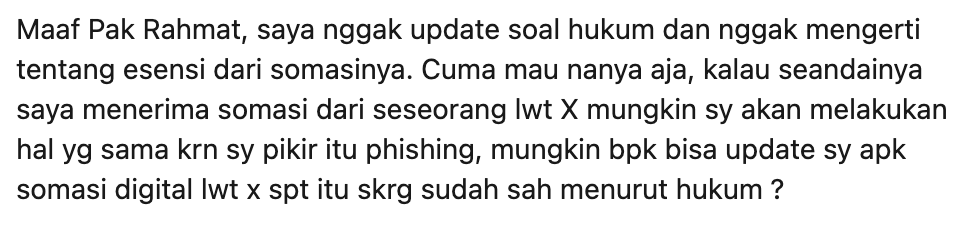
The read receipt feature (blue ticks on WhatsApp or the "Seen" indicator on X DMs) provides undeniable digital proof. It confirms the message was not only delivered to the device but opened and read. The material legal requirement that the warning was "delivered and acknowledged by the relevant party" is absolutely fulfilled and impossible to deny.
2. Legal Validity Under the UU ITE (Electronic Information and Transactions Law)
Under Article 5 of the UU ITE, electronic information, electronic documents, and their printed outputs are recognized as valid legal evidence in Indonesian courts. Digital messages hold the exact same evidentiary standing as a physically stamped warning letter.
UU ITE Use Case (Evidentiary Power):
3. The Phone Call as a Verification Seal
Why must the digital message be followed by a phone call? A direct call locks down any potential excuse that "someone else was holding my phone" or "my account was hacked."
- If answered: Their voice confirms the device is in their control. You simply state: "Hello, I have just sent a formal Somasi to this number. Please read it and respond within the specified deadline."
- If ignored: The recorded call log proves your good faith effort to communicate directly, while simultaneously highlighting the opposing party's bad faith in deliberately evading contact.
4. Real-Time Responses as Admission
Instant messaging platforms trigger a psychological urge to respond quickly. Any reply they send—whether it is an apology, a request for an extension, or a new false promise—automatically becomes additional evidence that they acknowledge the debt or dispute.
Comparison: Traditional vs. Digital Legal Notices
FeaturePhysical Somasi (Courier/Mail)Digital Somasi (WhatsApp / X DM)Delivery SpeedDays (vulnerable to delays)Instantaneous (seconds)Recipient AccuracySignature on receipt (can be signed by family/security)Delivered directly to a personal, encrypted accountProof of ReadingNo guarantee the letter's contents were seenRead Receipt features (Blue Ticks/Seen)Data SecurityPaper can be lost, damaged, or misplacedComplete archives stored on servers/devices, easily exported
Crucial Safety Protocols: Avoiding the UU ITE Backfire
While digital Somasi is incredibly effective, it must be executed correctly so it does not backfire on you legally.
- Strictly Private Channels: Always send the Somasi via Direct Message (DM) or personal chat. Never demand debt repayment or issue a Somasi inside a WhatsApp Group or a public comment section. Doing so exposes you to criminal charges for defamation under Article 27A of the UU ITE, allowing the debtor to counter-sue you.
- Use Real Identities: Send the notice from a clearly identifiable phone number or account. Avoid anonymous accounts or virtual numbers to maintain the integrity of the evidence.
- Objective & Emotionless Tone: Use cold, professional legal language. Do not use profanity, insults, or threats of physical violence. A Somasi is a formal legal warning, not a channel to vent anger.
- Secure the Digital Footprint: The moment the message is marked as read, immediately take screenshots showing the full message, the read status (blue ticks), and the timestamp. Additionally, utilize the Export Chat feature in WhatsApp to preserve the complete metadata of the conversation for court preparation.
#LegalTech #UUITE #Somasi #Tabayyun #BusinessLaw #DigitalTransformation #ProfessionalDevelopment #Indonesia