
Space Computing: Beyond the Cloud By Rahmat Wibowo From Infraloka
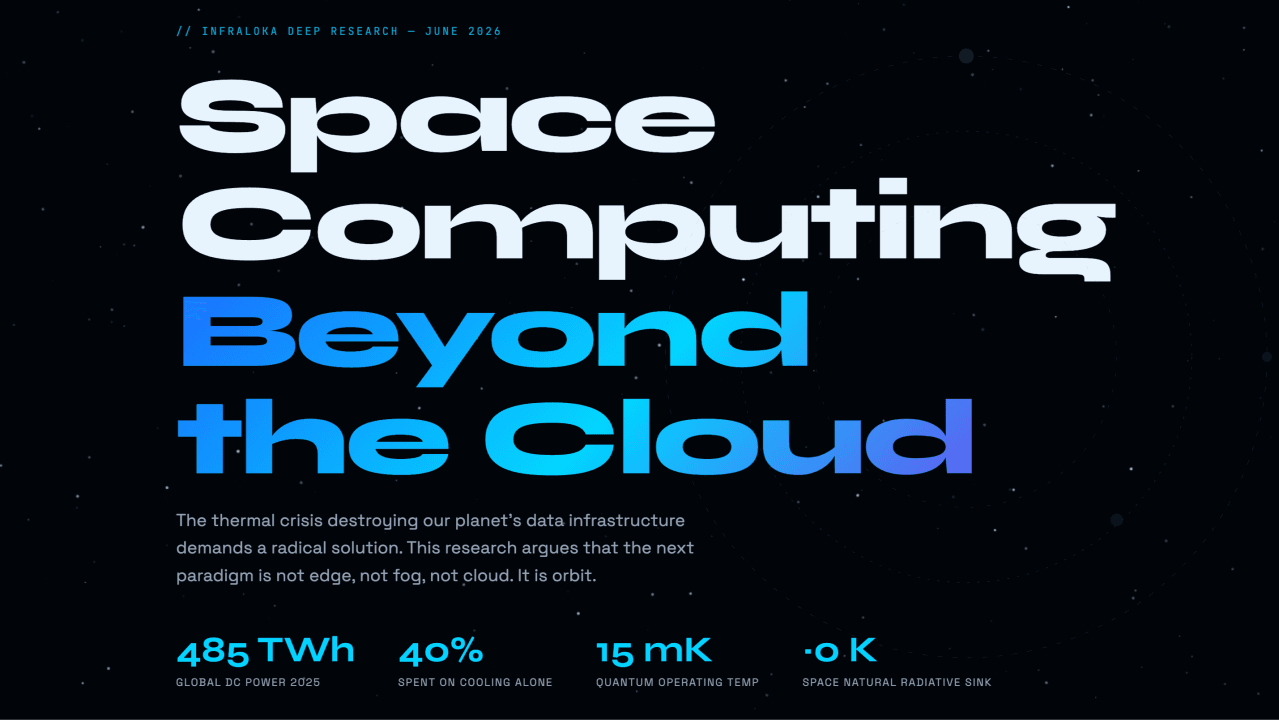
The thermal crisis destroying our planet's data infrastructure demands a radical solution. This research argues that the next paradigm is not edge, not fog, not cloud. It is orbit.
A Planet Overheating Its Own Mind
Modern digital civilization runs on data centers. And data centers are increasingly consuming planetary-scale energy just to stay cool, at the expense of electricity grids, freshwater reserves, and the climate itself.
"In 2025, data centers consumed 485 TWh of electricity globally. Thirty percent of that, more than the entire annual power consumption of Sweden, went purely to cooling."
// Source: New Atlas / University of Illinois Urbana-Champaign, 2025
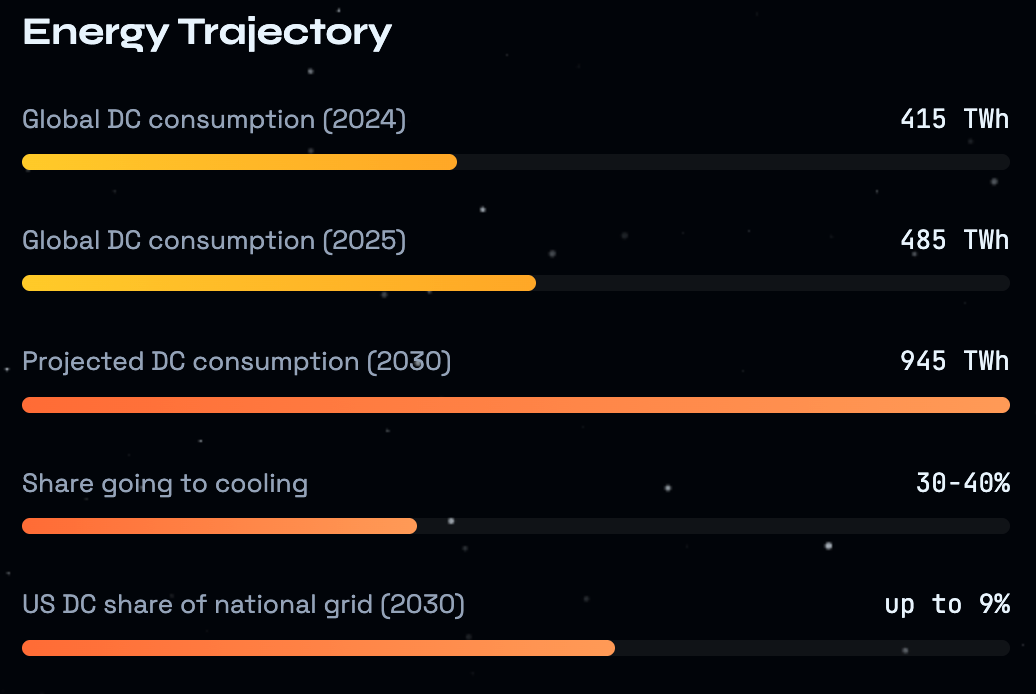
Water Consumption Crisis
Traditional cooling does not just consume electricity. It devours freshwater through evaporative cooling towers, chillers, and wet scrubbers. In 2023, US data centers directly consumed approximately 17 billion gallons of water. Hyperscale facilities alone are projected to require between 16 and 33 billion gallons annually by 2028.
Global average Power Usage Effectiveness (PUE) has stagnated between 1.55 and 1.59 since 2020, meaning that for every watt of useful compute, data centers consume an additional 0.55 to 0.59 watts in overhead, with cooling as the dominant overhead category.
Over one-third of all data center professionals actively report inadequate cooling capacity for their current workloads, driven by the explosive growth of AI-intensive GPU clusters that produce heat densities far beyond what traditional air cooling was designed to manage.
Why Conventional Solutions Are Running Out
🌘 Air Cooling
CRAC units and hot/cold aisle containment work up to roughly 10-20 kW per rack. Modern GPU clusters routinely exceed 40-100 kW per rack. Physics simply cannot be negotiated with air volumes at these densities.
💧Liquid Cooling
Direct-to-chip and immersion cooling dramatically improve heat transfer but require massive water infrastructure. In regions already experiencing water scarcity, sourcing sufficient coolant is a growing geopolitical challenge.
⚖️ Free Air / Geothermal
Nordic countries exploit cold ambient air effectively. But the global demand for AI compute cannot be concentrated entirely in Iceland or Norway. Latency, sovereignty, and fiber topology create hard geographic constraints.
👒 Underwater Data Centers
Microsoft's Project Natick proved technical viability but was discontinued in 2024. The sealed, modular design cannot be upgraded, repaired, or expanded to meet AI-era GPU density demands, making economics unviable at scale.
When Computing Needs to Be Colder Than Space
Classical data center cooling is already a crisis. Quantum computing takes the problem to a cosmological extreme. To achieve superposition and entanglement, qubits must operate at temperatures that do not naturally exist anywhere in the observable universe.
The Temperature Cascade Required
Dilution refrigerators cool qubits through a multi-stage thermodynamic process using a mixture of helium-3 and helium-4 isotopes. Each stage requires separate cooling infrastructure, and the whole system must be vibrationally isolated from every mechanical source nearby.

For reference: outer space averages 2.7 K. Quantum computers must operate roughly 270 times colder than deep space.
"IBM's 1,121-qubit Condor processor operates at temperatures below 15 mK. The dilution refrigerator required to achieve this is larger than a house, consumes megawatts just to maintain temperature, and despite this heroic effort is still 10,000 times warmer than its true target."
// Source: Quantum Zeitgeist / IBM Quantum Blog, 2024
The Machine That Cools the Machine
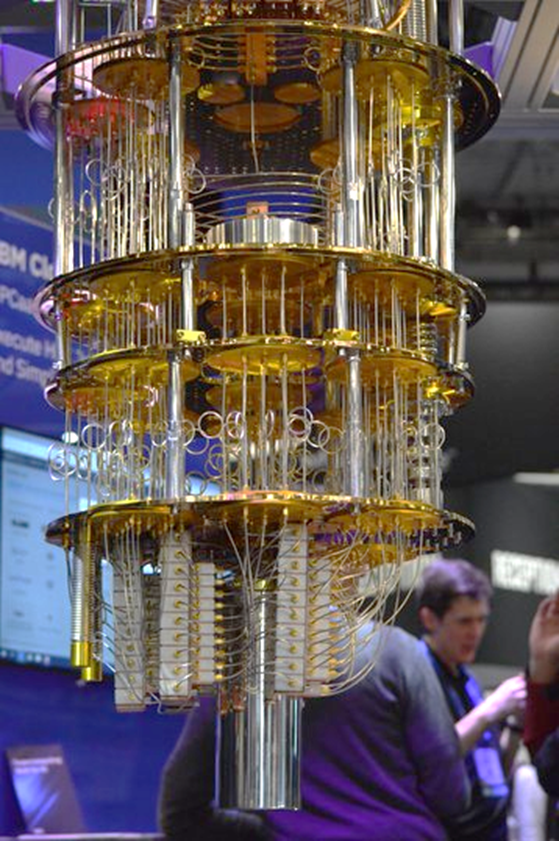
A modern dilution refrigerator is not a laboratory instrument. It is an industrial complex in its own right. The refrigeration infrastructure around a quantum processor frequently occupies more physical space, consumes more energy, and costs more to maintain than the quantum processor it serves.
Dilution Refrigerator
The central cooling unit using He-3/He-4 isotope mixtures. A single unit can cost between 3 million USD, takes days to cool down, and must remain undisturbed from vibration at all times once operational.
Pulse Tube Cryocooler
The precooling stage that brings the system from room temperature down to 4K before the dilution circuit takes over. Mechanical in nature, it introduces subtle vibrations that must be damped to protect qubit coherence.
Vacuum Canister Stages
Temperature-stage vacuum shields (300K to 10mK) that insulate each cooling layer. Multiple nested shells of thermal shielding, each requiring precision engineering and meticulous installation.
He-3 Circulation Loop
Helium-3 is one of the rarest stable isotopes on Earth. Its supply chain is constrained by nuclear reactor production and defense stockpiles. A single dilution fridge requires liters of He-3 cycling continuously.
All Forces of Physics Conspiring Against Qubits
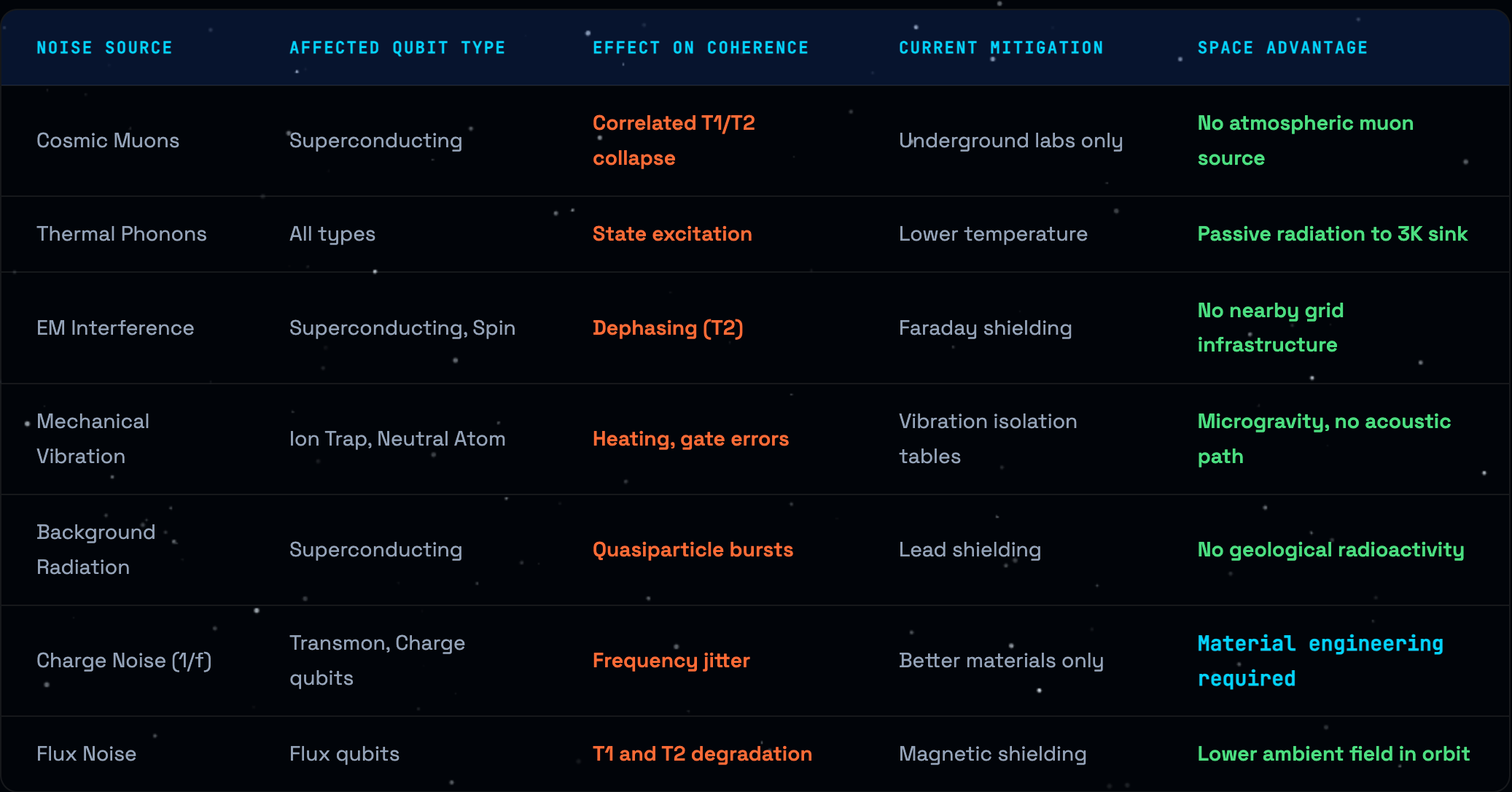
Even inside a dilution refrigerator at 15 millikelvin, qubits are under relentless assault from every physical interaction the universe permits. Decoherence, the collapse of quantum superposition into classical states, can be triggered by disturbances measured in femtojoules. Every branch of physics contributes a threat.
⚡ Thermal Noise
Even at 15 mK, residual thermal fluctuations can excite qubits out of their ground state. This is why the temperature target keeps being pushed lower. Each order-of-magnitude reduction in temperature requires exponentially more cooling infrastructure.
☂ Electromagnetic Interference
Radio waves, stray magnetic fields from power cables, nearby electronics, and even the Earth's geomagnetic field can perturb qubit states. Entire Faraday cage architectures and magnetic shielding layers must surround every qubit system.
💡 Cosmic Radiation
High-energy muons from cosmic ray showers penetrate kilometers of solid rock. When they strike qubit substrates, they create quasiparticle bursts that can simultaneously corrupt dozens of qubits. MIT research found natural radiation limits superconducting qubit coherence to just a few milliseconds, far too short for practical fault-tolerant computation.
🔠 Phonon Vibration
Mechanical vibrations, even from the cryocooler's own pulse tube compressor, propagate through material as acoustic phonons. These phonons scatter at superconductor boundaries, breaking Cooper pairs and generating quasiparticles that cause decoherence. The dilution fridge must be physically isolated from the building's floor.
🔬 Charge Noise
Fluctuating electric charges in the dielectric materials surrounding qubit junctions create a low-frequency noise called 1/f noise. These charge traps shift qubit transition frequencies unpredictably, causing dephasing that shortens T2 coherence times.
🧲 Flux Noise
For flux-tunable qubits, magnetic flux noise from fluctuating paramagnetic spins in oxide layers and two-level systems (TLS) at superconductor-insulator interfaces causes random frequency jitter, contributing to both energy relaxation (T1) and dephasing (T2) simultaneously.
🌞 Background Radiation
Naturally occurring radioactive decay from uranium, thorium, and potassium in concrete, soil, and building materials produces gamma rays and beta particles. These ionizing events deposit energy into qubit substrates and cause spatially correlated error bursts that standard quantum error correction algorithms cannot handle.
📖 Quasiparticle Poisoning
Any energy event that breaks Cooper pairs in the superconductor creates quasiparticles, free charge carriers that tunnel across Josephson junctions and directly destroy qubit states. Managing quasiparticle poisoning requires trap structures and phonon absorbers that add further engineering complexity.
The Orbital Paradigm: Not Cloud. Cosmos.
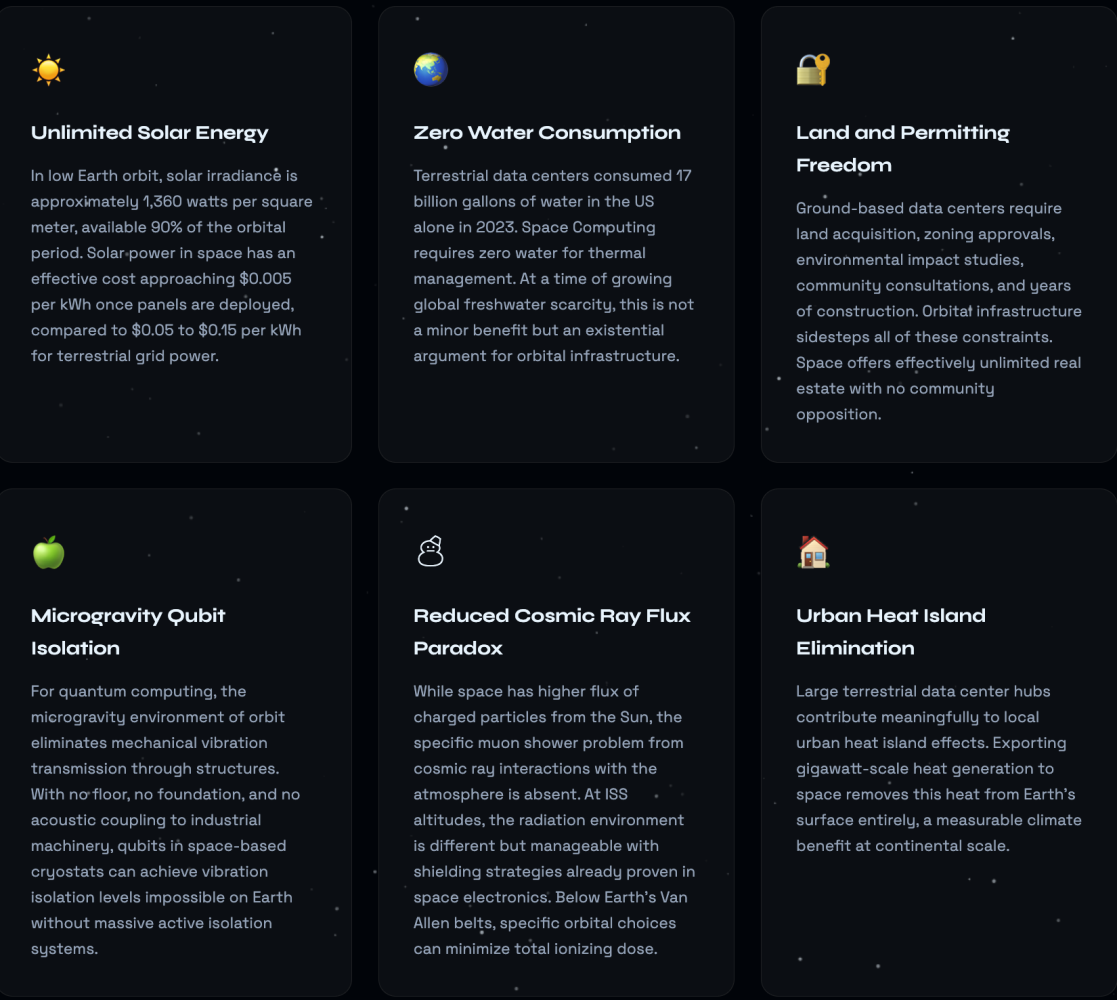
Space Computing is not an extension of cloud infrastructure. It is a categorical reimagining of where computation lives. By placing compute in low Earth orbit, we gain access to three resources Earth cannot offer: unlimited solar energy, an infinite radiative heat sink, and isolation from the physical disturbances that plague both classical and quantum systems.
Why Space Solves the Cooling Problem
The Misconception: "Space is Cold, So Cooling Is Easy"
The cosmic microwave background temperature is 2.7 Kelvin, near absolute zero. But space is a vacuum. Without a medium for convection or conduction, heat can only leave a spacecraft by thermal radiation. A single NVIDIA H100 GPU generates approximately 700 watts. To radiate this at an operating temperature of 50 degrees Celsius requires roughly 1 square meter of radiator surface facing deep space, per GPU. Scaling to a megawatt cluster implies hundreds of square meters of radiator, with mass implications that dominate launch budgets.
The Reality: Radiation Is Still Better Than Anything on Earth
Despite the radiator mass challenge, space-based thermal management operates on thermodynamically favorable physics. The radiative sink is effectively infinite and costs zero energy to maintain. On Earth, every joule of heat removed by cooling systems requires 0.3 to 0.4 joules of additional electricity to power pumps, chillers, and cooling towers. In orbit, that overhead drops toward zero. The energy efficiency gains from eliminating active cooling infrastructure compound dramatically at scale.
Passive Superconducting Cooling: Space-Only Physics
University of Arizona researchers have demonstrated a patent-pending passive radiative cooling system that can sustain superconducting electronics below their critical temperature in orbit without any active mechanical refrigeration. The system uses a space-facing radiative shield to cool a circulating working fluid to cryogenic temperatures through pure radiation. This is physically impossible on Earth, where residual atmospheric radiation and terrestrial heat sources set a floor on passive radiative cooling temperatures. Space is the only environment where this approach works.
Space Computing Advantages: A Comprehensive View
Current Milestones: The Race Has Already Started
The Technical Frontier: Remaining Challenges
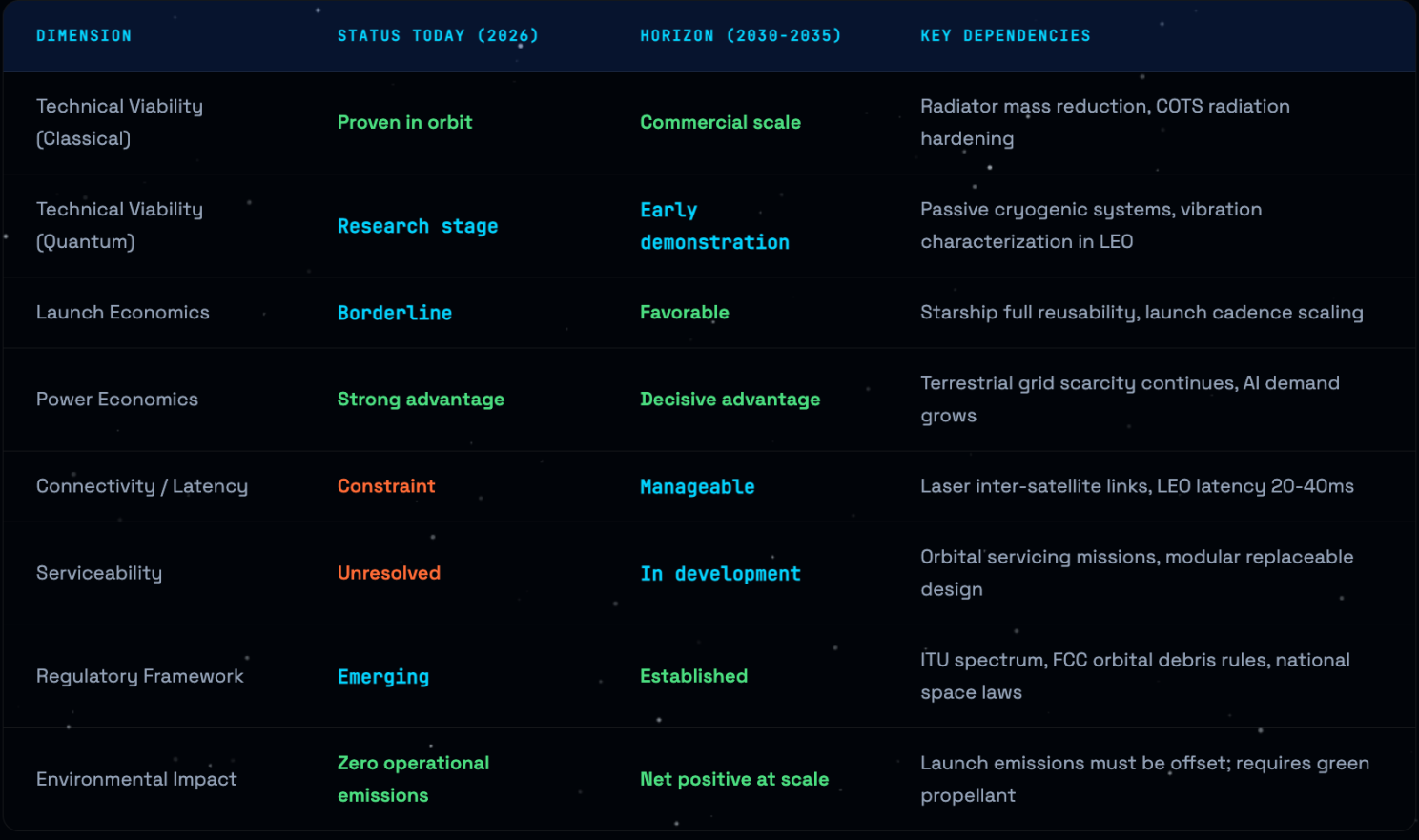
Radiator Mass Budget
NASA's ISS radiators reject 70 kW through 7 metric tons of hardware. Scaling to 1 megawatt of compute implies roughly 100 tons of radiators, far exceeding the mass of the compute hardware itself. Advanced emissive coatings and deployable ultra-thin radiator films are being developed to reduce this mass dramatically.
Launch Cost per Watt
Even with SpaceX's Starship reducing launch costs to approximately $100 per kilogram, the mass overhead of radiation shielding, power systems, and thermal radiators keeps orbital compute at a premium versus terrestrial alternatives. The crossover point depends on continued Starship cost reduction and terrestrial power cost increases.
Hardware Upgradeability
Once launched, an orbital data center cannot easily incorporate new GPU generations. The AI chip market turns over on 18-month cycles. Satellite servicing missions via SpaceX or autonomous orbital robots are under development, but module replacement at scale remains an unsolved operational challenge.
Flying Radiator Architecture
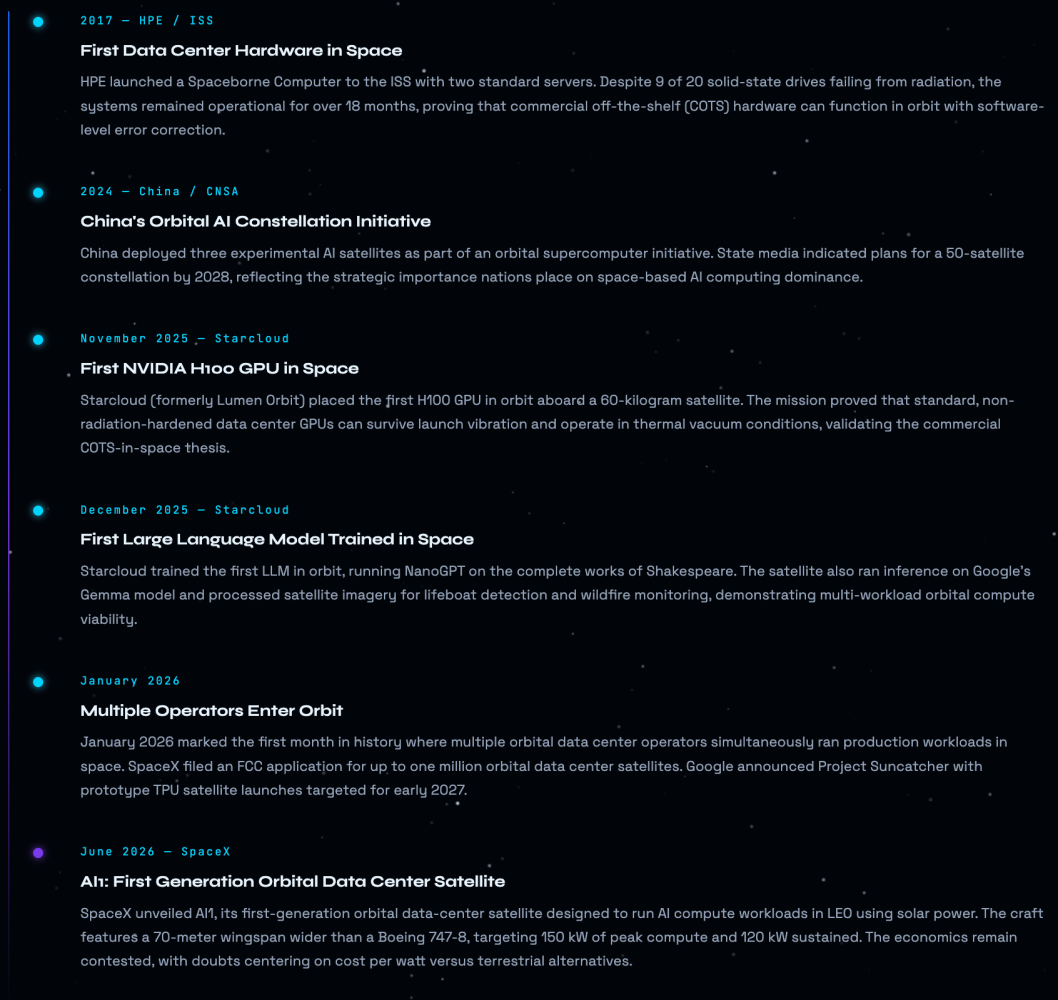
Starcloud's core thermal innovation is a deployable "Black Plate" radiator system, high-emissivity panels that radiate heat to deep space. Their whitepaper proposes a modular 5-gigawatt orbital cluster with a 4 km by 4 km radiator array, making it the largest human-made structure in history.
Laser Communications
NASA's TBIRD demonstration moved approximately 1.4 terabytes in 3 minutes at 200 Gb/s via laser downlink. As laser inter-satellite and ground-to-orbit communications mature, the bandwidth bottleneck that historically limited space-based compute becomes increasingly manageable.
Solar Power Arbitrage
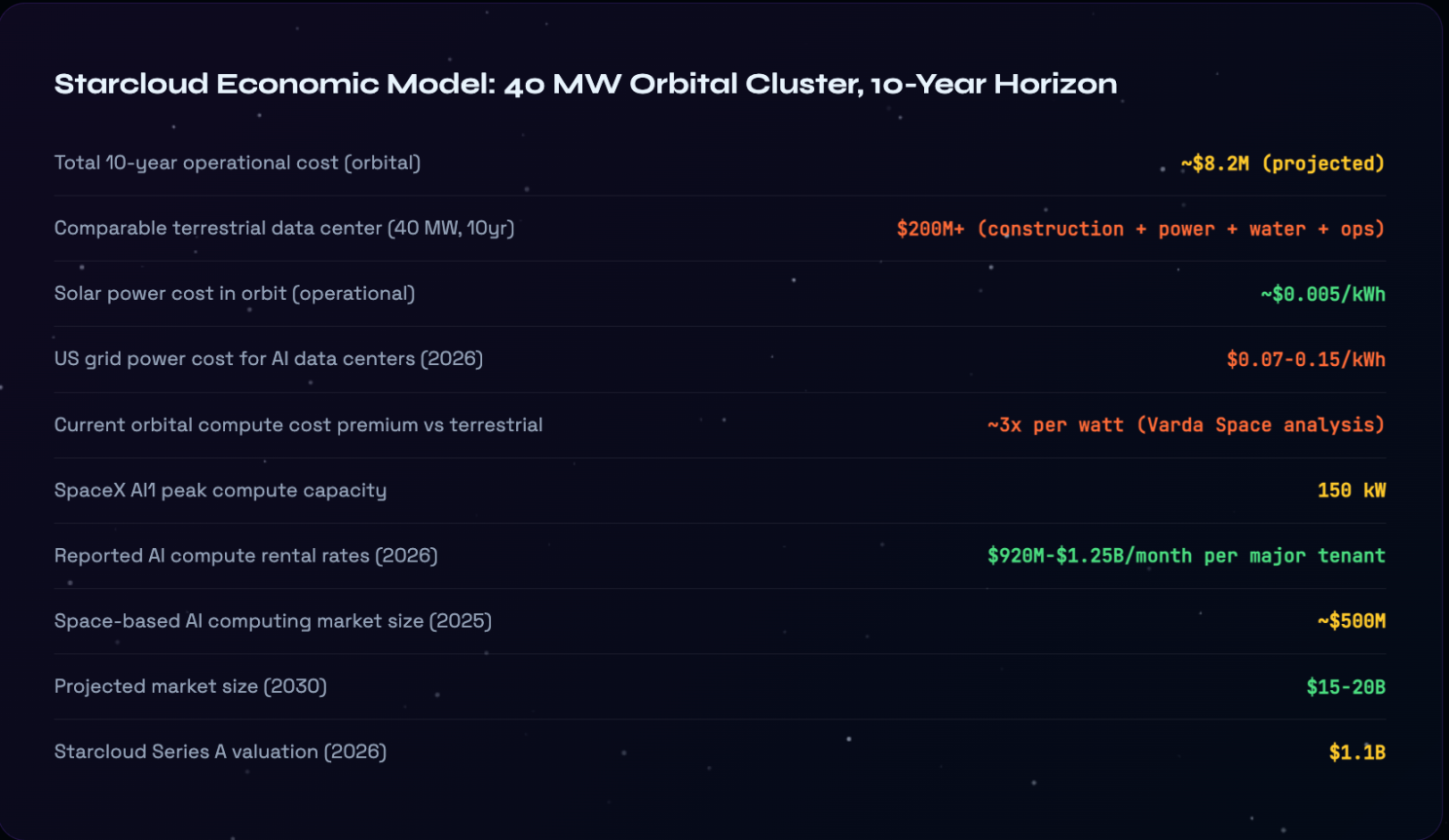
Terrestrial grid power for AI data centers ranges from 0.15 per kWh. Operational solar power in orbit approaches $0.005 per kWh once infrastructure is deployed. At sufficient scale, this 10 to 30x energy cost advantage becomes a decisive economic factor, particularly as terrestrial electricity prices rise under AI-driven demand growth.
The Business Case: Power Arbitrage at Scale
Space Computing economics are challenging today but potentially transformative by the early 2030s. The core thesis is a power arbitrage argument: as terrestrial electricity becomes scarcer and more expensive, and launch costs continue falling with Starship reusability, an economic crossover point is approaching.
Feasibility Assessment Matrix
The ESA ASCEND Study and EU Feasibility Research
The European Space Agency commissioned the ASCEND (Accelerating the Commercial Development of Novel Data Center Ecosystems) study, which found that while operational power in orbit would be clean solar energy, launch emissions and in-space logistics dominate the lifecycle environmental equation unless launch becomes approximately 10 times cleaner over a system's operational life.
A separate 2024 feasibility study by researcher Durand, examining the possibility of gigawatt-scale European orbital data centers, concluded that despite significant challenges, it should be possible to put facilities on par with the largest terrestrial data centers into orbit before 2050. This aligns with Starcloud's projection of its 88,000-satellite full-constellation milestone around 2035 to 2040.
The critical insight from these studies is that the question has evolved from whether orbital data centers are possible to which wave of deployment achieves cost parity with terrestrial alternatives first, and how quickly the crossover compounds thereafter.
Key Players and Investment Landscape
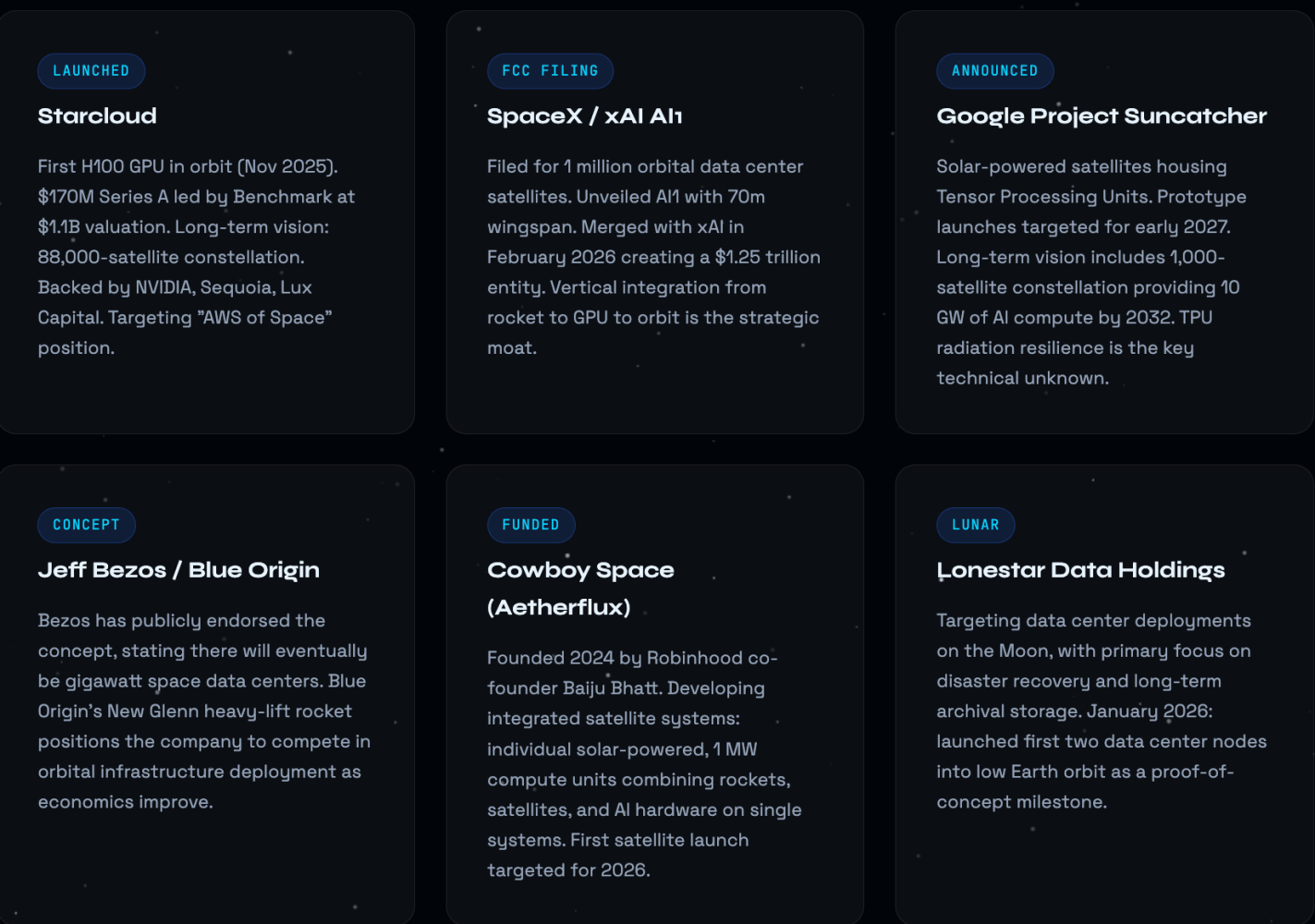
A Vision for Indonesian Space Infrastructure
Indonesia sits at the equator, one of the most strategically advantageous positions on Earth for space launch. The equatorial boost for orbital insertion reduces fuel requirements. The archipelago's digital sovereignty aspirations and rapidly growing AI infrastructure demand make Space Computing not a distant abstraction but a near-term strategic imperative.
"The next paradigm of digital infrastructure will not be defined by who builds the biggest air-conditioned warehouse. It will be defined by who first achieves sustainable, scalable, planet-positive computation in orbit. This is what we call Space Computing. Not cloud. Not edge. Cosmos."
// Rahmat Wibowo, Co-Founder and CEO, InfraLoka (PT. Infrastruktur Digital Nusantara)
Indonesia's Strategic Position
Indonesia lies astride the equator, giving it a natural advantage for equatorial low Earth orbit launches. Equatorial launches benefit from Earth's rotational velocity, providing a free 465 m/s boost relative to polar launches, translating directly to reduced launch costs and larger payload capacity.
As Southeast Asia's largest economy and the world's fourth most populous nation, Indonesia's digital infrastructure demand is growing rapidly. The country is simultaneously building cloud capacity, AI infrastructure, and an emerging cybersecurity ecosystem. Space Computing represents the next layer of this stack.
InfraLoka's Pathway AI and infrastructure suite positions the company to be an early integrator of orbital compute capacity into Indonesian enterprise and government workflows as the technology matures toward commercial viability in the 2028 to 2032 window.
Research Priorities for Southeast Asia
01 / Ground Station Topology
Optimizing optical and RF ground station placement across the 17,000-island archipelago for low-latency access to LEO compute constellations.
02 / Regulatory Framework
Contributing to KOTELSA / KORIKA standards for data sovereignty compliance when computation occurs in orbital jurisdiction outside national airspace.
03 / Hybrid Architecture
Designing hybrid terrestrial-orbital compute fabrics that route AI training workloads to orbital clusters while keeping latency-sensitive inference on-ground.
04 / Legal Tech Integration
Somasi as a Service and Pathway AI leveraging orbital compute resilience for always-available, jurisdiction-flexible legal intelligence infrastructure.
Research References
This research synthesizes findings from academic literature, industry reports, government studies, and primary technical documentation published between 2020 and June 2026.
International Energy Agency (IEA). "Electricity 2025 / Data Centres and AI." IEA, 2025. Global data center electricity consumption projected to exceed 945 TWh by 2030.
National Renewable Energy Laboratory (NREL). "Reducing Data Center Peak Cooling Demand and Energy Costs With Underground Thermal Energy Storage." NREL, January 2025. Up to 40% of data center electricity use attributed to cooling.
Utility Dive. "The 2025 Outlook for Data Center Cooling." January 2025. Industry survey: 35% of professionals make regular adjustments due to inadequate cooling capacity.Link
New Atlas / University of Illinois Urbana-Champaign. "Cooling Copper Plates Could Slash Data Center Energy Use by 90%." May 2025. 2025 global data center electricity consumption reached 485 TWh; 30% to cooling.
Pew Research Center. "US Data Centers Energy Use Amid the AI Boom." October 2025. US data centers consumed 183 TWh in 2024; US data center water consumption reached 17 billion gallons in 2023.
Uptime Institute. "Global Data Center Survey 2024." PUE has stagnated at 1.55 to 1.59 since 2020.
Zhang, Y. et al. "Cooling Technologies for Data Centres and Telecommunication Base Stations: A Comprehensive Review." Journal of Cleaner Production, 334, 130280, 2022.
Vepsäläinen, A. et al. "Impact of Ionizing Radiation on Superconducting Qubit Coherence." Nature, 2020. Natural radiation limits superconducting qubit coherence to a few milliseconds. DOI: 10.1038/s41586-020-2619-8
Chalmers University of Technology / University of Maryland. "Record Cold Quantum Refrigerator Paves Way for Reliable Quantum Computers." Phys.org, January 2025. New quantum refrigerator achieved 22 mK, advancing beyond standard dilution refrigerator performance of 50 mK.Link
IBM Quantum Blog. "IBM Cools Down World's Largest Quantum-Ready Cryostat: Project Goldeneye." IBM Research. Dilution refrigerators use He-3/He-4 mixtures to reach milli-Kelvin regimes.Link
Quantum Zeitgeist. "Inside the Freezer Colder Than Deep Space That Powers Quantum Supremacy." November 2024. IBM 1,121-qubit Condor operates at below 15 mK; coherence times exceeding 500 microseconds.Link
OriginQC. "Dilution Refrigerator for Quantum Computing: Principles, Applications and Trends." November 2025. Global dilution refrigerator market analysis; China investment exceeding $2B USD in 2024.Link
Castelli, A.R. et al. "Superconducting Qubit Decoherence Correlated with Detected Radiation Events." Lawrence Livermore National Laboratory, arXiv:2512.18171, 2025. Radiation-induced T1/T2 reductions up to 30.5% following muon events.
Fermilab LOUD Project. "Fermilab Goes Deep to Silence Noisy Radiation Affecting Qubits." Physics Today, October 2025. Deep underground qubit facilities as the only current shield against cosmic muon decoherence.
MIT Technology Review. "Four Things We'd Need to Put Data Centers in Space." April 2026. Durand 2024 feasibility study: gigawatt-scale orbital data centers possible before 2050.Link
TechTarget / Brien Posey. "Projections and Feasibility of Data Centers in Space." November 2024. HPE Spaceborne Computer history and future LEO feasibility analysis.Link
Introl Blog. "Orbital Data Center Race 2026." February 2026. Comprehensive market analysis: eight companies now pursuing orbital data centers. Starcloud 10-year cost projection of $8.2M for 40 MW orbital cluster.Link
Alpha Target. "Data Centres in Space." January 2026. Google Project Suncatcher announcement; Jeff Bezos endorsement of gigawatt space data centers.Link
Tech-Insider.org. "Starcloud's 1.1B Space Data Center Bet." 2026. Investment thesis: power arbitrage between terrestrial scarcity and orbital solar abundance.Link
Fierce Network. "Space Data Centers: Starcloud, SpaceX and Project Suncatcher Explained." March 2026. Lonestar Data Holdings orbital node launch, January 2026.Link
TechTimes / Richard L. Wells. "SpaceX AI1 Orbital Data Center Bets on Space Power and Cooling: Economics Stay Unproven." June 2026. AI1 unveiling details; AI compute rental rates context.Link
World Economic Forum. "Why Cooling Is the Real Obstacle to Space-Based Data Centres." June 2026. ISS radiator mass analysis: 70 kW requires 7 metric tons; 1 MW scale implies 100 tons of radiators.Link
University of Arizona Tech Transfer. "Passive Radiative Cooling System for Enabling Superconducting Electronics in Space." UA26-027. Patent-pending passive cryogenic system for orbital quantum computing.Link
Medium / Zheng "Bruce" Li. "The New Space Race: Chasing the Hottest Data Center in the Coldest Void Above Us." February 2026. Black Plate radiator architecture; H100 radiator area analysis (1 m2 per GPU).Link
Post Quantum. "The Many Faces of Decoherence." September 2025. Comprehensive analysis of decoherence mechanisms across qubit modalities including photonic, superconducting, and trapped ion systems.
Reuters / Joe Brock. "SpaceX's Orbital Data Centers Could Face Same Hurdles as Microsoft's Abandoned Undersea Project." April 2026. Cautionary analysis drawing parallels between Project Natick and SpaceX orbital ambitions.Link
Space Ambition Substack. "Space Data Centers: Promise, Physics, and the Parts That Still Are Not Penciled Yet." ESA ASCEND study findings on launch emissions and lifecycle environmental analysis.