
Stable Models. Dynamic Meaning. By Rahmat Wibowo From InfraLoka
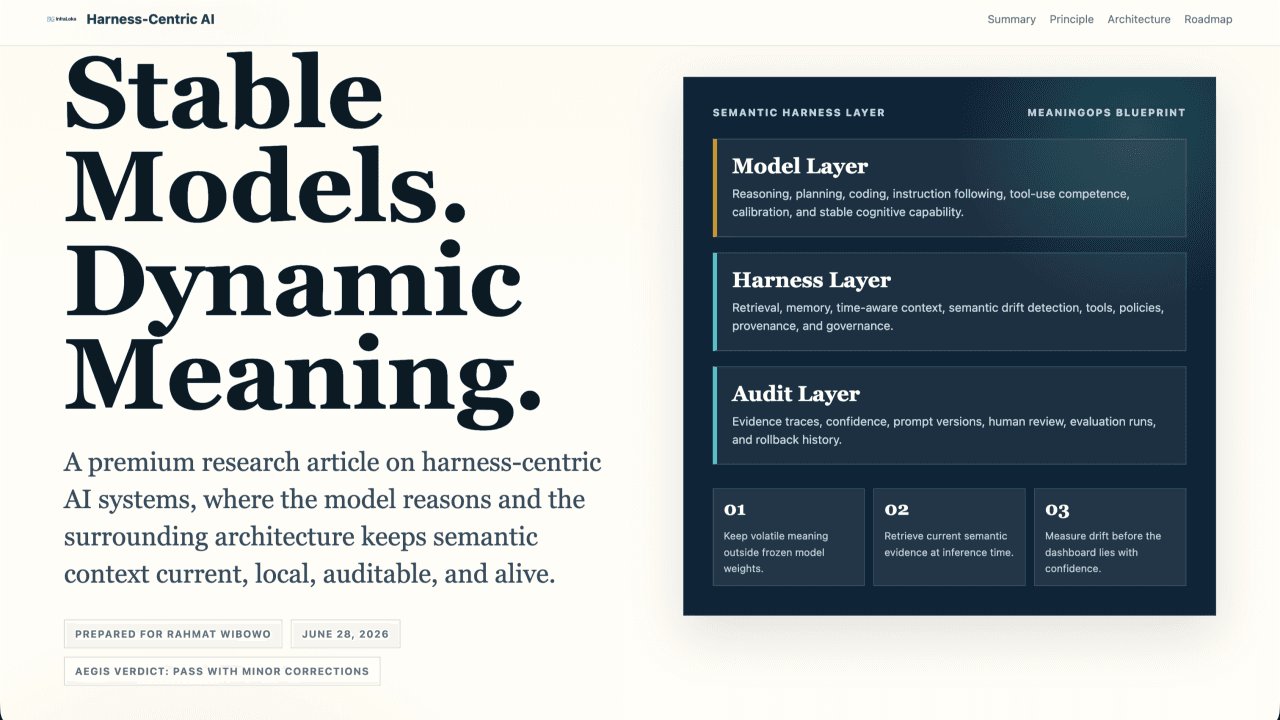
A premium research article on harness-centric AI systems, where the model reasons and the surrounding architecture keeps semantic context current, local, auditable, and alive.
1. Executive Summary
The source vision argues that modern AI competition is shifting away from the base model itself and toward the “harness” around the model: memory, retrieval, orchestration, tools, policies, evaluation loops, and continuously updated domain context. This report develops that idea into a formal research and implementation blueprint.
The central thesis is:
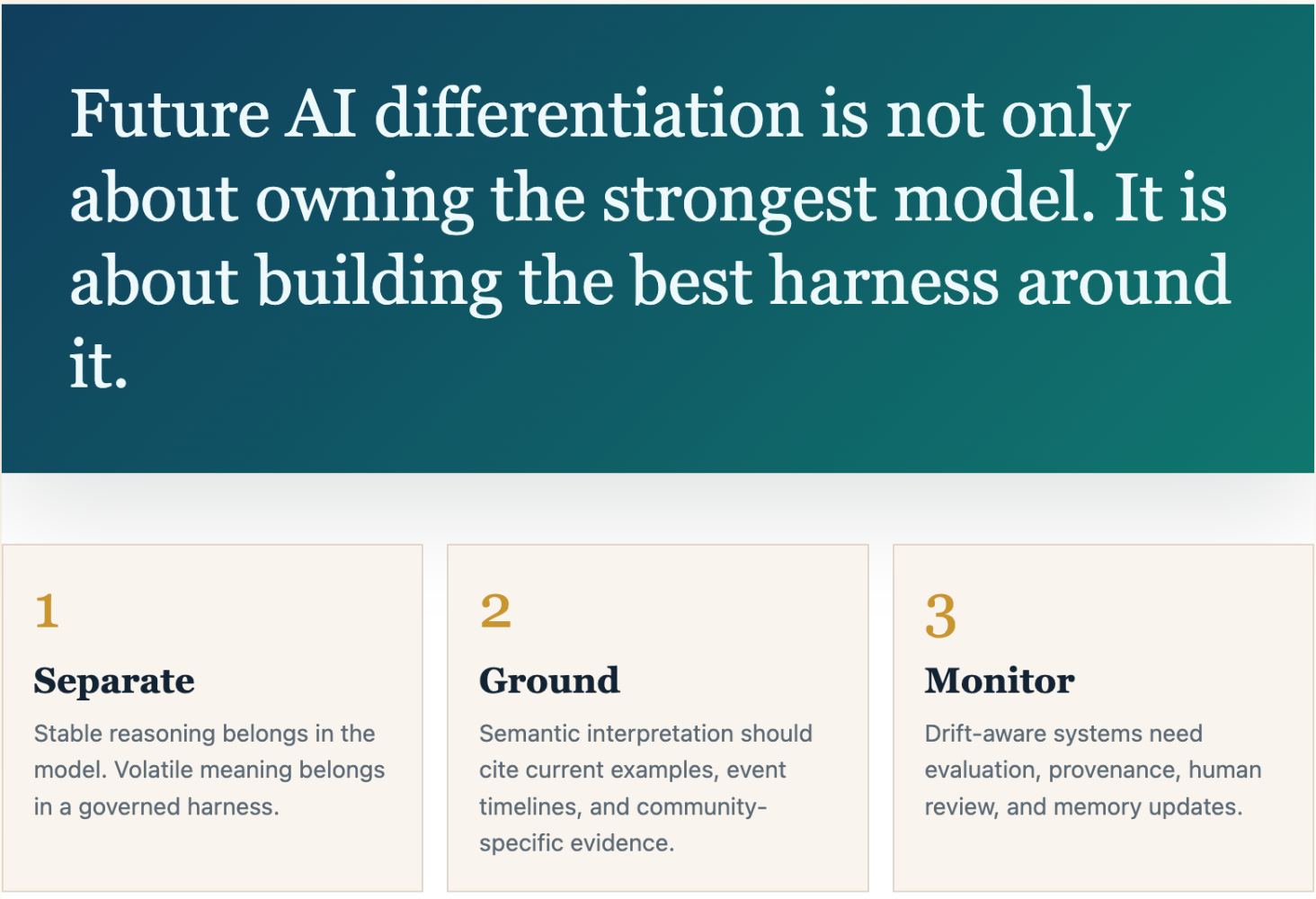
Future AI systems should treat the foundation model as a general reasoning and computation engine, while placing volatile semantic interpretation, domain meaning, sentiment definitions, factual updates, and local cultural context in a dynamic harness layer.
This is a strong thesis because it directly addresses a real weakness of large language models: their knowledge and language representations are partly frozen at training time, while society, markets, regulations, slang, political language, and sentiment associations keep changing. A sentiment label that was valid in 2024 can become misleading in 2026. A phrase that once signaled approval can become sarcastic. A brand name can move from neutral to controversial after a crisis. A regulatory term can change meaning after a court ruling. A political slogan can reverse emotional valence depending on the moment and community.
Fine-tuning a model every time meaning changes is expensive, slow, hard to audit, and risky. It may also contaminate the model with brittle, short-lived labels. A harness-centric architecture takes the opposite path: let the model become better at reasoning, planning, coding, tool use, uncertainty handling, and computation, while allowing the harness to inject fresh semantic evidence at inference time.
This report proposes a system called the Semantic Harness Layer: an AI infrastructure product that sits between users, models, and external knowledge sources. It maintains time-aware semantic memory, retrieves current domain evidence, routes tasks to appropriate models and tools, applies drift detection, and evaluates outputs against current ground truth. It does not attempt to make the base model remember everything. It makes the surrounding system responsible for what changes.
The report’s final recommendation is to build a staged MVP:
- Phase 1: Drift-Aware Sentiment Harness A domain-specific sentiment analysis system that retrieves recent examples, lexicons, events, and community-specific usage before asking the model to classify sentiment.
- Phase 2: Time-Aware Semantic Memory A knowledge layer that stores meaning with validity intervals, source provenance, domain tags, and confidence scores.
- Phase 3: Evaluation and Monitoring Platform A dashboard that detects semantic drift, measures model disagreement over time, flags stale retrieval corpora, and recommends when labels, examples, or policies need updating.
- Phase 4: General Harness SDK A developer platform for memory, RAG, tools, model routing, semantic governance, and drift-aware evaluation.
The AEGIS final verdict is PASS WITH MINOR CORRECTIONS. The idea is research-grounded and commercially relevant. The main correction is scope discipline: the first product should not attempt to be a general AI operating system. It should begin with one painful use case where drift is visible, measurable, and monetizable. Sentiment analysis, social listening, compliance interpretation, and customer feedback intelligence are the best starting points.
2. Source Vision Interpretation
The source note contains four important claims:
Claim 1: AI differentiation is moving from model ownership to harness quality. Many companies now use the same or similar frontier models. If two firms call the same model API, the difference between them is not the raw model. It is the surrounding system: data pipelines, retrieval quality, memory, tool orchestration, evaluation, user experience, governance, and domain adaptation.
Claim 2: The harness has become the real application layer. The harness is not merely a prompt wrapper. It contains orchestration, memory, retrieval-augmented generation, tools, policy checks, execution logic, state management, and feedback loops. In agentic systems, the harness decides what the model sees, which tool it calls, what memory it can access, what constraints it must obey, and how output is verified.
Claim 3: Fine-tuning should focus on stable capabilities, not volatile semantics. The source vision proposes that model training and fine-tuning should focus on computation, reasoning, planning, and general cognitive capabilities. It should not be the default place to encode fast-changing semantic meanings such as sentiment labels, temporary social associations, or current local context.
Claim 4: Semantic analysis should be handled in the harness. Because language meaning changes, the harness should supply current semantic context at inference time. Retrieval, examples, time-aware memory, human feedback, and domain-specific evidence can make semantic interpretation current without modifying the model weights.
These claims can be restated as a research proposition:
The more volatile a knowledge domain is, the more it should live outside the model parameters and inside a governed, updateable, observable harness.
This proposition has strong alignment with the direction of modern AI systems. Retrieval-augmented generation was introduced to combine parametric model memory with non-parametric external memory, partly because updating model knowledge remained an open challenge in parametric-only systems. Agentic systems such as ReAct and Toolformer similarly show that language models become more useful when they can act through tools, consult external systems, and incorporate results into reasoning.
The originality of the source vision is not simply “use RAG.” The sharper idea is that semantic interpretation itself should be treated as operational data, not model essence. This matters because semantic analysis is often treated as a natural language classification task that can be solved by a static trained model. The source vision challenges that assumption. It says that sentiment, meaning, and domain interpretation are moving targets, so they require operational infrastructure.
3. Research Thesis
3.1 Thesis Statement
This report advances the following thesis:
In production AI systems, dynamic semantic interpretation should be externalized into a harness layer that combines retrieval, memory, tools, temporal metadata, evaluation, and governance, while base models should be optimized primarily for stable reasoning, computation, instruction following, and tool-use capabilities.
3.2 Why the Thesis Matters
The thesis matters for four reasons.
First, the economics of model retraining and fine-tuning are mismatched with the speed of semantic change. Fine-tuning requires data preparation, training runs, evaluation, deployment, rollback planning, and safety review. Semantic drift can happen in days or weeks. A sudden public scandal can flip the sentiment around a brand. A new meme can alter the meaning of a phrase. A policy change can make yesterday’s correct compliance interpretation wrong.
Second, embedding fast-changing semantics into model weights creates audit problems. If a sentiment classifier changes because the model was fine-tuned, it is often hard to explain which examples caused the change. A harness can store source evidence, timestamps, validity intervals, and retrieval traces. This makes the system more transparent.
Third, different communities can assign different meanings to the same phrase at the same time. A single global model representation may flatten these differences. A harness can retrieve community-specific evidence: Indonesian Twitter, enterprise customer support tickets, legal documents, product reviews, news articles, or internal knowledge bases.
Fourth, harness-centric design creates business differentiation even when competitors use the same foundation models. The model may be commoditized. The harness is the company-specific asset: domain memory, evaluation history, user workflows, integrations, and proprietary feedback loops.
3.3 Research Questions
This report is organized around seven research questions:
- What should be stored in model parameters, and what should be stored in the harness?
- How does semantic drift undermine static sentiment and semantic analysis systems?
- When is fine-tuning appropriate, and when is retrieval or memory more appropriate?
- What architecture can support drift-aware semantic interpretation?
- How can such a system be evaluated scientifically?
- What MVP can make the idea commercially real?
- What are the risks of moving semantic analysis into the harness?
3.4 Core Contribution
The contribution is a design framework called Model-Harness Separation:
Model layer: stable capabilities such as reasoning, coding, mathematical manipulation, instruction following, summarization, planning, abstraction, and tool-use competence.
Harness layer: volatile and contextual capabilities such as current facts, domain semantics, sentiment drift, user memory, policy state, retrieval sources, tool execution, governance, and evaluation.
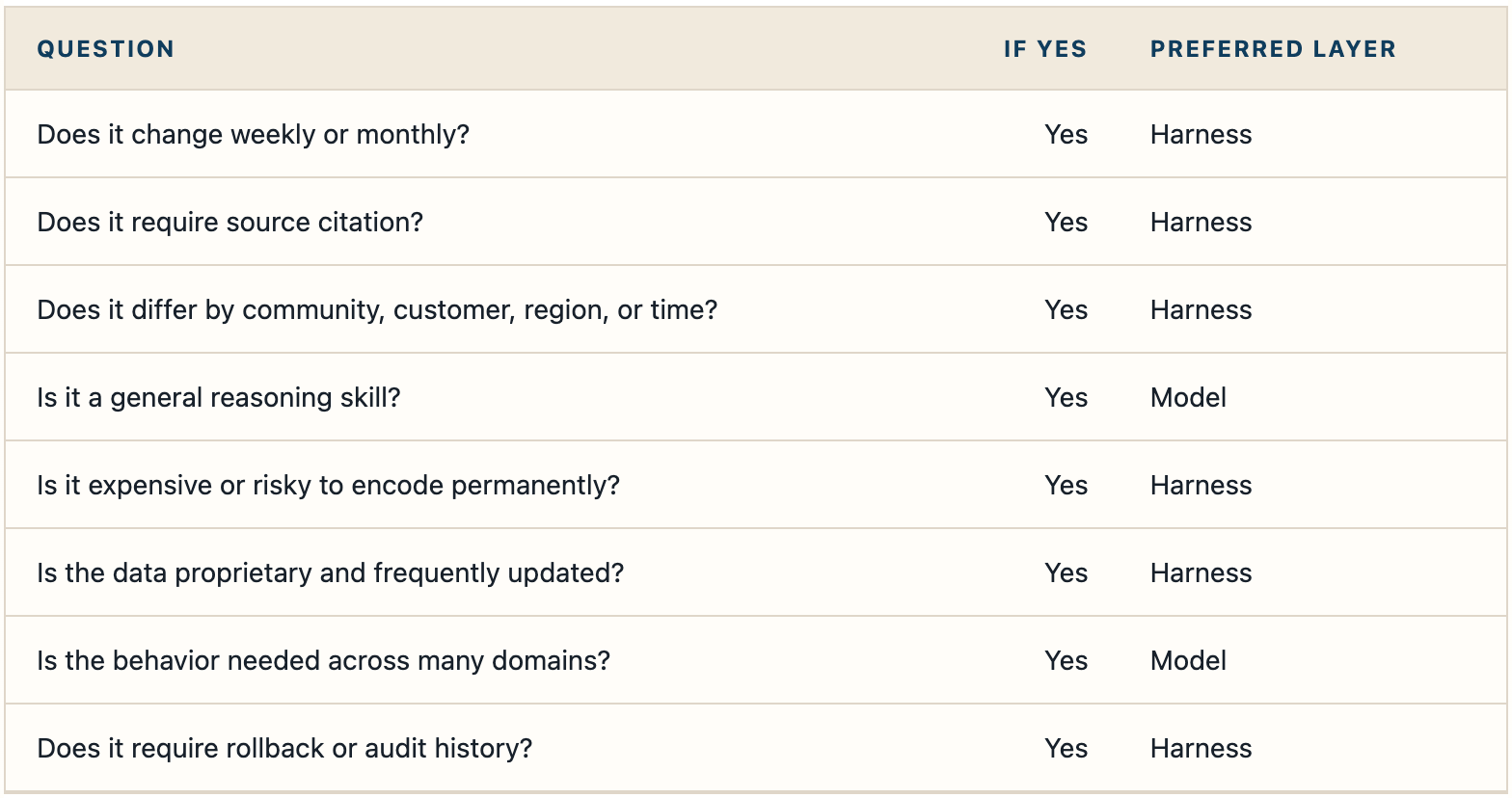
Boundary rule: if the information changes faster than the model deployment cycle, belongs to a narrow domain, requires source provenance, or differs across communities, it should be handled by the harness.
4. Literature and Technical Context
4.1 Parametric and Non-Parametric Knowledge
Large language models store a great deal of knowledge in their parameters. This parametric knowledge is powerful because it supports fluent generation and broad generalization. However, parametric knowledge has known limitations: it can become stale, it can hallucinate, and it can be difficult to update precisely.
Retrieval-Augmented Generation (RAG) directly addresses this limitation by combining a parametric model with an external, non-parametric memory. Lewis et al. introduced RAG for knowledge-intensive NLP tasks, showing that retrieval from an external index can improve factuality, specificity, and provenance compared with parametric-only generation. The key lesson for this report is that some knowledge should be retrieved rather than memorized.
The source vision extends that idea from factual knowledge to semantic interpretation. RAG is usually framed as a way to retrieve facts. The proposed harness-centric system retrieves meaning evidence: how a term is currently used, which communities use it positively or negatively, what recent events changed its interpretation, and what examples support a classification.
4.2 RAG as an Architectural Foundation
Recent RAG surveys identify several recurring design dimensions:
- Retriever quality and retrieval fusion
- Chunking and indexing strategy
- Context filtering and reranking
- Generator grounding and faithfulness
- Evaluation of retrieval and generation
- Robustness against noise, stale documents, and adversarial inputs
These are not small details. They are the operational substance of the harness. A weak retriever can feed irrelevant context to a strong model. A stale index can make the model appear confident while answering from old evidence. A missing reranker can bury the decisive document below lower-quality matches. In a harness-centric view, the model is only one component in a larger epistemic system.
4.3 Tool Use and Agentic Systems
Toolformer showed that models can benefit from learning when and how to call external tools. ReAct demonstrated the value of interleaving reasoning and action, allowing models to consult external sources and update their trajectory. Modern agentic systems add memory, planning, tool execution, reflection, and orchestration around the model.
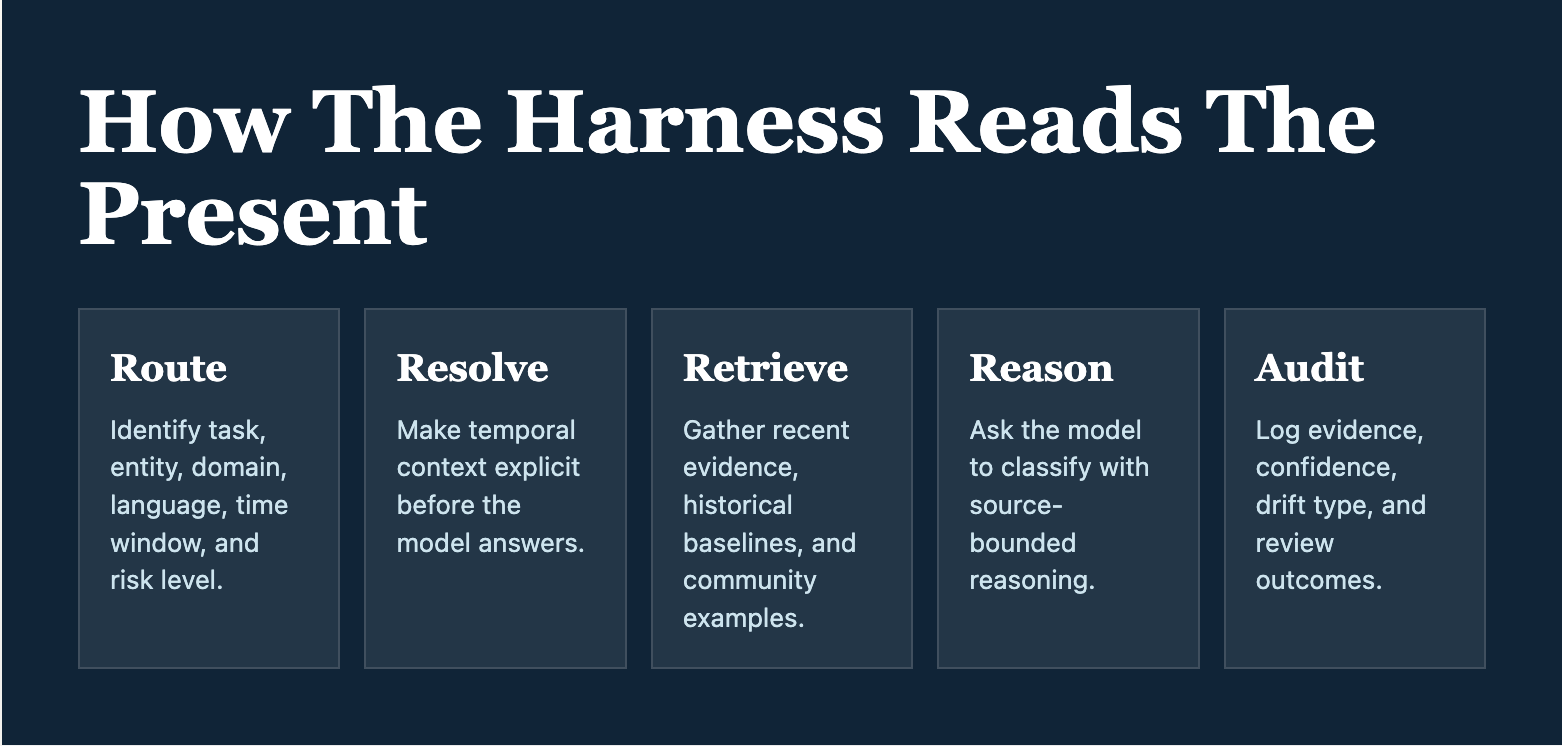
The harness in this report is related to agentic architecture but narrower and more disciplined. It does not assume that all AI systems should become autonomous agents. Instead, it argues that semantic tasks should be mediated by a reliable orchestration layer:
- Determine whether the task depends on current meaning.
- Retrieve time-bounded semantic evidence.
- Ask the model to reason over that evidence.
- Require confidence and uncertainty reporting.
- Log the sources and classification rationale.
- Evaluate output against drift-aware test sets.
4.4 Semantic Change and Diachronic Meaning
Semantic change is a long-studied phenomenon in linguistics. Words gain, lose, or alter meanings over time. Computational approaches to lexical semantic change use corpora, embeddings, temporal slices, and distributional statistics to detect meaning shifts.
For AI systems, this matters because many semantic tasks are not timeless. Sentiment analysis is especially vulnerable. The emotional meaning of a phrase can shift because of:
- Political events
- Brand crises
- Meme culture
- Platform-specific slang
- Community-specific irony
- Regulatory changes
- Religious or cultural reinterpretation
- News cycles
- Local language mixing
The source note gives the simple example: a sentiment can be positive today and negative one year later. That is not a minor edge case. It is a fundamental problem for static semantic classifiers.
4.5 Temporal Knowledge in LLMs
Recent work on time awareness in language models shows that real-world facts often depend on temporal context. A question like “Who is the president?” is not a timeless query. It requires a date. Studies such as TimeShift and ChroKnowledge evaluate whether language models can handle chronological knowledge and time-dependent facts.
This directly supports the harness-centric thesis. If facts and meanings have temporal validity, the system must represent time explicitly. The model alone cannot be trusted to infer the relevant temporal boundary unless the harness supplies it.
4.6 Domain Adaptation and Fine-Tuning
Fine-tuning remains useful. This report does not reject it. Fine-tuning can improve instruction following, domain style, extraction schemas, reasoning habits, tool-use patterns, and task-specific behavior. Domain-adaptive pretraining and supervised fine-tuning can improve performance when the target distribution is stable enough and when the organization can maintain evaluation discipline.
The critique is narrower:
Fine-tuning is the wrong default mechanism for fast-changing semantic labels when retrieval, memory, and evaluation can provide fresher, more auditable context.
This distinction is important. The proposal is not “never fine-tune.” It is “fine-tune stable capability; retrieve volatile context.”
5. The Model-Harness Separation Principle
5.1 Definition
The Model-Harness Separation Principle states:
AI system designers should separate stable cognitive capability from dynamic contextual knowledge. Stable capability belongs primarily in the model. Dynamic context belongs primarily in the harness.
This principle turns a vague architectural intuition into a decision framework.
5.2 What Belongs in the Model
The following capabilities are good candidates for model-level training or fine-tuning:
- General reasoning
- Mathematical manipulation
- Code generation and debugging
- Instruction following
- Structured output formatting
- Tool-use discipline
- Planning and decomposition
- Causal reasoning
- Summarization
- Translation ability
- General language understanding
- Safety behavior
- Refusal boundaries
- Calibration habits
These are relatively stable capabilities. They improve the model’s ability to process whatever context the harness provides.
5.3 What Belongs in the Harness
The following capabilities are good candidates for harness-level management:
- Current facts
- Regulatory updates
- Market events
- Brand reputation shifts
- Sentiment definitions
- Domain ontologies
- Company policies
- User memory
- Conversation state
- Retrieval corpora
- Tool results
- Audit logs
- Source provenance
- Evaluation sets
- Human feedback
- Temporal validity rules
- Community-specific language norms
These are dynamic, localized, auditable, and often organization-specific.
5.4 Decision Matrix
5.5 Example: Sentiment Around a Brand
Suppose the phrase “Brand X is brave” is positive in January 2025 because Brand X released a respected privacy feature. In March 2026, after a public scandal, the same phrase becomes sarcastic in online discourse. A static classifier may treat “brave” as positive. A fine-tuned model may learn some later examples, but it may not know which time window or community applies.
A harness-centric system would:
- Identify the target domain: brand sentiment.
- Retrieve recent posts, news, and customer feedback.
- Detect sarcasm markers and community usage.
- Compare current evidence against historical baseline.
- Ask the model to classify sentiment with evidence.
- Store the classification trace for audit.
- Update drift metrics if the label distribution has shifted.
The model still matters. It reasons over ambiguous context. But the harness decides what evidence is current and relevant.
6. Semantic Drift as the Core Failure Mode
6.1 What Is Semantic Drift?
Semantic drift is the change in meaning, connotation, association, or practical interpretation of language over time. In AI systems, semantic drift creates a gap between the meaning encoded in historical training data and the meaning needed at inference time.
The phrase “semantic drift” can refer to lexical change in linguistics, but in production AI it also includes:
- Change in sentiment polarity
- Change in entity reputation
- Change in taboo or sensitive meanings
- Change in professional terminology
- Change in regulatory interpretation
- Change in meme or slang usage
- Change in customer expectations
- Change in product category definitions
6.2 Why Sentiment Analysis Is Especially Exposed
Sentiment analysis looks deceptively simple: classify text as positive, negative, or neutral. In reality, sentiment depends on context, time, speaker, audience, platform, and events. Words are not stable sentiment carriers.
Examples:
- “Sick” can mean ill, impressive, or disturbing depending on context.
- “Cheap” can be positive for affordability or negative for quality.
- “Disruptive” can signal innovation in venture capital but harm in education.
- “Bold” can be praise or criticism.
- A political slogan can become ironic after a scandal.
- A product nickname can move from affectionate to hostile in a user community.
Static sentiment models often rely on learned correlations from past data. When the social meaning changes, those correlations become stale.
6.3 Three Types of Drift
Lexical drift A word or phrase changes meaning. Example: slang evolves, or a term gains a new sense.
Entity drift The sentiment associated with an entity changes. Example: a company becomes controversial after a data breach.
Frame drift The interpretive frame changes. Example: a policy once discussed as innovation is later discussed as surveillance.
These drift types require different harness responses. Lexical drift needs updated examples and semantic embeddings. Entity drift needs event timelines and reputation signals. Frame drift needs discourse analysis and topic modeling.
6.4 Why Static Benchmarks Hide the Problem
Many NLP benchmarks are static. They measure performance on a fixed dataset collected at a particular moment. A model can perform well on that benchmark while failing in production because the language distribution changes.
For semantic harness systems, evaluation must be temporal:
- Train or baseline on old data.
- Test on newer data.
- Measure label shift and error shift.
- Compare current retrieval-augmented classifications against static model outputs.
- Track whether the harness improves adaptation without retraining.
6.5 The Product Opportunity
Semantic drift is painful for:
- Brand monitoring platforms
- Customer support analytics
- Market intelligence systems
- Political risk analysis
- Financial news sentiment
- Compliance monitoring
- Social listening tools
- Public sector communication dashboards
- Indonesian multilingual and code-mixed NLP systems
These users need current interpretation, not just general language ability.
7. Why Fine-Tuning Is the Wrong Default for Dynamic Semantics
7.1 Fine-Tuning Has a Place
Fine-tuning can be valuable when:
- The target behavior is stable.
- The task format is repetitive.
- The training data is high quality.
- The evaluation set is representative.
- The cost of training is justified.
- The deployment process includes rollback.
- The organization can monitor regressions.
Examples include structured extraction, domain-specific formatting, stable classification taxonomies, coding style adaptation, or tool-call discipline.
7.2 The Problem with Fine-Tuning Volatile Meaning
Fine-tuning dynamic semantic labels creates four problems.
Problem 1: Latency of adaptation By the time data is collected, cleaned, trained, evaluated, and deployed, the semantic context may already have shifted again.
Problem 2: Audit opacity When a model changes behavior after fine-tuning, it can be difficult to identify which examples produced which classification changes. A harness can preserve retrieval traces.
Problem 3: Overwriting and interference Fine-tuning on recent semantic data can degrade older capabilities or produce unintended associations. The system may become overfit to a temporary discourse pattern.
Problem 4: Community conflict The same phrase can have different meanings across communities. Encoding one global meaning into model weights can erase local variation.
7.3 Retrieval as a Better Default
Retrieval allows the system to update semantic context without modifying model weights. If a meaning changes, update the corpus, examples, rules, or event timeline. The model receives current evidence at inference time.
Retrieval also supports provenance. The system can say:
- This classification used examples from the last 30 days.
- These three sources support the negative interpretation.
- Historical baseline sentiment was positive until this event.
- Confidence is low because communities disagree.
7.4 Memory as a Better Default
Memory allows the harness to store temporal and user-specific context:
- A term was positive in Q1 2025 but negative after Q3 2025.
- Customer A uses “aggressive” positively for growth strategy.
- Community B uses the same phrase sarcastically.
- Indonesian startup Twitter uses a loanword differently from formal Indonesian media.
This memory should not be an unstructured prompt dump. It should be structured and versioned.
7.5 Tooling as a Better Default
Tools allow the harness to compute, verify, and update:
- Search recent news.
- Query customer tickets.
- Retrieve social media samples.
- Compute sentiment shift over time.
- Detect emerging terms.
- Compare current label distribution with baseline.
- Call a human review workflow.
The model becomes a reasoning component within an evidence system.
8. Harness Architecture for Drift-Resilient AI
8.1 High-Level Architecture
The proposed harness has nine components:
- Input Router
- Task Classifier
- Temporal Context Resolver
- Semantic Retrieval Engine
- Memory Store
- Tool Orchestrator
- Model Gateway
- Evaluation and Drift Monitor
- Audit and Governance Layer
The architecture is intentionally modular. The base model can be OpenAI, Anthropic, Google, open-source, or local. The harness is model-agnostic.
8.2 Input Router
The input router receives the user’s request and extracts:
- Task type
- Domain
- Entities
- Language
- Time window
- User intent
- Required output format
- Risk level
For example:
“Analyze sentiment around Brand X after the March 2026 pricing controversy.”
The router extracts:
- Task: sentiment analysis
- Entity: Brand X
- Time window: after March 2026
- Domain: brand reputation
- Required evidence: recent sources
- Risk: medium to high
8.3 Task Classifier
The task classifier determines whether the request is:
- Timeless reasoning
- Current factual lookup
- Dynamic semantic interpretation
- Tool-execution workflow
- Long-term memory use
- Policy-sensitive classification
If the task is dynamic semantic interpretation, the harness activates drift-aware retrieval and temporal memory.
8.4 Temporal Context Resolver
The temporal resolver asks:
- What time does the user care about?
- What is the validity window of retrieved evidence?
- Does the query compare old and new meanings?
- Are there known events that changed interpretation?
- Should the model answer as of today or as of a historical date?
This component is crucial. Without explicit time handling, the model may blend old and new meanings.
8.5 Semantic Retrieval Engine
The retrieval engine searches multiple evidence stores:
- Recent documents
- Historical documents
- Labeled examples
- Domain lexicons
- Event timelines
- Knowledge graphs
- Customer records
- Social posts
- Human-reviewed annotations
It returns ranked evidence with metadata:
- Source
- Date
- Community or domain
- Confidence
- Label
- Entity
- Language
- Retrieval score
- Freshness score
8.6 Memory Store
The memory store keeps structured semantic facts:
{
  "term": "bold",
  "domain": "product reviews",
  "community": "enterprise SaaS buyers",
  "polarity": "mixed",
  "valid_from": "2025-01-01",
  "valid_to": null,
  "evidence_ids": ["ev_101", "ev_102", "ev_103"],
  "confidence": 0.72,
  "notes": "Positive when referring to feature ambition; negative when referring to pricing changes."
}
This memory is not a replacement for retrieval. It is a structured layer that summarizes stable findings from retrieval and human review.
8.7 Tool Orchestrator
The tool orchestrator calls external systems:
- Search APIs
- Vector databases
- SQL databases
- Web crawlers
- Sentiment baselines
- Topic models
- Named entity recognizers
- Translation tools
- Human review queues
- Experiment tracking systems
The tool orchestrator must enforce budgets, permissions, and schema validation. It should not allow the model to call arbitrary tools without guardrails.
8.8 Model Gateway
The model gateway chooses the model and prompt strategy:
- Fast model for low-risk classification
- Strong reasoning model for ambiguous drift cases
- Local model for private data
- Specialized model for language or domain
- Ensemble mode for high-risk decisions
The gateway also standardizes output:
{
  "classification": "negative",
  "confidence": 0.81,
  "time_window": "2026-03-01 to 2026-06-28",
  "evidence_summary": "...",
  "key_sources": ["source_1", "source_2"],
  "drift_detected": true,
  "drift_type": "entity_drift",
  "recommended_action": "update sentiment baseline"
}
8.9 Evaluation and Drift Monitor
The monitor measures:
- Accuracy against labeled data
- Retrieval relevance
- Faithfulness to sources
- Calibration
- Drift in term usage
- Drift in entity sentiment
- Disagreement between old and new classifiers
- Human override rate
- Error concentration by community or language
This makes the harness operationally useful. Without monitoring, the system is just a clever prompt pipeline.
8.10 Audit and Governance Layer
The audit layer stores:
- Prompt version
- Model version
- Retrieved evidence
- Tool calls
- Final output
- Confidence
- Human review decision
- Evaluation result
This is essential for enterprise, government, finance, legal, and public-sector use cases.
9. Product Concept: The Semantic Harness Layer
9.1 Product Name
Working name: Semantic Harness Layer Alternative names:
- DriftGuard AI
- MeaningOps
- Context Harness
- Semantics Control Plane
- Temporal RAG Studio
The strongest commercial name is likely MeaningOps because it communicates an operational layer for meaning, similar to DevOps, MLOps, and LLMOps.
9.2 Product Promise
MeaningOps keeps AI interpretation current when language, sentiment, and context change.
9.3 Target Customers
The first target customers should be organizations that already suffer from semantic drift:
- Brand monitoring and PR agencies
- Social listening teams
- Customer support analytics teams
- Banks monitoring complaint sentiment
- Public-sector communication teams
- Political risk analysts
- Market intelligence firms
- Indonesian enterprises handling multilingual customer feedback
- Compliance teams tracking regulatory language
9.4 Wedge Use Case
The best wedge is drift-aware sentiment analysis for customer and public discourse.
Why this wedge?
- The pain is easy to understand.
- Drift is measurable.
- Existing sentiment tools are often shallow.
- The product can show before-after improvement.
- It can use public, customer, and human-labeled data.
- It creates a path into larger enterprise AI governance.
9.5 MVP Workflow
- User uploads or connects a stream of text data.
- User defines entities, domain, language, and time windows.
- System builds a baseline sentiment profile.
- System retrieves recent evidence and detects changes.
- System classifies sentiment with source-grounded rationale.
- System flags terms or entities with drift.
- Human reviewer approves corrections.
- System updates semantic memory and evaluation set.
- Dashboard shows drift trends.
9.6 Differentiation
The product differs from ordinary sentiment APIs in six ways:
- It is time-aware.
- It stores semantic evidence.
- It supports domain-specific meaning.
- It distinguishes model confidence from evidence freshness.
- It logs provenance for audit.
- It improves through harness updates rather than constant model retraining.
9.7 Why This Could Become a Platform
Once the semantic harness works for sentiment, it can expand to:
- Compliance interpretation
- Policy analysis
- Legal clause meaning
- Market trend interpretation
- Customer intent detection
- Cultural localization
- AI agent memory governance
- Enterprise knowledge assistants
The platform opportunity is not “another chatbot.” It is a control plane for dynamic meaning.
10. Final Verdict
The source vision is technically sound and strategically valuable. It identifies one of the most important shifts in modern AI: as foundation models become widely accessible, durable differentiation moves into the harness.
The strongest form of the idea is not a general statement that “RAG is useful.” The stronger, more defensible thesis is:
Dynamic semantic interpretation should be governed outside the model, using time-aware retrieval, semantic memory, evaluation, and audit infrastructure.
This thesis can become both a research contribution and a product.
The recommended next step is to build a focused MVP:
MVP: Drift-aware sentiment analysis harness Audience: brand monitoring, customer analytics, and Indonesian enterprise feedback teams Core value: classify sentiment using current evidence, detect meaning drift, and preserve audit traces Research proof: compare against static LLM, naive RAG, and fine-tuned classifier on time-sliced drift datasets Commercial proof: show that customers discover false sentiment trends in existing dashboards and can correct them with evidence
The idea should be pursued. It is not merely an implementation detail. It is a serious product and research direction: AI systems where the model thinks, but the harness remembers what the world currently means.
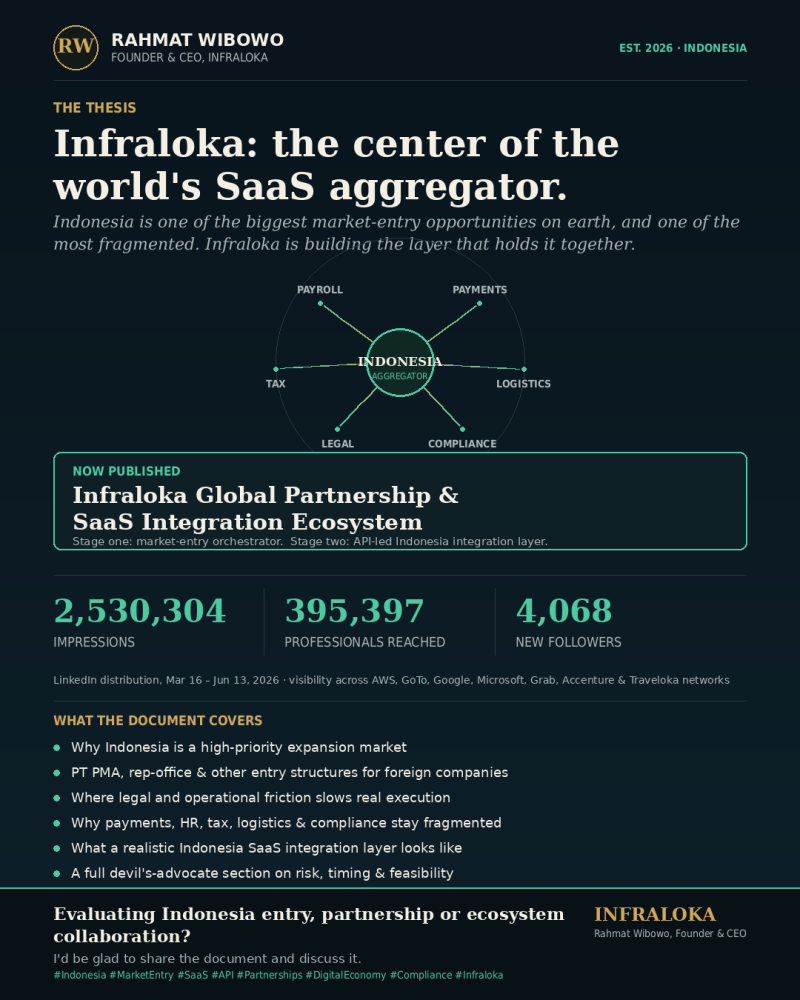
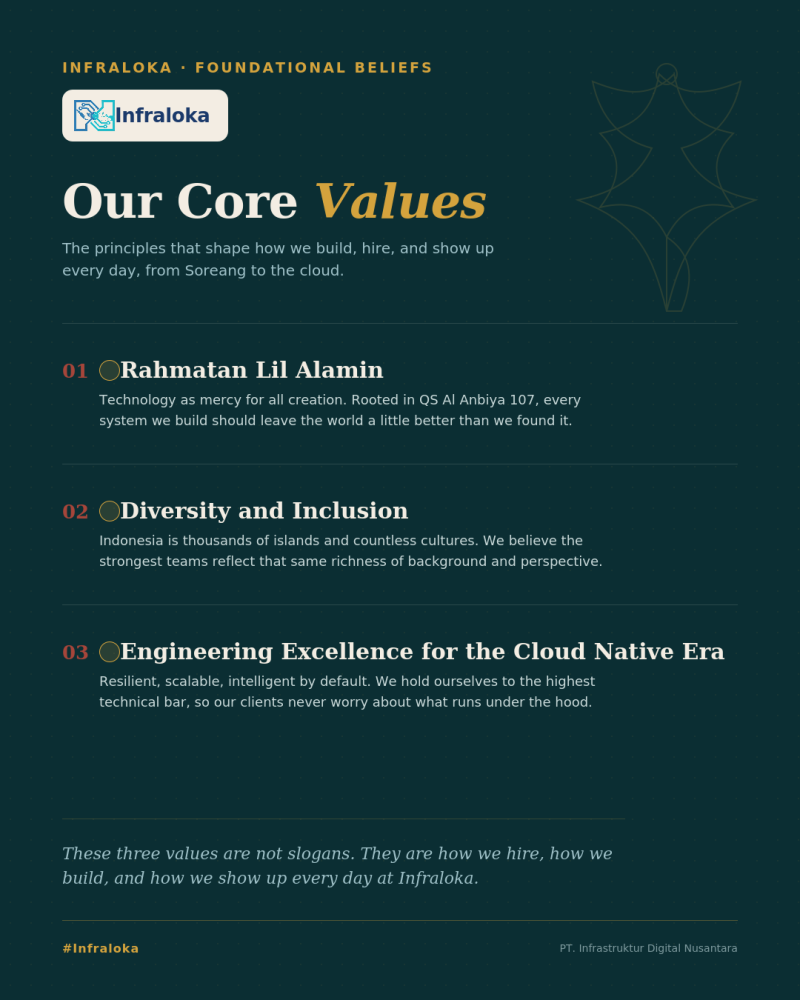
InfraLoka is an AI Native Engineering company. Our Founder, Rahmat Wibowo's vision is to make AI capabilities accessible to everyone in the world even with limited access his vision was. Make a good smaller language models so it can be run on local with good quality and makes a platform using the harness. Models will becomes commodity in tokenomics era you can Bring Your Own Token, But the key differentiator is to make the ecosystem using harness centric providers
#ITB #InfraLoka #QSWorldUniversityRankings #HigherEducation #UniversityStrategy #DigitalTransformation #ResearchImpact #Employability #Internationalization #Indonesia #EducationInnovation #InstitutionalIntelligence #EdTech #AcademicExcellence
11. References
Asai, A., Wu, Z., Wang, Y., Sil, A., & Hajishirzi, H. (2023). Self-RAG: Learning to retrieve, generate, and critique through self-reflection. arXiv. https://arxiv.org/abs/2310.11511
Gao, Y., Xiong, Y., Gao, X., Jia, K., Pan, J., Bi, Y., Dai, Y., Sun, J., Guo, Q., Wang, M., & Wang, H. (2023). Retrieval-augmented generation for large language models: A survey. arXiv. https://arxiv.org/abs/2312.10997
Guu, K., Lee, K., Tung, Z., Pasupat, P., & Chang, M. (2020). REALM: Retrieval-augmented language model pre-training. arXiv. https://arxiv.org/abs/2002.08909
Herel, D., Bartek, V., Jirak, J., & Mikolov, T. (2024). Time awareness in large language models: Benchmarking fact recall across time. arXiv. https://arxiv.org/abs/2409.13338
Karpukhin, V., Oguz, B., Min, S., Lewis, P., Wu, L., Edunov, S., Chen, D., & Yih, W. (2020). Dense passage retrieval for open-domain question answering. arXiv. https://arxiv.org/abs/2004.04906
Kutuzov, A., Øvrelid, L., Szymanski, T., & Velldal, E. (2018). Diachronic word embeddings and semantic shifts: A survey. arXiv. https://arxiv.org/abs/1806.03537
Lewis, P., Perez, E., Piktus, A., Petroni, F., Karpukhin, V., Goyal, N., Küttler, H., Lewis, M., Yih, W., Rocktäschel, T., Riedel, S., & Kiela, D. (2020). Retrieval-augmented generation for knowledge-intensive NLP tasks. arXiv. https://arxiv.org/abs/2005.11401
Park, J. S., O’Brien, J. C., Cai, C. J., Morris, M. R., Liang, P., & Bernstein, M. S. (2023). Generative agents: Interactive simulacra of human behavior. arXiv. https://arxiv.org/abs/2304.03442
Park, Y., Yoon, C., Park, J., Lee, D., Jeong, M., & Kang, J. (2024). ChroKnowledge: Unveiling chronological knowledge of language models in multiple domains. arXiv. https://arxiv.org/abs/2410.09870
Schick, T., Dwivedi-Yu, J., Dessì, R., Raileanu, R., Lomeli, M., Zettlemoyer, L., Cancedda, N., & Scialom, T. (2023). Toolformer: Language models can teach themselves to use tools. arXiv. https://arxiv.org/abs/2302.04761
Sharma, C. (2025). Retrieval-augmented generation: A comprehensive survey of architectures, enhancements, and robustness frontiers. arXiv. https://arxiv.org/abs/2506.00054
Shinn, N., Cassano, F., Gopinath, A., Narasimhan, K., & Yao, S. (2023). Reflexion: Language agents with verbal reinforcement learning. arXiv. https://arxiv.org/abs/2303.11366
Tahmasebi, N., Borin, L., & Jatowt, A. (2021). Survey of computational approaches to lexical semantic change. Language Science Press. https://langsci-press.org/catalog/book/303
Wang, L., Ma, C., Feng, X., Zhang, Z., Yang, H., Zhang, J., Chen, Z., Tang, J., Chen, X., Lin, Y., Zhao, W. X., Wei, Z., & Wen, J. (2024). A survey on large language model based autonomous agents. Frontiers of Computer Science. https://doi.org/10.1007/s11704-024-40231-1
Wang, J., Sun, K., Luo, L., Wei, W., Hu, Y., Liew, A. W.-C., Pan, S., & Yin, B. (2024). Large language models-guided dynamic adaptation for temporal knowledge graph reasoning. arXiv. https://arxiv.org/abs/2405.14170
Wu, S., Xiong, Y., Cui, Y., Wu, H., Chen, C., Yuan, Y., Huang, L., Liu, X., Kuo, T.-W., Guan, N., & Xue, C. J. (2024). Retrieval-augmented generation for natural language processing: A survey. arXiv. https://arxiv.org/abs/2407.13193
Yao, S., Zhao, J., Yu, D., Du, N., Shafran, I., Narasimhan, K., & Cao, Y. (2022). ReAct: Synergizing reasoning and acting in language models. arXiv. https://arxiv.org/abs/2210.03629
Yu, H., Gan, A., Zhang, K., Tong, S., Liu, Q., & Liu, Z. (2024). Evaluation of retrieval-augmented generation: A survey. arXiv. https://arxiv.org/abs/2405.07437