
The Dangerous Face of Racism in Indonesia — and Why Hukum Adat Makes It Even More Perilous By Rahmat Wibowo From Infraloka
When ethnic stereotypes collide with an uncodified legal tradition, the result is a powder keg. The Batak community deserves better — and so does Indonesia.
Indonesia is fond of celebrating itself as a Bhinneka Tunggal Ika nation — unity in diversity. But beneath the rhetoric of harmony, ethnic prejudice festers in comment sections, office corridors, and now, viral social media posts. Racism in Indonesia is not a relic of the past. It is present, it is spreading, and — uniquely — it is supercharged by a legal tradition that operates in the shadows of the formal legal system: Hukum Adat, or customary law.
This article examines a recent documented case of racially charged rhetoric targeting the Batak ethnic group through antisemitic association, analyzes why such speech is dangerous not only morally but legally, and explains where Hukum Adat sits in Indonesia's legal structure — and why its unwritten norms make it a potential instrument of abuse against already-vulnerable minoritie
Targeting the Batak: Ethnic Slur by Antisemitic Association
In March 2026, a post circulated on X (formerly Twitter) that illustrates precisely the kind of casual, normalized racism that corrodes Indonesian social cohesion. The original post by the account @rantzomize read:
Targeting the Batak: Ethnic Slur by Antisemitic Association
In March 2026, a post circulated on X (formerly Twitter) that illustrates precisely the kind of casual, normalized racism that corrodes Indonesian social cohesion. The original post by the account @rantzomize read:
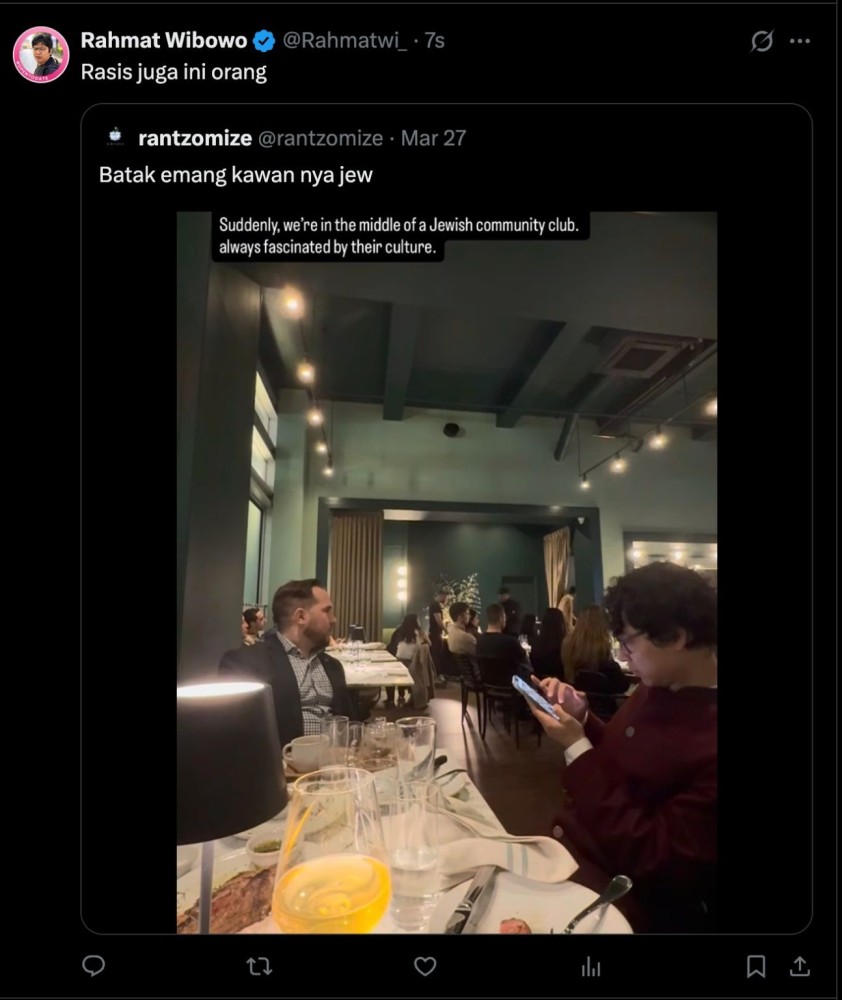
The comment — translating roughly to "Batak people are indeed friends with Jews" — was left as a reply to someone (a person bearing the name Rahmat Wibowo) who had shared a photo taken at a Jewish community dining event with an expression of cultural curiosity and appreciation.
The attack operates on two layers of prejudice simultaneously: (1) it weaponizes anti-Jewish sentiment — using "Jew" as a slur — and (2) it deploys that slur to demean and "mark" the Batak ethnic group of North Sumatra as suspicious, foreign-aligned, or untrustworthy. This is not an argument. It is ethnic targeting through association.
Why This Is Racism — Not Just Opinion
Some may dismiss the post as a throwaway internet comment. This dismissal is itself part of the problem. The post does not criticize a political position or a religious practice. It attacks an ethnic identity — Batak — by linking it to a globally stigmatized group in a context designed to invoke suspicion and contempt.
The Batak people are a large indigenous ethnic group from the North Sumatra region of Indonesia, comprising several sub-groups including Toba, Karo, Mandailing, Simalungun, Pakpak, and Angkola. They have contributed enormously to Indonesian public life — in law, medicine, the military, academia, and the arts. Historically, many Batak communities are Christian, which has long made them a target for ethnic-religious double prejudice in Indonesia's majority-Muslim society.
Associating them with Jewish people — in a context of anti-Jewish rhetoric — is a deliberate act of social othering. The message to the audience is: these people don't belong to us; they are aligned with those we are taught to distrust. This is the textbook anatomy of ethnic scapegoating.
Racism in Indonesia rarely announces itself. It arrives wearing the clothes of humor, tradition, or cultural commentary — and leaves behind fractured communities.
The Formal Legal Response: Indonesia's Existing Statutes
Indonesia does have formal legal instruments that address hate speech and ethnic discrimination. Understanding these is essential before we turn to the more complex territory of customary law.
UU No. 40 Tahun 2008 — Anti-Racial and Ethnic Discrimination Law
This law explicitly prohibits discriminatory actions based on race and ethnicity in public spaces, workplaces, and services. Perpetrators can face criminal sanctions. The post in question — publicly disseminated, ethnically targeted — falls squarely within its scope.
UU ITE (UU No. 11/2008 jo. UU No. 19/2019)
Article 28(2) of the Electronic Information and Transactions Law prohibits the intentional dissemination of information designed to incite hatred or hostility based on SARA — Suku (ethnicity), Agama (religion), Ras (race), and Antargolongan (inter-group). A post associating a specific ethnic group with a stigmatized identity in a hostile framing is a textbook Article 28(2) violation.
KUHP (Criminal Code) — Pasal 156 & 157
These articles criminalize expressions of hostility, hatred, or contempt toward population groups differentiated by race, religion, or descent. Sanctions include imprisonment and fines.
⚠ Legal Reality Check
Despite these statutes, enforcement is inconsistent. UU ITE has been disproportionately used against ordinary citizens — particularly critics of government — rather than against those spreading ethnic hate. The law's elastic framing has made it both a shield and a sword, and victims of ethnic hate speech often find themselves without effective recourse.
Where Does Hukum Adat Fit in Indonesia's Legal Structure?
Here is where the analysis becomes critical — and underappreciated. Indonesia does not operate on formal statute alone. Alongside the national legal system runs an ancient, deeply embedded parallel system: Hukum Adat.
📋 Indonesia's Legal Hierarchy (Tata Urutan Peraturan Perundang-undangan)
- **Undang-Undang Dasar 1945 (UUD 1945)**The Constitution — supreme law of the land. Article 18B(2) recognizes Hukum Adat communities and their traditional rights, subject to applicable national law and public interest.
- TAP MPRDecrees of the People's Consultative Assembly. Now limited in number and largely historical.
- Undang-Undang (UU) / PerpuActs of Parliament, including UU ITE, UU Anti-Diskriminasi, and KUHP. The primary layer of national statutory law.
- **Peraturan Pemerintah (PP)**Government Regulations implementing statutes.
- **Peraturan Presiden (Perpres)**Presidential Regulations.
- **Peraturan Daerah (Perda)**Regional Regulations. Here, local and adat community norms often begin to bleed into formal legal codes.
- **Hukum Adat (Customary Law)**Not formally in the hierarchy under UU No. 12/2011, yet constitutionally recognized, practically enforced by adat councils, and deeply authoritative in community life.⚡ PARALLEL SYSTEM — NOT FULLY CODIFIED
Hukum Adat is recognized under Article 18B(2) of the 1945 Constitution, which acknowledges masyarakat hukum adat (customary law communities) and their traditional rights. But its practical operation exists largely outside the written statutory framework. It is enforced by adat councils, community elders, and local power structures — with no requirement for codification, transparency, or due process in the constitutional sense.
This creates a profound legal ambiguity: Hukum Adat is real, it is recognized, and it is powerful — but because it is largely unwritten, it is also susceptible to interpretation, manipulation, and abuse.
The Unwritten Norms Problem: Norma Tidak Tertulis dan Risiko Rekayasa
Every Hukum Adat system carries within it a body of norma tidak tertulis — unwritten norms. These norms govern everything from land disputes to social hierarchy to interpersonal conduct. In many communities, they carry moral and community authority that exceeds formal law in everyday life.
The problem is this: unwritten norms can be invented, expanded, or selectively enforced. Because there is no written codification, no public record, and no judicial review mechanism in the constitutional sense, an adat council — or an influential community actor — can invoke "tradition" to justify rulings that are, in practice, discriminatory.
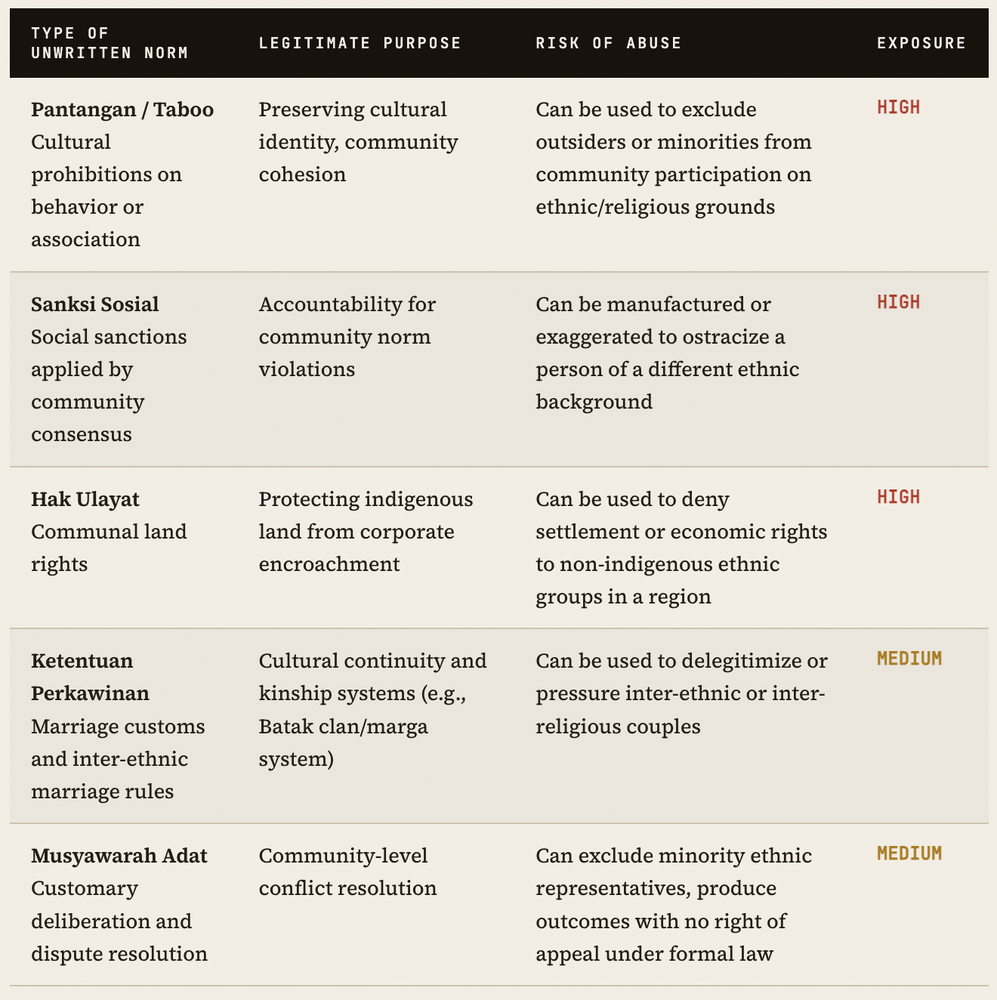
The risk is compounded when racism has already primed a community to view a particular ethnic group with suspicion. Once the stereotype has taken hold — Batak people as "foreign-aligned," or any ethnic group as "not truly Indonesian" — Hukum Adat norms can be selectively deployed to legitimize exclusion under the cover of "tradition."
⚠ Critical Risk: Dibuat-buat (Fabricated Norms)
In legal academic discourse, the term dibuat-buat (fabricated or contrived) refers to the real risk that unwritten customary norms can be constructed after the fact to justify a prejudicial outcome. Because there is no written record to verify, a community actor with sufficient social capital can claim that "this has always been our tradition" — effectively creating law retroactively. Without codification or judicial oversight, victims have limited recourse. This is not a hypothetical concern: documented cases of land theft, social exclusion, and community violence in Indonesia have been cloaked in the language of adat.
The Batak Community as a Recurring Target
It is not accidental that racist rhetoric in Indonesia so frequently selects the Batak community as its target. The Batak occupy a structurally vulnerable position: they are a large, visible minority — predominantly Christian in a Muslim-majority nation — with a strong cultural identity that makes them recognizable and, in the eyes of those who fear difference, "other."
Their strong communal solidarity (expressed through the marga clan system and dalihan na tolu kinship philosophy) is reframed by racists as clannishness or exclusivity. Their overrepresentation in law and business — a product of historical emphasis on education — is reframed as evidence of conspiracy or unfair advantage. And now, as this case study demonstrates, their cultural openness toward other communities is weaponized as evidence of dangerous foreign alignment.
This is the classic racist pattern: every attribute of the targeted group — whether positive or negative — is reinterpreted as a threat. The hate does not respond to evidence. It generates its own.
ℹ Historical Context
The Batak ethnic group numbers approximately 8–9 million people and has been integral to Indonesian national life since before independence. Batak figures were among the founders and early leaders of the Republic. The Dalihan na Tolu philosophy — which governs Batak social relationships through the three pillars of hula-hula (wife-givers), dongan tubu (clan brothers), and boru (wife-takers) — is one of the most sophisticated kinship systems in Southeast Asia. Depicting this community as a security threat or "Jewish ally" is not merely offensive — it is historically illiterate.
What Must Be Done
For individuals and civil society: Document incidents of ethnic hate speech systematically. Platforms like X/Twitter have reporting mechanisms, but community documentation — preserved in harassment journals, legal affidavits, or public archives — creates the evidentiary record needed for legal action under UU ITE or the Anti-Discrimination Law.
For legal advocates and LBH (Legal Aid Institutes): The intersection of online hate speech and Hukum Adat requires specialized attention. Legal aid organizations must build capacity to address cases where racist rhetoric in digital spaces translates into adat-based discrimination in communities. The gap between these two domains is precisely where the most vulnerable people fall through.
For Hukum Adat reform advocates: The Indonesian legal community has long debated the codification of Hukum Adat. This debate must include explicit anti-discrimination safeguards. A system of customary law that operates without written records, without transparent deliberation, and without right of appeal is not a vehicle of justice — it is a vehicle of power. Reform is not an attack on indigenous cultures; it is the protection of the most marginalized people within those cultures.
For the platforms: X/Twitter's moderation policies in Bahasa Indonesia remain dangerously inadequate. A post like the one described above — openly associating an ethnic group with a stigmatized identity as a means of attack — should trigger immediate review under international community standards. Indonesian-language content moderation cannot be an afterthought.
For all of us: Racism normalizes when good people stay silent. The "it's just a joke" framing, the "don't be so sensitive" dismissal, the "this is just our culture" excuse — these are the social lubricants that allow ethnic hatred to persist. Bhinneka Tunggal Ika is not self-executing. It requires active defense.
Closing Reflection
The post targeting the Batak community through antisemitic association is a small incident in the vast ocean of Indonesia's social media. But small incidents are how large crises begin. Ethnic stereotypes, once normalized, become the social substrate on which systemic discrimination grows — and in Indonesia's case, that discrimination can find legal cover in a customary law system that operates precisely in the space where accountability is hardest to demand.
Indonesia's diversity is one of its greatest assets. It is also one of its greatest vulnerabilities — not because of the diversity itself, but because institutions have not kept pace with the task of protecting it. Formal law exists. Hukum Adat is recognized. But between recognition and protection lies a chasm that prejudice is only too happy to exploit.
The Batak community does not need defenders who are embarrassed by their cultural confidence. They need a legal and social environment that treats their dignity as non-negotiable — not because of who their "friends" are, but because they are citizens of a Republic that was built, in part, by their hands.
#Indonesia #HakAsasiManusia #HukumAdat #AntiRasisme #Batak #BhinnekaTunggalIka #UUITE #LinkedIn