
The Friend of God and the Walid on Screen: Sufism, Sainthood, and the Crisis of Spiritual Legitimacy Study Case of Abuya Mama Ghufron Al Bantani
From the viral Malaysian drama Bidaah to the phenomenon of Mama Ghufron, Southeast Asia is wrestling with a question Islam has never stopped asking: what truly separates a genuine wali Allah from a charismatic performer of wonders?
Why This Moment Matters
In the space of twelve months, two cultural phenomena forced Malaysia and Indonesia to confront the same ancient problem from two very different angles. The first was a fictional one: the drama series Bidaah, written and produced by Eirma Fatima and directed by Pali Yahya, which depicted a charismatic cult leader known as Walid Muhammad manipulating his followers with promises of divine proximity, forcing marriages, demanding drinking of his bath water, and claiming the station of the Imam Mahdi. The character, portrayed with haunting precision by veteran actor Faizal Hussein, became a regional sensation.
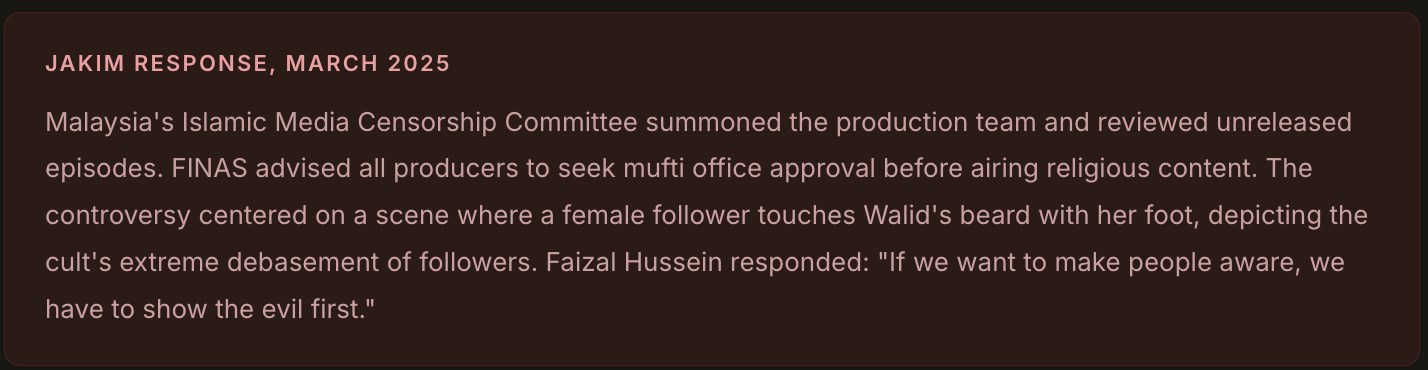
The second was real: Mama Ghufron, born Iyus Sugirman, a pesantren leader from Dampit, Malang, whose viral ceramah videos showed him claiming to speak ancient Syriac, converse with ants, video-call the Angel of Death, and hold a signed covenant from the Prophet Muhammad. The Majelis Ulama Indonesia launched an investigation. JAKIM in Malaysia did the same with Bidaah. Two institutions, one fictional trigger, one real one, and the same profound theological question underneath both.
That question is as old as Sufism itself: how does a Muslim distinguish a true wali Allah (friend of God) from a wali syaitan (friend of Satan disguised as light), or simply from a deluded or calculating man who has mistaken social charisma for spiritual elevation?
Bidaah / Walid

Bidaah (meaning heresy or religious deviation in Malay) follows Baiduri, a young woman compelled by her mother to join the sect Jihad Ummah, led by Walid Muhammad who claims divine status equivalent to the prophets. The series depicts forced marriages, followers drinking the leader's bath water, psychological coercion, and the slow unraveling of the sect's deceptions.
Scenes went viral on TikTok across Malaysia and Indonesia, where audiences recognized in Walid the archetype of a real phenomenon: the charismatic pesantren or sect leader whose spiritual authority becomes a tool of manipulation. Multiple real-world cases in both countries echoed in the drama's narrative.
What is Sufism?
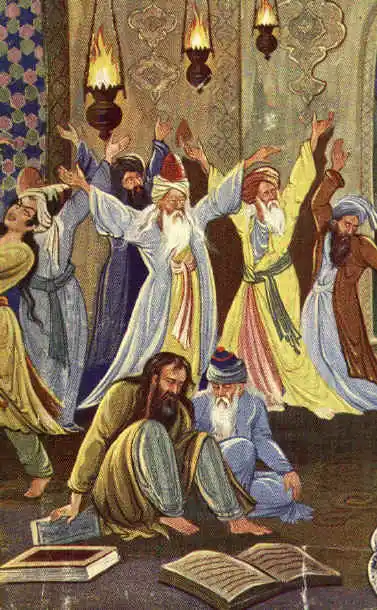
Sufism, or tasawwuf, is the inward science of Islam: the discipline of purifying the heart, annihilating the ego, and drawing near to God not merely through correct ritual but through transformed being. Where fiqh (jurisprudence) governs the body and aqidah (theology) governs the mind, tasawwuf governs the heart. It is not a sect, not a deviation, and not an alternative to Islamic law. At its classical best, it is Islam's deepest layer.
The word's origin is debated: some trace it to suf (wool), for the simple garments of early ascetics; others to safa (purity) or to the Ahl al-Suffah, the companions who slept on the Prophet's mosque bench, having given away every worldly attachment. Whatever the etymology, the meaning is clear: the path of love, of progressive ego-death, of learning to see through God's eyes rather than one's own.
Sufism shaped the entire cultural architecture of Islamic civilization. It spread Islam across West Africa and Southeast Asia more effectively than any army. It produced Rumi, Hafez, Ibn Arabi, al-Ghazali. It built the great Sufi orders (turuq) that have carried spiritual transmission from the Prophet's companions to the present day. And it produced, inevitably, its counterfeits.
The Maqamat: Stations the Soul Must Earn
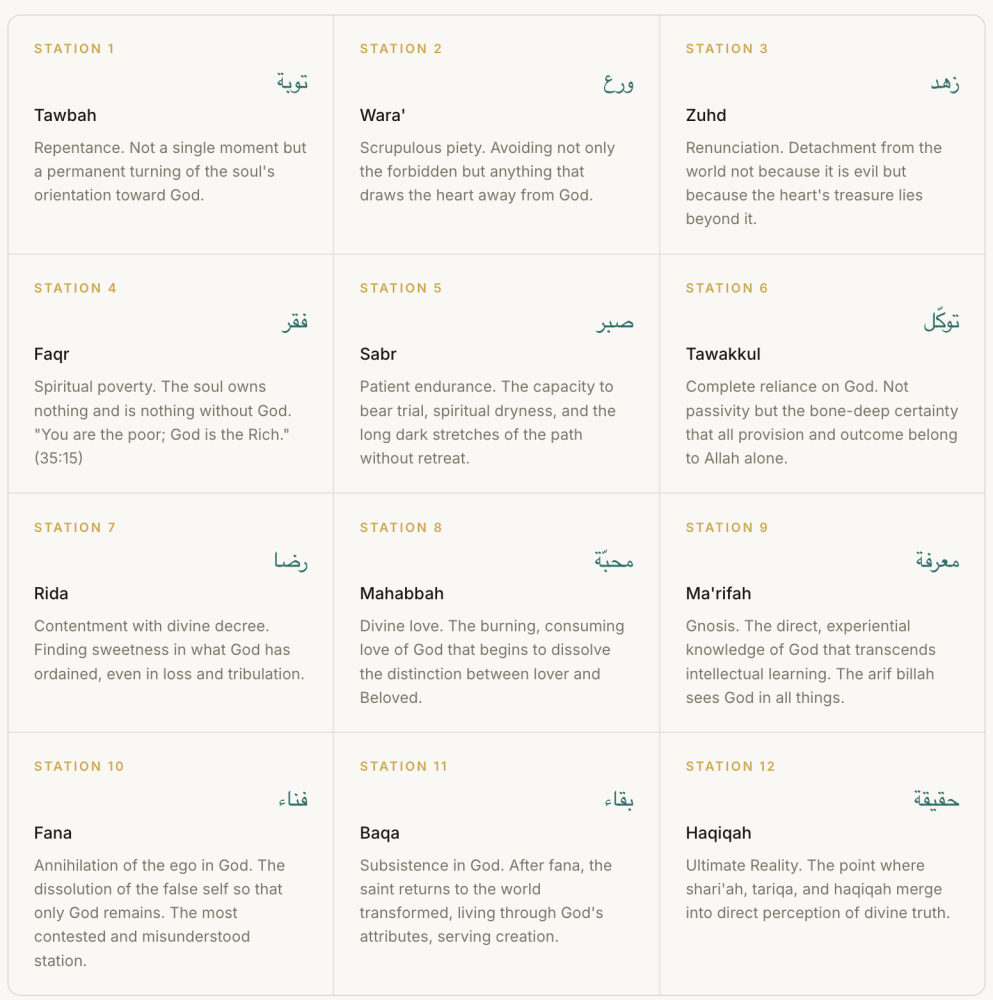
The backbone of Sufi spiritual science is the maqamat (مَقَامَات), permanent spiritual stations the seeker earns through sustained effort and struggle, as distinct from ahwal (states), which are divine gifts that arrive and depart like wind. A maqam is attained and then kept; the seeker cannot advance until the lower station is genuinely possessed and lived.
The Hierarchy of Saints: Wali al-Qutb and the Invisible Court
In Sufi cosmology, the friends of God form an unseen spiritual hierarchy that sustains creation. This is documented in Ali Hujwiri's Kashf al-Mahjub, in Ibn Arabi's Futuhat al-Makkiyya, and across dozens of canonical texts. It is not an institution with offices and records. It is a metaphysical reality, known fully only to God, and to those He grants sight.
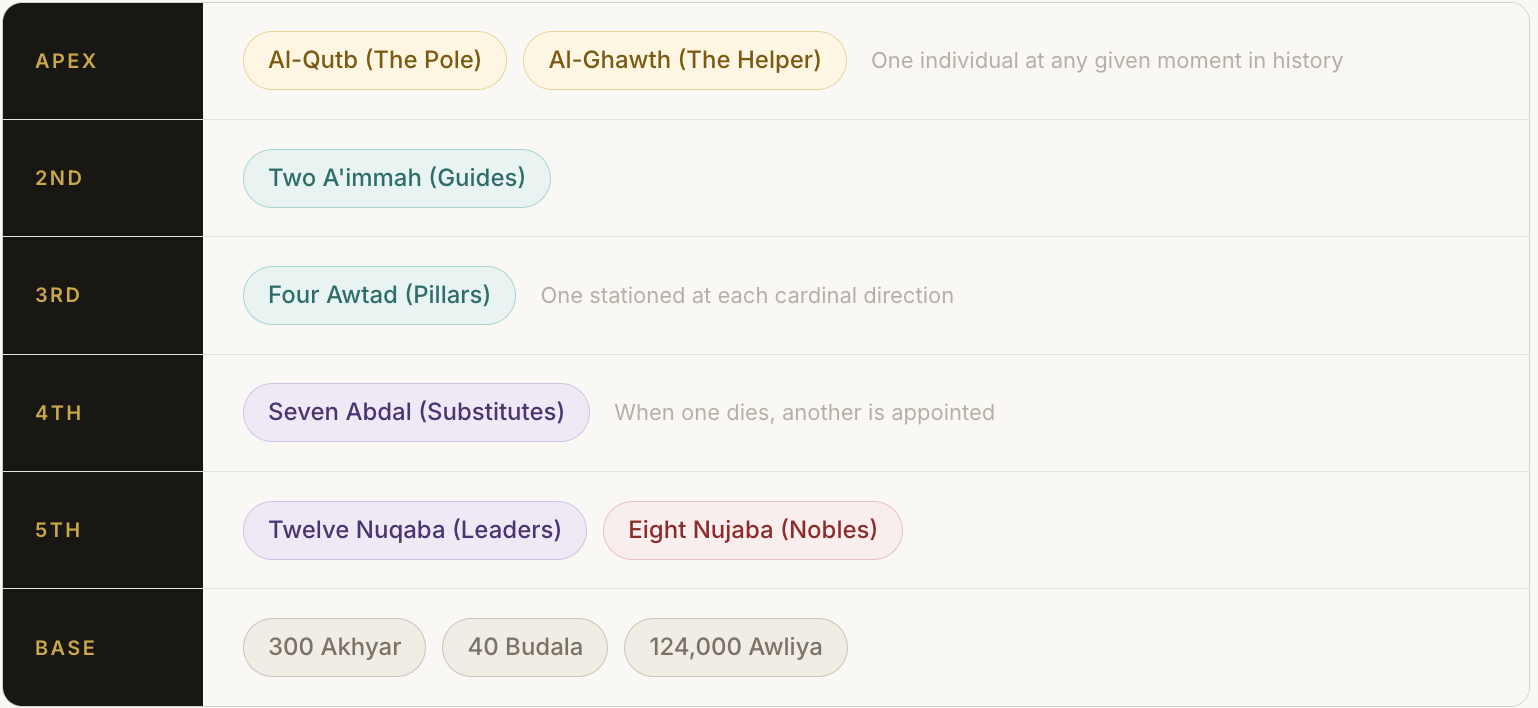
At the apex stands the Qutb, the Pole, sometimes called the Ghawth (the Succor). There is only one Qutb at any moment in history. Through the Qutb, divine light radiates down through the entire hierarchy and out into the world. Ali Hujwiri's version in Kashf al-Mahjub lists 300 akhyar, 40 abdal, 7 abrar, 4 awtad, 3 nuqaba, and the singular Qutb. Ibn Arabi's structure differs slightly but shares the principle: it is a hierarchy of unknowing, hidden from the world.
Crucially, the awliya are hidden. The first sign of a wali is that they do not announce their station. The classical scholars are unanimous: those who loudly proclaim their own proximity to God are, almost by definition, not close to God at all. Imam al-Sha'rani wrote that one of the clearest signs a man has attained a maqam is that he no longer speaks of it.
The Great Masters: What Authentic Sainthood Looked Like
Rabi'ah al-Adawiyyah
Basra, Iraq · c. 717 to 801 CE · Maqam: Pure Mahabbah
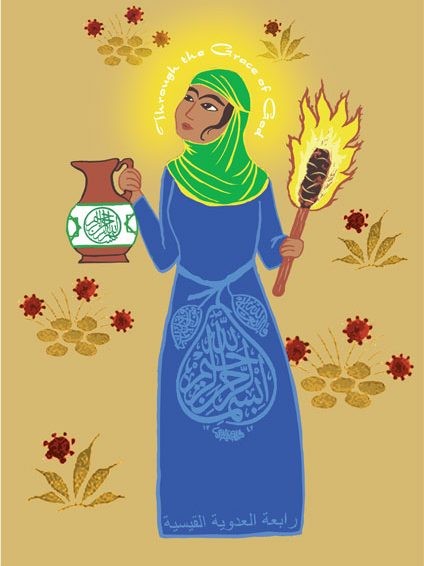
Martyr of Divine Love
Born into poverty and slavery in Basra, freed by her master, Rabi'ah became the spiritual pole of her generation. Her theology was radical in its purity: she prayed not from fear of Hell or hope of Paradise but purely for the love of God. Her famous supplication endures across fourteen centuries: "O God, if I worship You for fear of Hell, burn me in Hell. If I worship You in hope of Paradise, exclude me from Paradise. But if I worship You for Your own sake, do not withhold from me Your eternal beauty." She abolished the transaction model of worship. She recognized no intermediary. She was a woman in a society that would have refused her the title of scholar, yet the greatest scholars of her age sat at her feet. Her only miracle was her annihilation of the ego's agenda. That was enough.
Mansur al-Hallaj
Persia / Baghdad · c. 858 to 922 CE · Maqam: Fana / Ana al-Haqq
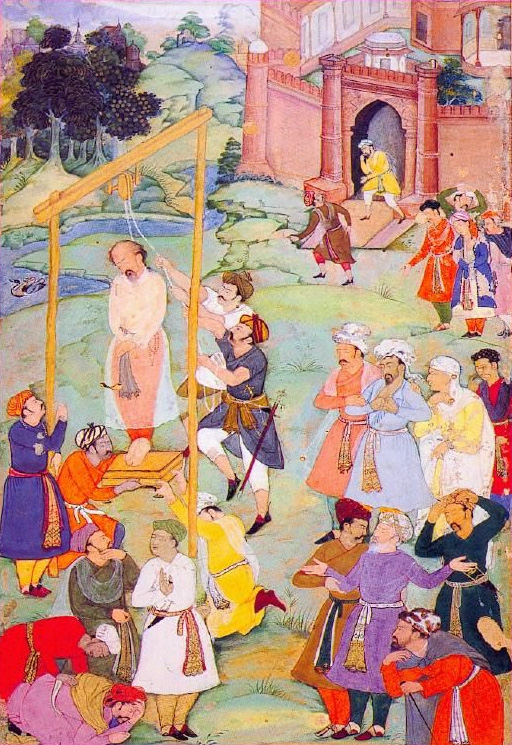
Martyr of the Path
The supreme martyr of Islamic mysticism. Al-Hallaj underwent decades of rigorous practice before uttering the words that would cost him his life: Ana al-Haqq, "I am the Truth," one of the divine names of God. Was this the station of fana, the complete dissolution of the ego in which only God remained and spoke through him? Or was it a catastrophic claim of divinity that could not be tolerated within Islamic monotheism? His own master, al-Junayd of Baghdad, believed his student had spoken a truth the world was not ready to hear, in a language it could not receive. The Abbasid authorities had him imprisoned for nine years, then publicly tortured, crucified, and burned in 922 CE. He reportedly laughed at his executioners and prayed for their forgiveness. For Rumi, al-Hallaj was the supreme example of love's annihilation. For orthodox scholars, he is the permanent warning about what happens when mystical experience is not grounded within the shari'ah's protective framework. His legacy is the defining tension of Islamic spirituality itself.

Imam Abu Hamid al-Ghazali
Tus, Khorasan · 1058 to 1111 CE · Role: Synthesizer of Law and Path
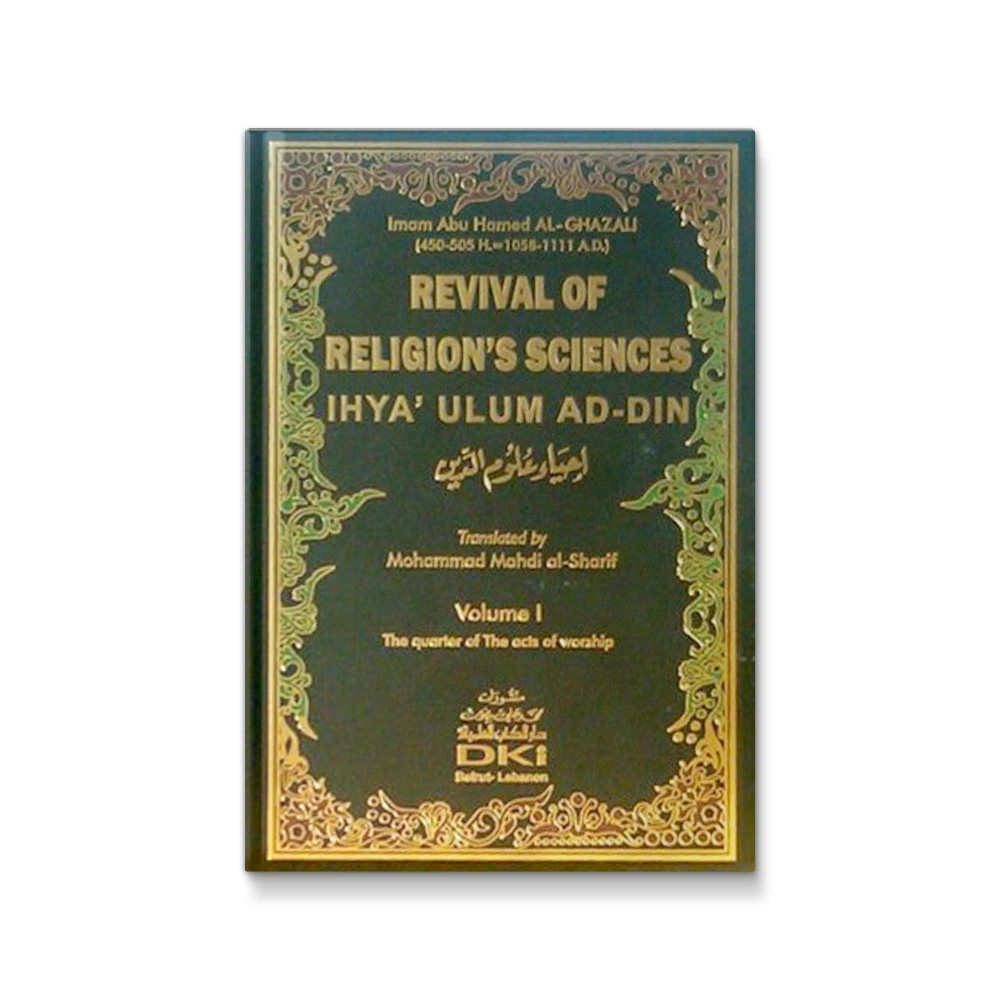
Hujjat al-Islam
The Proof of Islam. Al-Ghazali held the most prestigious teaching chair in the Islamic world at the Nizamiyya madrassa in Baghdad when, at the height of his fame, he suffered a spiritual crisis and fell into paralytic silence. He walked away from everything and wandered for eleven years through Syria, Palestine, the Hijaz, and Khorasan, retreating into dhikr and solitude. What he brought back was the Ihya Ulum al-Din (Revival of the Religious Sciences), the most comprehensive integration of Sufi inner science with Quranic theology and Shafi'i law ever written. Al-Ghazali established the principle that governs orthodox Sufism to this day: the mystical path is real, the stations are real, but they must be grounded in shari'ah, verified by a qualified guide, and never used as an excuse to abandon religious obligations. The path is shari'ah, then tariqa, then haqiqah: three concentric circles, not three alternatives.
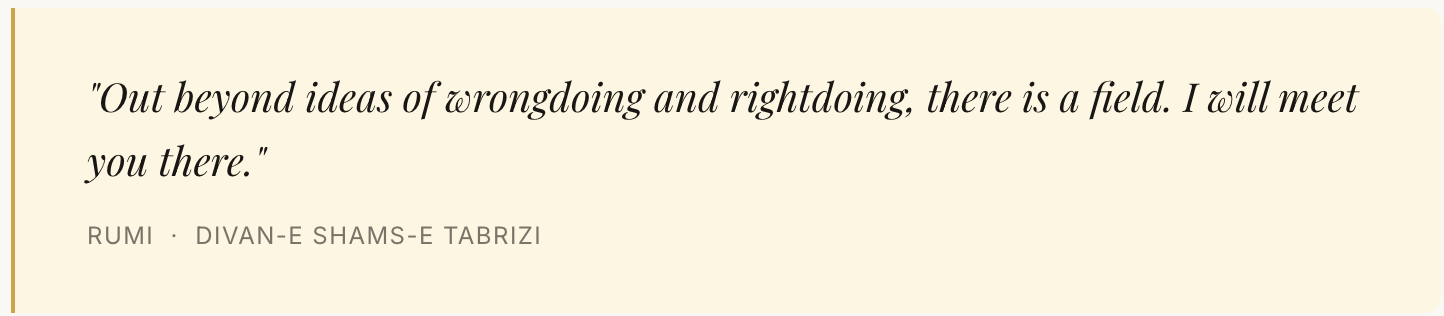
Maulana Jalaluddin Rumi
Balkh / Konya · 1207 to 1273 CE · Maqam: Yearning and Union
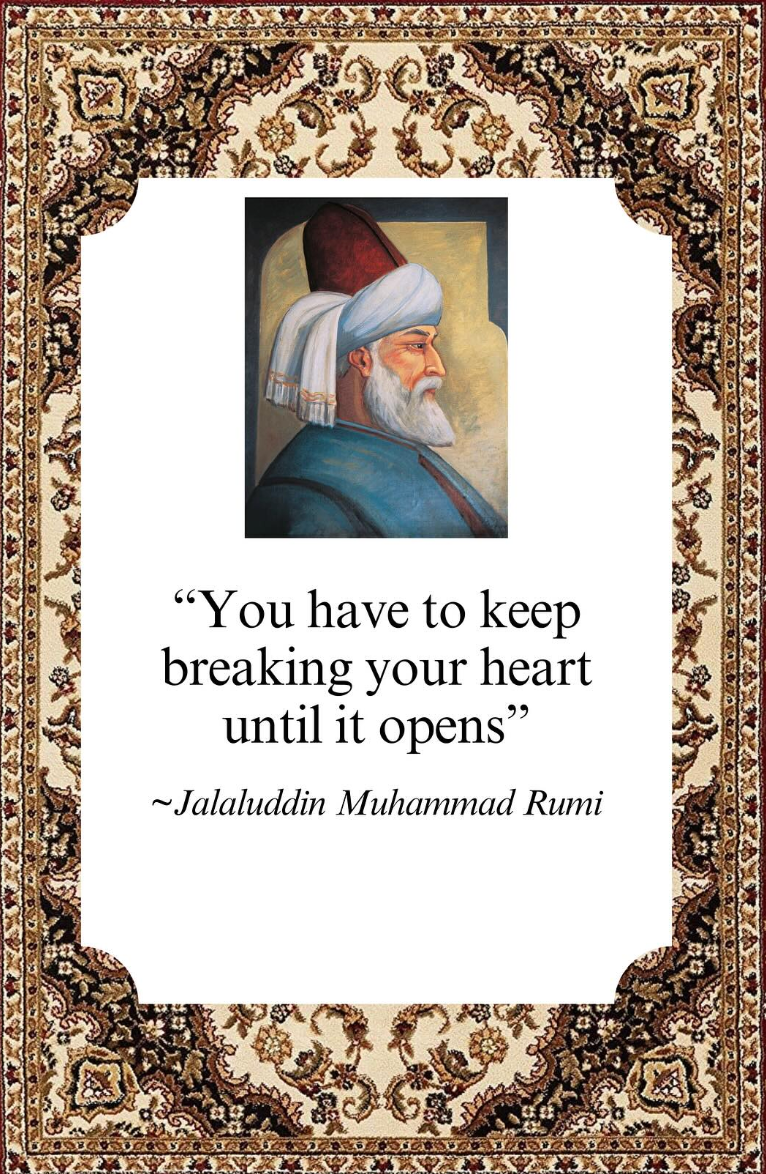
Sultan of the Lovers
Born in what is now Afghanistan, Rumi fled the Mongol invasion as a child and settled in Konya, Anatolia, becoming the most widely read mystical poet in human history. His life was transformed by a single encounter in 1244 CE: the wandering dervish Shams-i-Tabrizi, in whom Rumi recognized a spiritual mirror so pure it shattered every prior attachment. When Shams disappeared, likely murdered by jealous disciples, Rumi's grief became ecstasy, and his separation became the poem of all separation. The Masnavi, six volumes and over 25,000 verses, and the Divan-e Shams are among the most sustained expressions of mystical longing in any literary tradition. His central metaphor is the reed flute, cut from its reed bed and crying for reunion, a perfect image of the human soul separated from its divine source. The whirling sema of his Mevlevi order enacts this: the body rotating around its divine center, the hands open, one palm to heaven, one to earth, a living axis of spiritual transmission.
Syekh Siti Jenar
Java, Indonesia · c. 15th to 16th century CE · The Indonesian Al-Hallaj
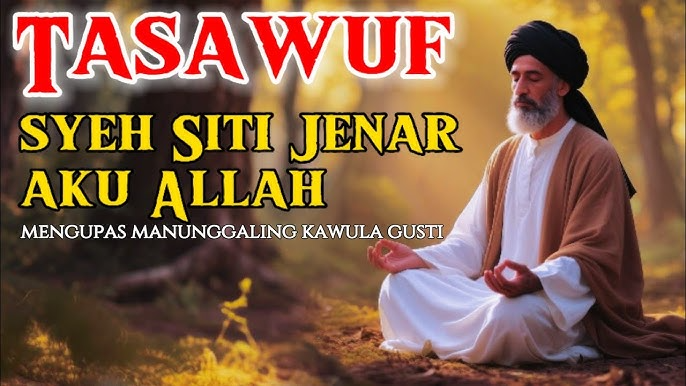
Indonesia's Great Controversy
Known also as Sheikh Abdul Jalil or Lemah Abang, Syekh Siti Jenar is the most contested figure in Indonesian Islamic history. Tradition holds that he was affiliated with the Wali Songo, the Nine Saints who brought Islam to Java, before departing radically from their orthodoxy. His teaching of manunggaling kawula Gusti, the mystical union of servant and Lord, bore unmistakable resemblance to al-Hallaj's Ana al-Haqq. He reportedly taught that daily prayer was the prison of the uninitiated, that death was liberation rather than transition, and that the truly enlightened had moved beyond external religious form. The Wali Songo convened a tribunal and sentenced him to death. Mythological accounts describe his blood running white, birds singing at his execution, and his welcoming of death as reunion. Historians debate whether he was a single historical figure or a composite symbol of the eternal tension between esoteric and orthodox Islam in Java. What is certain: his legacy animated centuries of Javanese kejawen mysticism and the persistent strand of Javanese Islamic thought that seeks God within, beyond institutional boundaries. His ghost haunts every subsequent debate about Indonesian spiritual authority, including the present one.
Wali Allah vs Walid: Two Words, One Defining Question
The word walid in Arabic simply means father. In the Bidaah drama, "Walid Muhammad" is a title adopted by the cult leader, carrying the warmth and authority of a paternal figure while projecting an aura of divine proximity. The word is not inherently sinister. What is sinister is the gap between what is claimed and what is real. That gap is precisely the gap between the wali and the Walid character of Bidaah, and between the authentic saint and Mama Ghufron.
The Mama Ghufron Case: What Was Actually Claimed

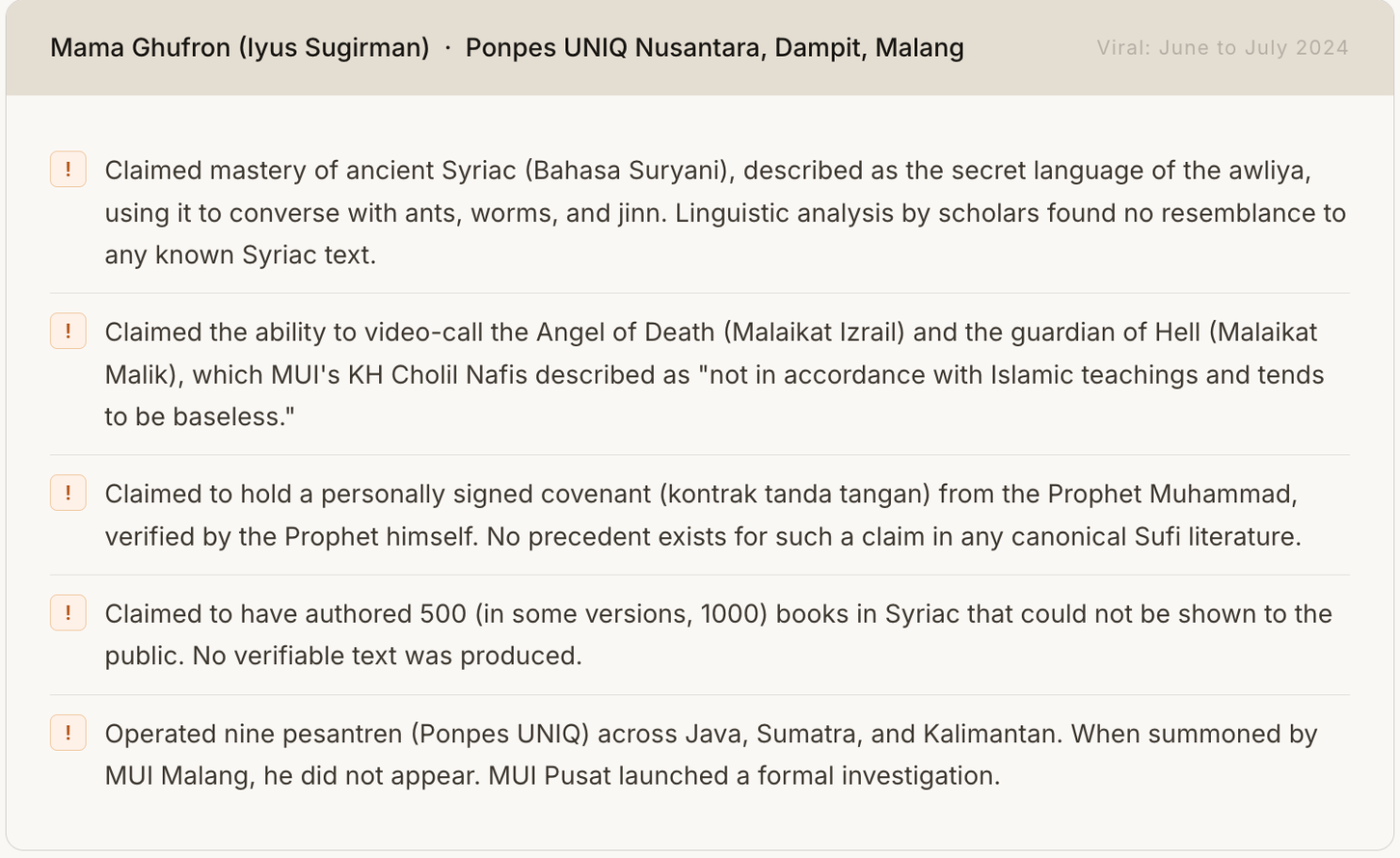
The MUI's formal position, issued through Prof. Utang Ranuwijaya of the Commission for Studies and Development, was measured but firm: "The emergence of Ghufron has the potential to give negative influence on the development of religious understanding. We are doing everything possible through coordination with MUI Malang and MUI East Java to find a resolution." Mama Ghufron eventually issued a public apology video, which spread as widely across social media as the original claims.
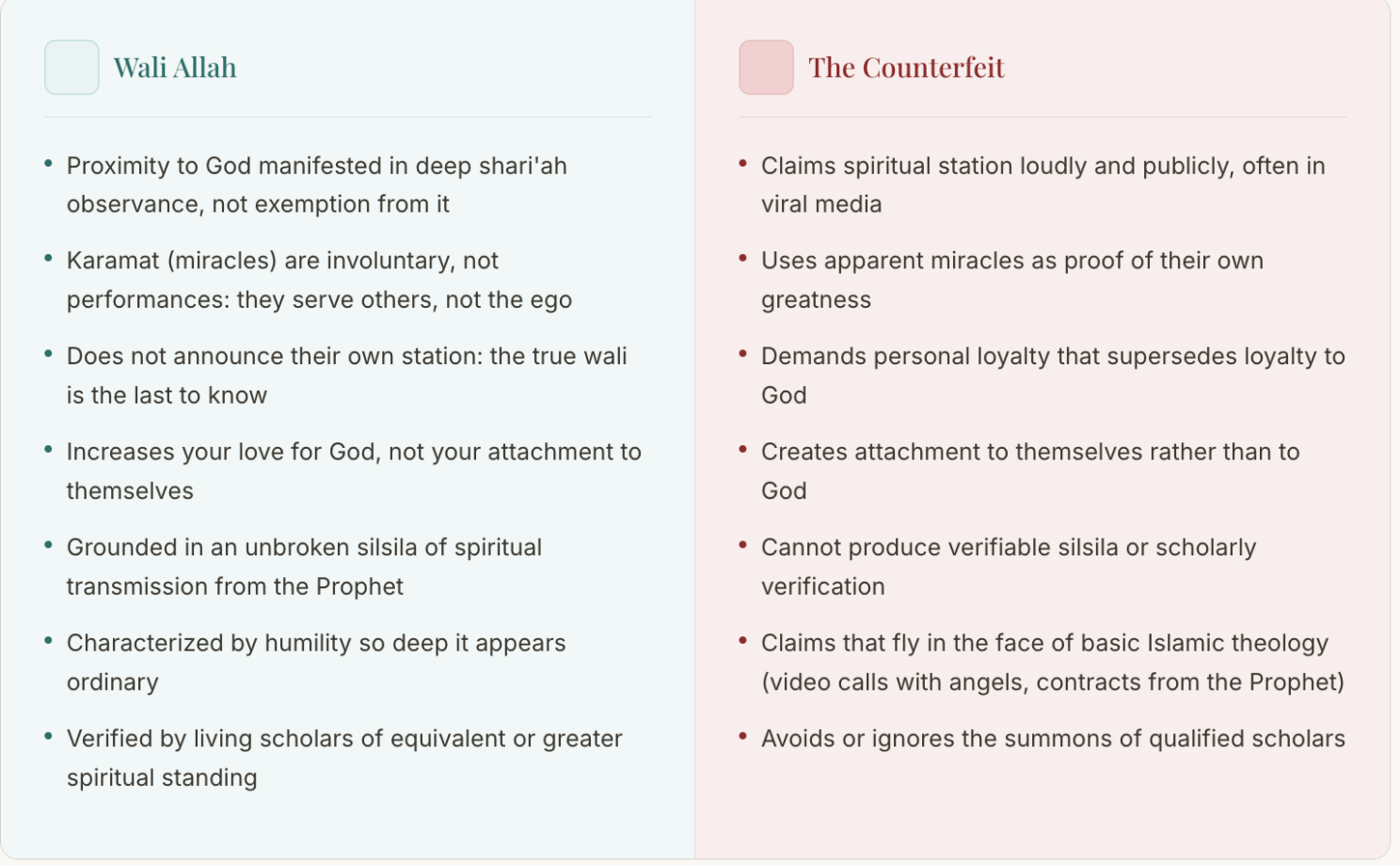
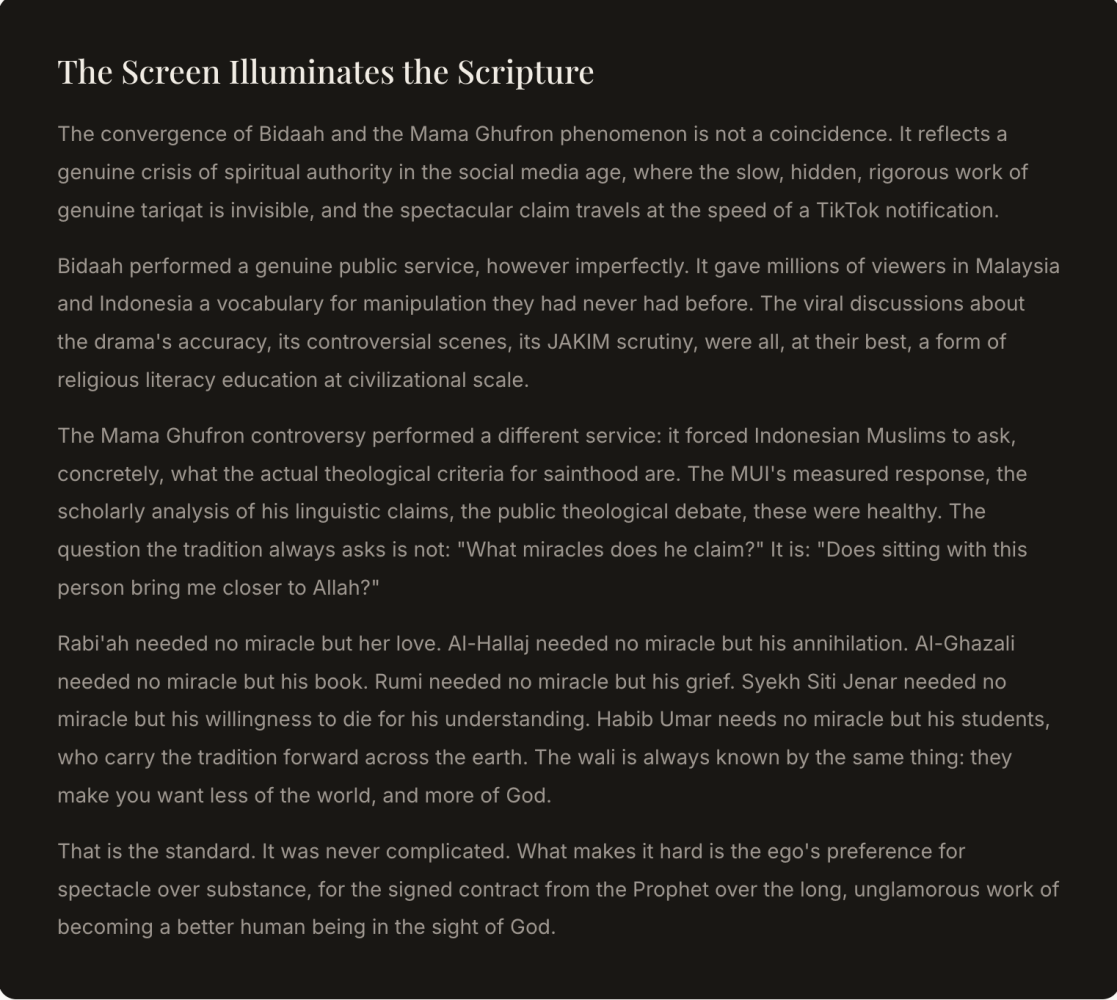
Reading the case through classical Sufi criteria, the problem is not that Mama Ghufron claims karamat. The problem is the nature and manner of the claims. A genuine karamah in Sufi tradition is typically involuntary, quiet, and serves someone else's need. It is not announced in a lecture hall. It is not designed for a TikTok audience. The true saint rarely knows their own karamah. They are the last to understand what has happened.
Istidraj: The Most Dangerous Concept in Spiritual Discernment
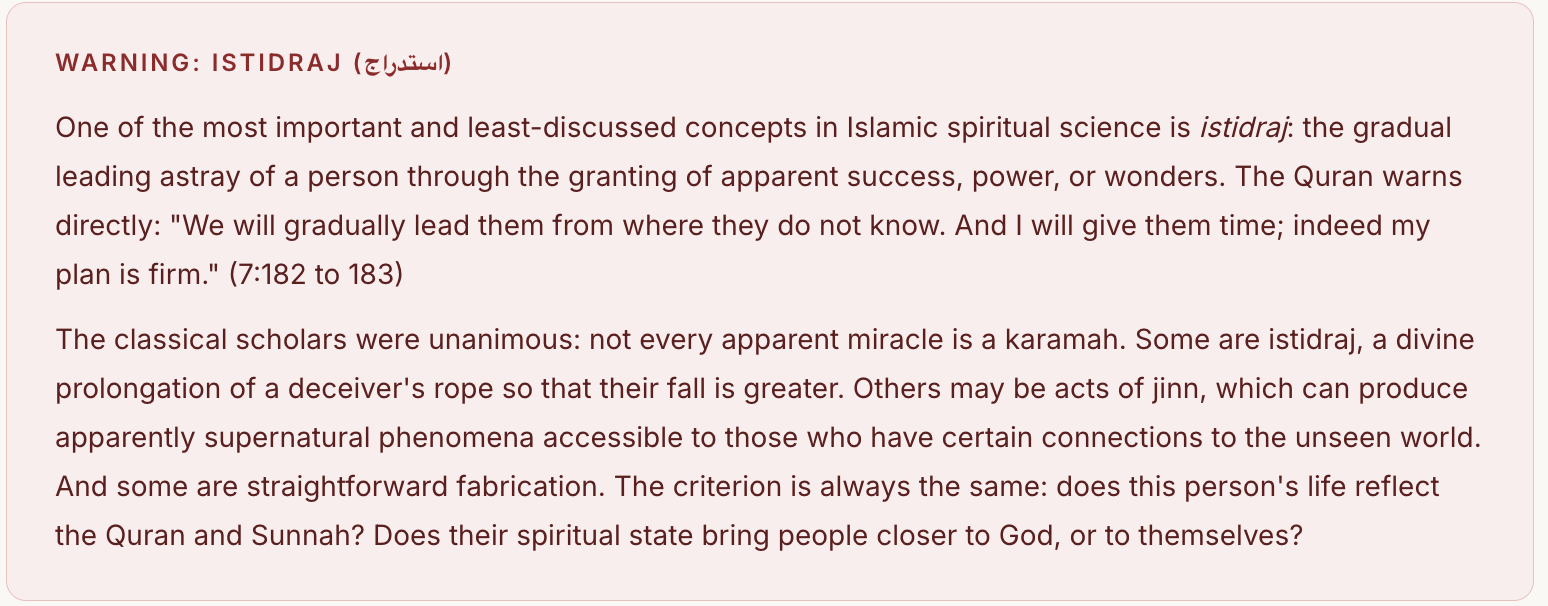
The Bidaah drama depicted istidraj with great psychological accuracy. Walid Muhammad's apparent spiritual authority accumulated over years, attracting genuine believers, before the full nature of his manipulation was revealed. The viewers who recognized themselves or their relatives in Baiduri's mother, the woman who believed completely, were not fools. They were people who had encountered the real phenomenon that Bidaah dramatized: a man whose apparent spiritual gifts created a force field around him that made critical thinking feel like faithlessness.
The most insidious aspect of istidraj is that it looks like elevation. The person appears to succeed, to be blessed, to be protected. Their audience grows. Their following deepens. This is precisely why the classical scholars insisted on the silsila: a verifiable chain of transmission through qualified teachers, checked and verified at every link. A man who claims spiritual authority without a traceable lineage connecting him through known teachers back to the Prophet is operating outside the tradition's safeguards entirely, and those safeguards exist for exactly this reason.
Classical Criteria for Authenticating Sainthood
1. Rooted in Shari'ah
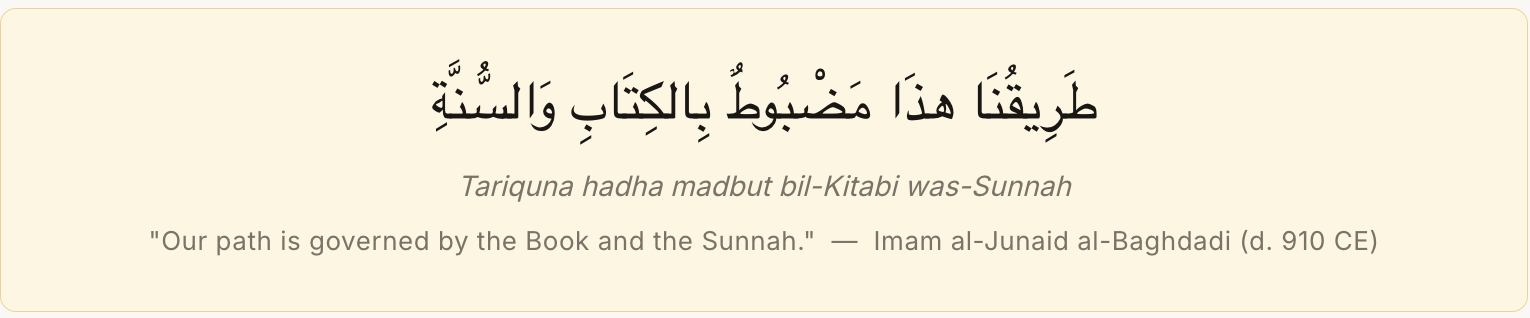
Al-Junaid: "Our path is governed by the Book and the Sunnah. Every road to God is closed except for those who follow in the Prophet's footsteps." Any claim to spiritual elevation that requires bypassing or dismissing religious law is, by definition, not genuine spiritual elevation.
2. Verified Silsila
Authentic Sufi transmission requires a living chain of qualified teachers linking the student back to the Prophet through named, verifiable individuals. This is not bureaucracy; it is the spiritual DNA test of the tradition.
3. Recognized by Peers, Not Self-Declared
The true wali is identified by scholars of equivalent or greater standing, or becomes known only after death. Self-proclamation of sainthood is nearly universally considered a disqualifying sign in classical Sufi literature.
4. Draws You to God, Not to Themselves
The fruit of sitting with a true wali is that you love God more, pray more, and serve creation better. The fruit of sitting with a counterfeit is that you become dependent on the person, make them the center, and neglect your own spiritual development.
5. Consistency of Inner and Outer State
Imam al-Sha'rani wrote that one of the clearest signs of genuine maqam is that the person no longer speaks of it. Their inner state and outer conduct align completely. There is no performance, because there is no audience for the performance in their heart.
6. Knowledge Precedes Station
The scholars held unanimously: "Allah does not elevate an ignorant man to the station of wali. If Allah elevates someone, He teaches him." Deep 'ilm (knowledge) is the foundation; mystical station built on ignorance of the tradition is suspect by definition.
References
[1] Al-Ghazali.Ihya Ulum al-Din. Cairo: Dar al-Salam, 1998.
[2] Ali al-Hujwiri.Kashf al-Mahjub. Trans. R.A. Nicholson. Lahore, 1982.
[3] Rumi, Jalaluddin.Masnavi-ye Ma'navi. Trans. Jawid Mojaddedi. Oxford, 2004.
[4] Al-Qushayri.Al-Risalah al-Qushayriyyah. Cairo: Dar al-Kutub, 2001.
[5] Ibn Arabi.Al-Futuhat al-Makkiyya. Beirut: Dar Sadir.
[6] Nicholson, R.A.The Mystics of Islam. Routledge, 2002.
[7] Smith, Margaret.Rabi'a the Mystic. Cambridge, 1928.
[8] Al-Hallaj.Kitab al-Tawasin. Trans. Aisha Abd al-Rahman, 1974.
[9] Woodward, Mark R.Islam in Java. Univ. of Arizona Press, 1989.
[10] Chittick, William C.The Sufi Path of Knowledge. SUNY Press, 1989.
[11] MUI. "Respons Polemik Mama Ghufron." mui.or.id, July 2024.
[12] Islami.co. "Mama Ghufron dan Garis Standar Kewalian." 2024.
[13] Malay Mail. "Bidaah stirs fierce debates, returns as Walid." Feb 5, 2026.
[14] Jakarta Globe. "Malaysian Drama Bidaah Gains Cult Following." Apr 2025.
[15] SCMP. "Malaysian series Bidaah on Islamic cult tops 1 billion streams." Apr 2025.
[16] Malay Mail. "Seek approval for religious themes, FINAS tells producers." Mar 2025.
[17] Rinkes, D.A.Nine Saints of Java. MSRI, 1996.
[18] Wikipedia. "Maqam (Sufism) / Qutb." en.wikipedia.org. Accessed June 2026.
#Sufism #Tasawwuf #WaliAllah #MamaGhufron #Bidaah #WalidMuhammad #FaizalHussein #IslamNusantara #Maqamat #WaliQutb #Karamah #Istidraj #SyekhSitiJenar #WaliSongo #Rumi #AlHallaj #RabiahAlAdawiyyah #ImamGhazali #HabibUmar #Fana #Baqa #Silsila #MUI #JAKIM #ViuMalaysia #Kejawen #RahmatalilAlamin #IndonesianIslam #MalaysianDrama