
The Gap the Law Left Open for Mental Illness in Indonesia By Rahmat Wibowo From Infraloka
KUHP No. 1 Tahun 2023 recognizes mental disability in criminal responsibility. But ADHD is unnamed. Autism is misclassified. And millions of Indonesians are left in a legal grey zone.
A law that acknowledges the brain matters in criminal accountability, but cannot name two of the most prevalent neurodevelopmental conditions affecting millions of Indonesians, has not finished the work it started.
What Pasal 38 and Pasal 39 Actually Say
The new Indonesian Criminal Code, KUHP No. 1 Tahun 2023, takes a meaningful step forward in Pasal 38 and Pasal 39 by formally recognizing mental and intellectual disability as legally relevant to criminal responsibility. This matters. It is the kind of provision that separates a modern criminal code from a punitive one.
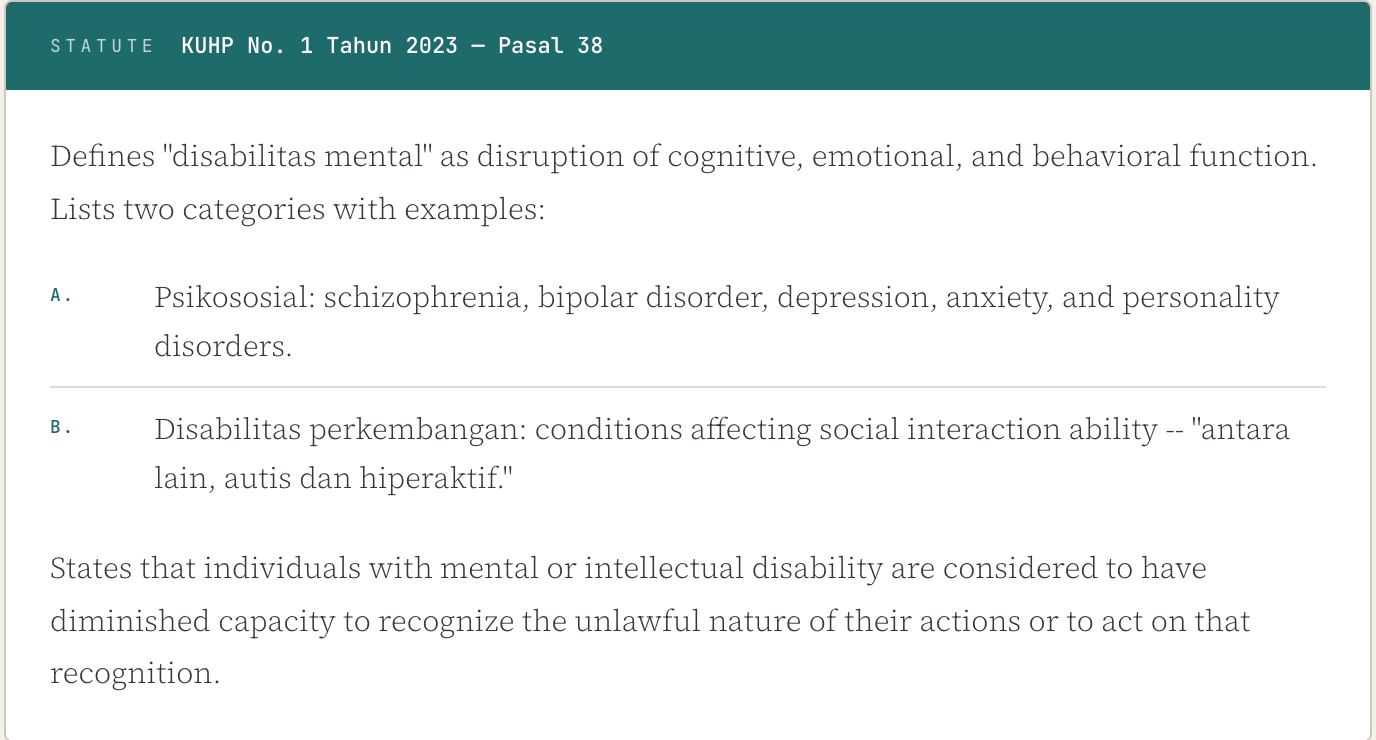
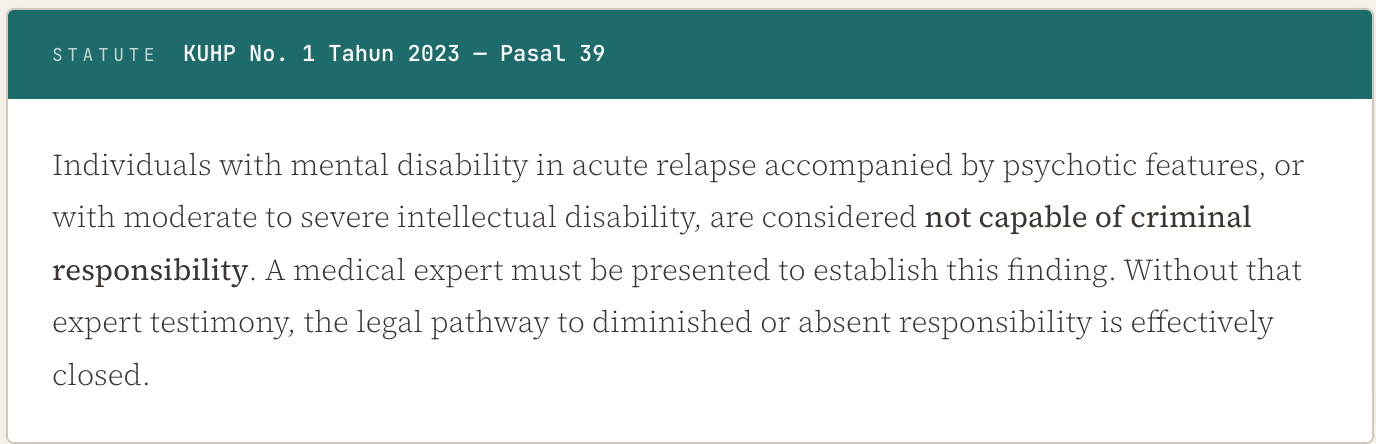
Read together, these provisions establish that Indonesia's new criminal code accepts neuroscience and psychiatry as relevant to culpability. That is a genuine achievement. But the devil, as always, lives in the specifics of the drafting.
What Is Missing, and Why It Matters
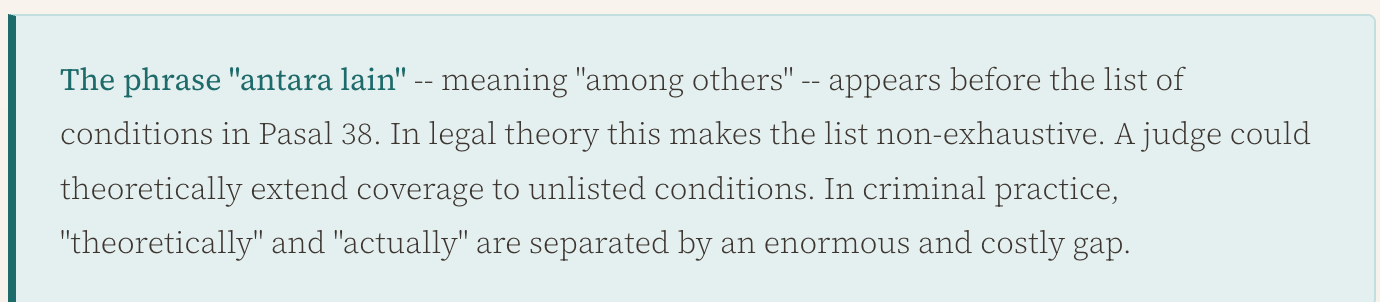
Explicit naming is not the same as implied inclusion. When a criminal code leaves a condition to judicial interpretation rather than stating it plainly, it does not protect people with that condition. It creates a gamble. And the stakes of that gamble are a person's freedom.
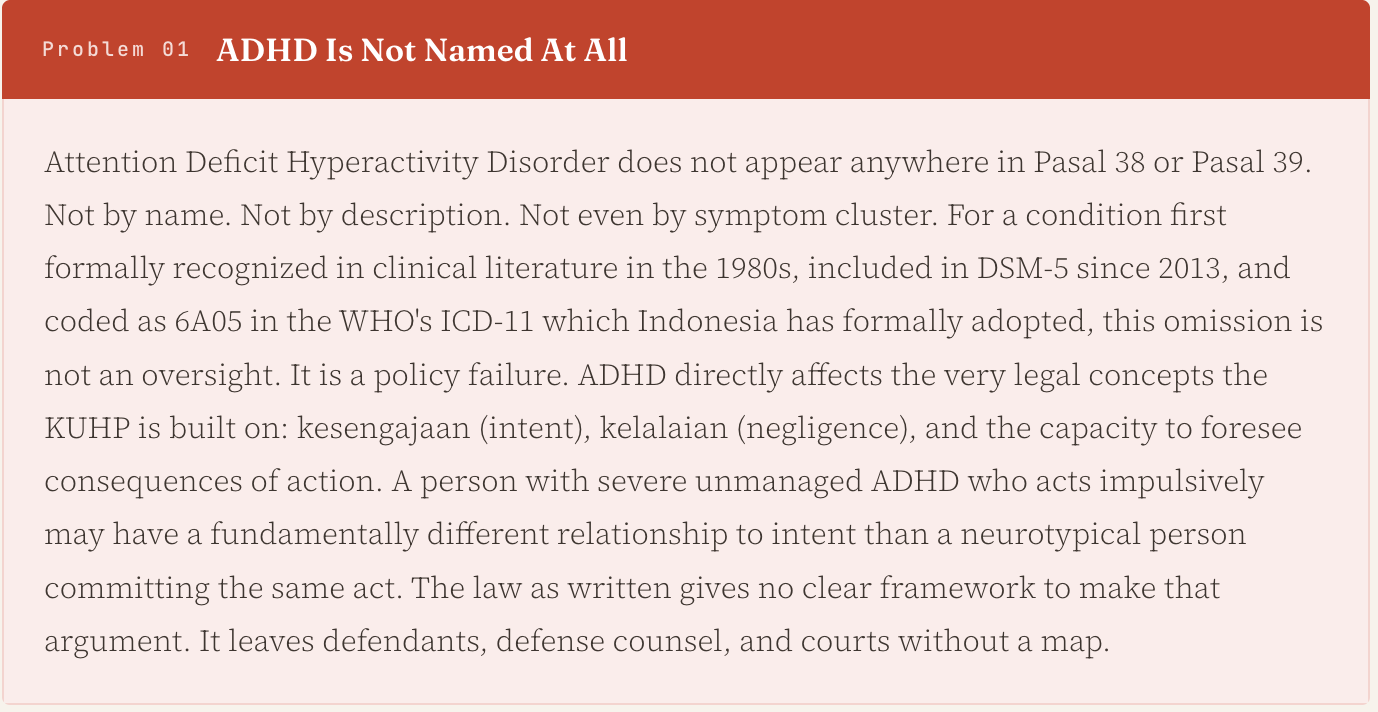
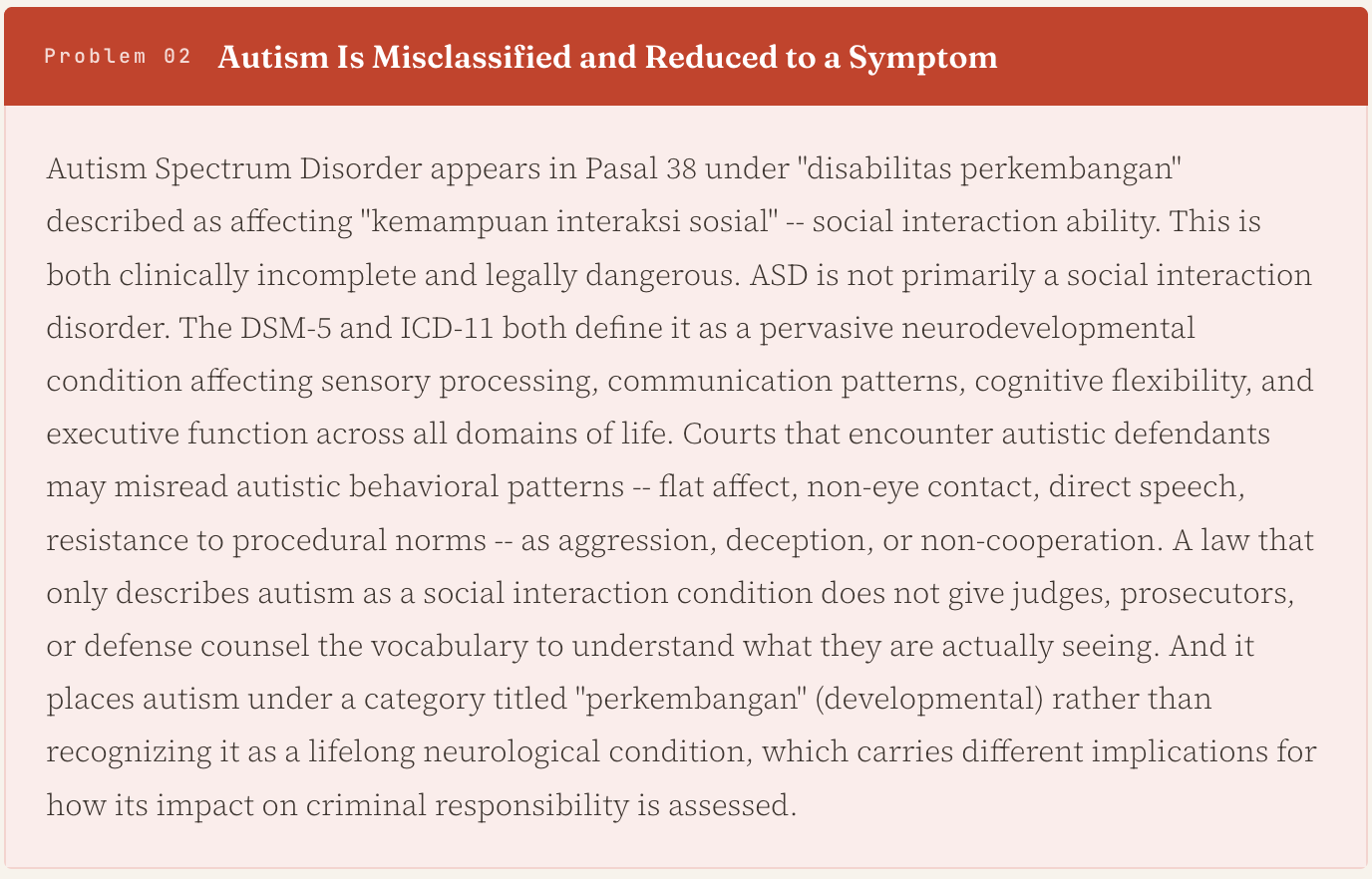
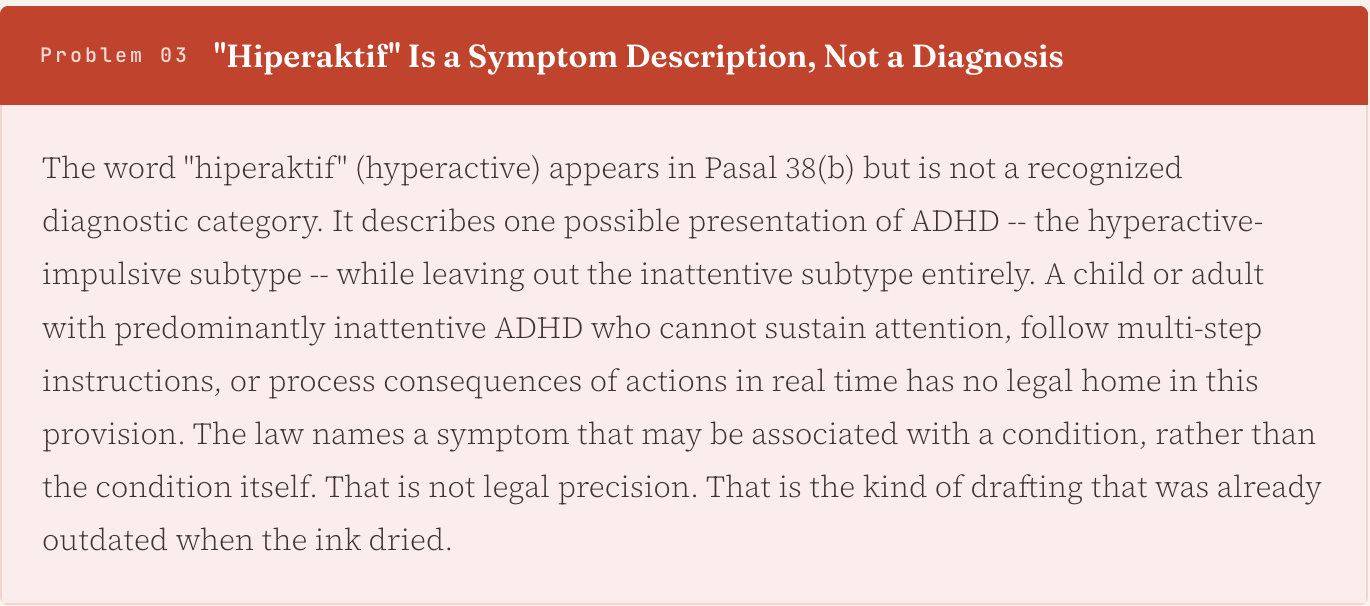

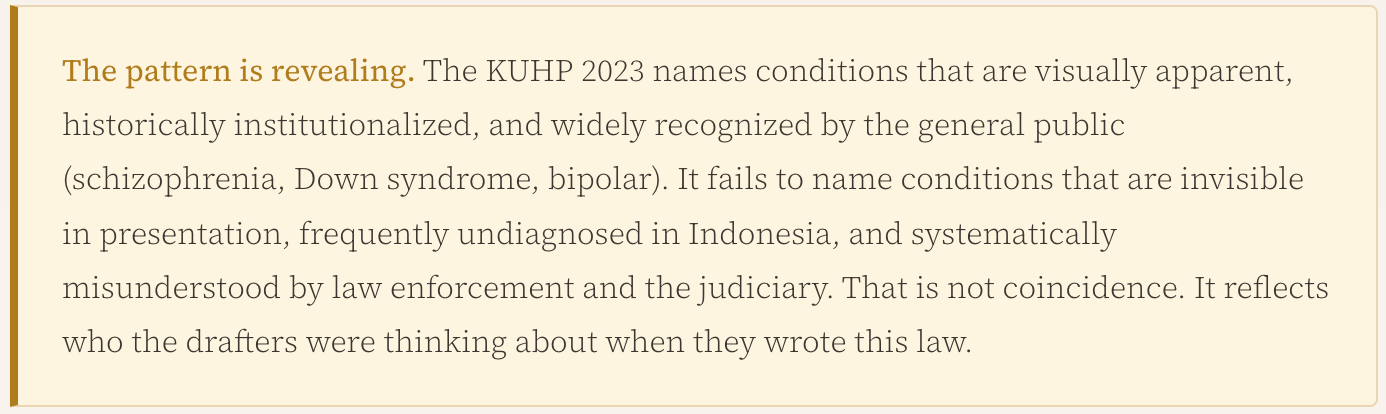
What the Law Names vs. What Science Recognizes
Compare how Pasal 38 KUHP 2023 treats three major neurodevelopmental conditions against their status in international diagnostic frameworks Indonesia has formally adopted:
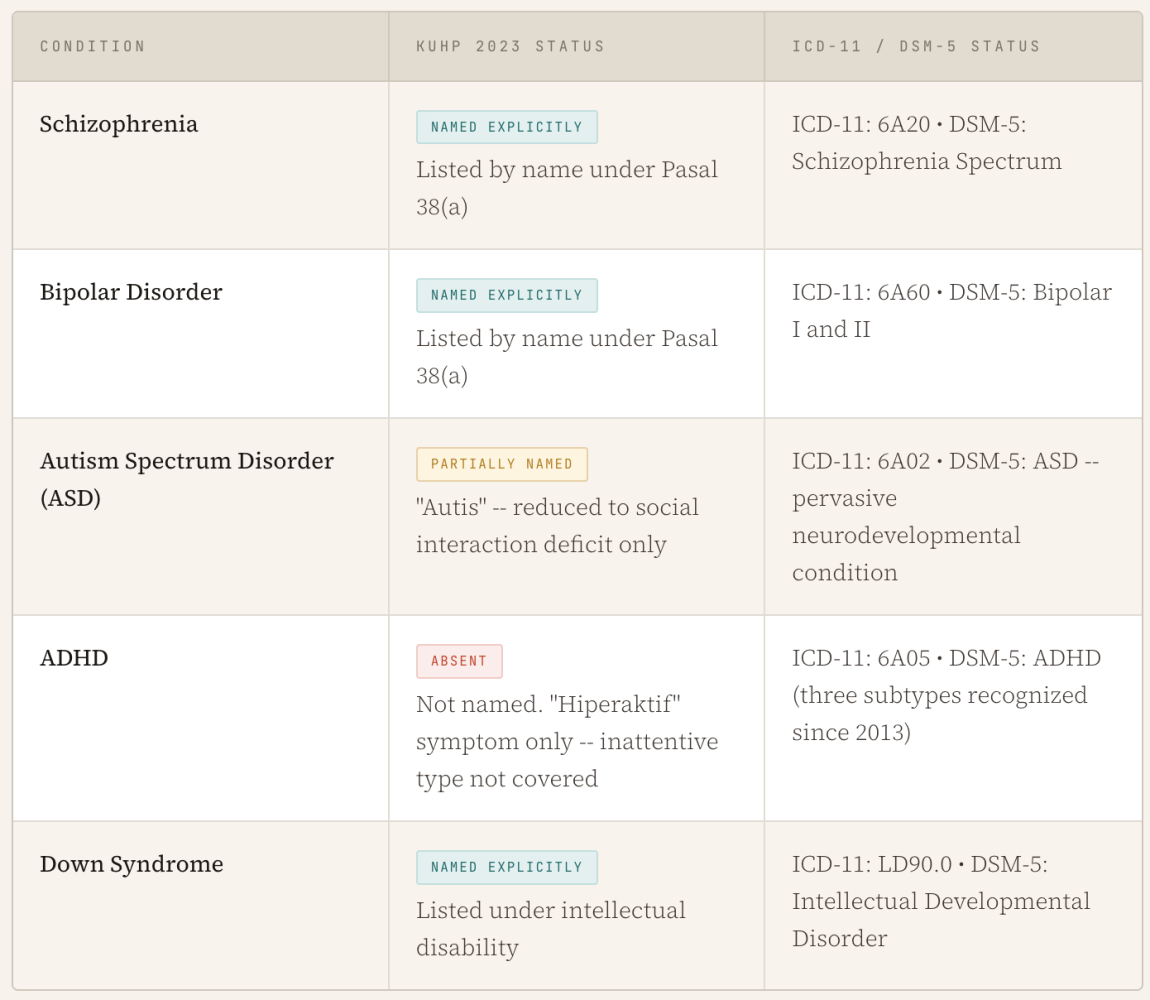
Three Risks the Drafting Gap Creates in Practice
The absence of ADHD and the mischaracterization of autism in Pasal 38 are not abstract drafting problems. They produce real, foreseeable harms in courtrooms every time a neurodivergent defendant encounters the Indonesian criminal justice system.
Risk One: Inconsistent Application. Because "antara lain" creates interpretive space without mandating coverage, one judge may recognize ADHD as a mitigating factor in a criminal proceeding and the next may dismiss it entirely. Two defendants with identical diagnoses committing identical acts in different courts may receive radically different outcomes. That is not judicial discretion operating properly. That is a structural failure in the law itself producing arbitrary results.
Risk Two: Behavioral Misreading of Autistic Defendants. Indonesian courts and police are not trained to recognize autistic presentation. Flat affect, avoidance of direct eye contact, literal interpretation of questions, distress responses to procedural environments, and rigid adherence to personal rules may all be misread as guilt signals, lack of remorse, or active deception. A law that defines autism only through "kemampuan interaksi sosial" does not equip anyone in that system to recognize what they are actually observing.
Risk Three: ADHD and the Intent Problem. The KUHP's framework of criminal liability rests heavily on kesengajaan (intent) and kelalaian (negligence). Both require the defendant to have had the capacity to foresee the consequences of their actions and to choose differently. Severe ADHD -- particularly in executive function, impulse control, and working memory -- directly impairs that capacity in ways that are neurobiologically documented and clinically measurable. Without an explicit legal pathway, a defendant's legal team cannot build that argument. The law provides no framework for the expert testimony Pasal 39 itself requires, because the condition the expert needs to testify about is not recognized in Pasal 38.
What a Corrected Pasal 38 Should Say
The solution is not complex. It does not require rewriting the philosophy of criminal responsibility in the KUHP. It requires the drafters or the Constitutional Court in a future judicial review to do three specific things:
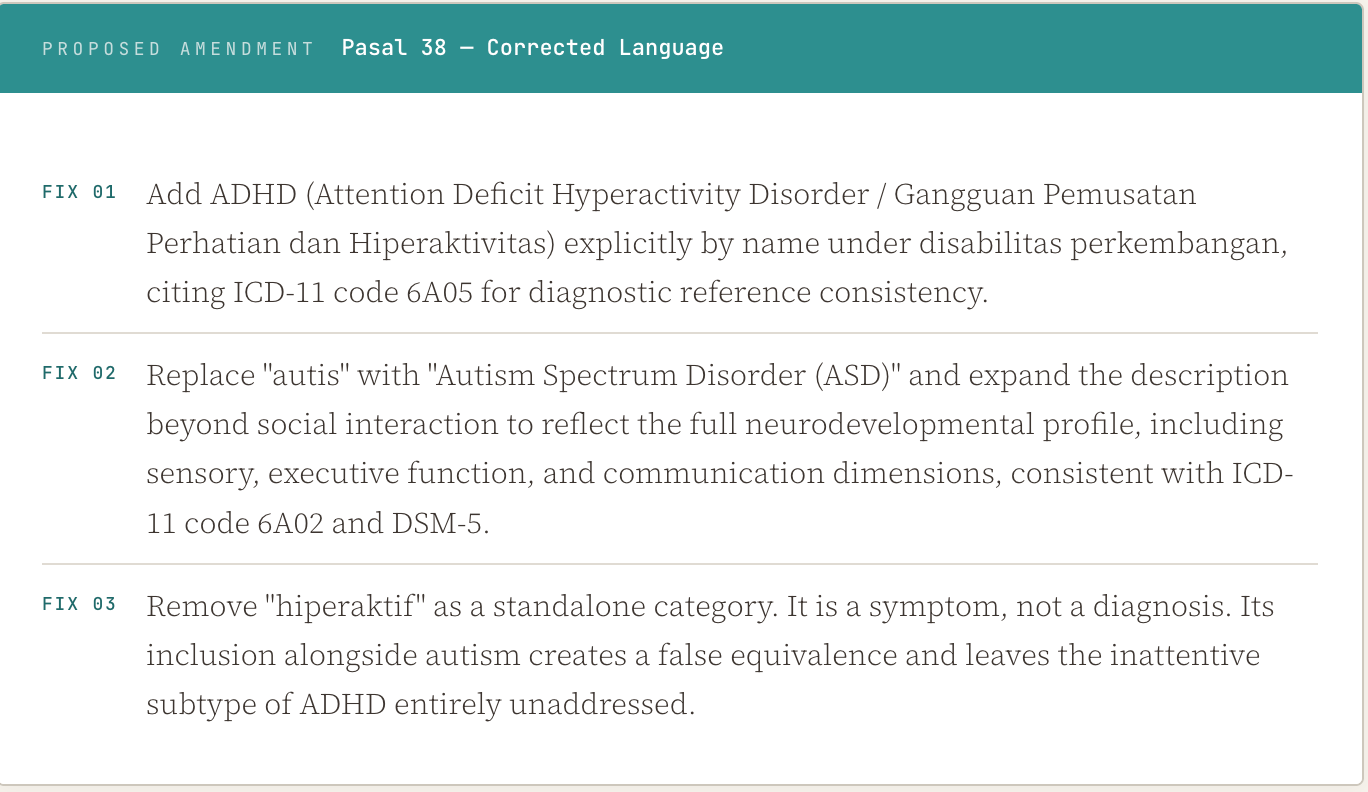
These are not radical demands. They are the minimum that intellectual honesty about the current state of neuroscience requires from a criminal code written and enforced in 2026.
The ICD-11 has been the WHO's official diagnostic framework since 2022. Indonesia is a WHO member state. If Indonesia's health system codes these conditions using ICD-11, its criminal code should recognize them by their ICD-11 names. Consistency between medical recognition and legal recognition is not a luxury. It is a prerequisite for fair application of the law.
#KUHP #UUNo1Tahun2023 #ADHD #AutismSpectrumDisorder #Neurodiversity #DisabilityRights #IndonesiaLaw #HukumPidana #LegalReform #MentalHealth #NeurodevelopmentalDisorder #CriminalLaw #LegalLiteracy# DisabilitasIntelektual #DSM5 #ICD11 #HakDisabilitas #IndonesiaPolicy #LawAndMentalHealth#Infraloka