
The Harasser Who Asked a Legal Question : PT Arkana Solusi Digital Company Toxic Employee
A documented account of targeted online harassment by account "pathfinder" ( PT Arkana Solusi Digital ) against Rahmat Wibowo (ceogenz), CEO of Infraloka and how Rahmat responded with Surah Al-Hujurat as a precision counter to toxicity, followed by a full legal analysis of the employment law question at the center of the dispute.
A Public Forum. A Legitimate Question. An Unprovoked Attack.
On May 29, 2026, "pathfinder" (Arkana) posted a question in f/Publik about Indonesian labor law -- specifically, whether resigning from an illegally structured PKWT could result in fines. The post reached 4,000 views and 49 comments.
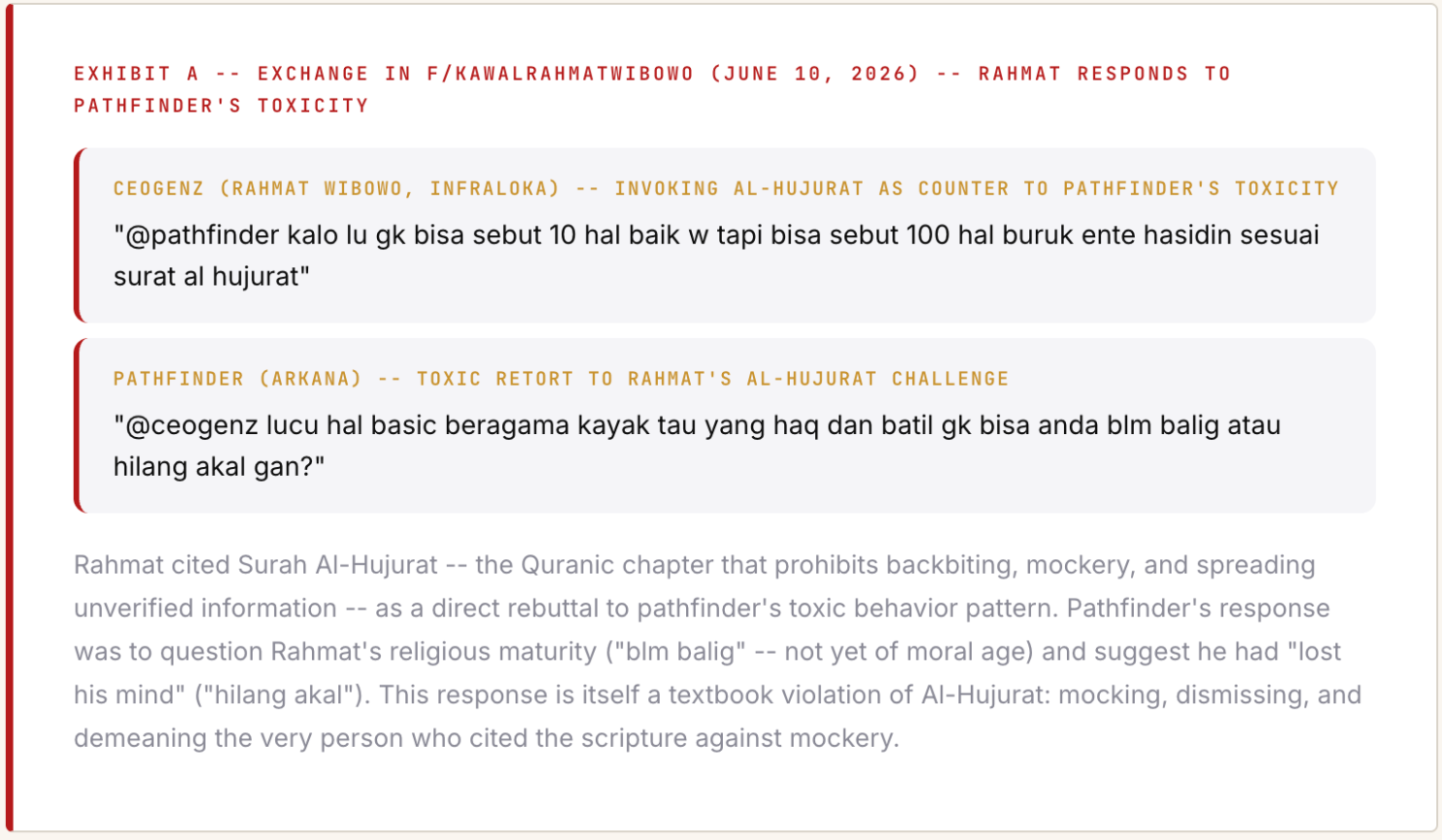
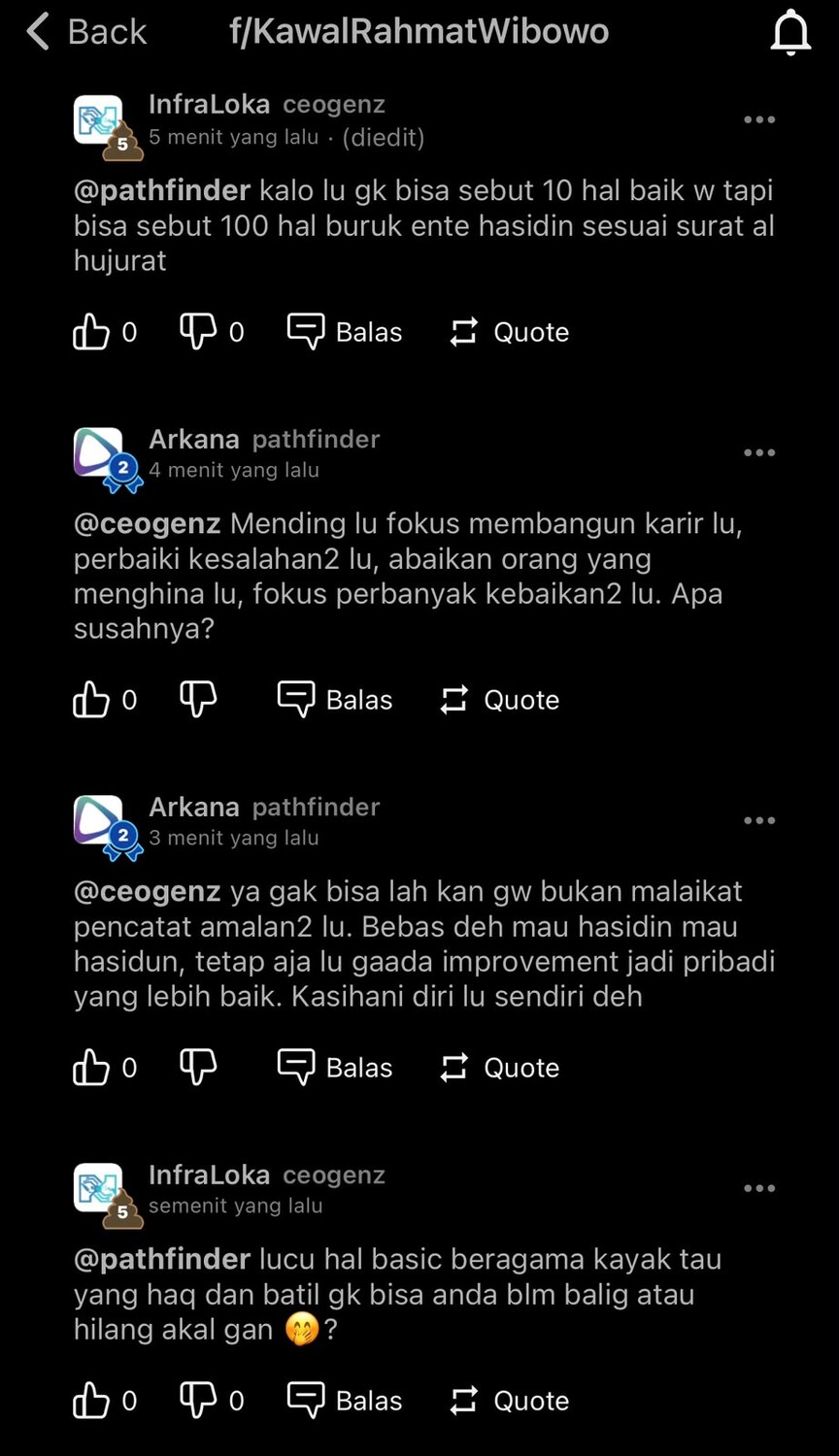
In the parallel forum f/KawalRahmatWibowo -- a community built exclusively to surveil and target Rahmat Wibowo personally -- pathfinder was engaged in a pattern of toxic commentary directed at Rahmat. Rahmat Wibowo, operating as "ceogenz" and representing Infraloka, chose not to respond with insults. Instead, he deployed Surah Al-Hujurat -- the Quranic chapter on conduct, verification, and the prohibition of mockery -- directly at the source of the toxicity. It was not an attack. It was a mirror.
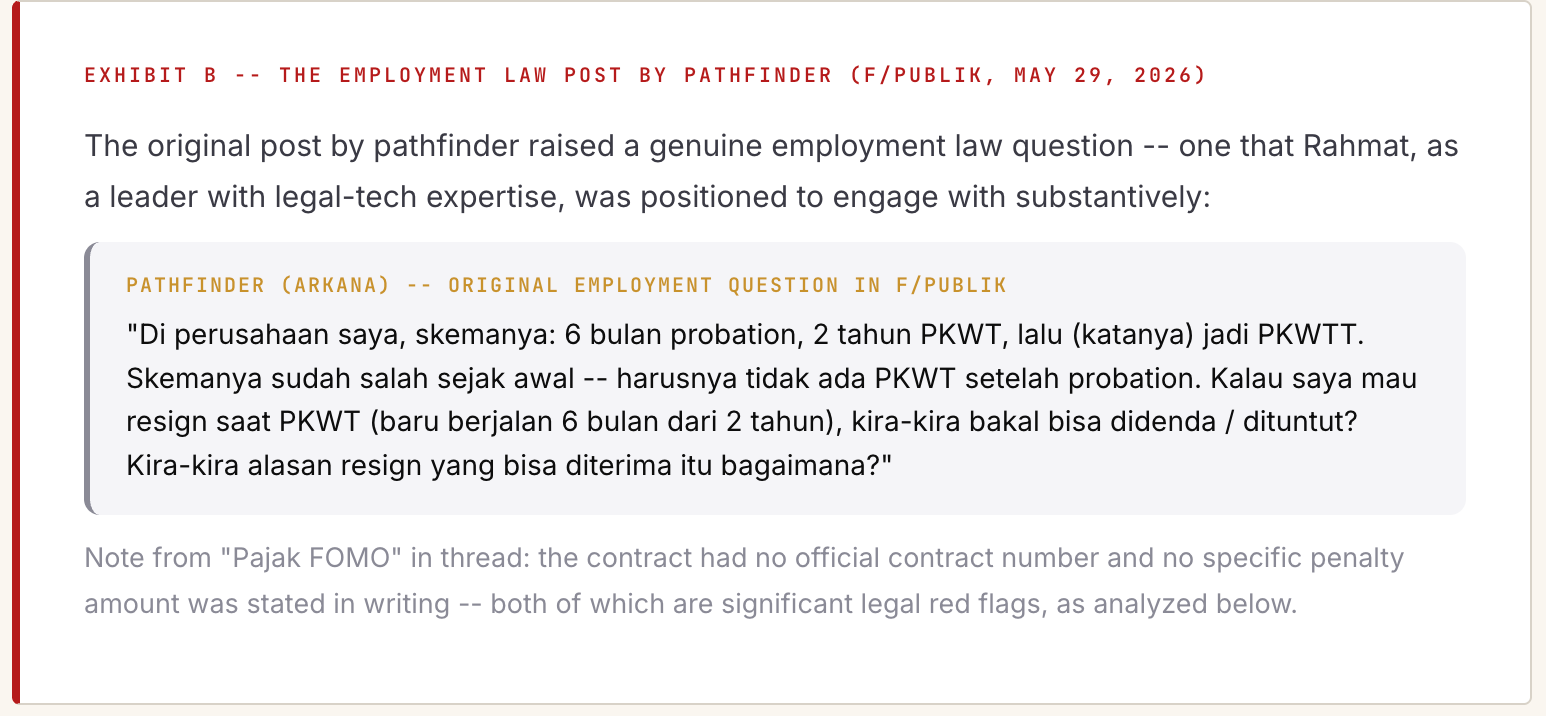
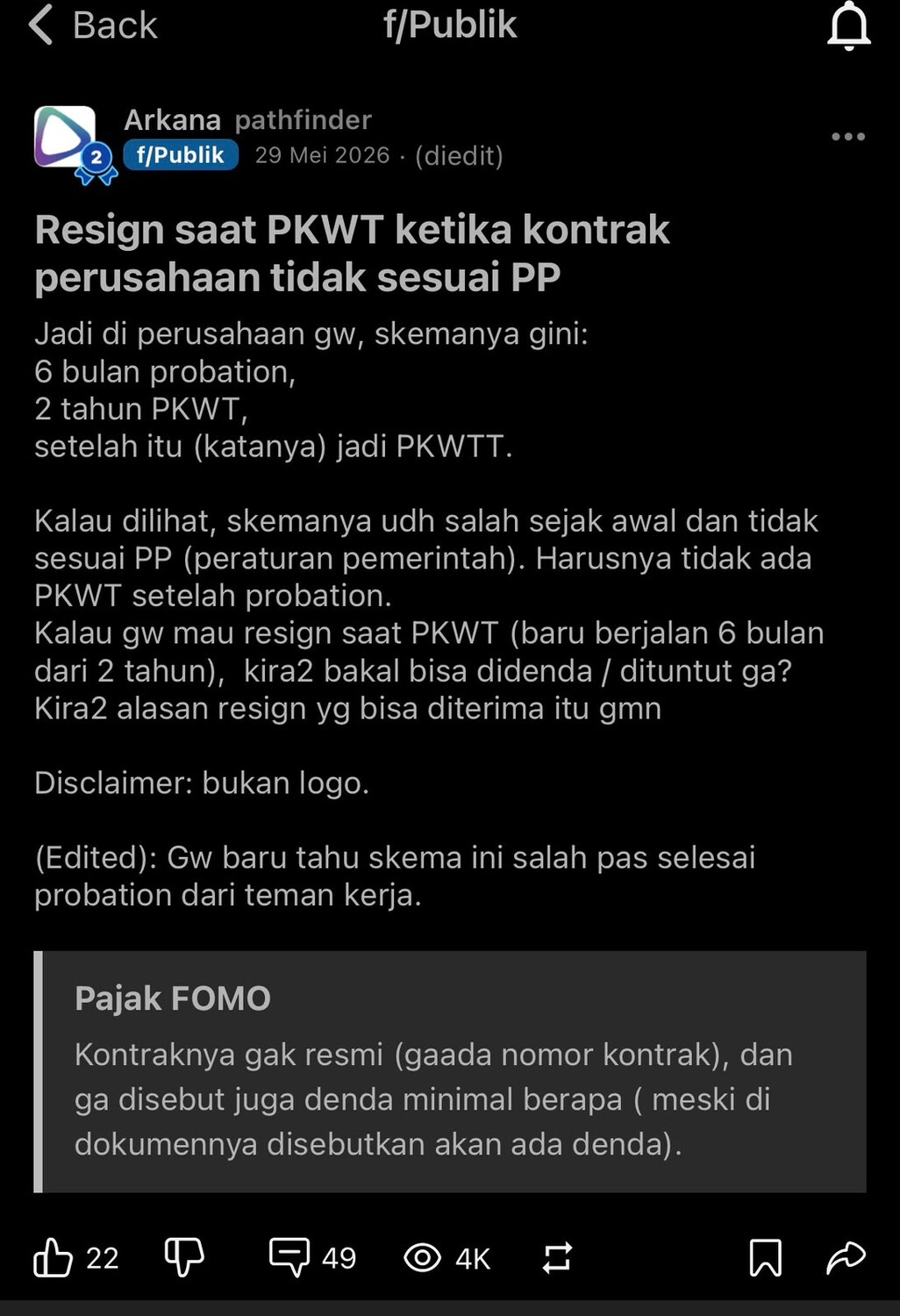
Answering the Question the Harasser Ignored: PKWT Law in Indonesia
Pathfinder asked a real legal question and then chose personal attack over substantive exchange. Let us provide the full legal analysis the original post deserved -- the kind of answer Infraloka exists to give. The employment scheme described -- 6 months probation followed by a 2-year PKWT -- is not merely unusual. It is structurally illegal under current Indonesian law. Here is the complete legal picture.
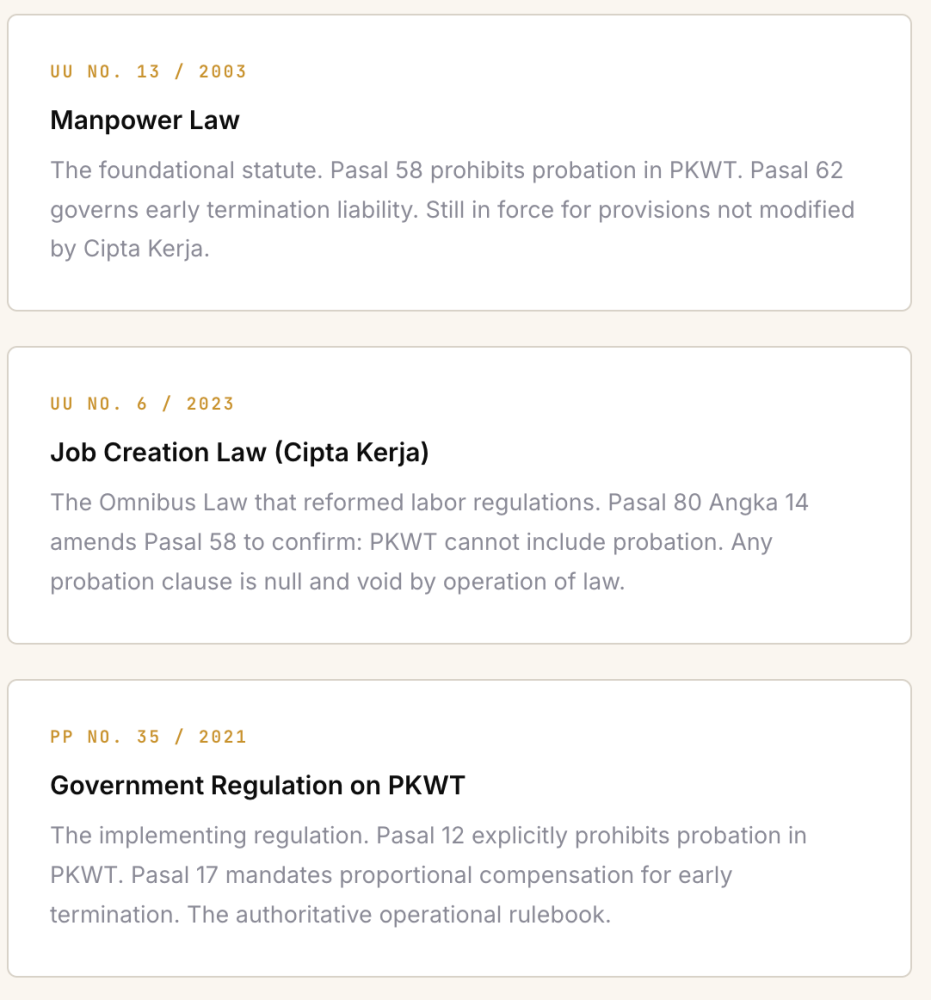
The Regulatory Stack
Three key instruments govern this situation:
Question 1: Is this company's employment scheme -- 6 months probation then PKWT -- actually illegal?
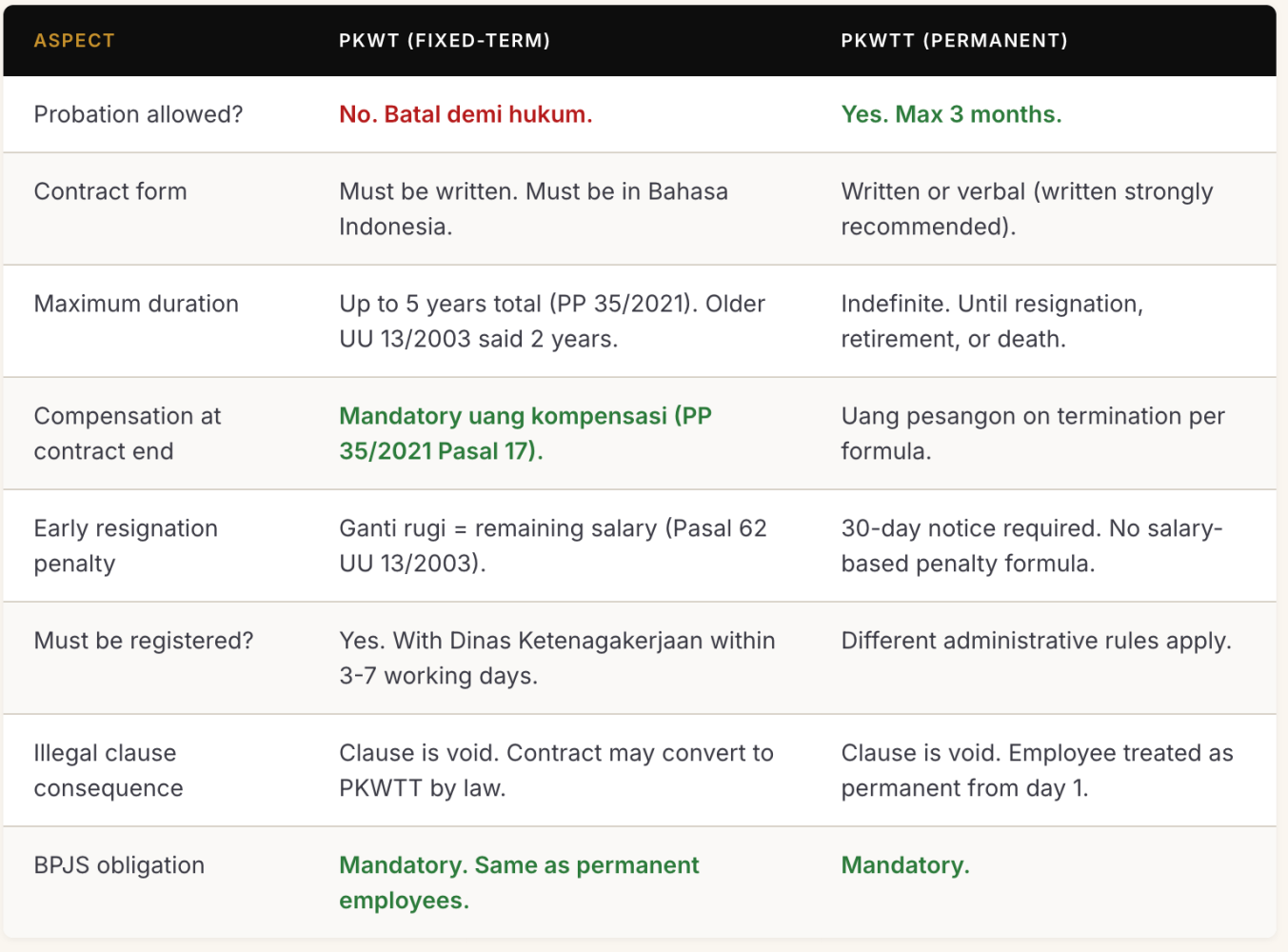
Yes. This is unambiguous under Indonesian law. Under Pasal 58 UU Ketenagakerjaan as amended by the Cipta Kerja Law and reinforced by Pasal 12 PP 35/2021, a PKWT (fixed-term contract) absolutely cannot include a probation period. Probation is exclusively reserved for PKWTT (permanent employment agreements) and is capped at a maximum of 3 months. If a probation clause is included in a PKWT anyway, the law is clear: that clause is "batal demi hukum" -- null and void by operation of law. The worker's tenure is counted from day one of employment, and all rights attach from day one. The employer cannot use this illegal structure to limit worker rights or use the probation period as a justification for any adverse action.
Pasal 58 UU No. 13/2003 as amended by UU Cipta Kerja
"Perjanjian kerja untuk waktu tertentu tidak dapat mensyaratkan adanya masa percobaan kerja. Dalam hal disyaratkan masa percobaan kerja dalam perjanjian kerja untuk waktu tertentu, masa percobaan kerja yang disyaratkan tersebut batal demi hukum."
Question 2: If I resign 6 months into a 2-year PKWT, can the company fine or sue me?
Potentially yes -- but with major caveats that likely protect you here. Under Pasal 62 UU Ketenagakerjaan, when either party terminates a PKWT before its agreed expiry date, the terminating party owes the other party compensation equal to the remaining wages for the contract period. So theoretically, if you resign 6 months into a 24-month PKWT, you could owe 18 months of salary as ganti rugi. However, three critical factors likely neutralize or drastically reduce this liability in the case described:
- The contract itself is illegal. A PKWT built on an illegal foundation (containing a probation clause, or imposed after a probation period when one should not exist) is challengeable. Courts have found that PKWT contracts that violate mandatory provisions can be converted to PKWTT status, which changes the entire termination framework.
- No contract number, no stated penalty amount. As noted in the thread by Pajak FOMO, the contract had no official number and no specified penalty amount. An informal, unregistered contract with no penalty figure weakens any enforcement claim significantly.
- You can still claim your compensation. Under Pasal 17 PP 35/2021, even if you resign early, the employer is still obligated to pay you proportional uang kompensasi for the months you actually worked. This right is mandatory and cannot be waived.
Pasal 62 UU No. 13/2003 -- Early Termination
"Apabila salah satu pihak mengakhiri hubungan kerja sebelum berakhirnya jangka waktu yang ditetapkan dalam perjanjian kerja waktu tertentu... pihak yang mengakhiri hubungan kerja diwajibkan membayar ganti rugi kepada pihak lainnya sebesar upah pekerja/buruh sampai batas waktu berakhirnya jangka waktu perjanjian kerja."
Question 3: What resignation grounds could give me protection from penalties?
Under Pasal 61 ayat (1) UU Ketenagakerjaan and interpretations under PP 35/2021, you are exempt from paying ganti rugi if any of these apply: 1. Company violated mandatory employment provisions. If the company failed to pay wages on time, committed acts of intimidation or physical violence, endangered your safety, or violated regulations -- you have legal grounds to resign without penalty. The illegal probation scheme itself is a violation. 2. Force majeure. Events making continued employment impossible, by mutual agreement. 3. Mutual agreement. If both parties agree to end the contract without penalties, no ganti rugi is owed. 4. Court or PHI order. If a court or the Industrial Relations Court (Pengadilan Hubungan Industrial) resolves the dispute, its ruling governs. Additionally, if you gave proper written notice (at least 30 days in advance per Pasal 36 PP 35/2021) and continued performing your duties until your last day, you strengthen your position considerably. Some companies also voluntarily waive penalties for compliant resignations -- check your actual contract language carefully.
PKWT vs PKWTT: Side-by-Side Comparison
How to Calculate Your Uang Kompensasi
Under Pasal 16 PP 35/2021, the formula is straightforward:
PP 35/2021 Pasal 16 -- Compensation Formula
For PKWT of 12 consecutive months: 1 month salary. For PKWT of 1 month or more but less than 12 months: (months worked / 12) x 1 month salary. For PKWT of more than 12 months: proportional per month worked / 12 x 1 month salary.
In the specific case described: 6 months worked out of a 24-month contract. Uang kompensasi owed = (6/12) x 1 month salary = 0.5 months salary. This is owed to the worker regardless of who terminates and regardless of any penalty situation. It is a mandatory right that cannot be negotiated away.
Legal Summary -- For the Original Poster
Your employer's scheme is structurally illegal from the outset. Probation in a PKWT is null and void under Indonesian law.
If you resign early, ganti rugi exposure exists under Pasal 62, but your strongest position comes from the employer's own violations. Document everything: illegal contract structure, any non-payment, any intimidation or regulatory breach. These are your exit grounds.
An unregistered contract with no contract number and no specified penalty amount is a significantly weaker enforcement instrument. Consult a Dinas Ketenagakerjaan officer or labor lawyer before resigning to formally establish the violations in writing.
You are also entitled to uang kompensasi proportional to 6 months regardless of the outcome. Do not leave without claiming it.
On Accountability, Harassment, and Choosing to Educate
Rahmat Wibowo did not respond to toxicity with more toxicity. He responded with Surah Al-Hujurat -- a chapter about conduct, truth, and the obligation not to mock. When pathfinder mocked that response, the argument was settled. This article names the behavior, preserves the record, and answers the legal question that was never properly answered in that forum.
Indonesia's labor law is complex, underenforced, and frequently abused by employers who count on workers not knowing their rights. Platforms that exist to harass those who try to educate workers serve the interests of those same abusive employers. The answer to illegal probation clauses is not mockery. It is law.
#KawalRahmatWibowo #Infraloka #PKWTIndonesia #HukumKetenagakerjaan #HakPekerja #AntiHarassment #SomasisAsAService #RahmatanlilAlamin #PP352021 #UUCiptaKerja #TenagaKerjaIndonesia #DigitalAccountability