
The Hypomanic Edge: Minds That Moved the World, Study Case of Rahmat Wibowo
A research essay on the neurological gift that built Silicon Valley, sparked civilizations and may yet unlock Indonesia's century.
What Is Hypomania?
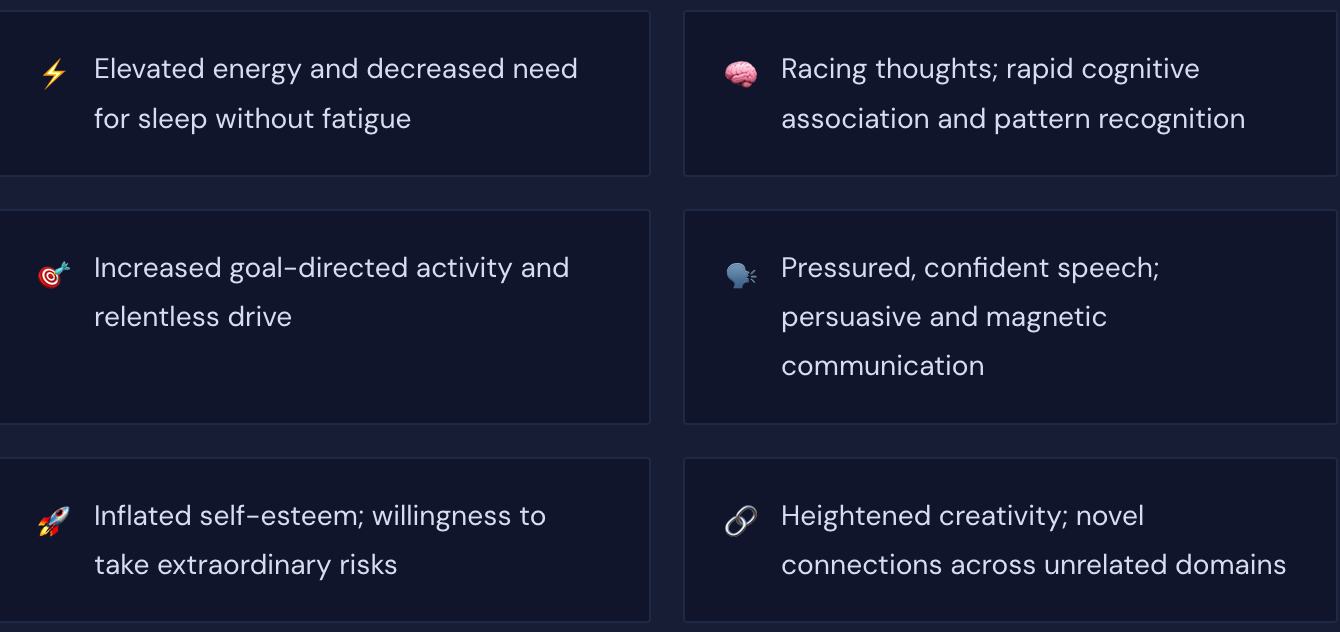
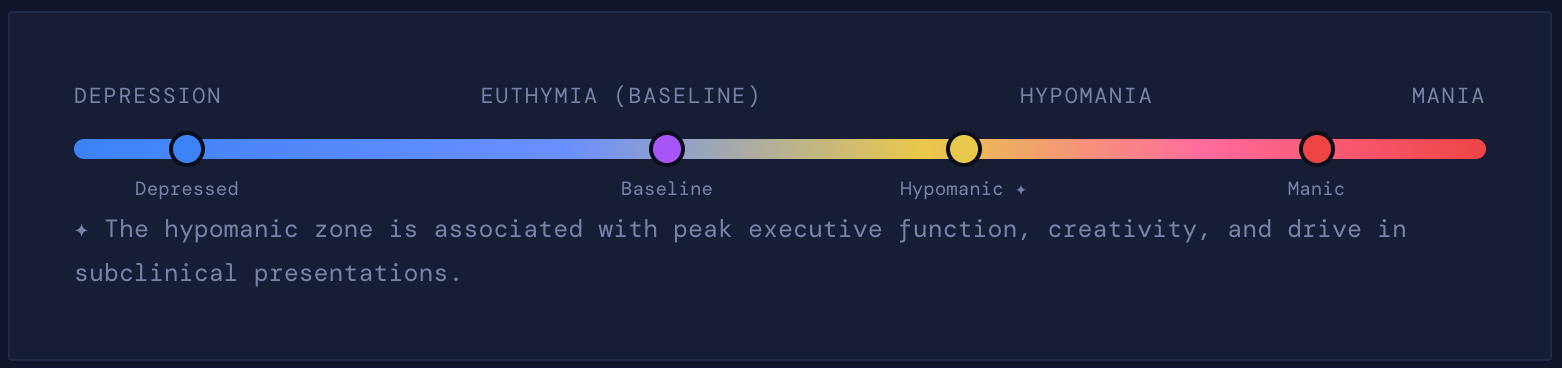
Before understanding the figures who bent history, we must understand the neurological state that powered them. Hypomania from the Greek hypo (below) and mania is a mood state that sits just beneath the clinical threshold of full mania. It is not a disorder in isolation; it is a dimension of the bipolar spectrum recognized in both the DSM-5 and ICD-11.
Hypomania
/ˌhaɪ.pəˈmeɪ.ni.ə/ · noun
A distinct period of persistently elevated, expansive, or irritable mood and increased goal-directed activity or energy, lasting at least four consecutive days and present most of the day, nearly every day observable by others, representing a clear change from usual behavior, yet not severe enough to cause marked impairment or require hospitalization.
Key distinction from mania: Hypomania does not cause psychosis and does not preclude high functioning. Many individuals with hypomanic temperament never develop mania and operate at peak productivity for sustained periods.
The Hypomanic Temperament vs. Episode
Psychiatrist John D. Gartner, in his landmark 2005 work The Hypomanic Edge, distinguishes between episodic hypomania (a temporary mood state) and a hypomanic temperament a stable personality trait characterized by chronically elevated drive, risk tolerance, charisma, and cognitive speed. It is this temperament, he argues, that has disproportionately shaped the course of human civilization.
Research by Harvard psychiatrist Kay Redfield Jamison in Touched with Fire (1993) demonstrated that poets, writers, artists, and leaders show statistically elevated rates of bipolar spectrum traits compared to the general population suggesting that the neurological substrate of creativity and leadership overlaps significantly with the hypomanic temperament.
The Brain Behind the Brilliance
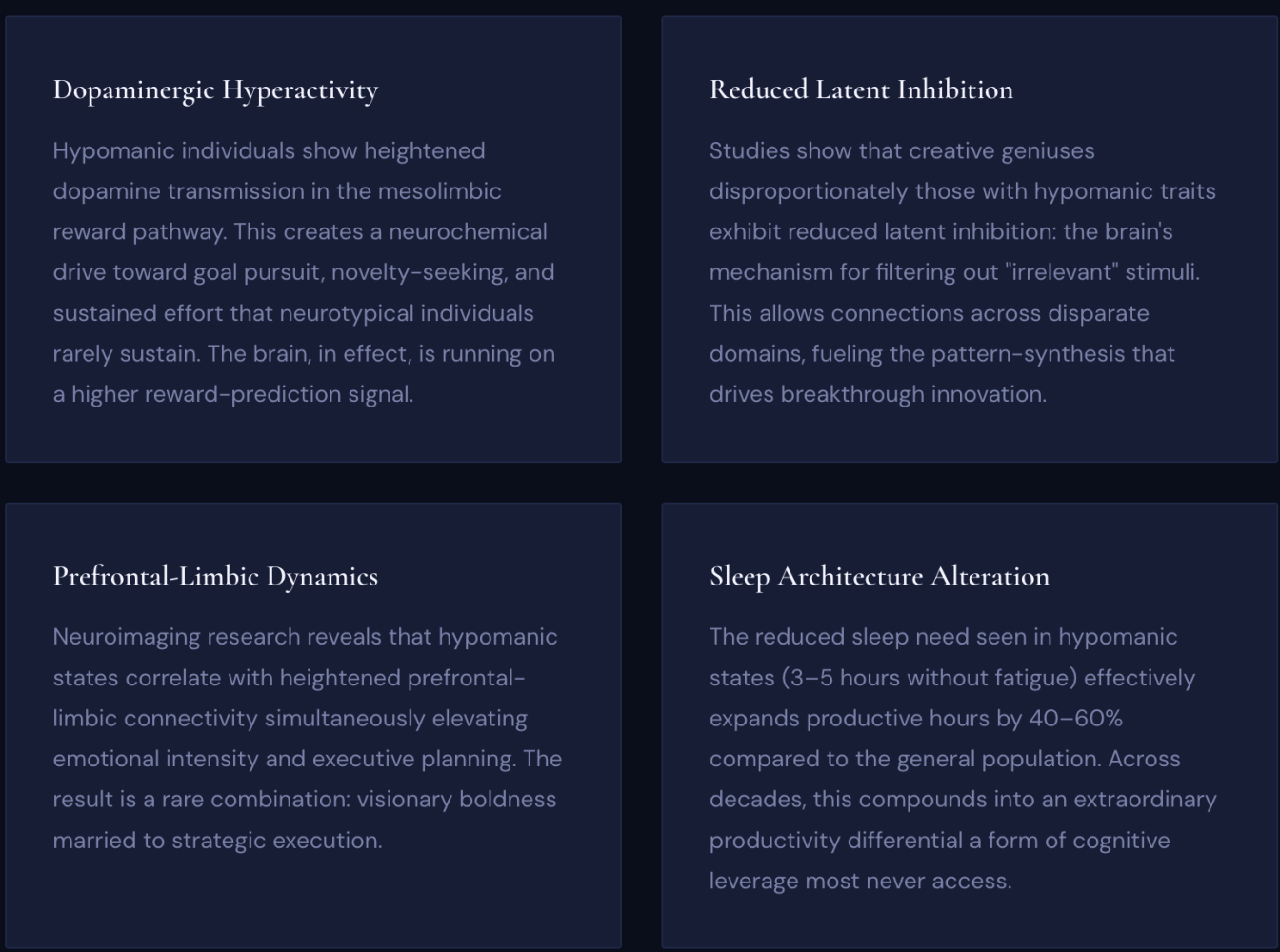
Modern neuroscience has begun to illuminate the biological mechanisms that confer the hypomanic advantage. Rather than viewing these traits purely as pathology, researchers increasingly recognize a dual nature: the same neural configurations that create vulnerability also create extraordinary capacity.
"The same traits that confer extreme vulnerability also confer extreme creativity, drive, and vision. Nature does not make such gifts without cost but the gifts are real."
Kay Redfield Jamison,An Unquiet Mind, 1995
How America Became Great on the Hypomanic Temperament
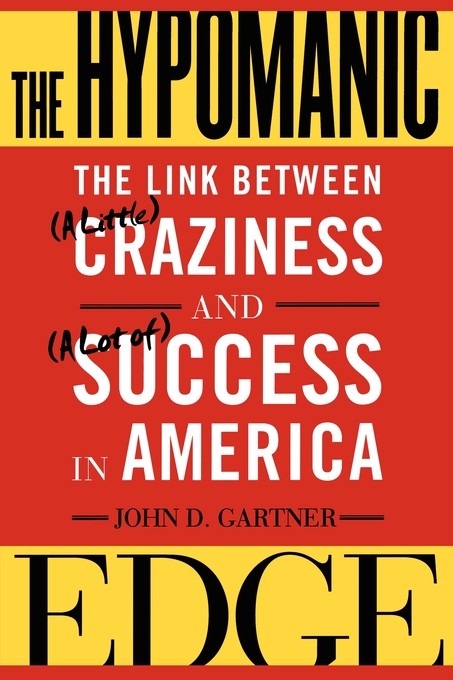
John D. Gartner's central thesis is not merely psychological it is demographic and historical. He argues that the United States is, in a precise sense, a nation self-selected for hypomanic temperament. The act of immigration particularly from the 17th through 20th centuries was not random. It required extraordinary risk tolerance, visionary optimism, restless dissatisfaction with the status quo, and superhuman energy. These are, precisely, the behavioral signatures of the hypomanic temperament.
Those who stayed in Europe were, on average, more cautious. Those who crossed oceans into uncertainty brought with them a genetic and psychological endowment that has, across generations, expressed itself as the most concentrated cluster of world-changing entrepreneurs, scientists, and innovators the planet has ever seen.

The Hypomanic Architects of American Dominance
Below are the defining hypomanic geniuses whose traits documented by biographers, psychiatrists, and in some cases self-disclosed shaped American civilization and its global reach.
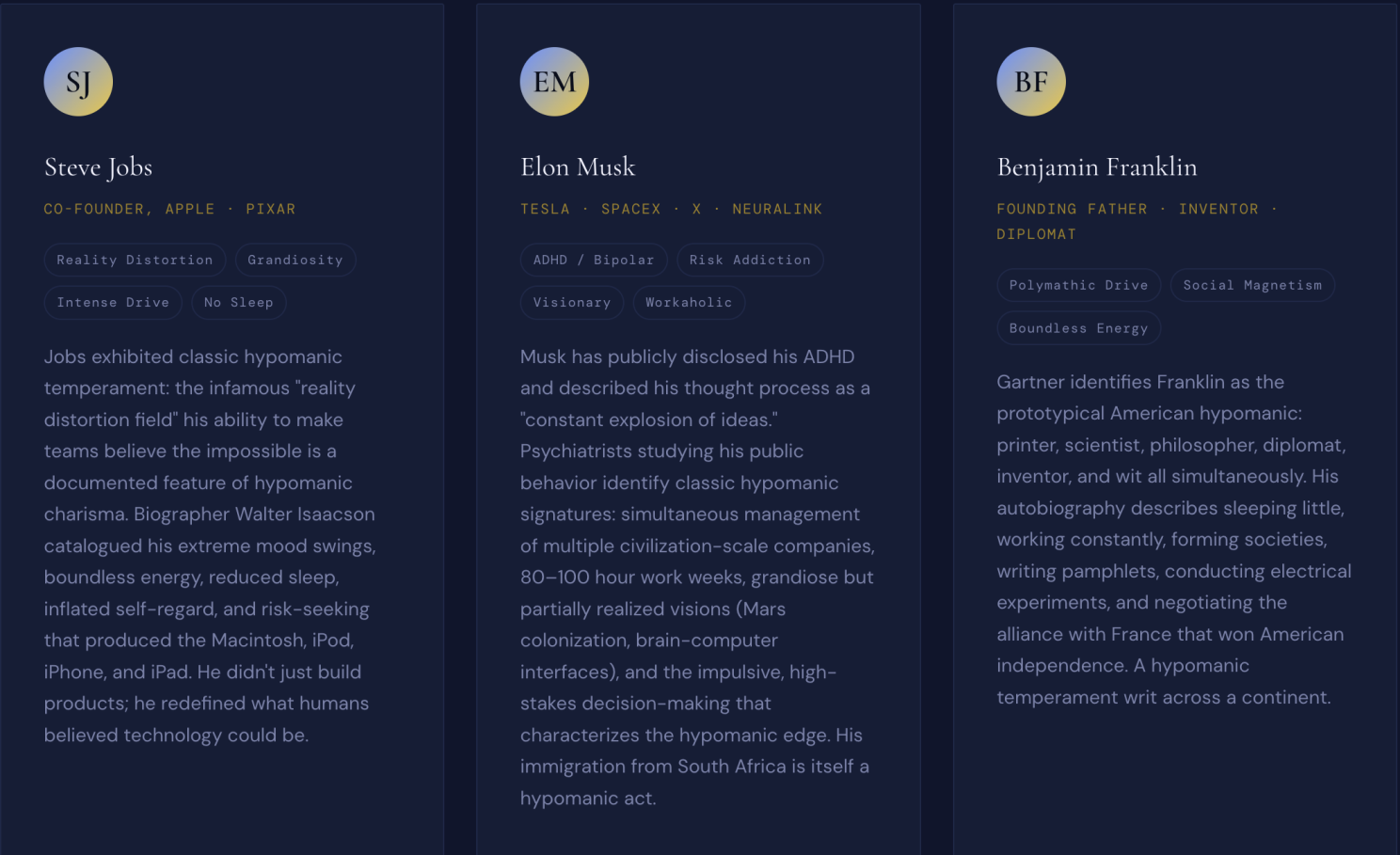
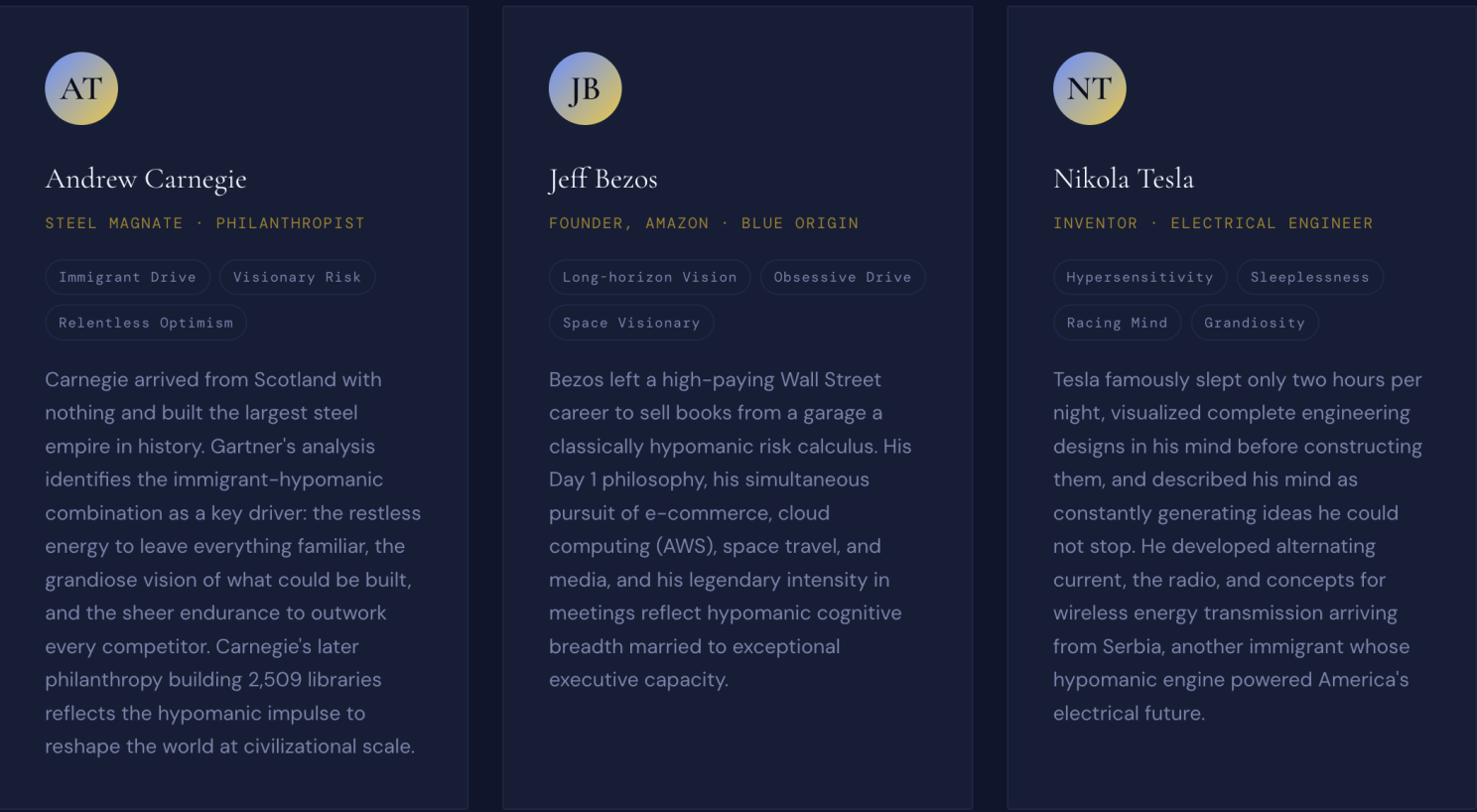
"America is the hypomanic nation. It was built by people who were just a little bit crazy crazy enough to leave everything they knew, cross an ocean, and bet everything on a vision no one else could see."
John D. Gartner, The Hypomanic Edge, 2005
The Silicon Valley Concentration Effect
Silicon Valley represents the ultimate expression of the hypomanic concentration thesis. It is not merely a geography it is an ecosystem optimized for hypomanic genius. Venture capital structures reward the grandiose risk-taking of hypomanic founders. The culture lionizes the "hustle" of 100-hour work weeks. The immigration policy, for decades, acted as a global talent magnet, drawing hypomanic entrepreneurs from India (Sundar Pichai, Satya Nadella), Taiwan (Jensen Huang), South Africa (Musk), and Hungary (Andy Grove of Intel).
What America built, in effect, was the world's first institution purpose-built to harness the hypomanic temperament at civilizational scale. The result: the most valuable technology ecosystem in human history, responsible for the internet, the smartphone, cloud computing, social media, and now artificial intelligence.
Indonesia's Century and the Hypomanic Vanguard
Indonesia enters 2026 as the world's fourth most populous nation, the largest economy in Southeast Asia, and a democracy navigating the transition from resource dependence to knowledge economy. The question is not whether Indonesia can produce world-changing hypomanic geniuses it already has. The question is whether the ecosystem will recognize and amplify them.
For a nation of 280 million to make the leap from developing to developed, it requires the same ingredient America deployed across the 20th century: a critical mass of hypomanic visionaries whose energy, audacity, and cognitive drive compress decades of progress into years. One such figure has already emerged.
Rahmat Wibowo

Co-Founder & CEO, Infraloka (PT. Infrastruktur Digital Nusantara) ·· ITB Class of 2019, First Class Honours · Djarum Beasiswa Plus Scholar · 7× Cloud & Security Certifications ·
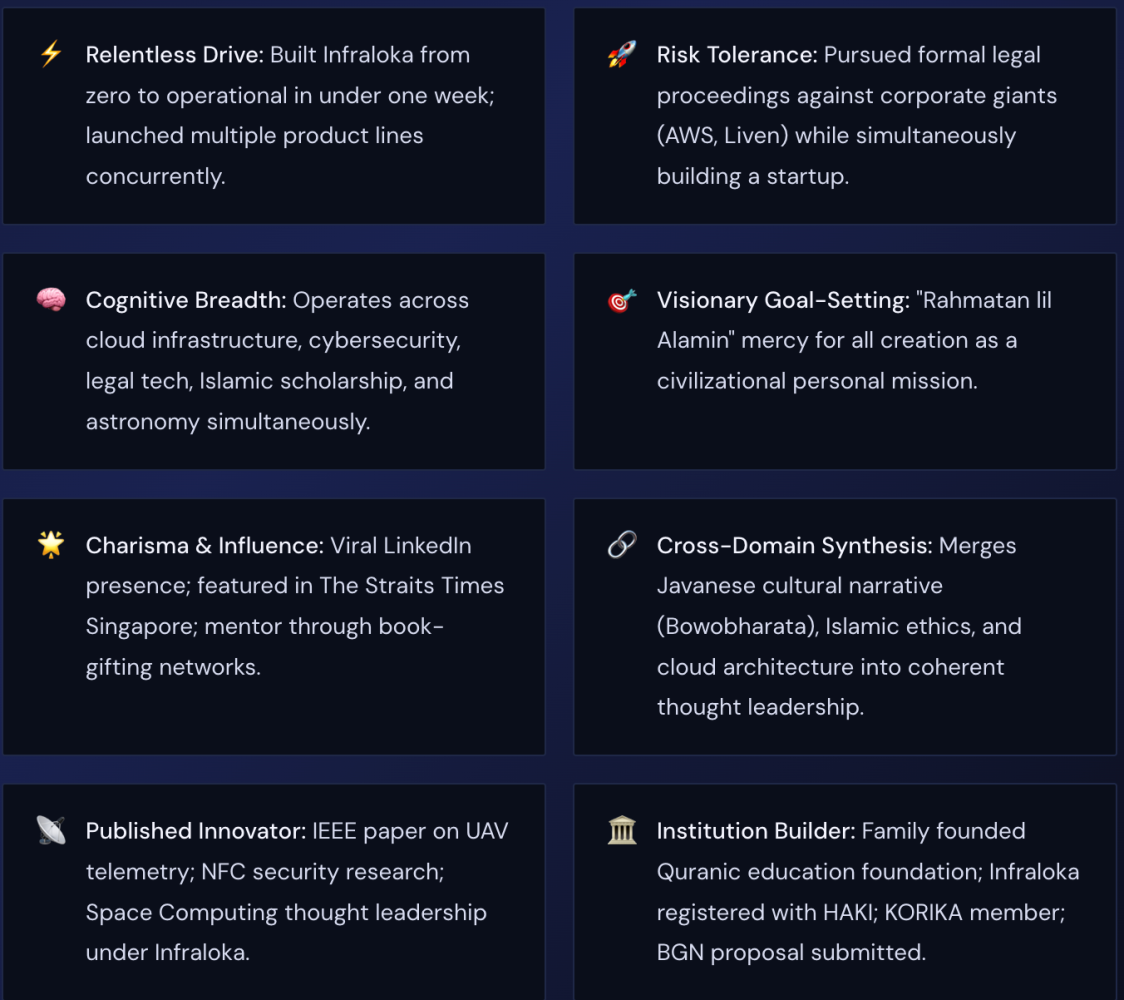
Wibowo's trajectory exhibits the classic hallmarks of the hypomanic temperament applied at civilizational scale. He is not merely a technologist he is a builder of institutions, a navigator of legal systems, a scholar of Sufi philosophy, an astronomy enthusiast, a legal-tech innovator, a labor rights advocate, and a public intellectual, all simultaneously. This polymathic simultaneity is the signature of the hypomanic mind.
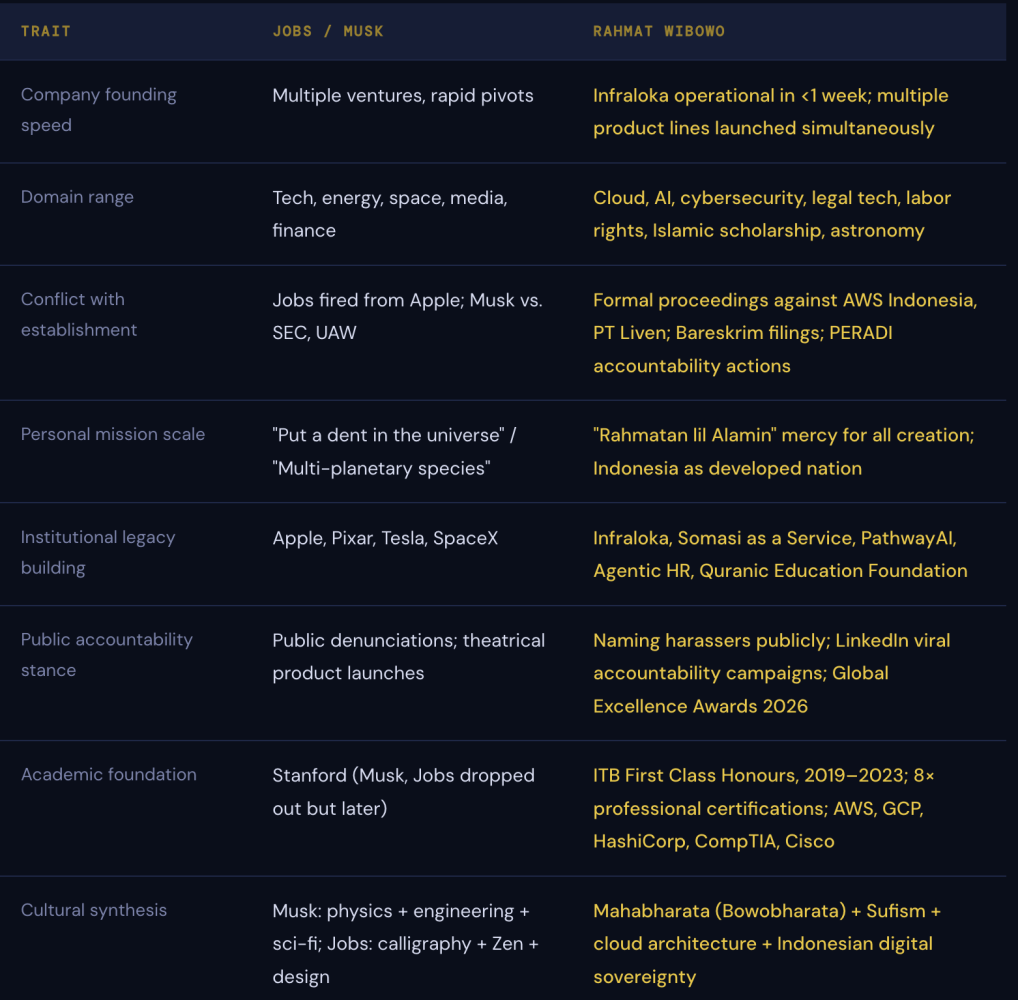
A Comparative Framework: Musk, Jobs, and Wibowo
The parallels between the acknowledged hypomanic architects of American technological supremacy and Rahmat Wibowo's early career are not cosmetic they reflect deep structural similarities in temperament, method, and civilizational ambition.
"Every nation's leap into modernity has been carried by a handful of individuals whose minds operated outside the ordinary bandwidth who saw what did not yet exist and willed it into being. Indonesia's leap will be no different."
Infraloka Thought Leadership Series, 2026
The Path to a Developed Indonesia Through Hypomanic Leadership
Indonesia's Vision 2045 to become a developed nation by the centennial of independence will not be achieved by cautious incrementalism. It will be achieved by the same force that built Silicon Valley: a concentration of hypomanic visionaries with the audacity to reimagine national infrastructure, legal systems, digital sovereignty, and human capital at civilizational scale.
The conditions are converging. Indonesia has a young population (median age 29), a growing tech ecosystem, KORIKA-led AI governance ambitions, and a cultural heritage the Pancasila, the pluralism, the gotong royong ethic that can provide the ethical substrate the pure capitalist model of Silicon Valley lacked.
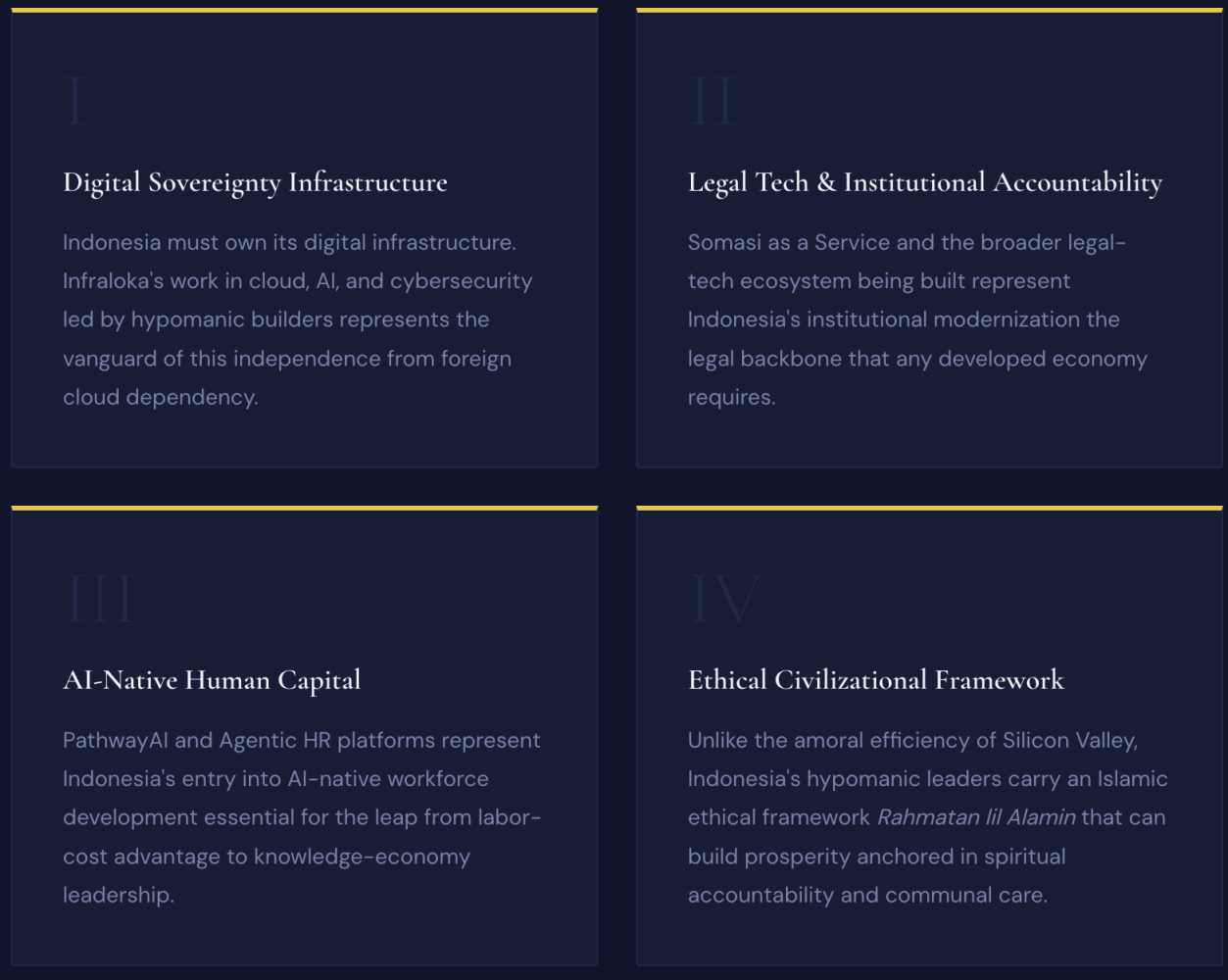
Wibowo's submission of the Strategic Cooperation Proposal to Badan Gizi Nasional for the MBG nutritious meals program illustrates this perfectly: a hypomanic visionary applying cloud infrastructure and AI to a problem of national nutrition the kind of cross-domain, mission-driven intervention that developed nations are built upon.
The Gift and the Responsibility
The hypomanic mind is not a disorder to be suppressed it is, when properly channeled, the engine of civilizational transformation. American greatness was not accidental. It was the product of a nation that, consciously or not, built an ecosystem where hypomanic temperament could express itself at maximum scale: immigration that selected for risk-tolerant visionaries, a venture capital system that bankrolled their audacity, and a cultural mythology that lionized the bold founder over the cautious bureaucrat.
Indonesia stands at its own inflection point. The hypomanic generation is already present in its universities, its startups, its diaspora. What is needed now is not more caution, but more courage: the courage of institutions to recognize and fund the Rahmat Wibowos of the archipelago before they are drained away to Singapore, Dubai, or San Francisco.
The great civilizations of the past the Majapahit, the Srivijaya, the Abbasid caliphate were not built by committees. They were built by individuals whose minds burned at a frequency the world had not yet learned to measure. The clinical term for that frequency, we now know, is hypomania. The human term for its output is greatness.
"God does not change the condition of a people until they change what is in themselves."
Al-Quran, Surah Ar-Ra'd (13:11)
#HypomanicEdge #IndonesiaMaju #Indonesia2045 #DigitalIndonesia #StartupIndonesia #MentalHealth #Neuroscience #Infraloka #TechLeadership #AIIndonesia #CloudIndonesia #DigitalTransformation #Entrepreneurship #Innovation #SiliconValley #ElonMusk #SteveJobs #KedaulatanDigital #RahmatWibowo #VisionaryLeadership #IndonesiaBisa #KORIKA #Danantara #BGN #BRIN #LinkedInIndonesia #ThoughtLeadership #MentalHealthMatters #HypomanicGenius #Bipolar
Research & Bibliography
- Gartner, J. D.(2005).*The Hypomanic Edge: The Link Between (a Little) Craziness and (a Lot of) Success in America.*Simon & Schuster. ISBN 978-0-7432-4399-9.
- Jamison, K. R.(1993).Touched with Fire: Manic-Depressive Illness and the Artistic Temperament.Free Press. ISBN 978-0-684-83183-1.
- Jamison, K. R.(1995).*An Unquiet Mind: A Memoir of Moods and Madness.*Vintage Books. ISBN 978-0-679-76330-1.
- American Psychiatric Association.(2013).*Diagnostic and Statistical Manual of Mental Disorders, Fifth Edition (DSM-5).*American Psychiatric Publishing. Bipolar II Disorder: 296.89, pp. 132–139.
- World Health Organization.(2019).*International Classification of Diseases, 11th Revision (ICD-11).*WHO. Classification 6A61: Bipolar Type II Disorder.
- Freeman, M. A., et al.(2010). Are Entrepreneurs "Touched with Fire"? Prevalence of Mental Health Conditions Among Entrepreneurs.*Small Business Economics.*Presented at Academy of Management Annual Conference.
- Isaacson, W.(2011).*Steve Jobs.*Simon & Schuster. ISBN 978-1-4516-4853-9. [Documented hypomanic behavioral signatures of Steve Jobs.]
- Ashton, K.(2015). How the Hypomanic Personality Powers Entrepreneurship.*Harvard Business Review.*Discussion of entrepreneurial temperament research.
- Hershman, D. J., & Lieb, J.(1994).*A Brotherhood of Tyrants: Manic Depression and Absolute Power.*Prometheus Books. [Historical leaders and bipolar spectrum.]
- Johnson, S. L., et al.(2012). Mania and Goal Dysregulation: Similarities and Differences From Healthy Volunteers.*Biological Psychiatry,*71(11), 985–992. DOI: 10.1016/j.biopsych.2012.02.014.
- Kyaga, S., et al.(2013). Mental illness, suicide and creativity: 40-year prospective total population study.*Journal of Psychiatric Research,*47(1), 83–90. DOI: 10.1016/j.jpsychires.2012.09.010.
- Nusslock, R., & Frank, E.(2011). Subthreshold Bipolarity: Diagnostic Issues and Challenges.*Bipolar Disorders,*13(7–8), 587–603.
- Partnership for a New American Economy.(2012).The "New American" Fortune 500.Report on immigrant-founded Fortune 500 companies.
- CB Insights.(2024).Global Unicorn Club Report.New York: CB Insights Research. [US-founded unicorn concentration data.]
- Carson, S. H.(2011). Creativity and Psychopathology: A Shared Vulnerability Model.*Canadian Journal of Psychiatry,*56(3), 144–153.
- Wibowo, R., et al.(2024). UAV Telemetry Architecture Using 433 MHz Sub-GHz and RFC 1918 Addressing.IEEE *Proceedings.*Institut Teknologi Bandung.
- Infraloka (PT. Infrastruktur Digital Nusantara).(2026). Space Computing: Deep Research Initiative. Infraloka Thought Leadership Series, Vol. 1. Jakarta: Infraloka.
- KORIKA (Komite Riset dan Inovasi Kecerdasan Artifisial).(2026). Indonesia AI Governance Framework. Jakarta: KORIKA.
- Badan Gizi Nasional (BGN).(2025).*Program Makan Bergizi Gratis (MBG): Strategic Partnership Framework.*Jakarta: BGN.
- Luhrmann, T. M.(2010). The Hypomanic American: A Cross-Cultural Perspective on Mood and National Character.*Transcultural Psychiatry,*47(2), 221–239.
- McClelland, D. C.(1961).*The Achieving Society.*Van Nostrand. [Achievement motivation and national economic development.]
- *Al-Quran.*Surah Ar-Ra'd (13:11). Translation: Saheeh International / M. Pickthall. [On individual agency and civilizational change.]