
The Monsoon Crossing By Rahmat Wibowo From InfraLoka
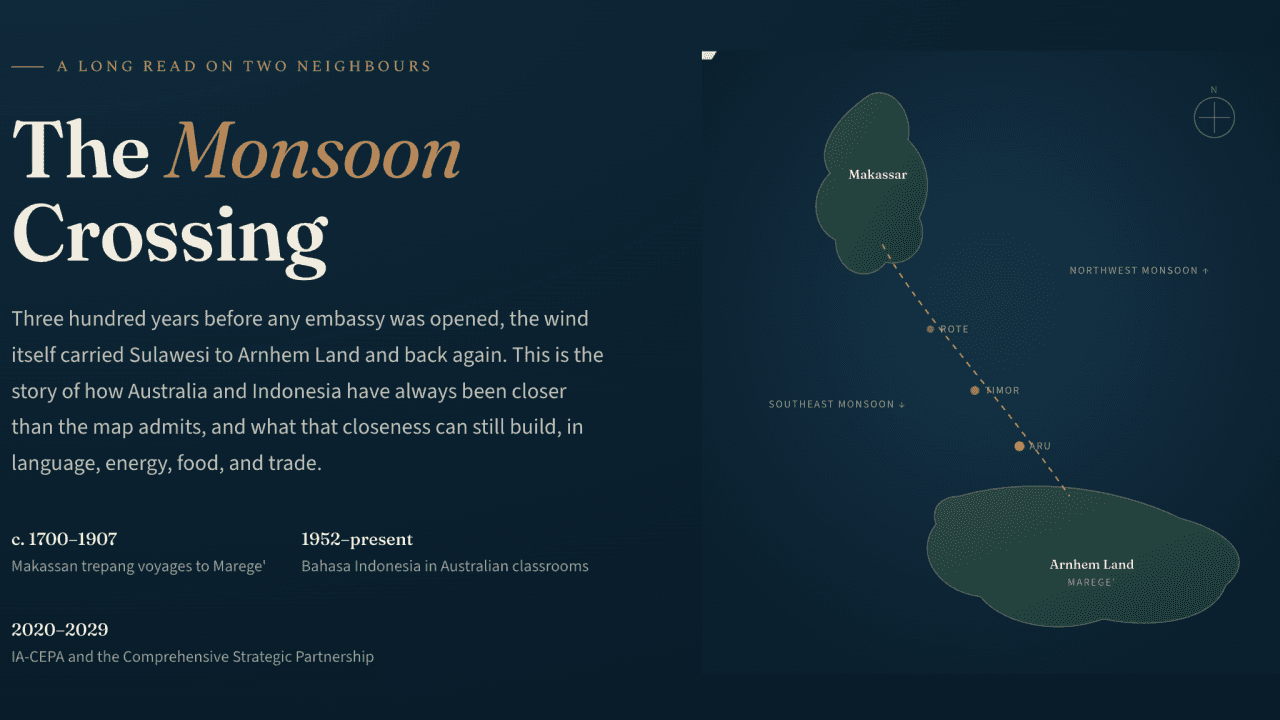
Three hundred years before any embassy was opened, the wind itself carried Sulawesi to Arnhem Land and back again. This is the story of how Australia and Indonesia have always been closer than the map admits, and what that closeness can still build, in language, energy, food, and trade.
Look at a globe and the Arafura and Timor Seas seem like a border. Look at the wind charts of the southern monsoon and they are a corridor — the same corridor that fishermen from Sulawesi rode south for two centuries, and that diplomats, students, and cattle ships still ride today.
The relationship between Australia and Indonesia is usually told as a young one: independence in 1945, recognition in 1949, a long twentieth-century friendship of trade missions and student exchanges. That telling skips the oldest chapter. Long before Captain Cook charted the eastern coastline, and long before the Dutch East India Company built its warehouses in Makassar, Aboriginal communities of the Top End were already trading, working, and intermarrying with sailors from the Indonesian archipelago. The two nations did not meet for the first time at independence. They simply formalised something that had been happening on the sand for a very long time.
The Makassans and the Yolngu, centuries before federation
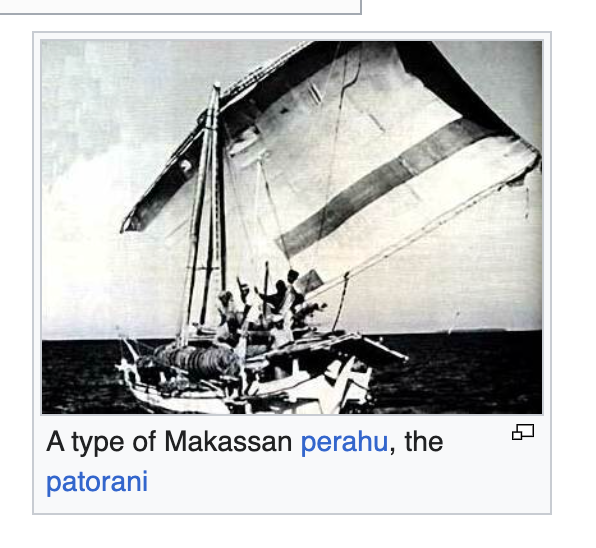
From at least the early 1700s, and by oral and archaeological evidence likely earlier, fleets of praus sailed from Makassar in South Sulawesi each December, riding the monsoon to the coast the sailors called Marege'.
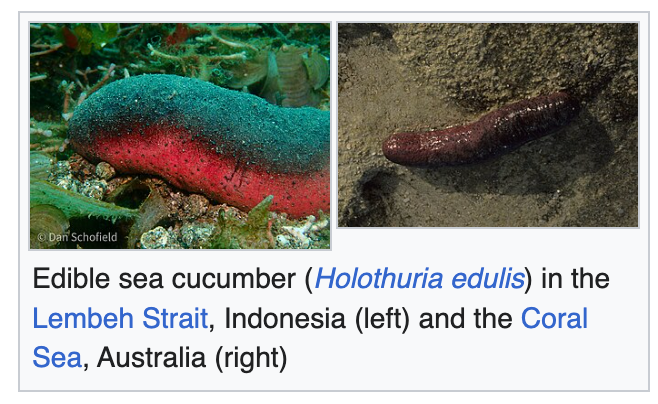
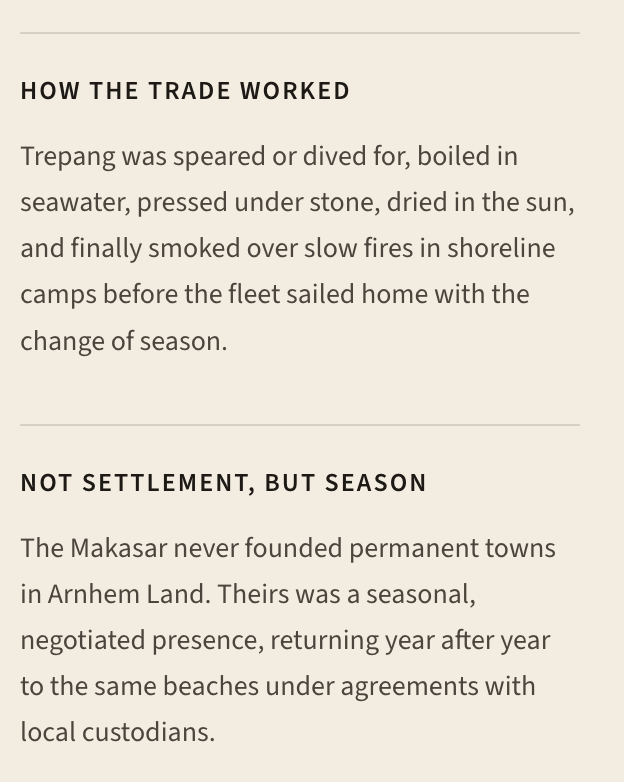
The visitors were not soldiers or colonists. They were trepang fishermen, Makassarese and Bugis seafarers, joined over time by Sama-Bajau sea nomads, in search of taripaŋ, the sea cucumber prized in Chinese medicine and cuisine. From at least 1700 until 1907, hundreds of fishermen sailed each year from Makassar on the island of Sulawesi to the northern Australian coast, an area they called Marege', where they caught, boiled and dried trepang before selling it on to China. They camped along the Arnhem Land coast each season in temporary settlements of bamboo and matting, processed their catch in iron cauldrons on the beach, and sailed home before the winds turned.
This was not a one-sided visit. Anthropological studies indicate the Makassans negotiated with local Aboriginal people for the right to fish certain waters, trading cloth, tobacco, metal axes and knives, rice, and gin, while the Yolngu of Arnhem Land traded turtle-shell, pearls and cypress pine in return, and some Yolngu were themselves employed as trepangers. Some Aboriginal people travelled back to Sulawesi on the returning praus; oral and written accounts describe Aboriginal people moving to Indonesian islands alongside Asian fishermen as far back as the 1600s, and in 2023 nineteenth-century photographs of Yolngu people taken in Makassar were rediscovered, prompting a search for living descendants.
The relationship was largely peaceful and commercially fair on both sides. Anthropologist John Bradley has described the contact between the two groups as successful, noting that they traded together as equals, without racial judgement, though the record also includes documented conflicts, such as a fight described by the Makassan captain Daeng Rangka. The encounter left a visible mark on Yolngu material and ceremonial life. The Makassan visits had a significant impact on Aboriginal culture, and the influence ran in both directions, shaping Yolngu language, art, ceremony, and food.
Archaeology continues to push the timeline earlier. Excavations on Niiwalarra Island in the Kimberley, carried out with the Kwini people, have uncovered Makassan pottery and trepang-processing hearths, some dating activity back as far as the 1600s, complementing oral histories that long preceded formal historical documentation. Even the legendary "Baijini," pale-skinned figures who appear in Top End song-cycles as builders of stone houses and weavers of cloth, may be a folk memory of these much earlier Austronesian visitors, layered over centuries into myth.
*"They traded together. It was fair — there was no racial judgement."*John Bradley, anthropologist, on Makassan–Yolngu contact
Words that crossed the strait and stayed
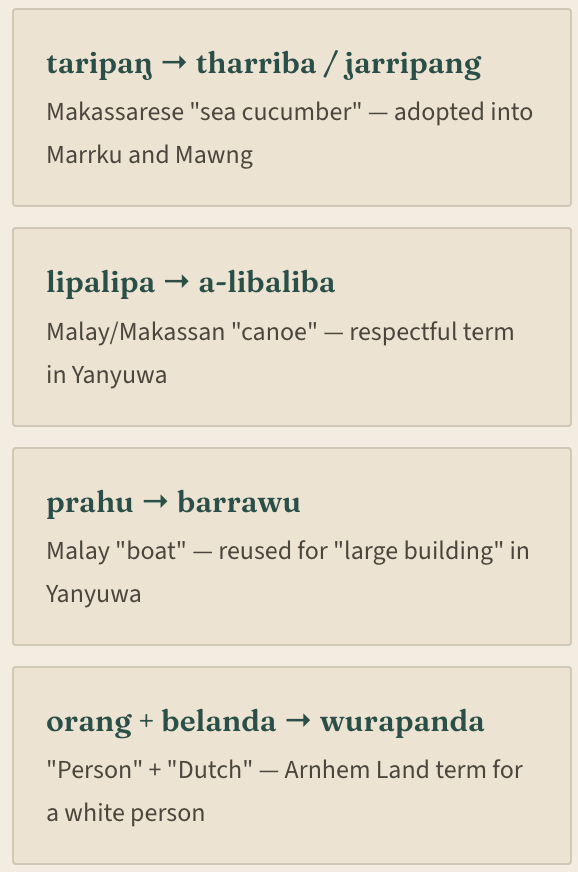
The deepest evidence of this contact is not in any museum. It survives in the mouths of Yolngu speakers today, in words borrowed from Makassarese, Buginese, and Malay centuries ago.
Linguists have spent over a century tracing these borrowings. For well over a century, scholars have been aware that some Aboriginal languages contain loanwords from languages spoken in the islands to the north of Australia, with early researchers describing the influence broadly as "Malay" before later, more precise scholarship identified it as specifically Makassan. The most thorough study, by Alan Walker and R. David Zorc, compiled words in the Yolngu-Matha language of northeast Arnhem Land considered loanwords from Makassarese, Buginese, and other Austronesian languages, analysing their phonetic adaptation and tracing their likely provenance.
The word for the prized commodity itself is the clearest case: the Makassarese word taripaŋ became tharriba in the Marrku language and jarripang in Mawng, carried directly into Aboriginal vocabularies along with the trade good it named. The influence reached beyond Arnhem Land too. Linguistic research into the Yanyuwa language of the southwest Gulf of Carpentaria has identified at least 22 words of Makassarese or Malay origin, including tharriba for trepang, a-libaliba for canoe derived from lipalipa, and barrawu, meaning a large building, derived from the Malay word for boat, prahu.
This was never just vocabulary. Three hundred years of seasonal contact left its mark on Yolngu language, art, ceremonial life, and cuisine, a depth of cultural exchange rarely afforded to a temporary, foreign, seasonal workforce. It is the oldest documented instance of sustained, peaceful economic contact between Aboriginal Australia and a foreign Asian people, and it predates the Australian Commonwealth by roughly two centuries.
Bahasa Indonesia in the Australian classroom
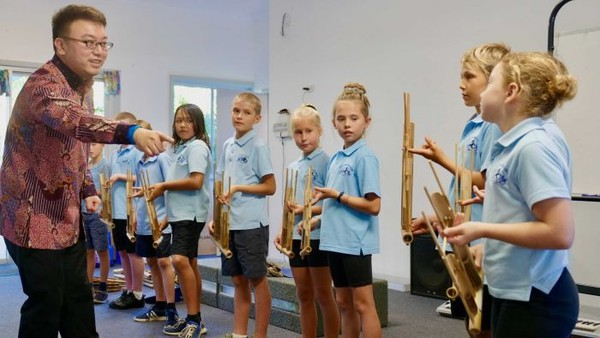
What Makassan sailors began through trade, Australian education tried to formalise through policy. The results have been a story of genuine ambition, followed by a stall that worries linguists, diplomats, and the Indonesian community alike.
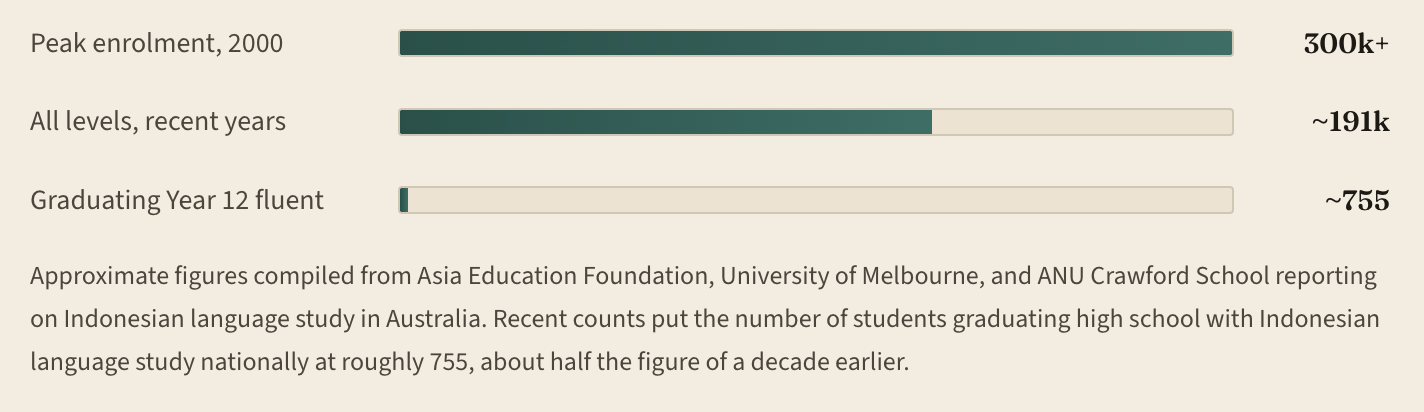
Since 1952, Indonesian has been among the most widely studied foreign languages in Australia, taught in some form for nearly seventy years. Its high-water mark came at the close of the twentieth century: in the 1980s and 1990s, Indonesian was taught widely across the country, with more than 300,000 students enrolled by the year 2000, supported by initiatives such as the National Asian Languages and Studies in Australian Schools Strategy. That strategy, along with its successor, the National Asian Languages and Studies in Schools Program, ran until 2012, after which education in Australia entered a sustained period of decline in national languages funding, professional development, and policy support.
The fall since has been steep and well documented. A 2010 report from Australian applied linguists found that the number of students taking Indonesian in Australian schools had been falling by at least 10,000 a year since 2001, and a 2021 independent study by linguist Michelle Kohler found enrolment dropping from around 14,000 students at the end of primary school to only about 350 by the end of high school. In Victorian public schools, just 3.3 percent of Year Eight Indonesian students in 2016 were still studying the language by Year 12 in 2020. Even flagship programs have closed: the long-running Indonesian studies course at Scotch College in Melbourne, a fixture of the field for decades, was discontinued, drawing comment from the Indonesian Embassy itself.
University-level study has followed the same curve. Registrations for Indonesian language courses at Australian universities fell 63 percent between their 1992 peak and 2019, and the University of Melbourne projected that by 2020 only twelve Australian universities would still offer Indonesian, down from twenty-two in 1992. Researchers point to structural causes rather than a lack of interest alone: in the absence of a specific national language-in-education policy, schools have leaned on general curriculum policy for guidance, which cannot resolve the deeper questions of program funding, staffing, and teacher training that actually keep a language alive in a school. Languages typically become optional after Year 8 in most Australian states and territories, and that single structural fact produces the sharpest enrolment cliff in the entire system.
The two governments have not stood by silently. On 6 December 2025, the Embassy of the Republic of Indonesia in Canberra, together with Australia's Ministry of Primary and Secondary Education, the Australia–Indonesia Institute, the ANU School of History and Languages, and the ANU Indonesia Project, hosted the first Australian Congress for Indonesian Language at the Australian National University, opened by Indonesian Ambassador Dr Siswo Pramono and Australian Ambassador Rod Brazier, bringing together educators, policymakers, and community organisations to strengthen the language's long-term sustainability. A new generation of advocacy has also taken a more practical, classroom-facing shape: the Asia Education Foundation's Indonesian Language Learning Ambassadors initiative now links Australia Awards alumni directly into Australian schools seeking native Indonesian-speaking support, treating returning scholars as a teaching resource as much as a diplomatic one.
A partnership measured in people, not just trade
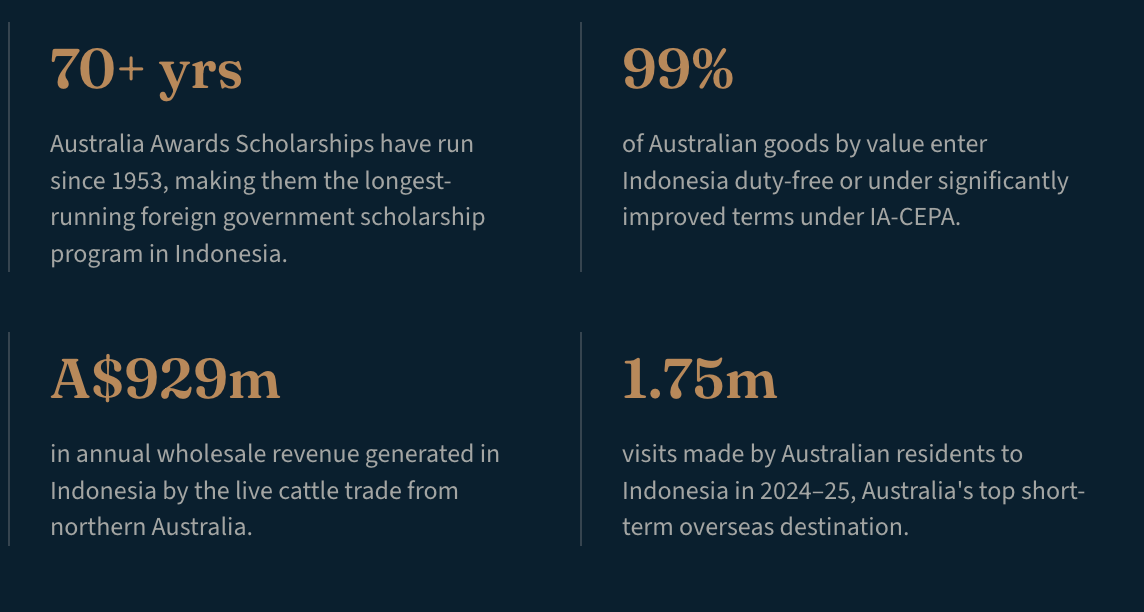
Five places the partnership is being built today
Under the bilateral Comprehensive Strategic Partnership, both governments have committed to expanding and deepening cooperation across trade, energy, agriculture, health, and education. Here is where that commitment is taking concrete shape.
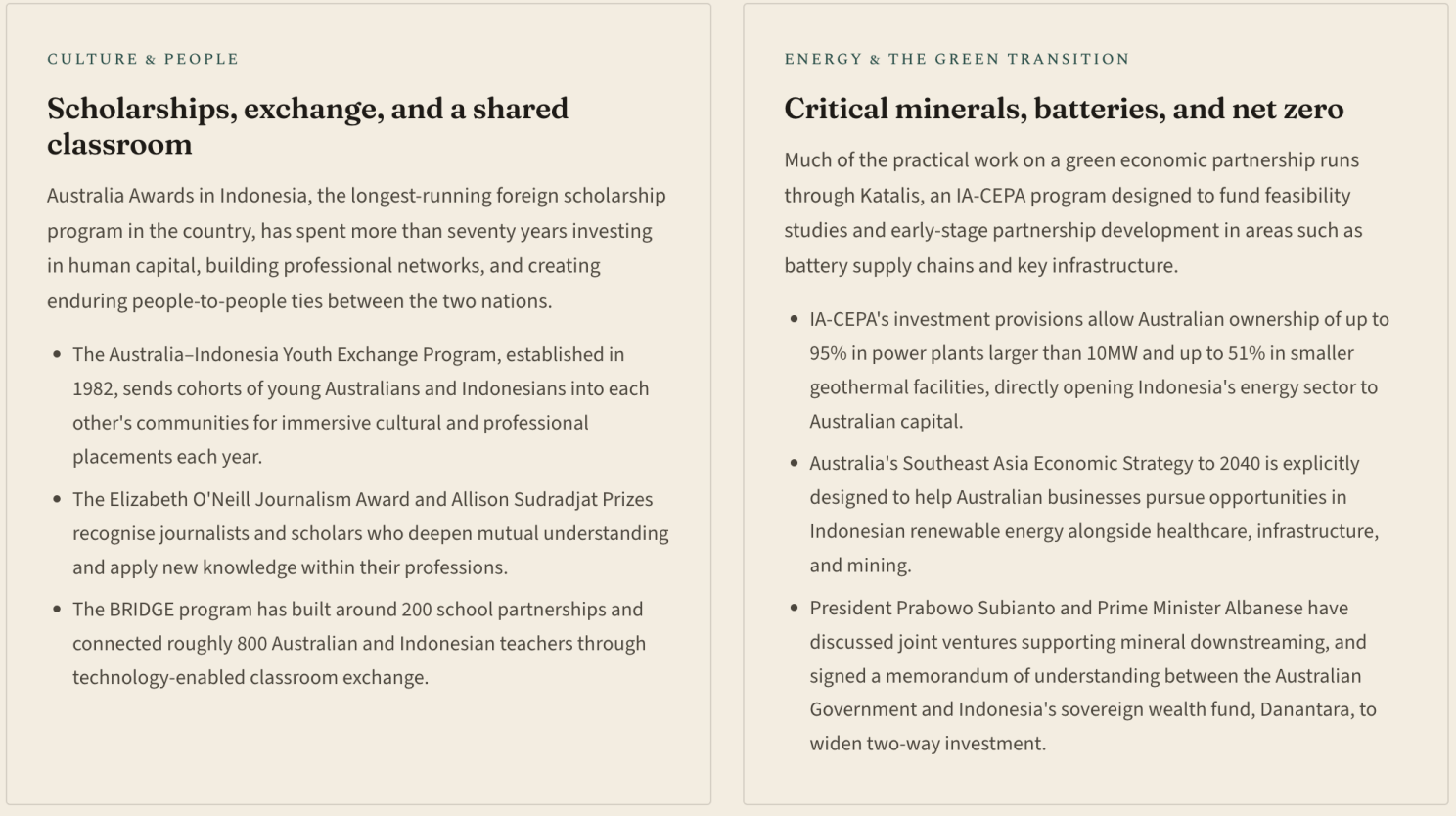
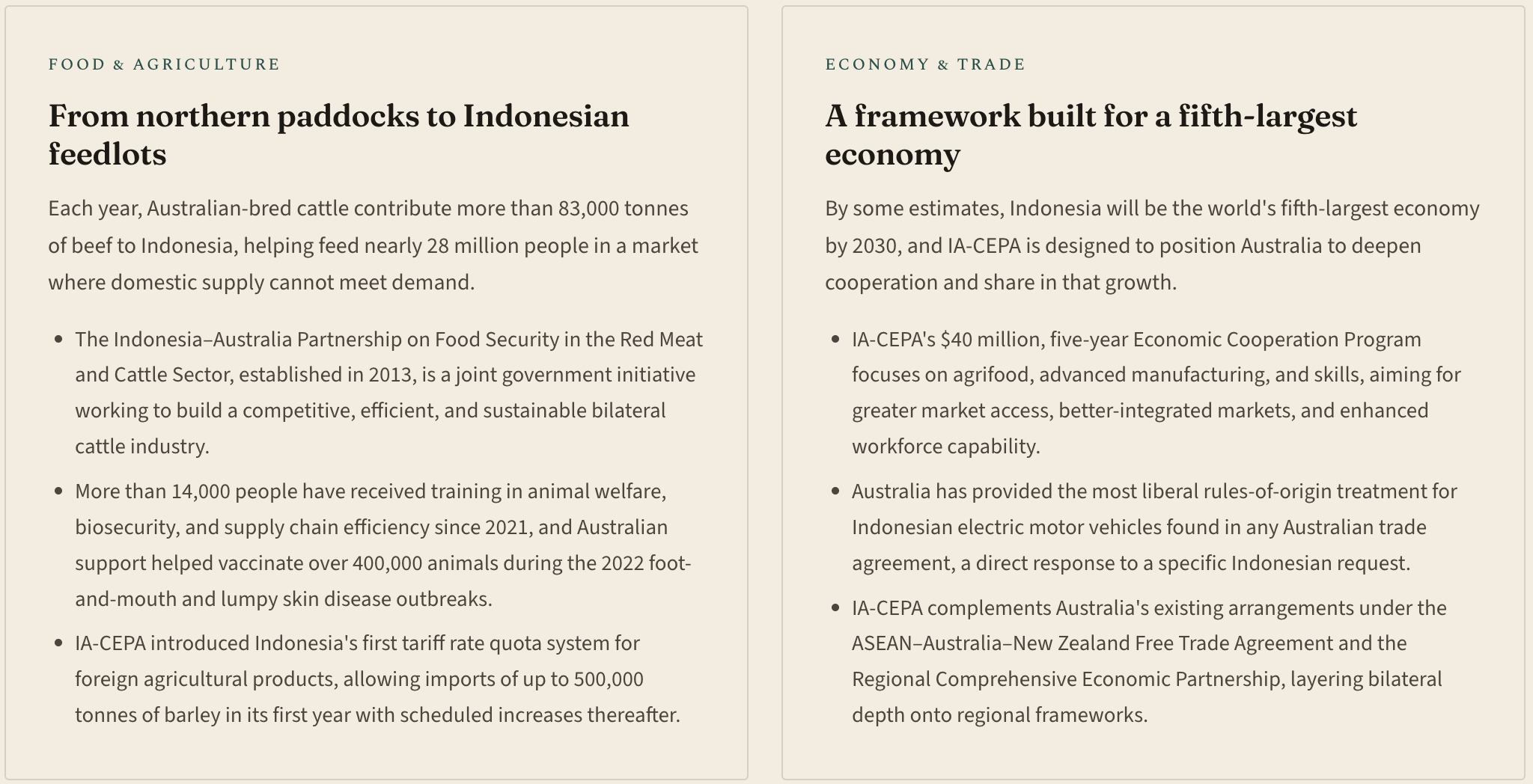
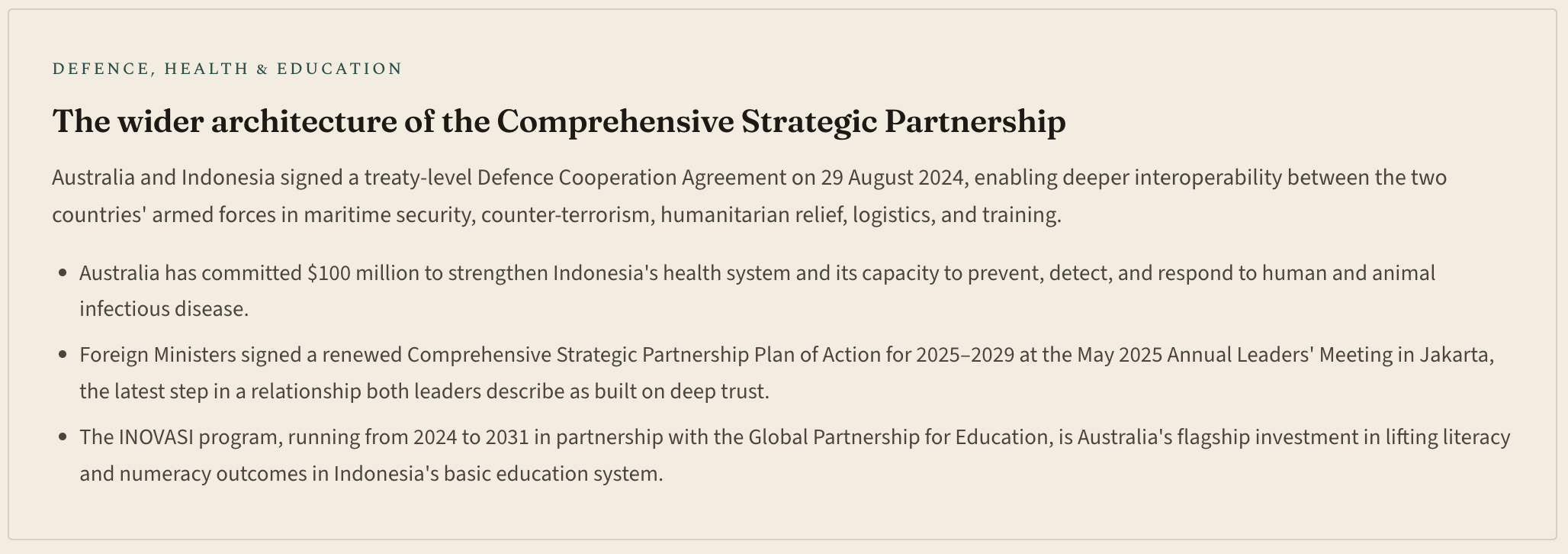
The same monsoon that once carried praus from Makassar to Marege' now carries cattle ships, scholarship cohorts, and trade delegations across the same stretch of water, on a schedule set by policy instead of wind.
At their 2025 Annual Leaders' Meeting, President Prabowo Subianto and Prime Minister Anthony Albanese explicitly recognised people-to-people ties as being at the heart of the bilateral relationship, tracing those connections back to trade between Makassan seafarers and the First Nations people of Australia as evidence of a bond that is long-standing and built on mutual respect. It is a rare thing for two heads of government to reach past a century of formal diplomacy and credit a relationship's foundation to fishermen and the Yolngu families who traded with them. But the citation is accurate. Whatever Australia and Indonesia build next, in clean energy corridors, in classrooms, in cattle yards and container ports, they are building on a crossing that the wind opened first.
#AustraliaIndonesia #IACEPA #AustraliaAwards #BahasaIndonesia #IndoPacific #DiplomaticHistory #YolnguCulture #MakassanTrade #ComprehensiveStrategicPartnership #FoodSecurity #EnergyTransition #SoutheastAsia #Infraloka #RahmatanLilAlamin #CulturalDiplomacy #BilateralRelations
References
Sources consulted in the research and drafting of this article, listed by subject area.
- Wikipedia. "Makassan contact with Australia." en.wikipedia.org/wiki/Makassan_contact_with_Australia
- Kiddle. "Makassan contact with Australia facts for kids." kids.kiddle.co
- Taylor & Francis Online. "The Macassan–Aboriginal relationship and the Commonwealth of Australia, 1901–1906." tandfonline.com
- National Museum of Australia. "Trade with the Makasar." Defining Moments Digital Classroom. nma.gov.au
- EBSCO Research Starters. "Sulawesi Traders Make Contact with Australian Aborigines." ebsco.com
- Taylor & Francis Online. "An historical reassessment of the maritime Southeast Asian forest and marine commodities trade." tandfonline.com
- Dash, Mike. "Dreamtime voyagers: Aboriginal Australians in early modern Makassar." A Blast From the Past. mikedashhistory.com
- Walker, Alan & Zorc, R. David. "Austronesian Loanwords in Yolngu-Matha of Northeast Arnhem Land." Aboriginal History, 2011. docplayer.net
- Walker, Alan & Zorc, R. David. "Austronesian loanwords in Yolngu-Matha of northeast Arnhem Land." ANU Press. press-files.anu.edu.au
- ResearchGate. "Austronesian loanwords in Yolngu-Matha of northeast Arnhem Land." researchgate.net
- Semantic Scholar. "Austronesian Loanwords in Yolngu-Matha of Northeast Arnhem Land." semanticscholar.org
- University of Melbourne, Pursuit. "Creativity and crisis: Teaching Indonesian in Australian schools." pursuit.unimelb.edu.au
- ANU Crawford School of Public Policy. "Preserving Indonesian Language Studies in Australian Schools." crawford.anu.edu.au
- University of Melbourne, Pursuit. "Indonesian matters in our schools." pursuit.unimelb.edu.au
- Australian Institute of International Affairs. "From Sate to Sour: Why Indonesian Studies Lose Flavour After Year Eight." internationalaffairs.org.au
- ANU Student Research Journal. "Indonesian language education in Australian high schools." studentjournals.anu.edu.au
- Academia.edu. "The current state of Indonesian language education in Australian schools." academia.edu
- Asian Studies Association of Australia. "Why Study Indonesian? A Rationale for Australian Education." asaa.asn.au
- ANU College of Asia & the Pacific. "Preserving Indonesian Language Studies in Australian Schools." asiapacific.anu.edu.au
- The Conversation. "Fewer Australians are learning Indonesian, and Indonesia could do far more to fix that." theconversation.com
- Australia Awards Indonesia. Official program site. australiaawardsindonesia.org
- Australian Embassy Jakarta. "Applications for Australia Awards Scholarships opening 1 February." indonesia.embassy.gov.au
- DFAT. "Australia Awards scholarships in Indonesia." dfat.gov.au
- Australian Embassy Jakarta. "Applications Open for the Australia Awards Scholarships." indonesia.embassy.gov.au
- DFAT. "Indonesia Australia Awards intake information." dfat.gov.au
- DFAT. "Scholarships and Fellowships" (Australia Awards Indonesia). indonesia.embassy.gov.au
- DFAT. "Australia-Indonesia Youth Exchange Program." dfat.gov.au
- International Energy Agency. "Indonesia-Australia Comprehensive Economic Partnership Agreement – Policies." iea.org
- DFAT. "Indonesia-Australia Comprehensive Economic Partnership Agreement." dfat.gov.au
- Austrade. "Indonesia-Australia Comprehensive Economic Partnership Agreement (IA-CEPA)." austrade.gov.au
- DFAT. "Indonesia-Australia Comprehensive Economic Partnership Agreement: Outcomes." dfat.gov.au
- Wikipedia. "Indonesia–Australia Comprehensive Economic Partnership Agreement." en.wikipedia.org
- Independent Australia. "The Australia-Indonesia green economic opportunity." independentaustralia.net
- Foreign Policy Talks. "Why Australia and Indonesia Must Deepen Agricultural Cooperation." foreignpolicytalks.com
- Indonesia Australia Red Meat and Cattle Partnership. Official site. redmeatcattlepartnership.org
- Meat & Livestock Australia. "Indonesia partnership underpins northern profitability." mla.com.au
- Lowy Institute. "Australia has a solution to Indonesia's soaring food prices." lowyinstitute.org
- Australian Department of Agriculture, Fisheries and Forestry. "Indonesia-Australia Partnership on Food Security in the Red Meat and Cattle Sector." agriculture.gov.au
- Meat & Livestock Australia. "Indonesia Live Cattle Industry Taskforce." mla.com.au
- Australian Embassy Jakarta. "Strengthen Our Agricultural Partnership." indonesia.embassy.gov.au
- Wiley Online Library. "Australian–Indonesian Live Cattle Trade—What Future?" Agricultural Economics. onlinelibrary.wiley.com
- Meat & Livestock Australia. "Livestock export R&D overview." mla.com.au
- Prime Minister of Australia. "2025 Annual Leaders' Meeting Joint Communique." pm.gov.au
- ASEAN Wonk. "Expanded Australia-Indonesia Talks in Prabowo Albanese Meet." aseanwonk.com
- Sekretariat Kabinet Republik Indonesia. "Indonesia, Australia Strengthen Strategic Partnership on Food Security, Mineral Downstreaming, Global Education." setkab.go.id
- Anthony Albanese, Prime Minister of Australia. "2025 Annual Leaders' Meeting Joint Communique." anthonyalbanese.com.au
- Prime Minister of Australia. "Investing in the Australia–Indonesia relationship." pm.gov.au
- Sekretariat Kabinet Republik Indonesia. "Indonesia, Australia Agree to Enhance Strategic Cooperation." setkab.go.id
- DFAT. "Indonesia country brief." dfat.gov.au
- Ministry of Foreign Affairs, Republic of Indonesia. "2025 Annual Leaders' Meeting Joint Communique" (PDF). kemlu.go.id