
The Paper Wall: why a university can't be built in a month, Case Study of Abil Sudarman School of Artificial Intelligence and Kampus Malaka By Ferry Irwandi
Two founders without a completed undergraduate degree are both, right now, trying to build something Indonesian law calls a "perguruan tinggi." This is a walk through every door they'd have to knock on, every regulation that stands in the way, and how long the real version of this actually takes.
"We'll build a university." It sounds like a sentence. It is actually a five-agency permission chain.
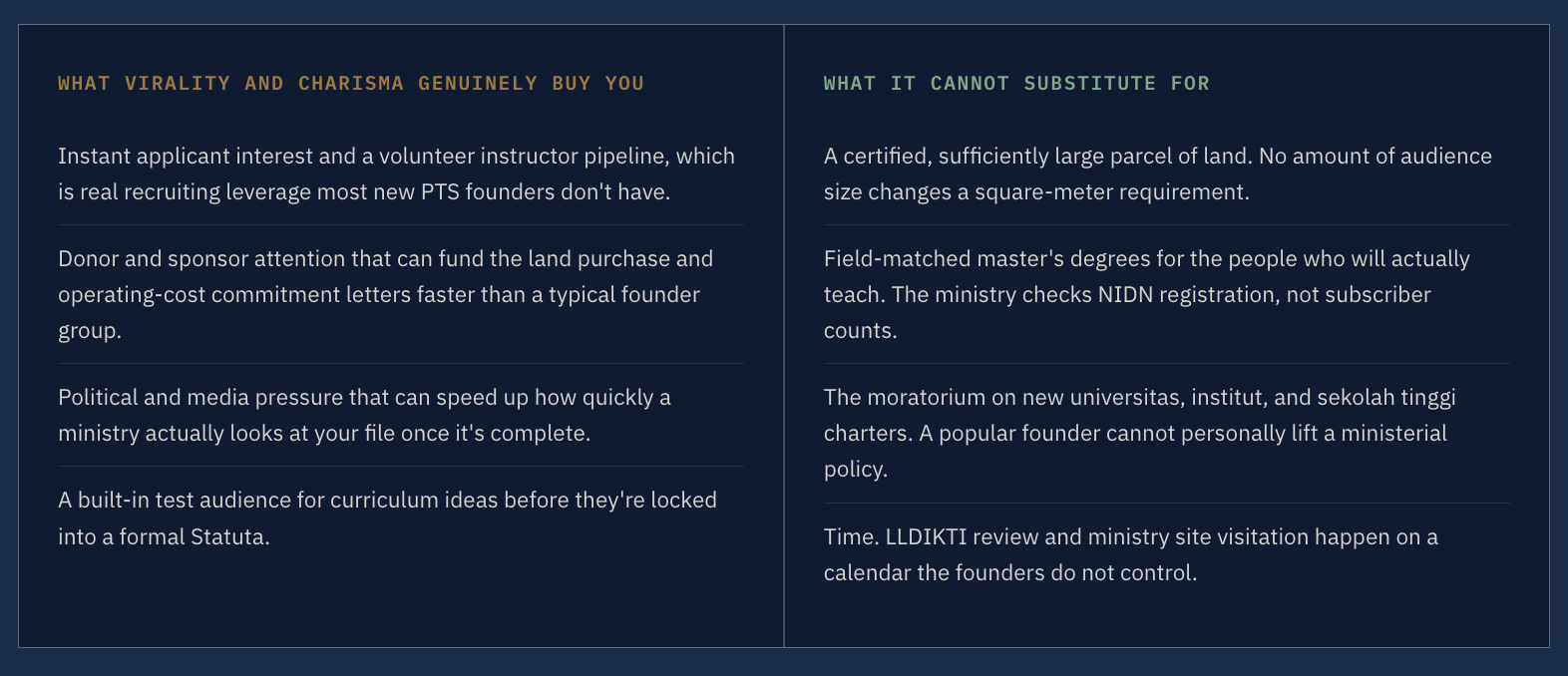
In Indonesia, the word universitas is not a brand you can put on a building. It is a legal status, granted by the national government, that requires a non-profit legal entity, a notarized land certificate, a minimum faculty roster with verified graduate degrees, an institutional accreditation score, and a ministerial decree, in that order. None of those five things can be skipped, rushed past a checklist, or substituted with audience size, content virality, or founder charisma.
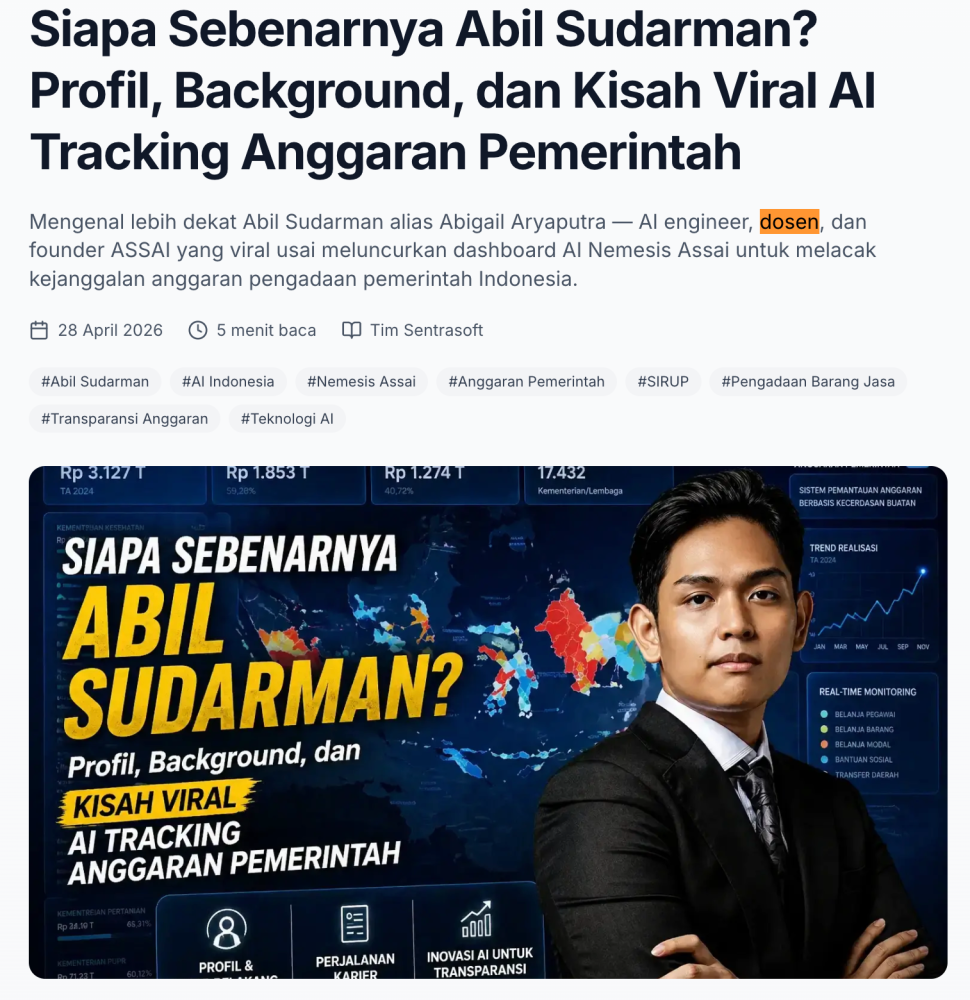
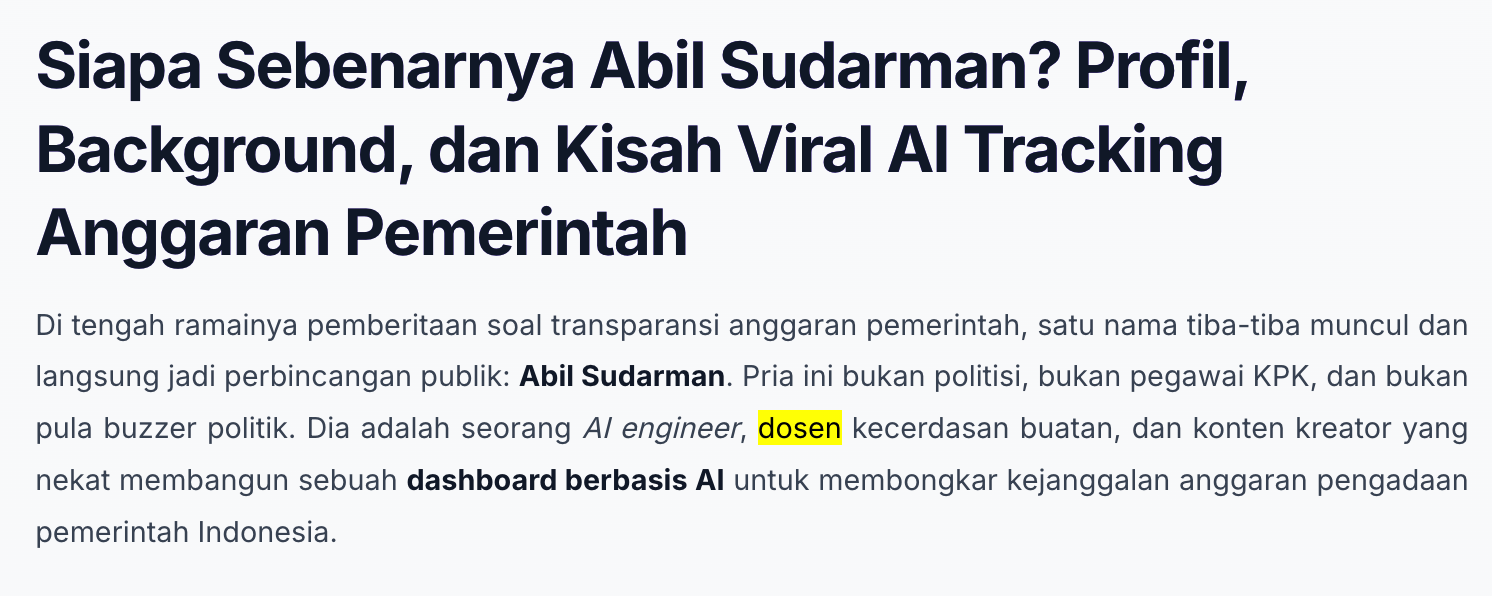
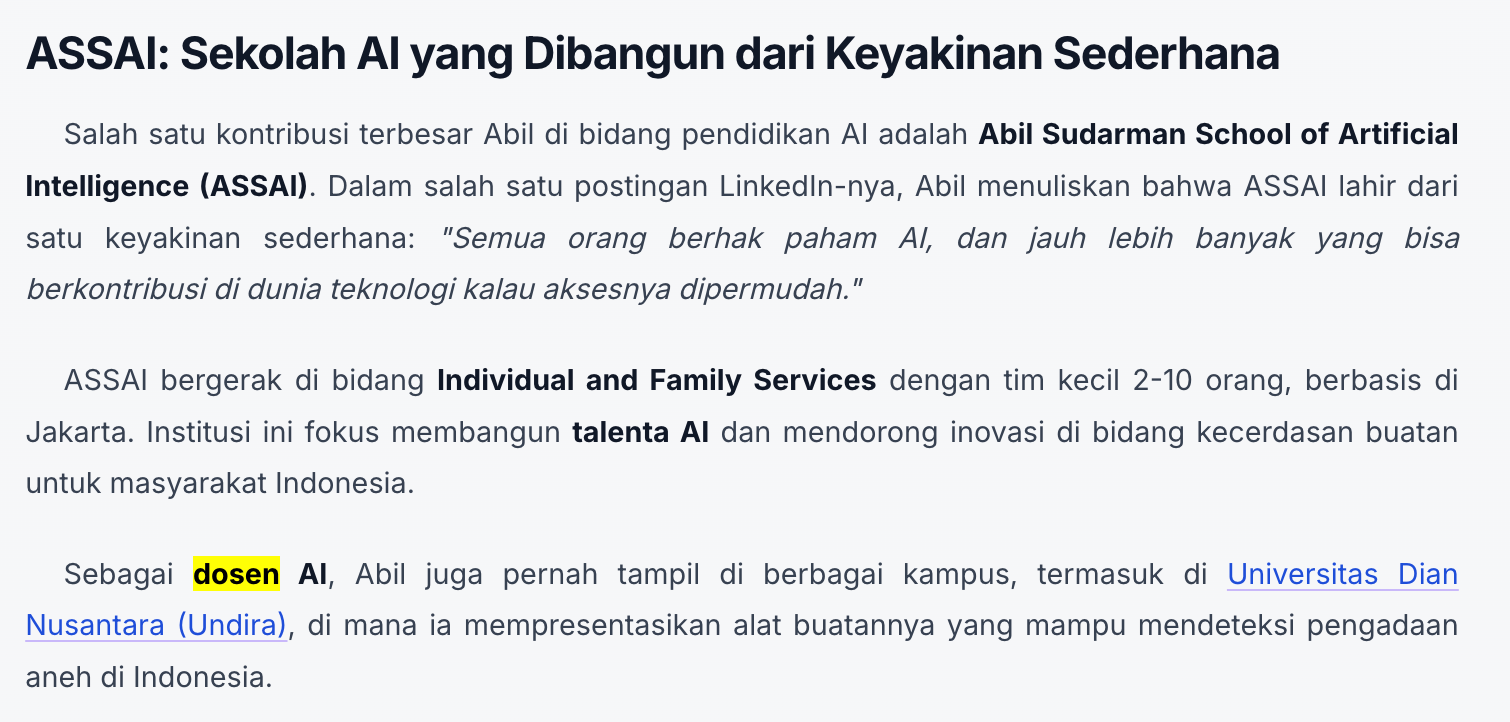
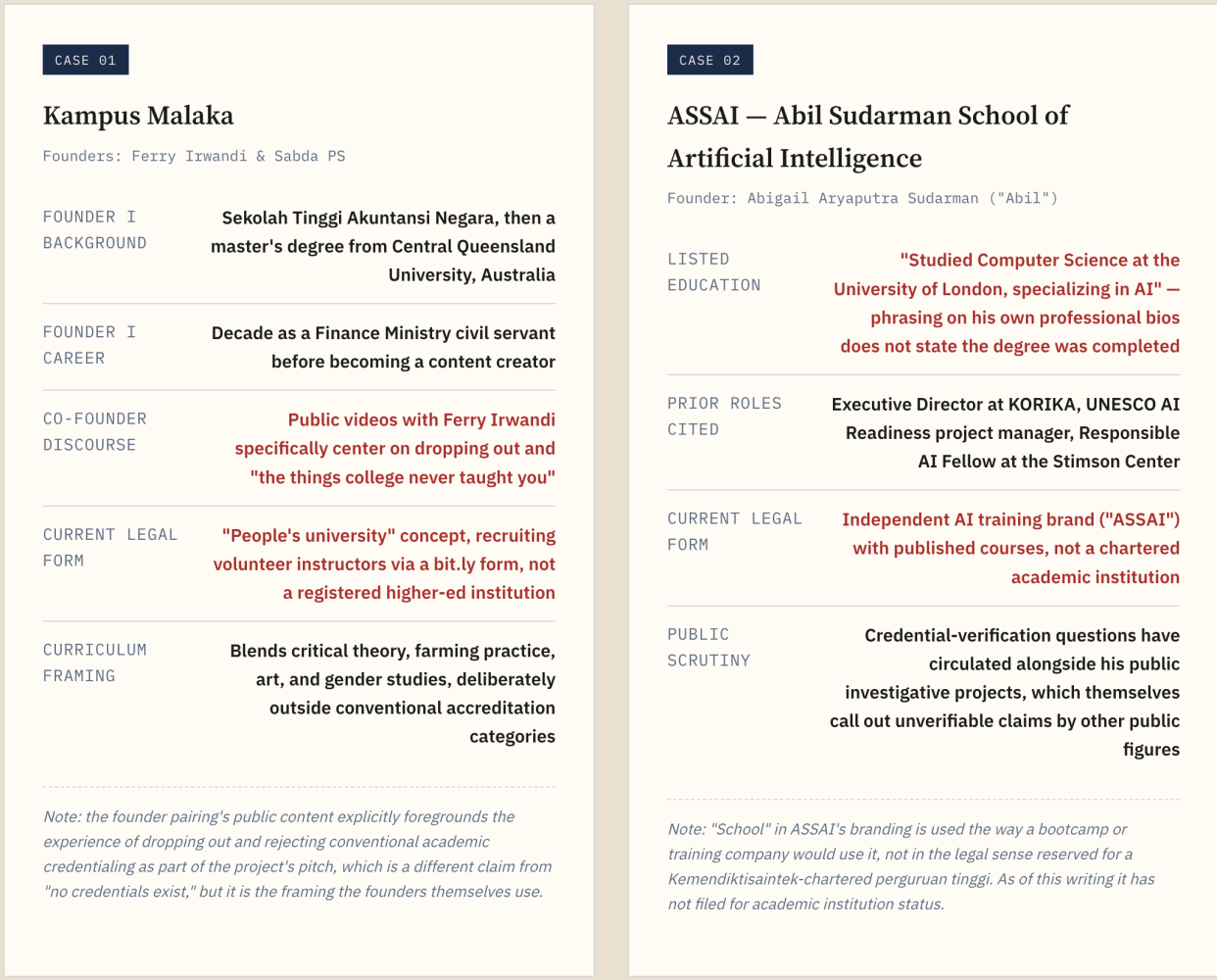
That matters right now because two of Indonesia's most visible new education ventures, Kampus Malaka (founded by content creator Ferry Irwandi and Sabda PS) and the Abil Sudarman School of Artificial Intelligence, ASSAI, are both being built and discussed in public by founders whose own undergraduate credentials are unverified or incomplete. Neither problem, the bureaucracy or the credentials, is hidden. Both are searchable. This page lays out exactly what stands between "we have an idea and a following" and "we are a legally recognized perguruan tinggi," using these two ventures as the worked example.
Two ventures, two unverified credentials, one regulatory wall ahead
Neither project has filed for, or received, an operating license from Indonesia's higher-education ministry as of this writing. Both are presently legal as media brands, communities, or training programs, categories with essentially no entry barrier. The wall appears the moment either one tries to call itself a university.
Seven regulations you cannot route around
Every requirement below traces to a specific, currently active Indonesian regulation. None of these are guidelines; each is the binding instrument a ministry cites when it rejects an application.
UU No. 16/2001 & UU No. 28/2004
**Foundation Law (Yayasan)**Defines how a non-profit legal foundation is created, who its organs are (founders, supervisors, management board), and what happens to its assets. A university cannot legally exist without a Badan Penyelenggara, foundation or association, sitting above it as the legal owner.
Permenkumham No. 2/2016 & No. 13/2019
Foundation Registration ProcedureSets out exactly how a foundation applies for legal-entity status through Kemenkumham's AHU Online system: name reservation, notarized deed, supporting documents, then ministerial ratification. This is the gate before the education-specific gate.
UU No. 12/2012
Higher Education LawThe umbrella statute defining what a perguruan tinggi legally is, the academic and vocational tracks, and the government's authority to set minimum standards (SN-Dikti) that every institution must meet before and after opening.
PP No. 4/2014
Higher Education ImplementationImplements UU 12/2012 with operational detail, including the lecturer-to-student ratio standard, 1:20 for exact sciences, 1:30 for social sciences, that institutions must hold to remain compliant after launch.
Permendikbud No. 7/2020
Establishment, Change, and Closure of PTN/PTSThe core regulation institutions are actually licensed under today. Specifies the Badan Penyelenggara's legal documents, the land certificate, the audited or self-declared financial capacity statement, and the signed commitment letters from prospective permanent lecturers, all of which must be bundled before a single application is filed.
Permendikbud No. 84/2013
Appointment of Permanent LecturersGoverns how a private institution appoints dosen tetap, including the requirement that they work a fixed 37.5 hours a week for that institution alone and hold a registered NIDN, a national lecturer identification number issued only after credentials are verified by the ministry's own database.
Kepmendiknas No. 234/U/2000 (as amended)
Guidelines for Establishing Higher Education InstitutionsThe original founding guideline, still cited as the basis for lecturer-ratio standards and minimum program-of-study counts: at least three study programs to be chartered as a universitas, two for a sekolah tinggi, academy, or polytechnic.
Before anything can be filed, a founder has to clear a minimum package, not an ideal one, since falling short on a single requirement gives LLDIKTI grounds to bounce the application back unread.
The legal entity must be a ratified Yayasan or Perkumpulan, since Indonesian law forbids a for-profit company or an unincorporated community group from operating a degree-granting institution, making the non-profit principle structural rather than optional.
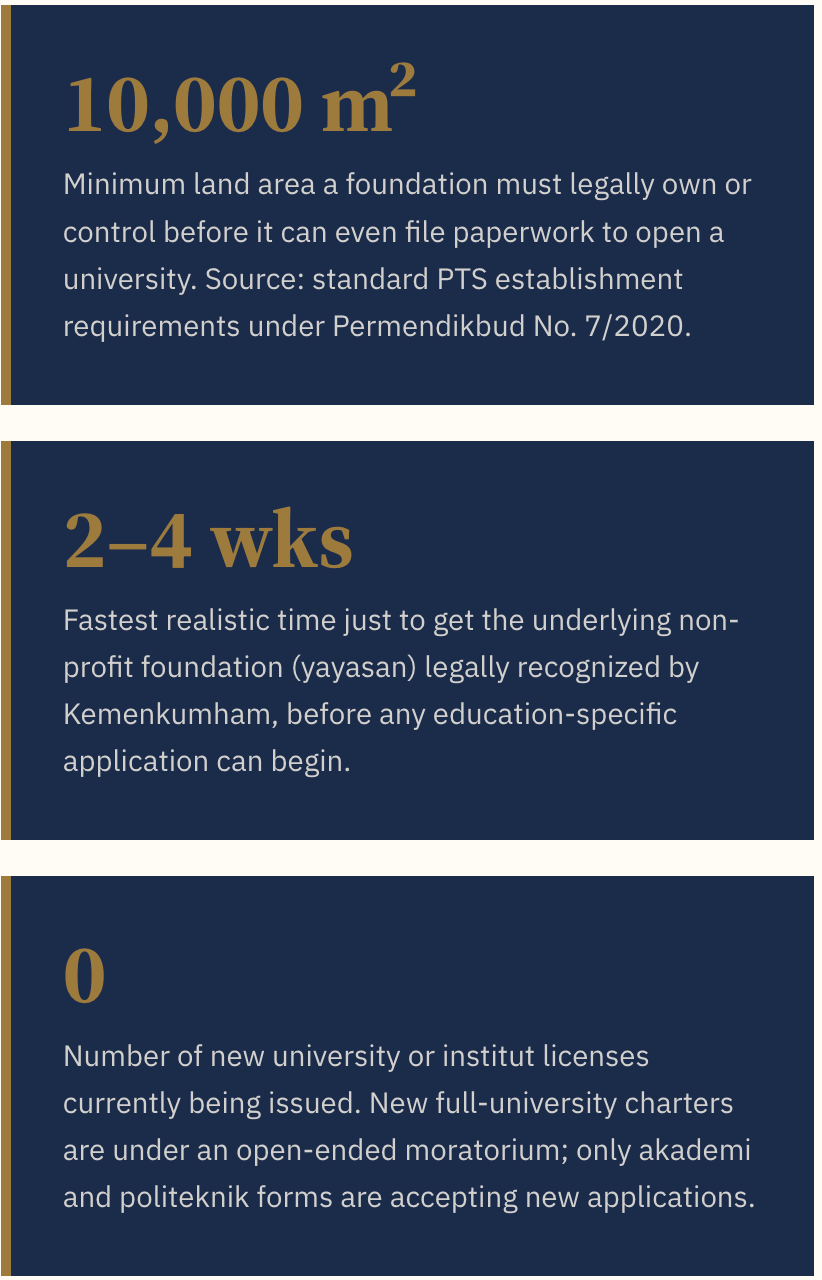
Land ownership must be certified (SHM or HGB) rather than leased, at 10,000 m² for a universitas, 8,000 m² for an institut, or 5,000 m² for an akademi, sekolah tinggi, or politeknik, demonstrating the institution isn't a pop-up that could disappear after one enrollment cycle.
The institution needs at least three study programs to open as a universitas (two for other forms), since a single course or bootcamp track doesn't meet the legal definition of higher education.
Each program needs a minimum of five permanent lecturers, at least three of them registered dosen tetap with a NIDN, guaranteeing a baseline of qualified full-time academic staff exists before a single student enrolls rather than being hired reactively afterward. Those lecturers must hold at least a master's degree (S2) field-matched to what they teach, since that credential is what the law actually polices, applying to staff rather than founders, given that no institution can be chartered around founders alone.
Financial capacity must be demonstrated through a signed commitment (audited if the Badan Penyelenggara is more than three years old) to cover both investment and operating costs, preventing a charter from being granted to an entity that can't survive its first accreditation cycle.
A full set of institutional documents, including the Statuta, RIP (master development plan), academic master plan, and internal quality assurance system, must be in place, since these are what BAN-PT and the ministry use to judge whether the institution can self-regulate once operating.
An LLDIKTI recommendation is also required, covering a regional track record review, a program saturation check, and a viability assessment of whether the area already has enough capacity in that field and whether this particular founder group has the track record to sustain it.
Finally, of the available institutional forms, only akademi and politeknik are currently open to new applicants.
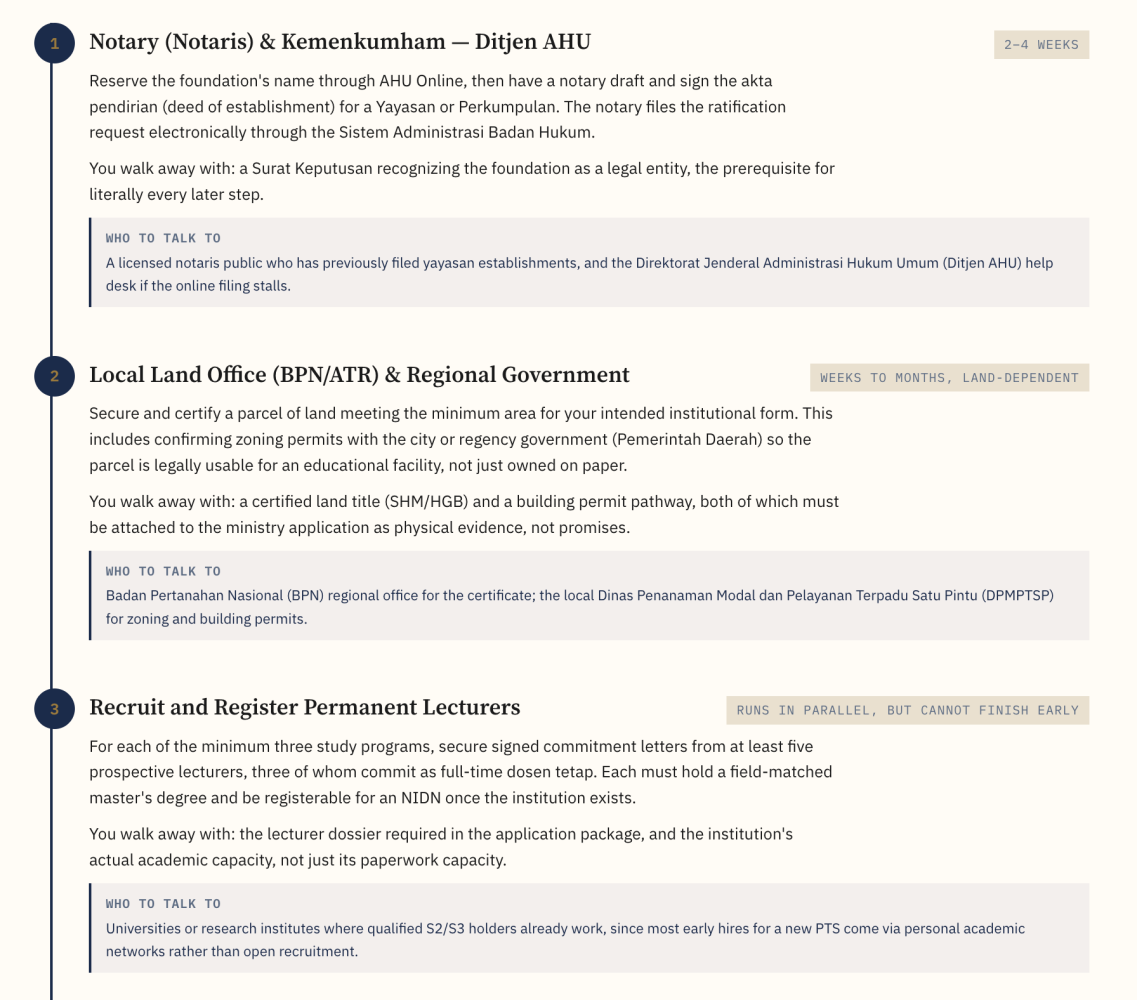
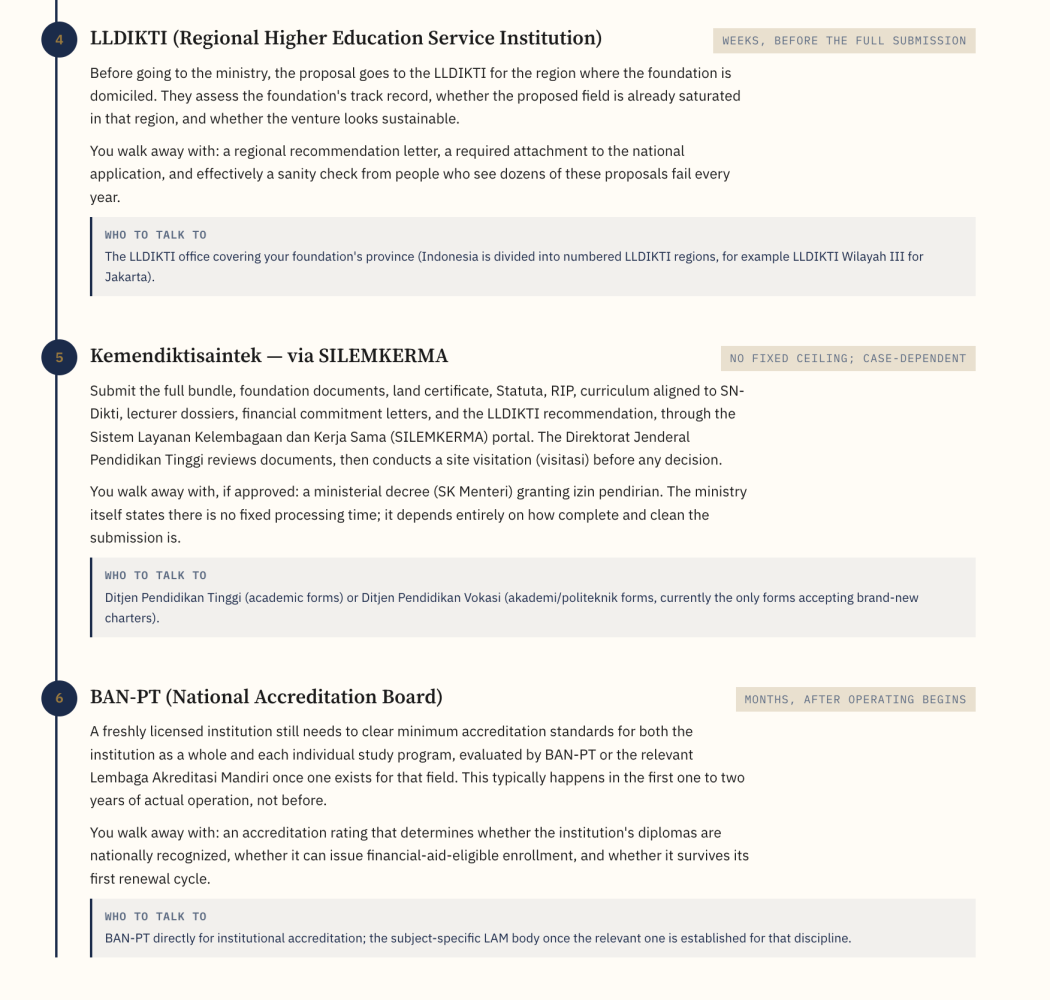
Six doors, in order. You cannot knock on door three before door one answers.
This is the literal sequence of institutions a founder has to engage, who specifically at each one, and what they walk away with before moving to the next door.
What a content following actually substitutes for, and what it cannot touch
Three ways founders try to compress the timeline, and what actually happens
"Launch as a community or bootcamp first, convert to a university later."
Legally sound, but it does not compress anything. A training brand, course platform, or "people's university" concept can launch immediately because it carries zero higher-education licensing burden, which is exactly why it isn't a university yet. Converting that brand into a chartered PTS later still means starting the full sequence on this page from step one: foundation, land, lecturers, LLDIKTI, ministry. The early brand only buys audience and funding, not regulatory progress.
Verdict: valid strategy, zero time saved on the legal process itself
"Acquire or merge with an existing, already-licensed PTS instead of starting fresh."
This is the one real structural shortcut in the system. Because brand-new universitas and institut charters are under moratorium, the realistic fast path for anyone wanting that exact legal form is a perubahan bentuk, taking over or merging with an existing, already-accredited private institution and rebranding it, rather than filing for a new charter that the ministry currently will not issue. This still involves due diligence, an existing foundation's legal transfer, and ministry approval of the change, typically several months, but it is meaningfully faster than the 18 to 30 month new-charter path and is the route most serious operators actually take.
Verdict: the legitimate fast lane, still measured in months, not weeks
"Self-declare faculty credentials and clean it up after approval."
This is the one move that doesn't just slow things down, it ends the application. NIDN registration cross-checks against the ministry's own academic records (Forlap/PDDikti) and degree-granting institutions. A lecturer dossier built on unverifiable or padded credentials is also the single most common reason LLDIKTI or the ministry sends a submission back, and repeated bad-faith submissions are explicitly grounds, under the governing regulations, for the ministry to simply stop processing further applications from that Badan Penyelenggara.
Verdict: not a shortcut, an exit from the process entirely
References
Compiled and verified 17 June 2026. Regulatory citations refer to the legal instruments as currently published; always confirm against the live SILEMKERMA and AHU Online portals before filing, since procedural detail pages are updated by the ministries without separate public notice.
- Disway — "Ferry Irwandi, Dari Konten Kreatif hingga Membangun Perguruan Tinggi Malaka"Profile covering Ferry Irwandi's transition from content creation to founding Perguruan Tinggi Malaka with Sabda PS.
- Wikipedia Bahasa Indonesia — Ferry IrwandiBiographical reference including STAN and Central Queensland University education history.
- Jurnal Aceh / Pikiran Rakyat — "Ferry Irwandi dan Malaka Project: Kisah di Balik Impian Membangun Kampus Rakyat"Coverage of the "people's university" concept and curriculum framing for Kampus Malaka.
- Hypeabis — "Profil Ferry Irwandi, dari PNS Kemenkeu Menjadi Kreator Konten dan CEO Malaka Project"Background on the founder's prior civil service career and scholarship program design.
- Ruang.id — "Membongkar Paradigma Pendidikan: Ferry Irwandi dan Misi 'Gila' di Balik Kampus Malaka"Reporting on Kampus Malaka's March 2026 instructor recruitment window.
- LinkedIn — Abil S., Founder of Abil Sudarman School of Artificial IntelligenceSelf-reported professional profile listing University of London education and prior KORIKA, UNESCO, and Stimson Center roles.
- Stimson Center — Abigail Aryaputra SudarmanInstitutional bio stating he "previously studied Computer Science at the University of London," without confirming degree completion.
- ASSAI — Official SiteASSAI's own description of its mission, curriculum, and current operating form as an AI training platform.
- Ridwan Institute — "Syarat Mendirikan Perguruan Tinggi Terbaru"Overview of current legal-entity, land, and academic planning requirements for new PTS.
- EDC — "Syarat Pendirian Perguruan Tinggi Swasta"Source for current land-area minimums by institutional form and the active moratorium on new universitas/institut charters.
- EDC — "Syarat Pendirian Institut Terbaru 2026"Definitions of Badan Penyelenggara and Pendirian PTS under the governing ministerial regulation.
- Jogloabang — Permendikbud No. 7 Tahun 2020, full text summaryPrimary source for foundation document requirements, land certificate rules, and lecturer commitment letter obligations.
- LLDIKTI Wilayah VII (Kopertis 7) — "Sistem Layanan Rekomendasi Pembukaan Program Studi Baru dan Pendirian PTS Baru"Official 2026 requirements notice for new study program and new PTS recommendation submissions.
- Dunia Dosen — "Syarat Dosen Tetap Yayasan yang Perlu Anda Ketahui"Source on Permendikbud No. 84 Tahun 2013 governing appointment of permanent (non-civil-servant) lecturers.
- Dunia Dosen — "Rasio Dosen dan Mahasiswa Ideal, Berapa Besarannya?"Source for the 1:20 and 1:30 lecturer-to-student ratio standards under UU No. 12/2012 and PP No. 4/2014.
- Universitas Padjadjaran — "Instrumen Pemenuhan Syarat Akreditasi Minimum Program Studi Baru"Official BAN-PT-aligned instrument specifying the minimum five-lecturer, three-permanent-lecturer threshold per new study program.
- Kontrak Hukum — "Apa Saja Syarat Mendirikan Yayasan?"Step-by-step description of the AHU Online name reservation and notarized deed process under UU No. 16 Tahun 2001.
- Valeed — "Syarat Mendirikan Yayasan Terbaru dan Lengkap Sesuai Hukum di Indonesia"Source for the realistic two-to-four-week Kemenkumham foundation ratification timeline.
- Direktorat Jenderal Administrasi Hukum Umum, Kementerian Hukum dan HAM RI — FAQ YayasanOfficial government source confirming Permenkumham No. 2 Tahun 2016 and No. 13 Tahun 2019 as the governing foundation-registration regulations.