
The Phantom CEO Problem: When Gen Z Plays Founder Without the Substance: Abil Sudarman, Marchel Shevchenko, and Muhammad Alif Ramadhan
On credential inflation, the Dunning-Kruger trap, and why dropping out only works when you actually have something to drop out for.
Indonesia has a phantom CEO problem. And it is getting worse.
Scroll through LinkedIn on any given day and you will find rows of profile cards: 20-year-olds declaring themselves "Founder and CEO," "Chief Executive Officer," and "Visionary Leader" of companies with zero registered capital, zero employees, and zero verifiable track record. The grammar of ambition without the grammar of accountability.
Recently, I came across three biodata records that stopped me cold. Three young men, all listed in Indonesian university systems, all apparently claiming some form of executive identity in digital spaces. Let me show you what the records say, not what they claim:
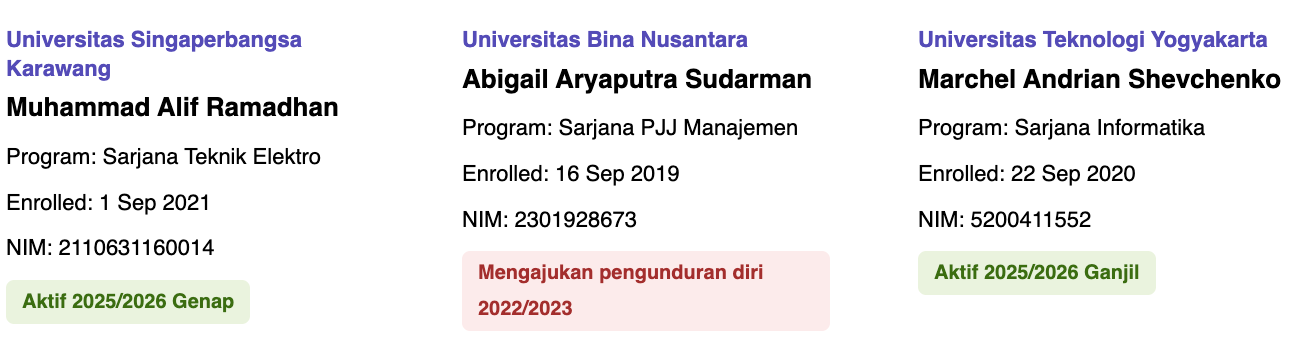
Two of them are still enrolled as undergraduates. One withdrew from university in the 2022/2023 odd semester, making him a dropout, not a graduate. None of them, according to the official academic records I am referencing, holds a completed degree. Yet somewhere on the internet, they wear the "CEO" title like a uniform.
The "Bill Gates Defense" and Why It Does Not Apply Here
I already know the counterargument. Someone is going to invoke the holy trinity: Bill Gates, Mark Zuckerberg, Sam Altman. All dropouts. All worth billions. Therefore dropout equals visionary and anyone who questions credentials is simply afraid of ambition.
Let us be precise about what these men actually were before they left school.
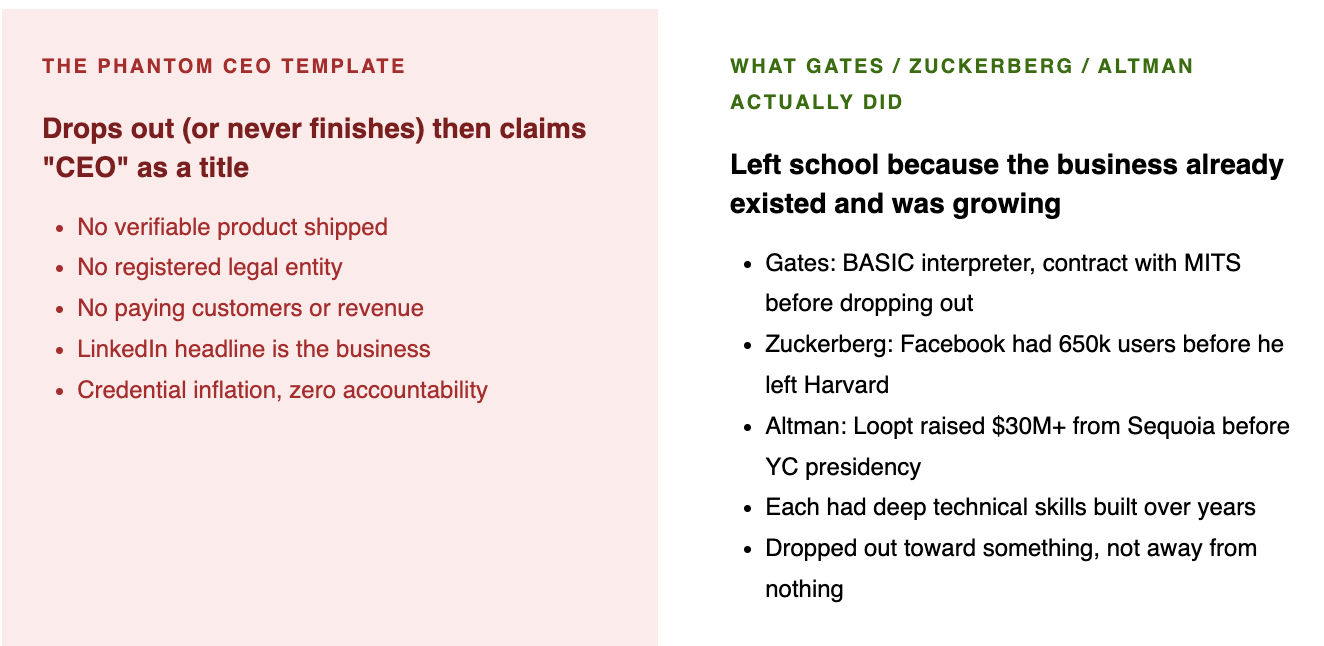
Jeff Bezos put it plainly: Zuckerberg and Gates are the exception, not the model. "I always advise young people: go work at a best-practices company somewhere where you can learn a lot of basic fundamental things," he said at Italian Tech Week. The dropout narrative sells because it is romantic. The actual prerequisite, which is deep skill built over years of obsessive practice, is not romantic. It is hard and unglamorous and it does not fit in a LinkedIn headline.
"People often decide that they want to start a company before they even decide what they want to do, and that just feels really backwards to me."
Mark Zuckerberg, in an interview with Sam Altman at Y Combinator
Mount Stupid: The Dunning-Kruger Topology of Startup Narcissism
In 1999, Cornell psychologists David Dunning and Justin Kruger published a paper titled "Unskilled and Unaware of It." Their finding was simple and devastating: people with low ability in a domain dramatically overestimate their competence in that same domain. The less you know, the more confident you feel. They called the peak of this overconfidence "Mount Stupid." The valley below it, when reality arrives, they called the Valley of Despair.
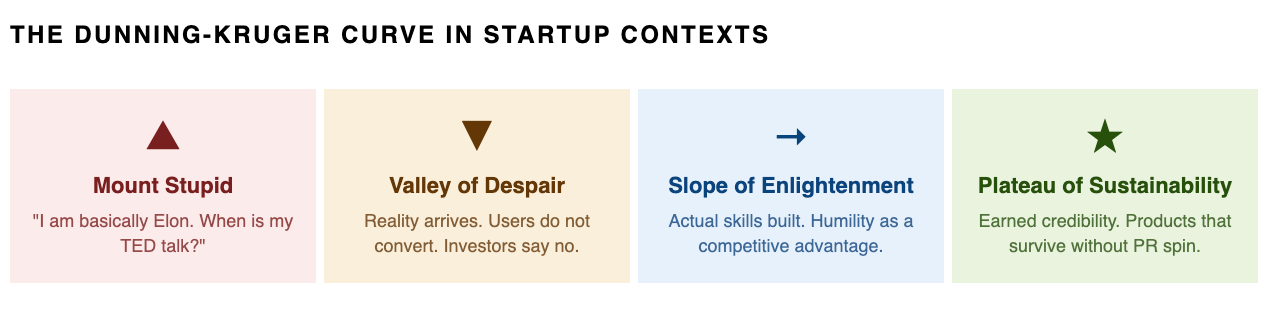
Startup mentor Steven Inke, after two decades working with founders, concluded that the Dunning-Kruger effect alone accounts for most first-year startup failures. Research He observed that the most overconfident founders are almost always the most resistant to feedback, because any challenge to their worldview registers not as useful input but as proof that the challenger simply does not understand their vision.
This is not a minor cognitive glitch. It is the architecture of the phantom CEO phenomenon. When someone puts "CEO" in their LinkedIn bio before they have shipped a single product to a single paying customer, they are not at the beginning of the Dunning-Kruger curve. They are at its peak. The title is not an aspiration label. It is a defense mechanism against having to prove anything.
Indonesia's Trust Crisis Is Already Here
The Phantom CEO is not just an aesthetic annoyance. Indonesia's startup ecosystem is currently paying the price for a culture that rewarded narrative over substance for years.
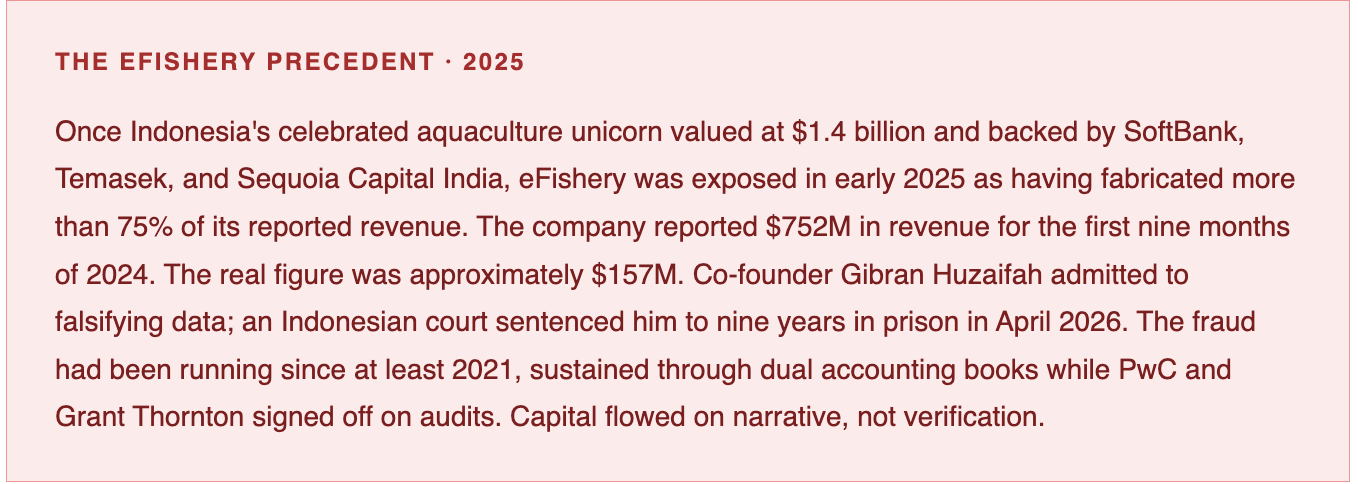
This is the endpoint of a culture that treats a founder's media presence as a substitute for diligence. It is the logical conclusion of a world in which LinkedIn headlines are accepted as credentials and boldness is mistaken for competence. Indonesia's startup ecosystem spent 2025 in what analysts described as a crisis of trust, shaken by a cascade of high-profile frauds spanning eFishery, KoinWorks, Investree, and TaniHub. Investors are now conducting what one managing partner called "more forensic" due diligence. The era of the narrative founder is over. The era of verification has begun.
The phantom CEO, still in his second year of Sarjana Teknik Elektro, who has never filed a business entity or shipped a product, is operating in a market that is now deeply allergic to exactly the behavior he is modeling.
What a Title Actually Requires
This is not an argument against ambition. I believe in audacious goals. I built Infraloka while managing SRE responsibilities at Pertamina Marine Solution. I know what it means to build while working. But there is a categorical difference between building in earnest and performing building for an audience.
A CEO title without a registered entity is not a title. It is cosplay. A founder claim without a product is not a story of entrepreneurship. It is a story of branding. And the Indonesian market, the investors now demanding forensic diligence, the partners who have been burned by unicorn fraud, the employers who must evaluate these profiles, they are increasingly capable of telling the difference.
Finish your degree. Or drop out toward something specific that already exists, that already has traction, that already needs you full-time. Build something real before you name yourself its chief executive. The "CEO" who is still completing their final semesters of Teknik Elektro or who withdrew from PJJ Manajemen in 2022 without a plan is not Bill Gates. They are not Mark Zuckerberg. They are not Sam Altman.
"Incompetence does not leave people disoriented, perplexed, or cautious. Instead, the incompetent are often blessed with an inappropriate confidence, buoyed by something that feels to them like knowledge."
David Dunning, co-author of the original Dunning-Kruger study (1999)
They are young people at the peak of Mount Stupid, and the Valley of Despair is waiting. The only question is whether they descend from it with something useful learned, or whether they damage others on their way down.
Indonesia deserves founders who build. Not founders who post.
#StartupIndonesia#GenZ#Leadership#DunningKruger#CredentialInflation#StartupEcosystem#Entrepreneurship#PhantomCEO#TechIndonesia#Accountability#eFishery#TrustEconomy#RahmatanLilAlamin#Infraloka
References
Dunning, D. & Kruger, J. (1999). "Unskilled and Unaware of It." Journal of Personality and Social Psychology, 77(6), 1121-1134. APA PsycNet
Inke, S. "The Truth About the Dunning-Kruger Effect and Startups." SteveBizBlog. stevebizblog.com
FOR. "Dunning Kruger Effect: What are its implications on startups?" for.co
Bloomberg. (April 2025). "How Indonesian Startup eFishery's ex-CEO Gibran Huzaifah Faked the Numbers." (Sentence updated April 2026: Gibran sentenced to 9 years.) bloomberg.com
Asia News Network. (Jan 2026). "Indonesia's start-up scandals in 2025 force investors to raise the bar." asianews.network
Oblique Asia. (Mar 2026). "The Trust Tax: How Indonesia's Startup Scandals Repriced an Entire Ecosystem." obliqueasia.com
Fortune / Bezos. "Jeff Bezos: Gen Z should get work experience first." fortune.com
Benzinga. (Dec 2025). "Sam Altman Says He's Envious of the Current Generation of 20-Year-Old Dropouts." benzinga.com
Entrepreneur. "Best Career Advice From Bill Gates, Mark Zuckerberg and Other Billionaire College Dropouts." Zuckerberg quote from Y Combinator interview with Sam Altman. entrepreneur.com
Manchester Digital / Bridcon. "The Dunning-Kruger effect on start-up businesses." manchesterdigital.com