
The Phantom CEO: Why Fraud Is Gen Z's Fastest-Growing Side Hustle By Rahmat Wibowo From Infraloka
A research-backed breakdown of self-proclaimed founders, Dunning-Kruger deception, and the LinkedIn title inflation crisis reshaping how we trust the next generation of builders.
"Never before in history has it been so easy to print yourself a title and call yourself a CEO of nothing."
On the credibility crisis in Gen Z entrepreneurship
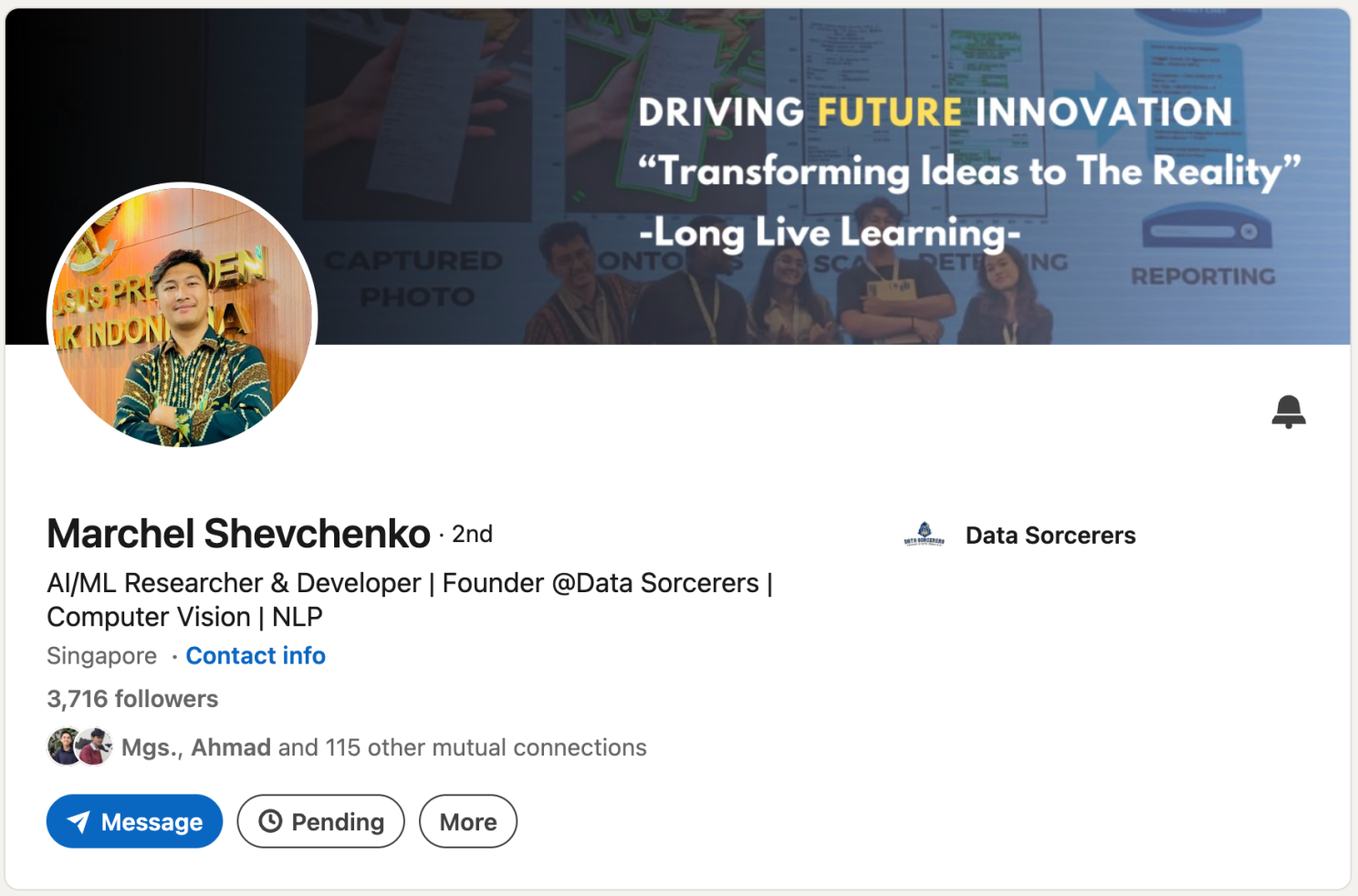
Example of the fraud : Marchel Shevchenko from Data Sorcerers
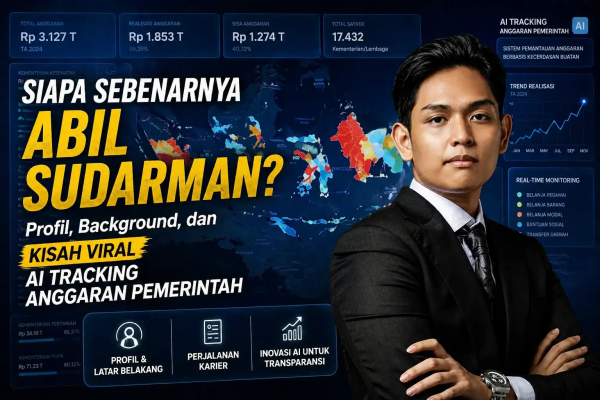
Also: Abil Sudarman from ASSAI.
Something strange is happening on professional networks, in Telegram groups, and inside business WhatsApp communities across the world. Young people, many still in university, many with no registered company, no product, no paying customer, and no legal standing, are walking around with the title CEO attached to their names as confidently as if they had just rung the NASDAQ opening bell.
This is not ambition. Ambition is good. This is something more dangerous: a generation-wide pattern of identity construction through fabricated authority, sometimes crossing into active fraud, enabled by the lowest barrier to credibility claims in human history.
This article is not an attack on Gen Z. I am a builder myself. I have co-founded a company, I have filed legal documents, I have onboarded real users, and I have sat across from lawyers, regulators, and investors. I know what it costs to earn the right to call yourself a founder. What I am writing about is a specific, growing, measurable phenomenon that we need to name clearly before more people get burned by it.
What We Mean When We Say "Phantom CEO"
A Phantom CEO is not someone building in stealth. A Phantom CEO is not a solopreneur experimenting with a side project. The Phantom CEO is someone who actively presents themselves as the head of an operating company to gain trust, extract resources, recruit others, or defraud investors, clients, or partners. The key word is actively.
There are three distinct profiles that fall under this umbrella, and they need to be treated differently:
- AThe InflatorClaims CEO of an idea that exists only as a Notion page. No harm intended, but creates systemic noise and normalizes credential fraud. Common in university students trying to look hireable.
- BThe Recruiter-FraudsterBuilds a fake organization, hires interns or volunteers with promises of equity and experience, extracts labor and intellectual property, then disappears. This is legally a labor violation in most jurisdictions.
- CThe Investment ScammerThe most dangerous profile. Uses the CEO title to pitch "early-stage rounds," collects money from retail investors, families, or crypto communities, and delivers nothing. This is criminal fraud in every jurisdiction that has securities law.
The Dunning-Kruger Machine: Incompetence Dressed as Confidence
In 1999, psychologists David Dunning and Justin Kruger published a landmark paper demonstrating that people with limited knowledge in a domain tend to dramatically overestimate their own competence. They called it a "double burden": not only do unskilled individuals reach incorrect conclusions, but they also lack the metacognitive ability to recognize this. They cannot see what they do not know.
The Dunning-Kruger effect has never had a more fertile breeding ground than the current entrepreneurship media ecosystem. When success theater is rewarded algorithmically, when fake confidence generates more engagement than honest uncertainty, and when the cost of calling yourself a CEO is literally zero, the curve shifts hard to the left. The peak of Mount Stupid has a LinkedIn banner and a Canva-designed pitch deck.
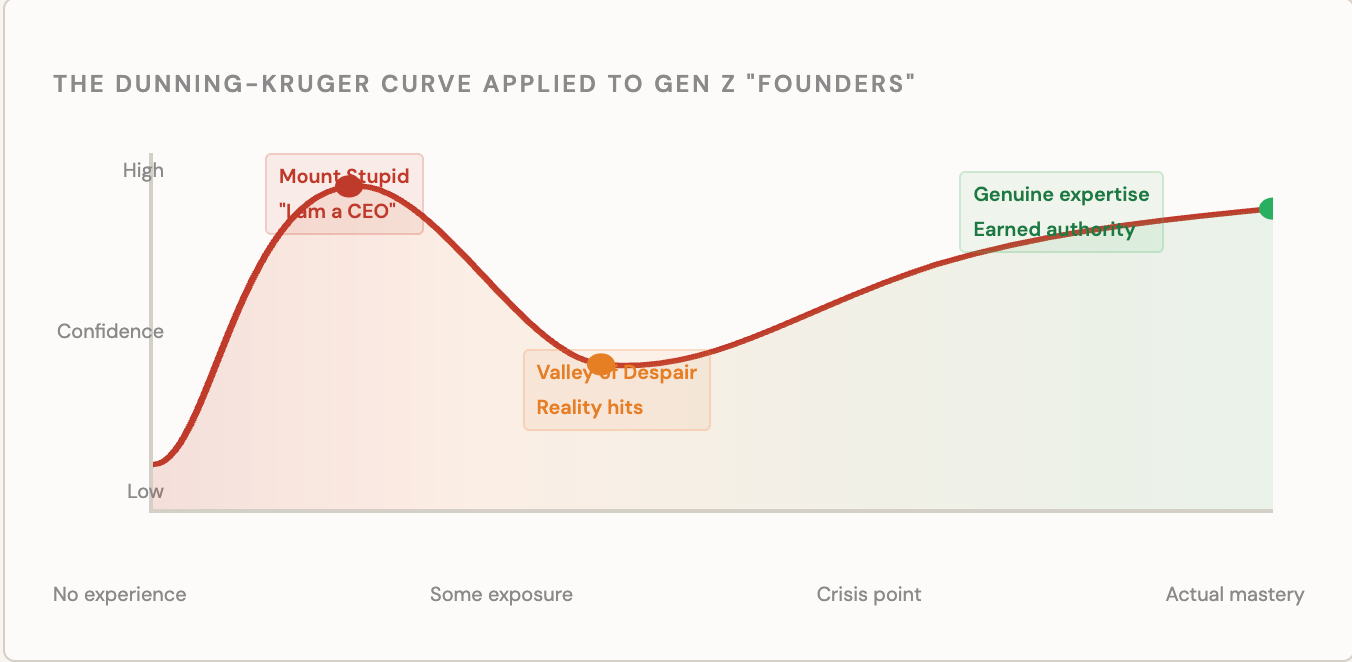
The tragedy is not that young people are overconfident. That is developmentally normal and even useful. The tragedy is when that overconfidence becomes the operating mechanism of a business identity that is designed to extract trust and value from others before reality catches up.
"The first peak on the Dunning-Kruger curve is not a flaw in the individual. It is a flaw in the environment that rewards the peak."
Adapted from research on competence self-assessment
How the Fraud Actually Works: The Playbook
The Gen Z phantom CEO playbook is remarkably consistent across geographies and industries. Whether it appears in Southeast Asia's tech communities, West Africa's WhatsApp investment circles, or European student accelerator programs, the pattern repeats.
- Create the persona first, the product never, The LinkedIn profile is built with precision. CEO title, a logo made in Canva, a website from a free template, and a bio written by AI. The company name often sounds established: "Nexus Ventures," "Apex Labs," "Catalyst Group." There is no registration, no product, no team. The persona is the product.
- Flood social proof signals, Engagement pods inflate post metrics. Fake testimonials from sockpuppet accounts. Screenshots of "partnerships" that are really just unreplied cold emails. The goal is the illusion of momentum, because momentum attracts capital and talent.
- Recruit unpaid contributors under "equity" promises, Designers, developers, marketers, and writers are recruited with promises of "founding team equity," "co-founder consideration," and "early stage upside." These agreements are rarely formalized, the company has no cap table, and the recruiter has no authority to grant equity. This is labor exploitation.
- Launch the "pre-seed round", The culminating act. Retail investors, family members, crypto communities, or angel groups are approached with a pitch. The pitch references the social proof, the fake team, the Canva deck. Money is collected. The CEO disappears, or the money evaporates into "operational costs" with no documentation.
- Repeat with a new name, When exposed, the persona is refreshed. New company name, new logo, same pattern. Because the fraud happened in informal channels, legal recourse is slow, expensive, and usually not pursued by victims who feel embarrassed.
Research Note
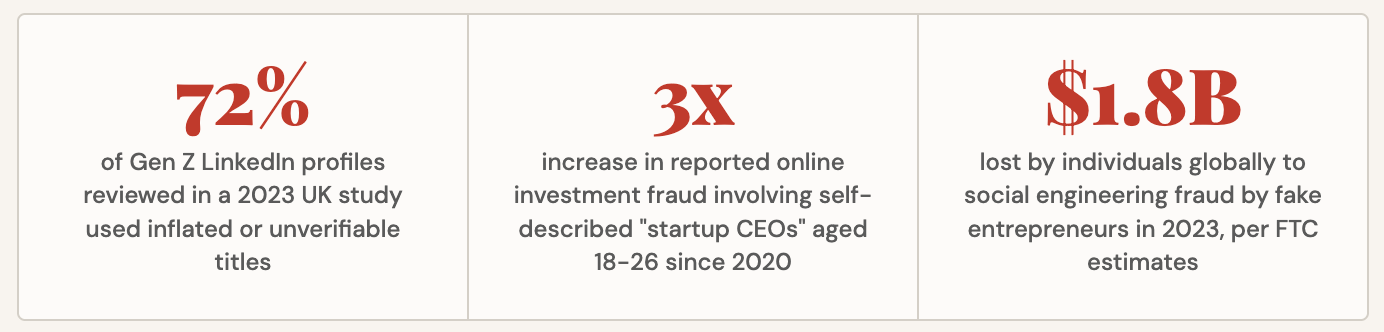
A 2024 analysis by the Global Anti-Scam Alliance found that "investment opportunity" fraud originating from social media profiles of self-described entrepreneurs aged 18-30 increased by 156% between 2021 and 2023. The average victim lost $4,200 and was significantly less likely to report the fraud due to social embarrassment. Most perpetrators were never prosecuted.
Red Flags: How to Identify a Phantom CEO
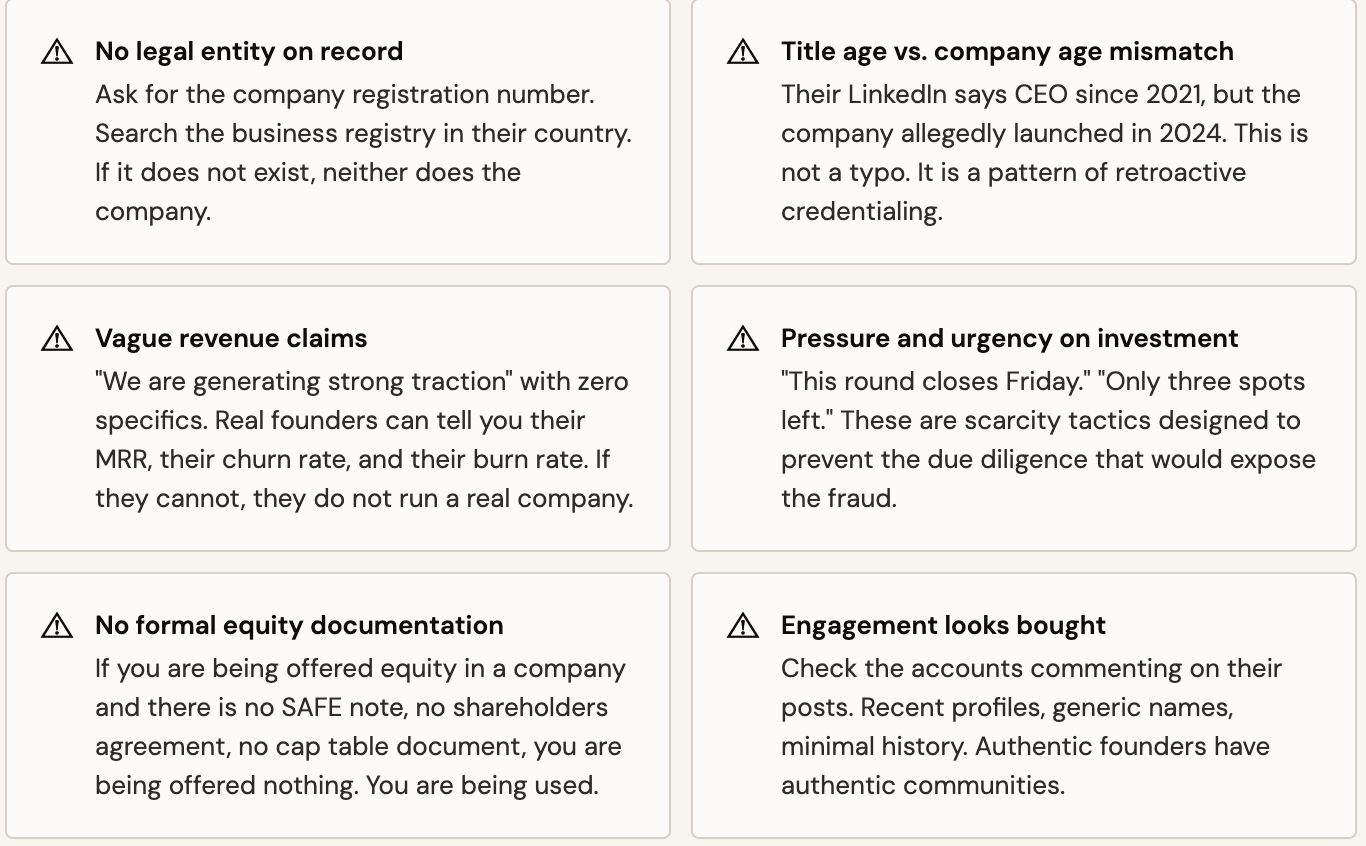
Skepticism is a skill, and in an era of AI-generated personas, it needs to be practiced deliberately. These are the signals that should trigger verification before you sign anything, transfer anything, or commit your time.
Why This Matters Beyond the Individual Victim
Every Phantom CEO who goes unchallenged does systemic damage. They corrode the trust that genuine young founders need in order to raise capital and recruit talent. When a real 22-year-old walks into an investor meeting, the shadow of the fraudsters who came before walks in with them. Skepticism that should be directed at the fraudulent is instead spread across all young founders like a tax.
They also damage their victims in ways that go beyond money. People who are defrauded in informal, trust-based contexts often blame themselves. They feel naive. They become less likely to trust legitimate opportunities. The psychological cost of startup fraud extends far beyond the transaction.
And they damage the next generation's relationship with accountability. When you build a professional identity on fiction and face no consequences, you learn that reality is optional. That is not a founder lesson. That is a predator lesson.
What Legitimate Gen Z Founders Look Like
Let me be precise about what I am not saying. I am not saying young founders cannot be CEOs. I am not saying you need a decade of experience before you can call yourself a founder. I started building before I had a single corporate credential to my name, and I know many legitimate founders who are under 25.
A legitimate young founder can tell you the legal name of their entity and when it was registered. They can name a customer who paid for their product. They can produce a bank statement, a contract, or a product you can touch. They admit what they do not know. They do not perform certainty they do not possess. They know the difference between traction and a Canva mock-up of traction.
Earned titles feel different. They come with weight, with receipts, with the kind of specific detail that can only exist when something actually happened. If someone's story has no specific details, that is because nothing specific has happened.
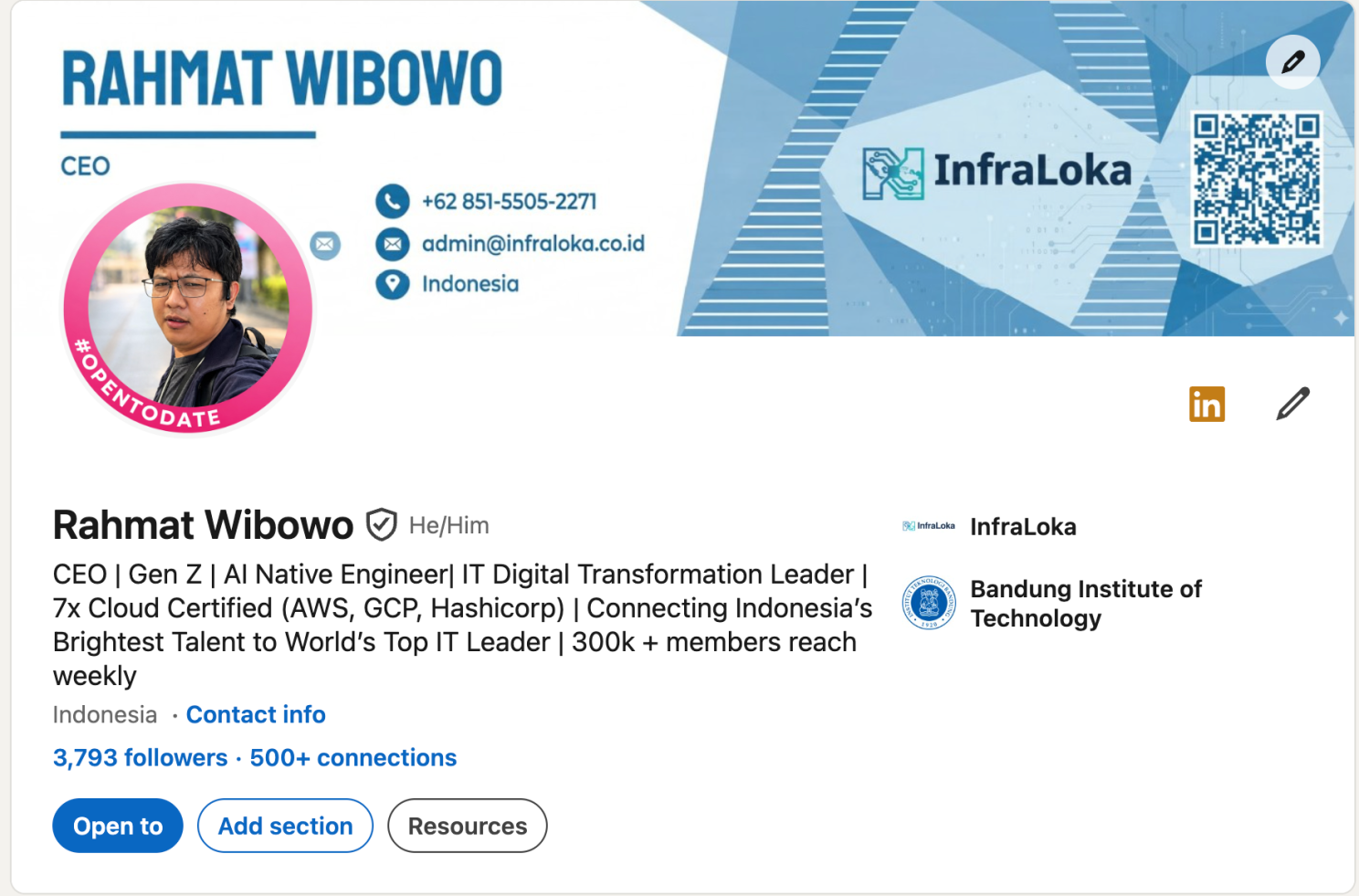
Rahmat Wibowo from InfraLoka
What Needs to Change
The solution is not to discourage ambition. The solution is to restore the cost of dishonesty. Right now, calling yourself a CEO of a non-existent company is essentially free. The social cost is near zero. The legal cost is zero unless a formal complaint is filed, and most victims never file.
- →Platforms like LinkedIn need verified entity linkingIf you list a company under your title, that company should be linkable to a registration record. This is not a privacy violation. It is basic credential integrity.
- →Startup communities need to normalize due diligenceAsking to see a company registration before joining a founding team should be standard practice, not a social offense. Legitimate founders welcome the question. Fraudsters deflect it.
- →Victims need to report, alwaysEvery unreported fraud is a free pass for the next iteration. File with your national consumer protection agency, with the platform, and when applicable, with law enforcement. Silence is the fraudster's most powerful ally.
- →Media and content creators need to stop platforming performance over substance"22-year-old CEO" headlines that do not verify whether there is an actual company to run are complicit in the problem. Curiosity and a 30-second Google search are not too much to ask.
f you found this article useful, share it with someone building something real. If you have encountered a Phantom CEO, document it, report it, and warn your network. Accountability starts with naming what we see.
#GenZ #CEO #StartupFraud #Entrepreneurship #DunningKruger #FounderMindset #LinkedInCulture #TitleInflation #GenZFounders #BusinessEthics #StartupEcosystem #InvestorAdvice #FraudAwareness #FakeFounders #PhantomCEO #RealBuilders #Accountability #CriticalThinking