
The PostgreSQL DBA toolkit: tools every database engineer should know By Rahmat Wibowo From Infraloka
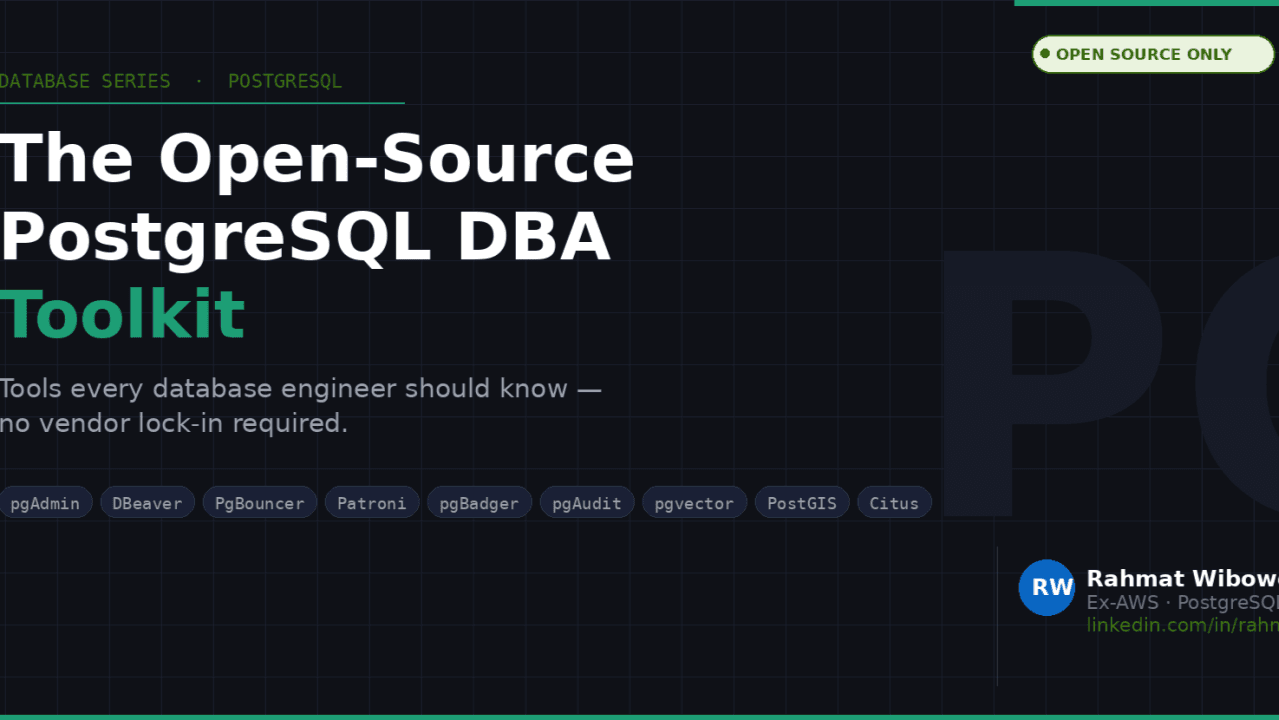
A practitioner's guide to the ecosystem — from connection poolers to zero-trust access — with real-world context on when and why to choose each tool.
PostgreSQL has earned its place as the world's most advanced open-source relational database. But mastering it goes far beyond writing good SQL. The real leverage comes from knowing the ecosystem around it — the tools that handle performance, resilience, security, and observability at scale.
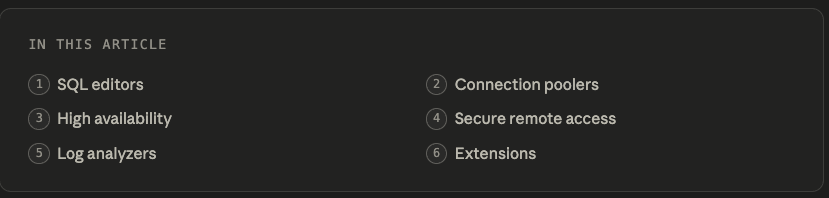
In this article I cover six core tool categories every PostgreSQL DBA should be familiar with. For each, I explain the what, the why, and how the main options compare — so you can make informed choices rather than just following defaults
1. SQL editors & GUI clients
Your SQL editor is where you spend most time as a DBA — writing migrations, debugging slow queries, exploring schema. The open-source options here are genuinely excellent and rival any paid alternative.
pgAdmin 4
The official PostgreSQL GUI. Unmatched depth — EXPLAIN visualizer, VACUUM monitor, role and privilege management, and a built-in query editor with syntax highlighting. Runs in browser or as a desktop app.
DBeaver Community
Cross-platform, supports 80+ databases. Great for teams working across multiple engines. ER diagram viewer, data export, and SSH tunneling included. The community edition covers nearly every DBA need.
Beekeeper Studio
Clean, modern UI focused on usability. The community edition is fully open source. Saved queries, table filters, and connection management without the cognitive load of heavier tools. Good for those who find pgAdmin overwhelming.
psql
PostgreSQL's native CLI client. Don't overlook it — psql supports meta-commands (\d, \dp, \timing), conditional logic, variables, and scripting. Any serious DBA should be fluent in psql alongside a GUI tool.
Practitioner tip
Use pgAdmin for production DBA tasks (it understands Postgres natively) and DBeaver or Beekeeper for everyday development. For automation, scripting, and CI pipelines, psql is irreplaceable.
2. Connection pooling
PostgreSQL spawns a new OS process per client connection. At scale this consumes significant RAM and CPU before a single query runs. Poolers multiplex many client connections onto a smaller set of real database connections — essential for any high-concurrency workload.
PgBouncer
The standard choice. Lightweight, battle-tested, minimal memory footprint. Three pooling modes: session, transaction (most common), and statement. Open source under ISC license. Used in production at scale worldwide.
Pgpool-II
Pooling plus load balancing, query caching, and automatic failover. More complex to configure. Appropriate for multi-replica setups where you want read queries automatically routed to standbys.
Odyssey
Open source pooler from Yandex. Handles multi-threaded pooling, unlike PgBouncer's single-threaded model. Performs well under extreme concurrency. Worth evaluating if PgBouncer becomes a bottleneck.
Supavisor
Elixir-based cloud-native pooler from Supabase. Designed for high-concurrency multi-tenant workloads. Open source and increasingly adopted outside Supabase itself as a modern PgBouncer alternative.
Key decision factor
Start with PgBouncer in transaction mode — it handles the vast majority of use cases with almost no operational overhead. Move to Pgpool-II only when you need read replica routing.
3. High availability & replication
PostgreSQL ships with streaming replication built in — but that alone doesn't give you automatic failover. When the primary fails, something needs to detect it, elect a new leader, and reconfigure replicas. That's what HA tooling does. All options below are fully open source.
Patroni
The modern standard for production HA. Uses distributed consensus (etcd, Consul, or ZooKeeper) for leader election. Fully automated failover. REST API for management. Ideal for Kubernetes and cloud-native setups. Developed at Zalando.
repmgr
Simpler HA tool focused on monitoring streaming replication and triggering manual or semi-automated failover. Lower operational complexity. Good for on-premises or traditional setups that don't need full automation.
Stolon
Cloud-native HA manager built specifically for Kubernetes. Separates keeper, sentinel, and proxy components cleanly. A strong alternative to Patroni for teams running strictly on Kubernetes.
pgBackRest
The go-to backup solution for HA setups. Parallel backup and restore, incremental backups, S3/GCS/Azure support, and point-in-time recovery. HA tools handle failover; pgBackRest handles backup — you need both.
Architecture note
HA replication propagates data corruption instantly. Always run pgBackRest or Barman alongside your HA solution. A replica is not a backup.
04. Secure remote access & auditing
Exposing a database port — even behind a VPN — is a meaningful attack surface. Modern access tools eliminate static credentials entirely, replacing them with identity-based, short-lived access that leaves a complete audit trail. Several excellent open-source options exist.
Teleport
Issues short-lived certificates per session. Records every session. Supports SSO. The community edition is fully open source and includes database access. The commercial version adds more at scale, but the OSS tier is production-capable.
pgAudit
PostgreSQL extension that adds object-level and role-level audit logging. Logs exactly who ran what, when, and against which object. Essential for SOC 2 and ISO 27001 compliance. The most widely used PostgreSQL audit solution.
pg_hba.conf
PostgreSQL's host-based authentication file. Controls which users can connect from which hosts using which auth method (scram-sha-256, cert, peer, ident). Often underutilized — tight pg_hba rules are your first security layer.
SSL/TLS + client certs
PostgreSQL supports mutual TLS out of the box. Combined with client certificates, you can enforce certificate-based authentication without any third-party tooling. Underused in self-hosted deployments despite being zero-cost.
Start here
Enable pgAudit and tighten pg_hba.conf before deploying any access broker. These two steps alone eliminate the most common PostgreSQL security gaps in production environments.
5. Log analysis & performance monitoring
Observability
You cannot optimize what you cannot measure. PostgreSQL generates rich logs and internal statistics — the open-source tools below turn raw data into actionable insight about slow queries, index usage, vacuum health, and long-term trends.
pgBadger
Fast log parser that generates detailed HTML reports from PostgreSQL log files. Ranks slowest queries, error frequency, lock waits, and connection statistics. Zero impact on a running server — parse logs offline or on a separate host.
Percona PMM
Full observability platform: Grafana dashboards, query analytics, EXPLAIN plan history, and alerting. Supports PostgreSQL, MySQL, and MongoDB. Self-hosted. Good for teams that want unified monitoring across multiple database engines.
pg_stat_statements
Built into PostgreSQL core. Tracks execution stats for every query type — total time, call count, rows, cache hit rate. The foundation almost all third-party monitoring tools build on. Enable this first on every server.
auto_explain
Automatically logs EXPLAIN ANALYZE output for slow queries. Captures query plans without manual intervention. Invaluable for finding performance regressions in production before you can reproduce them in development.
Where to start
Enable pg_stat_statements and set log_min_duration_statement = 500ms immediately on any production server. These two changes cost nothing and unlock most of your query diagnostics.
6. Open source extensions
Capabilities
PostgreSQL's extension system is one of its biggest differentiators. Extensions add capabilities directly inside the engine — from time-series storage to vector search to geospatial analysis — without an external service or vendor dependency.
TimescaleDB
Turns PostgreSQL into a high-performance time-series database. Hypertables auto-partition data by time. Compression and continuous aggregates reduce storage 90%+ on time-series workloads. Apache 2 license for the core edition.
pgvector
Stores and queries vector embeddings for AI/ML similarity search inside PostgreSQL. If you're building RAG applications, pgvector keeps everything in one system — no separate vector database needed. PostgreSQL license.
PostGIS
The gold standard for spatial data in relational databases. Adds geometry types, spatial indexes (GIST), and hundreds of GIS functions. Powers logistics, real estate, and mapping applications. GPLv2 license.
Citus
Horizontal sharding for PostgreSQL — distributes tables across nodes for multi-terabyte workloads. Previously commercial-only, now fully open source under the AGPL license. Use when vertical scaling reaches its limit.
Closing thoughts
The open-source PostgreSQL ecosystem is mature enough that there is no genuine gap requiring paid tooling for most production deployments. Connection pooling, HA, observability, security, and extensibility are all covered — and often covered exceptionally well.
Start lean: pg_stat_statements, PgBouncer, Patroni, pgAudit, and pgBadger will already give you a production-grade stack. Add extensions and observability depth as your workload grows.
What open-source PostgreSQL tools are essential in your stack that I missed? Drop them in the comments.
#PostgreSQL#OpenSource#DatabaseEngineering#DBA#DataEngineering#DevOps#CloudInfrastructure