
The Rupiah Lives on the Blockchain. By Rahmat Wibowo From Infraloka
While the world debates stablecoin dominance, Indonesia quietly built its own. Meet IDRT — the Rupiah's digital sovereign on Ethereum.
Most people think of the Rupiah as a currency that loses — loses to the Dollar, loses to the Euro, loses to the narrative. I want to challenge that story today.
Yes, the Rupiah's exchange rate has been under pressure. That's real, and I won't pretend otherwise. But here's the question nobody is asking: while traditional finance debates the Rupiah's weakness, has anyone noticed that the Rupiah already exists in Web3? Fully tokenized. Fully backed. Fully on-chain.
That's not a small thing. That's actually historic.
What Is Rupiah Token (IDRT)?
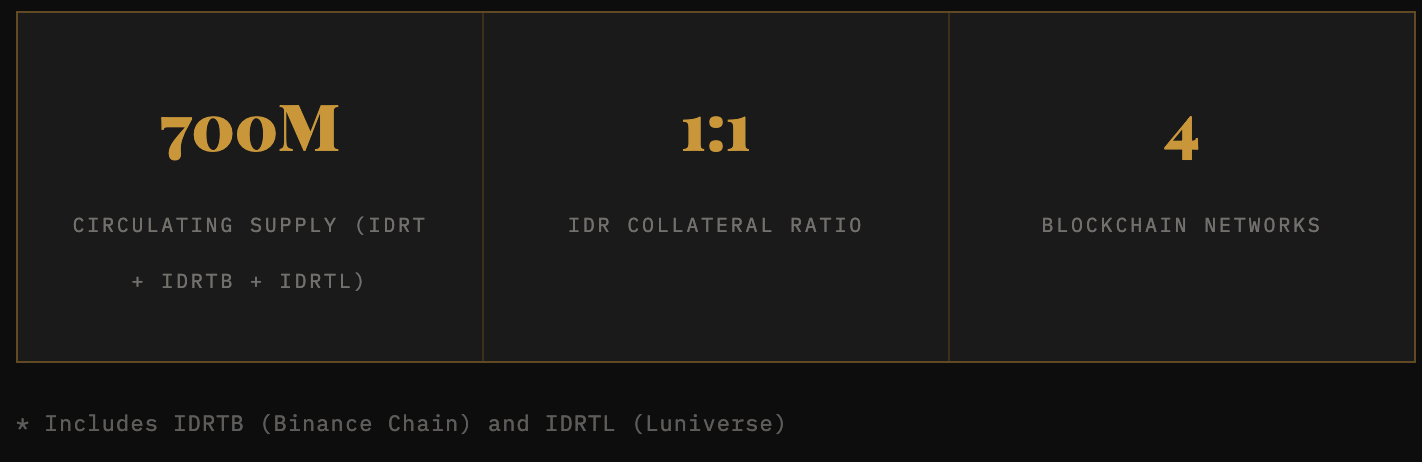
Rupiah Token (IDRT) is the first stablecoin backed by Rupiah, developed by PT Rupiah Token Indonesia — a team of alumni from top universities and tech unicorns including Harvard Business School, MIT, UT Austin, and Universitas Indonesia. Their mission: improve financial inclusivity and eradicate the difficulty of sending funds between parties. Every single IDRT is backed 1:1 by real Rupiah held in reserve, audited monthly by a financial partner.
The smart contract is audited by CertiK. The mint-and-burn mechanism is transparent on-chain. You deposit Rupiah → IDRT is minted. You redeem IDRT → Rupiah is returned, and the tokens are burned. No mystery. No fractional reserve sleight-of-hand.
The Exchange Rate Argument Is the Wrong Argument
People say: "The Rupiah is weak against the Dollar, so IDRT is weak." But this conflates two completely different questions.
The first question: Does Rupiah depreciate against USD? Sometimes, yes. This is a macroeconomic reality tied to current account balances, Fed policy, commodity cycles — forces larger than any single currency.
The second question: Does IDRT serve its core function as a digital representation of Rupiah on the blockchain? Absolutely and perfectly. That's an entirely different claim, and it's one IDRT wins on all counts.
The power of IDRT isn't that Rupiah beats the Dollar. The power is that Rupiah now exists in a financial layer that has no borders, no banking hours, no intermediaries.
Think about what that means for an Indonesian trader in Surabaya, a migrant worker sending money from Malaysia, a freelancer receiving payment from Singapore. For the first time, they can hold their Rupiah value digitally — stable, liquid, global — without converting to USDT or USDC and losing their connection to their own currency.
Indonesia's Digital Monetary Sovereignty
There is a geopolitical dimension here that rarely gets discussed in crypto circles. The global stablecoin market is overwhelmingly denominated in USD. USDT, USDC, BUSD, DAI — all pegged to the American dollar. When the developing world adopts DeFi, they are, by default, dollarizing their digital economy.
IDRT is a counter-movement. It is Indonesia saying: our currency deserves a seat at the Web3 table. It gives Indonesian users the ability to transact in their own unit of account within the blockchain ecosystem — without surrendering monetary identity to the dollar.
As someone who believes deeply in Indonesia's technological sovereignty — and who is building Infraloka precisely to democratize access to cloud infrastructure and AI across this archipelago — I see IDRT not just as a product, but as monetary infrastructure for Indonesia's digital future.
The Real Use Cases That Matter
Beyond trading pairs on exchanges, IDRT's real promise lives in these verticals:
Cross-border remittance. Sending money across borders has always been slow and fee-heavy. IDRT on the Ethereum blockchain settles in minutes — fast, borderless, and without the friction of traditional banking. An Indonesian worker abroad could send IDRT home instantly, with the recipient redeeming straight to their bank account in Rupiah.
DeFi access without dollar exposure. Indonesian retail investors can now participate in decentralized protocols, yield strategies, and on-chain financial products — denominated in their own currency. This is financial inclusion, not just financial access.
Smart contract payment infrastructure. Imagine Indonesian freelancers, SMEs, and creators getting paid in IDRT via smart contracts — programmable, trustless, instant. No PayPal dispute. No Wise processing delay. Just on-chain settlement.
Web3 commerce and e-commerce. IDRT's founders envisioned this from the start: having Rupiah on the blockchain enables new forms of e-commerce — trustless, borderless, programmable. Indonesian creators, freelancers, and SMEs can transact globally in their own currency without leaving the Rupiah ecosystem.
A Note on Maturity — and What Comes Next
I'll be honest: IDRT's trading volume is still modest compared to the giants. The website hasn't been updated extensively since 2019. The project deserves more community momentum. These are real observations, not dismissals.
But the infrastructure is proven. The peg holds. The smart contract has been live through multiple market cycles. The mint-and-burn model is transparent and sound. And the use cases IDRT's own team outlined from day one — trading, remittances, e-commerce — are only growing more relevant as Indonesia's digital economy matures.
What IDRT needs now is more builders, more integrations, more narrative. It needs the Indonesian Web3 community to rally behind a project that is fundamentally ours.
The Rupiah doesn't need to beat the Dollar to matter in Web3. It needs to exist, persist, and serve its people — across every chain, every border, every protocol. IDRT already does that. Indonesia should be proud of it. — Rahmat
#RupiahToken #IDRT #Web3Indonesia #Stablecoin #Blockchain #Rupiah #DeFi #Indonesia #FinancialInclusion #Infraloka #MonetarySovereignty #Ethereum